

What International Relations Is

International Relations is the study of the political relations of humankind organised into separate territorial units that acknowledge no authority above themselves. That one sentence contains the field’s whole problem. Because there is no world government, the questions that domestic politics settles by law and command — who decides, who enforces, who adjudicates — remain permanently open between states. Everything the discipline argues about follows from that opening.
- The field has a subject before it has a theory. Wars, treaties, empires, trade routes and embassies existed for millennia before anyone thought to study them systematically.
- Thucydides on the Peloponnesian War, Kautilya’s Arthashastra, Sun Tzu’s The Art of War and the diplomatic manuals of Renaissance Italy are all reflections on interstate conduct.
- What they are not is a discipline — a body of scholarship with its own chairs, journals, methods and disputes. That is a twentieth-century creation, and it has a birth date.
- The organising fact is anarchy. In IR the word does not mean chaos, disorder or violence.
- Anarchy means only the absence of a common government above states — no sovereign, no legislature, no police, no compulsory court.
- Anarchy is compatible with elaborate order: treaty law, customary norms, functioning institutions, long peaces. What it rules out is a guarantor of last resort.
- Every approach in this unit is, at bottom, an argument about what anarchy makes possible. Realists say competition; liberals say cooperation under the right institutions; Marxists say the question is wrongly posed because the real structure is capitalist, not anarchic; constructivists say anarchy has no fixed content at all.
“Security, in an objective sense, measures the absence of threats to acquired values, in a subjective sense, the absence of fear that such values will be attacked.” — Arnold Wolfers
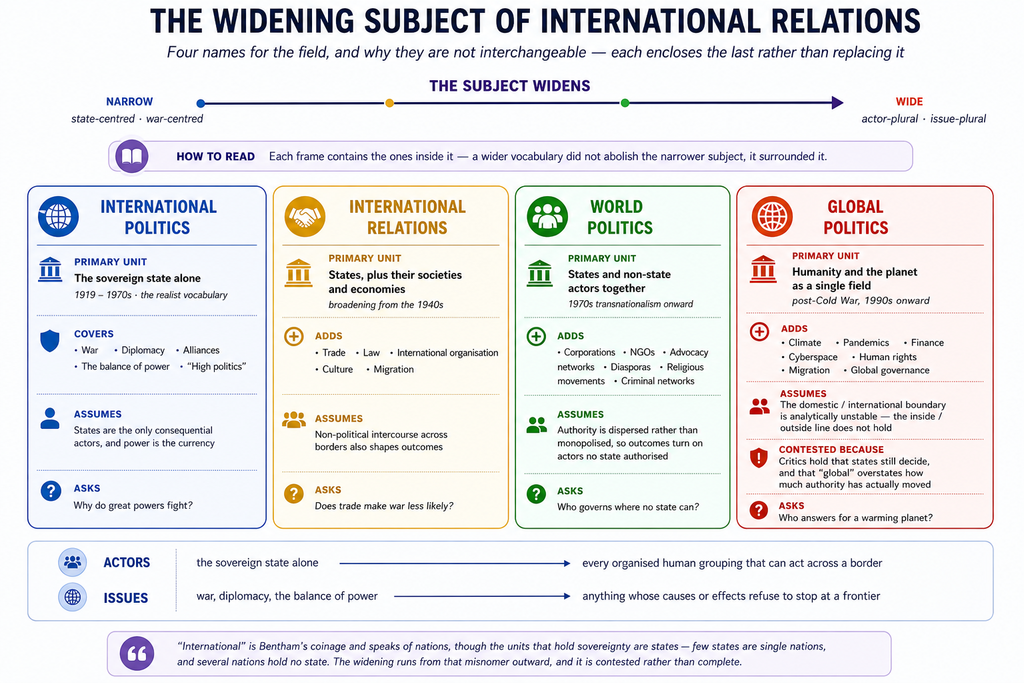
Four names for the subject, and why they are not interchangeable
The vocabulary has shifted over a century, and each shift records a change in what scholars thought they were studying. Treating international politics, international relations, world politics and global politics as synonyms erases exactly the history that the terms were coined to mark. The movement runs from a narrow, state-centred, war-centred subject to a wide, actor-plural, issue-plural one — and the movement is contested, not complete.
| Term | Primary unit | What it includes | What it assumes | Characteristic period |
|---|---|---|---|---|
| International politics | The sovereign state alone | War, diplomacy, alliances, the balance of power, “high politics” | States are the only consequential actors; power is the currency | 1919–1970s; the realist vocabulary |
| International relations | States, plus their societies and economies | The above, plus trade, law, organisation, culture, migration | Non-political intercourse across borders also shapes outcomes | Broadening from the 1940s onward |
| World politics | States and non-state actors together | Politics of and within the whole world, including transnational movements | Authority is dispersed, not monopolised by states | 1970s transnationalism onward |
| Global politics | Humanity and the planet as a single field | Climate, pandemics, finance, cyberspace, human rights, global governance | The domestic/international boundary is analytically unstable | Post-Cold War, 1990s onward |
- “International” is itself a misnomer, and knowing why is worth a moment. The word was coined by Jeremy Bentham and speaks of nations, whereas the units that actually hold sovereignty are states.
- Very few states are ethnically single nations, and several nations — the Kurds, the Palestinians, the Tibetans — hold no state.
- The imprecision matters: the central actor is a legal-territorial construct, while the loyalty that mobilises war attaches to something else.
- “Inter-national” also smuggles in the state-centrism it should be examining. If the subject is defined as what passes between nations, actors that are not nations are definitionally marginal before any evidence is heard.
- World politics and global politics were adopted precisely to escape that built-in assumption.
The expanding scope of the field
- War and peace remain the founding question, and no honest account demotes them. The discipline exists because industrialised war killed tens of millions and scholars wanted to know why.
- Causes of war, deterrence, arms control, alliance formation, civil war and intervention are still the largest single research cluster.
- Diplomacy and foreign policy — how states form intentions, signal them and bargain.
- The distinction between foreign policy analysis (why a particular state acted) and international politics (why the system produced this pattern) is a real one, and the levels-of-analysis discussion below is what formalises it.
- International political economy entered decisively in the 1970s with the oil shocks and the end of fixed exchange rates.
- Trade, monetary order, development, debt, sanctions and now supply-chain security are treated as political questions rather than technical ones.
- International law and organisation — the UN system, the WTO, regional bodies and courts, and the recurring question of whether rules bind the powerful.
- Transnational and non-state actors: multinational corporations, international NGOs, advocacy networks, diasporas, religious movements, terrorist organisations, criminal networks and, most recently, platform and technology firms whose infrastructural reach exceeds many states’.
- New security agendas that the founders would not have recognised as security at all.
- Climate change, which redistributes territory, water and habitability and generates displacement no border regime was designed for.
- Pandemics, where the failure mode is not invasion but a collapse of cooperation over surveillance, supply and vaccination.
- Cyber operations, neither peace nor war on the classical scale, which the law of armed conflict maps badly.
- Migration and refugees, where the right to exclude collides with the right to flee.
- Artificial intelligence, autonomous weapons and the control of chips and compute, which have turned technology policy into the core of great-power rivalry.
- Identity, gender, race and culture entered once it was accepted that interests are not simply given by material position.
The scope has widened in every direction at once, and the widening is precisely why the unit is called approaches in the plural. A field whose subject was only interstate war could plausibly have had one theory. A field whose subject includes carbon markets, refugee flows, sovereign debt, nuclear signalling and content moderation cannot.
A discipline that studies everything from nuclear deterrence to climate finance will not be held together by a single theory, and should stop apologising for it.
Theoretical pluralism as a position, not a hedge
- Pluralism is the claim that different approaches answer different questions, not that all approaches are equally right about the same question.
- Realism explains why security competition recurs among the strongest states; it explains almost nothing about why the ozone regime worked.
- Liberal institutionalism explains cooperation where interests overlap and information is scarce; it is weak on why states fight over prestige.
- Marxist approaches explain persistent global hierarchy in production and finance; they under-explain conflict between states at the same level of development.
- Constructivism explains change in what states want; it is not itself a theory of any particular outcome.
- The honest test is domain of applicability, not universality. Asking which theory is “correct” invites the wrong answer; asking which theory has purchase on which puzzle is what a working scholar actually does.
- The dishonest version of pluralism is a list of approaches with no judgement about any of them; pluralism earns its place only when it states where each approach’s power runs out.
International Relations as an Academic Discipline
1919 and the founding
The discipline has an unusually precise origin. In 1919, the year the First World War was formally closed at Versailles, the Woodrow Wilson Chair of International Politics was endowed at the University College of Wales, Aberystwyth, by the Welsh industrialist and Liberal politician David Davies, with a gift of £20,000, as a memorial to the war’s dead. Sir Alfred Zimmern was its first holder. It was the world’s first chair in the subject, and the department built around it the world’s first department of international politics.
- The founding was explicitly normative, and this is the single most important fact about it. The chair was not created to describe the world but to prevent a repetition.
- Davies’s purpose was the study of the causes of war so that war could be abolished — an endowment for peace, not for statecraft.
- The discipline was therefore born as an applied science of peace, and the first generation of scholars regarded themselves as reformers.
- This is why the first great debate took the shape it did: realism’s charge was not that idealists were wrong about facts but that they had confused what they wanted with what was.
- Naming the chair after Woodrow Wilson was itself a programme — the conviction that the old diplomacy had caused the war and a new one could prevent the next.
- The American presence is there from the first day of the discipline’s life, even though the chair sat in a small Welsh town.
War as the discipline’s engine
Every major reorientation of the field follows a war. This is not a coincidence but the mechanism by which the subject renews itself: catastrophe discredits the prevailing explanation and creates institutional demand for a new one.
| Conflict | What it produced | Intellectual consequence |
|---|---|---|
| Peloponnesian War | Thucydides’ history | The insight that a rising power’s growth and the established power’s fear drive war |
| Thirty Years’ War, 1618–48 | Hobbes, Grotius, the Peace of Westphalia | Sovereignty, non-intervention, the balance of power; the birth of international law |
| Napoleonic Wars | The Concert of Europe | Great-power management as a conscious practice |
| First World War, 1914–18 | The discipline itself; the League of Nations | Idealism and collective security as a research programme |
| Second World War, 1939–45 | Carr, Morgenthau, the United Nations | Realism’s ascendancy; power politics as the field’s default vocabulary |
| Cold War, 1945–91 | Deterrence theory, game theory, area studies | Massive institutionalisation and the behavioural turn |
| Post-2001 and post-2022 conflicts | Terrorism studies, then realism’s revival | Non-state violence, and the return of great-power war to the research agenda |
The Cold War and institutionalisation
- The Cold War made IR a large, funded, professional field, and it did so mainly in the United States.
- Nuclear weapons created an urgent demand for theory that no historical precedent could supply: there had never been a weapon whose use would destroy the user.
- Deterrence theory, crisis bargaining, arms control and game theory were built to meet a policy need, and universities, foundations and government institutes paid for them.
- The discipline acquired its infrastructure in this period — dedicated journals, doctoral programmes, professional associations, area-studies centres, and a two-way traffic of personnel between the academy and government.
- It also acquired a characteristic bias. A field funded to answer “how does the United States manage the Soviet Union?” will produce a literature in which the superpower rivalry is the natural unit of analysis and decolonisation is a sideshow.
“An American social science”
Stanley Hoffmann’s 1977 essay An American Social Science: International Relations is the standing indictment, and it remains the most-cited single claim about the discipline’s own character. His argument was not that Americans happened to dominate the field but that the field’s shape — its questions, its methods, its confidence — was produced by American conditions.
- Hoffmann gave three converging explanations.
- Intellectual predispositions: an American social science already committed to generalisation, quantification and the belief that social problems are solvable.
- Political circumstances: the United States emerged in 1945 as the power that had to manage a global order, and needed a body of knowledge suited to that role.
- Institutional opportunities: universities, foundations and think tanks with money, autonomy and a revolving door into policy — a combination no other country possessed.
- The consequence Hoffmann feared was proximity to power. A discipline that takes its questions from the state department of one state will mistake that state’s problems for the world’s problems, and will be least able to think about the order it is embedded in.
- The charge has empirical support even now. A large cross-national survey of IR scholars published in Security Studies is the best evidence available.
- American PhDs, American universities, American-based scholars and American-authored readings dominate the field’s rankings, citations and syllabi.
- US scholars are markedly the most insular; non-US scholars read widely but mostly read Americans, which reinforces the hierarchy rather than balancing it.
- The corroborating anecdotes are ugly. Morgenthau could describe much of Africa as politically empty; Waltz could suggest it would be absurd for the discipline to study the foreign policy of Malaysia or Costa Rica.
- These are not stray remarks but a settled view about which states are theoretically interesting.
- The counter-case is that the discipline has genuinely diversified. English School work, Scandinavian peace research, Latin American dependency theory, Chinese and Japanese IR and the Indian literature below are all real bodies of scholarship.
- The same survey that documents American dominance also finds substantial theoretical and topical diversity, which complicates any simple hegemony story.
The Five Phases of International Politics
The system the discipline studies has itself changed four times since 1648, and each change altered which questions were worth asking. The periodisation below is the spine of the whole unit: every approach in the articles that follow was formulated in one of these phases and bears its marks.
First phase: the Westphalian order, 1648–1919
The Peace of Westphalia in 1648 ended the Thirty Years’ War and, with it, the medieval European order of overlapping authorities — Pope above emperor, emperor above princes, princes above towns, all claiming jurisdiction over the same ground. What replaced it was a system of territorially bounded units each supreme within its own frontier.
- The modern state has three defining features that date from this settlement.
- Centralised authority — one command structure, not competing feudal and ecclesiastical claims.
- Clearly defined territorial boundaries — jurisdiction determined by geography rather than by personal allegiance.
- Sovereignty — supremacy internally, independence externally, with no superior.
- Three principles are conventionally drawn from the settlement.
- Cuius regio, eius religio — whose realm, his religion. Religion became an internal affair, and war over confession and values, as distinct from war over material interest, was placed outside the system’s legitimate business.
- Every prince is emperor in his own realm — the juridical equality and independence of states, and therefore non-intervention as the system’s cardinal rule.
- No one may become stronger than the rest — the balance of power as the system’s self-regulating mechanism, so that when one state reached for mastery the others combined against it.
- Sovereignty and territorial integrity became the sacred principles of the order, and remain the fundamental national interest of any state — which is why their violation, as in Crimea in 2014 and Ukraine in 2022, is read as an attack on the order and not merely on a country.
How the balance of power actually worked
- Balancing came in two forms, and both are still the standard vocabulary.
- Internal balancing — building one’s own capability: raising armies, taxing, industrialising, arming.
- External balancing — borrowing capability: alliances, subsidies, coalitions.
- Alliances were instrumental and reversible. The maxim that a state has no permanent friends and no permanent enemies, only permanent interests describes this phase exactly.
- Britain played the balancer, joining whichever coalition opposed the strongest continental power — against Louis XIV, then Napoleon, then Wilhelmine Germany.
- The system was multipolar: five or more great powers of comparable capability, with alignments shifting as capability shifted.
- There were no superpowers and no universal actors. No state was beyond the reach of a coalition, and there was no United Nations, no global institution, no body claiming to speak for the system as a whole.
- Self-help was therefore total — a state’s security was exactly what its own strength and alliances could buy.
- International politics in this phase was European politics, and nothing else. The rest of the world was colonial territory, an object of European competition rather than a participant in it; the United States held to isolationism under the Monroe Doctrine; Asia and Africa entered the ledger as assets, not as actors.
The billiard ball model
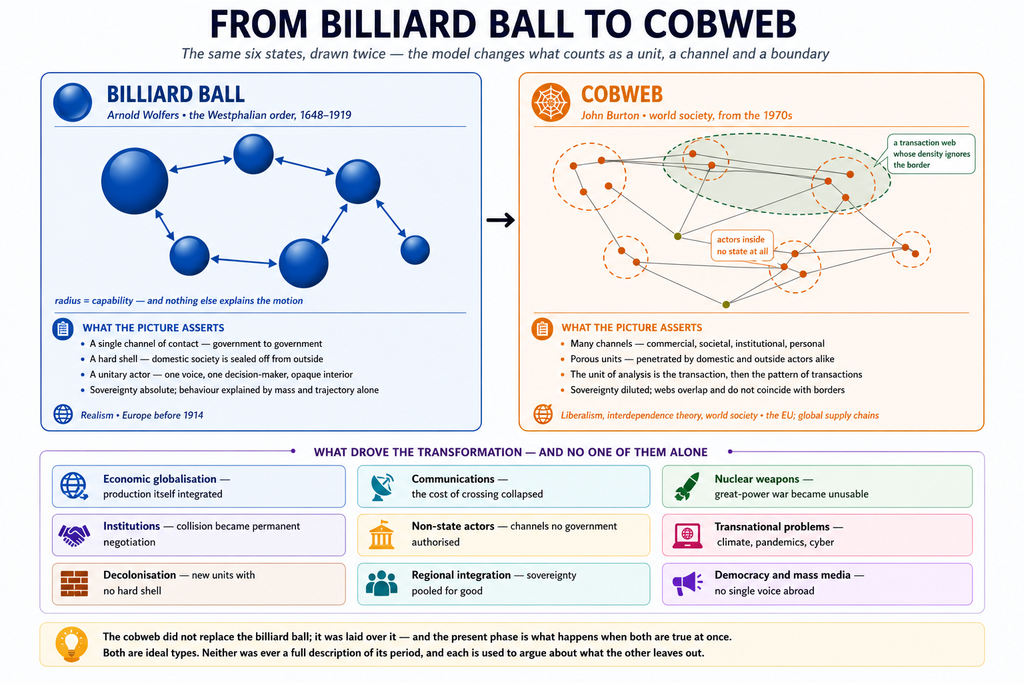
Arnold Wolfers, in Discord and Collaboration, gave this world its enduring image: states as billiard balls on a table, hard-shelled and impermeable, each internally opaque, colliding with one another and rebounding, their movements explicable entirely by mass and impact without any reference to what is inside them.
- The model’s assumptions are exactly realism’s, and are worth spelling out.
- The state is a unitary actor — it speaks with one voice and can be treated as a single decision-maker.
- The state is impermeable — a hard shell separates domestic society from the international realm, and outside forces do not reach in.
- Only one channel of contact exists — the official, government-to-government channel.
- Domestic politics is irrelevant to explanation — what matters is the ball’s mass and trajectory, not its internal composition.
- Sovereignty is absolute — no authority above, no penetration from outside.
- The model is a good description of its period and a bad one of ours, which is the point of the comparison developed later in this note.
Second phase: the interwar period and the liberal vision, 1919–1939
The First World War discredited the Westphalian machinery in the eyes of those who survived it. The balance of power had not prevented war; the alliance system had converted a Balkan assassination into a continental slaughter; secret diplomacy had committed states to obligations their publics never knew of. The response was a programme to replace the whole mechanism.
- Woodrow Wilson’s Fourteen Points, delivered in January 1918, is the programme’s founding text, and the six ideas that shaped the postwar order are these.
- A League of Nations — a general association of states with mutual guarantees of political independence and territorial integrity.
- Collective security in place of the balance of power — an attack on one treated as an attack on all, so that no aggressor could face an isolated victim.
- Free trade — removal of economic barriers, on the view that commercial interdependence makes war costly and so unlikely.
- Freedom of navigation on the high seas — the commons kept open in peace and war alike.
- Support for democracy — on the view that accountable governments do not choose the wars that autocrats choose.
- National self-determination — peoples governed by their own, removing a principal grievance behind European war.
“Open covenants of peace, openly arrived at, after which there shall be no private international understandings of any kind but diplomacy shall proceed always frankly and in the public view.” — Woodrow Wilson, Fourteen Points, Point I
- This body of thought became the first school of international politics, and it is called liberalism or idealism.
- It is often described as a set of peace theories, because each of its propositions is an argument about a cause of war that can be removed.
- Its wager is that war is a remediable defect of institutions and information, not a permanent feature of human nature — misunderstanding, secret commitments, arms races and unaccountable government are all fixable.
- It was also, unavoidably, American in provenance and congenial to American interest: free trade, open seas and self-determination weakened the European empires and suited a rising commercial power with no colonies to lose.
- Implementation failed comprehensively, and the specific failures matter more than the general verdict.
- The United States never ratified the Covenant. The Senate refused, and the League opened without the power that had designed it and was to have guaranteed it — leadership fell to Britain and France, neither of which was willing to bear the cost.
- Japan’s seizure of Manchuria in 1931 was investigated, condemned by the Lytton Report, and not resisted; Japan left the League and kept Manchuria.
- Italy’s invasion of Abyssinia in 1935 produced sanctions that excluded oil and left the Suez Canal open; Abyssinia fell, and collective security was shown to be a promise no one would pay for.
- The rise of fascism and the fear of communism made appeasement rational to those practising it — Germany and Italy were treated as revisionist states to be accommodated rather than as aggressors to be deterred.
- The old politics returned: protectionism after 1929, competitive alliances, rearmament, and finally war.
- The realist reply was born out of this wreckage.E. H. Carr’sThe Twenty Years’ Crisis, published in 1939 as the war began, is the demolition: the idealists had mistaken aspiration for analysis and had built a doctrine that served the states already satisfied with the status quo.
- This exchange is the first great debate, and it set the discipline’s terms for a generation.
Third phase: the Cold War, 1945–1991
The Second World War left two states of a kind the system had never contained. The distinction between a great power and a superpower is not rhetorical, and getting it right is the key to the whole phase.
- A great power can be balanced; a superpower cannot.
- In the Westphalian system, any state reaching for dominance could be checked by a coalition of the others — that was the balance of power’s entire mechanism.
- The United States and the Soviet Union each commanded such preponderance of military, economic and technological capability that no combination of remaining states could have balanced either. Only the other superpower could.
- Each also possessed global reach — bases, fleets, clients and nuclear delivery on every continent — and an ideological project claiming universal validity.
- The structure was therefore bipolar, and the classical balancing that had defined three centuries ceased to operate as before.
- Smaller states became satellites, and their sovereignty became formal rather than real.
- Eastern Europe under the Brezhnev Doctrine of limited sovereignty; Hungary in 1956 and Czechoslovakia in 1968 are what enforcement looked like.
- The Western bloc’s dependencies were looser and negotiated, but alignment constrained the foreign and often the domestic policy of states within it.
- This is why non-alignment was an assertion of sovereignty and not merely a preference about friends.
- Nuclear deterrence displaced the balance of power as the system’s stabiliser.
- Mutually Assured Destruction (MAD) rested on secure second-strike capability: because neither side could disarm the other in a first strike, both would be destroyed in any general war.
- The consequence was a paradox — the most heavily armed rivalry in history produced no direct war between its principals.
- Stability at the top displaced violence downward.
- Proxy war and ideological confrontation became the form conflict took. Korea, Vietnam, Angola, Afghanistan, Central America and the Middle East were fought by clients, with superpower money, weapons and advisers.
- This is the phase in which international politics became genuinely global, rather than Eurocentric, and the reasons are structural, not merely rhetorical.
- Decolonisation brought scores of new sovereign states into the system; UN membership has grown from its founding fifty-one to 193.
- The superpowers competed everywhere, which made everywhere strategically legible.
- Europe ceased to be the system’s centre and became one of its theatres.
- It is also the phase in which the discipline was institutionalised, for the reasons set out above.
Fourth phase: post-Cold War globalisation, 1991–2008
The Soviet collapse removed one pole and, with it, the organising assumption of forty years. US President George H. W. Bush announced a “New World Order” — a phrase that consciously echoed Wilson’s, and made the same wager that power politics could be superseded by rules.
- The defining features of the phase were interdependence and institutions.
- Globalisation in its strongest form: integrated capital markets, containerised trade, dispersed supply chains, the internet, and near-universal adoption of open-economy policy.
- Global governance — the WTO created in 1995, the expansion of UN peacekeeping, climate and human-rights regimes, and the spread of regional organisations.
- The diffusion of liberal-democratic norms, and a wave of democratisation across Latin America, Eastern Europe, Africa and parts of Asia.
- Non-state actors moved from the margin to the centre of analysis. Multinational corporations with revenues exceeding most states’ budgets, international NGOs with genuine agenda-setting power, transnational advocacy networks, and — after 2001 — transnational terrorist organisations able to strike the strongest state on earth.
- John Baylis and Steve Smith describe the shift as one from state-centric geopolitics to geo-centric global politics, and the phrase repays unpacking.
- State-centric analysis takes the state as both the unit and the container: everything that matters happens either inside states or between them.
- Geo-centric analysis takes the globe as the unit: financial contagion, carbon, disease, data and migration do not respect the container.
- The boundary blurs in both directions — domestic regulation becomes an international bargaining chip, and international commitments reshape domestic law.
- The billiard ball gave way to the cobweb.John Burton’s cobweb model, developed in his work on world society, replaces the table of colliding spheres with a mesh of transactions.
- The unit of analysis is not the state but the transaction — trade, mail, migration, finance, communication, travel.
- Mapping those transactions produces overlapping webs whose densities do not coincide with political borders.
- States are therefore porous, not hard-shelled, and are penetrated by domestic and global actors alike.
- The model belongs to a world society or society-centric view rather than a state-centric one, and it is the theoretical companion of complex interdependence.
Present phase: crisis of the liberal order and the return of geopolitics, 2008–
The 2008 global financial crisis is the hinge. It discredited the economic model at the centre of the order, damaged the prestige of the states that promoted it, and began a sequence of reversals that has not ended.
- The markers of the phase are cumulative rather than singular.
- Russia’s annexation of Crimea in 2014 — the first forcible annexation of European territory since 1945, followed by the full-scale invasion of Ukraine in 2022.
- Rising protectionism and trade wars, with tariffs used as general-purpose instruments of statecraft rather than as trade remedies.
- Nationalism and populist backlash against migration, multilateralism and supranational authority, of which Brexit is the clearest institutional case.
- Institutional decay: the WTO’s Appellate Body has been unstaffed since December 2019, leaving dispute settlement without a final instance.
- Technological decoupling: export controls on advanced semiconductors and the reconstruction of supply chains along political lines.
- The vocabulary of geopolitics has returned to both policy and scholarship, and with it the assumption that territory, spheres of influence and relative capability are the things to be explained.
- What has not returned is the simplicity of the Westphalian system. Interdependence has not been undone; it has been weaponised, which is a different condition.
Nye’s three-dimensional chess
Joseph Nye’s most useful image for the present is that power is not distributed on one board but on three, played simultaneously, and that a player who reads only the top board loses.
| Board | Domain | Distribution | What follows |
|---|---|---|---|
| Top board | Military power | Largely unipolar — American preponderance in global force projection | Classical balance-of-power analysis still applies, but only here |
| Middle board | Economic power | Multipolar for more than a decade — the United States, China, the European Union, Japan, India | Bargaining, coalitions and interdependence; no single hegemon |
| Bottom board | Transnational relations | Chaotically distributed among non-state actors — banks, corporations, hackers, networks, pandemics, terrorists, NGOs | The language of polarity does not apply at all; power is not concentrated anywhere to be counted |
- The bottom board is the analytically important one, and it is the one most often mis-stated. It is not “cultural power”. It is the entire domain of cross-border activity outside state control, where the question “who is the pole?” has no answer because there are no poles.
- The lesson Nye drew is against single-theory explanation. A fragmented order in which each board obeys different rules cannot be captured by one model, which is the strongest available argument for theoretical pluralism.
The five phases compared
| Westphalian 1648–1919 | Interwar 1919–39 | Cold War 1945–91 | Globalisation 1991–2008 | Present 2008– | |
|---|---|---|---|---|---|
| Polarity | Multipolar | Unstable multipolar | Bipolar | Unipolar | Contested; multipolar on some boards |
| Ordering mechanism | Balance of power | Collective security, attempted | Nuclear deterrence, MAD | Institutions and markets | Competition with residual institutions |
| Principal actors | European great powers | States plus the League | Superpowers and blocs | States, IOs, MNCs, NGOs | States again, but not only states |
| Geographic scope | European | European with US involvement | Genuinely global | Global and integrated | Global and fragmenting |
| Dominant model | Billiard ball | Contested | Billiard ball with two balls | Cobweb | Three-dimensional chess |
| Dominant theory | Realism avant la lettre | Idealism, then realism | Realism and neorealism | Liberalism and constructivism | Realism revived, plurality unresolved |
From Billiard Ball to Cobweb
The two models are the standard shorthand for the whole transformation, and comparing them properly means going beyond the four contrasts usually drawn.
| Dimension | Billiard ball model — Wolfers | Cobweb model — Burton |
|---|---|---|
| Focus | State-centric | Society-centric |
| Channels of contact | Single channel: government to government | Multiple channels — commercial, societal, institutional, personal |
| Nature of the unit | Hard shells, impermeable | Porous and interconnected |
| Sovereignty | Absolute | Diluted and shared |
| Unit of analysis | The state as a whole | The transaction, then the pattern of transactions |
| Do boundaries matter? | They define everything | They cut across transaction webs and often do not coincide with them |
| Source of behaviour | External pressure and relative capability | Domestic actors, interest groups, markets, ideas and outside actors alike |
| Hierarchy of issues | Security is always primary; “low politics” is residual | No fixed hierarchy; a trade or health issue may dominate the agenda |
| Role of force | The final arbiter and the currency of the system | Costly, often unusable, and irrelevant to most issues on the agenda |
| Character of relations | Zero-sum; one state’s gain is another’s loss | Positive-sum possible; shared gains from cooperation |
| Typical outcome | Conflict, alliance, war | Regimes, cooperation, and conflicts contained by interdependence |
| Theoretical family | Realism | Liberalism, interdependence theory, world society |
| Illustrative case | Europe before 1914 | The European Union; global supply chains |
What drove the transformation
- Economic globalisation integrated production itself, not merely trade. A single manufactured good crosses borders repeatedly before sale, which makes any state’s prosperity hostage to others’ policy.
- The communications and transport revolution collapsed the cost of moving goods, money, people and information, and destroyed the state’s practical monopoly over cross-border contact.
- Nuclear weapons made great-power war unusable, removing the mechanism by which billiard-ball politics resolved its disputes and forcing rivalry into economic, technological and normative channels.
- The growth of international institutions created standing arenas in which states meet continuously, so interaction became permanent negotiation rather than episodic collision.
- The rise of non-state actors — corporations, NGOs, advocacy networks, criminal and terrorist organisations — added channels that no government authorised and few can close.
- The emergence of genuinely transnational problems — climate, pandemics, financial contagion, cyber threats, ozone depletion — none of which can be solved by any state acting alone, however powerful.
- Decolonisation produced many units that lacked the hard shell the model assumes, penetrated by aid donors, lenders, diasporas and neighbours.
- Regional integration, above all in Europe, showed states pooling sovereignty permanently — which the billiard ball model treats as impossible.
- The spread of democracy and mass media made foreign policy answerable to domestic publics, dissolving the assumption that the state is a unitary actor with a single voice.
The cobweb did not replace the billiard ball; it was laid over it, and the present phase is what happens when both are true at once.
- The transformation is neither complete nor irreversible, and the qualification is an honest one. Crimea, Ukraine, tariff wars, export controls and the securitisation of technology all show hard-shell behaviour reasserting itself.
- What is different is that today’s competitors are also each other’s largest trading partners — the condition neither model was designed for.
Levels of Analysis
Before asking why something happened in international politics, one has to decide where to look — in the people who decided, in the states they governed, or in the system that constrained them. This is the levels-of-analysis question, and it is the discipline’s most portable analytical tool.
Waltz’s three images
Kenneth Waltz’s Man, the State and War sorted the entire Western tradition of writing on war into three images, according to where each located war’s cause.
| First image | Second image | Third image | |
|---|---|---|---|
| Locus of cause | Human nature and behaviour | The internal structure of states | The structure of the international system |
| Explanation of war | Aggression, greed, fear, stupidity, misperception | The character of regimes, economies and societies | Anarchy: nothing prevents war, so war recurs |
| Classic exponents | Augustine, Spinoza, Niebuhr, Morgenthau on human nature | Kant on republics, Lenin on capitalism, democratic peace theory | Rousseau’s stag hunt, Waltz’s own later structural realism |
| Prescription implied | Reform or restrain the individual | Change the character of states | Change the structure — or accept that you cannot |
| Difficulty | Human nature is constant, so it cannot explain variation | Good and bad states both fight; the correlation is loose | Says why war is possible, not why this war happened |
- Waltz’s own conclusion was that the third image is the permissive cause and the first two are efficient causes. Anarchy explains why war is always possible; the other levels explain why a particular war occurs.
- The argument that human nature cannot explain variation is the decisive one, and it is what carried the discipline from classical to structural realism: a constant cannot account for a variable.
Singer’s level-of-analysis problem
J. David Singer turned Waltz’s classification into a general methodological warning in The Level-of-Analysis Problem in International Relations. His point was not which level is right but that the choice has consequences the analyst usually fails to notice.
- Every level has its own descriptive, explanatory and predictive capacity, and its own costs.
- The system level yields elegant generalisation but treats states as more uniform than they are and cannot explain deviation.
- The state level captures variation in goals and regimes but loses sight of the system and slides into parochialism.
- The cardinal error is unconscious drift between levels within a single argument — explaining a state’s behaviour by systemic pressure in one paragraph and by leadership psychology in the next, without acknowledging the shift.
- A theory’s level determines what counts as evidence against it, which is why the choice cannot be made casually or left implicit.
- Later work added further levels — the individual decision-maker, the bureaucratic and organisational level, the domestic-societal level, and the global or transnational level for actors and processes that belong to no state.
Example. Ask why India tested nuclear weapons in 1998. A first-image answer points to the beliefs of a particular leadership; a second-image answer points to domestic politics, scientific-bureaucratic momentum and national identity; a third-image answer points to two nuclear-armed neighbours and a non-proliferation order that offered India no place. All three are partly right, which is exactly Singer’s warning.
The Four Great Debates
The discipline’s internal history is told as a sequence of four great debates. Each one is a quarrel about something more fundamental than the last: first about the world, then about method, then about paradigms, then about knowledge itself.
The first debate: idealism versus realism, 1930s–1940s
- The dispute was whether international politics can be reformed by design or must be understood as it is.
- The idealist position: war has removable causes — secret diplomacy, arms races, autocracy, national grievance — and law, organisation and self-determination can remove them.
- The realist position: those propositions describe what their authors wished were true, and mistaking wish for analysis produced the disasters of the 1930s.
- Carr’sThe Twenty Years’ Crisis is the pivotal text and the charge was utopianism: the interwar writers had built a doctrine on aspiration and had never tested it against how states actually behaved.
- Carr’s sharpest point was that the harmony of interests is not a discovery but an ideology of the satisfied — those who benefit from the existing distribution naturally conclude that everyone’s interest lies in preserving it.
- The evidence was supplied by events: Manchuria, Abyssinia, the failure of disarmament, and the war.
- Realism won the debate decisively and held the field for three decades, and Morgenthau’s Politics Among Nations became the discipline’s standard text.
- The verdict deserves qualification. The “idealists” were not a school with a shared doctrine, and the label was largely applied by their critics; the caricature was convenient for realism and has been substantially revised by later historians of the field.
The second debate: traditionalism versus behaviouralism, 1960s
This debate was about method, not about the world. Both sides could agree entirely on what states do and still disagree violently about how one is entitled to know it. The canonical exchange took place in the journal World Politics in 1966.
- The behaviouralist or scientific claim, carried into IR from the behavioural revolution in American political science, was that the field should become a science on the model of the natural sciences.
- Observable behaviour, operational definitions, quantitative data, hypothesis testing and replicable findings, in place of impression and erudition.
- Morton A. Kaplan’s system models and the early quantitative war-data projects are the programme in practice.
- The traditionalist or classical reply was made most forcefully by Hedley Bull in International Theory: The Case for a Classical Approach.
- His argument was that the important questions in international politics cannot be answered within strict standards of verification and proof, so restricting oneself to what can be measured means saying little of consequence.
- The alternative he defended was not impressionism but a disciplined use of philosophy, history and law, with propositions held tentatively because their origins are uncertain.
“…the approach to theorizing that derives from philosophy, history, and law, and that is characterized above all by explicit reliance upon the exercise of judgment.” — Hedley Bull
- Kaplan replied in the same journal with The New Great Debate: Traditionalism vs. Science in International Relations, defending explicit models on the ground that traditionalists reason from implicit ones and simply decline to state them.
- What was actually at stake was the status of judgement. Can the historian’s trained sense of a situation be knowledge, or is it merely opinion with a footnote?
- The outcome was a division of labour, not a victory. Quantitative work became normal and enormously productive; historical and interpretive work never disappeared; and mainstream IR settled into a positivist consensus that both camps could live inside — which is precisely what the fourth debate later attacked.
The third debate: the inter-paradigm debate, 1970s–1980s
- The 1970s broke realism’s monopoly and produced a three-cornered contest between realism, pluralism or liberalism, and structuralism or Marxism.
- The prompts were real-world: the oil shocks, the collapse of Bretton Woods, Vietnam, détente, the rise of multinational corporations and the New International Economic Order demand.
- Each paradigm had its own primary unit, its own conception of the system and its own account of conflict, and each was largely insulated from the others’ evidence.
- The debate narrowed by the late 1980s into the “neo-neo” synthesis, and the narrowing is what mattered.
- Neorealism and neoliberal institutionalism converged on shared assumptions — states as rational egoists under anarchy — and disagreed only about relative versus absolute gains, the durability of cooperation, and the independent effect of institutions.
- Marxist and radical approaches were pushed to the margin of an argument now conducted between two variants of the same rationalist premise.
- The convergence provoked the fourth debate, because a mainstream this narrow made its shared foundations visible and therefore attackable.
The fourth debate: rationalism versus reflectivism, late 1980s onward
- This is a dispute about knowledge, not about states. It is variously called rationalism versus reflectivism, positivism versus post-positivism, or explaining versus understanding.
- Rationalism — the neo-neo mainstream — treats interests as given, actors as utility-maximising, and the world as an object about which hypotheses can be tested.
- Reflectivism holds that interests are constituted rather than given, that theory is never neutral about its object, and that the researcher is inside the world being described.
- The reflectivist family is broad and quarrelsome: critical theory, constructivism, feminism, postmodernism and post-colonialism, sharing an opponent rather than a doctrine.
- The most consequential single charge is that positivism naturalises the existing order. By treating current arrangements as data to be explained rather than as outcomes to be accounted for, mainstream theory becomes what critical theorists call problem-solving theory — useful within the order, blind to it.
- Social constructivism occupies the middle ground and is the reason the debate did not end in mutual incomprehension: it accepts that ideas and identities constitute interests while retaining a broadly social-scientific method.
How many debates were there?
- The numbering is a convention and scholars dispute it, and knowing why is more useful than memorising the sequence.
- Some count three, treating the inter-paradigm contest as the second and folding the methodological dispute into it, or treating the fourth as the third.
- Some deny that the first debate happened as described, on the ground that no coherent idealist school existed to be defeated and that the “debate” is a founding myth realism told about itself.
- Some argue the debates never concluded, since each supposed victory left the loser’s questions unanswered rather than answered.
- Some now name a fifth debate over Global IR, Eurocentrism and the decolonisation of the discipline — the argument that all four earlier debates were conducted entirely within the Western academy about a Western experience.
- What is not in dispute is the direction of travel: from arguing about the world, to arguing about how to study it, to arguing about what counts as knowledge of it, to arguing about who gets to produce that knowledge.
A Map of the Approaches
The approaches that follow are not rivals competing to answer one question; they are answers to different questions about the same world. The quickest way to hold them together is to ask four things of each: what it treats as the primary actor, what it treats as the structure that constrains that actor, where it locates the source of conflict, and whether it thinks the system can change.
| Approach | Primary unit | Primary structure | Source of conflict | Prospect for change |
|---|---|---|---|---|
| Idealism / liberalism | States, but also individuals and institutions | Anarchy, mitigable by law and organisation | Removable defects — secret diplomacy, autocracy, arms races, misunderstanding | High: institutions, trade and democracy can be built |
| Realism | The sovereign state | Anarchy and the distribution of capabilities | Human nature, or the security dilemma anarchy imposes on all | Low: the structure recurs whoever occupies it |
| Marxism | Classes and the world capitalist economy | Global capitalism, core and periphery | Exploitation and unequal exchange, not interstate rivalry | Transformative, but only by ending capitalism |
| Functionalism | Technical agencies and expert communities | Overlapping functional needs across borders | Loyalty to the state, which functional welfare can gradually redirect | Incremental: peace assembled in pieces |
| Systems theory | The system, with states as its units | The system’s structure and its rules of behaviour | Structural pressures, varying with the system type | Change means change of system type, not of human intent |
| Constructivism | States, but with socially constituted identities | Shared ideas, norms and intersubjective meanings | Identities and understandings that make others enemies | High: anarchy has no fixed content, so it can be remade |
| Feminism | Gendered individuals and hierarchies | Patriarchy embedded in states and in the discipline itself | Militarised masculinity and the exclusion of women from decision | Requires reconstructing the categories, not adding women |
| Postmodernism | Discourses, texts and practices | Regimes of knowledge and power | The violence built into sovereignty’s own boundary-drawing | Deconstruction, not a programme of reform |
| Post-colonialism | Colonised and formerly colonised societies | Imperial hierarchy surviving formal independence | Persistent domination and the Eurocentrism of theory | Requires provincialising Europe and recovering other traditions |
- Read down the “primary unit” column and the whole plurality of the field becomes intelligible. Approaches disagree first about what exists, and only then about what it does.
- Read down the “prospect for change” column and the political stakes appear. A theory that says the structure recurs is not neutral about policy, and neither is one that says it can be remade.
Power: Hard, Soft and Smart
Joseph Nye’s distinction is the field’s most widely used vocabulary for power, and it belongs here because it is the concept through which the transformation from billiard ball to cobweb is usually described. Nye, who died in 2025, developed it across Bound to Lead and Soft Power: The Means to Success in World Politics.
- Power in IR is relational and contextual, not a possession. It exists in a relationship, capabilities useful in one domain are useless in another, and military superiority does not convert automatically into political outcomes — Vietnam and Afghanistan are the standing demonstrations.
- Hard power is coercion and payment — the stick and the carrot. Military force, the threat of it, sanctions, and economic inducement.
- Soft power is the ability to get the outcomes you want by attraction rather than coercion or payment. It works by shaping what others want, so that persuasion is unnecessary.
“Soft power is the ability to get what you want through attraction rather than coercion or payments.” — Joseph Nye
- Nye identified three sources of a country’s soft power, and this triad is the concept’s analytical core.
- Its culture, in places where it is attractive to others — language, education, media, cuisine, sport, popular and high culture alike.
- Its political values, when it genuinely lives up to them at home and abroad. The qualification is not decorative: values professed and violated generate contempt, not attraction.
- Its foreign policies, when they are seen as legitimate and as carrying moral authority — which requires consultation, restraint and consistency, not merely good intentions.
- Soft-power resources are largely not owned by governments, and this is the most important and most frequently missed point.
- Universities, film industries, diasporas, athletes, technology firms and civil society generate the attraction; the state can amplify or squander it but cannot manufacture it.
- It follows that soft power is slow, indirect and unreliable as an instrument, and that a government’s most damaging soft-power act is usually one it took for hard-power reasons.
- Smart power is the deliberate combination of hard and soft according to context — an argument against both pure coercion and pure attraction, and Nye’s answer to critics who read soft power as a claim that force no longer matters.
- Related concepts sharpen the picture.
- Structural power, in Susan Strange’s account, is the power to shape the frameworks within which others operate — in security, production, finance and knowledge — and she argued it matters more than relational power.
- Sharp power names authoritarian influence operations that exploit the openness of open societies; it is distinguished from soft power by its manipulative intent rather than by its instruments.
Its standing in contemporary world politics
- The concept has been vindicated and constrained at once. No serious inventory of national power now omits attraction; equally, no one now claims it substitutes for capability.
- The measurement industry that grew around it is itself evidence of the concept’s reach, though the indices are proxies and should be read as such.
- In the 2026 Global Soft Power Index the United States retained first place with 74.9 points but recorded the sharpest decline of all 193 nations assessed, falling 4.6 points, with immigration friendliness and generosity among its steepest drops.
- China ranked second on 73.5; India stood 32nd on 48.0, down two places.
- The 2022 invasion of Ukraine is the hardest case against soft power’s sufficiency. Russia’s cultural prestige did not restrain it, and Ukraine’s success in attracting sympathy did not stop the tanks.
- It did shape the flow of arms, money and sanctions, which is soft power doing exactly what Nye claimed it does.
- Sharp power complicates the picture: the same openness that generates attraction also creates vulnerability.
- Soft power is also now contested from within. Critics argue the concept is unfalsifiable, that attraction is nearly impossible to separate from inducement in practice, and that it flatters the self-image of powerful democracies. The reply is that the concept was always about resources and context rather than a measurable stock.
India and the Discipline
India is a large subject of International Relations and a small producer of it, and that asymmetry is itself one of the discipline’s standing problems.
The Eurocentrism charge
- The discipline’s founding narrative runs Westphalia to Versailles to the Cold War, a sequence in which most of humanity appears as territory rather than as agency.
- Colonialism is absent from the standard periodisation, although it was the principal form of international politics for the majority of the world’s people throughout the “Westphalian” phase.
- Sovereignty is presented as universal when for three centuries it was a privilege reserved for Europeans.
- Amitav Acharya and Barry Buzan put the question directly in Why Is There No Non-Western International Relations Theory? Their answers were several.
- Western theory presents itself as already universal, so alternatives look unnecessary.
- Its hegemonic position discourages competitors, and non-Western theorising that does exist goes unrecognised.
- Resources and institutional support are scarce, and local conditions often actively discriminate against theoretical work.
- Acharya’s Global IR agenda is the constructive reply.
- The agenda is itself now contested. A 2026 critique in International Affairs argues that Acharya’s later concept of a multiplex world promises democratisation but delivers elite co-optation.
- It remains embedded in American ways of practising the discipline and marginalises decolonial scholarship; the critics propose a critical multiplexity centred on popular struggles rather than elite bargains.
The indigenous tradition
- Kautilya’sArthashastra contains a genuinely systemic theory, not merely maxims of statecraft.
- The mandala scheme arranges states in concentric rings around the vijigishu, the would-be conqueror, and derives relationships from position: the immediate neighbour is the natural enemy, the neighbour beyond him the natural ally.
- The saptanga doctrine of the seven constituent elements of the state — ruler, ministers, territory and population, fortification, treasury, army and allies — is a theory of national power a good deal more disaggregated than most modern inventories.
- It is systemic because behaviour is deduced from structural position rather than from the character of rulers, which is precisely what a structural theory does.
India across the five phases
| Phase | India’s position | Doctrine |
|---|---|---|
| Westphalian | Object of the system, then the largest colonial possession within it | None available |
| Interwar | A founding member of the League while still unfree — a standing anomaly | Anti-colonial internationalism |
| Cold War | Independent from 1947; refusal to join either bloc | Non-alignment, and the Non-Aligned Movement from 1961 |
| Globalisation | Liberalisation from 1991; nuclear tests in 1998; engagement with the United States | Economic opening and strategic recalibration |
| Present | Simultaneous membership of the Quad, BRICS and the SCO | Strategic autonomy and multi-alignment |
- The movement from non-alignment to multi-alignment is a change of method rather than of purpose. Non-alignment kept distance from both blocs; multi-alignment keeps working relationships with all major poles and commits to none.
- The three approaches read the same behaviour differently, and the disagreement is a good test of the whole unit.
- Realists see classical hedging under structural uncertainty.
- Liberals see institutional engagement across overlapping regimes.
- Constructivists see identity continuity — a self-understanding formed in the anti-colonial struggle persisting through a complete change of material circumstances.
Indian scholarship
- Kanti Bajpai sorted Indian strategic thought into three schools, one of the few genuinely indigenous classifications in the field.
- Nehruvian — anarchy can be softened by law, institutions, restraint and negotiation.
- Neoliberal — economic interdependence and growth reshape what states want.
- Hyperrealist — peace comes only from military strength and the visible willingness to use it.
- Rajesh Rajagopalan has written the sharpest Indian work on nuclear strategy and deterrence, and on why Indian scholarship produces so little theory despite so much policy commentary.
- C. Raja Mohan supplied the most influential frame for the post-1991 turn, reading Indian foreign policy as a movement from ideological distance to pragmatic engagement with the major powers.
- The structural constraints are worth naming: few doctoral programmes in IR theory, a policy community that rewards commentary over theory, thin funding, and incentives to write about India for foreign journals rather than theorise from India.
Where the Discipline Stands Now
- Great-power competition has returned to the centre of the field. The war in Ukraine and US–China rivalry have restored realism’s prestige and made questions about war between the strongest states researchable again after three decades in which they seemed antiquarian.
- The vocabulary of polarity is under strain. Counting poles assumes power is a single quantity distributed among states, which Nye’s three boards already denied.
- The present order is unipolar militarily and multipolar economically, and has whole domains — finance, information, climate, disease — in which the question does not parse.
- The proposed replacements each capture part of it: multiplex, non-polar, heteropolar, partial orders. None has displaced polarity, because polarity is easy to count and its rivals are not.
- The new agenda strains a field built around interstate war. Climate change, artificial intelligence and pandemics are all issues where the threat is not another state, where the relevant capability is largely private, and where the failure mode is non-cooperation rather than aggression.
- Nothing in the classical toolkit tells us how to deter a virus, or balance against a warming trend, which is why constructivist, institutionalist and critical approaches have gained ground on these questions while realism has gained ground on Ukraine.
- The Global IR and decolonising agenda is the discipline’s live self-examination, and it is unusual in being aimed at the field itself rather than at the world.
- The plural condition is likely permanent. Approaches are no longer paradigms competing for total victory but instruments with known ranges, and the useful question is which has purchase on the case at hand.
The discipline’s next century will be judged on whether it can explain a world it did not invent, in a vocabulary it did not derive solely from Europe.
Previous Year Questions
- What, according to Joseph Nye, are the major sources of a country’s soft power? Discuss its relevance in the contemporary world politics. (2018)
- Discuss the main factors that have contributed to the gradual transformation of the world from ‘Billiard Ball Model‘ to ‘Cobweb Model‘. (2014)
- Comment: Traditional approach and its significance. (2003)
