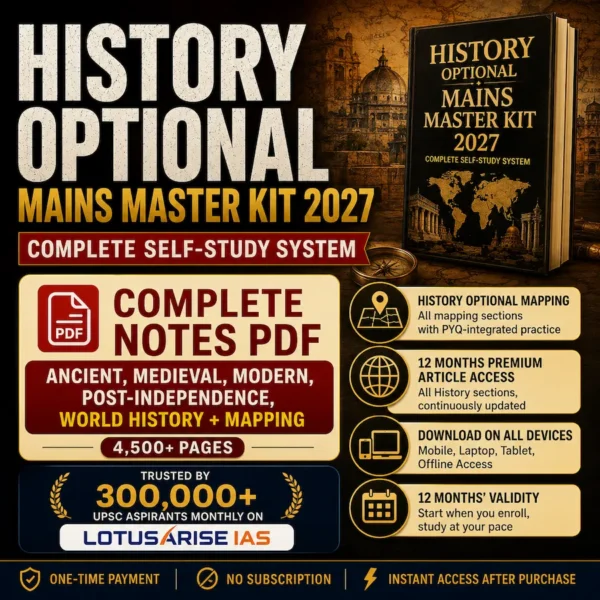
If this is your second or third attempt with History Optional, you already know something first-attempt guides never quite address: the problem was never that you didn’t know enough history. You’ve read the books, more than once. You can talk through the Mughal decline debate, the causes of the 1857 revolt, the drain of wealth theory, without opening a single note. And you still came back with an optional score that didn’t reflect any of that.
This is the most common — and most misdiagnosed — problem in History Optional. Almost every repeater’s instinct is to read more: a new book, a denser set of notes, a topic they feel shaky on. That instinct is usually solving the wrong problem, and it’s worth being precise about why.
The Real Gap Is Rarely Content

Across a wide range of subject areas, UPSC’s own data shows History Optional’s success rate has sat in the mid-single digits for years — not because the syllabus is impossibly hard to learn, but because the gap between an average answer and a strong one on identical content is enormous (we’ve broken down the actual marks mechanics of this elsewhere). If content knowledge alone explained most repeater scores, you’d expect a second attempt — with a full year of additional reading behind it — to move the needle substantially. In practice, it very often doesn’t, because the thing that was actually costing marks the first time wasn’t content depth. It was:
Structure. An answer that has all the right facts but no clear introduction, no organised argument, and no real conclusion forces the examiner to hunt for the marks you’ve earned instead of seeing them laid out. This costs marks independently of how much you know.
Historian citations. History Optional tests historiography, not just history — whether you understand that interpretations are contested and can cite who argued what. An answer with zero citations reads as a summary. An answer with vague or misapplied citations reads worse — it signals you’re naming names without understanding the positions.
The map section. Fifty marks, entirely separate from essay-writing skill, that most repeaters still haven’t systematically prepared on a second attempt because it doesn’t feel as urgent as “finishing the syllabus” — even though it’s arguably the most reliably scorable 50 marks on the whole paper.
If your last attempt’s optional score didn’t reflect your actual content knowledge, there’s a strong chance one or more of these three — not a content gap — is where those marks went.
A Self-Diagnostic Before You Start Round Two
Before re-reading anything, it’s worth honestly answering four questions about your last attempt:
- Did your answers have a real introduction and conclusion, or did you launch straight into facts and stop when the time ran out? If it’s the latter, that’s a structure problem, and it’s fixable in weeks, not months — it doesn’t require new content.
- Can you name, right now, without checking notes, which historian you’d cite for the five or six topics you consider your strongest? If the honest answer is “not specifically,” that’s a citation problem, not a content problem — you know the history but haven’t attached the historiography to it.
- How many hours did you spend on the map section in your last attempt, relative to the rest of Paper I? If it’s close to zero, you likely left a meaningful, low-effort-to-fix chunk of marks on the table — fifty marks that don’t depend on argumentative skill at all.
- When you got your score back, did you go through your answer copy (if you have it) or a reconstructed version of it, and mark exactly where you think marks were lost — or did you just conclude “I need to know more”? Most repeaters skip this step entirely, which is precisely why the same gap often repeats itself on the second attempt.
What a Second Attempt Should Actually Prioritise
Given limited months rather than limited knowledge, the highest-leverage use of a repeater’s time is usually not additional reading. It’s:
- Rebuilding your existing answers’ structure — taking topics you already know well and rewriting your mental template for how you’d answer them, with a clear intro–body–conclusion shape, rather than adding new facts to the same shapeless format.
- Attaching the correct historian citations to what you already know — this is a matter of learning who-said-what for topics you’ve already studied, not learning new topics.
- Systematically working through the map section — a fixed, learnable 50 marks that repay effort more predictably than almost anything else on the paper, and that most repeaters still haven’t touched properly by their second attempt.
- Practising against real PYQs, across years, grouped by topic — not to find new content, but to see how the same topics you already know get asked from different angles, so your answer doesn’t collapse the moment a question is phrased differently than you expected (we’ve shown concrete, real examples of this — the same Alauddin Khalji policy topic tested in both 2023 and 2025 — in a companion piece on how UPSC repeats topics across years).
None of this requires you to become a better historian than you already are. It requires converting the history you already know into the specific things an examiner is trained to reward.
Why This Is Different From “Try Harder” Advice
It’s easy to hear “focus on structure and citations, not content” as vague encouragement. The concrete version of it is: for every topic you’ve already studied, you need a rebuilt template — the right structure, the right historians to cite, and the value additions that lift an answer from average to strong — applied consistently, not worked out fresh under exam pressure for each question.
That’s exactly what the History Optional PYQ Master Pack gives you: every PYQ from 1985–2025 with a full model answer built around the correct structure and historian citations for that specific topic, plus the complete map section solved and organised — so your second attempt is spent applying a fix to knowledge you already have, not re-reading books you’ve already read.
You didn’t fail because you don’t know History. You’re about to find out how much of a difference the other half makes.
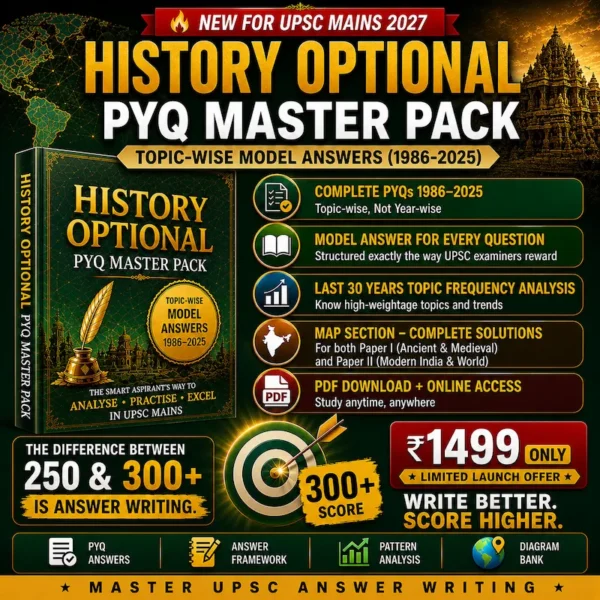
History Optional PYQ Master Pack: Topic-wise Model Answers (1985–2025) by LotusArise IAS
Most History Optional aspirants study PYQs the hard way — reading the question, guessing the answer, checking a random source, moving on. No structure. No historian citations. No idea what UPSC actually rewards. History Optional PYQ Master Pack — 100% complete and ready to download today — changes this completely.
📚 1985–2025 PYQs (Topic-wise) — Ancient India, Medieval India, Modern India, Post-Independence, World History — every question, fully solved
✍️ Model answers for every important question — exact structure, historian citations, diagram suggestions
🗺️ Map section solutions included — the full 50-mark section most aspirants ignore, at no extra cost
📲 PDF Download + Online Access — both included — study offline on any device, forever, not just while a subscription lasts
💰 Priced at ₹1,499 — for everything. Similar History Optional PYQ solutions elsewhere are sold for ₹2,500–₹3,500, often charging separately for online access, hard copies, and the Map section. Here, one price gets you PYQs + Map + PDF + online access, combined.
✅ Fully complete, nothing pending — every section is live the moment you enroll
You will be charged ₹1,499 today. Access is provided instantly. One-time payment. No subscription.