Peasant movements and tribal uprisings in the 18th and 19th centuries Including the Rangpur Dhing (1783), the Kol Rebellion (1832), the Mopla Rebellion In Malabar (1841-1920), the Santal Hul (1855), Indigo Rebellion (1859-60), Deccan Uprising (1875) and the Munda Ulgulan (1899- 1900); The Great Revolt of 1857 – Origin, character, causes of failure, the consequences; The shift In the character of peasant uprisings In the post-1857 period; the peasant movements of the 1920s and 1930s.
Indian Response to British Rule covers the Revolt of 1857 and the peasant and tribal uprisings of the nineteenth and early twentieth centuries. UPSC has set 42 questions on it between 1985 and 2026, and it has appeared in nine of the last ten papers. It is one of the largest units in Paper II and the one where “history from below” is examined most directly.
Every question the Commission has asked on this topic is listed below, newest first, with a written model answer linked against each one.
| Questions asked (1985–2026) | 42 |
| Appeared in | 9 of the last 10 papers |
| Paper | Paper II, Section A (Modern India) |
| Usual mark value | 10, 15 or 20 marks |
| Model answers available | 42 of 42 |
PYQs: Indian Response to British Rule [1985-2026]

| Year | Question | Answer |
|---|---|---|
| 2026 | Was the Moplah Rebellion in Malabar an expression of anti-landlord and anti-foreign discontent? Discuss. | View answer |
| 2025 | In what ways did the tribal and peasant uprisings of the 19th century contribute to the rise and growth of nationalism in India? Examine. | View answer |
| 2024 | Why was the Great Revolt of 1857 confined only to North India? How did it change the character of British rule in the subcontinent? Explain. | View answer |
| 2023 | The historical significance of tribal and peasant uprisings in India 'lies in that they established strong and valuable traditions of resistance to British rule'. Discuss. | View answer |
| 2023 | The root of the whole question behind the Indigo Revolt 'is the struggle to make the raiyats grow indigo plants without paying them the price of it'. Analyse. | View answer |
| 2023 | After 1857, "the peasants emerged as the main force in agrarian movements." Critically examine. | View answer |
| 2022 | 'Penetration of outsiders- called dikus by the Santhals- completely destroyed their familiar world, and forced them into action to take possession of their lost territory'. Critically examine. | View answer |
| 2022 | The British rule had differential impact on the Indian society. Describe in what ways the Indians responded to the Revolt of 1857. | View answer |
| 2020 | For long, the Revolt of 1857, has been mistaken to be a mere mutiny of the Indian sepoys in the Bengal army. However, its causes need to be searched for not only in the dissatisfaction of the army, but in a long drawn process of fundamental social and economic change that upset the peasant communities. Discuss. | View answer |
| 2020 | Do you feel that the Santhal Hool (rebellion) 1855-56, was the most effective tribal movement in pre-1857 India? | View answer |
| 2019 | Critically e x a m i n e: t h e Kol Insurrection was mainly a war of the tribal inhabitants of Chotanagpur against the non-tribal settlers and service-holders." | View answer |
| 2018 | Was the Moplah Rebellion in Malabar an expression of anti-landlord and antiforeign discontent? Discuss. | View answer |
| 2017 | Discuss the nature of peasant movements under the Kisan Sabhas during 1920-1940. | View answer |
| 2016 | "The Mutiny of 1857 was much more than a Mutiny of Sepoys and much less than a National Rebellion." Comment. | View answer |
| 2016 | How far is it correct to say that the 19th century tribal uprisings are a part of subalterns nationalism. | View answer |
| 2015 | Critically examine: "The Indigo Revolt of 1859-60 holds a very significant place in our history of national liberation movement. For the first time in the history of our anti – colonial struggle, its two independent currents- spontaneous peasant resistance and constitutional agitation in defence of the peasantry came into mutual contact." | View answer |
| 2015 | Analyze the nature of peasant movements during the nationalist phase and bring out their shortcomings. | View answer |
| 2014 | “The military, feudal and traditional overtones of the Revolt of 1857 were overshadowed by its nationalist or protonationalist character." Critically examine in 150 words. | View answer |
| 2012 | “The peasant movements of the second half of the nineteenth century lacked a positive conception of an alternative society – a conception which would unite the people in a common struggle on a wide regional and all- India plane and help develop long – term political developments." Critically examine in 150 words. | View answer |
| 2012 | “The Santhal hool began in July 1855. The core of the movement was economic, the basic cause of the uprising was agrarian discontent."- Elucidate. | View answer |
| 2011 | “In 1857, the rebal sepoys showed a remarkable centripetal tendency to congregate at Delhi." Do you agree? Substantiate. | View answer |
| 2011 | “Tribals revolted more often and far more violently than any other community including peasants to India.” Elaborate. | View answer |
| 2009 | “The annexation of Awadh shook the loyalty of the Sepoys, as it was for them an ultimate proof of untrustworthiness of the British." Comment. | View answer |
| 2007 | “The Revolt of 1857 seemed to call the very presence of the British into question. What it did not do was reverse these changes." Comment. | View answer |
| 2005 | ‘Whatever might have been its original character, it (Rebellion of 1857) soon became a symbol of challenge to the mighty British power in India.' | View answer |
| 2001 | 'The tribal and peasant rebellion laid the foundation of the revolt of 1857.’ Comment. | View answer |
| 2000 | The 1921 Moplah rebellion was"in essence an expression of long – standing agrarian discontent which was intensified by the religious and ethnic identity”. Comment. | View answer |
| 2000 | Towards the Princes, Canning adopted a policy of “punishing resistance and rewarding obedience”. Comment. | View answer |
| 1999 | Do you believe that the uprising in 1857 was nationalist in nature? If not, what was its character? | View answer |
| 1998 | Examine the nature of the Revolt of 1857 and indicate the manifold changes in British civil and military administration of India after 1857. | View answer |
| 1997 | Tribal movements should be viewed as “History from below”. Discuss the objectives & nature of the movements in 19th C. India. | View answer |
| 1994 | “The new attitude of caution and conservatism can detected in almost every sphere of British activity in India after the Revolt of 1857.” Comment. | View answer |
| 1992 | Discuss the origins and character of major peasant and tribal uprisings in the late 18th and 19th centimes’. Were these protest movements backwards – looking? | View answer |
| 1990 | The roots of the Moplah uprising (1921) were clearly agrarian. Do you agree? | View answer |
| 1989 | ‘If the paramount power cast its imperial cloak over the princes, it was also entitled to see that what was sheltered was in the main creditable.' Comment in about 200 words. | View answer |
| 1988 | "Whatever might have been its original character, it (Rebellion of 1857) soon became a symbol of challenge to the mighty British power in India.” Comment in about 200 words. | View answer |
| 1988 | Discuss briefly the tribal revolts in Eastern India from 1817 to 1857. Were they directed against land lordism and colonialism? | View answer |
| 1987 | ‘The British endeavoured as far as possible to live within a Ring-Fence and beyond that they avoided intercourse with the chiefs.’ Comment in about 200 words. | View answer |
| 1987 | Identify the various forms of 'rural protest in India in the second half of the nineteenth century. Were they expressions of anti-landlord or anti-foreign discontent? | View answer |
| 1986 | ‘The roots of Moplah discontent were clearly agrarian….’. Comment in about 200 words. | View answer |
| 1986 | ‘It is sometimes asked by Ruling Chiefs, as well as by the public in India and in Europe what our policy towards Native States is. I can tell you that the basis of the policy was laid in Queen Victoria's Proclamation of 1858 and repeated in the Coronation message of His Majesty the King Emperor.' Comment in about 200 words. | View answer |
| 1985 | “On the whole, it is difficult to avoid the conclusion that the so-called First National War of Independence was neither First, nor National, nor a War of Independence.” Comment in about 200 words. | View answer |
What UPSC keeps asking about Indian Response to British Rule
Forty-two questions fall into five threads. 1857 and the tribal uprisings are the largest; the Moplah rebellion is the single most repeated event after 1857.
1. The Revolt of 1857 — mutiny, revolt or war of independence? (1985, 1988, 1994, 1998, 1999, 2005, 2007, 2009, 2011, 2014, 2016, 2020, 2024)
- Thirteen questions — the largest thread.
- The nature of the revolt is the constant question: nationalist or not (1999), more than a mutiny and less than a national revolt (2016), mistaken for a mere mutiny (2020).
- Recent framings are narrower: why it was confined to the north (2024), the annexation of Awadh and sepoy loyalty (2009), the rebels’ centripetal pull towards Delhi (2011). S. B. Chaudhuri, R. C. Majumdar, S. N. Sen, Eric Stokes and Rudrangshu Mukherjee give you the full range of readings.
2. Tribal uprisings (1988, 1997, 2001, 2011, 2012, 2016, 2019, 2020, 2022, 2023, 2025)
- Eleven questions, seven since 2011.
- The Santhal Hool (2012, 2020, and 2022 on the dikus), the Kol insurrection (2019), tribal revolts in eastern India (1988).
- The framing is increasingly historiographical: tribal movements as “history from below” (1997), tribals revolting more often and more violently than anyone (2011). Ranajit Guha and K. S. Singh are the references.
3. Peasant movements and the Indigo Revolt (1987, 1992, 2012, 2015, 2017, 2023)
- The Indigo Revolt of 1859–60 (2015, 2023), peasant movements of the late nineteenth century (2012), the Kisan Sabhas and peasants in the nationalist phase (2015, 2017).
- 2023 said peasants emerged as the main force after 1857. Prepare the arc from Indigo through the Deccan riots to the Kisan Sabhas.
4. The Moplah rebellion (1986, 1990, 2000, 2018, 2026)
- Asked five times, and twice in near-identical words (2018, 2026): anti-landlord, anti-British, or communal?
- The older framing is that its roots were agrarian (1986, 1990, 2000). The strong answer holds all three dimensions and explains how Khilafat politics interacted with tenancy grievances in Malabar. Handle the communal violence frankly and evenhandedly — the examiner is testing balance.
5. British policy towards the princes (1985, 1986, 1987, 1989, 2000)
- Paramountcy, the ring fence, and Canning’s policy of punishing resistance and rewarding loyalty after 1857.
- Silent for twenty-five years. Worth one prepared answer, not more.
Every question above, already answered
Knowing the questions is half the work. The other half is seeing what a full-mark answer to each one looks like — not a hint or a bullet outline, but a complete answer at the mark and the word limit, with the historians named inside the argument.
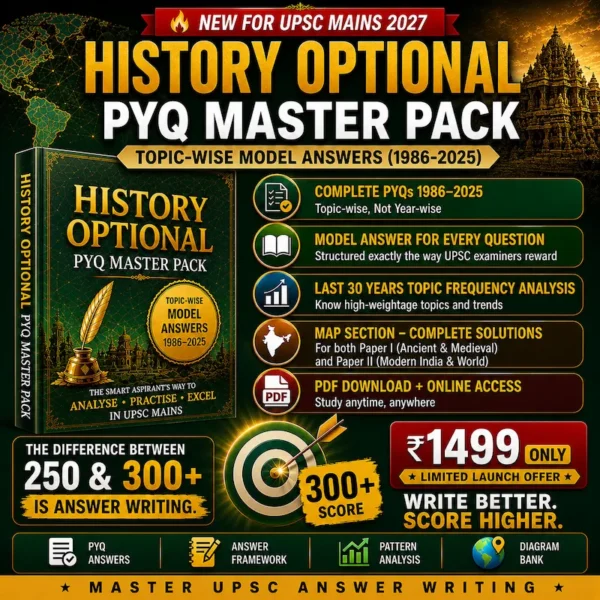
The History Optional PYQ Master Pack carries the same for every question the Commission has set since 1985, across the whole syllabus.
- PYQs 1985–2025, arranged topic-wise — revise a theme and see every way it has been asked
- Model answers with historiography — the debate cited where it belongs, not bolted on
- Map sections solved — the full 50-mark section, every year
- PDF plus online access — any device, permanently, no subscription
₹1,499 (regular ₹2,500). One-time payment, instant access.
How to use this topic list
Reading a question list feels like preparation and is not. Three sittings turn it into marks.
Sitting 1 — sort before you read (30 minutes)
- Copy the questions above into the threads identified in the previous section.
- Note which thread has gone longest without being asked — that is your priority, not the one you find most interesting.
Sitting 2 — write three answers cold (45 minutes)
- Pick the most recent question from three different threads.
- Seven minutes for a 10-marker, fifteen for a 20-marker. Stop when the time is up, even mid-sentence.
- Mark every place you wanted a historian’s name and could not produce one.
Sitting 3 — compare, then rewrite (45 minutes)
- Put your script beside the model answer for the same question.
- Compare structure first: opening claim, evidence, counter-view, judgement.
- Rewrite your weakest answer using that structure and no new content. Most candidates gain four to six marks from structure alone.
Two ways to prepare this optional
Two routes, depending on what is actually missing.
| PYQ Master Pack | Mains Master Kit 2027 | |
| Best when | Your notes are done; answer-writing is the gap | You are still building the subject |
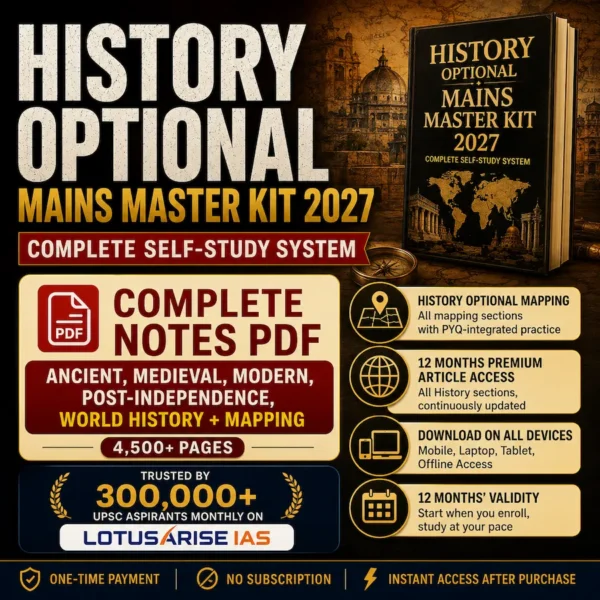
| What you get | Model answers to every question since 1985, topic-wise, map sections included | 4,500+ pages of notes, full mapping coverage, 12 months of article access |
| Price | ₹1,499 (reg. ₹2,500) | ₹1,770 (reg. ₹5,000) |
Frequently asked questions
Related topics
This unit connects to:
- Economic Impact of British Colonial Rule
- Social and Cultural Developments
- Early Indian Nationalism
- Other Strands in the National Movement
- All topics — History Optional PYQs, topic-wise
Prefer to work year by year?
The complete papers, with both papers in full, unit-wise analysis and the official PDFs:
- History Optional Question Paper 2026
- History Optional Question Paper 2025
- History Optional Question Paper 2024
- History Optional Question Paper 2023
- History Optional Question Paper 2022
- History Optional Question Paper 2021
- History Optional Question Paper 2020
- UPSC History Optional Map Solutions (2013–2025)