

Society in the Thirteenth and Fourteenth Centuries: Town Dwellers, Women, Religious Classes, Caste and Slavery

The 13th and 14th centuries witnessed the emergence of a distinctly urban, cosmopolitan society in North India, shaped by the establishment of the Delhi Sultanate, the revival and rapid growth of towns, and the deepening integration of India with the wider trading networks of West and Central Asia. This period brought together an old and sophisticated Indian tradition of trade and finance, embodied in communities such as the Multanis, with a new urban ruling class whose extravagant lifestyle shaped patterns of production, employment, and consumption across the towns of the Sultanate. Yet alongside this urban dynamism, traditional social structures — the caste hierarchy, the subordinate position of women, and the institution of slavery — showed a marked continuity, even as they were reshaped at the margins by the new political order. This article examines the trading and financial classes of Sultanate towns, the contrasting standards of living enjoyed by different social groups, the character of town life and artisanal production, the institution of slavery, and finally the condition of women, caste relations, and social intercourse between Hindus and Muslims during this period.
Town Dwellers: The Trading and Financial Classes
- India had an old tradition of trade, and a well-developed class of traders and financiers since ancient times. Laws relating to contract, loans, sale, and purchase were accordingly set out in the Dharmashastras.
- The emergence of the Vaishyas as a separate trading community, and their inclusion in the category of the dvija (twice-born, or privileged sections), is an index of their position in the social and economic life of the country.
- It is necessary to distinguish between the leading merchants (nagar sreshthins) and ordinary shopkeepers (banik) and transporters (banjaras).
- The former, according to the Panchatantra (a 5th-century fable), were considered socially close to the ruler, mingling freely with his family members.
- These leading merchants dealt not only in wholesale and long-distance trade — including foreign trade — but also in finance and money-changing.
- Long-distance trade was financed, insured against risk, and money transported from place to place through the system of hundis.
- (A hundi is a financial instrument developed in medieval India for trade and credit transactions — used as a remittance instrument to transfer money, a credit instrument or IOU to borrow money, and a bill of exchange in trade transactions.)
Factors Behind the Growth of Trade
- The establishment of a strong centralised empire in north India; the establishment of a sound currency system, mainly based on the silver tanka; the growing security of roads; the growth of towns; and the opening up of India to the Islamic world were all important factors that led to the growth and expansion of India’s overland trade to West and Central Asia, as well as overseas trade, mainly from Gujarat.
- This is testified to by the frequent reference to the Multanis as traders and financiers.
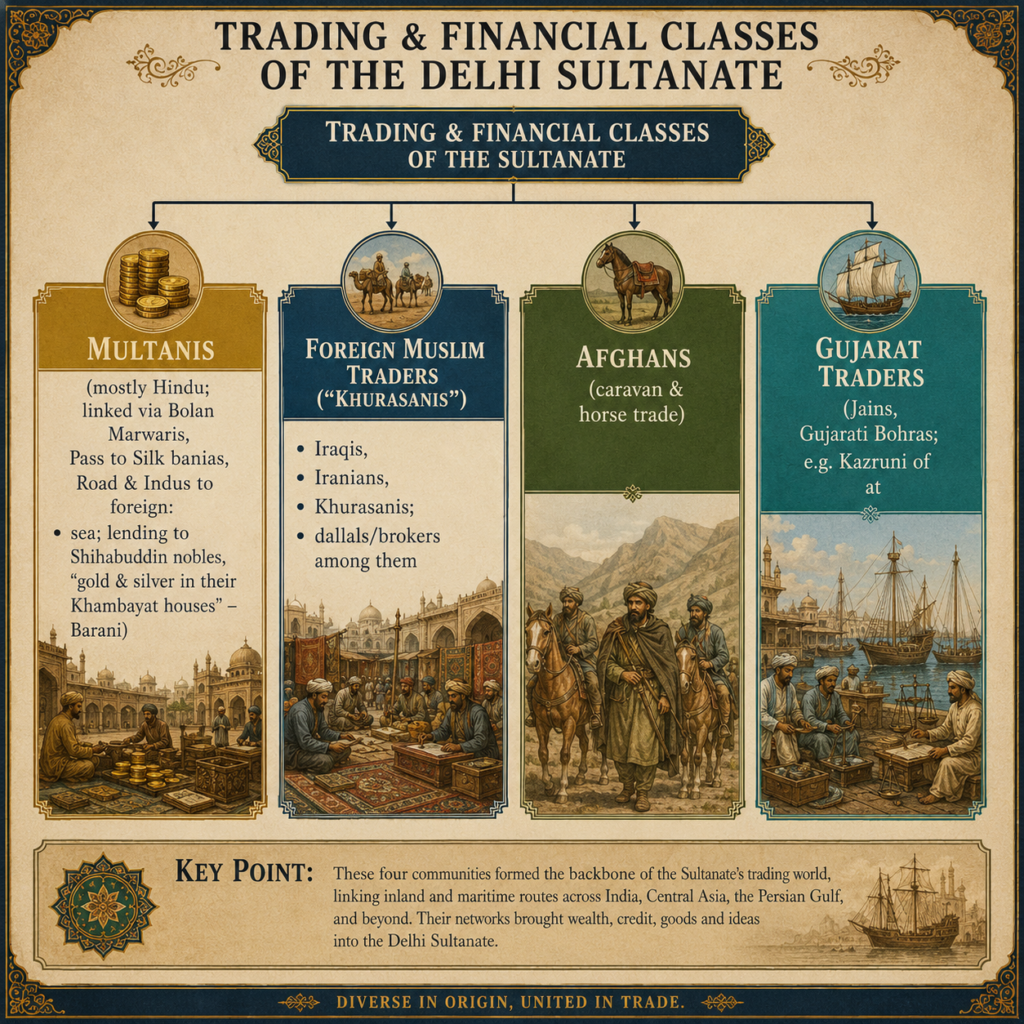
The Multanis
- Throughout medieval times, Multan was a very important trading centre, being linked directly across the Bolan Pass to Qandhar, Herat, and Bokhara — the junction of the “Silk Road,” extending eastward across Central Asia to China, and westward across Iran to Constantinople and Lebanon. Multan was also linked, via the river Indus, to the western sea ports.
- The bulk of the Multanis were Hindus. According to Barani’s accounts, the Multanis and the Sahs of Delhi had become so rich by lending money to the nobles that gold and silver were to be found in their houses alone.
- Barani testifies to the wealth and prosperity of the Multanis and the Sahs in other ways too. He records that Jalaluddin Khalji bluntly refused to take stern action against the Hindus, who — even at the capital, Delhi — enjoyed full religious freedom; the wealthy among them, obviously the Multani traders and merchants, led a life of ease and pleasure, with no fear for the safety of their life and property.
Brokers, Foreign Muslim Traders, and Afghans
- Another section of traders to whom Barani refers are the dallals or brokers — commission agents who charged a fee for bringing buyers and sellers together. Their emergence is an index of the growth of trade at Delhi.
- Buyers of different commodities, especially textiles, thronged to Delhi following the control of the market by Alauddin. Barani refers to brokers especially in the context of Alauddin’s effort to control the sale of horses, using strong words about these dallals, many of whom — especially the horse traders — were Muslims.
- They formed a rich and powerful group, which, on occasions, could even defy the Sultan, and disregard his orders.
- The Muslim traders at Delhi were generally foreigners — Iraqis, Iranians, Khurasanis, etc. — although we hear of a few Muslim Multanis.
- The father and grandfather of Hisamuddin, whom Alauddin had appointed a qazi, had been leading merchants of Multan.
- According to Ibn Battutah, in India, all foreign traders were called Khurasanis.
- Afghans were another group of Muslim traders, who specialised in the caravan trade, and trade in horses.
Gujarat’s Trading Communities
- Gujarat had a well-established tradition of trade, and of trading communities, both Indian and foreign.
- An Egyptian, Shihabuddin Kazruni, who owned many ships, lived at Khambayat.
- The Jains, the Marwaris, the Gujarati banias, and the Bohras were also active.
- It was from one of these traders that Malik Kafur was procured for Alauddin.
Standard of Living
Sultan and Nobles
- Contemporary chroniclers devote considerable space to describing the extravagant lifestyle of the Sultans — their palaces, furnishings, the lavish expense on the upkeep of the large number of women and relatives in their harems, their costly clothes and jewellery, expenses on the royal stables, and their extravagant gifts to nobles, poets, the learned, and the saintly.
- Such a lifestyle had become customary, and was also intended to impress the subjects and courtiers.
- There was growing affluence of the nobles from the time of the rise of the Tughlaqs. However, even during the reign of Balban, his cousin Malik Kishli Khan on one occasion gave away all his horses and 10,000 tankas to poets and minstrels.
- Fakhruddin, the kotwal of Delhi under Balban, used to give financial grants to 12,000 readers of the Quran, and provide dowries to 1,000 poor girls every year. He never wore the same dress twice, or slept in the same bed twice.
- Balban’s diwan-i-arz, Imad-ul-Mulk, was famous for his lavish repast — consisting of 50 to 60 trays of food served daily to his officials and clerks.
- Mir Maqbul, a noble of Muhammad Tughlaq, used to spend three-and-a-half lakh tankas on his personal expenses. Khan-i-Jahan, the wazir of Firuz, had 20,000 women in his harem.
- This lifestyle of the nobles did lead to the setting up of specialised industries in different parts of the country, catering to the demand they created.
- Most nobles did not hoard their riches, nor did they invest their wealth in productive enterprises — except in gardens, during the reign of Muhammad Tughlaq, and more especially under Firuz.
Other Sections
- Some of the famous hakims (physicians) seem to have been financially well off. The position of poets, etc., depended on the nature of the patronage they received.
- The father of Amir Khusrau had a stipend of 1,200 tankas a year from Balban, when he was a noble.
- Ahmad Chap, Balban’s ariz, once gave 10,000 tankas, 100 horses, and 320 dresses for the royal musicians to sing at his house.
- In general, these sections led a life of comfort, but not affluence.
The General Population: Prices and Wages
- For the general population in the towns, the standard of living was largely determined by prices and wages.
- We have little idea of prices before Alauddin Khalji.
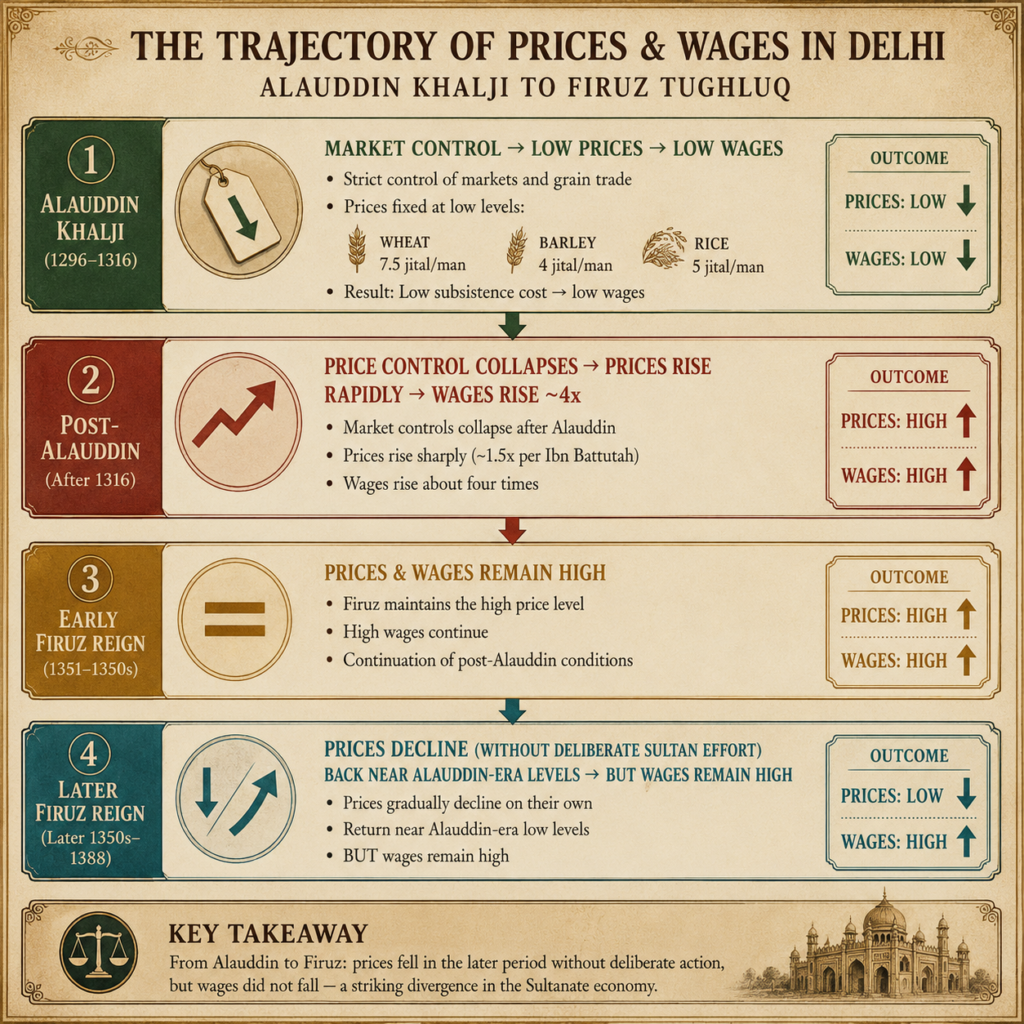
- Through his market control measures, Alauddin ensured the supply of cheap foodstuffs. Barani tells us that wheat sold at 7½ jital per man, barley at 4 jitals, and good-quality rice at 5 jitals.
- However, while the cost of subsistence was low, wages were also low.
- After the death of Alauddin, the price control system collapsed, and prices rose rapidly, with wages rising four times.
- By analysing the prices mentioned by Ibn Battutah, it seems prices rose a little over one-and-a-half times; wages may have risen in the same proportion.
- Prices and wages were higher still during the early years of Firuz’s reign.
- During his reign, according to Afif, without any effort on the Sultan’s part, prices declined almost to the level of Alauddin’s reign — however, wages still remained high.
- The causes of price fluctuation in food grains — whether linked to good harvests and expansion of cultivation, or to a world-wide shortage of silver — remains, even today, a matter of debate.
Towns and Town Life: Artisans
- There was a revival of towns in north India from the 10th century. This process was considerably accelerated from the 13th century, as a result of Turkish centralisation, and the growth of a new city-based ruling class with a high standard of living.
- Apart from Delhi — which Ibn Battutah calls the largest city in the eastern part of the Islamic world — Daulatabad (Deogiri) equalled Delhi in size.
- Other cities that rose to prominence in north India during this period were Multan, Lahore, Kara (near modern Allahabad), Lakhnauti, and Khambayat.
- The economic life of the town was dominated by the nobles and their retinues, along with traders and shopkeepers, as already noted.
- The largest section in the cities consisted of servants and slaves, artisans, soldiers, and a miscellaneous group — peddlers, musicians, performers (nat), self-employed people, and beggars.
- It seems that cities performed the function of a large social churner, whereby people of diverse backgrounds and ethnic origins — slaves, artisans, and others — came to live together.
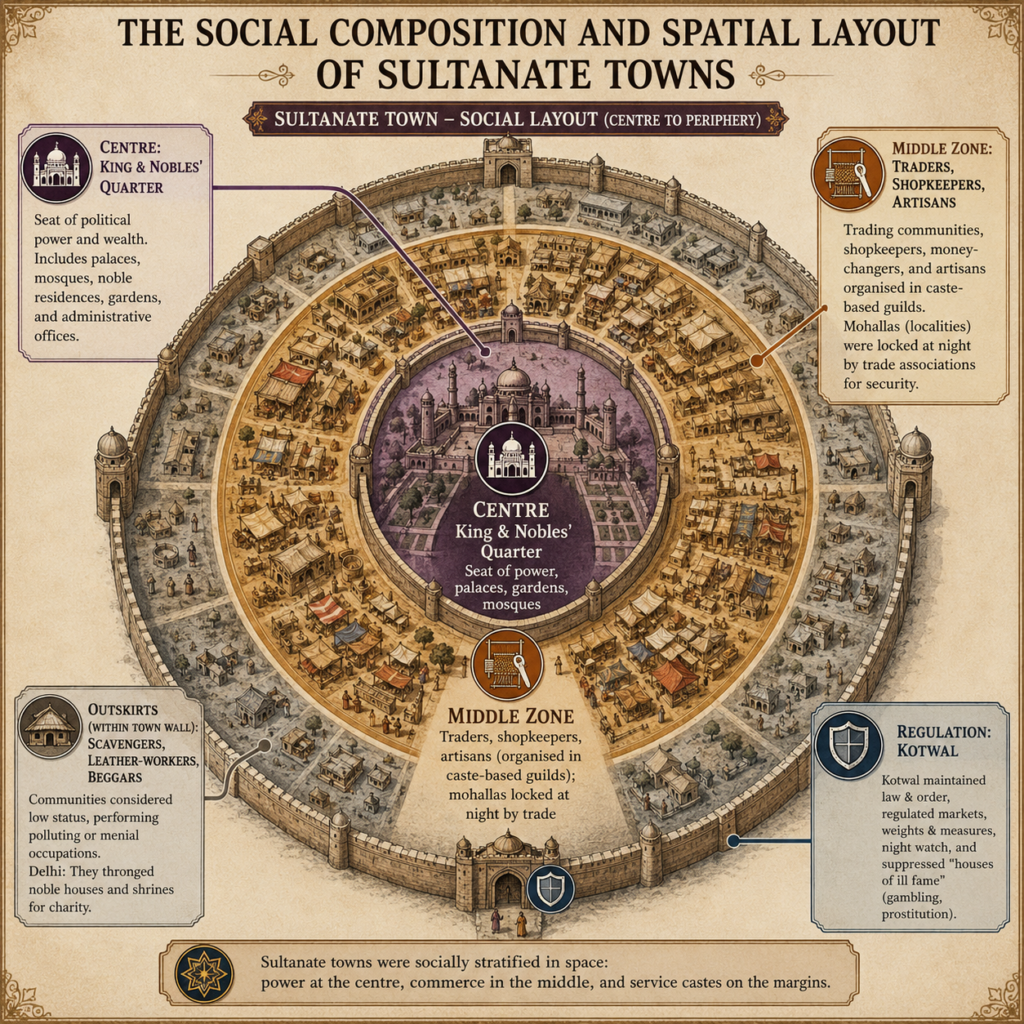
- The entry to the city was carefully regulated by the kotwal, who was responsible not only for the maintenance of law and order, but also regulated the markets, and houses of ill fame (gambling, prostitution, etc.).
- According to tradition, people following a particular profession lived in a particular area (mohalla), which was locked at night for the sake of safety.
- There was a definite pattern in the layout of towns — a separate quarter for the king and nobles, while scavengers, leather-workers, and beggars, etc., were allotted quarters at the outskirts of the town, though still within the town wall.
- Delhi had a large mass of beggars, who thronged the houses of nobles for charity, or resorted to mausoleums and shrines of Sufi saints. Like the ordinary population, they carried arms, and could sometimes create problems of law and order.
Crafts and Artisans
- The city was a centre of many crafts — weaving, painting on cloth, embroidery, etc.
- The royal karkhanas employed many artisans in preparing costly items, such as cloth embroidered with gold and silver thread, and silk.
- But most artisans worked at home, and were organised in guilds along caste lines.
- However, not all specialised crafts, such as weaving, were located in the towns.
- In south India and Gujarat, there were many villages and small towns that specialised in particular types of textile production.
- Thus, unlike medieval Europe, we should not divide crafts in India into water-tight compartments between towns and the countryside.
- The craft link between towns and the countryside was also a factor that facilitated the movement of artisans from the countryside to the towns.
Slaves
- Another large section of the town population consisted of slaves and domestic servants. Slavery had existed in India, as well as in West Asia and Europe, for a long time.
- The position of different types of slaves — one born in the household, one purchased, one acquired, and one inherited — is discussed in the Hindu Shastras.
- Slavery had been adopted by the Arabs, and later by the Turks as well. The most usual method of acquiring a slave was capture in war.
- Even the Mahabharata considered it normal to enslave a prisoner of war.
- The Turks practised this on a large scale in their wars, both in and outside India.
- Slave markets for men and women existed in West Asia, as well as in India.
- Turkish, Caucasian, Greek, and Indian slaves were valued and sought after. A small number were also imported from Africa, mainly Abyssinian.
- Slaves were generally bought for domestic service, for company, or for their special skills.
- Skilled slaves, or comely boys and handsome girls, sometimes fetched a high price.
- Skilled slaves were valued, and some of them rose to high offices — as in the case of the slaves of Qutbuddin Aibak.
Slave Raiding and the Slave Trade
- Slave raiding was widely practised in West and Central Asia, the ghazis being specially used to capture and then convert slaves from Central Asia.
- The early Turkish rulers, such as Qutbuddin Aibak, continued this practice in India.
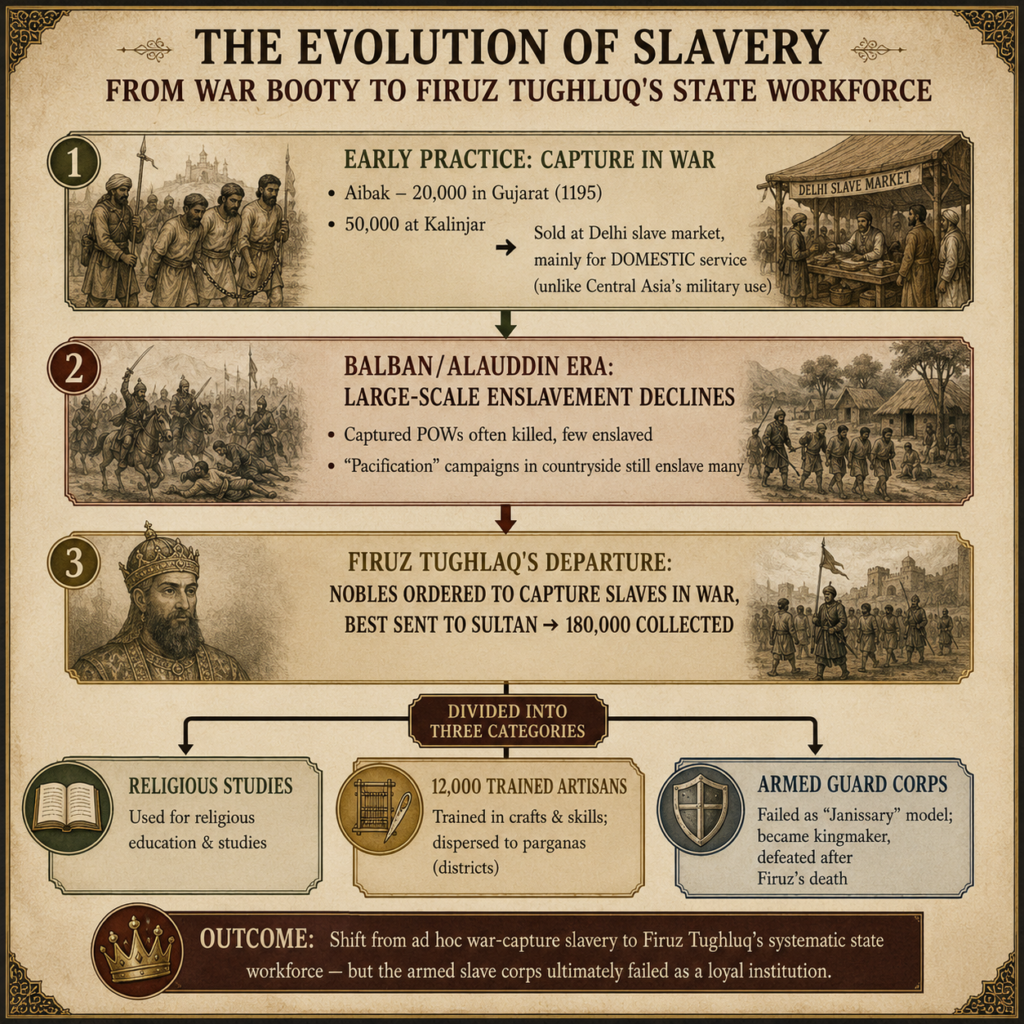
- When he invaded Gujarat in 1195, he captured and enslaved 20,000 persons, and another 50,000 during his raid of Kalinjar.
- However, we do not hear of any such large-scale enslavement during the campaigns of Balban and Alauddin Khalji, although slaves were still considered part of the booty. More often, captured prisoners of war were slaughtered, only a few chosen ones being brought back as slaves.
- But during campaigns of “pacification” in the countryside, large numbers of men, women, and children were enslaved, and sold in the slave market at Delhi.
- The sale and purchase of slaves was such a routine matter that Barani mentions the price of slave-girls and handsome boys alongside cattle.
- However, unlike Central Asia, where captured Turkish slaves were used for military purposes, the slaves sold in the Delhi market were used mainly for domestic service.
- Generally, slaves were not used or trained as craftsmen, though maid-servants were often used for spinning, and we hear of even Sufi saints living on the earnings of their slaves.
Firuz Tughlaq’s Departure: Slaves as a State Resource
- A departure from this practice was made by Firuz Tughlaq.
- He instructed the bigger nobles to capture slaves whenever they were at war, and to pick out and send the best among them for the service of the Sultan. Even various subordinate chiefs were asked to follow this practice.
- In this way, 180,000 slaves were collected. While some were trained for religious studies, 12,000 among them were trained as artisans, and dispersed into various parganas — suggesting an acute shortage of trained artisans in the towns.
- The slaves also formed a corps of armed guards. However, the effort to create a corps of Janissaries on the Turkish model failed — the corps of slaves tried to act as kingmaker at the death of Firuz, but were defeated and dispersed.
- Although domestic slavery continued under the Mughals, the slaves did not play any important role in manufacturing, or in the military.
- However, there is little doubt that the practice of slavery was not only inhuman, but also lowered the status of free labour, and depressed wages.
Women, Caste and Customs
Caste
- There were hardly any changes in the structure of Hindu society during this period.
- The Smriti writers of the time continued to assign a high place to the Brahmanas, while strongly denouncing the unworthy members of the order.
- According to one school of thinking, Brahmanas were permitted to engage in agriculture, not only in times of distress but also in normal times, since officiating at sacrifices, etc., did not furnish sufficient means of subsistence in the Kali Age.
- The Smriti texts continued to emphasise that punishing the wicked and cherishing the good was the duty of the Kshatriyas, and that the right to wield weapons for protecting the people likewise belonged to them alone.
- The duties and occupations of Shudras, and their disabilities, were more or less repeated.
- While the highest duty of the Shudra was service to the other castes, he was allowed to engage in all occupations, except dealing in liquor and meat.
- The ban on the study and recitation of the Vedas by Shudras was repeated, but not on hearing the recitation of the Puranas.
- Some writers went as far as to say that not only eating a Shudra’s food, but also living in the same house, sitting on the same cot, and receiving religious instruction from a learned Shudra were all to be avoided — though this may be regarded as an extreme view.
- The severest restrictions, however, were placed on mingling with the Chandalas and other “outcastes.”
Women
- There was little change in the position of women in Hindu society.
- The old rules enjoining early marriage for girls, and the wife’s obligation of service and devotion to the husband, continued.
- Annulment of marriage was allowed in special circumstances, such as desertion or a loathsome disease.
- Widow remarriage was included among the practices prohibited in the Kali Age — but this apparently applied only to the three upper castes.
- Regarding the practice of sati, some writers approve it emphatically, while others allow it with conditions.
- A number of travellers mention its prevalence in different regions of the country. Ibn Battutah mentions, with horror, the scene of a woman burning herself in her husband’s funeral pyre, amid great beating of drums.
- According to him, permission from the Sultan had to be taken for the performance of sati.
- Regarding property, the commentators upheld the widow’s right to the property of a sonless husband, provided the property was not joint — i.e., had already been divided.
- The widow was not merely the guardian of this property, but had the full right to dispose of it.
- Thus, it would appear that the property rights of women improved in Hindu law during this period.
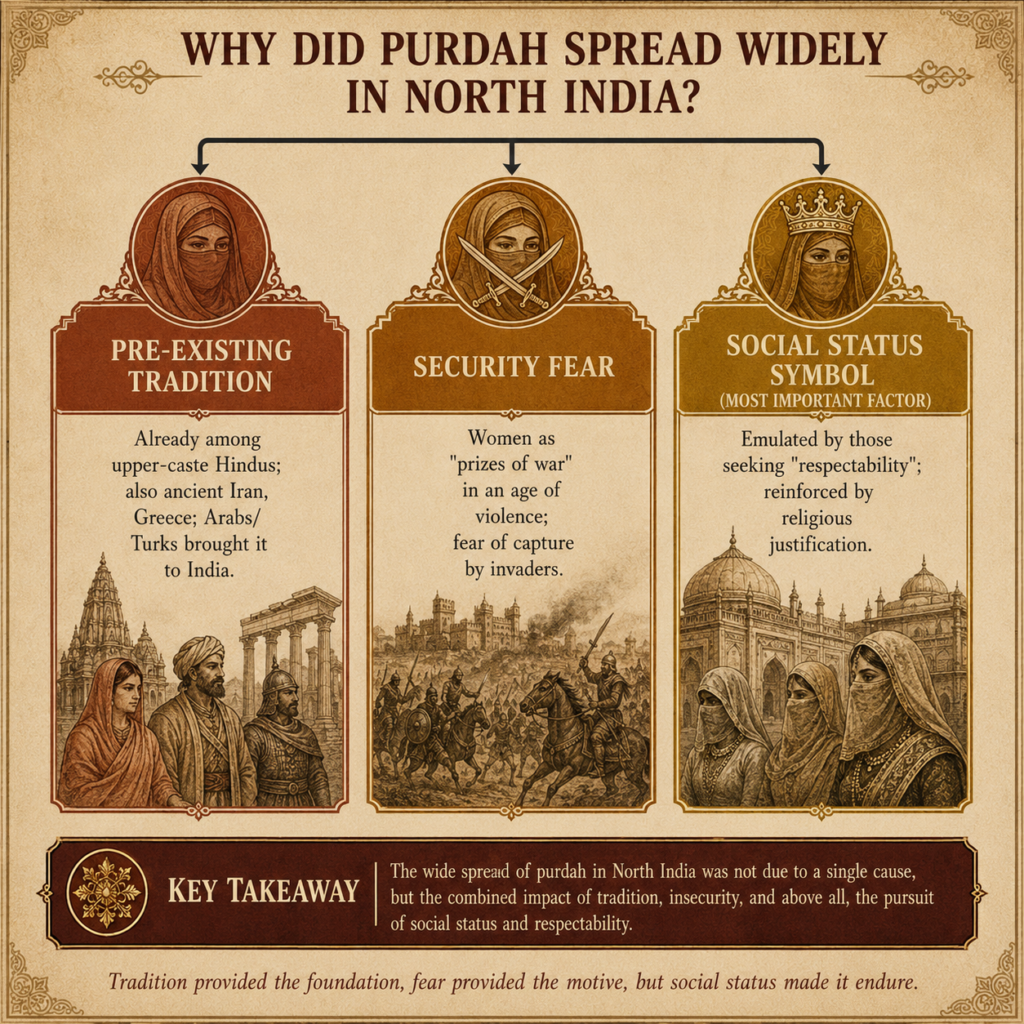
- During this period, the practice of keeping women in seclusion, and requiring them to veil their faces in the presence of outsiders — that is, the practice of purdah — became widespread among upper-class women.
- The practice of secluding women from the vulgar gaze was practised among upper-class Hindus, and was also in vogue in ancient Iran, Greece, etc. The Arabs and Turks adopted this custom, and brought it to India with them.
- Due to their example, it became widespread in India, particularly in north India.
- The growth of purdah has been attributed to the fear of Hindu women being captured by invaders — in an age of violence, women were liable to be treated as prizes of war.
- Perhaps the most important factor for the growth of purdah was social — it became a symbol of the higher classes in society, and all those who wanted to be considered respectable tried to copy it. Religious justification was also found for it.
- Whatever the reason, it affected women adversely, making them even more dependent on men.
Social Intercourse Between Hindus and Muslims
- During the Sultanate period, Muslim society remained divided into ethnic and racial groups, with deep economic disparities within it.
- The Turks, Iranians, Afghans, and Indian Muslims rarely married with each other. In fact, these sections developed some of the caste exclusiveness of the Hindus.
- Converts from lower sections of the Hindus were also discriminated against.
- The Hindu and Muslim upper classes did not have much social intercourse between them during this period — partly due to the superiority complexes of the latter, and partly due to religious restrictions on inter-marriage and inter-dining.
- The Hindu upper castes applied to the Muslims the same restrictions they applied to the Shudras.
- But caste restrictions did not close social intercourse between the Muslims and the upper-caste Hindus and Shudras.
- At various times, Hindu soldiers were enrolled in Muslim armies.
- Most nobles had Hindus as their personal managers.
- The local machinery of administration remained almost entirely in the hands of the Hindus.
- Thus, occasions for mutual intercourse were manifold.
- Conflict of interests, as well as differences in social and cultural ideas, practices, and beliefs, did, however, create tensions, and slowed down the processes of mutual understanding and cultural assimilation.
Conclusion
Society in the 13th and 14th centuries presents a picture of striking contrasts — a rapidly expanding urban economy, driven by wealthy trading communities such as the Multanis and sustained by a nobility of extraordinary extravagance, coexisting alongside deeply entrenched structures of caste hierarchy, gender subordination, and slavery that showed little fundamental change from earlier centuries. The growth of towns as genuine “social churners” — bringing together Turks, Afghans, Hindus, converts, and slaves of diverse origin — created new occasions for economic interdependence and administrative collaboration between communities, even as religious, caste, and ethnic exclusivity on both sides limited genuine social assimilation. Institutions such as slavery, adapted by Firuz Tughlaq into a systematic instrument of state labour and military recruitment, and the growing practice of purdah, adopted across both Hindu and Muslim elites as a marker of social status, together illustrate how the Sultanate period neither wholly transformed nor left untouched the social fabric it inherited — producing instead a genuinely composite, if deeply unequal, medieval Indian society.




