

Cholas: Polity and Administration

The Chola dynasty, one of the Three Crowned Kings of Tamilakam along with the Chera and Pandya, built one of the most extensive and sophisticated states of early medieval India — ruling the fertile Kaveri heartland and, at its peak, a maritime empire stretching from Sri Lanka to Southeast Asia. For UPSC History Optional aspirants, the Cholas are essential for two reasons: their political history of over five centuries of imperial rise, expansion, and eventual decline, and their remarkably advanced system of polity and administration, especially the village self-government recorded in the celebrated Uttaramerur inscriptions. This article first traces the historical background of the Chola dynasty — its sources, the Early Cholas, the Interregnum, and the Imperial and Later Cholas — before examining in detail the Chola system of polity and administration, covering the monarchy, provincial government, village autonomy, revenue policy, and military organisation.
Historical Background of the Chola Dynasty
- The Chola dynasty was one of the Tamil dynasties of southern India; at its height, it ruled an expansive maritime empire known as the Chola Empire.
- The Chola Empire reached its peak and achieved full imperial stature under the Medieval Cholas in the mid-9th century CE.
- As one of the Three Crowned Kings of Tamilakam, alongside the Chera and Pandya, the dynasty continued to govern varying territories until the 13th century CE.
- The heartland of the Cholas was the fertile valley of the Kaveri River.
- They ruled a significantly larger area at the height of their power, from the later half of the 9th century to the beginning of the 13th century, unifying peninsular India south of the Tungabhadra River and holding it as one state for three centuries, between 907 and 1215 CE.
- Under Rajaraja I and his successors — Rajendra I, Rajadhiraja I, Rajendra II, Virarajendra, and Kulothunga Chola I — the empire became a military, economic, and cultural powerhouse across South Asia and Southeast Asia.
- The power and prestige the Cholas commanded among the political powers of South, Southeast, and East Asia is evident from their expeditions to the Ganges, naval raids on cities of the Srivijaya empire based on the island of Sumatra, and repeated embassies to China; the Chola fleet represented the zenith of ancient Indian maritime capacity.
- Around 1070, the Cholas began to lose almost all their overseas territories, though the Later Cholas (1070–1279 CE) continued to rule portions of Southern India.
- The Chola empire went into decline at the beginning of the 13th century with the rise of the Pandyan dynasty, which ultimately caused its downfall.
Sources
- There is very little written evidence for the Cholas prior to the 7th century CE.
- The main sources of information on the early Cholas are ancient Tamil literature of the Sangam period, oral traditions, religious texts, and temple and copperplate inscriptions; later medieval Cholas also claimed a long and ancient lineage.
- The Cholas are mentioned in Ashokan edicts (inscribed 273 BCE–232 BCE) as one of the Mauryan Empire’s neighbours to the south (Ashoka’s Major Rock Edict No. 13), who, though not subject to Ashoka, were on friendly terms with him.
- There are also brief references to the Chola country and its towns, ports, and commerce in the Periplus of the Erythraean Sea (Periplus Maris Erythraei), and in the slightly later work of the geographer Ptolemy.
- The Mahavamsa, a Buddhist text written down during the 5th century CE, recounts a number of conflicts between the inhabitants of Sri Lanka and the Cholas in the 1st century BCE.
- The history of the Cholas falls into four periods:
- the Early Cholas of the Sangam literature;
- the interregnum between the fall of the Sangam Cholas and the rise of the Imperial medieval Cholas under Vijayalaya (c. 848);
- the dynasty of Vijayalaya (the Imperial Cholas); and
- the Later Chola dynasty of Kulothunga Chola I, from the third quarter of the 11th century.
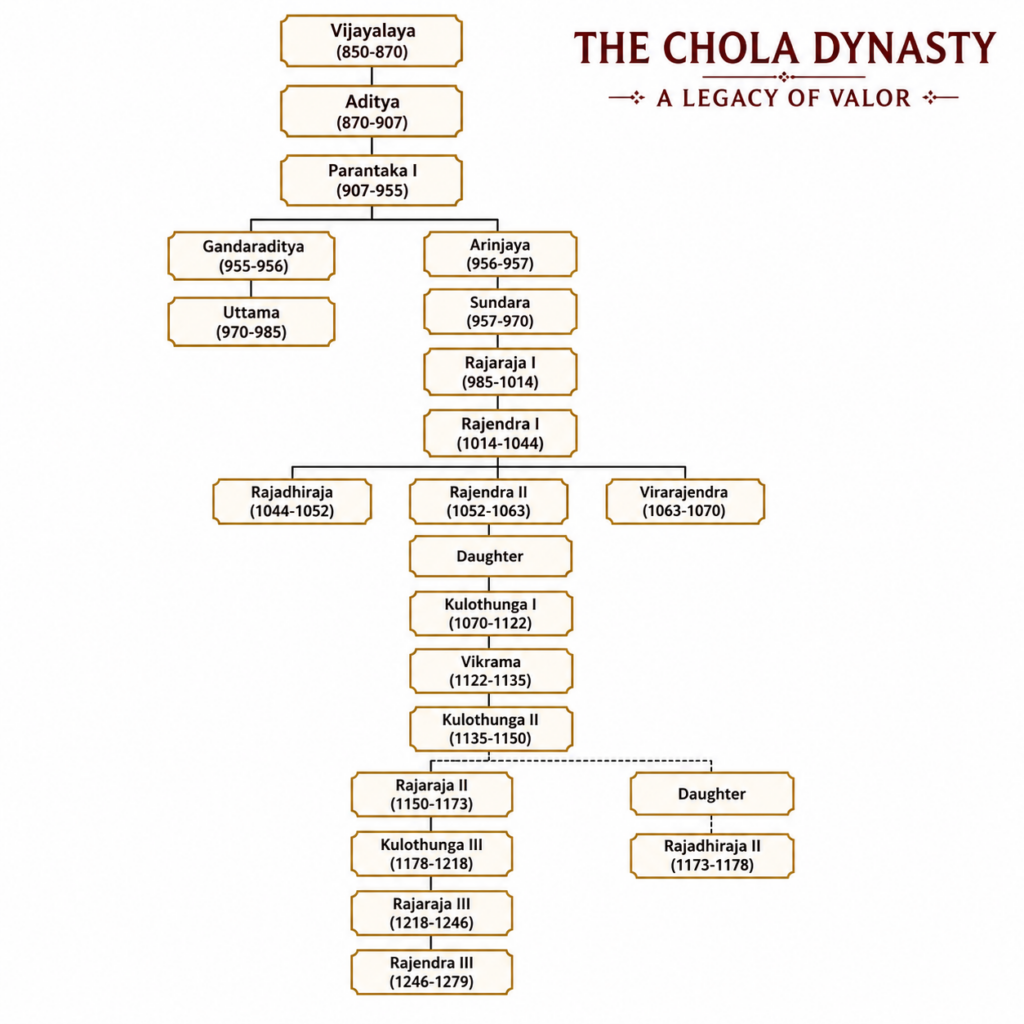
The dynastic succession of the Imperial and Later Cholas, from Vijayalaya to Rajendra III, may be traced as follows:
- Vijayalaya (850–870)
- Aditya I (870–907)
- Parantaka I (907–955)
- Gandaraditya (955–956)
- Uttama Chola (970–985)
- Arinjaya (956–957)
- Sundara Chola (957–970)
- Rajaraja I (985–1014)
- Rajendra I (1014–1044)
- Rajadhiraja I (1044–1052)
- Rajendra II (1052–1063)
- Virarajendra (1063–1070)
- (daughter)
- Kulothunga I (1070–1122)
- Vikrama Chola (1122–1135)
- Kulothunga II (1135–1150)
- Rajaraja II (1150–1173, per the dynastic chart; given elsewhere in the source as 1146–1175) — married to a (daughter)
- Kulothunga III (1178–1218)
- Rajadhiraja II (1173–1178)
- Rajaraja III (1218–1246)
- Rajendra III (1246–1279)
- Rajaraja III (1218–1246)
- Rajaraja II (1150–1173, per the dynastic chart; given elsewhere in the source as 1146–1175) — married to a (daughter)
- Kulothunga II (1135–1150)
- Vikrama Chola (1122–1135)
- Kulothunga I (1070–1122)
- (daughter)
- Rajendra I (1014–1044)
- Rajaraja I (985–1014)
- Sundara Chola (957–970)
- Gandaraditya (955–956)
- Parantaka I (907–955)
- Aditya I (870–907)
Early Cholas
- It is known that the Cholas were a ruling family since very early antiquity; along with the Pandyas and Cheras, they are first mentioned in Ashoka’s II and XIII Rock Edicts.
- This inscription claims that the Cholas were a friendly power in the south that existed outside the purview of Mauryan suzerainty.
- Sangam literature also provides a wealth of information on Chola chiefdoms.
- The best-known early Chola king was Karikala Chola, credited with establishing the town of Puhar at the mouth of the Cauvery River and building an embankment alongside it.
- He also demonstrated a strong interest in expanding irrigation infrastructure and in land reclamation.
- Even though Chola kings date back to the Mauryan era, little is known about their post-Sangam history or their relationship to the Cholas of the early medieval era.
Interregnum
- There is not much information about the transition period of around three centuries from the end of the Sangam age (c. 300) to the period in which the Pandyas and Pallavas dominated the Tamil country.
- An obscure dynasty, the Kalabhras, invaded the Tamil country, displaced the existing kingdoms, and ruled during this time.
- They were in turn displaced by the Pallava and Pandyan dynasties in the 6th century.
- Little is known of the fate of the Cholas during the succeeding three centuries until the accession of Vijayalaya in the second quarter of the 9th century.
- As per inscriptions found in and around Thanjavur, the kingdom was ruled by the Mutharaiyars (or Muthurajas) for three centuries; their reign was ended by Vijayalaya Chola, who captured Thanjavur from Ilango Mutharaiyar between 848 and 851 CE.
- Epigraphy and literature provide only a few glimpses of the transformations that came over this line of kings during this long interval. It is certain that as Chola power fell to its lowest ebb, while that of the Pandyas and Pallavas rose to the north and south of them, the dynasty was compelled to seek refuge and patronage under these more successful rivals.
- The Cholas continued to rule over a diminished territory in the neighbourhood of Uraiyur, but only in a minor capacity.
- In spite of their reduced power, the Pandyas and Pallavas accepted Chola princesses in marriage, possibly out of regard for their reputation; numerous Pallava inscriptions of this period mention having fought rulers of the Chola country.
- Despite this loss of influence, it is unlikely that the Cholas lost total grip of the territory around Uraiyur, their old capital, since Vijayalaya — when he rose to prominence — hailed from that area.
- An early silver coin of Uttama Chola found in Sri Lanka shows the tiger emblem of the Cholas and bears the Nagari script.
- Around the 7th century, a Chola kingdom flourished in present-day Andhra Pradesh; these Telugu Cholas traced their descent to the early Sangam Cholas, though it is not known if they had any actual relation to the early Cholas.
- It is possible that a branch of the Tamil Cholas migrated north during the time of the Pallavas to establish a kingdom of their own, away from the dominating influence of the Pandyas and Pallavas.
- The Chinese pilgrim Xuanzang, who spent several months in Kanchipuram during 639–640, writes of the “kingdom of Culi-ya” — an apparent reference to these Telugu Cholas.
Imperial Cholas
- Vijayalaya was the founder of the Chola empire, marking the beginning of one of the most splendid empires in Indian history.
- Vijayalaya, possibly a feudatory of the Pallava dynasty, seized an opportunity arising from a conflict between the Pandya and Pallava empires around c. 850, captured Thanjavur from the Muttarayar, and established the imperial line of the medieval Chola dynasty; Thanjavur became the capital of the Imperial Chola empire.
- The second Chola king, Aditya I, caused the demise of the Pallava dynasty and defeated the Pandyan dynasty of Madurai in 885, occupied large parts of the Kannada country, and forged marital ties with the Western Ganga dynasty.
- In 925, his son Parantaka I conquered Sri Lanka (known as Ilangai); Parantaka I also defeated the Rashtrakuta dynasty under Krishna II in the Battle of Vallala.
- Rajaraja Chola I and Rajendra Chola I were the greatest rulers of the Chola dynasty, extending it beyond the traditional limits of a Tamil kingdom.
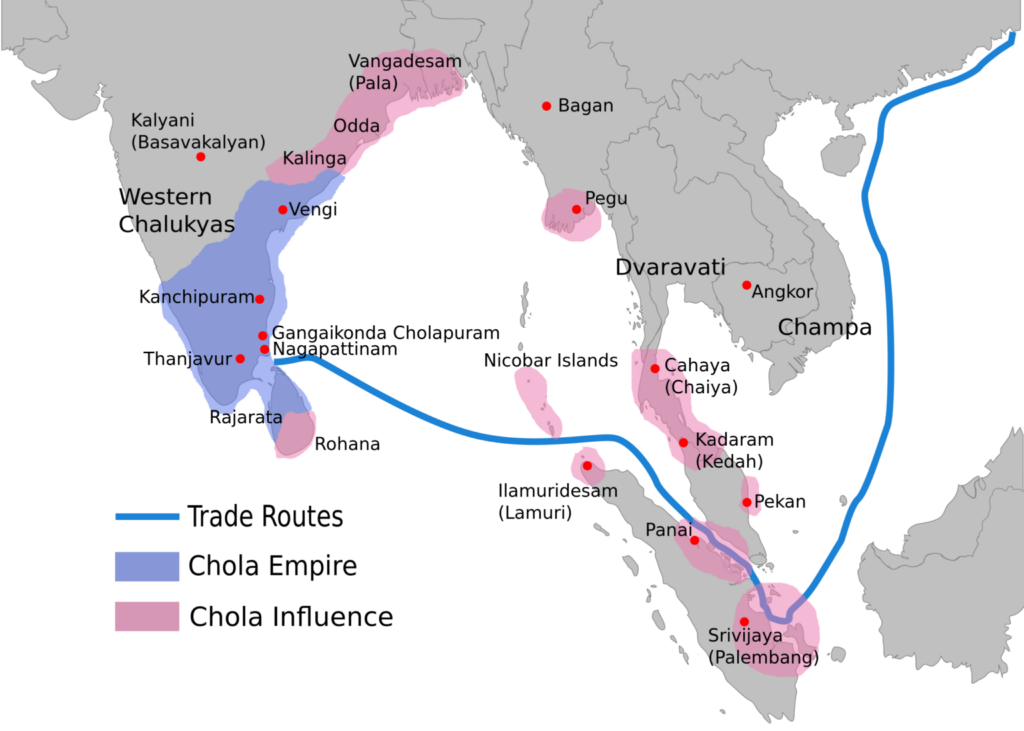
- At its peak, the Chola Empire stretched from the northern parts of Sri Lanka in the south to the Godavari–Krishna river basin in the north, up to the Konkan coast at Bhatkal, the entire Malabar Coast (the Chera country), and included Lakshadweep and the Maldives.
- Rajaraja Chola I was a ruler of inexhaustible energy who applied himself to governance with the same zeal he had shown in waging wars: he integrated his empire into a tight administrative grid under royal control while also strengthening local self-government, and conducted a land survey in 1000 CE to effectively marshal the resources of his empire.
- He also built the Brihadeeswarar Temple in 1010 CE.
- Rajendra Chola I conquered Odisha, and his armies marched further north, defeating the forces of the Pala dynasty of Bengal and reaching the Ganges river in north India.
- Rajendra Chola I built a new capital, Gangaikonda Cholapuram, to commemorate his victories in northern India.
- He successfully invaded the Srivijaya kingdom in Southeast Asia, leading to the decline of that empire.
- He also completed the conquest of the Rajarata kingdom of Sri Lanka and took the Sinhala king Mahinda V prisoner, in addition to his conquests of Rattapadi (territories of the Rashtrakutas), the Chalukya country, Talakkad, and Kolar — where the Kolaramma temple still preserves his portrait statue — in Kannada country.
- Rajendra’s territories included the area falling on the Ganges–Hooghly–Damodar basin, as well as Rajarata of Sri Lanka and the Maldives; the kingdoms along the east coast of India up to the Ganges acknowledged Chola suzerainty.
- Three diplomatic missions were sent to China in 1016, 1033, and 1077.
- The Western Chalukya Empire, under Satyashraya and Someshvara I, repeatedly tried to wriggle out of Chola domination, primarily owing to Chola influence in the Vengi kingdom.
- The Western Chalukyas mounted several unsuccessful attempts to engage the Chola emperors in war; except for a brief occupation of Vengi territories between 1118 and 1126, all their other attempts ended in failure, with successive Chola emperors routing Chalukya armies at various places in many wars.
- Virarajendra Chola defeated Someshvara II of the Western Chalukya Empire and made an alliance with Prince Vikramaditya VI; the Cholas consistently controlled the Chalukyas in the western Deccan by defeating them in war and levying tribute.
- Even under later Chola emperors like Kulothunga I and Vikrama Chola, wars against the Chalukyas were mainly fought in Chalukya territories in Karnataka or in the Telugu country — Vengi, Kakinada, Anantapur, or Gutti. Their former feudatories — the Hoysalas, Yadavas, and Kakatiyas — steadily grew in power and eventually replaced the Chalukyas.
- With the Hoysalas under Vishnuvardhana occupying Dharwar in north-central Karnataka (basing himself there with his son Narasimha I in charge at the Hoysala capital Dwarasamudra, around 1149), and with the Kalachuris occupying the Chalukyan capital for over 35 years from around 1150–1151, the Chalukya kingdom was already beginning to dissolve.
- The Cholas under Kulothunga Chola III hastened the dissolution of the Chalukyas by aiding the Hoysalas under Veera Ballala II (the Chola monarch’s son-in-law), defeating the Western Chalukyas in a series of wars with Someshvara IV between 1185 and 1190.
- The last Chalukya king’s territories did not even include the erstwhile Chalukyan capitals of Badami, Manyakheta, or Kalyani — the final dissolution of Chalukyan power, though the Chalukyas had existed only in name since 1135–1140. The Cholas, by contrast, remained stable until 1215, were absorbed by the Pandyan empire, and ceased to exist by 1279.
- From 1150 to 1280 CE, the Pandyas became the staunchest opponents of the Cholas, striving to win independence for their traditional territories; this period saw constant warfare between the two powers.
- The Cholas also regularly fought the Eastern Gangas of Kalinga; under Chola protection, however, Vengi remained largely independent.
- The Cholas dominated the entire eastern coast with feudatories such as the Telugu Cholas, Velananti Cholas, and Renandu Cholas, who consistently aided the Cholas in their campaigns against the Chalukyas and in levying tribute on the Kannada kingdoms.
- The Cholas also fought constantly with the Sinhala kings of the Rohana kingdom of Sri Lanka, who repeatedly attempted to overthrow Chola occupation of Rajarata and unify the island.
- Until the later Chola king Kulothunga I, the Cholas maintained firm control over the area; in one instance, Rajadhiraja Chola II defeated the Sinhalese, aided by a confederation of five Pandya princes, and retained control of Rajarata.
- His successor, the last great Chola monarch Kulothunga Chola III, reinforced Chola control by quelling further rebellions in the Rajarata area of Sri Lanka and in Madurai; he also defeated Hoysala generals fighting under Veera Ballala II at Karuvur, while continuing to hold traditional territories in the Tamil country, Eastern Gangavadi, Draksharama, Vengi, and Kalinga.
- After defeating Veera Ballala II, Kulothunga Chola III entered into a marital alliance with him through Ballala’s marriage to a Chola princess, which improved relations between the two powers.
Overseas Conquests
- During the reign of Rajaraja Chola I and his successors Rajendra Chola I, Virarajendra Chola, and Kulothunga Chola I, Chola armies invaded Sri Lanka, the Maldives, and parts of Southeast Asia — Malaysia, Indonesia, and southern Thailand — then under the Srivijaya empire, in the 11th century.
- Rajaraja Chola I launched several naval campaigns that resulted in the capture of Sri Lanka, the Maldives, and the Malabar Coast.
- In 1025, Rajendra Chola launched naval raids on the ports of Srivijaya and against the Burmese kingdom of Pegu.
Later Cholas (1070–1279)
- The Later Chola dynasty was led by capable rulers such as Kulothunga Chola I, his son Vikrama Chola, and later successors like Rajaraja Chola II, Rajadhiraja Chola II, and Kulothunga Chola III, who conquered Kalinga, Ilam, and Kataha.
- However, the rule of the Later Cholas between 1218 — starting with Rajaraja Chola II — and the last emperor Rajendra Chola III was not as strong as that of the emperors between 850 and 1215.
- Around 1118, the Later Cholas lost control of Vengi to the Western Chalukyas and of Gangavadi (the southern Mysore districts) to the Hoysala empire.
- These were only temporary setbacks: immediately following the accession of king Vikrama Chola, son and successor of Kulothunga Chola I, the Cholas lost no time in recovering Vengi by defeating Chalukya Someshvara III, and also recovered Gangavadi from the Hoysalas.
- The Chola Empire, though not as strong as it had been between 850 and 1150, remained largely territorially intact under Rajaraja Chola II (1146–1175) — a fact attested by the construction and completion of the third grand Chola architectural marvel, the chariot-shaped Airavatesvara Temple at Dharasuram, on the outskirts of modern Kumbakonam.
- Chola administration and territorial integrity remained stable and prosperous up to 1215 under Kulothunga Chola III, but during his rule itself the decline of Chola power began, following his defeat by Maravarman Sundara Pandiyan II in 1215–16.
- Subsequently, the Cholas also lost control of the island of Lanka and were driven out by the revival of Sinhala power.
- This decline was compounded by the resurgence of the Pandyan dynasty as the most powerful rulers in South India; the lack of a controlling central administration in erstwhile Pandyan territories prompted several claimants to the Pandya throne to spark a civil war, in which the Sinhalas and the Cholas became involved by proxy.
- Details of the Pandyan civil war and the roles played by the Cholas and Sinhalas are recorded in the Mahavamsa as well as the Pallavarayanpettai inscriptions.
Chola Polity and Administration
- The administration under the Cholas was first-rate.
- At the top of the hierarchy stood the emperor or king, typically referred to in Chola inscriptions as Ko (“king”) or Perumal Adigal (“the great one”).
- The Chola throne was hereditary, following the principle that the eldest son of the king should succeed to it; the heir apparent was called the Yuvaraja.
- The early Cholas’ modest titles gave way to more grandiloquent ones — rulers were given opulent names denoting their status, such as Raja-Rajadhiraja and Ko-Konmai-Kondan, both meaning “king of kings.”
- According to the inscriptions, the king was portrayed as a great warrior and conqueror, a defender of Varnadharma, a slayer of the evils of the Kali Age, a generous giver of gifts, a great patron of the arts, and a ruler of beautiful physical appearance.
- Kings were frequently compared to the gods, sometimes directly and sometimes through extended metaphor — Rajaraja, for instance, is referred to as “Ulakalanda Perumal” (“the great one who measured the earth”).
- During this period, the cult of the god-king was accorded proper respect and importance; the worship of dead kings’ images and the construction of temples over their graves provide ample evidence of this.
- In carrying out his duties, the king was supported by a body of officers, or a council of ministers, known as the Udankuttam.
- The priest of the royal family, known as the Raja Guru, was crucial to Chola politics, serving as the king’s temporal and spiritual advisor.
- Inscriptions make it clear that some Chola kings took a personal interest in touring the realm, typically spending the night in temples while on tour — these visits gave kings a chance to stay in touch with the general public and to directly monitor how their officials carried out their duties.
- The Cholas maintained a sophisticated and elaborate administrative bureaucracy comprising officials of various ranks.
- Higher officials enjoyed the status of Perundanam, and lower officials that of Sirudaram; officers were rewarded and encouraged through titles in addition to being paid through land assignments.
- The tiger was the royal emblem of the Chola kings.
Provincial Government
- The Chola empire was divided into principalities (under vassal chiefs) and Mandalams (provinces under viceroys, who were primarily royal princes), with further subdivisions of provinces into Valanadus, Nadus, and villages, for administrative convenience.
- The fundamental administrative unit was the village.
- Towns had their own independent administration: a town was governed by a council known as the Nagarattar and was itself known as a Nagaram.
- The Chola Empire comprised nine provinces, also known as mandalams; the viceroy was the province’s ruler, and viceroys were appointed from among close royal relatives.
- Viceroys remained in constant contact with the central government: the king issued orders to viceroys, who reported back to him regularly, and were assisted in their administrative duties by a large body of officials.
- The existence of Sabhas and assemblies to oversee the administration of these territorial divisions was the most notable aspect of Chola polity.
- There were various assemblies at various levels, including at the Nadu, Kurram, and Grama level; inscriptions occasionally mention the gathering of all the inhabitants of a province.
Divisions of Administration
- The success of Chola administration depended heavily on the smooth operation of its administrative divisions.
- Mandalams were generally named after the original names or titles of Chola kings.
- Each mandalam was subdivided into Kottams or Valanadus; every kottam was further subdivided into Nadus; and each nadu was further subdivided into (Ur) villages, which formed the final administrative unit.
Administration in the Village (Local Self-Government)
- The self-sufficient villages and the administrative structure that controlled them were among the most striking characteristics of South Indian polity; the level of autonomy at the village level was remarkably high by any standard.
- The fundamental tenet of this emerging form of village autonomy was that villagers should run the village themselves; a village assembly was established for this purpose and vested with real power.
Assemblies
- The rural administration of the Chola era was overseen by three types of assemblies — Sabhas, Urs, and Nagarams — and their committees, known as Variyams.
- Ur: a village assembly made up of all socio-economic groups with a stake in the community, or of village residents who paid taxes.
- Sabha: present only in the agrahara or Chaturvedimangalam villages, and solely a Brahmin assembly.
- Nagaram: a gathering of business people; since it primarily served mercantile interests, it was more frequently found in trade centres.
- The Ur and Sabha could occasionally be found in the same village, suggesting that non-Brahmins (the Ur), who held land, were the original villagers in charge, with Brahmins later granted the village as an agrahara.
- In general, all these assemblies — which served as the main legislative bodies of their localities — oversaw shared local issues, assisted by committees with authority over specific spheres of activity.
- The primary source for reconstructing village administration under the Cholas is the Uttaramerur inscriptions, written under the Chola monarch Parantaka I between 919 and 921 CE and found in the Vaikunta Perumal temple at Uttaramerur, in the Chengalput district of Tamil Nadu.
- The conclusion of the two Uttaramerur inscriptions states that new guidelines for the committees were established so that “wicked men might perish while good men might prosper” — implying that village administration had become disorganised owing to dishonest men joining the committees. Because of these corrupt elements, Parantaka I issued the two inscriptions to improve village administration.
- The Uttaramerur inscriptions provide comprehensive information on the composition of committees, the requirements for membership, and the process used to select committee members.
- The first inscription established the procedures for selecting the various committees.
- The second inscription, issued two years later, revised these procedures to address operational issues that had arisen.
- According to the rules of 921 CE, each of a village’s thirty wards was required to nominate candidates who met the following requirements:
- ownership of more than one-fourth Veli (roughly one and a half acres) of land;
- residency in a home built on one’s own site;
- age between 35 and 70; and
- a working understanding of Vedic literature.
- The following individuals were ineligible: those who had served on any committee in the previous three years; those who had served on a committee but failed to submit their financial accounts, along with all their relatives; those who had committed adultery or other serious sins, along with their relatives; and those who had stolen another person’s property.
- One member was to be chosen for each of the thirty wards from among those duly nominated, by Kudavolai (pot ticket, or lot), for a term of one year in the manner specified.
- The committee itself was called the Variyaperumakkal; the Mahasabha was called the Perunguri; and its members were called Perumakkal.
- The assembly typically convened in the village temple, though it would occasionally gather outside, or by the banks of a tank.
- In general, neither royal nor central authority had any influence over the assemblies; officers of the central government did, however, attend meetings when important business was conducted — such as a change in constitutional procedure or in land rights affecting the king’s revenues — though they served only to advise and watch over village affairs, not to administer them.
- The Uttaramerur inscriptions reveal that village committee members were not eligible for a salary or any other form of payment for their services; since the position was honorary, no member was expected to devote more than a portion of his time and effort to it.
- The men in charge of village assemblies and committees were expected to uphold the ideals of sacrifice, duty, and the welfare of the village community.
- The village assembly held more or less sovereign rights, including:
- the authority to levy taxes for village purposes, and to remit taxation in special circumstances;
- the authority to seize the land of those who did not pay land tax;
- the power to resolve local disputes and declare the guilt or innocence of parties involved, even though punishments were handed down by royal officials; and
- charge of local charitable endowments.
Variyams
- Village assemblies effectively managed village administration with the help of Variyams (committees), made up of male members of society; the composition of these committees, and the qualifications and duration of membership, varied from village to village, and every village had a plethora of them.
- The Thottavariyam looked after flower gardens, while the Niyaya variyam administered justice.
- The Dharma variyam was in charge of charities and temples, while the Erivariyam was in charge of water tanks and supply.
- Finances were overseen by the Pon variyam, and the Gramakariya variyam was in charge of overseeing the work of all the committees.
- Members of these variyams were called Variyaperumakkal and performed honourable service; village officials were paid either in cash or in kind.
- The effectiveness of these variyams increased the overall efficiency of Chola local administration.
Agricultural Organization and Fiscal Policy
- Like all South Indian kingdoms, the Chola kingdom was founded on agriculture, and land revenue was the main source of income.
- The Chola kings took considerable interest in the advancement of irrigation and agricultural infrastructure; kings and feudatories frequently engaged in the reclamation of waste land and the clearing of forests.
- The existence of a permanent method of assessing land tax is indicated by systematic land surveys conducted at regular intervals; in this context, peasants and workers were grossly exploited.
- The tax could be paid in kind or in cash, and by most estimates represented one-third of the produce — high by any measure.
- The state also imposed a number of taxes in addition to land tax: animals, pasture lands, roads, oil refineries, forests, salt, and different professions and markets were all subject to taxation.
- Other sources of state income included judicial fines; intriguingly, a death duty was also levied during this period.
Military Management
- The Chola regular army was made up of elephants, cavalry, infantry, and a navy; inscriptions list up to 70 regiments, with names derived from royal titles.
- Considerable attention was paid to their training, discipline, and the so-called Kadagam cantonments; the Chola army maintained some 60,000 elephants, and expensive Arabian horses were imported to strengthen the cavalry.
- The Cholas typically maintained two types of soldiers: the Kaikkolar, royal troops paid regularly by the treasury, and the Nattuppadai, militia used only for local defence.
- The Velaikkarars were the most dependable soldiers in royal service within the Kaikkolar, prepared to defend the king and his cause with their lives; the Cholas gave their navy special attention.
- There were also regiments of bowmen and swordsmen, the swordsmen being the most permanent and dependable troops; the Chola army was spread across the country and stationed in local garrisons or military camps known as Kadagams.
- The Chola rulers built several palaces and fortifications to protect their cities, mostly of brick, though other materials such as stone, wood, and mud were also used.
- According to the ancient Tamil text Silappadikaram, Tamil kings defended their forts with catapults that hurled stones, huge cauldrons of boiling water or molten lead, and hooks, chains, and traps.
- The Kallar served in the armies of the Chola kings, and a martial art called Silambam was patronised by the Chola rulers.
- Ancient and medieval Tamil texts mention different forms of martial tradition, but the ultimate expression of a warrior’s loyalty to his commander was a form of martial suicide called Navakandam.
- The medieval Kalingathu Parani text, which celebrates the victory of Kulothunga Chola I and his general in the battle for Kalinga, describes the practice in detail.
- Ancient and medieval Tamil texts mention different forms of martial tradition, but the ultimate expression of a warrior’s loyalty to his commander was a form of martial suicide called Navakandam.


Detailed and Minute details of Chola Empire It will be very much helpful for students who prepare for Competitive Exams
Keep it up such Good work
Deadly diagnosis