Conflict in Middle East

The Middle East has been one of the world’s most troubled regions since 1945, with wars and civil wars raging almost non-stop. At the heart of this instability lies the Arab-Israeli conflict, layered over decades of great-power interference, competing visions of Arab unity, and the region’s immense strategic and oil wealth. This article traces the roots of Arab unity and foreign intervention in the Middle East, followed by the complete arc of the Arab-Israeli conflict — from the creation of Israel in 1948 to the Oslo Accords of 1993.
Overview of the Middle East Region
- The Middle East consists of Egypt, Sudan, Jordan, Syria, Lebanon, Iraq, Saudi Arabia, Kuwait, Iran, Turkey, the Yemen republics, the United Arab Emirates, and Oman.
- Most of these states, except Turkey and Iran, are peopled by Arabs; Iran, though not an Arab state, contains many Arabs living around the northern end of the Persian Gulf.
- The region also contains the small Jewish state of Israel, set up by the United Nations in 1948 in Palestine.
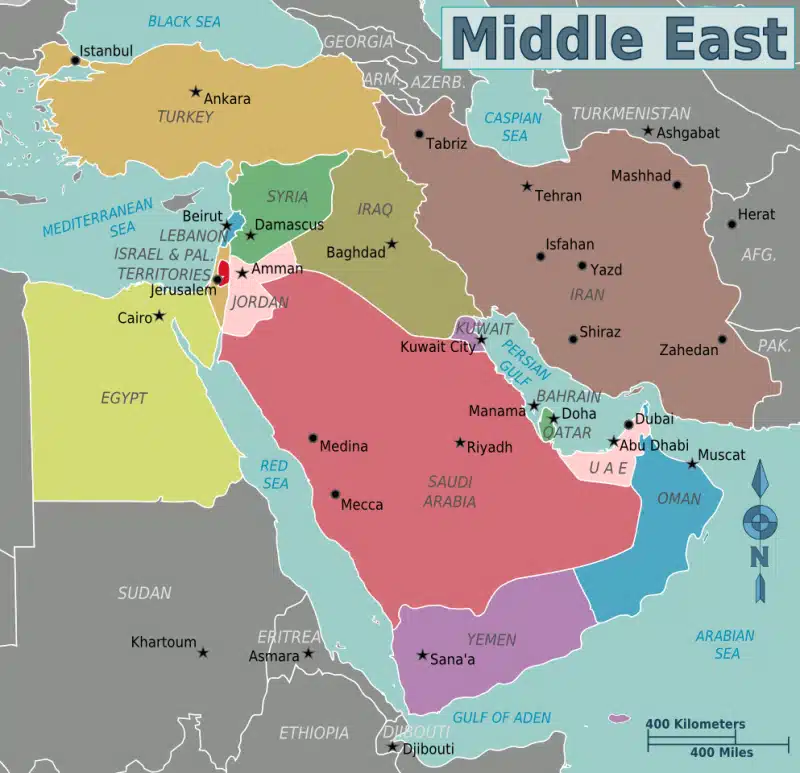
- Its creation, on land the Palestinian Arabs regarded as their own, outraged Arab opinion worldwide (other Arab states outside the Middle East include Morocco, Algeria, Tunisia, and Libya).
- The Arabs blamed Britain for favouring the Jews over the Arabs, and blamed the USA even more strongly for its firm support of a Jewish state.
- The Arab states refused to recognise Israel and vowed to destroy it. Four short wars followed — 1948–9, 1956, 1967, and 1973 — but Arab attacks failed each time, and Israel survived, while the underlying Israeli-Palestinian conflict remained unresolved.
- The Arab desire to destroy Israel tended to overshadow all else, but two further themes ran through Middle East affairs alongside it:
- the desire of some Arabs to achieve political and economic unity among Arab states, and
- the desire of many Arabs to end foreign intervention in their countries.
- The region’s strategic location and rich oil resources drew close attention from both Western and communist powers, alongside several conflicts involving individual Arab states:
- a civil war in Lebanon lasting nearly 15 years from 1975;
- the Iran-Iraq War, from 1980 to 1988; and
- the First Gulf War (1990–1), in which Iraqi troops invaded Kuwait and were driven out by a US-led international coalition.
- Interpretations of the Middle East situation vary sharply depending on perspective — for instance, many British politicians and journalists regarded Colonel Nasser (Egyptian leader, 1954–70) as a dangerous fanatic comparable to Hitler, while most Arabs saw him as a hero and the symbol of the Arab people’s drive towards unity and freedom.
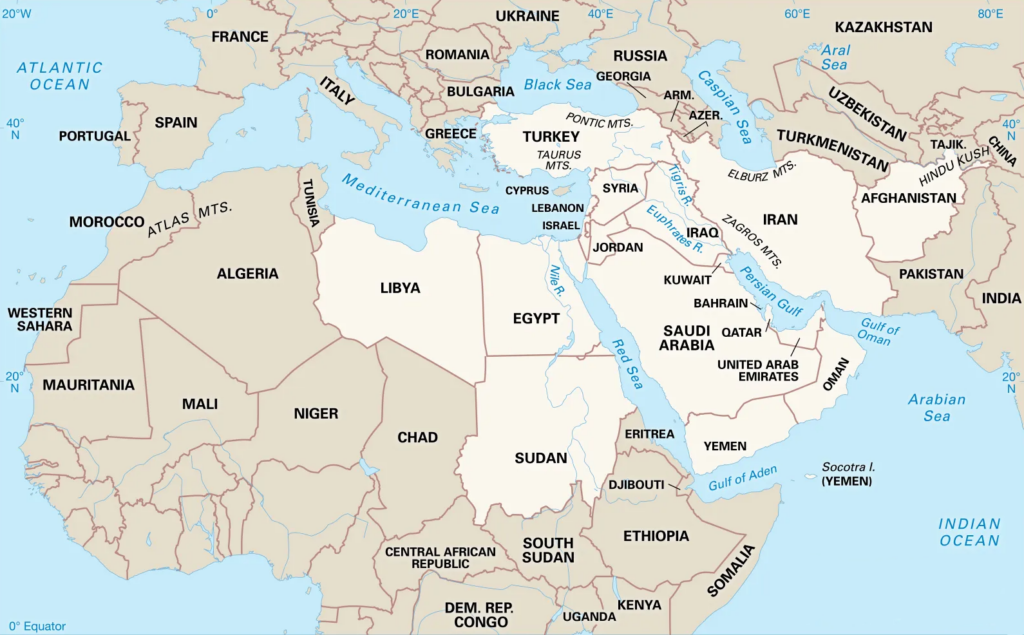
Arab Unity and Interference from the Outside World
What Arabs Have in Common
- Arabs share the Arabic language and are nearly all Muslim, except for roughly half the population of Lebanon, who are Christian.
- Most Arabs wanted to see Israel destroyed so that Palestinian Arabs could reclaim land they considered rightfully theirs, and many wanted Arab unity to develop into a full political and economic union, comparable to the European Community.
- As early as 1931, an Islamic conference in Jerusalem declared: “The Arab lands are a complete and indivisible whole … all efforts are to be directed towards their complete independence, in their entirety and unified.”
Attempts at Arab Unity
- The Arab League, founded in 1945, initially included Egypt, Syria, Jordan, Iraq, Lebanon, Saudi Arabia, and Yemen; membership later expanded to 20 states by 1980. However, it achieved little politically and was constantly hampered by internal disputes.
- Arab unity — sometimes called pan-Arabism — received a major boost in the mid-1950s under the energetic leadership of Colonel Gamal Abdel Nasser of Egypt, who gained enormous prestige after the 1956 Suez Crisis.
- In 1958, Syria joined Egypt to form the United Arab Republic, with Nasser as president, but Syria withdrew in 1961, resenting Nasser’s attempts to dominate the union.
- After Nasser’s death in 1970, his successor President Sadat organised a loose union between Egypt, Libya, and Syria, known as the Federation of Arab Republics, though it never amounted to much.
Why Arab Unity Remained Elusive
- Jordan and Saudi Arabia, ruled by conservative royal families, were often criticised as too pro-British by Egypt and Syria, whose governments were pro-Arab-nationalist and socialist.
- The other Arab states fell out with Egypt in 1979 after it signed a separate peace treaty with Israel, leading to Egypt’s expulsion from the Arab League.
Interference in the Middle East by Outside Powers
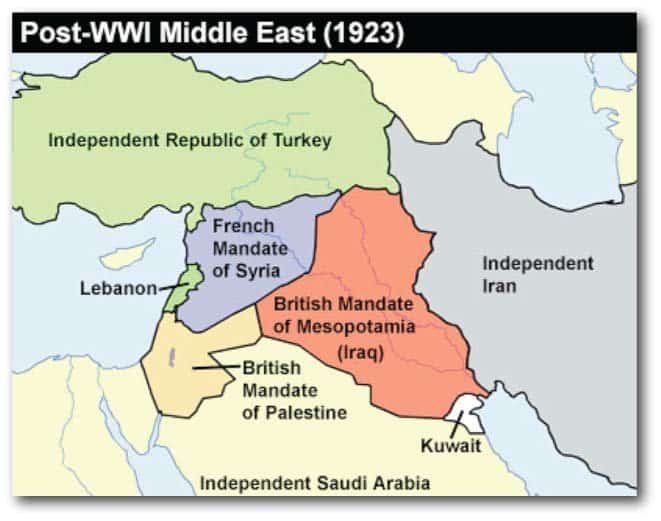
The British and French Legacy
- British and French involvement in the Middle East stretched back many years.
- Britain ruled Egypt from 1882 (following a British invasion) until 1922, when Egypt was granted semi-independence under its own king — though British troops remained, and Egypt still had to accommodate British wishes.
- Under the Versailles settlement at the end of the First World War, Britain and France took over large areas of the former Ottoman Middle East as mandates.
- Britain granted independence to Iraq (1932) and Jordan (1946), though both remained pro-British; France granted independence to Syria and Lebanon (1945), while still hoping to retain influence in the region.
Strategic and Economic Stakes
- The Middle East held immense strategic importance, acting as a crossroads between the Western nations, the communist bloc, and the Third World countries of Africa and Asia.
- At one point, the region produced over a third of the world’s oil supply, led by Iran, Iraq, Saudi Arabia, and Kuwait.
- Before North Sea oil and nuclear power became available, European nations depended heavily on Middle Eastern oil and sought to keep friendly governments in power in the oil-producing states.
Lack of Arab Unity Invited Outside Intervention
- Most Arab states had nationalist governments that bitterly resented Western influence. One by one, governments seen as too pro-West were swept away and replaced by regimes seeking non-alignment — freedom to act independently of both the Communist East and the West.
Country Profiles
- Egypt:
- British troops remained in the Suez Canal zone after the Second World War, protecting Britain’s and France’s majority shareholding in the canal.
- In 1952, a group of army officers overthrew King Farouk, seizing power themselves; by 1954, Colonel Nasser had become president.
- Nasser’s defiance of Britain led directly to the Suez War of 1956, a complete humiliation for Britain that ended British influence in Egypt.
- Jordan:
- King Abdullah, installed by the British in 1946, was assassinated in 1951 by nationalists who felt he was too subservient to Britain.
- His successor, King Hussein, ended the treaty allowing British bases in Jordan in 1957, after which all British troops withdrew.
- Iraq:
- King Faisal and his prime minister, Nuri-es-Said, were pro-British; in 1955, they signed the Baghdad Pact with Turkey for a joint defence and economic policy, later joined by Pakistan, Iran, and Britain.
- Britain’s humiliation in the 1956 Suez War emboldened Iraq’s anti-British movement: Faisal and Nuri-es-Said were murdered, Iraq became a republic in 1958, and the new government withdrew from the Baghdad Pact — marking the end of Britain’s major role in Arab affairs.
- Iran:
- Iran was the only Middle Eastern state bordering the USSR; in 1945, the Russians attempted to set up a communist government in Iran’s north, where a large, active communist party existed.
- The Western-educated Shah, Reza Pahlevi, resisted the Russians and signed a defence treaty with the USA in 1950, receiving economic and military aid, including tanks and jet fighters — a move Washington saw as part of the wider Cold War effort to block communist advances.
- A strong nationalist movement in Iran resented all foreign influence, including Britain’s majority shareholding in the Anglo-Iranian Oil Company and its Abadan refinery.
- In 1951, Premier Dr Mussadiq nationalised the company; a British-led boycott of Iranian oil exports forced his resignation, and a 1954 compromise gave British Petroleum 40% of the shares while Iran retained 50% of the profits, which the Shah used for cautious modernisation and land reform.
- This was not enough for the left or devout Muslims, who resented the Shah’s close ties to the USA and suspected he was diverting national wealth into his private fortune. He was forced to leave the country in January 1979, and an Islamic republic was established under Ayatollah Khomeini, who — like Nasser — wanted his country to be non-aligned.
Arab-Israel Conflict
The Creation of Israel and the War of 1948–9
Origins of the Problem
- The roots of the conflict stretch back to AD 71, when the Romans drove most Jews out of Palestine, their historic homeland; small communities remained, and a gradual trickle of Jews returned over the following 1,700 years. Until the late 19th century, however, their numbers were too small to alarm the Arabs who by then regarded Palestine as their own homeland.
- In 1897, European Jews founded the World Zionist Organization in Basle, Switzerland. Zionists believed Jews should be able to return to Palestine and establish a national homeland — a Jewish state — partly as a safe refuge from the persecution Jews had recently suffered in Russia, France, and Germany. This alarmed the Arab population already inhabiting Palestine.
- Britain became involved in 1917, when Foreign Minister Arthur Balfour announced British support for a Jewish national home in Palestine — the Balfour Declaration.
- After 1919, when Palestine became a British mandate, large numbers of Jews began arriving, prompting Arab protests demanding an independent Palestine and an end to Jewish immigration.
- The British government stated in 1922 that it had no intention of allowing Jews to occupy the whole of Palestine, and Balfour himself had pledged that “nothing shall be done which may prejudice the civil and religious rights of the existing non-Jewish communities in Palestine.” Britain, however, failed to grasp the depth of the religious divide between the two communities and ultimately failed to honour this promise.
- Nazi persecution after 1933 sent a flood of Jewish refugees to Palestine; by 1940, about half the population was Jewish.
- From 1936, violent Arab protests and an uprising were suppressed by the British with considerable brutality, killing over 3,000 Arabs.
- The 1937 Peel Commission proposed partitioning Palestine into separate Arab and Jewish states, which the Arabs rejected; a 1939 British offer of an independent Arab state within ten years, coupled with capping Jewish immigration at 10,000 a year, was in turn rejected by the Jews.
- The Second World War worsened the crisis, with hundreds of thousands of Jewish refugees from Hitler’s Europe seeking somewhere to go.
- In 1945, the USA pressed Britain to admit 100,000 Jews into Palestine — a demand echoed by Jewish leader David Ben Gurion — but Britain refused, unwilling to further alienate the Arabs.
- Jewish groups launched a terrorist campaign against both Arabs and the British, including the bombing of the King David Hotel in Jerusalem (the British headquarters), killing 91 people. Britain responded by arresting Jewish leaders and turning back immigrant ships such as the Exodus.
- Weakened by the strain of the war, Britain’s Labour foreign secretary Ernest Bevin referred the problem to the United Nations, which voted in November 1947 to partition Palestine, setting aside roughly half for an independent Jewish state.
- Early in 1948, Britain withdrew its troops entirely, leaving the UN to implement its own plan even as fighting had already broken out between Jews and Arabs.
- In May 1948, Ben Gurion declared the independence of the State of Israel, which was immediately attacked by Egypt, Syria, Jordan, Iraq, and Lebanon.
Who Was to Blame?
- Much of the world blamed Britain for the chaos, with critics arguing British troops should have stayed to ensure a smooth partition. The Arabs accused Britain of favouring the Jews; the Jews accused Britain of favouring the Arabs.
- Bevin blamed the USA, and the evidence lends him some support: President Truman pressured Britain to admit 100,000 extra Jews in April 1946, yet refused to send American troops to keep order or admit more Jews into the USA itself. Truman also rejected the British Morrison Plan (July 1946) for separate Arab and Jewish provinces under British supervision, and pushed the partition plan through the UN despite unanimous Arab opposition.
- Some historians defend Britain, arguing it tried to be fair to both sides in an ultimately irreconcilable situation, and that withdrawal shifted responsibility — and cost, after Britain had already spent over £100 million since 1945 trying to keep the peace — onto the Americans and the UN.
The War and Its Outcome
- Against expectations, Israel decisively defeated the invading Arab states, capturing even more territory than the UN partition had allotted — roughly three-quarters of Palestine plus the Egyptian port of Eilat.
- Israeli success owed much to troops experienced from fighting in the British army during the Second World War (some 30,000 Jewish volunteers), against Arab states that were divided and poorly equipped, and Palestinian forces demoralised and organisationally weakened by the British suppression of the 1936–9 uprisings.
- The war’s most tragic outcome was the plight of the Palestinian Arabs, who lost three-quarters of their homeland: some came under Israeli rule, others fell under Jordanian control in the area known as the West Bank, and nearly a million fled into Egypt, Lebanon, Jordan, and Syria as refugees. Jerusalem itself was divided between Israel and Jordan.
- Although the USA, Britain, and France guaranteed Israel’s frontiers, the Arab states never accepted the ceasefire as permanent, viewing the war only as the first round in an ongoing struggle to destroy Israel and liberate Palestine.
The Suez War of 1956
Who Was to Blame?
- Blame depended heavily on perspective: the Arabs blamed Israel for initiating hostilities by invading Egypt; the communist bloc and many Arab states blamed Britain and France for imperialist aggression, accusing the Americans of encouraging the attack; Britain, France, and Israel in turn blamed Colonel Nasser for his anti-Western stance — though even the Americans felt Britain and France had overreacted by resorting to force.
Nasser’s Actions Leading to War
- Nasser was aggressively committed to Arab unity, independence, and the liberation of Palestine, and repeatedly antagonised the British, Americans, and French:
- He organised fedayeen (“self-sacrificers”) guerrillas to carry out sabotage inside Israel, and Egyptian ships blockaded the Gulf of Aqaba, cutting access to the Israeli port of Eilat.
- He refused to renew Britain’s 1936 treaty rights to keep troops at Suez, demanded immediate British withdrawal, aided the Algerian resistance against France, opposed the British-sponsored Baghdad Pact, and pressured King Hussein of Jordan into dismissing his British army chief of staff.
- He signed an arms deal with Czechoslovakia (September 1955) for Soviet-bloc fighters, bombers, and tanks, with Russian military advisers training the Egyptian army — a move that outraged Washington, since it broke Western control over arms supplies to Egypt and drew Egypt firmly into Cold War calculations.
- In response, the USA cancelled a promised $46 million grant toward Egypt’s Aswan Dam (July 1956), intending to force Nasser to abandon his Soviet ties. Nasser retaliated by nationalising the Suez Canal, promising compensation to shareholders — most of whom were British and French — to fund the dam instead.
Britain’s Response
- Anthony Eden, the British prime minister, viewed Nasser as building a united, communist-leaning Arabia capable of cutting off Europe’s oil supply, comparing him to Hitler or Mussolini — a view Churchill echoed with his remark, “We can’t have this malicious swine sitting across our communications,” and which the new Labour leader Hugh Gaitskell also endorsed, warning against appeasing Nasser as Hitler and Mussolini had once been appeased.
- This view largely ignored that Nasser had offered compensation to shareholders and pledged that ships of all nations except Israel could continue using the canal.
- Secret talks between Britain, France, and Israel produced a collusion plan: Israel would invade Egypt across Sinai, giving Britain and France a pretext to occupy the canal zone “to protect it,” restoring Anglo-French control and, it was hoped, toppling Nasser.
- Later research suggests the war may have been avoidable — Eden had in fact favoured a peaceful removal of Nasser through the secret Anglo-American Omega Plan and, in mid-October 1956, remained open to continued talks, having called off the military option.
- Eden ultimately faced pressure from MI6, cabinet figures including Harold Macmillan (who assured him the USA would not oppose British force), and especially the French government, which pushed him toward the joint military operation with France and Israel.
Events of the War
- The war began with Israel’s invasion of Egypt on 29 October, a rapid success that captured the entire Sinai peninsula within a week, while British and French forces bombed Egyptian airfields and landed troops at Port Said.
- The attacks provoked worldwide outcry. The Americans, wary of pushing the Arab world closer to the USSR, withdrew their earlier hints of support, and at the UN, the USA and USSR jointly demanded an immediate ceasefire and the deployment of a UN force.
- Facing overwhelming international pressure, Britain, France, and Israel agreed to withdraw, and UN troops moved in to police the Egypt-Israel frontier.
Outcome
- The war was a complete humiliation for Britain and France, who achieved none of their objectives, and a triumph for Nasser, whose prestige as the leader of Arab nationalism against European interference grew enormously.
- Egypt blocked the canal; Arab states cut oil supplies to Western Europe, forcing petrol rationing for a time; and Soviet aid replaced American aid to Egypt.
- Britain’s action cost it its ally in Iraq — Nuri-es-Said, who faced growing Arab criticism for his pro-British stance and was murdered in 1958 — and left Britain unable to pursue an independent foreign policy from the USA.
- Algeria’s independence struggle against France was encouraged by the episode, achieving success in 1962.
- Israel, though forced to return all captured Egyptian territory, had inflicted heavy losses on Egypt’s forces, gaining a temporary halt in fedayeen raids and a breathing space to consolidate; following Britain’s humiliation, Israel increasingly looked to the USA as its principal supporter.
The Six-Day War of 1967
Build-up to War
- With no peace treaty signed after 1948–9 and Israel still denied recognition, Iraq, Syria, and Egypt led a renewed Arab attempt to destroy Israel in 1967.
- In Iraq, a Ba’ath Party-influenced government came to power in 1963; its president, Aref, declared in June 1967, “Our goal is clear — to wipe Israel off the map.”
- In Syria, the Ba’ath Party took power in 1966 and backed El Fatah, the more effective successor to the fedayeen, founded in 1957. Fatah later became the core of the Palestine Liberation Organization (PLO) under Yasser Arafat. Syria also began shelling Jewish settlements from the Golan Heights.
- In Egypt, Nasser remained immensely popular through his socialist reforms — including capping farm sizes at 100 acres, redistributing land to peasants, and building over a thousand government-run factories. The Aswan Dam, completed in 1971, promised electricity and irrigation for an extra million acres. Confident of support from Iraq and Syria, Nasser moved troops into Sinai and closed the Gulf of Aqaba.
- The USSR encouraged Egypt and Syria with anti-Israeli propaganda, hoping to expand its regional influence at American and Israeli expense, and hinted at military support if war broke out.
- Syria, Jordan, and Lebanon massed troops on their frontiers with Israel, joined by contingents from Iraq, Saudi Arabia, and Algeria, leaving Israel’s position appearing precarious.
- Judging a pre-emptive strike the best option, Israel launched devastating air strikes on 5 June, destroying most of the Egyptian air force on the ground.
- Israeli forces advanced with remarkable speed, capturing the Gaza Strip and all of Sinai from Egypt, East Jerusalem and the West Bank from Jordan, and the Golan Heights from Syria, forcing the Arabs to accept a UN ceasefire on 10 June — the entire war lasted less than a week.
- Israel’s rapid success owed much to the slow, ponderous Arab troop build-up (which gave Israel ample warning), Israeli air superiority, and poor Arab preparation and coordination.
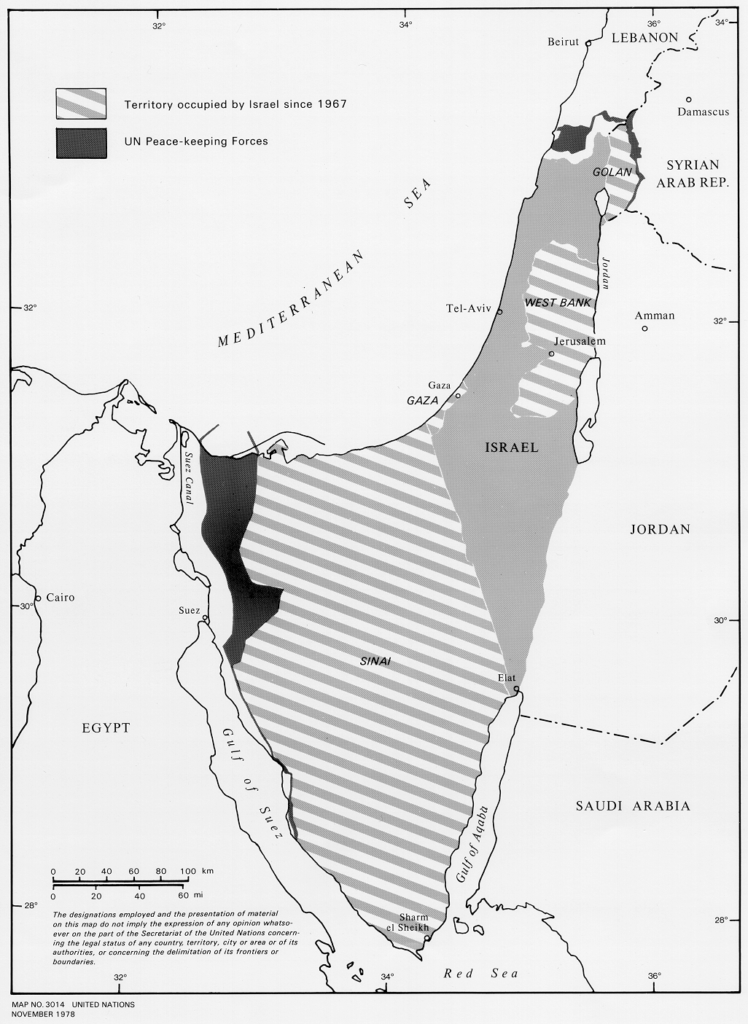
Results of the War
- For Israel, the outcome was a spectacular success: this time it ignored UN calls to return captured territory, retaining it as a buffer zone that made Israel considerably easier to defend.
- This came with a new challenge — governing roughly a million additional Arabs, many already living in refugee camps established in 1948, who now fell under Israeli rule in the West Bank and Gaza Strip.
- The defeat was a severe humiliation for the Arab states and especially for Nasser, who realised the Arabs would need outside help to liberate Palestine. Disappointed that the USSR had sent no direct assistance, the Soviets began resupplying Egypt and Syria with modern weapons to repair relations — setting the stage for the next round of conflict in 1973.
The Yom Kippur War of 1973
Events Leading Up to the War
- Pressure from the PLO under Yasser Arafat for further action, combined with the more extreme Popular Front for the Liberation of Palestine (PFLP), produced a wave of terrorist attacks, including the hijacking of three airliners flown to Amman and blown up in 1970 — an embarrassment for King Hussein, who now favoured negotiated peace and expelled the PLO from Jordan in September 1970.
- Terrorist attacks continued, culminating in the killing of Israeli athletes at the 1972 Munich Olympics.
- Anwar Sadat, Egypt’s president since Nasser’s death in 1970, increasingly favoured a negotiated settlement with Israel, worried that PLO terrorism was damaging the Palestinian cause internationally. He hoped for American support to pressure Israel toward peace, but Washington declined to get involved.
- Sadat, together with Syria, decided instead to attack Israel again — hoping this would force the USA into the role of mediator — buoyed by confidence from newly supplied Russian weapons and Russian-trained forces.
The War
- Egyptian and Syrian forces attacked on 6 October 1973, the Jewish festival of Yom Kippur, catching Israel off guard.
- After early Arab gains, Israel — using mainly American weapons — turned the tide, retaining all territory captured in 1967 and even crossing the Suez Canal into Egypt.
- Sadat’s underlying goal was partly achieved: both the USA and USSR intervened to broker a UN-backed ceasefire, which both sides accepted.
Outcome
- The war’s end brought a glimmer of hope for lasting peace, with Egyptian and Israeli leaders meeting (albeit not directly) in Geneva. Israel agreed to withdraw from the Suez Canal, enabling Egypt to reopen it in 1975 — though not to Israeli shipping.
- Arab oil-producing states pressured the USA and pro-Israel Western European states by cutting oil supplies, causing serious shortages, especially in Europe.
- The Organization of Petroleum Exporting Countries (OPEC) used this moment to raise oil prices substantially, contributing to global inflation and a broader energy crisis in industrialised nations.
Camp David and the Egypt-Israel Peace, 1978–9
Why the Two Sides Began Talking
- Sadat had become convinced that force could never destroy Israel and that further wars would only waste Egypt’s resources, but engaging with Israel directly — implicitly recognising its lawful existence — required great political courage, given fierce likely opposition from the PLO and states like Iraq and Syria. He nonetheless offered to visit Israel and address the Knesset.
- Israel, facing economic strain from heavy defence spending and a global recession, and under US pressure to settle with at least some Arab states, accepted. Sadat visited Israel in November 1977, and Israeli prime minister Menachem Begin visited Egypt the following month.
- President Carter of the USA played a decisive mediating role, hosting formal negotiations beginning September 1978 at Camp David.
The Peace Treaty and Its Aftermath
- With Carter as intermediary, a peace treaty was signed in Washington in March 1979, with the main terms being:
- the state of war between Egypt and Israel since 1948 was formally ended;
- Israel would withdraw its troops from Sinai;
- Egypt would not attack Israel again and would supply her with oil from newly opened wells in southern Sinai; and
- Israeli ships would be permitted to use the Suez Canal.
- The treaty was condemned by the PLO and most Arab states, except Sudan and Morocco, leaving Egypt diplomatically isolated and treaties with Syria and Jordan still far off. World opinion began shifting toward recognising the PLO’s grievances, though Israel resisted US efforts to bring the PLO into international talks.
- In November 1980, Begin declared Israel would never return the Golan Heights to Syria or allow the West Bank to become part of an independent Palestinian state, calling it a mortal threat to Israel’s existence — even as resentment grew among West Bank Arabs over expanding Jewish settlements, raising fears of renewed violence.
- Peace was further threatened when Sadat was assassinated in October 1981 by extremist soldiers who viewed his deal with Israel as a betrayal; his successor, Hosni Mubarak, nonetheless committed to continuing the Camp David agreement.
- Through much of the 1980s, the Arab-Israeli feud was overshadowed by the Iran-Iraq War. From December 1987, however, mass Palestinian demonstrations in the Gaza Strip and West Bank grew into the intifada (“shaking off”) — a sustained campaign of civil disobedience, including strikes and boycotts of Israeli products. An Israeli crackdown failed to suppress the uprising, which lasted over three years and drew international condemnation of Israel’s methods.
Peace between Israel and the PLO
- The election of a less hawkish Labour government in Israel in June 1992, under Prime Minister Yitzhak Rabin and Foreign Minister Shimon Peres, opened the door to renewed negotiations, and Yasser Arafat responded positively.
The Oslo Accords, September 1993
- Negotiated at a conference in Oslo, the accord established that:
- Israel formally recognised the PLO;
- the PLO recognised Israel’s right to exist and renounced terrorism; and
- Palestinians would receive limited self-rule in Jericho (West Bank) and part of the Gaza Strip, with Israeli troops withdrawing from these areas.
- The agreement faced opposition from extremists on both sides — the PFLP continued demanding full Palestinian statehood, while Israeli settlers on the West Bank opposed any concessions to the PLO.
- Despite this, moderate leaders on both sides — notably Yossi Beilin, Israel’s deputy foreign minister, and Mahmoud Abbas (“Abu Mazen”), one of Arafat’s key advisers — showed considerable courage in pushing the process forward, laying the groundwork for further steps beyond the Oslo Accords in the years that followed.