Nationalism and State-Building in Italy

The unification of Italy (Risorgimento) is one of the classic case studies in the UPSC History Optional syllabus on 19th-century European nationalism. For centuries, the Italian peninsula remained a politically fragmented mosaic of kingdoms, duchies, and papal territories, with Austria exercising decisive control over its richest provinces. The French Revolution and Napoleon first planted the seeds of a shared Italian identity, but it was the Congress of Vienna (1815) that forced Italy back into its old, disunited order. Over the following decades, secret societies like the Carbonari, radical thinkers like Giuseppe Mazzini, and soldier-patriots like Giuseppe Garibaldi kept the flame of Italian nationalism alive through repeated failed uprisings, culminating in the ambitious but short-lived Revolutions of 1848–49. This article traces the evolution of nationalism and state-building in Italy from the fall of Napoleon to the emergence of Piedmont-Sardinia as the nucleus of a future united Italy — laying the essential background for understanding the final unification achieved under Cavour in the 1860s.
Background
- For many centuries, the Italian peninsula remained a politically fragmented conglomeration of independent states.
- When war broke out between Austria and the Revolutionary French Government in 1792, the French invaded the Italian peninsula, consolidated many of the Italian states, and established them as republics.
- In 1799, the Austrian and Russian armies pushed the French out of the peninsula, leading to the collapse of these fledgling republics.
French Invasion and the Rise of Nationalism
- After Napoleon’s rise to power, the Italian peninsula was once again conquered by the French, who divided it into three entities:
- Northern parts — Piedmont, Liguria, Parma, Piacenza, Tuscany, and Rome — were annexed directly to the French Empire.
- The newly created Kingdom of Italy, comprising Lombardy, Venice, Reggio, Modena, Romagna, and the Marches, ruled by Napoleon himself.
- The Kingdom of Naples, first ruled by Napoleon’s brother Joseph Bonaparte, before passing to Napoleon’s brother-in-law.
- The period of French invasion and occupation proved significant in several ways:
- French ideas crossed the Alps into Italy along with French soldiers, and the Napoleonic regime infused new life into a long-devitalised Italy.
- The invasion introduced revolutionary ideas about government and society, overthrowing the old ruling orders and destroying the last vestiges of feudalism.
- The ideals of freedom and equality proved highly influential, and the very concept of nationalism was introduced — sowing the seeds of Italian nationalism across the peninsula.
- For a time, Italians experienced a genuine sense of national unity, making it all the more disappointing when the Congress of Vienna forced them back into the Old Regime.
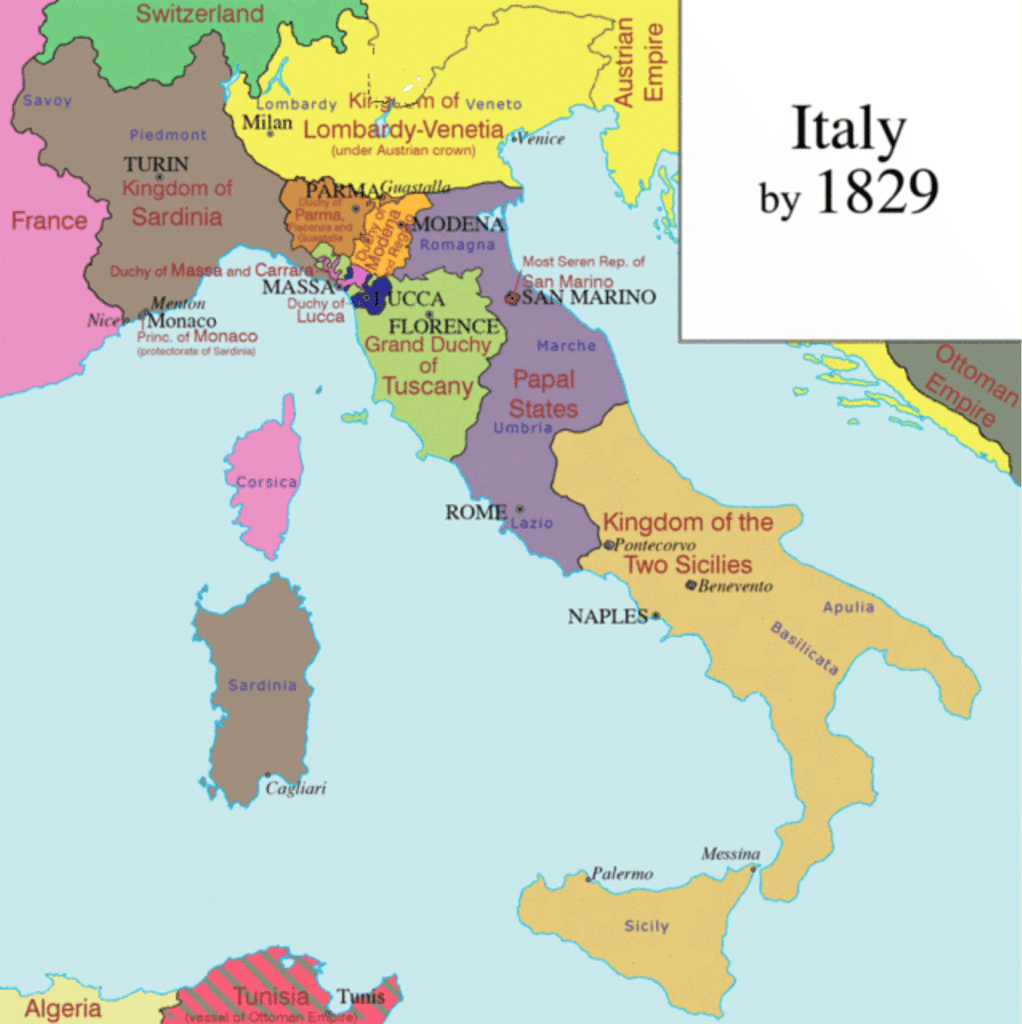
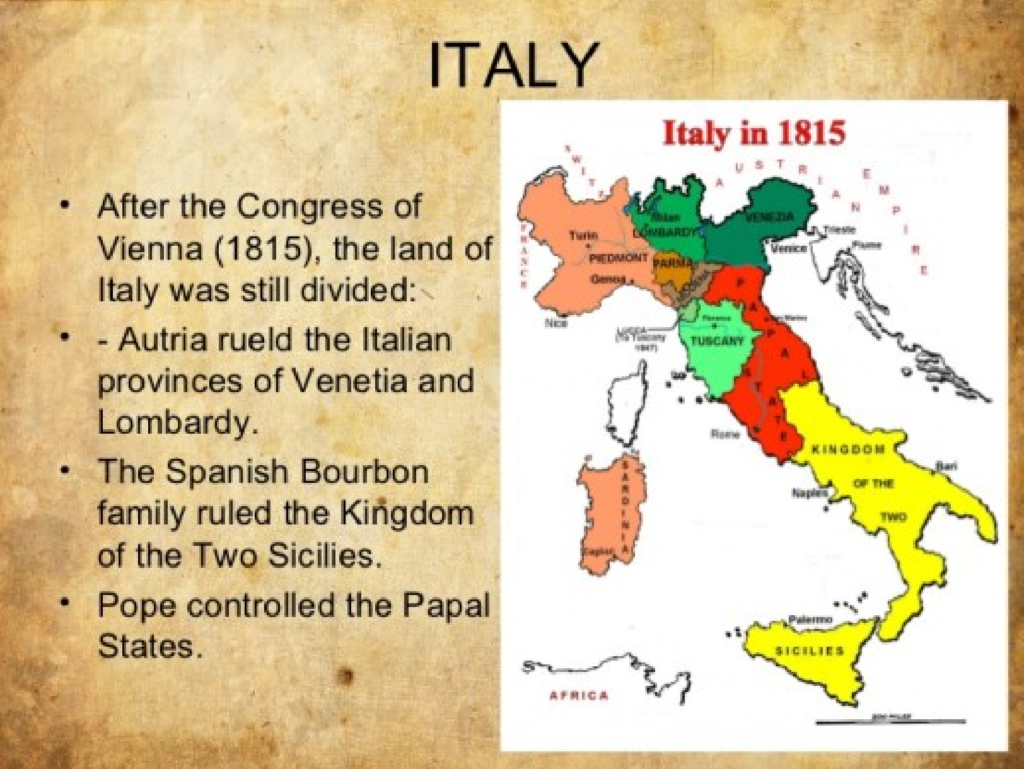
Italy from 1815 to 1850
Reconstitution Under the Congress of Vienna
- Following the defeat of Napoleonic France, the Congress of Vienna (1815) was convened to redraw the map of Europe.
- In Italy, the Congress restored the pre-Napoleonic patchwork of independent governments, either directly ruled or heavily influenced by the major European powers — particularly Austria.
- It was in Italy that the principles of legitimacy and balance of power, central to the Vienna settlement, found their greatest scope.
- Of the 8 states into which Italy was divided, only the Kingdom of Piedmont-Sardinia had a native Italian ruler.
- Habsburg princes (connected to the Austrian royal house) were re-established in Parma, Modena, and Tuscany.
- The Papal States were restored to the Pope.
- Bourbon rule was restored in the Kingdom of the Two Sicilies, formed by fusing the old Kingdom of Naples and Kingdom of Sicily.
- Genoa was joined to Piedmont, to bar the coastal route to the French.
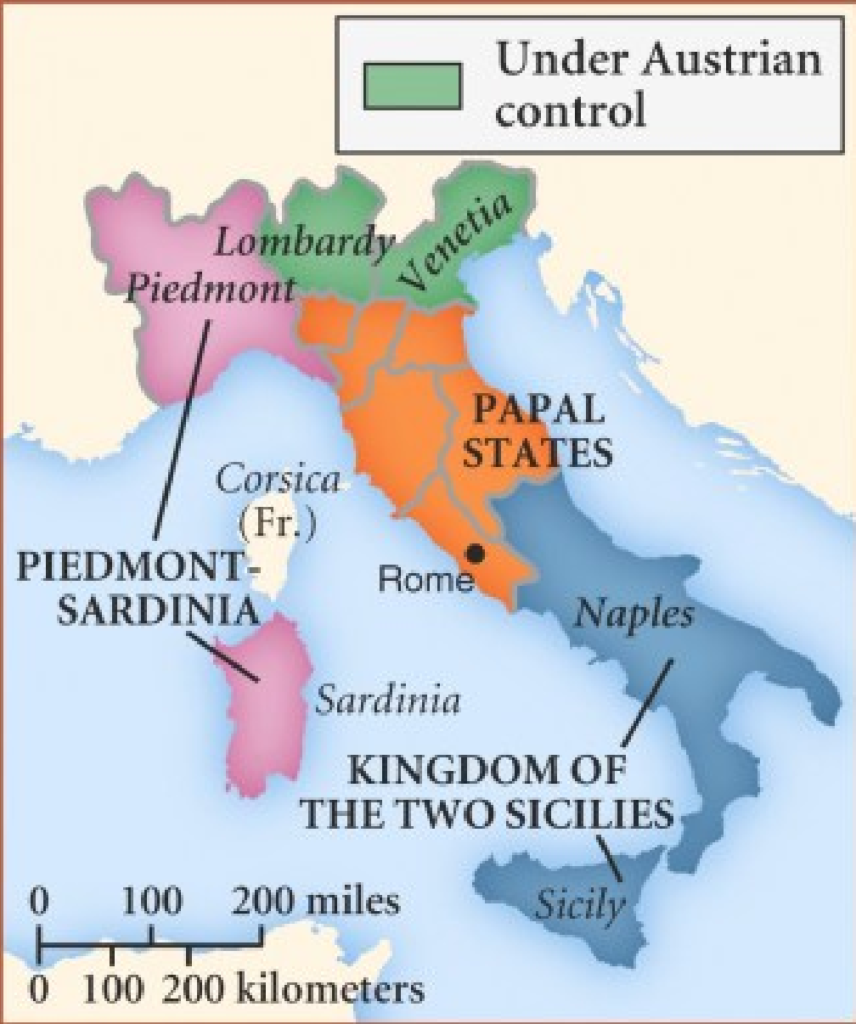
- Austria was granted the two most prosperous provinces, Lombardy and Venice, to secure Italy against possible future French aggression.
- Italy was thus put back on a pre-revolutionary basis, with the sole exception of the extinction of the two former republics of Venice and Genoa.
Austria: The Main Villain of Italian Unification
- The disunion of Italy and the diversity of its political conditions directly enabled Austrian domination.
- The struggle for Italian unification came to be perceived primarily as a struggle against the Austrian Empire and the Habsburgs, since they directly controlled the predominantly Italian-speaking northeastern part of the peninsula and, together, formed the strongest force opposing unification.
- Austria directly controlled the two richest provinces, Lombardy and Venetia, while rulers connected with her imperial house occupied the thrones of Parma, Modena, and Tuscany.
- King Ferdinand of Naples was also treaty-bound not to introduce any form of government unacceptable to Austria.
- The Austrian Empire vigorously repressed nationalist sentiment on the Italian peninsula, just as it did across the other parts of its Habsburg domains.
- The Austrian diplomat Metternich, one of the most influential figures at the Congress of Vienna, famously dismissed the word “Italy” as nothing more than “a geographic expression.”
- The individual Italian states were too small to be economically self-sufficient, forcing them to lean on Austria for support.
Artistic and Literary Sentiment and Nationalism
- Artistic and literary sentiment also turned decisively toward nationalism, with numerous literary precursors of Italian nationalism emerging during this period.
- The most celebrated of these proto-nationalist works was Manzoni’s The Betrothed, a thinly veiled allegorical critique of Austrian rule.
Disunion and Provincialism
- King Victor Emmanuel I of Sardinia-Piedmont was a rigid supporter of the Old Regime, and worked energetically to restore it — sweeping away French laws and institutions.
Attitude of the Pope
- Those favouring unification also faced opposition from the Pope, particularly after failed attempts to broker a confederation with the Papal States (territories under the Pope’s direct sovereign rule), which would have left the Papacy with some measure of autonomy over the region.
- Pope Pius IX feared that relinquishing power in the region could expose Italian Catholics to persecution.
- Italy, as the cradle of an ancient civilisation, saw each city retain its own distinct tradition, breeding jealousy between them.
Diverse Opinions About Unification
- Even among those who wanted the peninsula unified as a single country, different groups could not agree on what form the unified state should take.
- Vincenzo Gioberti, a Piedmontese priest, proposed a confederation of Italian states under the rulership of the Pope.
- Others favoured unification under a federal republic, while some supported a confederation of separate Italian states led by Piedmont.
The Carbonari
- The Carbonari was an informal network of secret revolutionary societies active in Italy during the early 19th century.
- They served as a focal point for those unhappy with the repressive political situation following 1815, especially in southern Italy.
- Their goals carried a patriotic, liberal, and republican character; in general, the Carbonari favoured constitutional and representative government and sought to protect Italian interests against foreign domination.
- However, they never had a single unified programme and lacked a clear immediate political agenda — some wanted a republic, others a limited monarchy; some favoured a federation, others a unitary Italian state.
- Members of the Carbonari, and those influenced by them, took part in key events of the unification process (called the Risorgimento), especially the failed Revolution of 1820, and in the subsequent development of Italian nationalism. Many leaders of the unification movement had, at some point, belonged to this organisation.
Early Revolutionary Activities
Insurrection in Naples
- In 1820, Spaniards successfully revolted over disputes concerning their constitution, which influenced the development of a similar movement in Italy.
- Inspired by the Spanish Revolution, the Carbonari incited a revolt in Naples in 1820, forcing King Ferdinand I to grant a constitution.
- Austria sent an army — fearing these liberal ideas could spread to Venice and Lombardy — which suppressed the revolution and restored Ferdinand to absolute power.
- Ferdinand subsequently abolished the constitution and began systematically persecuting known revolutionaries.
Insurrection in Piedmont
- Before the Naples movement was fully suppressed, Piedmont fell into rebellion, and Lombardy began stirring as well.
- Once again, Austrian intervention caused the movement to collapse.
- The 1821 Piedmont revolt aimed to remove the Austrians and unify Italy under the House of Savoy (rulers of the Kingdom of Sardinia), but it was defeated with the help of the Holy Alliance.
Echoes of the July Revolution of France (1830) in Italy
- By 1830, revolutionary sentiment favouring a unified Italy began to resurge, with a series of insurrections laying the groundwork for a future unified Italian nation.
- Revolts broke out in Parma, Modena, and some Papal States but were quickly suppressed by armed Austrian intervention, with Austria monitoring all Italian movements closely from its vantage point in Lombardy.
Causes of failure:
- These uprisings were too localised, while the forces arrayed against them were too strong.
- The population as a whole was not yet ripe for revolution.
- Italian revolutionaries were initially encouraged by the new French king following the July Revolution, Louis-Philippe, who had promised revolutionaries such as Ciro Menotti that he would intervene should Austria interfere militarily in Italy.
- Fearing for his own throne, Louis-Philippe ultimately did not intervene in Menotti’s planned uprising.
Significance:
- Despite its failure, the episode exposed the weakness of the reactionary rulers and deepened popular hatred of the Austrians.
Giuseppe Garibaldi
- Garibaldi was a native of Nice (then part of the Kingdom of Sardinia), a disciple of Mazzini, and a highly able military leader.
- After participating with Mazzini in an abortive republican uprising against the King of Sardinia in 1834, he was sentenced to death and escaped to South America, where he gained fame for his military exploits.
- He spent fourteen years in South America, taking part in several wars and mastering the art of guerrilla warfare, before returning to Italy in 1848.
- On his return in 1848, Garibaldi fought first against the Austrians and then against the French, and put up a gallant but ultimately hopeless struggle to defend the Roman Republic of 1849.
- (Garibaldi’s later role in unification is discussed further later in the chapter.)
Mazzini’s Young Italy
- Two prominent radical figures of the unification movement were Giuseppe Mazzini and Giuseppe Garibaldi.
- Mazzini was an Italian nationalist and fervent advocate of republicanism, envisioning a united, free, and independent Italy.
- Unlike his contemporary Garibaldi — also a republican — Mazzini never compromised his republican ideals, refusing to swear allegiance to the House of Savoy.
- From an early age, Mazzini was gripped by the vision of a free and united Italy; he joined the Carbonari and was imprisoned by the Piedmontese government in 1830, before being exiled.
Young Italy:
- The repeated failure of isolated insurrectionary attempts made clear that the Carbonari’s methods could not resolve the problem of national emancipation.
- After his release in 1831, Mazzini organised a new political movement called Young Italy, with the motto “God and the People,” seeking to propagate republicanism, nationalist ideas, and the unification of Italy.
- Its goal was to create a united Italian republic through general insurrection in the reactionary Italian states and in the territories occupied by the Austrian Empire.
- Unlike the Carbonari, Young Italy was not merely a body of conspirators; its methods combined education and insurrection, and it superseded the Carbonari as the nucleus of national revolution.
- Its members spread the doctrine of nationalism, and Mazzini’s agents made frequent — though ultimately unsuccessful — attempts at uprisings.
Mazzini’s service to the cause of Italian liberation:
- Mazzini’s contribution cannot be judged solely by his practical failures; his true service lay in the realm of ideas and inspiration.
- He infused the national movement with a moral fervour it had long lacked, kindled popular enthusiasm, and kept the spirit of insurrection alive.
- He gave definite shape to the idea of Italian nationality, transforming the cause of a free and united Italy into a genuine popular movement.
Other facts:
- Mazzini was vigorously opposed to Marxism and Communism:
- In 1871, he condemned the socialist revolt in France that produced the short-lived Paris Commune, prompting Karl Marx to later brand him a “reactionary” and an “old ass.”
- Metternich described Mazzini as “the most influential revolutionary in Europe.”
- Indian independence leader Vinayak Damodar Savarkar was influenced by both Giuseppe Garibaldi and Giuseppe Mazzini.
- Mazzini’s socio-political thought has been referred to as Mazzinianism, and his worldview as the Mazzinian Conception — terms later adopted by Benito Mussolini and Fascists such as Giovanni Gentile to describe their own political ideology and spiritual conception of life.
Mazzini’s Conception of Italian Nationality and His Ideal of the Moral Unity of Mankind
- Following the collapse of the Carbonari movement and the 1830 uprisings, it was Mazzini who most insistently preached the cause of Italian unity.
- His revolutionary society, Young Italy, founded in 1831, served as the chief vehicle through which he sought to educate his compatriots.
- Mazzini’s geopolitical thinking and activity revolved around three fundamental points: Nation, People, and Humanity.
- His core ideas were set out in Young Italy, the society’s namesake newspaper, and further developed in his prolific subsequent writings.
Mazzini’s conception of Italian nationality — a triple goal:
- Independence
- Unity
- Liberty (to be secured through a republic)
- Through the republic, the nation would be made; by “nation,” Mazzini meant “the totality of citizens speaking the same language, associated together with equal political and civil rights in the common aim of bringing the forces of society… progressively to greater perfection.”
- For Mazzini, nationalism was never divorced from liberalism, though its basis was partly linguistic — a principle he expressed as: “As far as this frontier your language is spoken and understood: beyond this you have no rights.”
Mazzini’s ideal of the moral unity of mankind:
- Mazzini’s conception of Italian nationality was not exclusive; his dominant ideal was the recreation of the moral unity of mankind, expressed through a concept of Threefold Unity:
- Unity of man — to overcome the dispersion of the modern individual within an industrialised mass civilisation.
- Unity of nation — to bind all free individuals of a democracy into a community of liberty and equality.
- Unity of mankind — to assure peace and collaboration among all nations.
- Mazzini was among the first proponents of European unity, advocating an early vision of a “United States of Europe.” For him, European unification was a logical continuation of Italian unification.
- After the failure of Young Italy’s revolutionary attempt in Piedmont in 1833, Mazzini founded an even more ambitious society, Young Europe, which met on 15 April 1834 to draw up a pact of fraternity — a kind of holy alliance of the youth of all nations dedicated to liberty, equality, and fraternity.
- The mission of Young Europe was “to constitute humanity so as to enable it through a continuous progress.”
- According to Mazzini: “Every people has its special mission, which will cooperate towards the general mission of Humanity. That mission is its Nationality. Nationality is sacred.”
- Like Young Italy, Young Europe was soon drawn into unsuccessful revolutionary activity; though both societies were ultimately doomed to failure — Young Europe in particular a typically utopian product of romantic internationalism — they set an example imitated widely, from the Young Ireland and Young Serbs movements of the 19th century to the Young Turks and Young Chinese of the 20th.
- Mazzini’s concept of the moral unity of mankind may thus be considered partially successful.
The 1848 Revolutions in the Italian States
Problems of the Peasantry
- As is often the case in historic revolutions, the hunger and poverty of the lower classes served as the central spark of the 1848 revolutions in Italy.
- Meagre seasonal harvests in 1846 and 1847 left poor Italians facing hunger alongside dramatically inflated food prices, triggering widespread demonstrations.
- Meanwhile, peasants lost long-held communal land to the wealthy conservative ruling class, while industrial workers faced lay-offs from over-production — factors that together fuelled further riots and protests across both rural and industrial Italy.
Reform Movements Under Pope Pius IX
- On 16 June 1846, Pope Pius IX was elected. Considered a liberal, he raised the hopes of political liberals and the poor across the Papal States and throughout Italy.
- He initiated numerous political and economic reforms:
- He immediately pardoned hundreds of political prisoners, creating a sensation.
- He established a Council of State to share his power, along with a municipal council for Rome and a Citizens’ Guard, arming the middle class in support of his regime.
- These projects raised high hopes for greater popular influence in papal government and for Italian unification.
- Metternich, growing uneasy, sought to coerce the Pope by occupying Ferrara with Austrian troops, provoking strong papal protests and a wave of furious indignation across Italy.
- A surge of democratic sentiment, mixed with strong anti-Austrian feeling, swept over Italy in 1847 — setting the stage for the revolutions of the following year.
Revolt in Sicily and Naples
- Inspired by the liberal developments in Rome, the people of other states began demanding similar treatment.
- In Sicily, the people demanded a Provisional Government, separate from mainland rule.
- King Ferdinand II attempted to resist, but a full-fledged revolt erupted in Sicily, with further revolts breaking out in Salerno and Naples.
- These revolts forced Ferdinand and his forces out of Sicily and compelled him to permit a provisional government.
- The revolt culminated in the proclamation of the Kingdom of Sicily, with Ruggero Settimo as Chairman of the independent state until 1849, when the Bourbon army retook the island by force on 15 May 1849.
Spread of Revolt Across Italy
- Despite the events in Rome and Naples, other states remained under conservative rule; Italians in Lombardo-Veneto enjoyed none of these freedoms, as the Austrian Empire tightened its grip through harsher taxation.
- Disturbances began with a civil disobedience strike in Lombardy, where citizens stopped smoking and playing the lottery to deny Austria the associated tax revenue.
- In February 1848, relatively nonviolent revolts in Tuscany led Grand Duke Leopold II to grant a constitution; a breakaway republican provisional government subsequently formed there.
- On 21 February, Pope Pius IX granted a constitution to the Papal States, a surprising move given the historical recalcitrance of the Papacy.
- By the time revolution erupted in Paris, every Italian state except the Austrian dominions had a constitution — so far, the movement remained a democratic one, achieving temporary success in the form of constitutional governments.
The Revolt Develops into a Struggle for Italian Liberation
- The democratic movement evolved into a broader struggle for national independence.
- In Lombardy, rising tensions culminated in the Milanese and Venetian uprisings of 18 March 1848; the insurrection in Milan succeeded in expelling the Austrian garrison after five days of street fighting.
- Italian insurgents were further encouraged by news of Metternich’s abdication in Vienna and the revolution in Paris; by this time, Charles Albert of Piedmont had already published a liberal constitution for Piedmont.
- Cavour, then a young editor, wrote a stirring appeal urging Charles Albert of Sardinia-Piedmont to declare war on Austria.
Charles Albert Leads the National War Against Austria — and His Defeat
- Urged by the Venetians and Milanese to aid their cause, Charles Albert, King of Sardinia (ruler of Piedmont and Savoy), judged the moment ripe to unify Italy and declared war on Austria — the First Italian Independence War.
- As he marched toward the front, Charles secured pledges of support from fellow princes: Leopold II, Grand Duke of Tuscany, sent 8,000 troops; Pope Pius contributed 10,000; and Ferdinand II sent 16,050 men — largely under public pressure.
- After initial successes, Charles Albert was decisively defeated by Radetzky at the Battle of Custoza (24 July). An armistice followed, and Radetzky regained full control of Lombardy-Venetia.
- At this point, Pope Pius IX, growing nervous about defeating a fellow Catholic empire, withdrew his troops, citing his inability to endorse a war between two Catholic nations; King Ferdinand of the Two Sicilies likewise recalled his soldiers.
- The monarchs who had reluctantly granted constitutions in March now found themselves in conflict with their own constitutional ministers.
After the Defeat
- Although Pius IX had abandoned the war effort, many of his subjects had continued fighting alongside Charles Albert.
- The people of Rome rebelled against the papal government and assassinated Rossi, the Pope’s minister.
- With the Italian royals defeated, popular sentiment turned toward republicans such as Mazzini and Garibaldi, forcing monarchs — including Pope Pius IX — to flee their capitals.
- Pius IX fled to the fortress of Gaeta, under the protection of King Ferdinand II; in February 1849, he was joined there by Leopold II, Grand Duke of Tuscany, who had likewise fled another insurrection.
- Piedmont was also lost to the Austrians in 1849; Charles Albert abdicated in favour of his son, Victor Emmanuel II, and a peace treaty signed on 6 August 1849 forced Piedmont-Sardinia to pay Austria an indemnity of 65 million francs.
The Republican Movement in Rome
- Although initially something of a reformer, Pius IX’s conflicts with the revolutionaries soured him on constitutional government. In November 1848, following the assassination of his minister Rossi, the Pope fled Rome just before Garibaldi and other patriots arrived.
- Elections for a Constituent Assembly were held in early 1849, and the assembly proclaimed the Roman Republic on 9 February. In early March, Mazzini arrived in Rome and was appointed Chief Minister.
- The Republic succeeded in inspiring the people toward the idea of an independent Italian nation:
- Its constitution guaranteed religious freedom, abolished the death penalty, and provided free public education.
- It attempted to improve the economic conditions of the poor by redistributing some of the Church’s large landholdings to peasants.
- It carried out prison and asylum reforms, granted freedom of the press, and provided secular education, though it shied away from guaranteeing a “Right to Work,” having witnessed this policy fail in France.
- Together, Garibaldi and Mazzini sought to build a “Rome of the People,” and Tuscany followed Rome’s example by establishing its own republic.
The Fall of the Roman Republic
- Runaway price inflation doomed the Republic’s economy, while the dispatch of troops to defend Piedmont from Austrian forces left Rome exposed to attack.
- Pope Pius appealed to Napoleon III for help; the French president saw this as an opportunity to secure Catholic support and to counter growing public discomfort with Austria’s sole control over the Italian situation.
- The French army arrived by sea and, despite an early loss to Garibaldi, eventually defeated the Roman Republic with Austrian assistance.
- On 12 July 1849, Pope Pius IX was escorted back into Rome and ruled under French protection until 1870 — a stroke that simultaneously strengthened Napoleon III’s domestic standing and cast him as the champion of the Catholic religion.
Collapse of the Struggle
- The premature struggle for Italian independence thus collapsed; Austria regained her position in Lombardy and Venetia.
- Absolutism was restored in every state except Piedmont, where Victor Emmanuel II remained loyal to the constitution granted by his father.
Why Did the 1848 Revolutions in Italy Fail?
Confusion of Aims
- Mazzini favoured a republic, Gioberti a federation of states under the presidency of the Pope, and others a union of Italy under the House of Savoy (i.e., under the King of Piedmont).
- The nationalists remained divided in their aims — the removal of Austria was the only point of common agreement.
- Issues were usually localised, with little cooperation between revolutionary groups; in Piedmont, for instance, Charles Albert would only accept volunteers from other states if they first declared loyalty to him.
- This lack of organisation and unity made it easy for leaders like King Ferdinand to suppress risings in areas such as Naples and Sicily.
- In Sicily, aims diverged so sharply from the broader cause that the movement was not even concerned with national unity — Sicily aimed to break away from Naples and become independent rather than unified.
- With the states unwilling to cooperate and pursuing such varying aims, failure of the revolutions was effectively inevitable.
Lack of Coordination of Efforts
- The revolutions suffered from a lack of sound leadership: Mazzini could inspire, and Garibaldi could fight, but neither possessed the statesmanship needed to exploit the moment to full advantage.
- With no real leadership to unite behind, the nationalists could not present a united front against the Austrians, leading directly to failure.
- Of the three possible leaders — Pope Pius IX, Mazzini, and Charles Albert — none proved universally acceptable:
- Charles Albert, defeated twice by Austrian troops, became a very weak potential leader.
- The Pope’s allocution separated him entirely from the nationalist movement, eliminating him as a possible ruler.
- Mazzini led the Roman Republic for 100 days after the Pope fled, urging the states to cooperate against Austrian rule, until he was crushed by the French troops the Pope had summoned.
Austrian and French Intervention
- One of the largest obstacles Italian revolutionaries faced was Austria’s strong military power.
- Austrian intervention not only crushed revolts but also restored absolutist rule by reinstating previous rulers.
- Initially, Austria was weakened by revolutions in areas such as Vienna, along with Metternich’s resignation on 13 March 1848 — developments that gave hope to Italian revolutionaries and encouraged Charles Albert to declare war on Austria for the first time.
- The Austrians, however, soon recovered, crushing the revolt and defeating Charles Albert at the Battle of Custoza (24 July 1848) under Radetzky.
- Piedmont, Italy’s strongest state, could not defeat Austria — a significant failure for the revolutionary cause.
- In battles with both Piedmont and Venetia (where the Austrians briefly surrendered in March 1848), revolutionary success proved short-lived, as Austria ultimately returned and crushed the risings with its superior military strength.
- Austria was not the only foreign power involved: France deployed 20,000 troops to restore papal control over the Papal States after the Pope was forced to flee.
The Pope’s Refusal to Support the Revolutions
- The Pope was forced to flee the Papal States after his chief minister Rossi was murdered in November 1848, as the nationalist movements had grown significantly anticlerical since his allocution.
- Pius IX had initially appeared liberal, introducing reforms such as pardoning 2,000 political prisoners, ending church press censorship, and granting more power to laymen.
- This led nationalists like Gioberti to see the Pope as a potential leader for their movement, given his apparent anti-Austrian stance and standing to counter foreign powers.
- However, in his allocution issued on 29 April 1848, the Pope announced that the war against Austria did not carry his blessing, and that the Papacy did not support the idea of a united Italy.
- This allocution proved decisive, eliminating any prospect of papal leadership or support for a unified Italy, and prompted the Pope to appeal to France to crush the revolts in the Papal States — leaving the nationalists without either leadership or allies against Austria.
Lack of Involvement from the Masses
- The revolutions also failed to secure the support of the masses.
- On the whole, they were organised only by the social elite or radicals; liberals were reluctant to encourage popular or peasant involvement, viewing politics as a middle-class concern.
- Since the revolutionaries showed little interest in social reform or improving the lives of ordinary people, most peasants stayed uninvolved — leaving revolutionary leaders unable to sustain power once gained.
- The exception was Sicily, where a large section of the population joined marches in Palermo, as government repression coincided with a cholera outbreak affecting all classes. Even with mass support, Sicily was easily defeated by the intense bombardment ordered by King Ferdinand, nicknamed “King Bomba.”
Significance of the Revolution of 1848
- For the first time, Italians had combined in a common cause, shedding — at least temporarily — their narrow provincialism.
- The war exposed Sardinia’s failure to defeat Austria single-handedly, pushing Sardinia to seek foreign allies against Austria; only with French help (1859) and Prussian help (1866) would Sardinia eventually succeed in driving the Austrians from northern Italy.
- The Piedmontese king had risked his throne for a national cause, emerging as the only plausible national leader — a significant gain that simplified the questions of both leadership and aim.
- Republicanism appeared discredited, seen as too radical to attract the masses, and Mazzini’s failure in Rome left the republican option a spent force.
- Consequently, the only viable solution remaining was the establishment of a Constitutional Kingdom under the King of Sardinia-Piedmont.
Why Piedmont Became the Centre of Nationalist Hopes
- Only Piedmont had fought wholeheartedly against the Austrians during 1848–49.
- Piedmont was among the biggest losers of the “springtime of the peoples”: her army was crushed, and she lost Lombardy — the future powerhouse of the Italian economy.
- Carlo Alberto, who had followed a liberal policy, was forced to abdicate in favour of his son, Victor Emmanuel II.
- Fortunately, Victor Emmanuel shared his father’s liberal views, and thanks to this, Piedmont retained its liberal constitution — despite heavy pressure from a victorious Austria — allowing its liberal atmosphere to outlast 1848 and attract numerous political exiles from elsewhere in Italy.
- Nationalists thus came to realise that Italy could be united only through a Constitutional Monarchy under the House of Savoy.
- Revolutionaries could now appreciate the efforts Piedmont had made against Austrian authority.
- Earlier, Piedmont had been perceived as an oppressor similar to Austria, with revolutionists fearing that cooperation with the Piedmontese would merely swap one authority for another of the same kind.
- Now, the perception of Piedmont’s role shifted: people realised there was no other viable path to Italian unity except an alliance with Piedmont, and their priority shifted from pure independence and freedom toward unification itself.
- The period from 1849 to 1859 is known as the “Decade of Preparation.”
- This liberal approach enabled a wide range of political and economic reforms, most of which are credited to the governance of Cavour, who became Prime Minister of Piedmont in 1852.
- Cavour believed firmly in economic progress as the product of liberal policy and political stability; under his governance, he sought to weaken the Church, viewed as the main pillar of reaction in Italy.
- He achieved remarkable results in modernising Piedmont — standardising the credit and banking system, encouraging foreign investment, and developing modern communications such as railways.
- The expansion of Piedmont’s railway network offers concrete evidence of this progress: between 1849 and 1859, its original 8 km of track grew to an impressive 850 km.
- This rapid economic development was a key reason Piedmont was able to take the lead in unification, while the other Italian states stagnated both economically and politically.
- A further reason lay in Piedmont’s unique status as the only Italian state never controlled by Austria, ruled by a king who was the sole representative of a native Italian dynasty.
Conclusion
The period from 1815 to 1850 established the essential preconditions for Italian unification, even as the immediate revolutionary attempts of 1820, 1830, and 1848 all ended in failure. The Congress of Vienna entrenched Austrian domination and confirmed that Italy’s disunity served foreign interests; the Carbonari, Mazzini’s Young Italy, and Garibaldi’s early exploits kept the nationalist ideal alive through repeated setbacks; and the collapse of the 1848 revolutions — undone by confused aims, weak leadership, papal withdrawal, foreign intervention, and popular apathy — exposed the limits of both republicanism and unco-ordinated popular uprising as paths to unity. Out of this failure emerged a crucial realisation: only a Constitutional Monarchy under Piedmont-Sardinia, backed by sound economic modernisation under leaders like Cavour, could carry the movement for nationalism and state-building in Italy to its eventual completion in the 1860s.