

Ibn Battuta’s Accounts

- Ibn Battuta (1304–1369) was a Moroccan explorer who occupies a premier position among writers of travelogues. He is best known for his extensive travels, an account of which was published as the Rihla (“Journey”) in Arabic — a substantial portion of which is devoted specifically to his experiences of Indian life. He first arrived in India in 1334.
- Over roughly thirty years, Ibn Battuta visited most of the known Islamic world, as well as many non-Muslim lands — journeys spanning North Africa, the Horn of Africa, West Africa, Eastern Europe, the Middle East, South Asia, Central Asia, Southeast Asia, and China, covering a distance far greater than that travelled by his predecessors, or even by his near-contemporary Marco Polo.
- Ibn Battuta’s contribution to history and geography is, without question, as significant as that of any historian or geographer of his time.
- This article traces Ibn Battuta’s account of India — his personal journey through the Delhi Sultanate under Muhammad bin Tughluq, the Rihla as a source for reconstructing Tughluq-era society and administration, his detailed observations on food, cities, agriculture, and slavery, and finally the genuine limitations of the Rihla as a historical source.
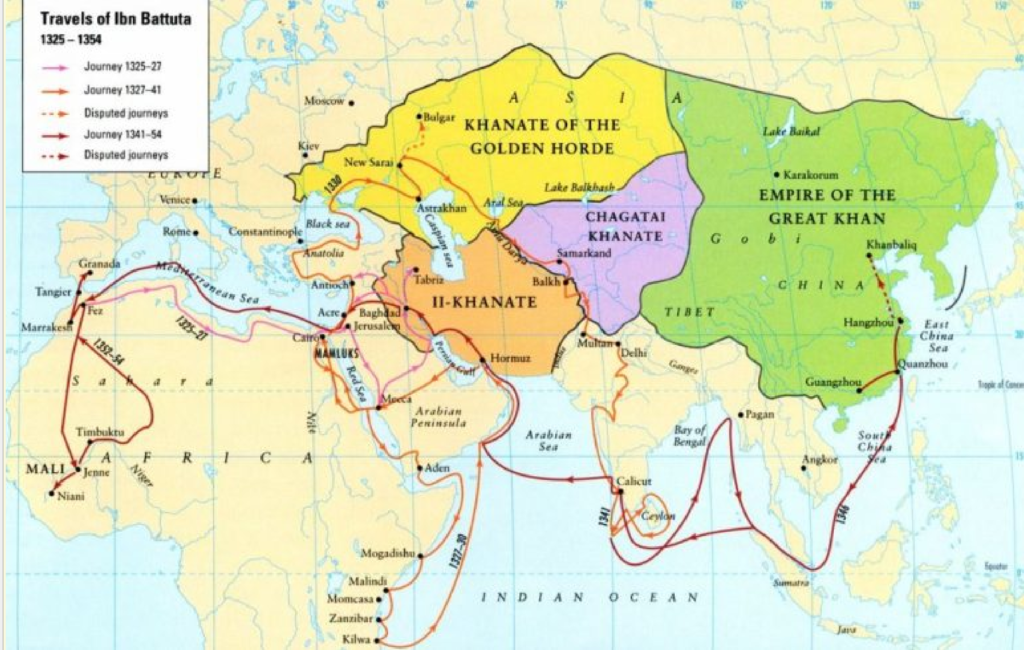
Ibn Battuta’s Account of India (As Recorded in the Rihla)
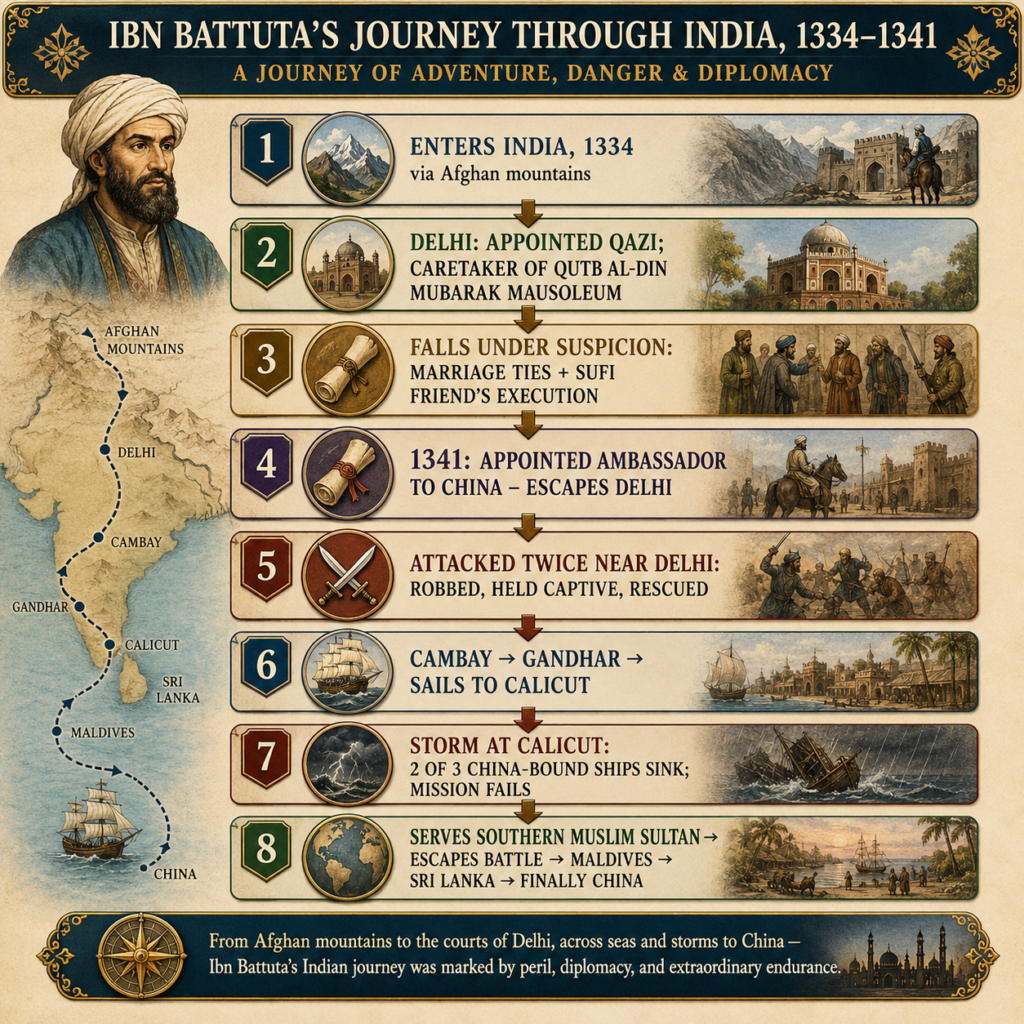
- Ibn Battuta entered India in 1334 (remaining until 1341), crossing the high mountains of Afghanistan — following the same route taken a century earlier by the Turkish warriors who had established the Delhi Sultanate.
- In late 1334, he travelled to Delhi to seek official employment, cleverly assembling gifts for Sultan Muhammad bin Tughluq — everyone at court knew the Sultan customarily returned gifts of far greater value to his visitors.
Employment under the Sultan
- Ibn Battuta began working as a judge (Qazi).
- Since he did not speak Persian well, he was assigned two assistants.
- He also had ample opportunity to accompany the Sultan and high officials on elaborate hunting expeditions.
- Extravagance and high living eventually pushed him into debt, though the generous Sultan simply gave him more money to settle it — and even assigned him a second role: caretaker of the Qutb al-Din Mubarak mausoleum.
- He thus combined the roles of a judge dispensing punishments and a custodian of the tomb.
- His duty of collecting debts from assigned villages was made considerably harder by a disastrous famine that struck North India in 1335, lasting for seven years.
- The Sultan, meanwhile, returned from an unsuccessful campaign against a rebellious army in the south — only for army officers and a governor near Delhi to rebel as well, as the empire appeared to be disintegrating around Muhammad Tughluq. On this occasion, the Sultan proved himself a skilful soldier, marching out to secure the town — with Ibn Battuta serving as a direct witness to these events for future historians.
Problems Faced by Ibn Battuta
- Even Ibn Battuta himself came under suspicion. While living in Delhi, he married a woman whose father — a court official — had plotted a rebellion and was subsequently executed by the Sultan.
- His most serious problem, however, arose from his friendship with a Sufi holy man.
- This holy man refused any involvement in politics, choosing instead to live a purely religious life — he openly snubbed the Sultan and refused to obey his commands.
- In retaliation, Muhammad Tughluq had the man arrested, tortured, and beheaded.
- The following day, the Sultan demanded a list of the holy man’s associates — and Ibn Battuta’s name was included. For many days, he remained under guard, living in genuine fear of execution.
Escape from Delhi: The Mission to China
- Having feared for his life while serving as judge under the moody, tyrannical Sultan, Ibn Battuta was offered an unexpected way out.
- Aware of Ibn Battuta’s love of travel, the Sultan devised a task he found genuinely fascinating: appointment as his ambassador to the Mongol court of China.
- He would escort 15 Chinese messengers back to their homeland, carrying shiploads of gifts for the Chinese emperor — a mission that offered Ibn Battuta both an escape from Muhammad Tughluq and the chance to see more of Dar-ul-Islam.
- In 1341, Ibn Battuta set out from Delhi at the head of a China-bound expedition, commanding roughly 1,000 soldiers tasked with protecting the accompanying treasure and supplies until they could board ship.
Attack on Ibn Battuta’s Group
- A few days outside Delhi, the group was attacked by roughly 4,000 Hindu rebels — though vastly outnumbered, Ibn Battuta’s forces defeated them easily.
- A second attack followed shortly after, during which Ibn Battuta became separated from his companions.
- After escaping, he was confronted once more — this time by forty Hindus, who robbed him of everything except his clothes.
- His captors held him overnight in a cave, planning to kill him the next morning — but since he had almost nothing left to steal, Ibn Battuta managed to negotiate his release in exchange for his remaining clothes.
- Eight days later, exhausted, barefoot, and wearing only his trousers, he was rescued by a passing Muslim traveller, who carried him to a nearby village.
- Two days later, Ibn Battuta rejoined his party and resumed his original mission to China.
- After a brief rest, the group proceeded to the coastal city of Cambay, filled with foreign traders living in fine homes, before reaching Gandhar, where they boarded four ships — three large dhows carrying the gifts, and a fourth warship (roughly half its soldiers African archers and spear-throwers) to guard against piracy.
Disaster in Calicut
- Propelled by the monsoon winds, the four ships sailed south and arrived at the port of Calicut, where the party was received with drums, trumpets, horns, and flags.
- The same harbour held 13 Chinese junks — vessels far larger than the dhows Ibn Battuta had sailed on the Indian Ocean, and whose luxurious accommodations he greatly admired. Three of these great ships were to carry the party onward to China.
- Before he could board, however, a violent storm struck. Since the harbour itself was too shallow, the junk captains ordered their ships out to deeper water to ride out the storm.
- Ibn Battuta waited helplessly on the beach through the night, watching in horror the next morning as two ships were driven ashore, broke apart, and sank.
- Some crew from one junk survived; no one survived from the other — the very ship on which he had been due to sail.
- Ibn Battuta was left alone and deeply ashamed — a failed leader of the Sultan’s mission to China, yet fortunate simply to be alive.
Leaving India
- Uncertain where to turn, Ibn Battuta wished to return to Sultan Muhammad Tughluq, but feared execution for the failure of his mission.
- He judged it safer instead to seek employment and protection from another Muslim sultan in southern India — even joining a day-long battle to win this sultan’s favour, though when defeat appeared imminent, he managed to escape through the battle lines, heading down the coast and reaching Calicut for the fifth time.
- There, he resolved to continue toward China on his own — though once again taking the long way round, making a brief tour of the Maldive Islands, followed by a pilgrimage to Adam’s Peak in Sri Lanka (Ceylon), before finally continuing on to China.
The Rehla as a Source of Indian History
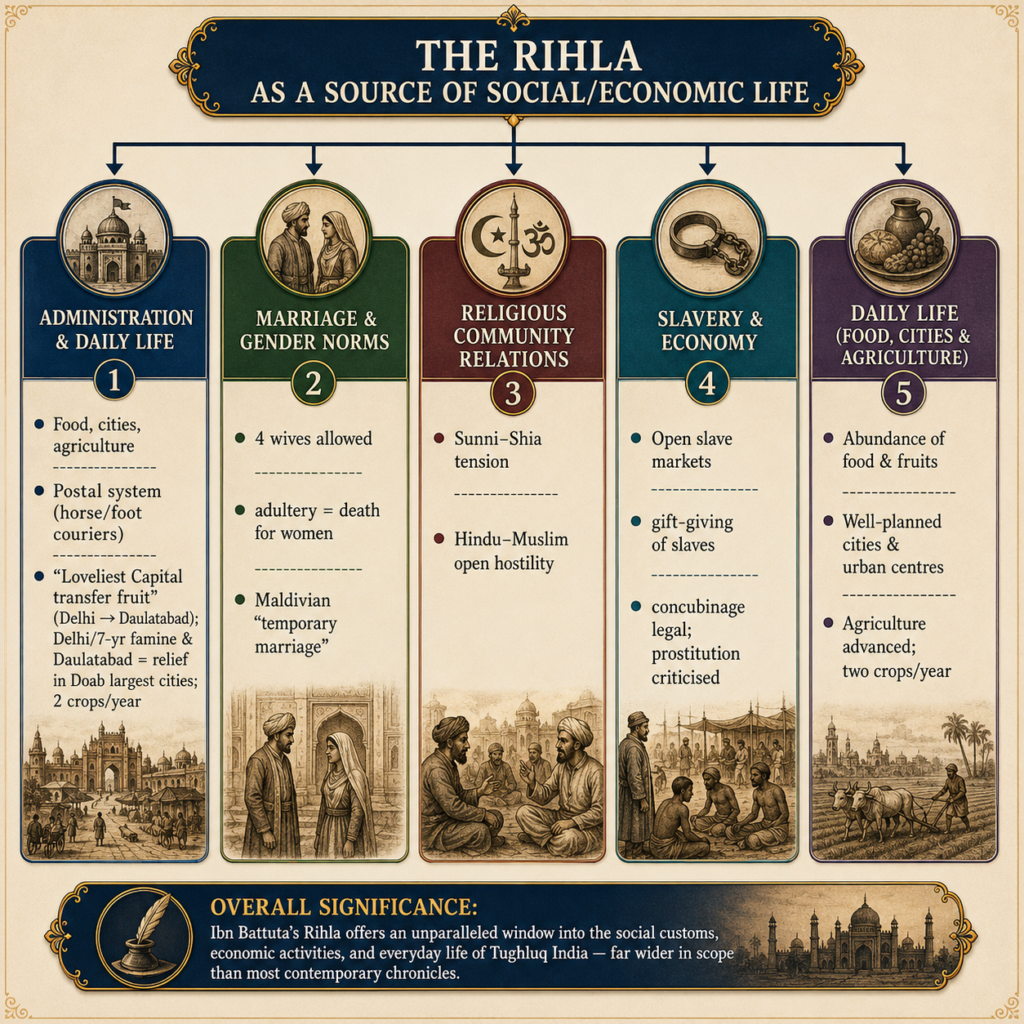
- The Rehla stands as a primary source for the history of the Delhi Sultanate under Muhammad bin Tughluq, shedding valuable light on the socio-political conditions of his time.
- Ibn Battuta stayed in Delhi for eight years, patronised throughout by Muhammad bin Tughluq, who appointed him Qazi (judge).
- When Battuta left Delhi in 1342 for China, the Sultan formally designated him head of a diplomatic mission to the Chinese emperor.
The Personal Character of Muhammad bin Tughluq
- In the Rehla, Ibn Battuta offers direct insight into the personal character of Muhammad bin Tughluq.
- He records, for instance, that the Sultan enjoyed receiving gifts from visitors, and would reciprocate with gifts of far superior value in return.
- The Sultan was equally harsh toward both non-Muslims and Muslims, and would punish subjects severely even for minor faults.
- Battuta’s overall portrait casts Muhammad bin Tughluq as a genuinely eccentric ruler, prone to severity of temper.
Espionage and Communication Systems
- Ibn Battuta provides genuinely useful information on the Tughluq administrative structure, particularly its espionage and communication systems.
- He describes the postal system, which relied on both horse couriers and human runners.
- The system is said to have stationed a horse courier every four miles, and a foot courier every mile.
- This system allowed merchants not only to transmit information and remit credit across long distances, but also to dispatch urgently required goods at short notice.
- Nearly all major trade routes were well supplied with inns and guest houses, and Ibn Battuta himself expressed genuine admiration for the efficiency of this courier network.
- He describes the postal system, which relied on both horse couriers and human runners.
Policies and Administrative Measures
- Ibn Battuta documents several of Muhammad bin Tughluq’s most famous policies and administrative measures, most notably:
- The transfer of the capital from Delhi to Daulatabad.
- The prolonged famine — lasting roughly seven years from 1335 AD — which killed large numbers of people near Delhi, during a period when the Sultan himself was preoccupied with suppressing rebellions.
- He also describes the relief measures undertaken during this famine in the Doab region.
- Ibn Battuta gives a detailed description of the magnificent city of Delhi as it stood after Tughluq compulsorily relocated every resident to Daulatabad.
- (Notably, Ibn Battuta — who arrived in Delhi in 1334 — makes no mention of the earlier episode of token currency, suggesting the entire scheme, abandoned in 1333, had already been swiftly forgotten by the time of his arrival.)
Insights into Social and Economic Life
- Ibn Battuta’s observations on the following subjects provide valuable insight into the social and economic life of the Tughluq Sultanate: slavery and the slave market, the caste system, social customs, art and crafts, trade — especially the import of horses, the practice of sati (the burning of widows), the currency system, and shipbuilding.
On Marriage
- Muslim men were permitted up to four wives. Ibn Battuta himself married his first wife while crossing North Africa; in Damascus, he married again, fathering a son he never met; in India, he married once more, having a daughter by this wife.
- In the Maldive Islands, he took several wives before divorcing them, fathering at least one further child — a son he left behind with the mother.
- He recorded of the Maldivian custom: “It is easy to marry in these islands because of the smallness of the dowries and the pleasures of society which the women offer… When the ships put in, the crew marry; when they intend to leave they divorce their wives. This is a kind of temporary marriage. The women of these islands never leave their country.”
On Adultery
- Adultery was treated as a very serious crime across the Islamic world, punishable by death — a rule applied especially strictly to women, since men retained several legal avenues for multiple sexual relationships (marrying up to four wives, or taking slave women as concubines). As a judge, Ibn Battuta himself supported the strict enforcement of this rule.
On Eunuchs
- Eunuchs were a widespread institution, closely associated with powerful empires — some employed thousands of eunuchs in government service.
- Ibn Battuta describes eunuchs serving amirs, shaikhs, and sultans across Egypt, India, and China, performing roles ranging from protectors of the royal harem, to custodians of the Prophet’s mosque in Medina and other shrines, to administrators in China.
On Celibacy and Pious Women
- Ibn Battuta praises several holy men and young Turkish men who had adopted a life of celibacy.
- He similarly praises several women for their piety — including a celebrated Quranic scholar, the wife of a sultan who built wells along the pilgrimage route to Mecca, and others, including Muhammad Tughluq’s own mother, for their charitable works.
Relations between Sunni and Shi’a Muslims
- Ibn Battuta was himself a strict Sunni Muslim, and at several points in the Rihla directs pointed criticism at Shia beliefs, recounting disparaging anecdotes about what he considered their “fanatical and misguided” observances.
- He avoided mixing extensively with Shi’i scholars, and deliberately steered clear of towns with predominantly Shi’i populations.
Relations between Muslims and Hindus
- The repeated conflicts between Ibn Battuta’s travelling party and the attackers he identifies as Hindu offer real insight into the tensions between these communities at the time.
- He portrays the relationship between Muhammad Tughluq and the local Hindu population as one of open hostility, with both sides engaged in genuine violent conflict.
Other Cultural Observations
- Ibn Battuta frequently experienced culture shock in regions where the customs of recently converted populations diverged from his own orthodox Muslim background.
- Among the Turks and Mongols, he was struck by the freedom and respect enjoyed by women, remarking that on seeing a Turkish couple in a bazaar, one might easily mistake the husband for his wife’s servant.
- He also considered certain regional dress customs overly revealing.
Food and Cuisine in India
- On a hunting trip with Sultan Muhammad Tughluq, Ibn Battuta describes food such as mutton, fattened fowl, and cranes.
- Royal meals typically included: bread; large slabs of meat; round dough cakes made with ghee, stuffed with sweet almond paste and honey; meat cooked with ghee, onions, and green ginger; “sambusak” (the modern samosa); rice cooked in ghee topped with chicken; and sweetcakes and sweetmeats for dessert.
- He also documents: mango; pickled green ginger and peppers; jackfruit, which he calls “the best fruit in India”; tandu (fruit of the ebony tree); sweet oranges; wheat, chickpeas, and lentils; and rice, which he notes was sown three times a year. Sesame and sugarcane were similarly cultivated.
- He describes the jackfruit with particular admiration, terming it the “loveliest of all fruits in Hindustan,” and was equally intrigued by the mango — noting that a mango-and-ginger pickle commonly accompanied meals.
- He records that Indians most commonly ate millet, along with peas and mung beans cooked with rice and ghee, eaten as a standard breakfast. Animals, meanwhile, were fed barley, chickpeas, and leaves as fodder, and were even given ghee.
- Pan and betel nut, he notes, were supplied to the imperial capital from Chanderi, near Gwalior — the betel plant itself resembling a grape vine, cultivated specifically for its leaves.
- People customarily drank sugared-water sherbet before meals and barley-water afterward, followed by betel leaf and areca nut (a mild narcotic).
- He also documents various pulses and chicken cooked in ghee, and notes that a favourite dish of the Muslim community in Kerala (where his disastrous shipwreck occurred) was rasoi, made from rice, lamb, grated coconut, and onion.
- Muslim women, he observes, ate separately from men in India, as was common across most Muslim countries he had visited.
- Coconut trees, he writes, resembled date palms; the coconut itself resembles a man’s head, with an interior resembling a brain, while its fibre resembles human hair and is used to make the rope used for pulling ships.
Description of Indian Cities
- Ibn Battuta found the cities of the subcontinent full of exciting opportunities, resources, and skills — densely populated and prosperous, save for occasional disruptions caused by wars and invasions.
- Most cities featured crowded streets and vibrant, colourful markets, stocked with a wide variety of goods.
- He describes both Delhi and Daulatabad as vast cities with enormous populations — the largest in India.
- Bazaars functioned not merely as sites of economic exchange but as genuine hubs of social and cultural life; most contained both a mosque and a temple, and some even designated specific spaces for public performances by dancers, musicians, and singers.
- Ibn Battuta explains that towns derived a significant share of their wealth from the appropriation of agricultural surplus from surrounding villages, made possible by soil fertile enough to support two crops a year.
- He also notes that the subcontinent was well integrated into inter-Asian trade networks, with Indian manufactures — particularly cotton cloth, fine muslins, silks, brocade, and satin — in high demand across both West Asia and Southeast Asia, fetching substantial profits for local artisans and merchants.
Agriculture
- Ibn Battuta observed that Indian soil was highly fertile, supporting two crops — rabi and kharif — each year.
- Rice and sugarcane were grown in the east.
- Wheat and oilseeds were grown in the north.
- Other crops included cotton, barley, and sesame.
Village Industry
- Ibn Battuta records information on various village industries, including jaggery production, oil pressing, and indigo spinning and weaving.
- He also provides detailed information on the process of army recruitment, the trading activities of nobles, and the Sultan’s practice of encouraging nobles to take up administrative work, alongside details of ships owned by the king and nobility.
- Ibn Battuta writes extensively on the lifestyle of the nobility, the various customs and rituals prevailing at court, and important monuments, scholars, and saints of Delhi.
- He studied and wrote about the history of the famous Qutb complex, including the Quwat-al-Islam Mosque and the celebrated Qutb Minar.
- His account also discusses jogis, who performed magic tricks on the streets.
Travels to South India
- During his travels south, Ibn Battuta describes the magnificent fort of Deogiri, renamed Daulatabad by Tughluq, with its massive walls stretching some three miles.
- He also mentions the Marathas living in the region, noting that their diet consisted of rice, green vegetables, and sesame oil, and that they took particular care to wash their food thoroughly.
- Ibn Battuta travelled further south and stayed at Calicut, where he describes the way of life of South Indian people and the marked dominance of Muslims in India’s international trade.
- His accounts of sea voyages and shipping reveal that Muslims completely dominated maritime activity across the Red Sea, the Arabian Sea, the Indian Ocean, and Chinese waters.
- He also notes that while Christian traders faced certain restrictions, most economic transactions were conducted on a basis of genuine equality and mutual respect.
- He documents, too, the significant involvement of large Chinese junks in trade with China.
Why Travel Was More Insecure in the Medieval Period
- According to Ibn Battuta’s own experience, travel in this period carried real danger: he was attacked by bands of robbers on several occasions.
- Though he generally preferred travelling in a caravan with companions, this did not deter highway robbers.
- While travelling from Multan to Delhi, his caravan was attacked and many fellow travellers lost their lives; the survivors, including Ibn Battuta himself, were severely wounded.
- He also suffered from genuine homesickness, and in many places found himself unwelcomed by local populations.
Evidence of Slavery in Ibn Battuta’s Account
- Ibn Battuta’s observations offer valuable insight into the social and economic role of slavery and the slave market within the Tughluq Sultanate.
The Slave Market
- Ibn Battuta’s account records that both male and female slaves were openly sold in markets like any other commodity, and were routinely exchanged as gifts.
- He purchased several slaves himself during his travels, including two Greek female slaves, with whom he fathered children.
- He notes that everything in Chittagong was remarkably cheap, including slaves — he purchased an “extremely beautiful” girl there, while a friend bought a young boy for a couple of gold dinars.
- The price of slaves — particularly female slaves required for domestic labour — was generally very low, and most families who could afford it kept at least one or two.
Slaves as Gifts
- On reaching Sind, Ibn Battuta purchased horses, camels, and slaves (including female slaves) specifically as gifts for Sultan Muhammad bin Tughluq.
- He records that the Sultan of Delhi was once so pleased with a sermon delivered by a preacher named Nasiruddin that he gifted him one hundred thousand tankas and two hundred slaves (male and female).
- Ibn Battuta also describes how Chinese emissaries had earlier arrived in Delhi with 100 slaves and cartloads of fine clothing, brocade, musk, and swords as gifts for Muhammad Tughluq — who, feeling obliged to reciprocate even more lavishly, sent back a gift including 200 Hindi slaves, along with songstresses and dancers.
On Sexual Relations with Female Slaves
- This practice was considered legal under the medieval Islamic law Ibn Battuta followed, and he himself fathered children by at least two of his own slaves.
- One young Greek slave woman bore him a daughter who died in India; another slave died when his ship sank in India en route to China.
The Work of Slaves
- Most female slaves were women captured during raids and military expeditions.
- Some female slaves at the Sultan’s court were skilled in music and dance — Ibn Battuta himself enjoyed such a performance at the wedding of the Sultan’s sister — while others performed domestic labour.
- Male slaves, meanwhile, were found essential for carrying wealthy men and women in palanquins.
- Female slaves were additionally employed by the Sultan to keep watch over his nobles, though most continued to be used chiefly for domestic work.
On Prostitution among Slave Girls
- Although Ibn Battuta approved of concubinage — in his own case, sexual relationships with his female slaves — he was notably critical of prostitution, regarding it as immoral.
- He records how slave girls were sometimes forced into prostitution, with each required to pay a regular due to her master.
On Runaway Slaves
- Ibn Battuta’s account never specifies the exact punishment for a slave who ran away, though this happened to him personally at least twice — with the escaped slave later recaptured and punished.
Criticism and Limitations of the Rehla
- After returning home from his travels in 1354, and at the instigation of the ruler of Morocco, Ibn Battuta dictated an account of his journeys to the scholar Ibn Juzayy. This dictated account remains the sole source for Ibn Battuta’s adventures — there is no indication that he kept any written notes during his twenty-nine years of travel.
- When he came to dictate his experiences, he was forced to rely on memory, along with manuscripts produced by earlier travellers.
- Scholars generally do not believe that Ibn Battuta personally visited every place he describes, arguing that in order to provide a comprehensive account of the Muslim world, he relied in part on hearsay and on the accounts of earlier travellers.
- As a foreigner, Ibn Battuta could not converse in the language of the masses, and was consequently unable to gather information directly from common people.
- His account also contains genuine chronological errors, and at times mixes established fact with hearsay, reducing the overall credibility of certain passages.
- Even so, even where the Rehla is not entirely based on first-hand experience, and some of its specific observations prove inaccurate, the overall picture it presents remains an important source — not only for political history, but equally for the social and economic life of medieval India.
Conclusion
- Ibn Battuta’s account of India, preserved in the Rehla, stands as one of the richest surviving windows into the Delhi Sultanate under Muhammad bin Tughluq — spanning everything from the Sultan’s personal eccentricities and administrative reforms, to the daily food, dress, agriculture, and slave economy of ordinary Indian life.
- While the Rehla must be read with real caution — given Ibn Battuta’s reliance on memory, occasional hearsay, and his position as a foreign outsider unable to converse directly with the masses — it remains, taken as a whole, an indispensable source for reconstructing both the political and socio-economic history of fourteenth-century India.




