Lekhapaddhati as a Source of History

Among the lesser-known but historically invaluable texts of early medieval India is the Lekhapaddhati — an anonymous work composed in Sanskrit and Prakrit in Gujarat, around the 13th century. Unlike conventional chronicles or inscriptions, the Lekhapaddhati is essentially a manual of legal documentation, offering direct and practical insight into the everyday administrative, economic, and social life of medieval Gujarat. Its close correspondence with the contemporary inscriptions of the Chaulukya kings of Gujarat, who ruled from the 10th to the 13th century, lends the text a rare degree of historical reliability. This article examines what the Lekhapaddhati reveals about the economic institutions of the period — trade, credit, banking, and coinage — as well as its testimony on social conditions, particularly the institutions of slavery and famine.
The Text and Its Nature
- A text that provides direct, useful historical information is the anonymous Lekhapaddhati, a work in Sanskrit and Prakrit, composed in Gujarat in about the 13th century.
- It contains models of various types of legal documents — a collection of specimen letters, and rules for drafting a variety of documents, such as:
- Rules for drawing up land grants.
- Treaties between rulers.
- Rules of administration.
- Drafts of private letters.
(A) Economy
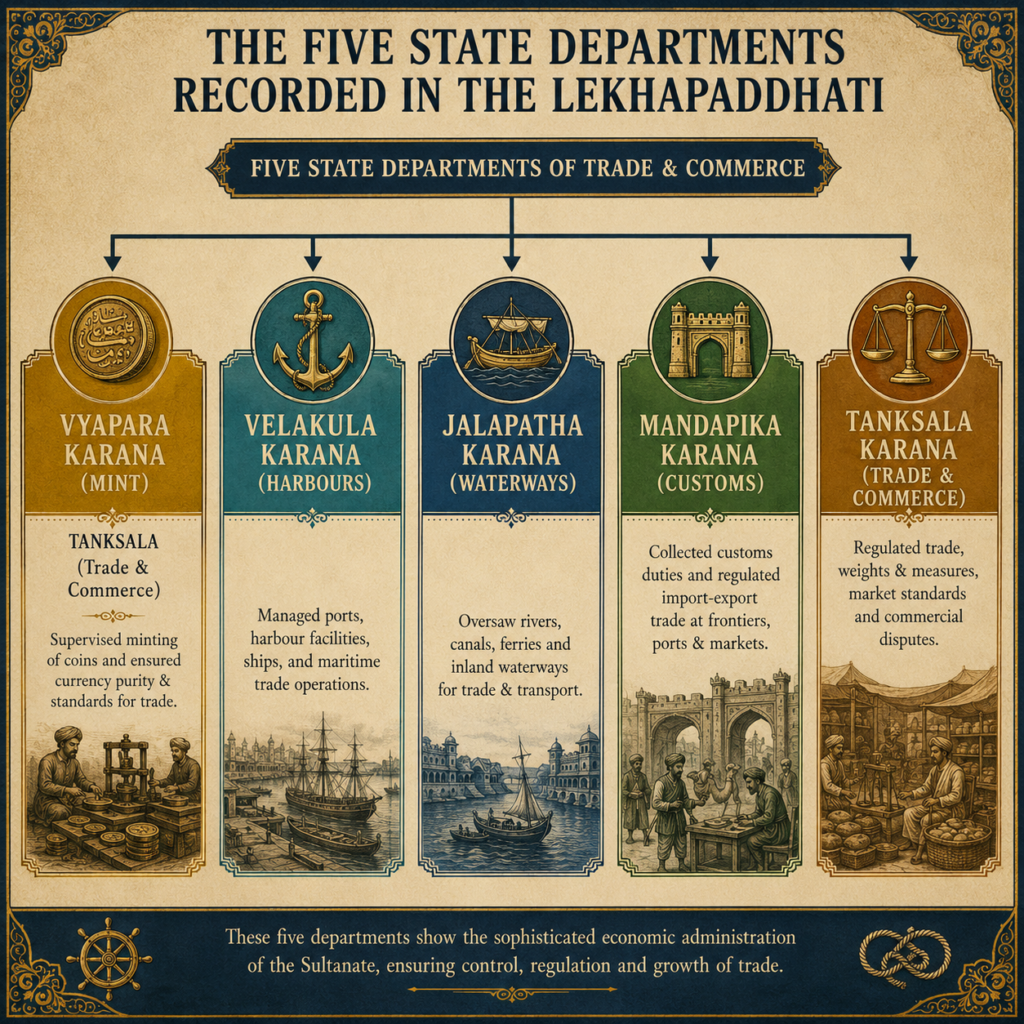
- The Lekhapaddhati refers to five departments of the state relating to trade and commerce:
- Vyapara karana — the department of trade and commerce.
- Velakula karana — the department of harbours.
- Jalapatha karana — the department of waterways.
- Mandapika karana — the department of customs.
- Tanks sala — the mint.
- What makes the Lekhapaddhati invaluable is its close correspondence with the contemporary inscriptions of the Chaulukya kings of Gujarat, who ruled from the 10th to the 13th century.
Sureties for Loans
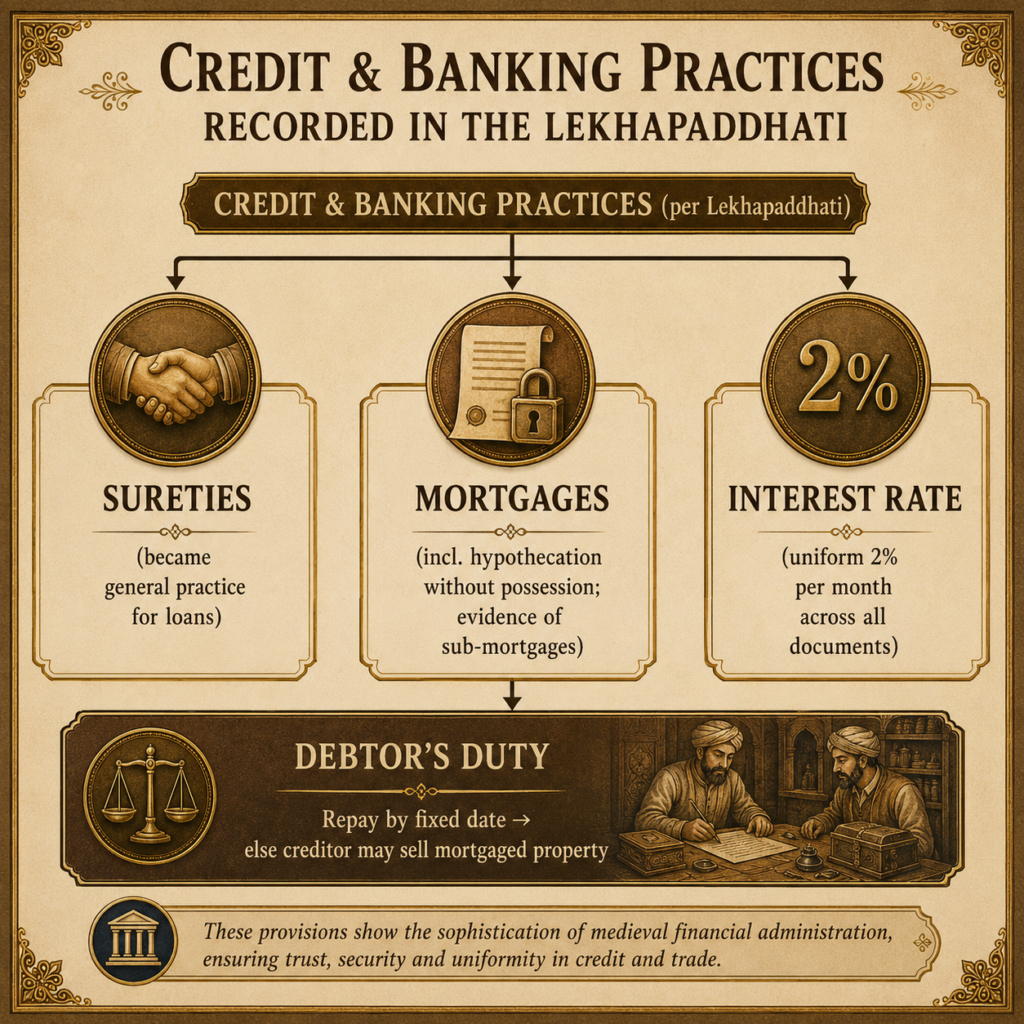
- From the Lekhapaddhati, it appears that the practice of requiring sureties for loans had become general during this period.
Credit and Banking
- The Lekhapaddhati discusses money-lending as one of the major activities of merchants, and emphasises the duty of the debtor to repay on or before a certain date — after which the creditor could sell the mortgaged property to recover the amount due.
- It mentions different kinds of mortgages, one of which may be termed hypothecation without possession. It also provides significant evidence for the law concerning sub-mortgages.
- All the Lekhapaddhati documents specify 2% per month as the rate of interest.
Coinage System
- The text refers to the different types of coins, including a variety of dramas used for cash transactions.
(B) Society
Slavery
- The Lekhapaddhati tells us that slavery was widely prevalent in Gujarat.
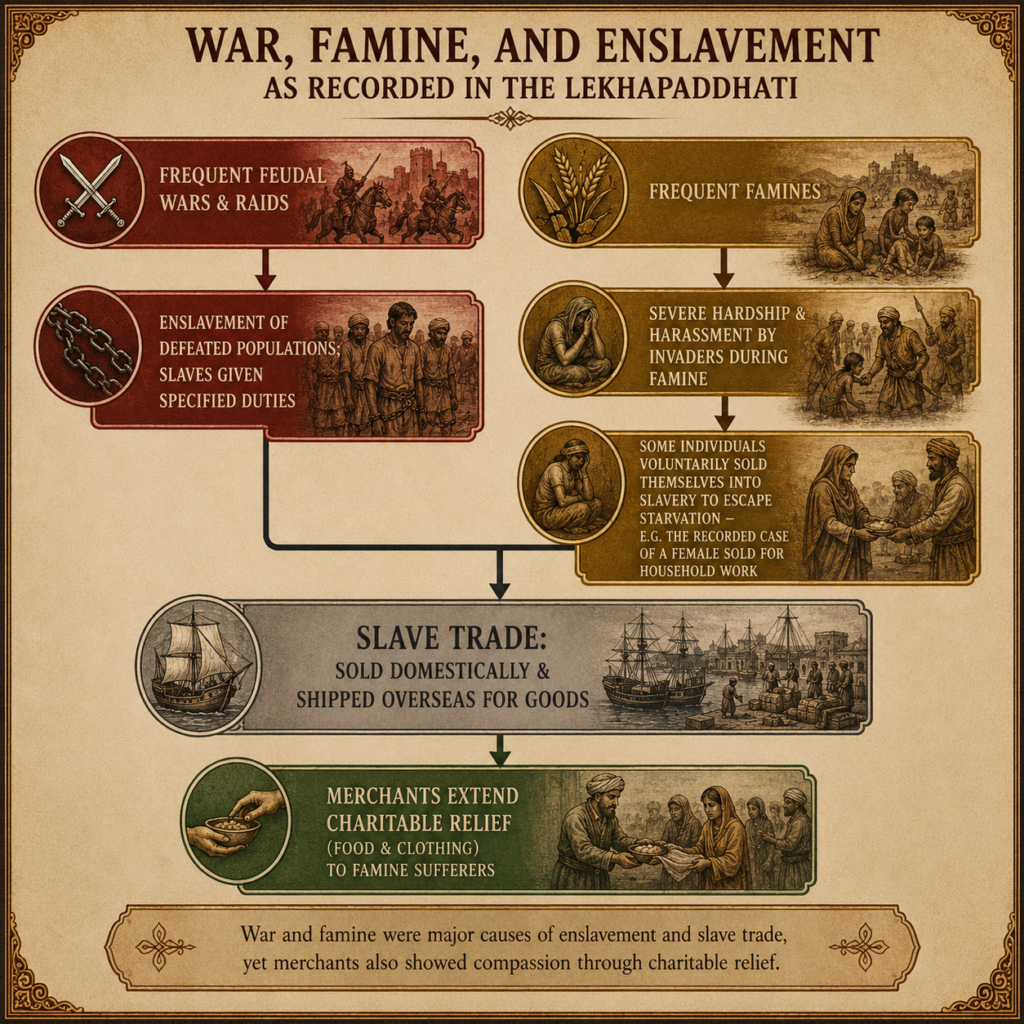
- It records that frequent feudal wars and raids led to the enslavement of the people of the defeated country.
- It also mentions the duties of different types of slaves.
- In one case, there is a reference to the sale of a female who voluntarily chose to become a slave, in order to escape severe famine and harassment by invaders — she was kept for household work.
- Trade in slaves also finds mention in the Lekhapaddhati. It refers to slaves being shipped overseas, and sold for other commodities.
Famines
- The evidence from the Lekhapaddhati shows that famines occurred frequently, and that merchants extended charitable help to the sufferers, in the form of food and clothing.
Conclusion
The Lekhapaddhati, though a modest and practical manual of legal documentation rather than a conventional historical chronicle, offers a uniquely direct and unembellished window into the economic and social realities of 13th-century Gujarat. Its detailed record of state departments overseeing trade, harbours, waterways, customs, and minting, alongside its precise documentation of credit practices, mortgage law, and interest rates, reveals an economy of considerable administrative sophistication — one closely corroborated by the surviving inscriptions of the Chaulukya dynasty. At the same time, its unflinching testimony on the prevalence of slavery, the enslavement of populations through war and voluntary distress sale, and the recurrence of famine, reminds us that this administrative sophistication coexisted with genuine social hardship. Together, these features make the Lekhapaddhati an indispensable, if underutilised, primary source for reconstructing the economic and social history of early medieval western India.