Painting, Music, and the Evolution of Composite Culture in the 13th and 14th Centuries

- Alongside the well-documented growth of architecture, the Delhi Sultanate period also witnessed important, if less obvious, developments in painting and music — art forms whose history remains considerably more obscure, but which nonetheless reveal a genuine process of Persian–Indian cultural fusion.
- This article examines these two art forms in turn, before situating them within the broader evolution of a composite culture during the 13th and 14th centuries — tracing how conflict and cultural accommodation unfolded together across architecture, literature, music, and religion.
Painting
- The history of painting during the Sultanate period is genuinely obscure compared with that of architecture — largely because no surviving specimens exist from at least the first hundred years following the Delhi Sultanate’s establishment.
- Equally surprising is the apparent absence of illuminated books, an art form that had reached supreme heights across the wider Islamic world by 1200.
- However, research over the last 20–25 years has unearthed significant new evidence, forcing scholars to radically revise their earlier views — it is now clear that both book illumination and murals were indeed produced during the Sultanate period.
- Genuine examples of court painting from the Sultanate remain rare, though there is little doubt that the new culture brought by the Sultanate’s rulers had already begun influencing the classical Indian style during this period.
- Traditions of calligraphy, book illumination, and figural murals were already well established across the Islamic world; the early Turkish Sultans carried these traditions to Delhi, where they flourished through the 13th and 14th centuries.
- Sultanate painting, overall, reflects a genuine attempt to achieve a fusion of newly introduced Persian and traditional Indian styles — visible in the few scattered surviving works of the age.
- These works range from illustrated historical poems of Amir Khusrau Dihlavi and the epic of Firdausi, to folk tales glorifying an early Muslim hero filled with missionary zeal.
- In these illustrations, scenes are portrayed in a relatively simple manner, though the colour scheme remains genuinely bold and attractive.
- One of the earliest known examples dates from the 15th century — a copy of the Shahnama (“Book of Kings”), produced under Lodi rule, bearing a close relationship to contemporary Jain painting.
- Indian-influenced features in Delhi Sultanate paintings include:
- Groups of figures standing in rows, arranged in identical poses.
- Narrow decorative bands running across the full width of the painting.
- Bright, unusual colours, replacing the more muted hues typical of contemporary Timurid painting.
- The illustrated manuscript of the Niamat Namat (early 16th century), for instance, shows a clear fusion of Persian and Jain stylistic elements — many illustrated manuscripts of this period more broadly show the influence of Jain and Rajasthani painting styles.
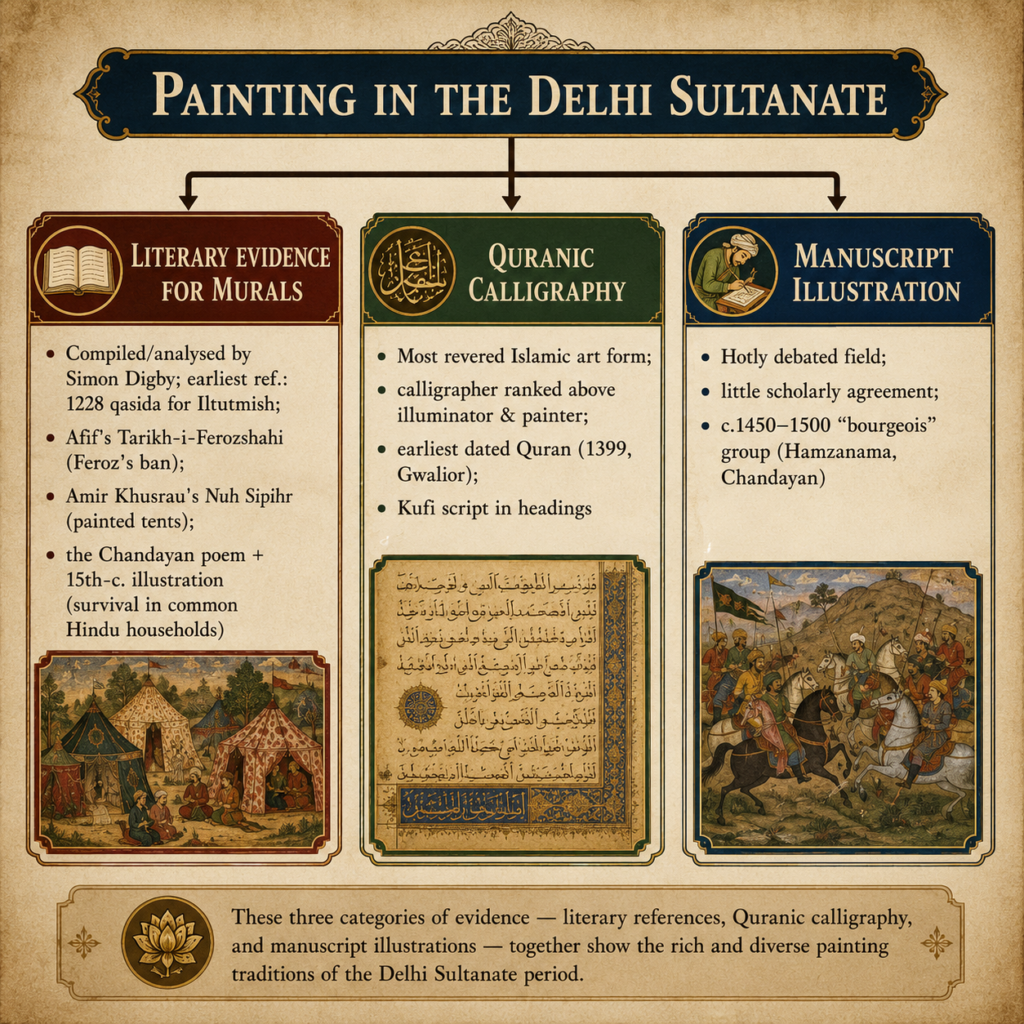
- The art of painting from this period may usefully be divided into three categories: literary evidence for murals, Quranic calligraphy, and manuscript illustration.
Literary Evidence for Murals
- A substantial body of literary references to murals appears scattered across the chronicles of this period — references that have been carefully compiled and analysed by the historian Simon Digby.
- The earliest known reference to murals in the Sultanate period appears in a qasida (in the Tabaqat-i Nasiri) composed in praise of Iltutmish, on the occasion of receiving a khilat (robe of honour) from the Caliph in 1228.
- The verses of this composition make clear that human or animal figures were depicted on the spandrel of the main arch raised to welcome the Caliph’s envoy.
- In the Tarikh-i Ferozshahi of Afif, the single most important reference to painting in the Delhi Sultanate occurs in the context of the un-Islamic observances of earlier rulers, which prompted a formal ban by Feroz Tughluq.
- This reference indicates the existence of a continuous tradition of figural painting on the walls of Delhi’s palaces — a tradition Feroz Tughluq specifically sought to suppress.
- The Nuh Sipihr of Amir Khusrau contains a reference to entertainment parties hosted by Qutbuddin Mubarak Khalji, describing decorations on a painted, open-sided tent — indicating that this artistic tradition was not confined to murals alone.
- The tradition of wall painting also survived within the homes of common people, particularly non-Muslims, as attested by two pieces of evidence:
- A stanza from the 14th-century Hindi poem Chandayan, written by Maulana Daud in 1379–80, which describes the painted decoration of the upper rooms of the house where Chanda, the poem’s leading lady, sleeps with her female companions.
- An actual surviving painting from a 15th-century illustrated manuscript of this same poem, depicting Chanda’s bedchamber, its walls painted with scenes from the Ramayana.
The Quranic Calligraphy
- Calligraphy was the single most revered art form across the Islamic world, employed as a decorative feature on both stone and paper.
- Within the hierarchy of craftsmen, a calligrapher ranked above both the illuminator and the painter.
- The calligraphy of the Quran became one of the foremost forms of book art, with copies produced on a genuinely majestic and expansive scale.
- The earliest known copy of the Quran from this period is dated 1399, calligraphed at Gwalior, featuring a variety of ornamental motifs drawn from both Iranian and Indian sources.
- The geometrical frontispiece of this manuscript appears to reflect the Sultanate style, suggesting several prominent features of the Delhi ateliers of the 14th century:
- The overall work produced reflects the broader Iranian tradition.
- The script used in headings and inscriptional panels is invariably Kufi.
- The illumination of geometrical frontispieces was a genuine speciality of this school.
- The overall state of book art declined considerably during the 15th century, under the Sayyid and Lodi dynasties, remaining a rather sad shadow of its former self — artistic initiative appears to have shifted instead to the various provincial dynasties.
Manuscript Illustration
- Manuscript illustration during the Sultanate period remains a genuinely hotly debated and disputed subject, with very little scholarly agreement on either terminology or provenance — making the task of characterising Sultanate manuscript illustration a genuinely cumbersome one.
- A good number of illustrated manuscripts in Persian and Awadhi, dating from the period between 1400 and the arrival of the Mughals, are now known — though some of these appear to have been produced at provincial courts rather than Delhi itself.
- There is, however, a distinct — if small — group of manuscripts likely not connected to any court, apparently produced instead for independent patrons located somewhere within the Sultanate.
- This group is sometimes termed a “bourgeois” group, attributable to the period 1450–1500. Examples include:
- Hamzanama: dated to roughly 1450, depicting the legendary exploits of Amir Hamza, a companion of the Prophet.
- Chandayan: datable to 1450–70, illustrating the romance of the two lovers Laur and Chanda, composed in the Awadhi dialect of Hindi by Maulana Daud of Dalmau, near Rai Bareilly.
- This group is sometimes termed a “bourgeois” group, attributable to the period 1450–1500. Examples include:
- There is, however, a distinct — if small — group of manuscripts likely not connected to any court, apparently produced instead for independent patrons located somewhere within the Sultanate.
Jain and Caurapancasika Styles of Painting
(“Discuss the Caurapancashika and Jain styles of paintings.”)
Jain Styles of Painting
- The Western Indian style of painting, also known as Jaina painting, represents a highly conservative style of Indian miniature painting, prevailing across Gujarat, Rajasthan, and Malwa.
- The motivating force behind artistic activity in Western India was Jainism, much as Buddhism had driven the art of Ajanta and the Pala tradition.
- Jainism enjoyed patronage from the Chalukya dynasty, ruling Gujarat and parts of Rajasthan and Malwa from 961 AD to the end of the 13th century; an enormous number of Jain religious manuscripts were commissioned between the 12th and 16th centuries by princes, ministers, and wealthy Jain merchants, largely to earn religious merit.
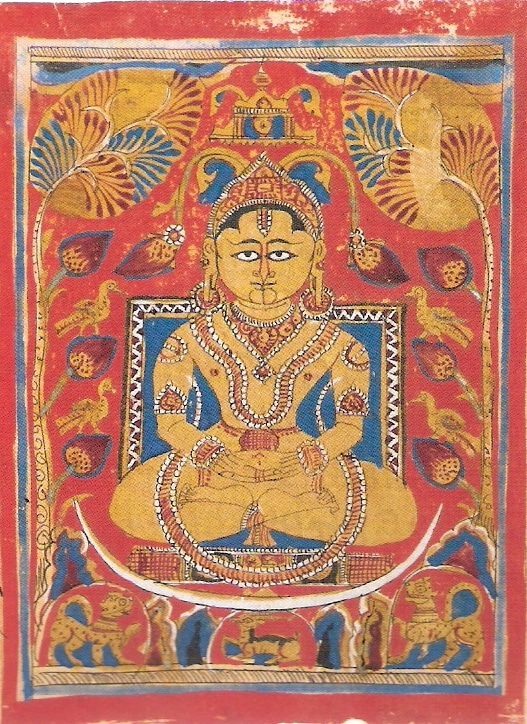
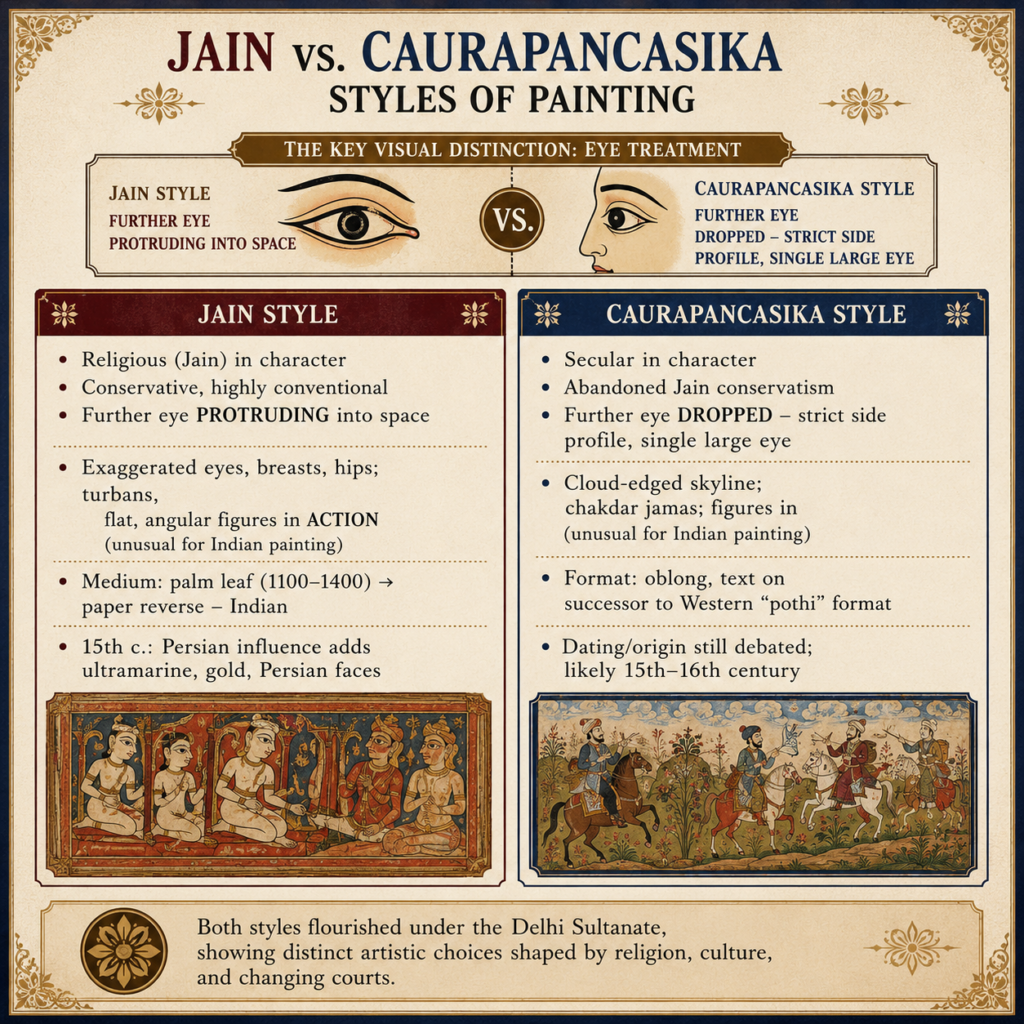
- Jain manuscript illustrations follow a style of genuine vigorous distortion:
- Certain physical traits — eyes, breasts, hips — are deliberately exaggerated.
- Figures appear flat, with angular features, and the further eye is shown protruding into space — an art marked by primitive vitality, forceful line, and bold colour.
- The school as a whole favours simple, bright colours, highly conventionalised figures, and wiry, angular drawing; the naturalism characteristic of earlier Indian wall painting is entirely absent.
- Figures are typically shown from a frontal view, with the head rendered in profile — the characteristic pointed-nose facial type relates directly to that found in the Ellora wall paintings (mid-8th century), and remains remarkably close to contemporary medieval sculpture.
- Western Indian painting exerted considerable influence on the later development of Indian painting, particularly the Rajasthani schools of western and central India.
- From roughly 1100 to 1400 AD, palm leaf remained the standard manuscript medium, with paper introduced only later. Two especially popular Jain texts — the Kalpasutra and the Kalakacharya-Katha — were repeatedly written and illustrated with paintings.
- During the 15th century, the Persian style began influencing Jaina painting, visible in the appearance of Persian facial types and hunting scenes on the borders of some illustrated Kalpasutra manuscripts.
- The introduction of ultramarine blue and gold colour into Western Indian manuscripts is likewise believed to reflect Persian influence.
Caurapancasika Style of Painting
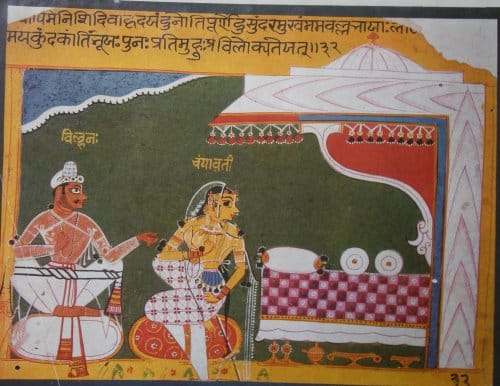
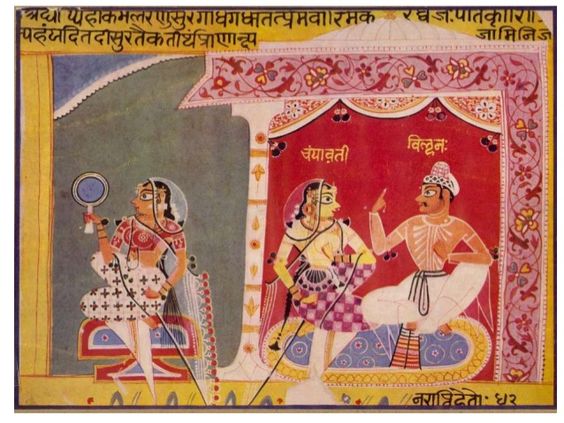
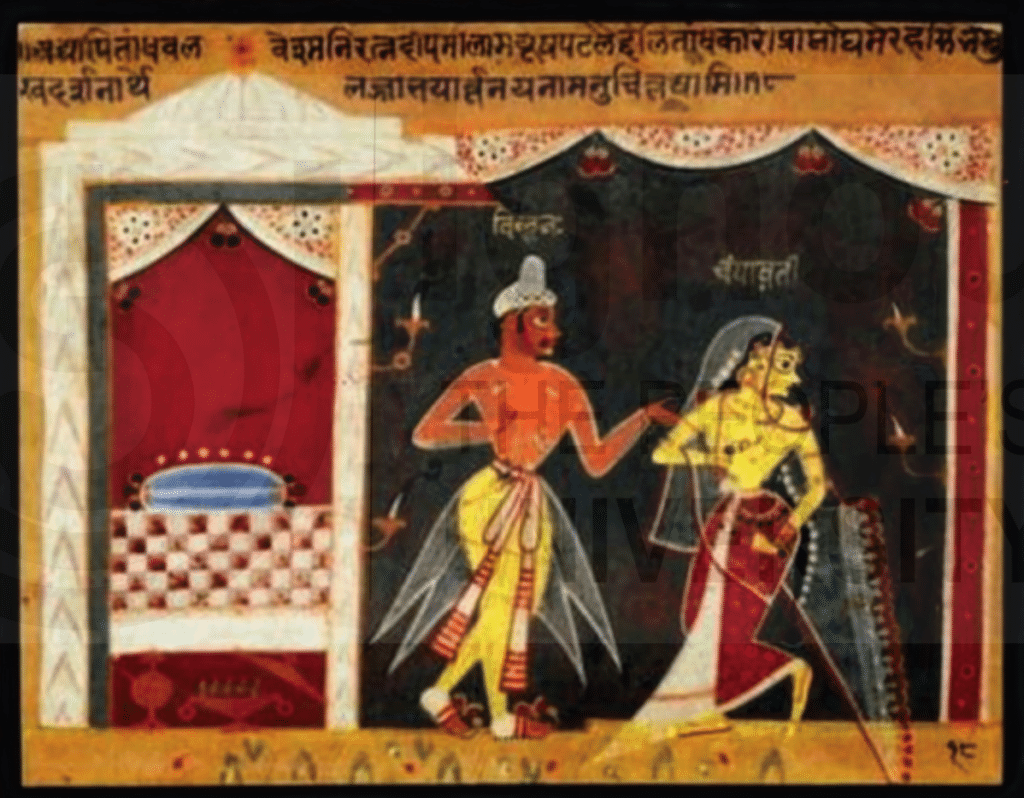
- The Caurapancasika (“Fifty Stanzas of a Love-Thief”) is a Sanskrit love poem composed by the Kashmiri poet Bilhana, working at the Kalyana court in the late eleventh century.
- The poem describes a poet recalling his shared passion with a royal princess, in whose household he had served, as he awaits imminent execution for loving above his social station.
- These genuinely poignant verses later inspired a series of manuscript paintings, probably dating to the 15th and 16th centuries — works less purely decorative or anecdotic in character than earlier styles, though paintings designated as “Caurapancasika” are often only loosely connected to the original text.
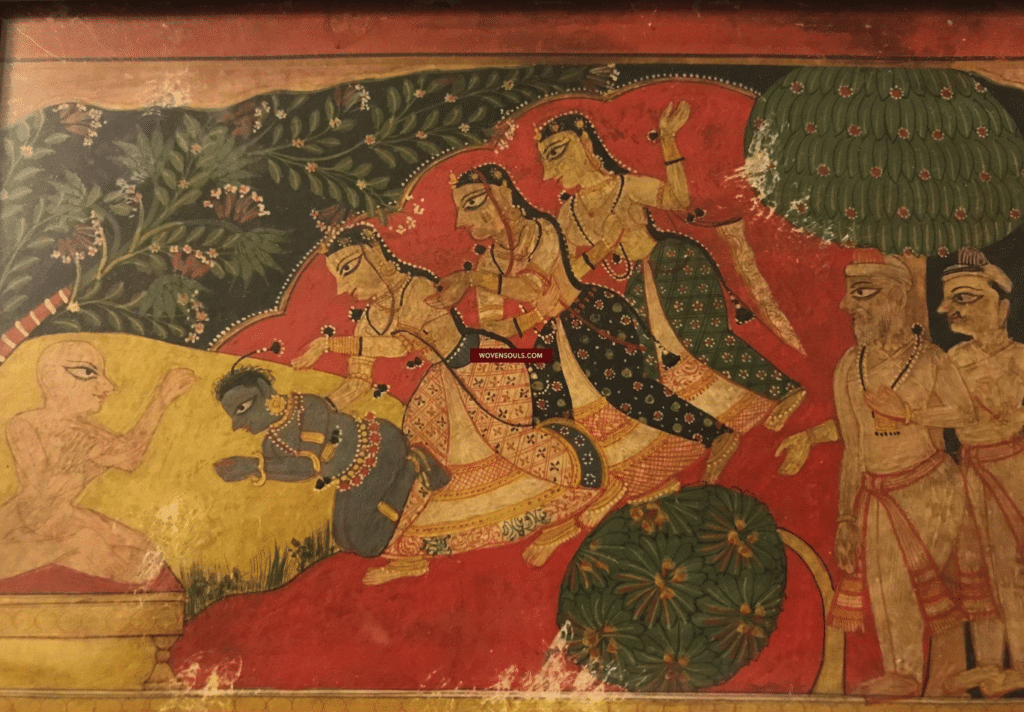
- These manuscript paintings gave rise to the broader term “Caurapancasika style” of painting — a style that abandoned the conservative character of the Jaina tradition, and was, unlike Jaina painting, essentially secular in nature.
- The precise origin and dating of manuscripts illustrated in this style remains a matter of genuine scholarly debate; the style appears to have developed only once painters had discovered how to turn the human head into strict profile, dropping the earlier convention of the “further projecting eye.”
- Characteristics of the Caurapancasika style include:
- Flat, intense colour; profile heads with strikingly pronounced eyes; a cloud-edged skyline; and detailed depiction of turbans and chakdar jamas.
- Paintings remain within a single plane, set against backgrounds in brilliant primary colours — the style is recognised for its expressive beauty, its dramatic use of colour, and the sheer richness of painterly imagination.
- Nearly all paintings in this style follow an oblong format, with accompanying text written on the reverse — in this sense, they are direct successors to the earlier pothi format of the Western Indian style.
- The protruding further eye of the Western Indian style gives way here to an uncompromising side view, with a single, very large eye.
- On occasion, a human figure is caught genuinely in action — an unusual attachment to movement within Indian painting more broadly; few Indian paintings rival the sheer vitality of the finest Caurapancasika examples.
Note on the Pothi Format
- Pothis were traditional Indian manuscripts made from dried palm leaves, bound between wooden covers, and preserved in temple libraries (bhandaras) — the wooden covers, slightly wider than the leaves themselves, served to protect them.
- Since the pothi format had already been in use across India since ancient times, the Caurapancasika style cannot accurately be described as its true precursor — rather, Caurapancasika paintings are properly understood as successors to the earlier pothi format of the Western Indian style.
Music
- Trends toward mutual understanding and cultural integration during this period are visible not only in religious belief, architecture, and literature, but equally in the fine arts, particularly music.
- Even so, the development of music as an art form under the Delhi Sultanate took a genuine back seat compared with the parallel growth of architecture and painting.
- When the Turks arrived in India, they brought with them the rich Arab musical tradition, further developed across Iran and Central Asia.
- They introduced a number of new musical instruments, such as the rabab and sarangi, along with new musical modes and formal regulations.
- Indian music, and Indian musicians present at the Caliph’s court in Baghdad, had likely already influenced musical development there — but genuinely systematic contact between the two traditions began only in India, under the Sultanate.
- The history of music during this period suffers, however, from a serious documentary handicap: historical references remain scattered and scanty, and much modern writing on the subject leans toward the speculative rather than the historically substantive, often replete with fables and legends about Sultanate-era music.
- The 14th century stands out as perhaps the single most important period in Delhi Sultanate music history.
- That music, in some form, was practised at the courts of the early Sultans seems entirely plausible.
- Kaiqubad built himself a magnificent palace at Kilugarhi, where courtly revels featured dancing and the singing of Persian and Hindi songs by accomplished female performers.
- Balban actively encouraged the establishment of a formal society of dancers and musicians.
- Alauddin Khalji patronised notable musicians such as Gopal Nayak and Amir Khusrau.
- That music, in some form, was practised at the courts of the early Sultans seems entirely plausible.
The Musical Contributions of Amir Khusrau
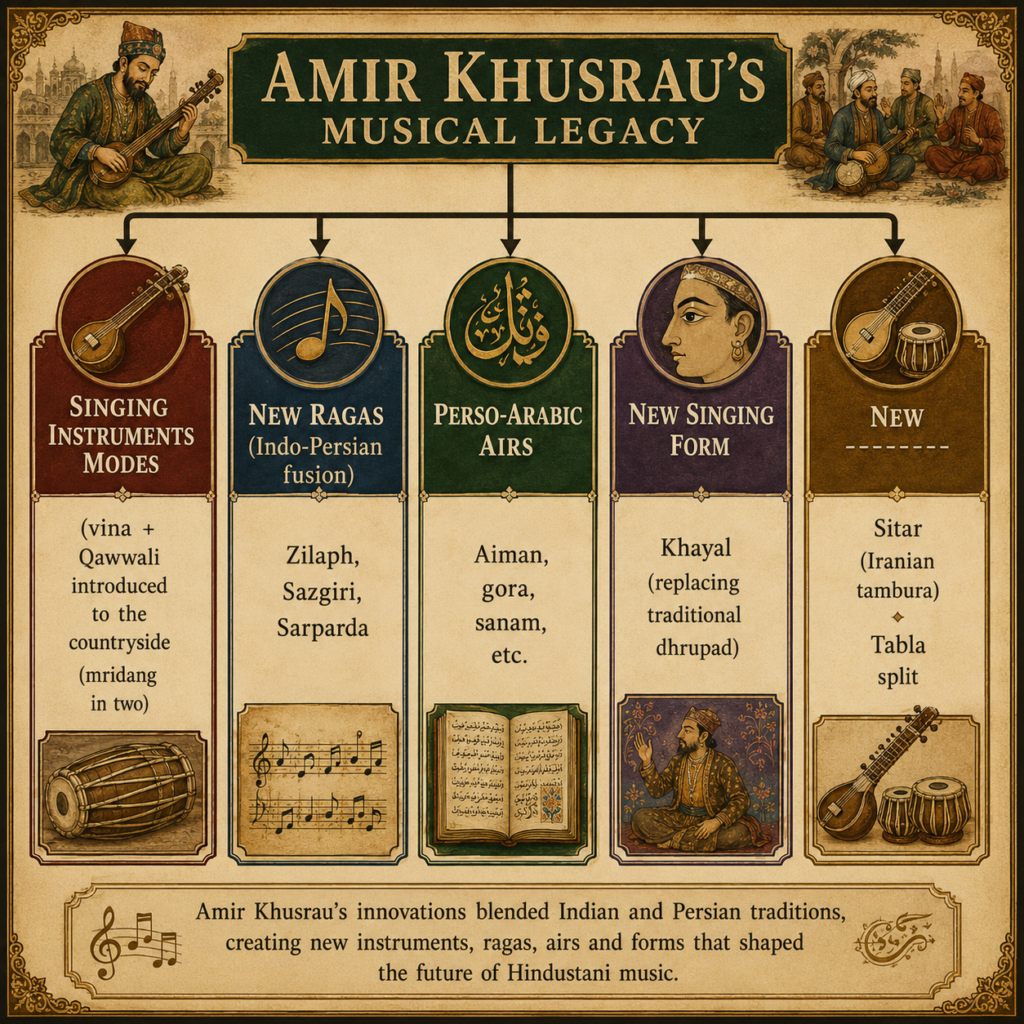
- It was Amir Khusrau who left the single most enduring mark on the music of the Sultanate — and, indeed, of India as a whole.
- Khusrau was formally given the title nayak, “master” of both the theory and practice of music.
- He was a disciple of the great Sufi saint Shaikh Nizamuddin Auliya of Delhi, and served as court poet under Alauddin Khalji, who was himself genuinely devoted to music.
- Khusrau’s musical genius was chiefly directed toward innovating new compositions, and toward assimilating diverse musical forms current in his own time.
- Amir Khusrau is credited with a remarkable range of musical innovations:
- Introducing the qawwali mode of singing into the wider countryside for the first time.
- Developing several modern ragas, such as Zilaph, Sazgiri, and Sarparda, by combining Persian and Indian musical tunes.
- Introducing numerous Perso-Arabic airs (ragas), such as aiman, gora, and sanam.
- Introducing the khayal form of singing, moving away from the traditional dhrupad.
- Creating a new musical instrument, the sitar, by combining the older Indian vina with the Iranian tambura.
- Modifying the conventional percussion instrument mridang, bifurcating it into two separate drums that came to be called the tabla.
- The changes Amir Khusrau introduced carried genuinely far-reaching social consequences, helping to bring together people of two divergent creeds through their shared appreciation of music.
Music under Later Rulers
- Although music was formally banned during Ghiyasuddin Tughluq’s reign, it was actively encouraged under Muhammad Tughlaq.
- The broader process of musical integration continued under Firuz Tughlaq — the classical Indian musical treatise Ragadarpan was translated into Persian during his reign.
- Musical gatherings gradually spread beyond the abodes of the Sufis into the palaces of the nobility. Sultan Husain Sharqi, ruler of Jaunpur, proved a genuinely great patron of music.
- The Sufi saint Pir Bodhan is regarded as the second great musician of the age, after Khusrau himself.
- Gwaliyar emerged as another regional kingdom where music was cultivated to a high degree.
- Raja Man Singh of Gwaliyar was a genuine music lover, under whose patronage the treatise Man Kautuhal — cataloguing all the new musical modes introduced by Muslim musicians — was compiled.
- The musical modes of North India gradually began to diverge from those of the South, largely due to the incorporation of Perso-Arabic modes, airs, and scales.
- A genuinely distinctive musical style, substantially shaped by Persian music, developed within the kingdom of Kashmir.
- After conquering Jaunpur, Sikandar Lodi continued its established tradition of lavish musical patronage — a tradition further developed by subsequent Afghan rulers.
- Adali, a successor of Sher Shah, was himself a great master of music — though music would ultimately come fully into its own only under the later Mughals.
- Overall, the development of art and architecture under the Delhi Sultanate followed a genuinely uneven pattern: while architecture occupied the paramount position, other art forms such as painting and music received comparatively less sustained attention — much of the era’s broader artistic impulse instead found expression in architecture itself, enriching it both structurally and stylistically.
Evolution of a Composite Culture
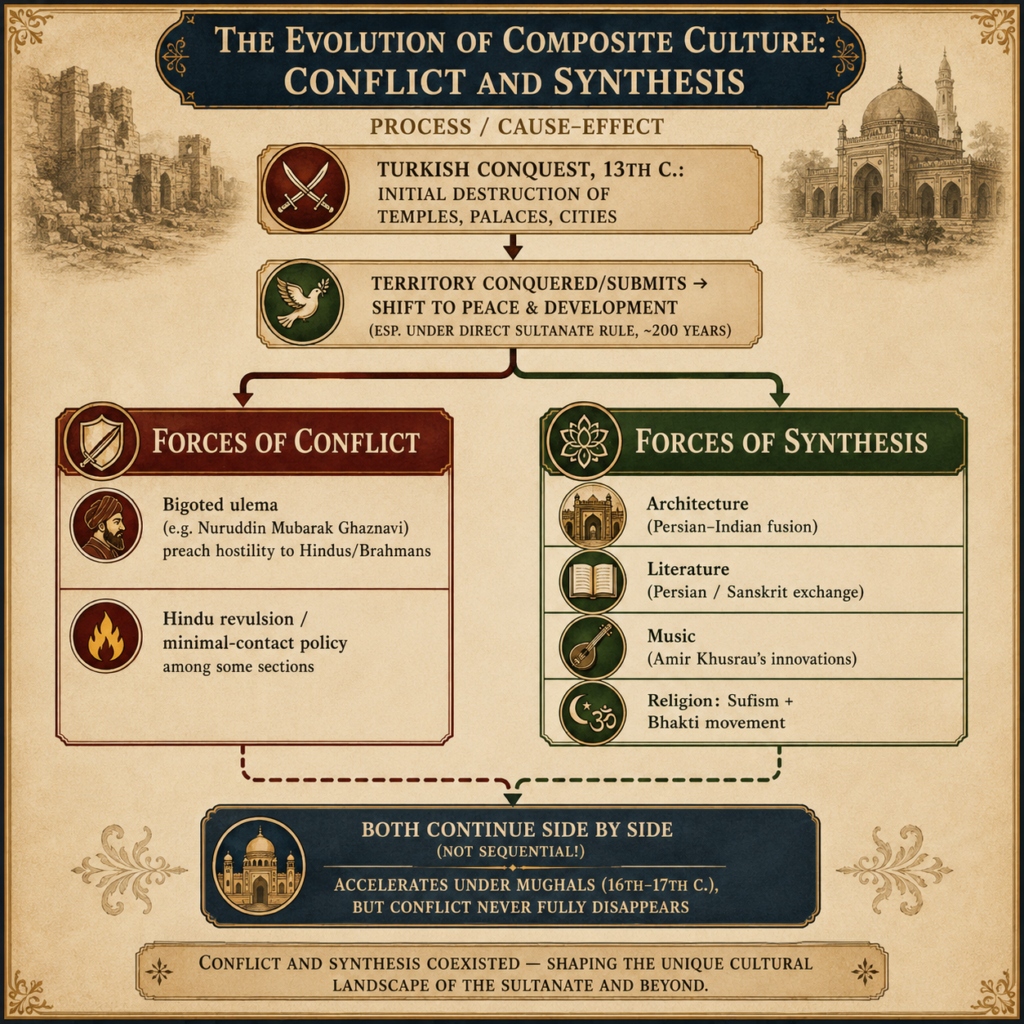
- The arrival of the Turks in India, and the establishment of the Delhi Sultanate during the 13th century, marked a period of both genuine turmoil and development.
- The initial phase involved widespread death and destruction, with many beautiful temples destroyed and numerous palaces and cities ravaged — a process that continued, in phases, as the empire expanded.
- Once a given territory had been fully conquered, or had formally submitted, however, a corresponding process of peace and development would begin. This process unfolded gradually in northern India, where large areas remained under direct Sultanate rule for some 200 years.
- Having arrived from Central Asia during the 8th century, the Turks had, over time, embraced Islam, thereby inheriting the broader Islamic culture of the region — sharing the cultural and administrative norms established under the Abbasids, with only minor local adjustments.
- The Turks who came to India considered themselves not only champions of Islam, but proud inheritors of its rich intellectual tradition — whether in architecture, literature, governance, or science and technology. They had also adopted Persian, by then firmly established as the language of government and culture across Central Asia.
- The Hindus, in turn, were themselves inheritors of a religious and cultural tradition that had evolved over thousands of years.
- The 4th and 5th centuries are often regarded as the period of India’s cultural and scientific climax. In the centuries that followed, even as India began to fall behind in certain scientific fields, and original creative thinking gradually diminished, its broader cultural traditions remained genuinely alive.
- Recent scholarship shows that the period from the 8th to the 12th century was by no means a period of pure cultural decline, but rather one marked by considerable building activity, particularly in temple architecture.
- Magnificent temples were constructed at Khajuraho (Bundelkhand), across Orissa, and at sites such as Mathura, Kashi, and Dilwara — all reflecting a genuinely high level of architectural and sculptural skill.
- This period also saw important developments in religion and philosophy: Shankara decisively shaped the philosophy of Vedanta, while a devotional movement centred on love and devotion to a personal God emerged in South India.
- Genuine contact between Hinduism, Buddhism, and Islam had, in fact, begun well before Islam’s arrival in India — though this interaction quickened considerably following Islam’s establishment on the subcontinent.
- It remains important, even so, to distinguish the political dimension of Turkish rule from its religio-philosophical dimension, even where the two clearly overlapped in practice.
- Certain bigoted ulema — such as Nuruddin Mubarak Ghaznavi, at Iltutmish’s court — actively advocated a policy of inveterate hostility toward Hindus, particularly Brahmans, whom they regarded as the greatest enemies of the “true faith.”
- A corresponding section of Hindu society, in turn, harboured real loathing and revulsion toward Muslims, adopting a deliberate policy of minimal contact.
- Despite these genuine obstacles — and the seemingly irreconcilable theological gulf between Islam’s strict monotheism (rejecting all deities other than Allah) and Hinduism’s acceptance of unity in diversity, multiple deities, and image worship (which Islam firmly rejected) — a slow process of mutual adjustment and rapprochement nonetheless began to take hold.
- This process is visible at work across the fields of architecture, literature, and music examined above, and equally in the sphere of religion — through the entry of Sufism into India, and the parallel growth of the Bhakti movement in North India.
- This process of synthesis continued steadily through the fifteenth century, gathering further momentum during the 16th and 17th centuries under the Mughals.
- It would, however, be genuinely mistaken to assume that the underlying elements of conflict simply vanished during this process.
- Both conflict and the broader process of rapprochement continued to operate side by side — subject to real setbacks under certain rulers and in certain regions, even as development proceeded more rapidly elsewhere. The elements of conflict and accommodation, in short, must always be assessed together, in proper historical perspective.
Conclusion
- Though painting and music never rivalled architecture as the Delhi Sultanate’s flagship art forms, both reveal the same underlying dynamic that shaped the era as a whole — a genuine, if uneven and often contested, process of Persian–Indian cultural fusion, visible in the Jain-influenced Shahnama illustrations, in the secular vitality of the Caurapancasika style, and in Amir Khusrau’s enduring musical innovations (the sitar, the tabla, the qawwali, and khayal).
- This same dynamic defines the broader evolution of composite culture during the 13th and 14th centuries: an initial phase of genuine conquest and destruction, followed by a slow, uneven, but ultimately sustained process of mutual accommodation across architecture, literature, music, and religion — one that would continue to deepen under the Mughals, even as underlying tensions between conquerors and conquered never fully disappeared.