

Government and Administration under the Delhi Sultanate

The Delhi Sultanate, as a political system, was shaped fundamentally by its historical experience of being part of the wider Islamic world, even as it changed and evolved in response to India’s own needs and circumstances. Two structural realities had an important bearing on the nature of the Turkish state: the Turks were far fewer in number than the indigenous population they sought to govern, and they lacked resources of their own. Consequently, the administrative machinery that evolved under the Sultanate drew heavily on the Abbasid, Ghaznavid, and Seljukid systems, on the Iranian tradition of monarchy, and on existing Indian administrative traditions — while also generating genuinely new institutions, such as the iqta system, that provided an unprecedented basis for the centralisation of power in India. This article examines the various historiographical interpretations of the nature of the Sultanate state, the structure of its central administration, its revenue system, the iqta and provincial administration, and finally, the evolving theory of kingship across the Sultanate’s major dynasties.
Influences on the Administrative System
- The machinery of administration under the Delhi Sultanate was derived from the Abbasid, and following it, the Ghaznavid and Seljukid systems of administration.
- It was also influenced by the Iranian system of administration, as well as by the situation in India and Indian traditions. Both West Asia (including Iran) and India shared a long tradition of rule by a monarch assisted by a council of ministers.
- Hence, some departments of government, or even specific offices, were essentially old institutions under new names.
- However, the Turks were also able to evolve a number of new institutions and concepts, which provided the basis for a centralisation of power and authority of a type that had not existed in India earlier.
The Nature of the Delhi Sultanate State
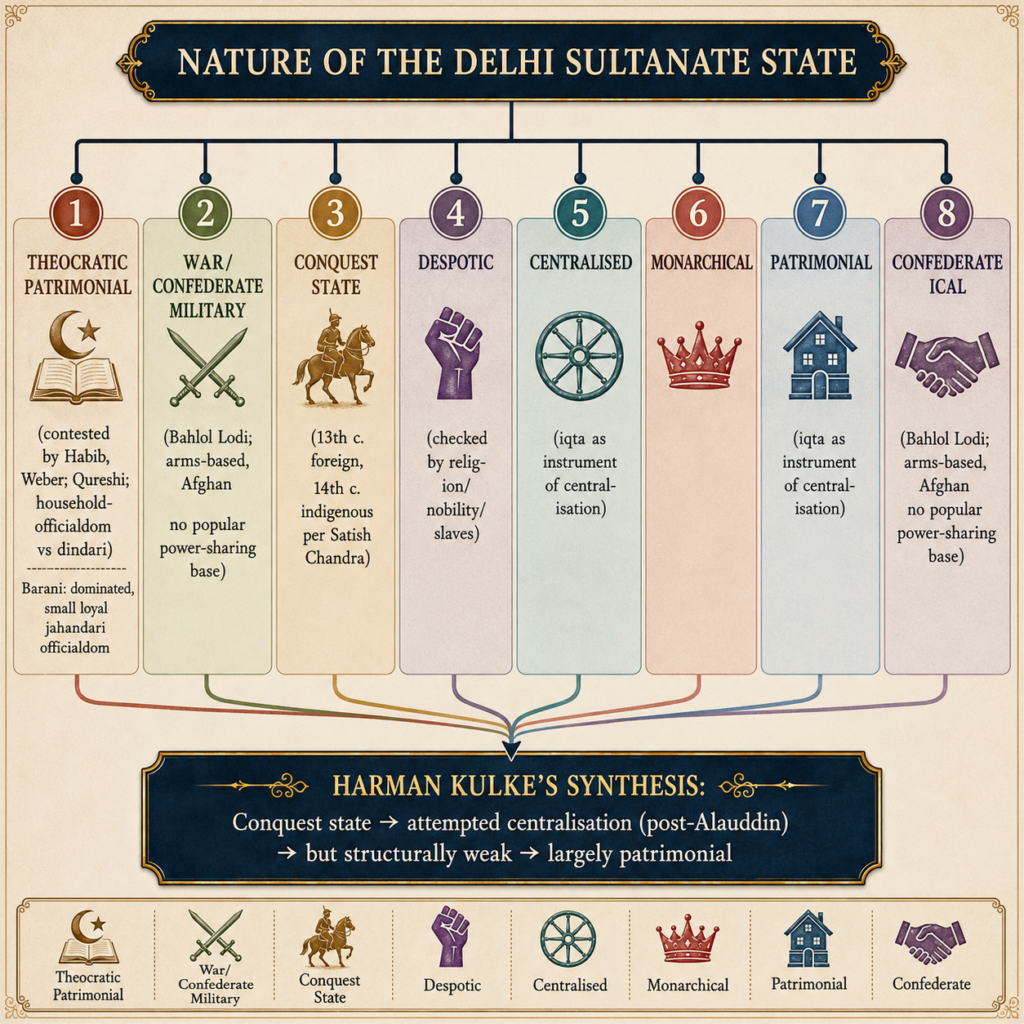
Historians have offered different interpretations for explaining the nature of the Delhi Sultanate.
Theocratic State
- Historians such as Aarti Tripathi, Ishwari Prasad, and A.L. Shrivastava present this view, based on:
- Rule based on the shariat.
- Islam as the state religion.
- The influence of the Ulemas.
- The Sultans’ formal allegiance to the Caliph.
- The imposition of Jaziya on non-Muslims.
- The destruction of temples.
- A social order in which Muslims formed a privileged class (“Millets”), while non-Muslims held a subordinated status (“Zimmis”).
- Historians such as Md. Habib and I.H. Qureshi question this view, arguing that:
- The shariat was not the core basis of rule, and the Ulemas were not a dominant element in the overall political system.
The More Widely Accepted View
- Historians such as Satish Chandra have presented a comprehensive analysis, concluding that, in theory or principle, the Sultanate was an Islamic state, but in practice, it showed several deviations:
- The basis of rule was more political than religious.
- Wars were not religious wars, but politico-military in nature.
- The Sultans, though Muslim, did not act as missionaries.
- The Ulemas were not an important entity in the political system, and their views were frequently negated — for instance, by Alauddin Khalji and Muhammad Bin Tughluq.
- Several unislamic practices and customs were adopted, such as Sijda and Pabos, introduced by Balban.
- There was no policy of forced conversion, and Hindus in general enjoyed freedom.
- The destruction of temples occurred more often in situations of political hostility — that is, it was more a political than a purely religious issue.
- The Sultans were sovereign in their own right; the relationship with the Caliph was merely a formal link.
- As per Barani’s observation, the Delhi Sultanate was placed under the category of Duniyadari (worldly/secular governance).
- In a theoretical and formal sense, the Delhi Sultans recognised the supremacy of Islamic law (shariah), and tried to prevent its open violation. But they had to supplement it with secular regulations (zawabit) as well.
- The needs of the emergent state shaped many policies and practices, not always consistent with Islamic fundamentalism — one view holds that the Turkish state was, in theory, a theocracy, but in practice, a product of expediency and necessity, wherein the needs of the young state assumed paramount importance.
- Ziauddin Barani distinguished between jahandari (“secular”) and dindari (“religious”), and accepted the inevitability of some secular features.
- For example: a sectarian group (Shafai) of Muslim divines approached Iltutmish, asking him to strictly enforce Islamic law — giving Hindus the option of “Islam or Death.” On behalf of the Sultan, the wazir Junaidi replied that this could not be done for the moment, as the Muslims were “like salt in a dish of food.”
- Barani also tells us that when the Qazi (Mughisuddin) pointed out the legalistic position preventing the Sultan from taking the major share of war booty, the Sultan (Alauddin Khalji) emphasised that he acted according to the needs of the state, which were paramount.
- Hence, in practice, the Turkish state was not theocratic, but evolved according to its special needs and circumstances, despite the fact that the main ruling class professed Islam.
War State
- War was a regular feature, necessary to sustain and expand the state — hence, military preparation was always important.
- In medieval times, states in general tended to be war states, since the medieval situation was characterised by conflict; military might and warfare were essential to sustain and survive.
Military State
- There was no popular base, and the state rested exclusively on the force of arms.
- There were separate military departments.
- Policies were often militarily oriented — for example, Alauddin Khalji’s market control, which was designed partly for military purposes.
- The absence of the rule of primogeniture meant that military might played an important role in succession.
Conquest State
- The Sultanate was, in essence, an institutionalised form of foreign conquest.
- This foreign conquest represented conquest by the Turks, under the leadership of Muhammad Ghuri.
- As per Satish Chandra: the 13th century may be characterised as one of foreign conquest, but by the 14th century, the rulers had become increasingly indigenous in political, economic, social, and cultural aspects.
Despotic State
- Rule under the Sultanate was marked by despotism, with the will of the Sultan supreme.
- However, there were checks on despotism — from religion, nobility, and slaves.
- According to Barani, despotism was un-Islamic, and religion served as a check on despotic tendencies.
- The reigns of a few Sultans showed elements of benevolent despotism — such as Jalaluddin Khalji, Ghiyasuddin Tughluq, and Firuz Shah Tughluq.
Centralised State
- This view has been advanced by historians such as Md. Habib and Ishwari Prasad.
- The state system was marked by centralised structures — such as central departments, and political-administrative units under Muqtis, who were in turn controlled by the Sultan.
- The iqta was a main instrument of centralisation.
- However, in certain regimes, trends of decentralisation are also visible — for example, during the rule of weak Sultans, especially Firuz Shah Tughluq.
Monarchical State
- The head of state and government was a monarch.
- The office of the king was all-powerful, with all others subservient to it.
- The king served as the head of justice, commander-in-chief, and supreme legislator.
Patrimonial State
- This view was advanced by Max Weber, the German sociologist.
- As per this view, the Sultanate state was a household-dominated, patrimonial, bureaucratic system.
- Rulers were dependent upon a small number of trained and loyal officials, involved in specialised functions.
- It was, in essence, rule by a household.
Confederate Kind of Union/Confederacy
- This character developed under the rule of Bahlol Lodi.
- It was based on the Afghan concept of political system, characterised by partnership in power — that is, power shared by Afghan chiefs (shared sovereignty).
A Synthesis: Harman Kulke’s View
Given this multiplicity of interpretations — each with its own shortcomings — it is difficult to bind the Sultanate’s nature to any single characterisation. As per Harman Kulke:
- Initially, the Delhi Sultanate was a conquest state.
- After Alauddin Khalji, a serious attempt at centralisation of administration was made.
- But the Delhi Sultanate remained structurally weak, and thus, in essence, largely remained a patrimonial system.
Central Administration
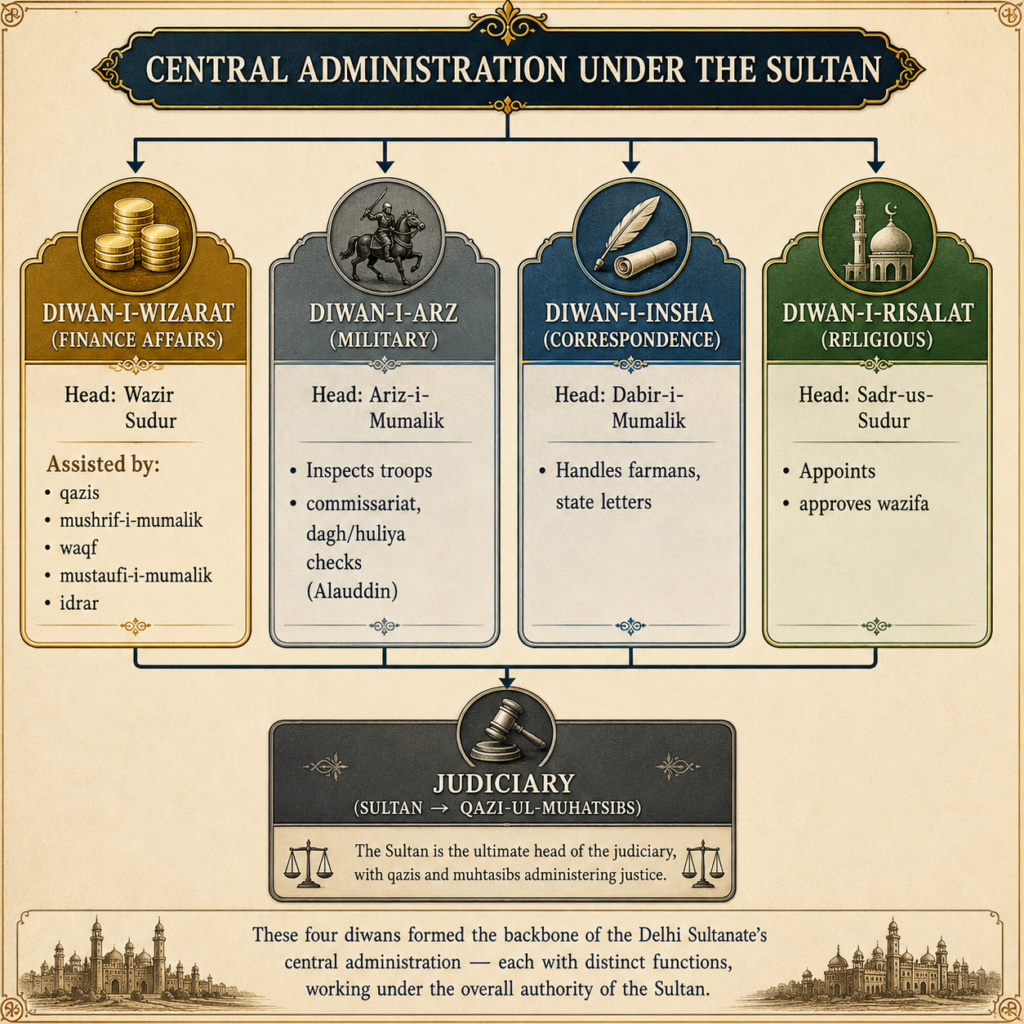
The central administrative machinery of the Sultanate consisted of nobles controlling various offices, with the Sultan at the helm of affairs.
The Sultan
- The Sultan could make civil and political regulations for public welfare. Khutba and sikka were recognised as important attributes of sovereignty.
- The khutba was the formal sermon following the congregational Friday prayer, in which the Sultan’s name was mentioned as head of the community.
- Coinage was the ruler’s prerogative — his name was inscribed on the coins (sikka).
- Barani says that Balban stressed the special position of the Sultan as “shadow of God” (zill al-Allah) on earth. Balban emphasised courtly splendour, decorum, and etiquette, and believed in severe, exemplary punishments, even for nobles.
- Many nobles, however, felt that they had an equal right to rule.
The Wizarat (Finance)
- The head of the diwan-i-wizarat was the most important figure in the central administration.
- Though he was one of four important departmental heads, he exercised a general supervisory authority over the others.
- The wizarat organised the collection of revenue, exercised control over expenditure, kept accounts, disbursed salaries, and allotted revenue assignments (iqta) at the Sultan’s order.
- Several officials assisted the wazir, such as the mushrif-i-mumalik (accountant-general) and the mustaufi-i-mumalik (auditor-general).
- During the reign of Alauddin Khalji, the diwan-i-mustakhraj was made responsible for the collection of arrears of revenue.
The Diwan-i-Arz (Military Department)
- This department was headed by the ariz-i-mumalik, responsible for the administration of military affairs.
- He inspected the troops maintained by the iqta-holders, and also supervised commissariat duties (supply and transport) of the Sultan’s army.
- During Alauddin Khalji’s reign, measures were introduced to maintain a check on recruitment and quality.
- He ordered a descriptive roll (huliya) of every soldier to be kept, and also ordered the branding (dagh) of horses, to ensure poor-quality horses were not brought by the amirs or iqta-holders to the muster.
- The branding of horses appears to have been strictly maintained till the reign of Muhammad Tughluq.
- The army consisted of troops maintained by nobles, as well as the standing army (hashm-i-qalb) of the Sultan.
- In the 13th century, the royal cavalry, in lieu of cash salary, was assigned the revenue of small villages in the vicinity of Delhi — what Moreland calls a “small iqta.”
- Under Iltutmish, the number of such cavalry was about three thousand. Balban tried to do away with these assignments, causing much dissatisfaction.
- Alauddin Khalji was successful in doing so, and began paying soldiers in cash — a trooper received 238 tankas, with an additional 78 tankas for those bringing an extra horse.
- Firoz Tughluq gave up the practice of paying royal soldiers in cash, instead giving them a paper called itlaq — a sort of draft against which they could claim their salary from the Sultan’s revenue officers of the khalisa (“Crown” or “reserve” land).
- In the 13th century, the royal cavalry, in lieu of cash salary, was assigned the revenue of small villages in the vicinity of Delhi — what Moreland calls a “small iqta.”
Other Central Departments
- Diwan-i-Insha: looked after state correspondence.
- Headed by the dabir-i-mumalik, this department dealt with correspondence between the Sultan and other rulers, and between the Sultan and provincial governments — issuing farmans and receiving letters from subordinate officials.
- Barid-i-Mumalik: the head of the state news agency.
- He kept information on all that was happening in the Sultanate. Local barids in the administrative sub-divisions sent regular news-letters to the central office, reporting on wars, rebellions, local affairs, finances, and the state of agriculture.
- Spies (barids) were appointed to different parts of the empire, keeping the Sultan informed of developments — this was the main weapon used by Balban and Alauddin Khalji to control and demoralise the nobles.
- Apart from the barids, another set of reporters existed, known as munhiyan.
- Diwan-i-Risalat: headed by the highest religious officer, the sadr-us-sudur.
- He took care of ecclesiastical affairs, appointed qazis, and approved various grants, such as waqf for religious and educational institutions, and wazifa and idrar to the learned and the poor.
The Judiciary
- The Sultan headed the judiciary, serving as the final court of appeal in both civil and criminal matters.
- Next to him was the qazi-ul-mumalik (or qazi-ul-quzzat), the chief judge of the Sultanate.
- Often, the offices of the sadr-us-sudur and the qazi-ul-mumalik were held by the same person.
- The chief qazi headed the legal system, and heard appeals from lower courts.
- The muhatsibs (public censors) assisted the judicial department, tasked with ensuring there was no public infringement of the tenets of Islam.
Court and the Royal Household
In a system where the Sultan was the centre of power, the organisation of the court and royal household was of prime importance. Unlike under the Mughals, however, no single officer was in charge of the court and royal household during the Sultanate.
Wakil-i-Dar
- The most important officer connected with the royal household was the wakil-i-dar.
- He controlled the entire royal household, supervising the payment of allowances and salaries to the sovereign’s personal staff — including the royal kitchen, wine department, and royal stables.
- He was even responsible for the education of the princes.
- Courtiers, princes, the Sultan’s private servants, and even the queens had to approach him for various favours.
- Given its sensitivity, this post was bestowed only upon a noble of high rank and prestige.
Amir Hajib
- Another officer of high importance connected with the court was the Amir Hajib, also called the barbek.
- He served as master of ceremonies at court, marshalling the nobles according to rank and precedence.
- All petitions to the Sultan were presented through him, or his subordinates, called hajibs.
- This post was so sensitive that sometimes princes of blood were appointed to it.
- There were also many minor officials, such as the head of the hunt, and the officer in charge of royal parties (majlis). Two departments worth noting are the Karkhana (royal stores) and the Public Works Department.
- From the time of Alauddin Khalji, great importance was given to the diwan-i-amirat (Public Works Department). But the “prince of builders” was Firuz Tughlaq, who not only repaired many old buildings — including sarais and mausoleums — but also dug canals and built many new towns. A separate department was accordingly set up under Malik Ghazi, styled Mir-i-Imarat.
Karkhanas
- The needs of the royal household were met through karkhanas, broadly of two types:
- (i) Manufactories.
- (ii) Store houses.
- Even the royal library (kitabkhana) was considered a karkhana.
- The karkhanas were responsible for the storing and manufacture of all articles required by the Sultan and the royal household — including food and fodder, lamps and oil, clothes, furniture, and tents.
- Firuz Tughlaq gave great importance to the karkhanas, training many slaves as good artisans within them.
- Under Firuz Tughluq, there were 36 karkhanas.
- Muhammad Tughluq employed about five hundred workers in gold brocade and four thousand weavers to manufacture cloth for the court, and to make robes of honour given as gifts to favoured individuals.
- Robes of silk and wool, distributed to nobles twice a year by Muhammad bin Tughlaq, were manufactured in these royal karkhanas.
- Each karkhana was supervised by a noble holding the rank of malik or khan, and a mutasarrif, responsible for accounts and acting as immediate supervisor.
- A separate diwan, or accounts office, existed for the karkhanas.
- The karkhanas manufactured articles for the Imperial household, as well as for military purposes.
- It must be remembered, however, that articles produced in the royal karkhanas were not commodities — i.e., not for sale in the market. Nobles, too, maintained their own karkhanas.
Slaves
- Slaves were an important feature of the royal household.
- Alauddin Khalji owned 50,000 slaves, while Feroz Tughluq is reputed to have had 180,000 slaves. During Feroz’s reign, a separate department of slaves (diwan-i-bandagan) was established.
- Slaves were used for personal service, and acted as bodyguards (the latter numbering 40,000).
- Afif also records that a large number of Feroz’s slaves (12,000) worked as artisans (kasibs).
- Barani describes a large slave market at Delhi, but by the first quarter of the 16th century, there is no mention of slave markets.
Revenue Administration
- The exact revenue system and magnitude of revenue demand during the Ilbarite (Slave Dynasty) rule remains uncertain. Perhaps the old agrarian system continued to function, with the change being that the composition of the supreme appropriators of the surplus produce at the centre had changed.
- Some reconstruction is possible by projecting back Barani’s account of the situation prevailing under Alauddin Khalji’s early rule.
- Three groups of rural aristocracy — khot, muqaddam, and chaudhuri — collected land revenue (kharaj) from peasants on behalf of the state, and deposited it with officials of the diwan-i-wizarat.
- For this service, they were allowed perquisites (haqq-i-khoti) as remuneration — being exempted from revenue on a portion of the land they held.
- They also took something from peasants as their share of the produce, which Barani calls qismat-i-khoti.
- The Chaudhari might not have been directly involved in revenue collection — according to Ibn Battuta, he was head of “100 villages” (pargana); this inference is reinforced by the fact that Barani always uses terms like haqq-i-khoti or muqaddami, but never haqq-i-chaudhrai.
- W.H. Moreland, however, uses the term “intermediaries” for all three groups.
- Besides land revenue (kharaj), every cultivator had to pay a house tax (ghari) and a cattle or grazing tax (charai).
- Three groups of rural aristocracy — khot, muqaddam, and chaudhuri — collected land revenue (kharaj) from peasants on behalf of the state, and deposited it with officials of the diwan-i-wizarat.
Alauddin Khalji’s Revenue Measures
- What motivated Alauddin Khalji to introduce stern revenue measures? As explained by Barani: the intermediaries had become intractable, always ready for rebellion. The Sultan levelled the following main charges against them:
- They did not pay revenue themselves on the portion of their land not exempt from assessment; rather, they shifted this burden onto the peasantry, realising additional levies from peasants beyond the state’s fixed demand.
- They did not pay the grazing tax.
- Their ill-gotten “excess of wealth” made them so arrogant that they flouted the orders of revenue officials, refusing to attend the revenue office even when summoned.
- As a result, the Sultan struck at their resources for both economic and political reasons, taking the following measures:
- The state demand was set at half the produce of the land. The land was to be measured (masahat), with revenue fixed on the yield of each unit of area. The term used was wafa-i-biswa (wafa = yield; biswa = 1/20th of a bigha) — most probably levied separately on each cultivator’s holding.
- Intermediaries and peasants alike were now to pay the same standard demand (50%), without distinction between intermediary and ordinary peasant (balahar).
- The perquisites of intermediaries were disallowed.
- Grazing and house taxes were also to be taken from the intermediaries.
- One objective was to free the peasants from the illegal exactions of intermediaries — as Barani puts it, the Sultan’s policy was that the “burden” (bar) of the “strong” (aqwiya) should not fall upon the “weak” (zuaja).
- Problems created: The 50% demand was the highest in the agrarian history of India.
- Though peasants were now protected from the economic oppression of intermediaries, they had to pay a higher rate of taxation than before.
- Since the rate was uniform, it was, in a sense, a form of regressive taxation.
- Thus, the state gained at the cost of the intermediaries, leaving the peasants in the lurch.
- It is true that intermediaries were eliminated from direct revenue collection, but they were still expected to maintain law and order in the countryside and assist revenue officials, without remuneration or perquisites.
- The state’s direct relations with the peasants resulted in an expansion of revenue officials, variously called ummal, mutasarrif, mushrif, muhassilan, navisindagan, etc.
- Soon, large-scale corruption and embezzlement surfaced among these officials, for which they were ruthlessly punished by the naib wazir, Sharaf Qaini — about 8 to 10 thousand officials were imprisoned.
- The process for discovering deceit was simple: the bahi (ledger) of the village patwari was meticulously scrutinised by auditors, and payments recorded were compared with receipts — corruption occurred despite the fact that Alauddin Khalji had raised the salary of revenue collectors.
Barani’s Account of Peasant Oppression Under Alauddin Khalji
- According to Barani’s vivid account: weak and resourceless peasants were completely made prostrate, while rich peasants with means turned rebels; whole regions were devastated, and cultivation was totally abandoned.
- Peasants of distant regions, hearing of the ruin of the Doab peasantry, fled to the jungles, fearing similar orders would be issued for them.
- During the two years the Sultan was in Delhi (c. 1332–4), the Doab was devastated due to the rigours of revenue demand and the multiplicity of abwab (additional cesses).
- Hindus set fire to grain heaps, and drove away cattle from their homes. The Sultan ordered shiqqdars and faujdars to lay waste and plunder the country, killing many khots and muqaddams, and blinding many others.
- Those who escaped fled into jungles, which were then surrounded, and everyone found within was killed.
- The Sultan himself plundered and laid waste from Kanauj to Dalmau, killing whoever was captured; most peasants who fled into jungles were also hunted down.
- Barani indicates the extent of the area where these measures operated — covering the heart of Alauddin’s empire. However, Bihar, Awadh, Gujarat, and parts of Malwa and Rajputana are not mentioned; these measures were largely meant for the khalisa (“crown” or “reserve” land).
Mode of Payment
- Moreland believes that payment in cash was the general practice during the 13th century, becoming quite widely prevalent by the 14th century.
- However, Alauddin himself preferred collection in grain. He decreed that the whole revenue due from the khalisa in the Doab should be realised in kind, and only half the revenue due from Delhi (and its suburbs) in cash.
- Reasons for this preference:
- To maintain a large reserve of grain stored at Delhi and other areas, for contingencies such as drought-induced scarcity.
- To use the storage as a lever for his price-fixation measures in the grain market.
- Reasons for this preference:
Subsequent Changes to the Revenue System
- Ghiyasuddin Tughluq introduced two important changes:
- The intermediaries got back their haqq-i-khoti (but not qismat-i-khoti), and were also exempted from the house and cattle tax.
- The procedure of measurement (masahat) was to continue alongside observation of the “actual yield” (bar hukm hasil).
- Muhammad Tughluq: There are two (incorrect) views regarding his revenue policy:
- (i) That he enhanced the land tax rate beyond 50%.
- (ii) That after Alauddin’s death, the rate was reduced by the Khalji rulers, and later raised back to the previous level by Muhammad Tughluq.
- Feroz Shah:
- Abolished twenty-three cesses, including charai and ghari.
- A “water tax” (haqq-i-sharb) was taken from cultivators who irrigated their land using water supplied from state-constructed canals.
- Another development, especially under the Tughluqs, was the practice of revenue-farming — the task of collecting revenue from certain areas was sometimes given to contractors, who paid a lump sum in advance for the right to collect revenue for a set period.
Total Estimated Revenue of the Sultanate
- No attempt to estimate the total revenue of the kingdom appears to have been made before the reign of Sultan Feroz Shah Tughluq.
- Afif tells us that, at Feroz Shah’s order, Khwaja Hisamuddin Junaid determined the jama (estimated revenue) of the kingdom according to the “rule of inspection” (bar hukm mushahada).
- This took six years, and the figure arrived at was six crores and seventy-five lakh tankas, which remained valid for the entire remainder of the Sultan’s reign.
Iqta System and Provincial Administration
The Iqta System
- The iqta was a territorial assignment given to administrative officers and nobles, in lieu of the services they performed for the state. The system began as a means of dividing conquest and resources, functioning as both a reward and a medium of payment.
- Gradually, the system was more clearly defined, with the responsibilities of holders clearly marked, and it became a principal system of state.
- In order to consolidate their rule, the Turkish rulers made revenue assignments (iqta), in lieu of cash, to their nobles (umara). The assignees (known as muqti/wali) collected revenue from these areas, defrayed their own expenses, paid the troops maintained by them, and sent the surplus (fawazil) to the centre.
- Assignments could be large (a whole province or a part), and even carried administrative, military, and revenue-collecting responsibilities.
Features of the Iqta System
- There were big and small iqtas — the holder of a big iqta was known as Muqti or Wali, and of a small iqta as an iqtadar.
- The muqti was responsible for the collection of revenue from these territories, and also worked as administrative head.
- They retained revenue equivalent to their personal pay, as well as the salaries of the troops they employed.
- The grant of iqta did not imply a right to the land, nor was it hereditary — though holders of iqta tended to acquire hereditary rights during Feroz Tughluq’s reign.
- These revenue assignments were transferable — the iqta-holder being transferred from one region to another every three or four years.
- Therefore, the iqta should not be equated with the fief of medieval feudal Europe, which was hereditary and non-transferable.
- Tithe land could not be given as iqta to anyone, except on grounds of poverty.
- The muqti had specific responsibilities: (a) maintenance of law and order, and (b) maintenance of troops. The iqtadar, by contrast, had no such responsibility, beyond the service he was expected to render to the state.
- The muqti separated a portion of total revenue collected for his personal expenditure and that of his troops; the balance, known as fawazil, was deposited with the state.
- The muqti appointed a naib ariz to represent him at the centre.
- This was not a feudal but a bureaucratic system — subject to the pleasure of the Sultan, with elements of transfer, removal, punishment, audit, and control exercised from the top.
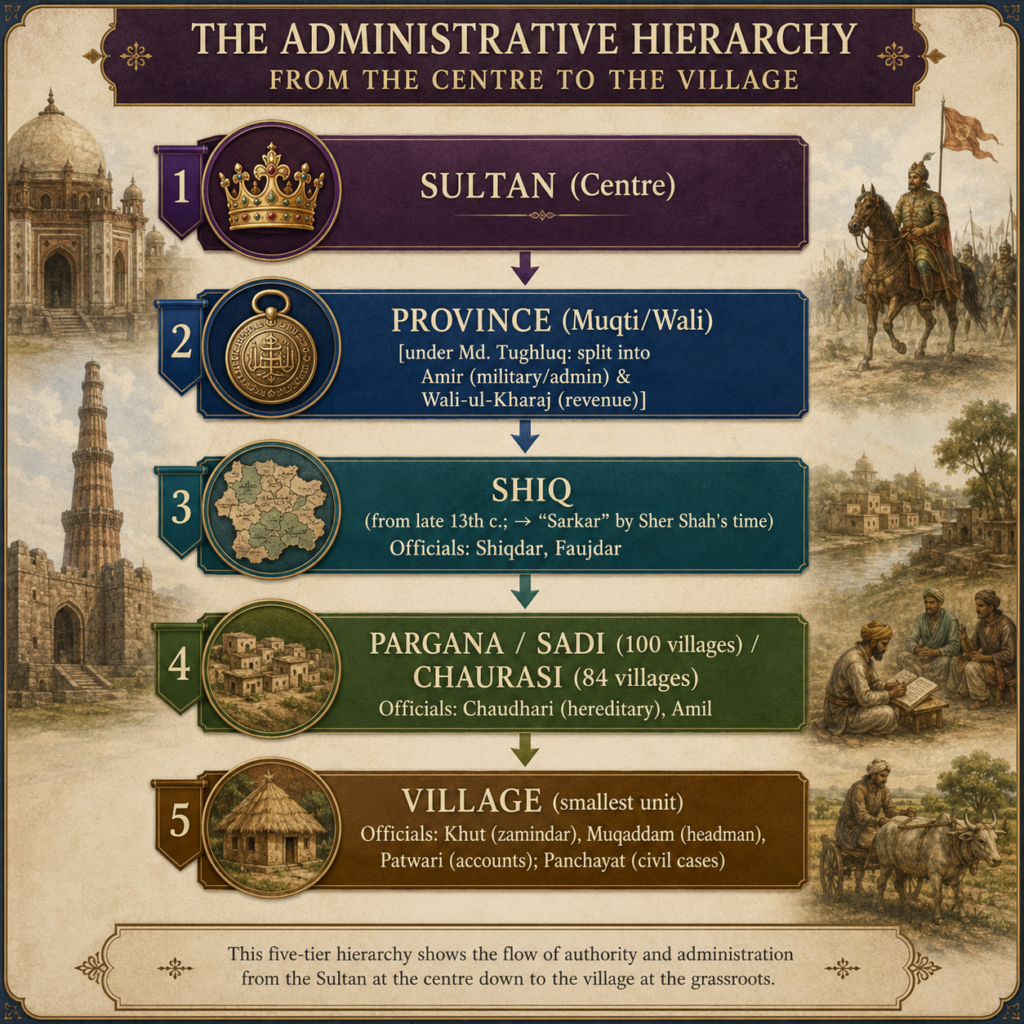
- Thus, provincial administration was headed by the muqti or wali, who had to maintain an army composed of horsemen and foot soldiers.
On the Rights of the Muqti — Nizamul Mulk Tusi’s Siyasatnama
- A relevant passage states: “They (the muqtis) should know that their right over the subjects is only to take the rightful amount of money or perquisite (mal-i-haqq) in a peaceful manner… the life, property and the family of the subject should be immune from any harm, the muqtis have no right over them, if the subject desires to make a direct appeal to the Sultan, the muqti should not prevent him. Every muqti who violates these laws should be dismissed and punished … the muqtis and walis are so many superintendents over them as the king is superintendent over other muqtis… After three or four years, the amil and the muqtis should be transferred so that they may not be too strong.”
Significance of the Iqta System
- It was a major pillar of the Sultanate’s state system.
- It served as an instrument of centralisation.
- It functioned as an instrument for organising the nobility and military chiefs, associating them with the state, with clearly defined responsibilities.
- It served as the system of provincial governance, with the Muqti/Wali functioning somewhat as a provincial governor.
- It served as a mode of payment, and a system for revenue collection.
- It provided a revenue base, since fawazil was the right of the state.
- It was a system of maintaining troops.
- It provided the basis for later systems of granting land, laying the background for the jagir system under the Mughals.
Changes in the Iqta System Across Reigns
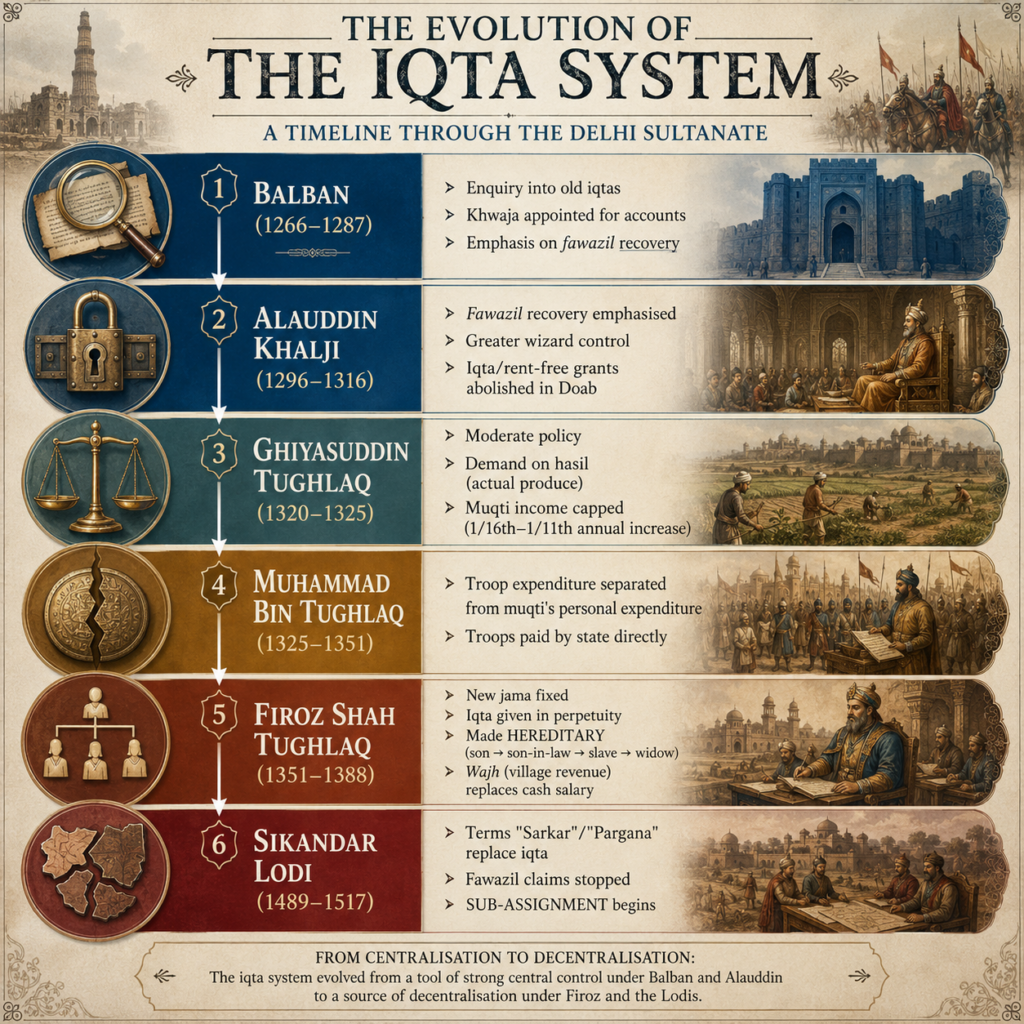
- Balban:
- Enquiry into old iqtas.
- Appointment of a Khwaja attached to the muqti, to maintain accounts.
- Emphasis on recovery of fawazil.
- Alauddin Khilji:
- Emphasis on recovery of fawazil.
- Greater control of the wizarat over iqta.
- Abolition of iqta and other rent-free grants in the Doab.
- Ghiasuddin Tughlaq:
- A moderate policy.
- Demand based on hasil (actual produce), not past records.
- The income of the muqti was not to be increased by more than 1/16th or 1/11th annually.
- Muhammad Bin Tughlaq:
- Separation of expenditure of troops from the personal expenditure of the muqti.
- Troops to be paid by the state.
- Iqta to be used for personal salary only.
- Firoz Shah Tughlaq:
- A new jama (used for the first time) fixed at 6 crore and 75 lakh tankas.
- Iqta was given in perpetuity.
- Increased personal pay of the muqti.
- Iqta was made hereditary.
- In the event of the muqti’s death, the iqta would pass to sons, then sons-in-law, then slaves, then widows.
- Payment to soldiers through barat or italaq (a kind of draft).
- A new arrangement, wajh (meaning revenue of a village), was introduced, given in lieu of cash salary.
- These changes, introduced by Firoz Tughlaq and continued afterward, gave birth to unhealthy trends, weakening the system as a tool for centralisation and organisation of the nobility.
- Sikandar Lodi:
- New terms Sarkar and Pargana replaced iqta.
- Stopped claims over fawazil.
- Beginning of sub-assignment of portions of sarkar by principal assignees.
Thus, the nature of the iqta system changed progressively with each successive Sultan.
Provincial Administration
- As central control grew, control over the muqti’s administration also increased.
- The naib diwan (also called khwaja), in charge of revenue administration, began to be appointed from the centre.
- A barid (intelligence officer) was also posted to keep the Sultan informed. However, it seems the muqti still appointed his own troops, keeping a naib ariz at the centre to represent him.
- Appeals from the qazis, and against the conduct of governors, could be made to the Sultan. The governor, however, could give revenue-free lands to scholars out of his own iqta.
- Under Muhammad bin Tughlaq, we hear of persons appointed governors on revenue-farming terms — an attempt to maximise income that, in effect, represented a step back, since it implied the elimination of central control over revenue affairs.
- Such persons were not required to maintain troops for the centre’s service, these being placed under a separate officer. This duality of functions, however, did not work, and was apparently given up by Firuz.
- According to Barani, there were 20 provinces in the Sultanate, when it did not include the south — smaller than the subahs of Akbar’s time.
- Out of modern U.P., the middle doab was divided between Meerut, Baran (now Bulandshahr), and Koil (now Aligarh), with another three provinces in the north-west.
- Provinces in the Mughal sense really began under Muhammad bin Tughlaq.
- Under him, the number of provinces covering the entire country up to Malabar, according to the Arab writer Shihabuddin al-Umari, was twenty-four.
- As the state became more settled, and efforts were made towards greater centralisation, provincial administration also changed — a separation between fiscal and military responsibilities began to evolve.
- During the reign of Muhammad Tughluq, fiscal responsibilities were partially withdrawn from the muqtis or walis, and placed under central officers.
- According to Ibn Battuta, the iqta of Amroha was placed under two central officers — one called amir (possibly in charge of army/administration), and the other, wali-ul-kharaj (in charge of revenue collection).
- Muhammad Tughluq also ordered that the salaries of soldiers maintained by iqta-holders be paid directly by the diwan-i-wizarat, to prevent fraud by the officers.
- During the reign of Muhammad Tughluq, fiscal responsibilities were partially withdrawn from the muqtis or walis, and placed under central officers.
- The central diwan‘s office exercised greater control over fiscal matters of the provinces:
- It received and examined detailed statements on income and expenditure in the provinces.
- It supervised the work of provincial revenue officials.
- The provinces had a sahib-i-diwan, whose office kept books of account, and submitted information to the centre — assisted by officials such as mutasarrifs. The entire lower revenue staff was called karkun.
Local Administration
- We do not know whether there were units equivalent to the modern district or division below the provinces.
- We hear of shiqs and sarkars in the Afghan histories dealing with the Lodis and the Surs.
- Shiqs — mentioned from the end of the 13th century, referred to as an administrative division, though adequate information about their exact nature is not known.
- By the time of Sher Shah (1540–1545 A.D.), the shiqq had emerged as a well-defined administrative unit, known as the sarkar.
- Administrative officials mentioned in relation to the shiqq were the shiqqdar and faujdar — though the demarcation of their duties is not very clear.
- Shiqs — mentioned from the end of the 13th century, referred to as an administrative division, though adequate information about their exact nature is not known.
- We also hear of parganas, sadis (unit of 100), and chaurasis (unit of 84) — the sadis and chaurasis being collections of villages, whose number could vary.
- A chaudhari (a hereditary landholder) and an amil (revenue collector) were perhaps posted there, especially in areas under khalisa.
- According to Ibn Battuta, the chaudhuri was the head of a hundred villages — this formed the nucleus of the administrative unit later called pargana.
- The village was the smallest unit of administration; its functioning remained basically the same as under pre-Turkish times.
- The main village functionaries were the khut, muqaddam (headman), and patwari.
- The khut was the zamindar of one or more villages, while the muqaddam was the village headman.
- The patwari was also a village official — Alauddin Khalji had the account books of the patwaris examined to detect frauds by the amils and mutsarrifs, who were dealt with harshly.
- The main village functionaries were the khut, muqaddam (headman), and patwari.
- The judicial administration of the sub-division was patterned on that of the centre — courts of the qazi and sadr functioned in the provinces.
- The kotwal maintained law and order.
- At the village level, the panchayat heard civil cases.
- Thus, a rudimentary system of government — some of it inherited from earlier Hindu rulers — continued down to the village level.
- In this way, a new centralised form of government gradually emerged. The first step was the consolidation of the central government.
- As the central government grew stronger and more confident, it tried to extend its direct control over the regions and countryside, implying the reduction of powers and privileges of local chiefs.
- This led to a prolonged struggle, and no clear forms had emerged by the time the Delhi Sultanate disintegrated — a task taken up later by the Mughals.
Theory of Kingship Under the Delhi Sultanate
- No clear and well-defined law of succession developed in the Sultanate.
- The hereditary principle was accepted, but not adhered to invariably.
- There was no rule of primogeniture — in one case, even a daughter was nominated (e.g., Raziya Sultan).
- A slave, unless manumitted, could not claim sovereignty. In practice, “the longer the sword, the greater the claim.”
- Thus, in the absence of any succession rule from the very beginning, intrigues surfaced to usurp power:
- After Aibak’s death, it was not his son Aram Shah, but his slave and son-in-law Iltutmish, who captured the throne.
- Iltutmish’s death (1236 A.D.) was followed by a long period of struggle, until Balban, Iltutmish’s slave of “the Forty” fame, assumed power in 1266 A.D.
- Balban attempted to give a new shape to the concept of kingship, but the struggle for power that followed his own death confirms that the “sword” remained the main deciding factor.
- Kaiqubad was installed against the claims of Balban’s nominee, Kaikhusrau; Kaiqubad himself was later slain by the Khalji Maliks (1290 A.D.), who laid the foundation of Khalji rule.
Balban’s Theory of Kingship
- Balban’s assumption of the throne at Delhi in 1266 marked the beginning of an era of strong, centralised government. He sought to increase the prestige and power of the monarchy, and to centralise all authority in the Sultan’s hands, believing this to be the only way to face internal and external dangers.
- The Divine Kingship Theory:
- Balban underlined the theory that the Sultan was the “shadow of God” (zil-i-Allah), insisting that anyone presented at his court perform sijda and pabos — prostration before the sovereign — a practice which, per theologians, was reserved for God alone.
- He harked back to the Iranian theory of kingship, according to which the king was divine or semi-divine, answerable only to God, and not to any intermediaries, i.e., religious figures.
- As such, there was a fundamental difference between the ruler and the nobles — the latter being dependent on the Sultan’s favour, and in no way his equal.
- He maintained a splendid court, in which all nobles had to stand in serried ranks, strict order maintained by the Mir Hajib, always an important noble.
- Balban himself maintained the utmost dignity in court — he would neither laugh out loud himself, nor allow anyone else to do so.
- Balban was not prepared to share power with anyone. At the same time, he tried to stand forth as the defender of the entire Turkish nobility.
- He declared he would not give any post in government, an iqta, or a position of local authority, to any person of “low or ignoble family.”
- He was critical of the low-born, remarking: “When I look at a low born, every artery in my body begins to irritate with fury and my hand goes to the sword.”
- He emphasised lineage and race, claiming descent from Khaqan Afrasiyab, a mythical hero described in Firdausi’s Shahnama.
- Balban’s rule was highly autocratic, characterised by cold, calculated despotism.
- He focused on justice, following the dictum: “Kingship knows no kinship.”
- The influence of the turkan-i-chihilgani was minimised.
- His overall approach was to make the crown a magnificent institution, establishing its prestige and power.
- He maintained a formal link with the Caliph — the Caliph’s name remained in use on coins and in the khutba.
Jalaluddin Khalji’s Theory of Kingship
- Followed liberal and humanitarian principles.
- Kingship based on the goodwill and support of people of all communities.
- A benevolent and beneficial approach.
- Negated the demands of some Ulemas.
- Pursued a policy of granting freedom to Hindus — Hindus moved in procession, beating drums near his palace, for the immersion of images in the Yamuna.
- He held that a policy of terror could establish fear of government for a short time, but would mean discarding true Islam from the people’s hearts.
- Barani notes his benevolent approach — that he did not harm even an ant.
- In 1296 A.D., Alauddin Khalji killed his uncle, Jalaluddin Khalji, and occupied the throne; Alauddin’s own death would later signal civil war and a scramble for power.
Alauddin Khalji’s Theory of Kingship
- Alauddin’s idea of kingship held that it was not the monopoly of any privileged class, but within the reach of those with the power and ability to hold it.
- Saw a broadening in the composition of nobles — he did not admit monopolisation of the state by any single group; state offices were open to talent and loyalty, to the exclusion of race and creed. He controlled the nobility through various measures.
- He did not claim sovereignty on the strength of racial superiority.
- Near-secular outlook:
- He tried to separate state from religion — the first Sultan to make such a declaration.
- He negated the role of the Ulemas, declaring: “I don’t know what is right and what is wrong, I give orders which are in the interest of state.”
- To him, law depended on the will of the monarch, not that of the prophet. When the Chief Qazi remonstrated with him over severe punishments contrary to canon law, he bluntly stated (per Barani): “I issue such orders as I conceive to be good for the State and the benefit of the people. Men are heedless, disrespectful and disobey my commands. I am then compelled to be severe to bring them to obedience. I do not know whether this is lawful of unlawful; whatever I think for the good of the state or suitable for the emergency that I decree and as for what may happen to me on the approaching day of judgement that I do not know.”
- Hence, Alauddin ruled according to political exigencies, in no way bound by the Ulemas, who ultimately had to acquiesce to his authority.
- Kingship based mainly on force, military power, and control over nobility:
- He adhered more to Balban’s theory that fear was the basis of good government, applying it to both nobles and ordinary people.
- After the outbreak of rebellions early in his reign, he took harsh measures to control the nobles.
- He revived Balban’s system of spies, keeping himself informed of developments even within the privacy of noble households.
- Nobles were forbidden to associate with each other, or hold convivial parties — even marriage alliances required the Sultan’s permission.
- He hearkened back to Balban’s belief — shared by Barani — that people should not be left enough means to harbour thoughts of rebellion.
- As part of this policy, he ordered all charitable lands (waqf or inam) confiscated.
- Almost all the nobles of Jalaluddin’s time, whom Alauddin had won over with gold and positions, were uprooted, their accumulated wealth confiscated.
- Imperial outlook:
- He was the Sultan who began Sultanate imperialism, adopting the title Sikandar-i-Sani on his coins.
- He pursued a policy of reducing the kingdoms of the Deccan and South to tributary states, accepting his suzerainty and paying annual tribute.
- He was conscious that administering these distant regions from Delhi was very difficult, and that removing local rulers might provoke local resistance and trouble.
- That Alauddin established his authority and suzerainty in the Deccan and South is also borne out by the Jain work Nabinandra-Jinodhara-Prabandha.
- One aim of his Deccan policy was territorial expansion, since wealth in the form of added revenue always accompanies expansion — but in Alauddin’s case, it was more about securing annual tribute without administrative expenditure.
- He maintained a formal relationship with the Caliph, adopting the title “Lieutenant of the Caliph.”
- Amir Khusro and Ziauddin Barani describe him as the “Shadow of God on earth” — indicative of a divine kingship conception.
Muhammad Bin Tughluq’s Theory of Kingship
- Highly autocratic and despotic.
- Near-secular outlook:
- Pursued separation of state and religion, focused on political consideration and state interest.
- While he never openly defied the shariat, he also did not strain himself to win Ulema support on important issues.
- He went so far as to substitute the Abbasid caliph’s name on his coins; later, he also received a formal rescript (manshur) from the Caliph — but this could hardly change the attitude of orthodox elements towards him.
- Negation of the Ulemas.
- He personally supervised the enforcement of justice, overruling the advice of Ulemas and Qazis whenever he found it divorced from the law.
- Whenever Ulemas were found guilty of embezzlement or rebellion, the Sultan inflicted severe punishment.
- Catholic approach to religions:
- He was the first Sultan to participate in the festival of Holi, and the first to employ Hindus in even high offices.
- Imperial approach:
- He held higher imperial ambitions than Alauddin — it was under him that the territory of the Sultanate reached its peak.
- He was full of imperialistic ambitions, cherishing extravagant visions of universal conquest. Having inherited the largest empire ever bequeathed to a Delhi Sultan, it was logical for him to seek fresh avenues of conquest, both within and beyond India.
- Creation of a composite nobility:
- His approach to the nobility was not based on racial or narrow considerations.
- He created a composite nobility, including persons of very low status, based on talent — such as the cook and the gardener.
- He welcomed not only families long settled in India, but also admitted persons from artisan or other classes/castes despised by the Turks — such as gardeners, barbers, cooks, weavers, wine-distillers, and musicians. Some of these were converts, and some were Hindus.
- Thus, his nobility was very heterogeneous in character, but could not serve as an instrument on which the Sultan could lean in times of difficulty.
- Even though low-caste appointees and many Turkish and Hindustani nobles remained loyal, the Mongol and Afghan Sadah Amirs behaved differently.
- He was also the first to include Sufis into the nobility, and to enter into matrimonial alliances with them.
- He had a highly innovative approach, taking steps such as the second capital at Daulatabad, token currency, agricultural experiment, and foreign campaigns.
Firuz Shah Tughluq’s Theory of Kingship
- Linked state and religion — he proclaimed to rule on the basis of Islam, appeasing the Ulemas, abolishing many unislamic taxes, and imposing Jaziya on Brahmans.
- Benevolent and welfare approach: including irrigation, a marriage bureau, an employment bureau, promotion of public works, and education — establishing madrasas and hospitals, etc.
- Followed an appeasement approach towards nobles and muqtis, making the iqta hereditary.
- Maintained his link with the Caliph, using the Caliph’s name on coins and in the khutba.
The Afghan Concept of Sovereignty and the Rise of the Lodis
- With the accession of the Lodis (1451–1526 A.D.), a new element — the Afghans — was added to the Sultanate’s political structure.
- The Afghans had a peculiar concept of sovereignty: they were prepared to accept the position of a Sultan over them, but sought to partition the empire among their clans (Farmulis, Sarwanis, Niyazis, etc.).
- After the death of Sultan Sikandar Lodi (1517 A.D.), the empire was divided between Ibrahim and Jalal (his younger brother) — even royal privileges and prerogatives were equally shared among clan members.
- For example, the keeping of elephants was a royal privilege — yet Azam Humayun Sarwani is reported to have possessed seven hundred elephants.
- The Afghans entertained the concept of maintaining a tribal militia, which, in the long run, greatly hampered the military efficiency of the Central Government.
- Sikandar Lodi did try to keep ambitious Afghan nobles in check, but the concept of Afghan polity remained more tilted towards decentralisation, ultimately creating fissures that hastened the Sultanate’s end.
Conclusion
The government and administration of the Delhi Sultanate reveal an evolving political system that never fully settled into any single, stable model — moving, in Harman Kulke’s formulation, from an initial conquest state, through a genuine attempt at centralisation under Alauddin Khalji, before revealing its underlying structural weakness as a largely patrimonial system. Its central administration, built around the Wizarat, Diwan-i-Arz, Diwan-i-Insha, and Diwan-i-Risalat, and its innovative iqta system — which functioned simultaneously as a mode of payment, a tool of centralisation, and the backbone of provincial governance — together represented a genuinely sophisticated administrative apparatus for its time. Yet this apparatus rested on deeply unstable foundations: an absence of any clear law of succession, a perennial contest between the Sultan and an ambitious nobility, and a revenue system whose harshest expression, under Alauddin Khalji, brought real prosperity to the state at a devastating human cost to the peasantry. As the iqta system gradually shifted from an instrument of central control to a source of hereditary noble privilege — a process completed under Firuz Tughluq — the stage was set for the fragmentation that would culminate in the Sultanate’s final collapse before Babur in 1526, and the assumption of many of its unresolved administrative challenges by the Mughal Empire that followed.




