Rajput Painting (Rajasthani Painting)

Rajput painting, also known as Rajasthani painting, is a school of Indian miniature art that evolved and flourished in the royal courts of Rajputana in northern India, mainly between the late 15th and 18th centuries. Distinguished by its vivid colour palette, emotional intensity, and deep engagement with Bhakti devotionalism and Hindu mythology, Rajput painting represents one of the most significant regional schools of medieval Indian art. Scholar Ananda K. Coomaraswamy traced its emergence to the earlier pre-Turkish traditions of western Indian painting, holding that the style reached its consummation around 1600 CE. Originating in Mewar, it gradually spread to other Rajput states — Marwar (Jodhpur), Bikaner, Bundi, Kishangarh, Kota, Amber (Jaipur), and Alwar — each of which developed a distinctive sub-style while retaining certain shared features. For UPSC History Optional aspirants, Rajput painting is an important theme under medieval Indian art and culture, frequently tested for its schools, its Mughal-Rajput interface, and its comparison with Pahari painting.
Origin and Evolution of Rajput Painting
- Rajput/Rajasthani painting is considered to have evolved out of the earlier western Indian painting tradition and later came under Mughal influence.
- Early phase: the style displayed great vigour and vitality before absorbing Mughal elements.
- Mughal interface: artists trained in the Mughal miniature tradition dispersed from the imperial court (notably during periods of reduced royal patronage) and found employment in Rajput courts, blending Mughal technique with local painting traditions, especially those illustrating the Hindu epics — the Mahabharata and Ramayana.
- Post-Mughal revival: after the decline of Mughal power, Rajput painting re-emerged and flourished independently under the patronage of the various Rajput kingdoms.
- Each Rajputana kingdom developed its own distinct regional style, yet common stylistic threads (colour symbolism, compartmental composition, emotional intensity) run across all of them.
- Medium:
- Primarily executed as miniatures — in manuscripts or as single sheets meant to be preserved in albums.
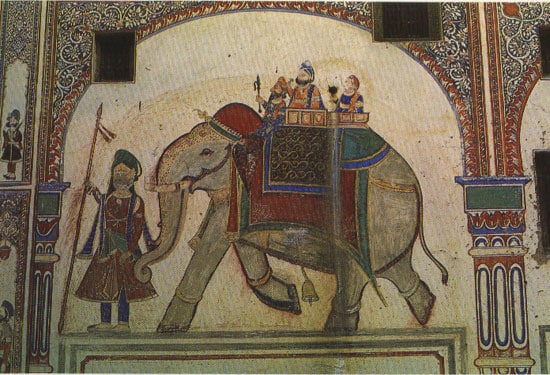
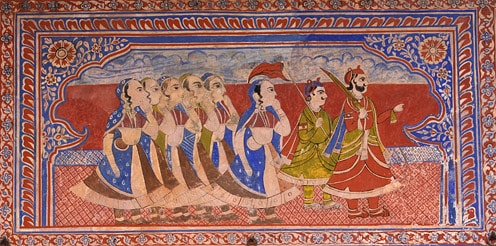
- Also rendered as wall murals — on palace walls, inner chambers of forts, and havelis, most notably the havelis of Shekhawati, built by the Shekhawat Rajputs.
- Note: The Kangra and Kullu schools, though often discussed separately under the Pahari style of painting, are also considered part of the broader Rajput painting tradition.
Style and Themes of Rajput Painting
- From its inception, Rajput painting adopted nature as a central theme, reflecting the influence of the growing Bhakti movement and vernacular literary traditions.
- Literary influence: popular devotional and courtly texts supplied recurring themes and were often directly illustrated, including the Bhagavata Purana, the Gita Govinda, the Chaurapanchasika, the Rasikpriya, and the Baramasas.
- Depiction of heroes and heroines: nayakas and nayikas are frequently portrayed in the guise of the celestial lovers Radha and Krishna.
- Illustrations often resemble landscape paintings, where human figures play a comparatively subordinate role within a larger natural setting.
Forms of Rajput Painting
- Miniature painting
- Book illustration (itself a form of miniature painting)
- Portraits
- Murals — found in palaces, forts, and havelis
Themes Depicted
- Nature
- Bhakti (devotionalism)
- Epics
- Love and romance
- Nataraja (dancing Shiva)
- Flute-playing Krishna
- Musical seasons (Ragamala themes)
Themes Introduced Under Mughal Influence
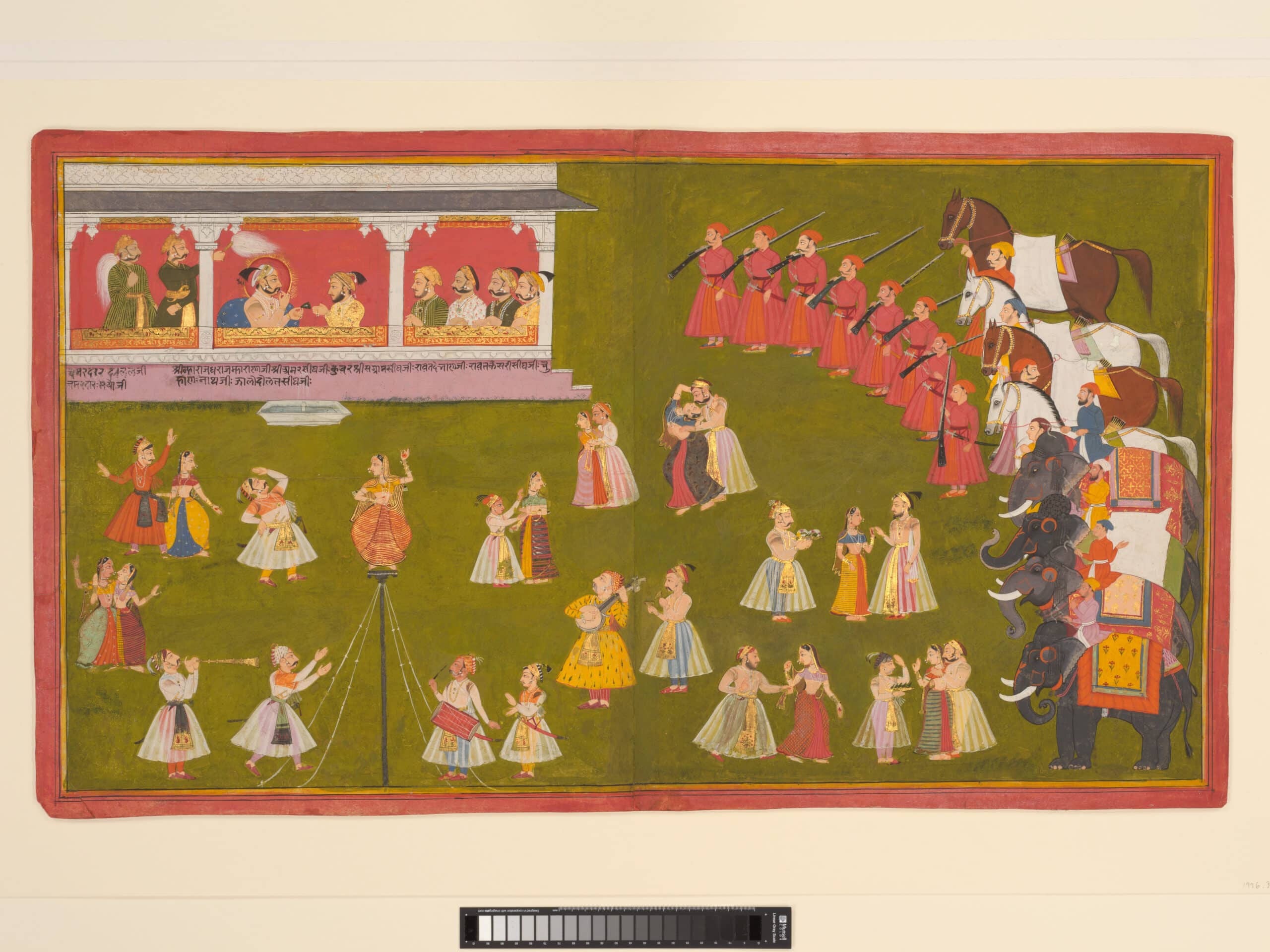
- Court scenes
- Hunting scenes
- Display of royal splendour and luxury
- Portraits
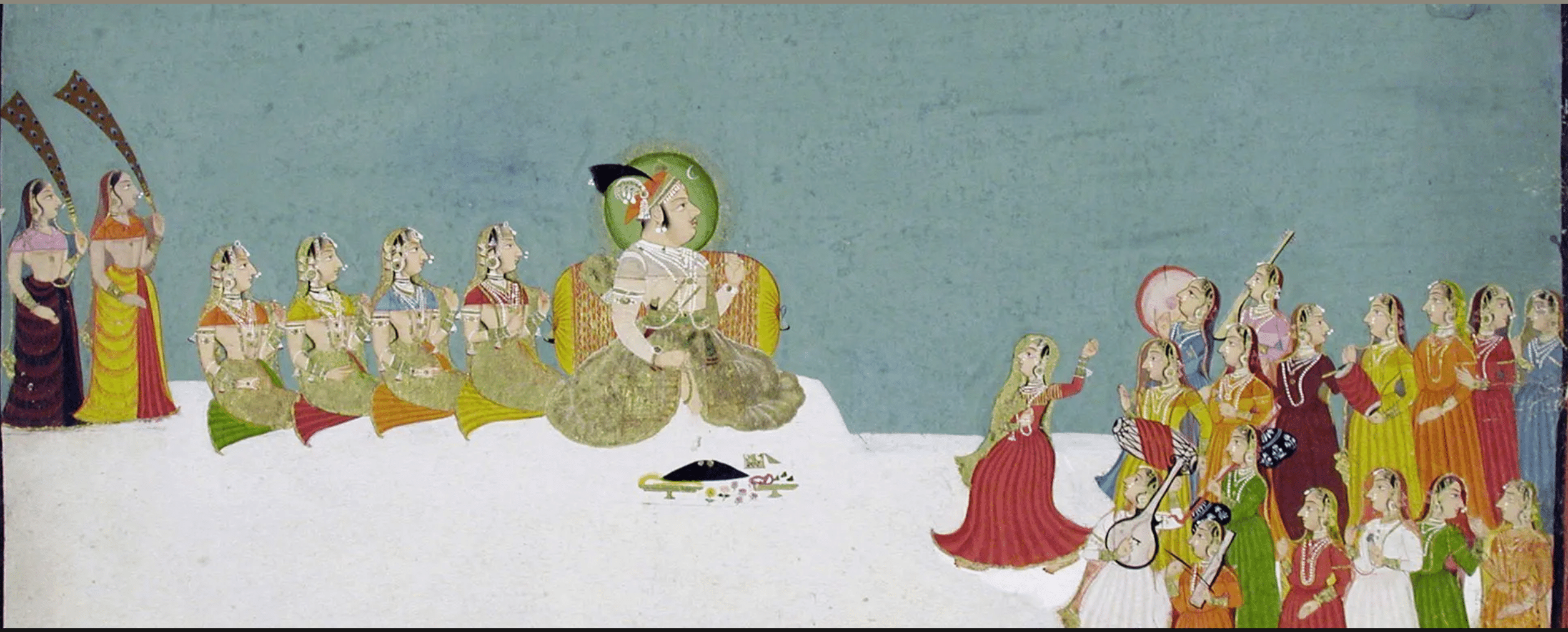
- Scenes from the women’s quarters (zenana)
Elements of Nature Commonly Depicted
- A variety of tree forms and dense foliage
- Singing birds and frolicking animals
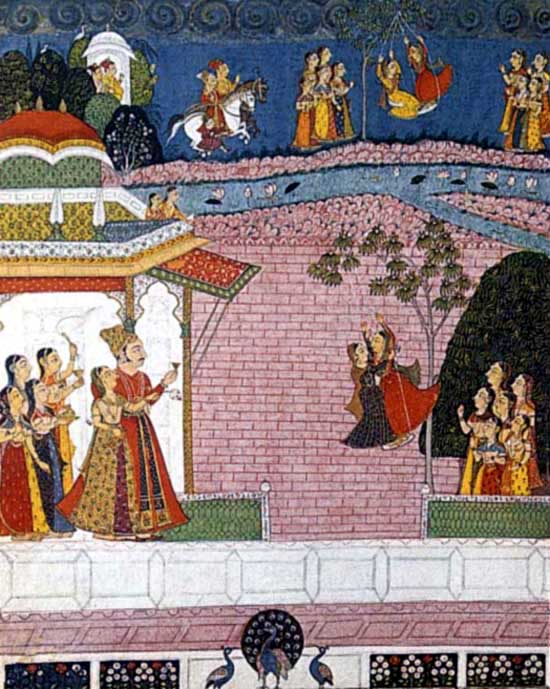
- Rivers filled with lotus blossoms
- Drops of rain falling from deep blue clouds
Use of Colour
- Rajasthani miniatures are noted for the intensity of colours used:
- Deep blue — for clouds
- Streaks of gold — showing flashes of lightning
- Emerald green — for foliage
- Compartmental technique: space is divided into bands and rectangles, which serve as frames for figures and groups — a distinctive compositional device.
- Other stylistic features:
- Use of bright and luminous colours
- Highly decorative style of painting
- Emotional elements predominate over realism
- Vertical format, with paper as the main material
- Multi-colour palette — red, green, blue, black, white, yellow
- Colour symbolism — a distinctive feature where specific colours convey specific emotions:
- Yellow → the marvellous (adbhuta)
- Brown → the erotic (shringara)
- Red → fury (raudra)
Main Centres and Schools of Rajput Painting
- Rajput painting developed across four principal schools, each encompassing several regional sub-styles:
- Mewar School — includes the Chavand, Nathdwara, Devgarh, Udaipur, and Sawar styles.
- Marwar School — comprises the Kishangarh and Bikaner styles, along with painting traditions from Jodhpur, Nagaur, Pali, and Ghanerao.
- Hadoti School — includes the Kota, Bundi, and Jhalawar styles.
- Dhundar School — covers Amber, Jaipur, Shekhawati, and Uniara styles of painting.
Mewar School
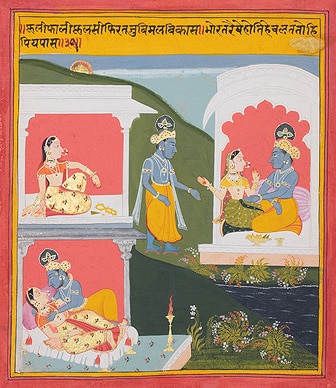
- The oldest surviving manuscripts of Mewar painting are the Supasanachariyam and Suparsanatham, painted around 1423 AD.
- These display traces of the Apabhramsa style, identifiable through projecting eyes.
- The Mewar style crystallised into a distinct school only by the end of the 16th century.
- Key artists:Nisar Din (active 1606), followed by Sahib Din (active 1627–1648), who brought the Mewar school to its peak.
- The illustrated series produced ran into hundreds, covering a wide range of subjects, including mythology.
- Under the patronage of Jagat Singh I (1628–52), a long illustrated series titled Nayakabheda was executed by multiple painters in a poetic and sentimental style.
- Over the subsequent half-century, growing Mughal stylistic influence gradually weakened the vitality of the Mewar school, which became increasingly subdued.
Features of Mewar Painting
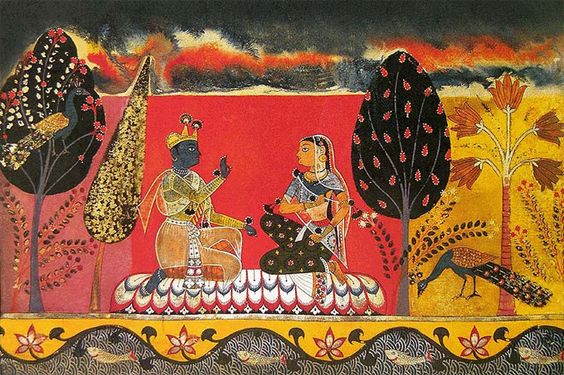
- Profuse use of bright and brilliant colours — red, orange, green, and bright blue.
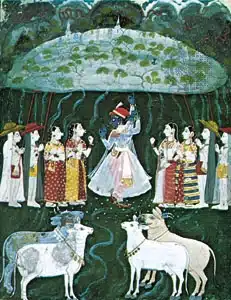
- Male and female figures are drawn with long noses, oval-shaped faces, and elongated, fish-like eyes — a legacy of the Apabhramsa style.
- Female figures are drawn relatively smaller than male figures.
- Costume: males wear loose-fitting garments with embroidered patka (sashes) and turbans; females wear loose long skirts, choli, and transparent odhnis (veils).
- Birds, animals, and trees are rendered in an ornate style, with flowers drawn in bunches and hills/mountains depicted in the Persian manner; small hillocks and mounds are inserted into compositions.
- The Nathdwara, Devgarh, and Shahpura sub-styles all developed out of the parent Mewar style.
Bundi School
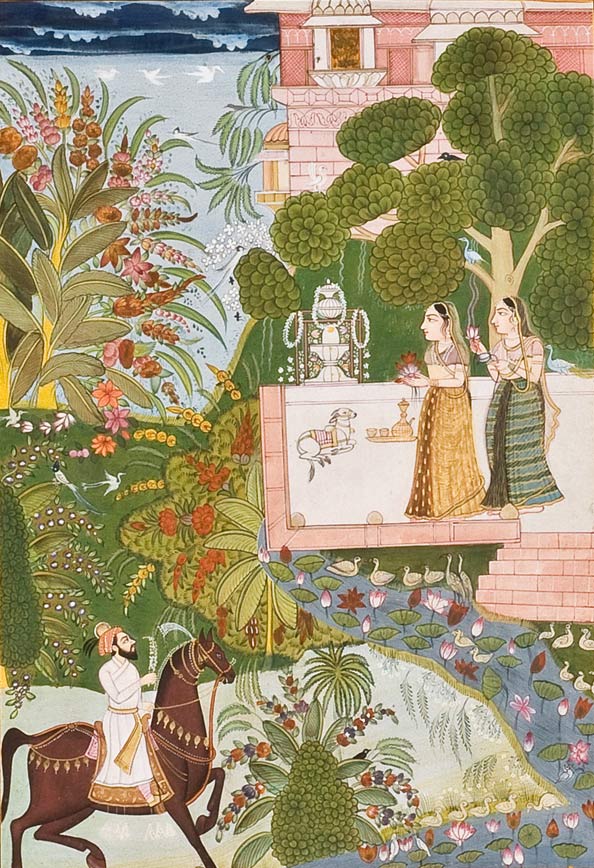
- An important school of Rajasthani miniature painting that flourished from the 17th to the late 19th century in the princely state of Bundi, mainly under the rule of the Hada Rajputs.
- Origins: an early influence was the popular Mughal-style Ragamala series painted at Chunar (near Banaras) in 1561; it was this Chunar series that gave rise to the Bundi School.
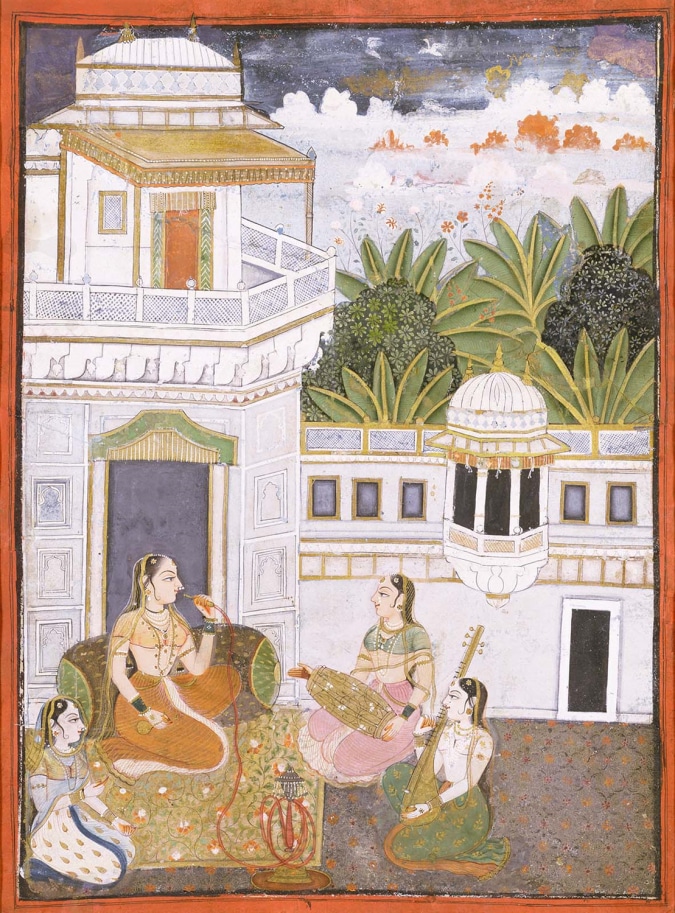
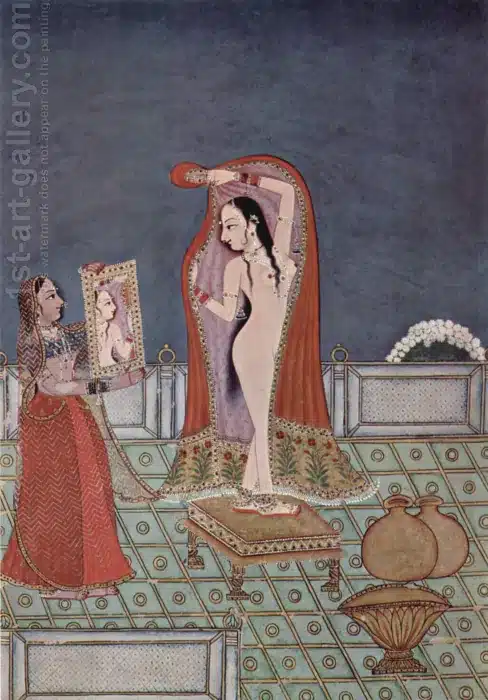
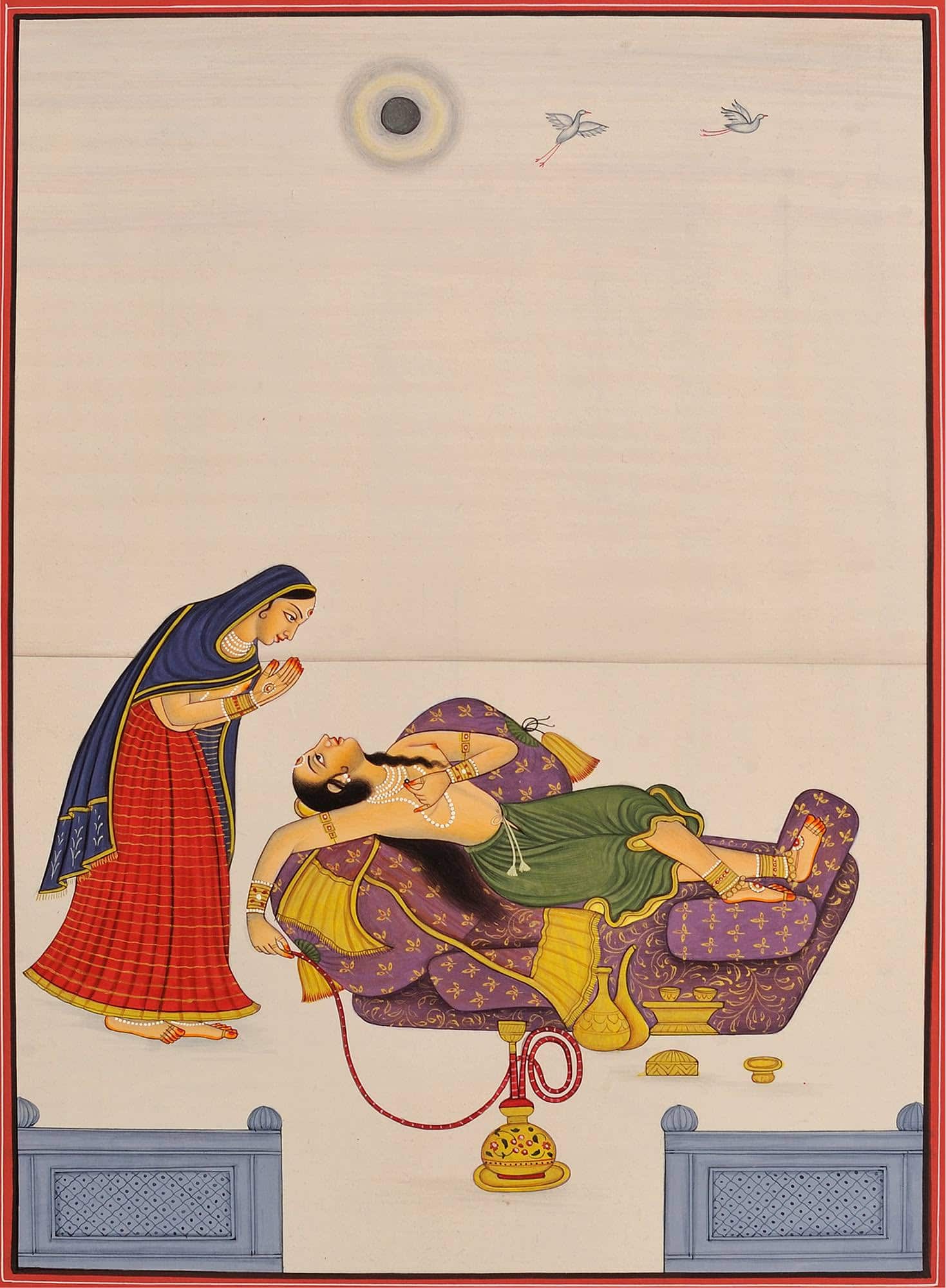
- Depiction of feminine beauty: Bundi artists followed their own standard — women are shown with small round faces, receding foreheads, prominent noses, and full cheeks; female dress typically consists of a pyjama worn under a transparent jama.
- Human figures are tall, slim, and graceful; women are further marked by deep red lips, small noses, round faces, and small chins.
- Landscape: lush settings rendered in vibrant colours; a yellow band with text in Nagari characters sometimes appears at the top of the painting.
- Themes: hunting, court scenes, festivals, processions, life of nobles, lovers, animals, birds, and scenes from the life of Krishna.
- Although closely associated with the Mughal style, this influence was never fundamental to Bundi’s evolution — the school retained its own delicate character even while absorbing Mughal refinement.
- 18th century: while retaining originality, the school increasingly followed Mughal subject-matter and technical detail, with growing emphasis on the display of feminine grace.
Kota School
- Kota, in southern Rajasthan, separated from Bundi in 1624; the Kota style is considered a sub-branch of the Bundi style and remains closely related to it.
- A distinctive Kota style evolved by the mid-17th century, though similarities with Bundi persisted, with variations mainly in costume detail and facial shading technique.
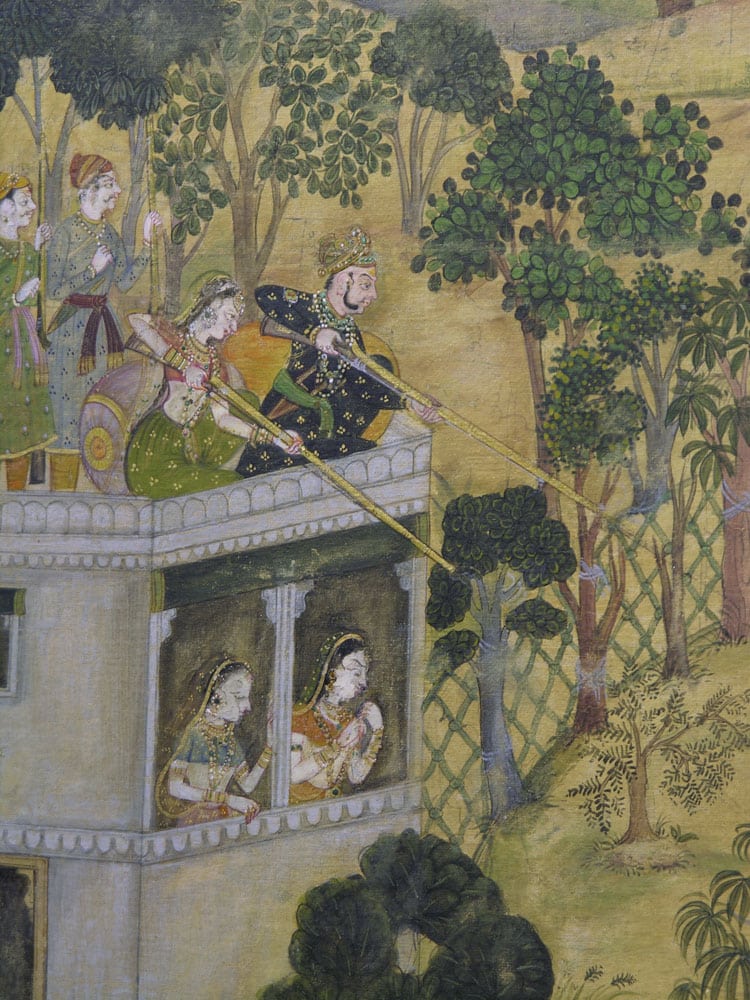
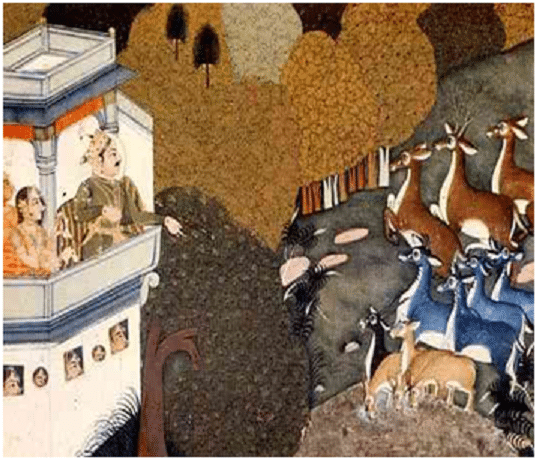
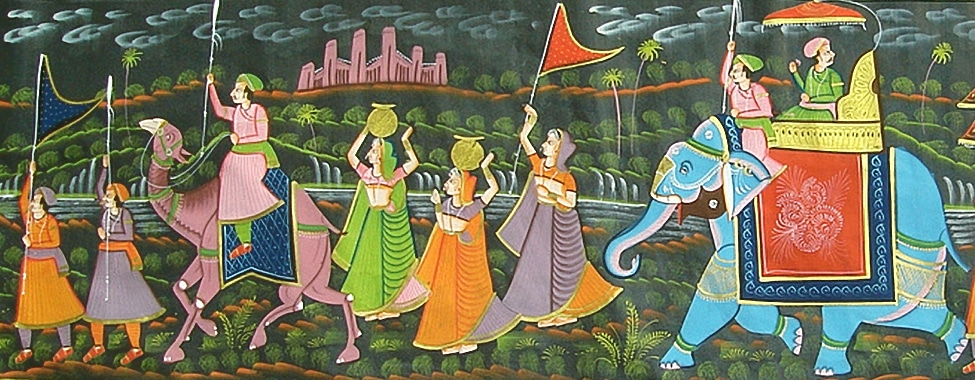
- Signature theme — hunting scenes: Kota’s depictions of princes and nobles hunting lions and tigers in the region’s rocky, sparsely wooded forests are now world-famous.
- Some Kota paintings were executed directly on palace walls, depicting nature; artists were especially skilled at hunting scenes and beautiful female figures.
- Chronological development:
- Under Jagat Singh (1658–1684) — portraiture using vibrant colours and bold lines.
- Under Arjun Singh (1720–1723) — emergence of a style depicting the male figure with a long, hooked nose.
- 18th century — Kota gained fame for outstanding hunting scenes, Ragamalas, and portraits.
- Under Ram Singh II (1827–1866) — a 19th-century revival, with commissioned paintings of worship, hunting, durbar, and procession scenes.
- Features: stout bodies, shining faces, and bulging eyes; frequent use of green, red, and gold.
Kishangarh School
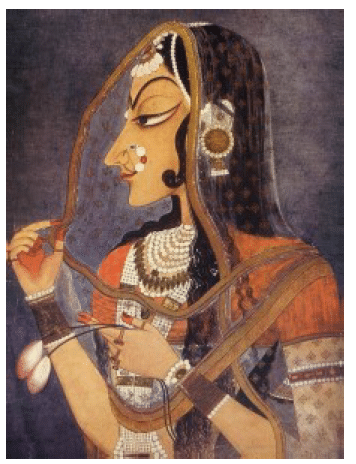
- Distinguished by its highly individualistic facial type and pronounced religious intensity; the style is often described as lyrical and sensuous.
- Figures are drawn with pointed noses and chins, deeply curved eyes, and serpentine locks of hair, typically set within large panoramic landscapes.
- The elegant Kishangarh female form — sharp nose, almond eyes, arched mouth — established a new tradition within Rajasthani painting.
- While secular Mughal influence touched every Rajput court, deep Hindu devotionalism appears to have survived most strongly at Kishangarh.
- Patronage: the style was encouraged by Maharaja Sawant Singh (also known by his pen-name Nagari Das, 1699–1764).
- Under his reign (1748–57), there was a marked increase in paintings inspired by the love-lore of Radha and Krishna, largely credited to his personal inspiration.
- Sawant Singh was himself a poet (writing as Nagari Das) and a devout follower of the Vallabhacharya sect, which venerates Krishna as the divine lover incarnate on earth.
- He fell in love with Bani Thani (“Lady of Fashion”), a singer at his stepmother’s court; it is speculated that her features shaped the distinctive Kishangarh facial type.
- Bani Thani is among the most celebrated Indian miniatures of this school — the subject is popularly referred to as “India’s Mona Lisa.”
- The artist chiefly responsible for translating Sawant Singh’s romantic and religious sensibility into visual form was Nihal Chand.
Bikaner School
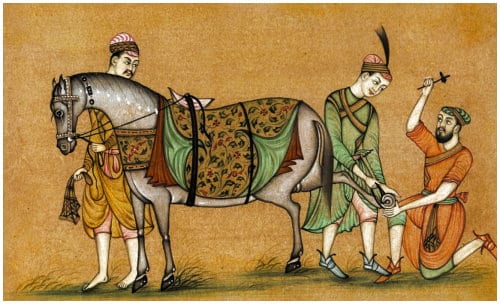
- Developed in the late 17th century, aided by artists from the imperial Mughal workshops who dispersed after Aurangzeb withdrew royal patronage from painting.
- Subjects were mainly court portraits or illustrations of Hindu texts; the Bikaner style is more closely aligned with the Mughal idiom than most other Rajput styles, with some admixture of Deccan elements.
- Reasons for strong Mughal affinity:
- Close association between Bikaner rulers and the Mughal court — Raja Rai Singh was particularly close to Akbar and Jahangir.
- Migration of unemployed Muslim painters from Delhi and Agra, some of whom produced exquisite work under Rai Singh, Karan Singh, and Anup Singh.
- Subject matter: portrait studies, and illustrations of Baramasa, Ragmala, Bhagavata Purana, and Krishnalila.
- Painters displaced by Shah Jahan’s growing preoccupation with architecture found patronage under artistically inclined rulers like Karan Singh.
- Ali Raza — painted works including Lakshmi Narayana and a portrait of Karan Singh.
- Rukn-ud-din — introduced Deccani art elements to Bikaner, particularly techniques for rendering fountains, court scenes, and nature-based backgrounds.
- Later phase: Bikaneri art turned toward depicting the city’s architecture (havelis); artists began displaying work outside the royal court, allowing merchants and landlords to patronise the style.
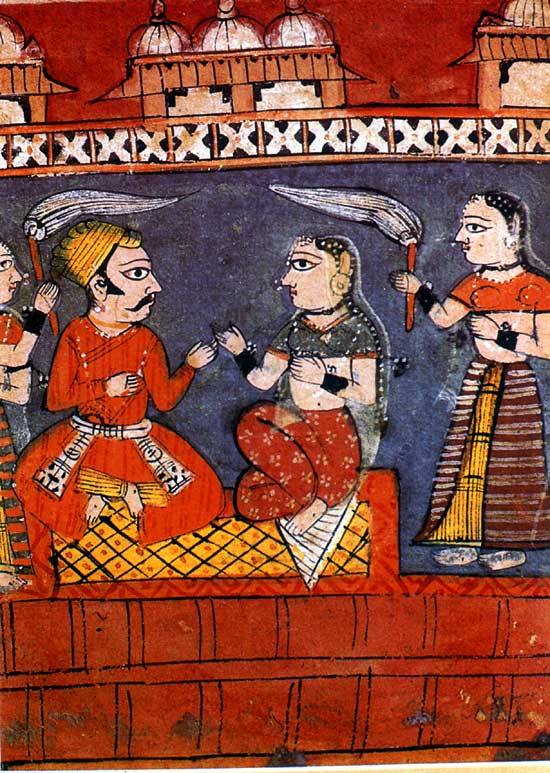
Amber Style
- Represents the artistic heritage of the rulers of the Kachhwaha (Kush) dynasty.
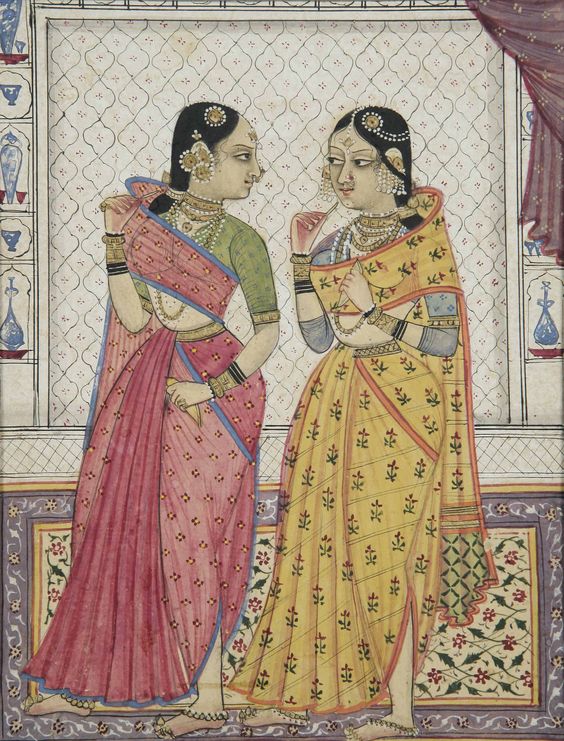
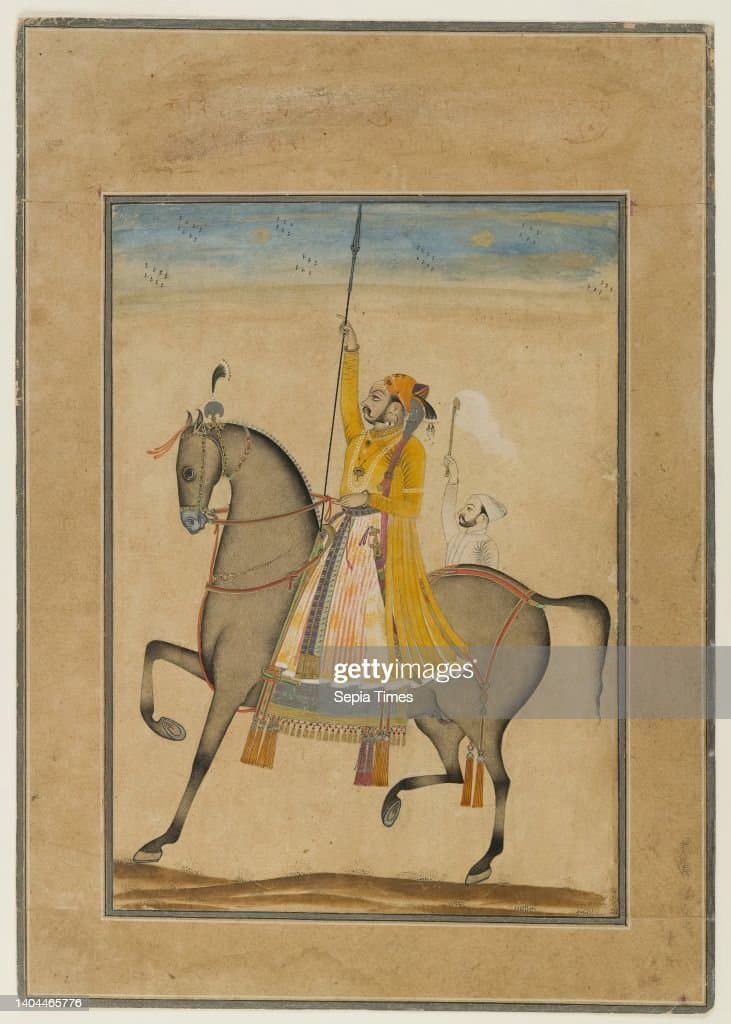
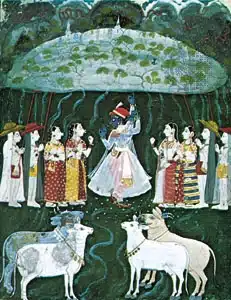
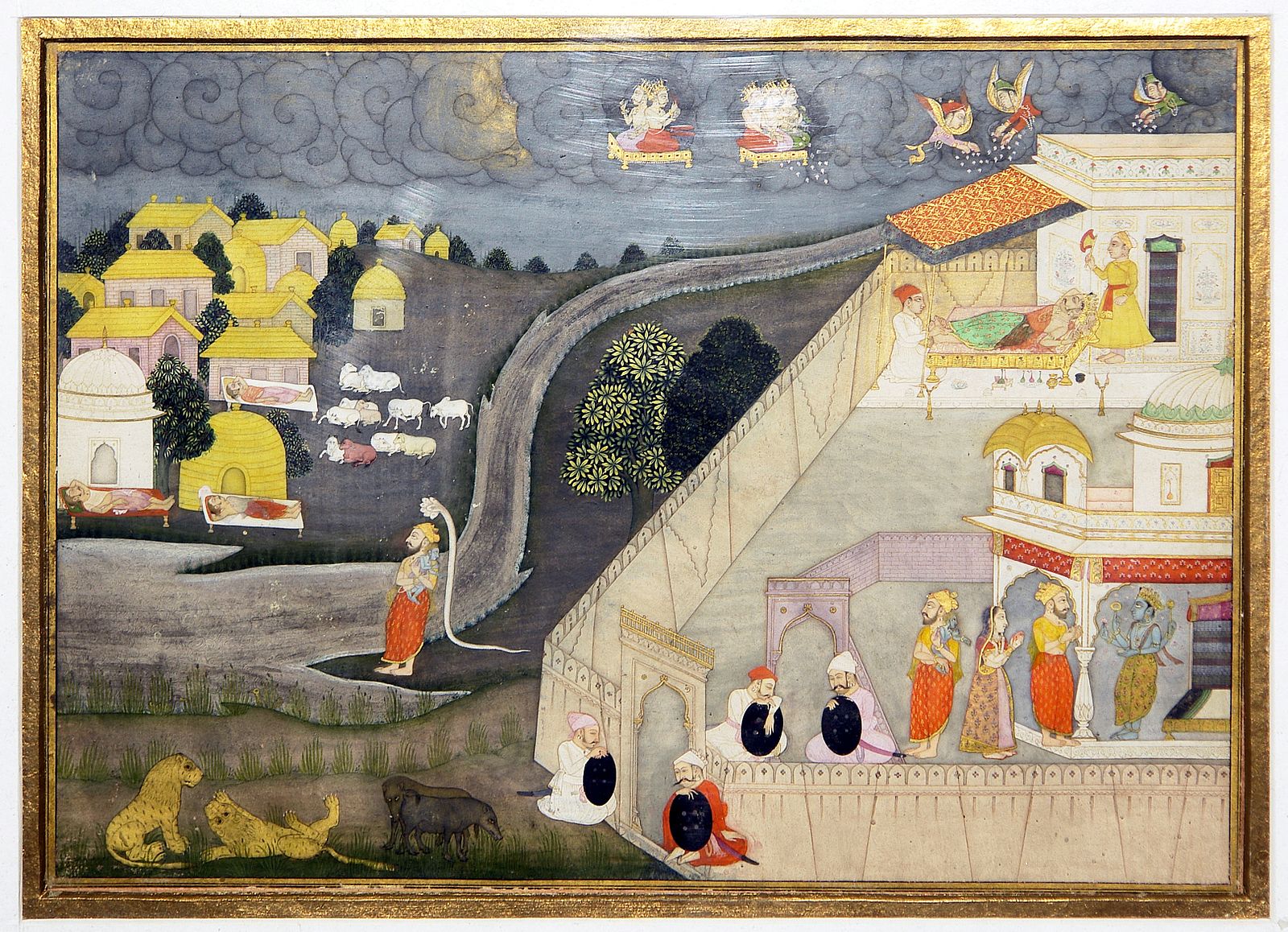
- Paintings show strong Mughal influence, a natural outcome of the close kinship and cultural exchange between the Amber rulers and the Mughals — visible especially in the ornamented dress styles of the Akbar–Jahangir period.
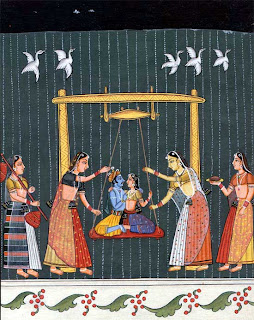
- During the late 18th and early 19th centuries, numerous works depicted episodes from the life of Krishna.
- The style retains its own character: the body structure of both male and female figures shows strong influence from Rajasthani folk art, while a somewhat coarser line quality reminiscent of the Apabhramsa style persists.
- Amber-style works sometimes include accompanying pictorial texts.
Jaipur Style
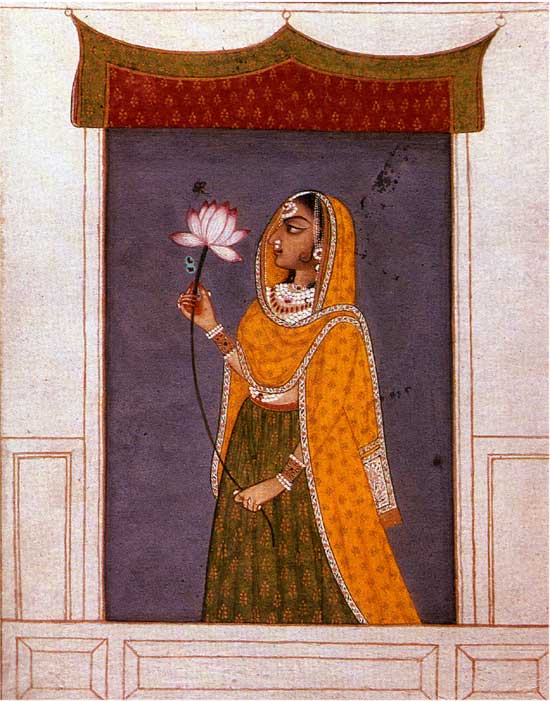
- Jaipur, along with the surrounding regions of Alwar and Tonk, is known for a painting style with a substantial Mughal element, inherited as a cultural legacy from the Amber style.
- The school emerged distinctly in the 18th century.
- Chronological development:
- Under Jai Singh I (1622–1668) — marked by simplicity of composition and delicate depiction of women; by the end of his reign, Shah Jahan-era Mughal influence was clearly evident.
- Under Jai Singh II (1693–1743), Ishwari Singh (1743–1750), and Madho Singh I (1750–1767) — a new style of the female face emerged, with a good deal of Rajput-Mughal painting characterised by an oval face.
- Under Pratap Singh (1779–1803) — Mughal influence declined; compositions retained Mughal inheritance but adopted bold, distinctly regional abstraction.
- Notable artists:
- Sahib Ram — emerged as a talented artist under Ishwari Singh, painting his portrait, and later earning renown as the “seasoned artist” under Madho Singh I (1751–1767).
- Lall Chittara — known for depicting animals and birds in struggle.
- Technique: artists applied deep reds in the painting margins; white, red, and yellow were extensively used.
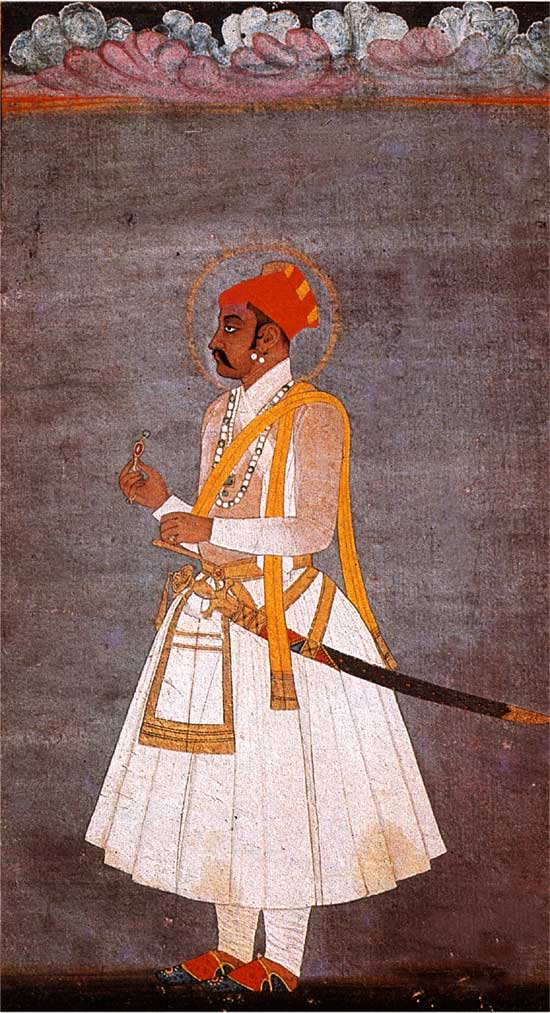
- Subject range: the style excelled at life-size portraits, depiction of myths, ragas, astrological principles, and both amusing and erotic themes; compositions typically used a large canvas, ornate backgrounds, and bright, gorgeous borders.
- Figure conventions:
- Men and women are shown in proportion; male figures have clean, attractive faces; wealthy men wear turban, kurta, pyjama, belt, and shoes.
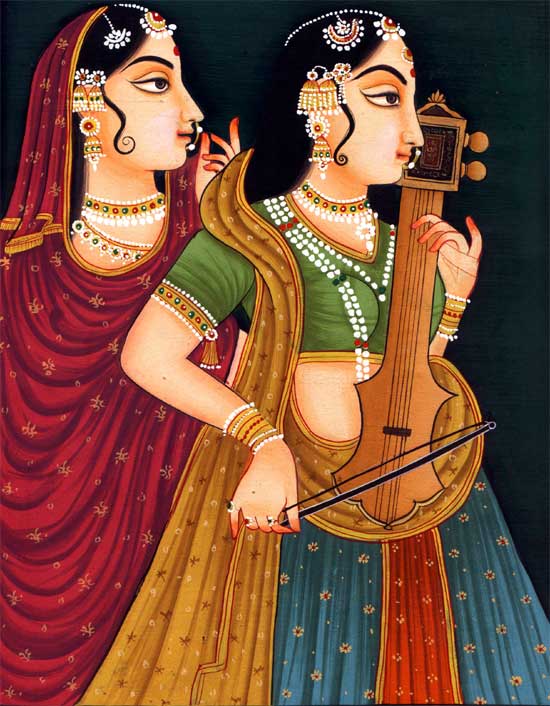
- Female figures have large eyes, a bunch of long hair, a stout physique, and a pleasant expression, adorned with ornaments — necklaces, anklets, bangles, earrings — as in other Rajasthani styles.
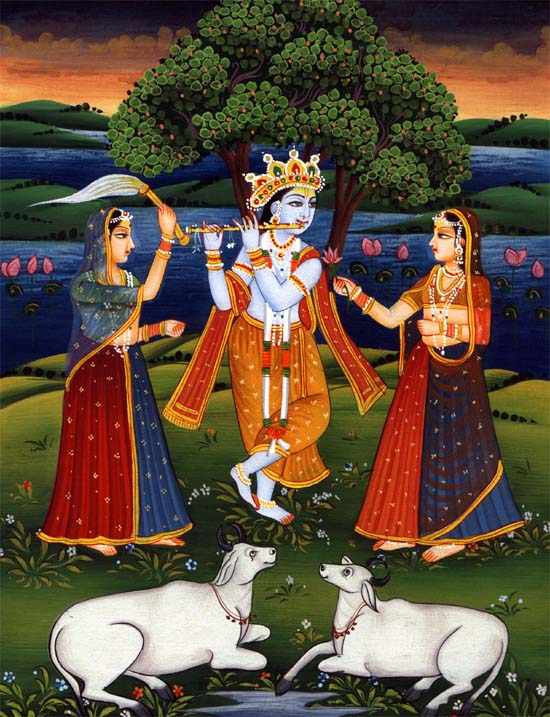
- Favourite themes: Krishna and Radha, Rajput princes, fierce camel fights, the pomp and ceremony of the Mughal court, and illustrations from the Bhagavata Purana, the Ramayana, and the Mahabharata.
Shekhawati Style
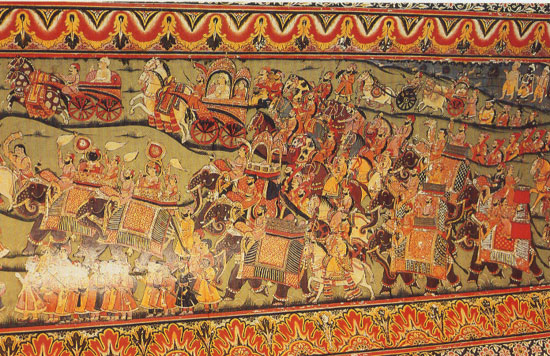
- Shekhawati is renowned for its richly painted and decorated mansions (havelis), many built by the region’s prosperous merchants, some dating to the 18th century.
- The region is particularly known for its frescoes, which depict mythological and historical themes as well as images of large animals.
Features of the Shekhawati Style
- Elephants, horses, and guards rendered in bold relief on the brackets of havelis.
- Gods and goddesses painted in sharp outlines on the main gates.
- Interior and exterior walls covered with imagery showing the impact of the Company style.
- Depictions of modern innovations of the Victorian age — railway trains, motor vehicles, bicycles, sewing machines, aeroplanes, and sofa sets.
- The impact of British rule on eating habits, dress, and lifestyle is vividly captured in these murals.
Differences Between Mughal and Rajput Painting
| Aspect | Mughal Painting | Rajput Painting |
|---|---|---|
| Dominant theme | Royal pursuits — court and hunting scenes | Socio-religious and Bhakti themes |
| Mythological themes | Almost absent | Prominent |
| Character | More intellectual and realistic | More emotional and lyrical |
| Depiction of women | Limited | Various facets of women depicted extensively |
| Indigenous tradition | Less visible | Indian tradition more visible |
| Colour symbolism | Absent | Present — colours convey specific emotions |
| Compartmental composition | Absent | Present |
| Birds/animals | Depicted out of curiosity and entertainment | Depicted symbolically |
| Treatment of figures | Individualised, realistic | Symbolic and suffused with poetic metaphor — figures represent archetypes (e.g., all women symbolic of femininity) |
| Muraqqa (bound albums) | Present as a tradition | Absent |
| Authorship | Often collaborative — one painting by many artists | Typically the work of individual artists |
Similarities and Dissimilarities Between Rajput and Pahari Painting
- Scholar Ananda Coomaraswamy classified Hindu painting into two schools based on provenance: the Rajasthani (from the central plains) and the Pahari (from the Himalayan foothills).
- Chronology: Rajput painting spans the late 15th to 17th centuries AD, while Pahari painting belongs to the late 17th century to the first half of the 19th century AD.
Elements of Similarity
- Both traditions enjoyed royal patronage.
- Both had multiple regional centres — Kangra, Basohli, etc. for Pahari painting; Kishangarh, Mewar, etc. for Rajput painting.
- Both include miniature paintings and manuscript illustrations.
- Shared themes — love-romance and Bhakti themes feature in both.
- Both make extensive use of bright colours.
- Similarities also extend to decorative patterns, depiction of social life, and the vertical format on paper.
Elements of Dissimilarity
- Murals in havelis and palaces are found in Rajput painting but absent in Pahari painting.
- Portrait painting is prominent in Rajput painting but only limited in Pahari painting.
- Mughal influence is more visible in Rajput painting than in Pahari painting.
- Depiction of royal splendour and luxury is more pronounced in Rajput painting, unlike Pahari.
- Court and hunting scenes feature in Rajput painting but are largely absent in Pahari.
- Book illustration is more extensive in Rajput painting — e.g., illustrations of the Bhagavata Purana, Gita Govinda, Chaurapanchasika.
- The compartmental technique of composition is a Rajput feature, not found in Pahari painting.
- Colour-emotion symbolism (brown for erotic mood, yellow for the marvellous, red for fury) is present in Rajput painting but absent in Pahari painting.
Ragamala Painting of Medieval India
- Ragamala (“garland of ragas”) is a form of miniature painting from medieval times that visually depicts India’s musical modes (ragas).
- It is associated with multiple regional schools of painting — Rajasthani/Rajput, Deccani, Pahari, and Mughal — accordingly termed Rajasthani/Rajput Ragamala, Deccani Ragamala, Pahadi Ragamala, and Mughal Ragamala.
- Each raga is personified through a specific colour, i.e., a given raga is represented pictorially through a designated colour.
Association with Seasons
- Ragamala depicts the six principal ragas, each meant to be sung in a specific season:
- Raga Bhairava — summer
- Raga Dipika — monsoon
- Raga Shri — autumn
- Raga Kaushik/Malkauns — early winter
- Raga Megha — winter
- Raga Hindola — spring
Association with Time of Day
- Raga Hindola — night
- Raga Bhairava — dawn
- Raga Deepak — afternoon
- Raga Kaushik — night, etc.
Association with Emotion (Rasa)
- Raga Hindola — love
- Raga Bhairava — fear
- Raga Kaushik — joy
- Raga Megh — peace, etc.
Association with Deities
- Raga Bhairava — Shiva
- Raga Shri — Devi, etc.
The Concept of the “Raga Family”
- Ragamala painting also depicts the female counterparts of the ragas, known as Raginis, along with their offspring — Ragaputra/Ragaputri.
- Example: Raga (Bhairava) → Ragini (Bhairavi) → Ragaputra (Pancham)
Other Characteristics
- Each painting is typically accompanied by a short verse-form text, distilling the essence of a story involving a hero and heroine (Nayak and Nayika).
- Executed as multicolour painting.
- Represents a unique confluence of painting, music, and poetry.
- Ragamala works exist in both two-dimensional and three-dimensional forms.
Conclusion
Rajput painting stands as one of the richest expressions of regional artistic identity in medieval India — a tradition that absorbed the technical refinement of the Mughal school while remaining rooted in indigenous devotional and folk sensibilities. Its evolution across the four principal schools — Mewar, Marwar, Hadoti, and Dhundar — produced a remarkable diversity of style, from the poetic sentimentality of Mewar and the hunting grandeur of Kota, to the sensuous lyricism of Kishangarh and the Mughal-inflected refinement of Bikaner and Jaipur. Its distinctive features — colour symbolism, compartmental composition, and the primacy of emotion over realism — set it apart sharply from the more intellectual and realistic Mughal idiom, while its comparison with the Pahari school further sharpens understanding of India’s regional painting traditions. Allied forms such as Ragamala painting, blending music, poetry, and visual art, underline the deeply syncretic and interdisciplinary character of Rajput artistic culture — making this a high-value theme for both Mains answer-writing and cultural GS/Optional preparation.