Literature in Sanskrit: Introduction

Even as regional vernaculars began to rise and Islamic conquest reshaped India’s political landscape, Sanskrit continued to be a vehicle for higher thought and a principal medium of literature through much of the early medieval period. From Advaita philosophy to drama, lyric poetry, historical writings, mathematics, and music, Sanskrit scholarship flourished under the patronage of Hindu rulers, monastic centres, and specialised academies — even in areas under Muslim domination. Yet, by the close of this period, Sanskrit’s dominance was gradually challenged by Persian, the new official language of the Delhi Sultanate, and by the growing vernacular literatures nurtured by the Nathpanthi and Bhakti movements. This article traces the flourishing of Sanskrit literature across its many genres — drama, lyric poetry, prose, historical writing, epics, grammar, lexicography, the sciences, law, philosophy, politics, and music — before examining the causes behind its eventual decline as the dominant literary language of India.
The Continued Vitality of Sanskrit Literature
- Sanskrit continued to be a vehicle for higher thought and a medium for literature during the period under review.
- Following the great Sankara, works in the field of Advaita philosophy by Ramanuja, Madhava, Vallabha, and others continued to be written in Sanskrit.
- The speed with which their ideas were disseminated and discussed in different parts of the country demonstrated the important role Sanskrit continued to play during the period.
- Ramanuja wrote his commentaries on the Brahma Sutras, in which he explained his conception of Bhakti.
- Many books on the Yoga, Nyaya, and Vaisheshika systems of philosophy were written during this period.
- Deva Suri was a great Jain logician of the 12th century.
- The Gita-Govinda of Jayadeva is an excellent specimen of typical poetry.
- There existed a network of specialised schools and academies in different parts of the country, including areas under Muslim domination.
- These schools and academies were not interfered with and continued to flourish; many took advantage of the introduction of paper to reproduce and disseminate older texts.
- Thus, some of the oldest available texts of the Ramayana and Mahabharata belong to the period from the eleventh or twelfth century onwards.
- The Hindu rulers, particularly those of Warangal and the Vijayanagara Empire, provided encouragement to Sanskrit literature.
- Various types of works — poetry, drama, philosophy, and religious commentaries — were produced by scholars under royal patronage.
- Rulers such as Hammir Deva, Kumbha Karna, Prataprudra Deva, Basantraja, Vemabhubhala, Katya Vem, Virupakaya, Narsingh, Krishnadevaraya, and Bhupal patronised Sanskrit scholars and encouraged their writings — a few of them were themselves scholars.
- Besides philosophy, works in the fields of kavya (poetical narrative), drama, fiction, medicine, astronomy, and music continued to be written.
Dharmashastra Literature: Commentaries and Digests
- A large number of commentaries and digests on Hindu law (Dharmashastras) were prepared between the twelfth and sixteenth centuries.
- The great Mitakshara of Vijnaneshwar (a commentary on the Yajnavalkya Smriti), composed around the twelfth century, formed one of the two principal schools of Hindu law and remained the law of the land for many centuries.
- Jimuta Vahan authored the Dayabhaga, which formed the basis of the law of inheritance and partition in Bengal for many centuries.
- The Smriti literature flourished so luxuriantly in Mithila that its writers came to be regarded as forming a separate school.
- Another famous commentator on the Dharmashastras was Chandeshwar of Bihar, who lived in the fourteenth century.
- Most of these works were produced in the south, followed by Bengal, Mithila, and western India, under the patronage of Hindu rulers.
Jain and Dramatic Contributions
- The Jains, too, contributed significantly to the growth of Sanskrit.
- Naga Chandra (also known as Abhinava Pampa) authored the Pampa Ramayana.
- Other notable Jain writers included Hema Chandra, Prabha Chandra, Asadhara, and Sakalakriti, with Hemchandra Suri being the most eminent among them.
- A large number of dramas were written during this period.
- Harkeli Nataka and Lalitavigraharaja Nataka were written in the 12th century.
- Prasanna Raghava was written by Jayadeva, and Hammir Mada-Mardana by Jaya Singh Suri.
- Pradyumnabhyudaya by Ravivarman, Pratap Rudra Kalyan by Vidyanath, and Parvati Parinaya by Vamana Bhatta Bana were also composed.
- Jiva Goswami wrote as many as 25 books in Sanskrit.
Sciences, History, and Religious Texts
- The study of astronomy was promoted by Bhaskaracharya, born in 1114 CE.
- Kalhana wrote the famous Rajatarangini, which deals with the history of Kashmir, followed by Prithvirajavijaya and Hammiravijaya, two works produced during the 12th century.
- Another outstanding piece of Sanskrit literature was Vidyaranya’s Rajakakinirnaya, dealing with the history of Vijayanagar.
- Other important writers included Padma Bhatta, Vidyapati Thakur, and Vachaspati Misra.
- Sayana wrote his famous commentaries on the Vedas; Madhava was responsible for the composition of the Siva-Gama Stotra.
- Little attempt was made to translate Islamic works or Persian literature into Sanskrit.
- The only notable exception was the translation of the love story of Yusuf and Zulaikha, originally written by the famous Persian poet Jami.
- This has been taken as another example of the insularity of outlook among Hindus, a trait earlier noted by Al-Biruni.
Decline of Sanskrit
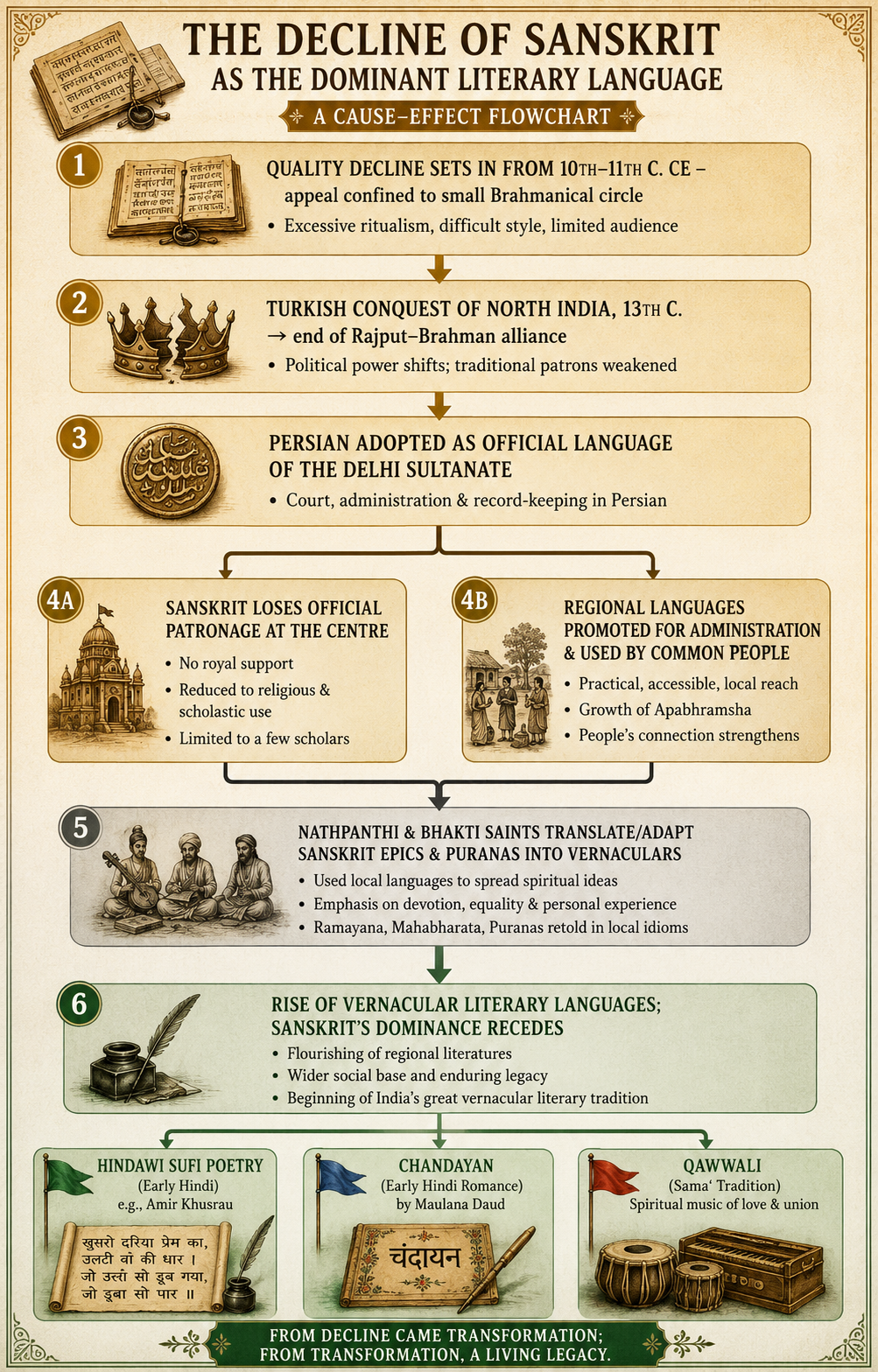
- Serious competition with Sanskrit as the language of literature re-emerged when the Muslim conquests brought Persian into play, and when the vernaculars, shortly after 1000 CE, began first to influence Sanskrit and then to develop into full literary languages.
- The decline in the quality of Sanskrit literature had, in fact, set in well before the establishment of the Delhi Sultanate.
- Much of the Sanskrit literature that appeared from the 10th–11th centuries lacked spontaneity and failed to appeal to the masses; its appeal was confined to a very small Brahmanical circle.
- The replacement of Sanskrit by Persian as the official language during the Sultanate period further intensified the decline of Sanskrit literature.
- Once Sanskrit lost the official patronage it had enjoyed at the centre, many kingdoms during the Sultanate period promoted the use of regional languages, since Persian remained unfamiliar in most parts of the country.
- Regional languages were used, alongside Sanskrit, for administrative purposes in many kingdoms even during the pre-Turkish period.
- In the territories under the rule of the Sultans of Delhi, there are references to Hindi-knowing officials at the local level.
- The Turkish conquest of Northern India during the 13th century led to the end of the Rajput-Brahman alliance, and consequently the influence of the Brahmans diminished in society.
- Once upper-caste (Rajput-Brahman alliance) dominance diminished, the primacy of Sanskrit received a setback with the loss of prestige of the Brahmans, and regional languages spoken at the popular level came to the fore.
- The growth of the non-Brahmanical and non-conformist Nathpanthi movement, and later the various Bhakti movements — both conformist and radical monotheistic — played an important role in the rapid growth of regional literature.
- Bhakti saints belonging to the conventional stream of the movement translated or adapted epics, Puranas, and the Bhagavad Gita from Sanskrit into regional languages to make their contents accessible to the people.
- In this way, the bhakti poets popularised bhakti episodes drawn from various Sanskrit texts.
Remember Some Examples from the Following Works in Sanskrit in Early Medieval India
(Aspirants need only remember a few representative examples from each section — not the entire list.)
Works on Drama
- In drama, men of the upper classes spoke in Sanskrit, while men and women of the lower classes spoke various forms of Prakrit.
- The dramatist Bhavabhuti was a Brahmana of Vidarbha (modern Berar) in southern India.
- His name is mentioned by Kalhana in the Rajatarangini as a poet in the court of Yasovarman, king of Kanyakubja (Kanauj), who reigned during the first half of the 8th century CE.
- Bhavabhuti wrote three rupakas (dramas) — Malati-Madhava, Mahaviracharita, and Uttararamacharita.
- The Mahavira-charita (“Biography of the Great Hero”) relates to the Ramayana, depicting the heroic achievements of Rama’s early life; Malyavan, minister of Ravana, plays a significant role in it.
- The best-known and most popular of Bhavabhuti’s dramas is the Malatimadhava; the Uttararama-charita forms the second part of the Biography of Rama.
- Rajasekhara, a poet-dramatist who went to Kanauj seeking favour and fame, was the reputed teacher of King Mahendrapala of Kanauj (893–907).
- He composed four dramas: Balaramayana (narrating the story of the Ramayana), Karpurmanjari, Viddhasalabhanjika, and Balabharati.
- Kshemisvara, a contemporary of Rajasekhara in the court of Mahipala of Kanauj (whose accession took place in 914 CE), wrote two dramas — Naishadhananda and Chandakausika — the latter depicting the story of King Harishchandra and Sage Vishvamitra.
- The Venisamhara, written by Bhattanarayana, is a drama based on a character from the Mahabharata.
- Murari, author of Anargharaghava, belonged to the end of the 8th or beginning of the 9th century CE and depicted the story of the Ramayana.
- Saktibhadra, disciple of Sankaracharya (788–820), belonged to Kerala and wrote Chudamani, depicting the story of Rama.
- Damodaramisra wrote Mahanataka as a court poet under the patronage of Bhoja, king of Malava, resident at Dhara; a second edition, based on the Ramayana and comprising nine acts, was written by Madhusudana.
- Ramabhyudaya, another drama based on the Rama story, was written by Yasovarmana.
- Kundamala, a play describing the story of the Ramayana, was written by Dimnaga in 1000 CE.
- Vatsaraja, minister and feudal lord of Kalinjar under ruler Parmardideva (1163–1203), was a scholar and politician who wrote six dramas — Kiratarjuniya, Rukminiharana, Tripuradaha, Samudramanthana, Karpuracharita, and Hasyachudamani.
- The poet Bilhana wrote Karanasundari in the 11th century CE; its hero was the Chalukya prince Anhilavad Karna, and it was performed at the temple of Santinatha during the festival of Jina Rishabha.
- Krishnamisra wrote Prabodha-Chandrodaya (“Rise of the Moon of Knowledge”), approximately dated to the latter half of the 11th century CE, composed for King Kirtivarmana of Chandela, who ruled between 1050–1116 CE.
- Jayadeva, author of Prasanna-Raghava (a nataka describing the life of Rama), was a resident of Berar in the 12th century CE — distinct from the famous Jayadeva of the Gitagovinda.
- Kshemendra (11th century CE) wrote a play named Chitrabharata.
- Ramachandra, a Jaina dramatist and pupil of Hemachandra, authored two plays — Nalavilasa and Nirbhayabhima.
Lyric Poetry
- Amaru wrote the Amarusataka (“Hundred Stanzas of Amaru”), a living and refined picture of love and sexual joy; Anandavardhana (c. 850 CE), a great thinker on poetry, quotes his name.
- Kuttanimata of Damodaragupta, a minister of King Jayapida of Kashmir (772–813 CE), is a highly interesting small poem representing Harsha’s Ratnavali.
- Bhallata-sataka of Bhallata, written under King Samkarvarman of Kashmir, belongs to the 9th century CE and is a collection of a hundred stanzas in different metres; Bhallata was a junior contemporary of Anandavardhana.
- Anandavardhana, the famous 9th-century rhetorician, wrote the Devisataka, a hundred highly ornate stanzas addressed to the goddess Bhavani.
- The Chaurapanchasika (“Fifty Stanzas of the Thief”) of Bilhana is a lyric poem describing a variety of love scenes in a simple style.
- The Kashmiri poet Bilhana belonged to the latter half of the 11th century.
- According to tradition, he was condemned to death for a secret love affair with a princess, but the fifty stanzas he composed so pleased the king that he was set free and permitted to marry her.
- In the 18th century CE, the Bengali poet Bharatachandra, in his popular poem Vidyasundra, drew inspiration from this great work of Bilhana.
- Govardhana, a contemporary of the famous Jayadeva, wrote the Aryasaptasati, comprising 700 erotic stanzas; though lacking in popularity, this work served as the model for poet Bihari Lal, who composed the Satsai in Hindi.
- Jayadeva produced the Gitagobinda, representing the transitional stage between pure lyric and pure drama; he lived in the court of King Lakshmanasena of Bengal in the 12th century CE, and his poem ranks among the finest in Sanskrit lyric poetry.
- Dhoyi, a contemporary of Jayadeva under King Lakshmanasena’s patronage, wrote the poem Pawanduta in imitation of the Meghaduta.
- Sarvajnamitra, a Buddhist of the 8th century CE, wrote the Sragdharastotra — thirty-seven stanzas dedicated to Tara, the Buddhist goddess.
- In the 11th century CE, Lilasuka wrote the Krishnakarnamrita (“Nectar for Krishna’s Ears”).
Prose Literature
- After the 6th century CE, numerous books were written in prose, broadly divisible into two categories — fable and romance:
- Romance: Akhyaika (with a historical basis) and Katha (purely poetic creation).
- Fable: popular tales, beast fables, and fairy tales (further divided into Buddhistic and non-Buddhistic).
- There were several stages in the evolution of fables as a form of literature — beginning with stories used purely for entertainment or amusement, followed by longer, more elaborate, and artificially narrated stories in the works of great masters such as Dandin, Bana, and Vasavadatta, based either on historical fact or purely imaginary.
- After Banabhatta, no proper Gadya-Kavya (prose-kavya) appears for nearly four centuries, from the 7th to the 10th century CE — work during this period was largely confined to classical epics rather than prose.
- Ananda wrote Madhavanala-Kamakandala-Katha, probably composed in honour of Bhoja, and it belongs among the most popular stories of India.
- Dhanapala (c. 1000 CE), son of Servadeva, wrote the Tilakamanjari, prose stories/romance composed in imitation of Bana’sKadambari.
- Dhanapala, impressed by the advice of his brother Sobhana, converted to Jainism; as court-poet to King Bhoja of Dhara, he attempted to impress the king through the teachings of the Jain religion.
- Vadibhasimha, another Digambara Jaina, wrote Gadya-Chintamani in the 11th–12th century CE, closely imitating Bana’s Kadambari.
- King Chittaraja patronised Soddhala (11th century CE), who wrote the Udayasundarikatha (1025–50).
- However, none of these later authors composed anything comparable to the earlier works of Bana, Dandin, and Subandhu.
- Fables and fairy tales occupy a very important place in the history of Indian literature — the old tales are reflected in the Jatakas and Avadanas, forming a treasure house of political and practical wisdom.
- Three Sanskrit versions of Gunadhya’s Brihatkatha exist:
- Buddhasvamin’s Slokasamgraha (composed between the 8th and 9th centuries CE), whose manuscripts survive from Nepal.
- Kashmiri Kshemendra’s Brihatkathamanjari, based on the story of the Brihatkatha, written around 1037 CE.
- Somadeva, a Brahmana of Kashmir (1063–1081 CE), wrote the Kathasaritsagara (“Ocean of Streams of Stories”); though Kshemendra and Somadeva worked independently, Somadeva’s narration provides considerably more detail than either Kshemendra’s or Buddhasvamin’s.
- Trivikrambhatta’s Nalachampu (915 CE) and Somadeva’s own Yasastilakachampu both praised Gunadhya’s Brihatkatha.
- The Hitopadesa is another beast-fable work, written by Narayana Pandita, whose patron was Dhavala Chandra, in the 11th century CE.
Historical Writings
- Although Indian literature was rich in ancient times, historical writing was comparatively less developed — Indians have often been charged with lacking historical sense, a charge particularly levelled by Al-Biruni.
- There is hardly any writer who can be seriously regarded as a critical historian through the great period of Sanskrit literature. Possible reasons for this include:
- The political condition of India and national feelings.
- The doctrine of karma and belief in destiny.
- The doctrine of periodical creation and destruction of the world.
- The Indian caste system.
- Belief in magic and miracle, among other factors.
- Hiuen-Tsang, the Chinese Buddhist pilgrim who visited India during the reign of King Harshavardhana in the 7th century CE, testifies to the existence of an official in each province tasked with maintaining written records of good and evil events, calamities, and fortunate occurrences.
- These older charges regarding India’s lack of historical sense have recently been contested.
- It is generally admitted that Kalhana, author of the Rajatarangini, possessed genuine historical sense — his work remains the main source for understanding the history of Kashmir (and India more broadly) in a systematic and modern way.
- The beginnings of historical kavya can be traced to the gathas and prasastis (eulogies), which present a curious mixture of history, myth, legend, and imagination.
- Ramachandra, styling himself Kavisvara, composed prasastis of the 8th century CE, displaying mastery over language in a poem of fourteen stanzas; a similar phenomenon appears in the inscription of Lalitasuradeva in the 9th century CE.
- The Navasahasanka-charita of Padmagupta (Parimala), an important historical kavya, was written as court poet to Sindhuraja Navasahasanka of Malava, referring to the history of his patron; Padmagupta likely belonged to the end of the 10th century CE, as Bhoja, Kshemendra, and Vardhamana mention him.
- Sandhyakara Nandin’s Ramacharita (11th–12th century CE) describes the story of Rama alongside the history of Ramapala of Bengal (c. 1084–1130); it is a sleshakavya (with double meanings in its stanzas) and, while possessing great historical value as a contemporary record, falls short as poetry.
- The Vikramankadeva-charita of the Kashmiri Bilhana is an important historical work.
- Bilhana was under the patronage of Vikramaditya VI (1076–1127 CE), a Chalukya king of Kalyana.
- Born in Kashmir, Bilhana left his home and travelled through Mathura, Kanauj, Prayaga, and Kashi before reaching Vikramaditya VI’s court, where he received the title Vidyapati.
- The work glorifies his patron, opening with an account of the origin of the Chalukya dynasty and closing with an account of the author himself; Bilhana also wrote Karanasundari (a semi-historical drama) and the Chaurapanchasika (a lyrical epic).
- Though more a poet than a historian, his works furnish many valuable historical facts.
- After Bilhana, the Kashmiri Kalhana is regarded as the best of the Indian historians, flourishing in the mid-12th century CE; he wrote the Rajatarangini, chronicling the kings of Kashmir from the beginning down to his own time.
- Hemachandra (1088–1172 CE), a Svetambara Jaina Acharya, wrote the Kumarapalacharita (or Dvyasrayakavya) in honour of his patron, the Chalukya king of Anhilvada, Kumarapala.
- Composed in two languages — partly Sanskrit and partly Prakrit — the work establishes its author as poet, historian, and grammarian of both languages simultaneously, and offers much information on Gujarat and King Kumarapala.
- Towards the close of the 12th century CE, the anonymous Prithvirajavijaya, probably a product of Kashmir, describes the victories of the Chahamana king Prithviraja of Ajmer, who defeated Muhammad Ghauri in 1191 CE.
- Minor historical kavyas include:
- Sanbhu’s Rajendra Karnapura (11th century CE), in praise of his patron Harsha, king of Kashmir (1089–1101 CE).
- Atula’s Musikavamsa (11th century), a fifteen-canto work describing the kings who ruled over the Musika kingdom (South Travancore).
- The Kirtikaumudi, written by Somesvara (1179–1262 CE), giving an account of the Vaghela dynasty of Gujarat.
Epics
- Sivasvamina, a Kashmiri Buddhist during the reign of King Avantivarmana of Kashmir in the 9th century CE, wrote the epic Kapphanabhyudaya, based on a tale from the Avadana-sataka; heavily influenced by Bharavi and Magha, he was a prodigious author of seven mahakavyas, several plays, songs, and eleven hundred thousand hymns on Siva.
- The Kashmiri poet Ratnakara wrote the epic Haravijaya (“Victory of Siva”); Kalhana notes he was prominent under Avantivarmana, who began his reign in 855 CE, and was influenced by Bana and Magha.
- Another Kashmiri, Abhinanda, wrote Kadambari-kathasara in the 9th century CE, describing the story of Bana’s Kadambari, and refers to Rajasekhara as a contemporary.
- In Bengal, under the patronage of Pala king Dharmapala, another writer also named Abhinanda authored the Ramacharita.
- Kashmir in the 11th century CE produced the writer Kshemendra, who wrote two great epics — Ramayanamanjari and Bharatamanjari.
- Kashmir also produced Mankha, a 12th-century pupil of Ruyyaka, who wrote the Srikanthacharita in twenty-five cantos, based on the tale of the destruction of the demon Tripura by Siva; the work holds some historical interest as an assembly of learned men under the patronage of the poet’s brother Alankara, a minister of Jayasimha of Kashmir (1127–1150 CE), and is written in a highly ornate style.
- Sriharsha’sNaisadha-charita is a classical kavya, probably composed under Jayachandra of Kanauj in the latter half of the 12th century CE.
- The story of Nala and Damayanti forms its central theme; it is counted among the five panchamahakavyas, and Sriharsha’s name, by Indian tradition, is placed alongside Kalidasa, Bharavi, and Magha. He also authored the Khandana Khandakhadya.
- Several Jaina writers composed mahakavyas, describing Jaina legends in poetic garb as well as historical and biographical accounts.
- The Harivansapurana, written by the Digambara Jaina Jinasena in the 8th century CE, is among the important Jain epics; Jinasena also wrote the Parshvabhyudaya in the 9th century CE, incorporating the entire text of Kalidasa’s Meghduta while relating the story of Pashravnatha.
- The Yasodharacharita of Kanakasena Vadiraja, a resident of South India (first quarter of the 11th century CE), describes King Yasodhara; another work of the same name was written by Manikya Suri, a Svetambara Jain of Gujarat.
- The Tamil Jaina Odayadeva Vadibhasimha (11th century CE) composed the Kshatra-chudamani; Asaga wrote the Mahaviracharita in the 10th century CE; and Lolimbaraja (c. 1100 CE) wrote the Harivilasa, describing the Krishna legend.
- Superior in merit and extent is Hemachandra’s (1088–1172) Trishashti-salakapurusa-charita, describing the lives of the twenty-four Jinas.
Champu Literature
- A particular type of kavya mixing prose and verse is called Champu; the tendency to combine prose and verse is first observed in works from the 10th century CE.
- This style of kavya is remarkable for having flourished particularly in Southern India, where scholars adopted it to showcase their knowledge and erudition.
- The Nalachampu of poet Trivikramabhatta is the most famous and earliest work in this genre.
- He narrated the Nala story around 915 AD; his other work, Madalasa-champu, was composed as court poet of the Rashtrakuta king Indra III.
- In the same century, the versatile Digambara Jaina scholar Somadeva Suri composed the Yasastilakchampu around 959 CE, during the reign of the Rashtrakuta king Krishna III (940–968 CE).
- The Ramayana Champu, narrating the story of Rama, is ascribed to King Bhoja and Lakshmana Bhatta in the 11th century CE.
Grammar
- The commentary on Panini’s Sutras, called Padamanjari, was written by Haradyatta in the 12th century CE.
- Buddhist scholar Saranadeva wrote the Durgata-vritti in 1172 CE, dealing with difficult passages of Panini’s text.
- In the 11th century, the Astadhyayi was reorganised topic-wise by the Buddhist scholar Dharmakirti.
- Kaiyata of Kashmir wrote the Pradipa, a commentary on Patanjali’s Mahabhashya, in the 11th century CE.
- Purushottamadeva, a great grammarian of the 12th century CE, wrote the Bhasha-vritti, a vritti on Panini’s sutras.
- The Siddha-Hemachandra (or Haima Vyakarana), written by the prolific Jaina writer HemachandraSuri in the 12th century CE, is a grammar of both Prakrit and Sanskrit.
- Composed at the command of King Jayasimha Siddharaja, it exists in two versions — Laghvi and Brihati — and Hemachandra himself wrote a commentary upon it.
- A number of grammatical works were produced during the early medieval period, the most extensive being the Sarasvati Kanthabharana, written by the Paramara king Bhojadeva of Dhara in the first half of the 11th century CE.
Lexicography
- The Amarakosa of Amarasimha, the standard and most popular work in the history of Sanskrit lexicography, was composed before the 7th century CE, though numerous commentaries were written on it in later times.
- Bhatta Kshirasvamin’s commentary, Amarakosadghatana, dates to the 11th century CE.
- The Buddhist Subhutichandra wrote the Kamadhenu (a commentary on the Amarakosa) between 1062–1172 CE.
- A supplement to the Amarakosa is the Trikandasesa of Purushottamadeva, a Buddhist of the 12th century CE, who also authored the small dictionary Haravali.
- The Abhidhana-ratnamala of Halayudha, written around 950 CE, is a very small dictionary; this Halayudha has also been identified as the author of the grammatical work Kavi Rahasya.
- The Vaijayanti-kosa of Yadavaprakasa has been identified with the preceptor of Ramanuja around 1050 CE.
- Yadava, originally a staunch follower of Sankara, later converted to Vaishnavism in favour of Ramanuja’s philosophy; his work arranges words alphabetically by initial letter and contains numerous words from Vedic literature.
- The Gujarat polymath Hemachandra (born 1088 CE) produced a rich variety of lexicons — Abhidhanachintamani-mala, Anekartha-samgraha, and Nighantusesha — the first two dealing with synonyms and homonyms respectively, and the third serving as a botanical glossary; Hemachandra himself wrote a commentary on this work.
- Kesavasvamina, in the service of Chola king Rajaraja II, wrote the Nanartharnava-Samkshepa, one of the largest lexicons and the only Sanskrit lexicon that mentions and critiques preceding authors.
- King Bhoja (1050 CE) of Dhara wrote the Nama-malika, a small lexicon.
Astronomy, Astrology, and Mathematics
- Astronomy:
- Bhattotpala (10th century CE) wrote a commentary on Aryabhatta’s Khanda-Khadyaka (dealing with Karana — the eleven divisions of the day according to Indian astrology).
- Lalla (748 CE) wrote the Sishyadhi Vriddhitantra; Bhaskara wrote a commentary on it, though tradition also regards him as a pupil of Aryabhatta.
- In the 11th century CE, two writers — Bhoja (who wrote the Rajamriganka, a karana work, in 1042 CE) and Satananda (who wrote the Bhasvati, a karana, in 1099 CE) — made notable contributions.
- The next great name is Bhaskaracharya (c. 1150 CE), who wrote his masterpiece the Siddhanta-Siromani, divided into four parts:
- Lilavati and Bijaganita on mathematics.
- Grahaganita and Gola on astronomy — the Gola section includes discussion of astronomical instruments and a description of the seasons.
- His second work, the Karana-kutuhala, was written in 1178 CE; no significant progress can be recorded in Indian astronomy after Bhaskara.
- Astrology:
- Bhattopala, a famous 10th-century astrologer, wrote the Hora-sastra and a commentary (c. 966 CE) on Varahamihira’s Brihatsamhita.
- The astrological treatise Adbhutasagara was begun in 1168 CE by Ballalasena of Bengal and completed by Lakshmanasena.
- The astrological treatise Samudratilaka was begun in 1160 CE under Kumarapala of Gujarat by Durlabharaja, and finished by his son Jagaddeva, who also wrote the Svapnachintamani.
- Mathematics:
- Mahaviracharya, a Jaina, wrote the Ganita-sara-sangraha (a work on geometry), flourishing during the reign of the Rashtrakuta ruler Amoghavarsha (814–878 CE).
- Sridhara, born 991 CE, wrote the Trisati, dealing with the quadratic equation in algebra.
- The two important mathematical chapters of Bhaskaracharya’s Siddhanta-siromani — the Lilavati and the Bijaganita — remain foundational.
- Brahmagupta (7th century), Mahavira (9th century), and Bhaskara (12th century) were the great mathematicians of medieval India.
Medicine
- Nagarjuna, near Somanatha, wrote the comprehensive work Rasaratnakara in the 10th century CE.
- Madhavakara’s Madhavanidana (9th century CE) remains the earliest and most authoritative treatise on pathology.
- In the 8th or 9th century, Dridhabala, a Kashmiri, revised the present text of the Charaka Samhita.
- Chakrapanidatta of Bengal, a commentator on Susruta, was a successful medical author of the 11th century CE.
- He wrote commentaries named Ayurveda-dipika (on Charaka) and Bhanumati (on Susruta), and authored the Chikitsasara-Samgraha, a major work on therapeutics, around 1060 CE.
- Bhoja wrote the Salihotra in the 11th century CE, providing information on horses, their diseases, and remedies.
- Suresvara, court physician of King Bhimapala of Bengal, wrote the Sabdapradipa, a dictionary of medical botany, in 1075 CE.
Works on Erotics
- Padmasri, possibly a Buddhist of the 10th century CE, wrote the Nagara-sarvasva.
- Jyotirisvara Kavisekhara of Mithila wrote the Panchasayaka, flourishing in the 12th century CE; the work is divided into five chapters called sayakas, alluding to the five arrows of the Indian love-god.
- Koka Pandit wrote the Ratirahasya (or Kokasastra), before the 12th century CE, claiming to have collected together the teachings of Vatsyayana.
Works on Law
- Numerous commentaries were written on the Manusmriti.
- Medatithi wrote the Manubhashya (commentary on the Manusmriti), flourishing between 823–900 CE.
- Gobindaraja wrote a commentary on the Manusmriti and the Smriti Manjari, dealing with all principal topics of the Dharmasastra, flourishing between 1080–1140 CE.
- Numerous commentaries also exist on the Yajnavalkya-smriti.
- The Mitakshara of Vijnanesvara is the most famous, early attaining the status of a standard work not only in the Deccan but in Banaras and much of North India.
- Visvarupa (c. 800–850 CE) and Aparaka (Aparaditya, 12th century CE) also wrote commentaries on the Yajnavalkya-smriti; later scholars commented interestingly on the Mitakshara itself, emphasising women’s claims to property rights.
- The Narada Smriti was the first to limit dharma to law in the strict sense; Asahaya wrote a commentary on it in the 8th century CE, which Medhatithi later quoted.
- Bhavadevabhatta, son of Govardhana and resident of Bengal, flourishing in the 11th–12th century CE as minister of King Harivarmana of south Bengal, composed several valuable works on the Dharmasastra.
The Digest of Law
- A general tendency to write digests rather than commentaries emerged from the 11th century CE.
- These digests were composed on the orders of kings, written not within a school of dharma (unlike the Smritis) but by jurists, ministers, and similar personalities acting under royal command.
- One of the oldest such digests, the Smritikalpataru of Lakshmidhara (minister of King Gobindachandra (1105–43) of Kanauj), occupies a unique place — it includes religious as well as civil and criminal law and the law of procedure.
- In the 12th century CE, the jurist Halayudha wrote Brahmanasarvasva for King Lakshmanasena of Bengal, dealing with the daily duties of a Brahmana.
- The next important work in this field is the Smritichandrika of Devannabhatta (c. 1200 CE).
- Sankara quotes the Manusmriti many times in his work Vedanta Sutra-Bhashya.
- Dharesvara (King Bhoja of Dhara, 11th century CE) also appears to have written on the Dharmasastra and is quoted by the Mitakshara as “Dhareswara.”
Works on Philosophy
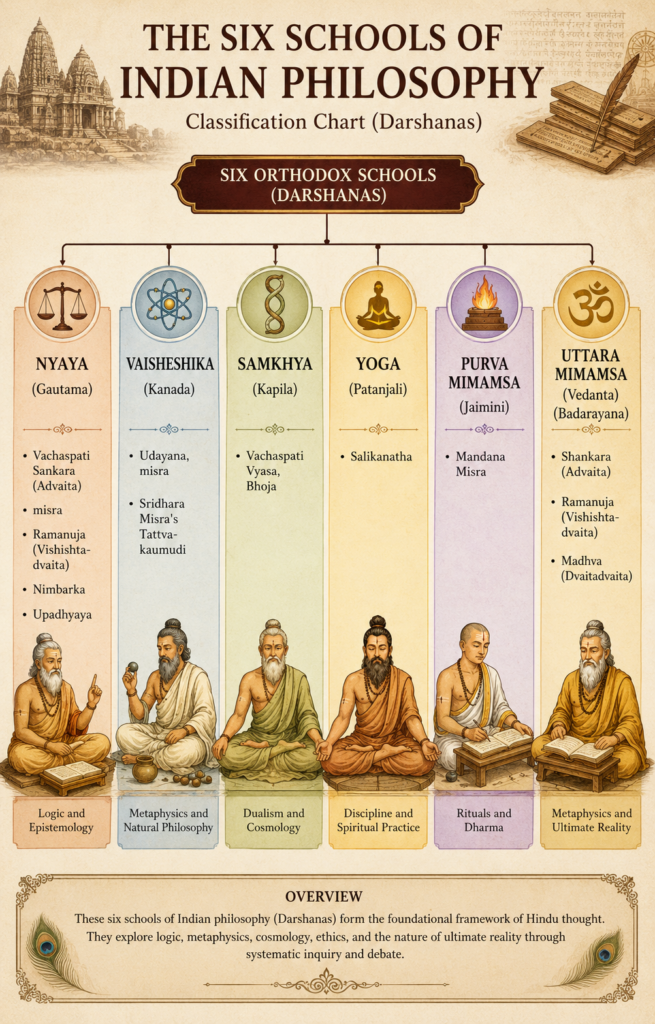
- Nyaya of Gautama:
- The greatest name in philosophy in the 9th century CE is Vachaspatimisra, who touched upon every branch of the orthodox systems of Indian philosophy — Advaita, Vedanta, Samkhya, Yoga, and Mimamsa.
- He wrote the Nyaya-varttika-tatparyatika, a super-commentary on the Nyayavarttika of Uddoyotakara, and the Nyaya-suchinibandha (CE 841).
- Udayana, under whom both the Nyaya and Vaisheshika schools gained fame in the 10th century CE, wrote the Tattva-suddhi (CE 984) and the Kusumanjali, which deals jointly with Nyaya and Vaisheshika.
- Jayanta Bhatta wrote the Nyaya-manjari, a commentary on the Nyaya-sutra, in the last quarter of the 9th century CE.
- Gangesa Upadhyaya, father of the new school of Nyaya (Navya-Nyaya), flourished in the last quarter of the 12th century CE, writing the Tattva-chintamani, a standard text of the modern Nyaya school.
- The greatest name in philosophy in the 9th century CE is Vachaspatimisra, who touched upon every branch of the orthodox systems of Indian philosophy — Advaita, Vedanta, Samkhya, Yoga, and Mimamsa.
- Vaisheshika of Kanada:
- The Vyomavati by Vyomasivacharya (10th century CE).
- The Nyaya-Kandali of Sridhara (991 CE) — the first work in which theism seems to have been formulated.
- The Lakshanavali by Udayana (984 CE), a short manual on Vaisheshika.
- The Nyaya-lilavati by Vallabhacharya (11th century CE).
- The Saptapadarthi by Sivaditya, another important work on Vaisheshika, containing Nyaya theory (11th century CE).
- Samkhya of Kapila:
- The famous commentary on Samkhya philosophy is the Tattva-kaumudi of Vachaspati Misra (9th century CE), the most popular work of this school.
- Yoga of Patanjali:
- Vyasa wrote a commentary on the Yoga Sutra in the 4th century CE.
- Vachaspati wrote a glossary on Vyasa’s Bhashya, called the Tattvavaisaradi, in the 9th century CE.
- Bhoja wrote a commentary on the Yoga Sutra, named the Rajamartanda, in the 11th century CE.
- Purvamimamsa of Jaimini:
- Salikanatha wrote a commentary, the Rijuvimala, in the 9th century CE.
- Mandana Misra, a follower of Kumarila, authored the Vidhiviveka and Mimansanukramani in the 9th century CE.
- Uttaramimamsa (Vedanta) of Badarayana:
- The greatest thinker on monistic Vedanta is Sankaracharya (788–820 CE), who wrote numerous commentaries on the Upanishads, the Bhagavad Gita, and the Vedanta-sutra.
- His main work is the Sarirakabhashya, a commentary on the Vedanta-sutra; he also wrote the Gitabhashya (commentary on the Bhagavad Gita), as well as Viveka Chudamani and Atmabodha.
- Vishishtadvaita of Ramanuja:Ramanuja, a Tamil Brahmana, was another great commentator on the Brahmasutras, flourishing between the last quarter of the 11th century and the first half of the 12th century CE.
- He wrote a commentary on the Brahma-sutra known as the Sri Bhasya, along with Vedartha-samgraha, Vedanta-sara, Vedanta Dipa, Gita-bhashya (a commentary on the Bhagavad Gita), Gadya-traya, and Bhagavadaradhanakrama.
- Nimbarka: Nimbarka, a Telugu Brahmana of the Vaishnava faith, lived a little after Ramanuja and wrote a commentary on the Brahma-sutra titled the Vedanta-parijata-saurabha.
- The greatest thinker on monistic Vedanta is Sankaracharya (788–820 CE), who wrote numerous commentaries on the Upanishads, the Bhagavad Gita, and the Vedanta-sutra.
Works on Arthashastra (Political Treatises)
- The Nitisara of Kamandaka is the most important political treatise after Kautilya’sArthashastra.
- Written in verse with the character of a kavya, it is based on the Arthashastra but is not a mere redaction of it; Vamana (c. 800 CE) mentions Kamandaki Niti in a stanza, placing this work between 700–750 CE.
- The Nitivakyamrita (“Nectar of the Science of Polity”) by Somadeva Suri, a Jaina writer of the 10th century CE (also author of the Yasastilaka-champu, c. 959 CE), is another important niti treatise.
- It is a mixture of ethics and politics in short sutras or aphorisms. While Kautilya’s work is a pure Arthashastra in which dharma is recognised only insofar as it aids the acquisition of artha, the Nitivakyamrita uses the term niti to encompass both political wisdom and moral conduct, aiming to instruct rulers in administering the state and achieving pre-eminence among rival states.
- Hemachandra (1088–1172 CE), a voluminous Jaina writer, authored the Laghuvar, a small manual of politics for Jains.
- The Manasollasa (or Abhilashitartha-chintamani) is attributed to the Western Chalukya king Somesvara, son of Vikramaditya VI, whose reign spanned 1127–1138 CE (the work’s composition dated to c. 1131 CE); it discusses the necessary qualifications of a king and, through its brief but comprehensive chapters on polity, takes on the character of an encyclopaedia.
- The Nitisutras of Brihaspati is written in short prose sentences, much like other works after the 6th–7th century CE; the Agni-purana also contains chapters on this subject.
- King Bhoja of Dhara (Paramara dynasty, 11th century CE) wrote the Yuktikalpataru, a niti text of comparatively little merit, though Bhoja is otherwise regarded as the greatest Indian critic available to us, offering the largest number of quotations and references with a very fine taste in selection and comment.
Literature on Music
- The Sangita-makaranda, written by Narada in the 11th century CE, deals with music and dance in two separate parts.
- The Manasollasa of Somesvara (son of Vikramaditya VI, composed c. 1131 CE) contains verses on music and musical instruments; Somesvara was an eminent authority on music, as evident from the introductory stanzas of the Sangitaratnakara.
- Jayadeva, the celebrated poet of the Gitagobinda, was himself a poet-musician in the court of King Lakshmanasena of Bengal (12th century CE) and a devout worshipper of Krishna.
- The most comprehensive treatise on the subject is the Sangitaratnakara of Sarangadeva (1210–47), a Brahmana from Kashmir.
- He lived in Daulatabad (Devagiri) under the patronage of the Yadava king Singhana of Devagiri, serving as a musician at his court.
- The Sangita-ratnakara occupies the most important place in Indian music literature, comprising seven chapters dealing with musical notes, technical terms, melodies, measures of time, musical instruments, acting, and dancing — it can be regarded as the first modern book on Indian music.
- Parsvadeva, contemporary of Sarangadeva and son of Adideva and Gauri, a Jaina, authored the Sangita Samayasara, dealing with all aspects of music.
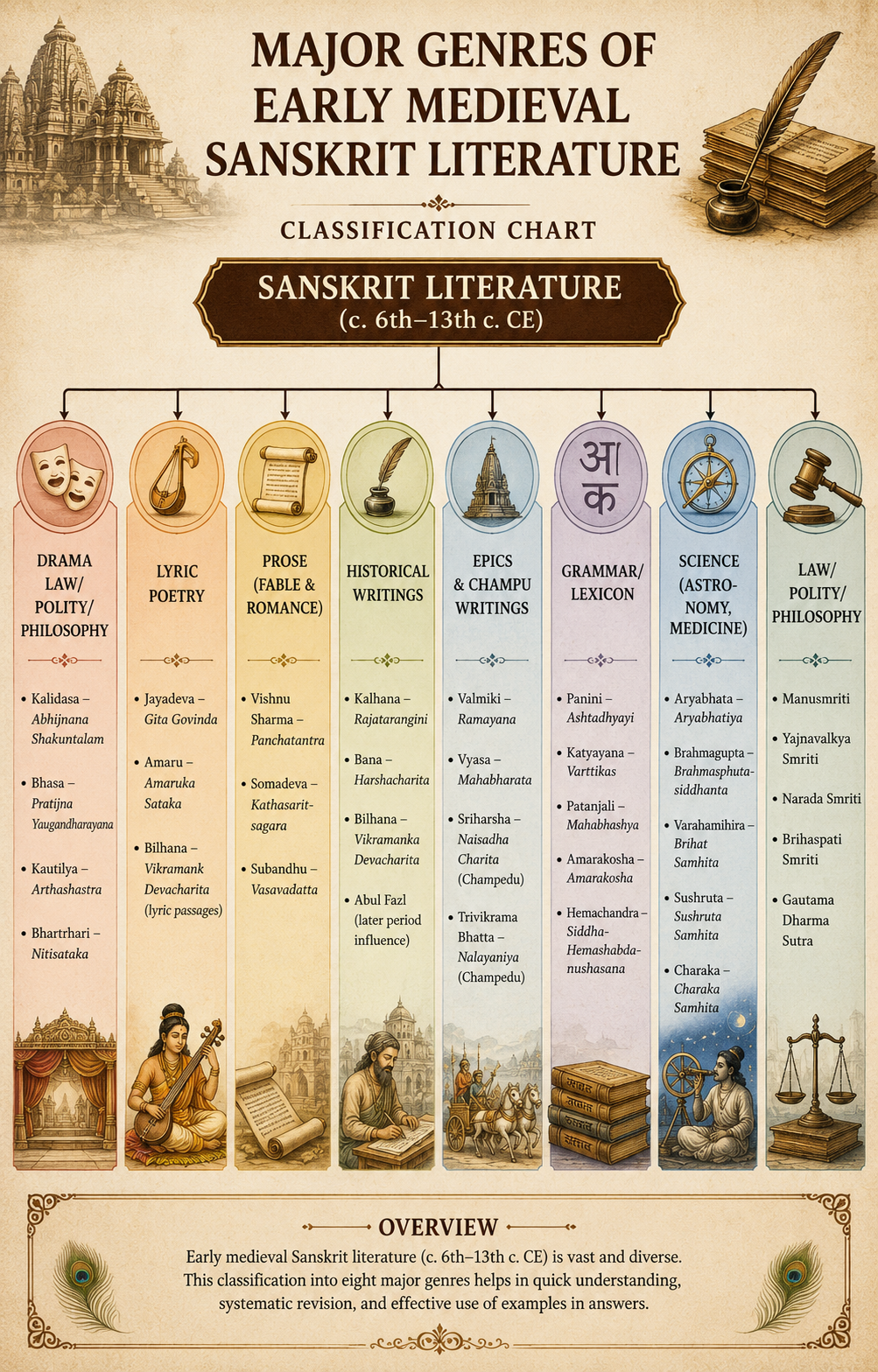
Conclusion
The trajectory of Sanskrit literature in early medieval India reveals a civilisation of extraordinary literary and intellectual productivity — spanning drama, lyric poetry, prose romance and fable, historical writing, epic composition, grammar, lexicography, the exact sciences, law, the six schools of philosophy, political treatises, and music — sustained by the patronage of Hindu rulers from Kashmir to Vijayanagara and Kanauj to Bengal. Yet this very richness coexisted with structural limitations, most notably Sanskrit’s narrowing social base and its near-total insulation from Persian and Islamic literary traditions. The combined pressures of the Turkish conquest, the adoption of Persian as the language of state, and the rise of vernacular literatures propelled by the Nathpanthi and Bhakti movements gradually displaced Sanskrit from its position of unchallenged literary dominance. Nonetheless, the vast corpus produced during this period remains an indispensable source for reconstructing the political, social, religious, and intellectual history of early medieval India — making it a vital theme for the UPSC History Optional syllabus.