Kalhana’s Rajatarangini

Rajatarangini (“The River of Kings”), composed in Sanskrit by the Kashmiri historian Kalhana in the 12th century CE, stands as one of the most remarkable works of historical writing produced in early medieval India — a period otherwise often criticised for its lack of a developed historiographical tradition. Covering the entire span of Kashmir’s history from the earliest times down to the date of its composition, and running to 7,826 verses divided into eight books (Tarangas, or “waves”), the Rajatarangini marks a genuine turning point in ancient Indian historiography.
Kalhana’s enduring reputation rests not merely on the historical content of his chronicle but on his remarkably modern sense of historical method — his insistence on impartiality, his critical use of sources, and his willingness to censure even the kings whose courts his family had served.
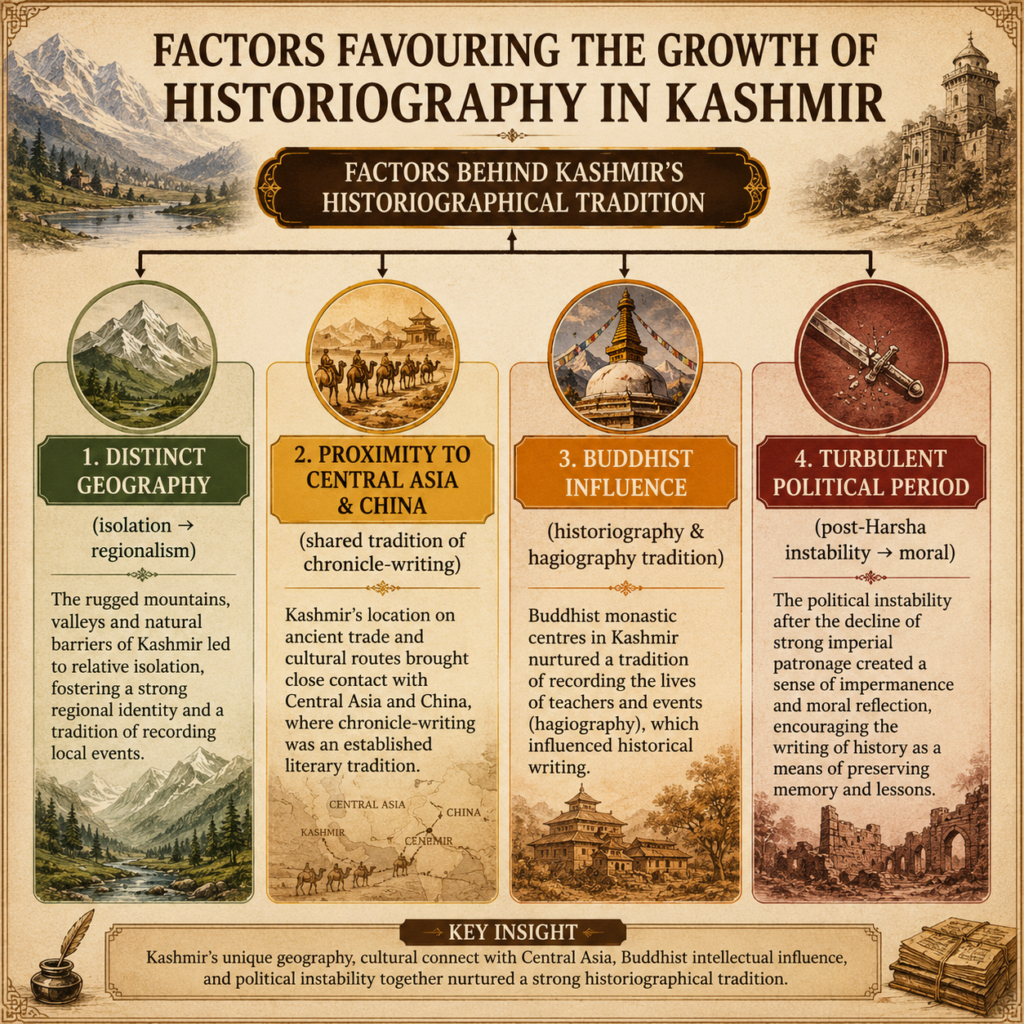
Factors Which Favoured the Growth of the Sense of History Writing in Kashmir
- Distinct geography:
- Kashmir possessed a distinct geographical identity, being separated from mainland India.
- This isolation contributed to the development of a separate cultural identity and a strong feeling of regionalism.
- Due to the growth of feudalism, similar regional feeling was strong elsewhere in India as well, and attempts to write local chronicles (called gathageet) were prevalent in other regions too — but their sense of historiography was far inferior to that of the Rajatarangini.
- Proximity with Central Asia and China:
- This proximity contributed to Kashmir’s tradition of history writing, since Central Asia and China historically possessed strong traditions of historical composition.
- Buddhism:
- Kashmir had witnessed the development of Buddhism, which carried a strong tradition of historiography and hagiography compared to other religions.
- Turbulent period in Kashmir:
- Kalhana was writing during a very turbulent period — Harsha’s reign had ended, and it was an age of wars and internal struggles.
- By writing the Rajatarangini, Kalhana sought to convey that all earthly possessions and pleasures are ultimately transient and useless.
His Sources
- Kalhana utilised the works of eleven chroniclers of Kashmir who preceded him as sources of information for composing his work.
- His father, Champaka, was a minister of King Harsa (1089–1101) and also adorned the court of King Jayasimha (1127–59) — giving Kalhana access to important information about the contemporary court.
- He analysed royal charters, edicts, records of land grants, contemporary documents, coins, and inscriptions, among other sources.
Content of the Rajatarangini
Political History
- The Rajatarangini embraces the history of Kashmir from the time of the first Hindu king Gonanda to AD 1149 — the 22nd year of the reign of the last illustrious king, Jayasimha.
- It contains the genealogies and chronology of kings of the various dynasties that ruled Kashmir during this period, along with the achievements of important kings and the details of significant events during their reigns.
Books I–III
- Of the fifty-two kings said to have ruled Kashmir in the early phase, only a list of seventeen — including Gonanda I and his successors, along with some other kings — has been provided in Book I (the Gonanda dynasty); Kalhana could not find the names of the remaining thirty-five kings, as their records were lost.
- The same book contains the list of twenty-one kings who succeeded Gonanda III, followed by a list of six princes — from Pratapaditya I to Aryaraja — belonging to the Aditya dynasty.
- From Book III, it appears that there was a restoration of the Gonanda dynasty, with princes from Meghavahana to Baladitya subsequently reigning in Kashmir.
- These three books contain more or less a traditional history, spanning from the great Battle of Kurukshetra (or the beginning of the Kali-yuga) to the end of the 6th century AD, based largely on the Itihasa-Purana tradition.
- Some of the kings mentioned are, of course, mythical, but the historicity of others — such as Asoka and his son Jaluka, and Kanishka — is well established, and their activities are also recorded in Kalhana’s work.
- However, there is an anachronism in the genealogical list furnished in Book I, and the chronology of some of the kings mentioned in these first three books is not reliable.
Books IV–VIII
- The information Kalhana provides in Books IV–VIII, covering the period from the early 7th century AD to about the middle of the 12th century, is considerably more trustworthy than that of the earlier three books, both historically and chronologically.
- Book IV contains the history of seventeen kings, from Durlabhavardhana to Utpalapida, belonging to the Karkota dynasty.
- Durlabhavardhana, descendant of Naga Karkota, founded this dynasty and appears to have ruled from AD 598 to 634.
- The most powerful ruler of this line was Lalitaditya (AD 724–60), the third son of Durlabhaka (alias Pratapaditya).
- Lalitaditya has been described as an efficient administrator, valiant warrior, great conqueror, and patron of arts and culture; Kalhana provides a faithful account of his digvijaya (conquest).
- Book V provides the narrative of fifteen princes, from Avantivarman to Suravarman II, belonging to the Utpala (or Varman) dynasty.
- Book VI provides the history of ten kings in the lines of Yasaskara and Parvagupta.
- After Suravarman II, Yasaskara (son of Gopalavarman’s minister, Prabhakaradeva) was elected king by the Brahmanas.
- During his benevolent reign of nine years (AD 939–48), a new era of peace, progress, and prosperity commenced in Kashmir.
- His son and successor, Samgrama, was killed in AD 949 by the minister Parvagupta, who then usurped the throne himself.
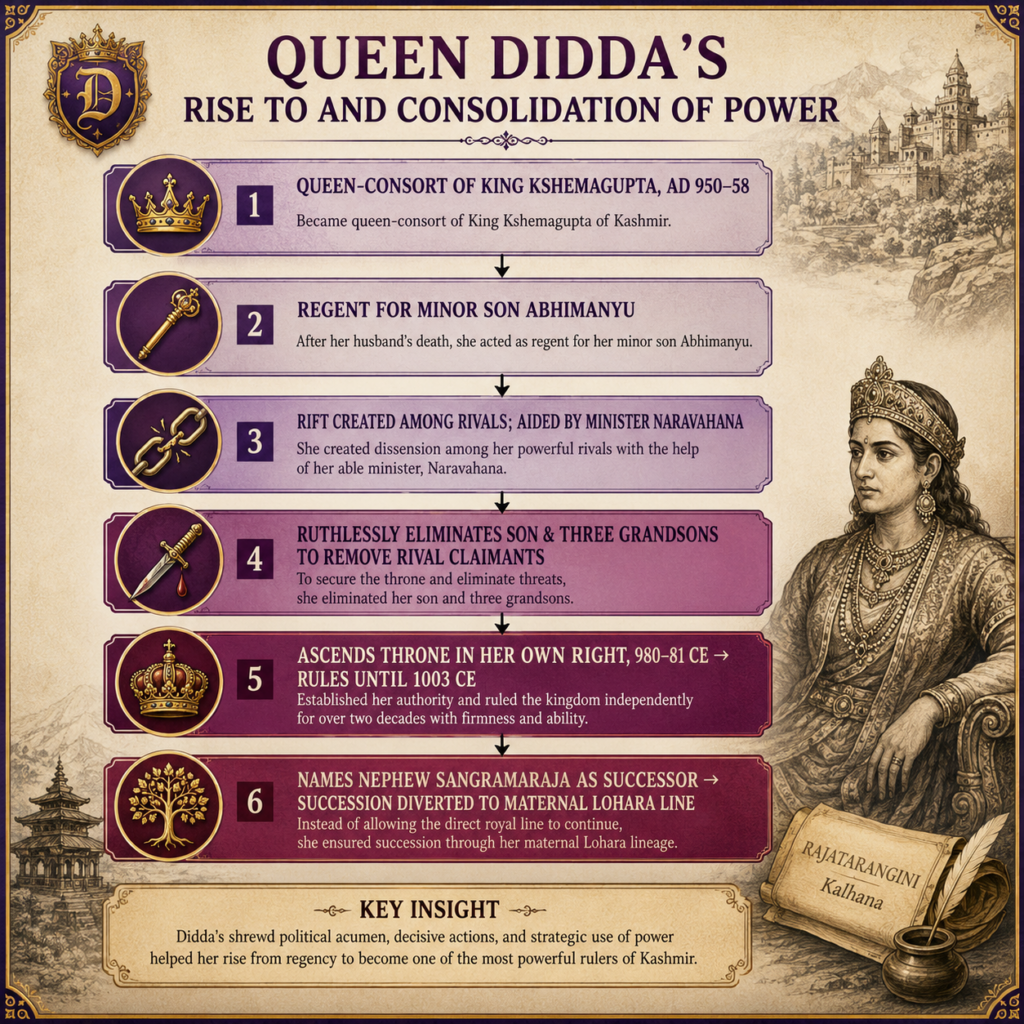
- The most prominent and powerful ruler in this line was Didda, granddaughter of Bhima Shahi and daughter of Simharaja, a chief of Lohara (in the Punch state).
- She was an ambitious and energetic woman who, for nearly half a century — first as queen-consort of King Kshemagupta (AD 950–58), then as regent, and finally as ruler (AD 980–1003) — remained the dominant personality in the politics of Kashmir.
- After Suravarman II, Yasaskara (son of Gopalavarman’s minister, Prabhakaradeva) was elected king by the Brahmanas.
Didda of Kashmir
- The history of Kashmir also reveals a tradition of powerful queens. The Rajatarangini’s account of Kashmir’s history mentions three women rulers — Yashovati of the Gonanda dynasty, Sugandha of the Utpala dynasty, and Didda of the Yashaskara dynasty.
- Of these, Didda (a respectful term for an elder sister, still used by Kashmiri Pandits) had the longest and most eventful stint, exercising political power for almost 50 years. This included:
- The period of her husband Kshemagupta’s reign.
- The time she served as regent for her minor son Abhimanyu.
- The years she ruled Kashmir in her own right after ascending the throne in 980–81 CE.
- Didda’s career is described in the sixth Taranga of the Rajatarangini.
- Kalhana describes how this queen was aided in her rise to power by her minister, the loyal Naravahana, who made her “comparable to Indra.”
- He describes how she managed to create a rift in the ranks of her enemies, and how she ruthlessly killed her son and three grandsons before ascending the throne.
- Didda had an affair with a courier and herdsman named Tunga, who became her trusted confidante; she chose her nephew Sangramaraja as successor, thereby diverting the line of succession to her maternal family from Lohara.
- Kalhana credits Didda with founding towns, temples, and monasteries — including the towns of Diddapura and Kankanapura, and a temple called the Diddasvamin temple — and with repairing many temples dedicated to the gods.
- Kalhana disapproved of her:
- He describes her as deficient in moral character, merciless by nature, and easily influenced by others.
- For Kalhana, her personality reflected the defects of womankind.
- In spite of his prejudices, Kalhana portrays both royal and non-royal women as historically relevant figures.
- In the realm of political power, women appear as sovereign rulers as well as powers behind the throne.
- The Rajatarangini also reflects the direct and indirect political influence of courtesans and women of “low” birth in the harem.
- In Kashmir, as elsewhere, within the constraints of the prevailing patriarchal power structure, male control over political power was occasionally breached.
- Book VII contains the history of six princes, from Samgramaraja to Harsa, belonging to the so-called Lohara dynasty.
- Samgramaraja (alias Ksamapati), nephew of Didda and brother of the Lohara prince Vigraharaja, ascended the throne in AD 1003 and ruled until 1028.
- Samgramaraja proved to be a weak king, and during the earlier part of his reign, Tunga was virtually the ruler of the state.
- Book VIII, the last book, contains the history of seven kings, from Ucchala (AD 1101–11) to Jayasimha (AD 1127–59), the last illustrious sovereign.
- The author provides an eye-witness account of events that took place around the middle of the 12th century AD.
Misrule in Kashmir
- Kalhana describes in detail the misrule prevailing in Kashmir.
- Local feudal elements, the Damras, had become very strong and were attempting to destabilise the throne.
- He therefore argues that the king should be strong and must ensure there is no concentration of wealth, even in the villages, lest such wealth be used to challenge royal authority.
Administration
- Kalhana severely criticises the bureaucracy, most of whom were Kayastha, alleging that they were behind most of the conspiracies against the king.
Social Life
- Kalhana describes the social life of Kashmir — for instance, the Rajatarangini notes that the rich drank perfumed wines and ate meat, while the poor survived on wild vegetables.
- Kalhana also records that Harsha introduced a general dress of a long coat in Kashmir.
Economic Life
- Kalhana provides useful information about Kashmir’s economic life, describing agriculture and water works, such as dams built to prevent landslides, which were supervised by a minister of Avantivarman.
- This contributed to the subsequent economic prosperity of Kashmir, and led to Kashmir’s withdrawal from plains politics, since the need to engage there was lessened.
Kalhana’s Views on History
Kalhana, in the prologue of the Rajatarangini, expresses his views on history. The following aspects of his historiography and method of writing history mark him as the greatest historian of his time:
- Kalhana believed that good history has the power to transport the reader into the past, allowing them to explore events almost as an eyewitness would — a superior kind of creativity that retains its relevance even after many centuries.
- He held that a historian should be praised for honestly judging past events, unaffected by personal likes and dislikes — for Kalhana, history must be unbiased.
- His minute detail regarding contemporary court intrigues is considered authentic due to his access to the court, since his father served in the Kashmir court of King Harsha of the Lohara dynasty.
- Though he lived under several kings, he received no patronage from them — hence his writing is not biased to please any ruler, and offers a detailed, objective analysis.
- As a result, his writing is devoid of rhetorical flourish and free of the praises evident in other writers who worked under royal patronage.
- According to Kalhana, the quality of a good historian is a virtue exceeding even the value of the stream of nectar, because it immortalises the glory of both self and others.
- Kalhana was also critical of earlier historians, arguing that many earlier history books contained missing or even incorrect information.
- Early historians, he noted, wrote eulogies to please their patrons.
- He criticised the text Nripavali for its lack of historical content, describing it as more like literature than history.
- He also criticised Suvrata’s writing, which presented early history in a form so compact and critical that it remained incomprehensive and even misleading for many readers.
- According to Kalhana, mere narration of events was not the true way of writing history — such an approach amounted to little more than a chronicle with no validity.
- Kalhana explains his own extensive study, holding that history should be written only after comprehensive research.
- Kalhana displayed surprisingly advanced technical expertise for his period, and was careful to cite the sources of his writing.
- For instance, in writing his history, he gave importance to viewing inscriptions, recording the construction of temples and other architecture, inspecting various kinds of grant plates issued by ancient kings, consulting epigraphic sources relating to royal eulogies, studying coins, monumental remains, and family records, and studying earlier texts such as the Harshacharita, the Brihat-samhita, local rajkathas, and previous works on Kashmir such as Nripavali by Kshemendra and Parthivavali by Helaraja.
- He mentions his sources in detail — including the eleven scholars who provided him with the family tree of Kashmir’s rulers — and also draws upon legends, myths, and folklore.
- His use of records as reason-based sources of history was indeed an important contribution to historiography.
- Kalhana did not merely describe events but also sought to understand and explain the conditions of the time. In his view, people should learn lessons from the mistakes of the past.
Criticism
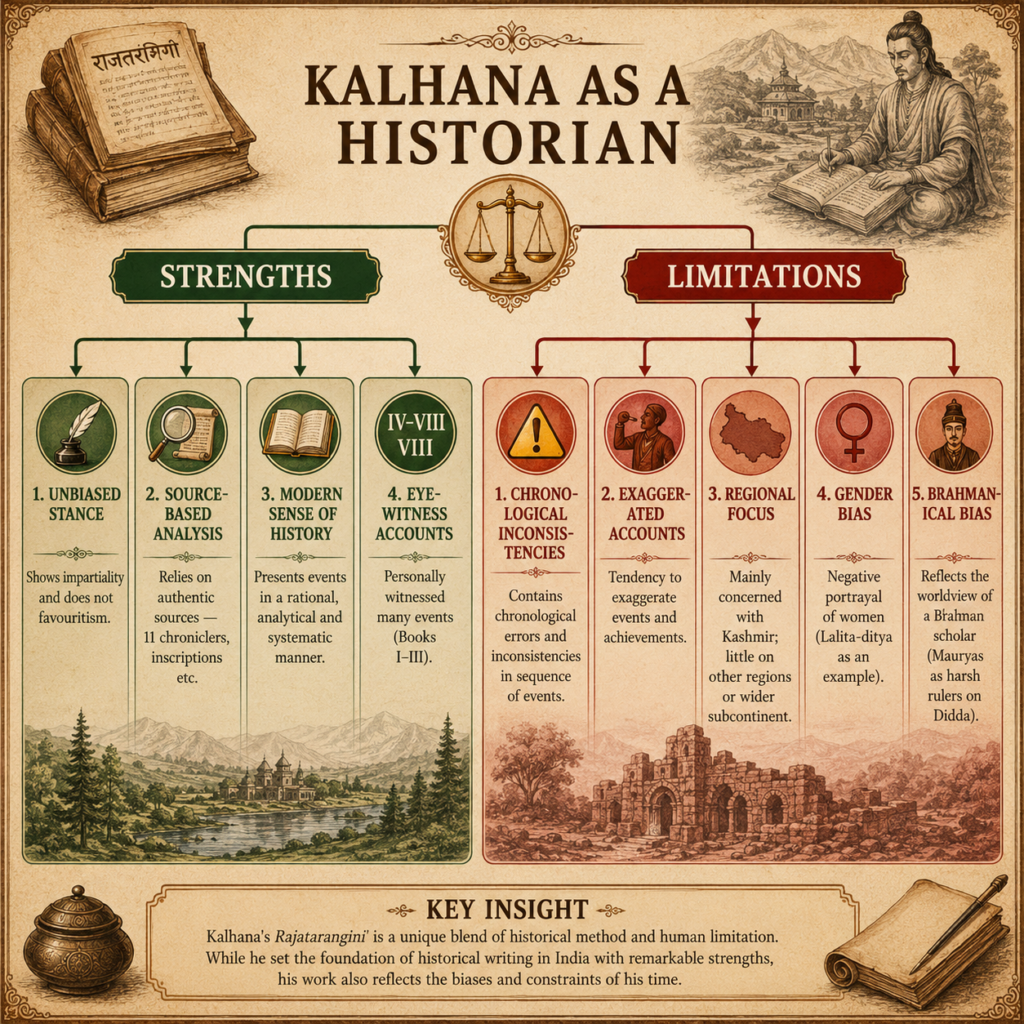
- Kalhana chose Sanskrit as the medium of verse for his writings, and his style was inclined towards an ornate style, in which he mingled some fiction with historical truth.
- There are inconsistencies in chronology and dates in the earlier chapters of his book, especially the first three parts (out of the eight total), which cover a history of more than 3,000 years, relying mainly on the Puranas and legends.
- In these earlier chapters, he seems, at times, to be presenting folklore — for example, he assigns a reign of 300 years to Ranaditya.
- He exaggerated the military conquests of Lalitaditya Muktapida in Book IV.
- Regionalism is also apparent in his writing — for instance, he includes the Mauryas as rulers of Kashmir, which is clearly a mistake.
- Gender bias is also showcased on occasion — for instance, in his excessive criticism of Queen Didda.
- His thought also shows favouritism towards Brahmins.
Conclusion
Despite these inconsistencies, the Rajatarangini remains far more important and historically valuable than any comparable work produced during the same period — indeed, it stands as the only authentic source for the history of early Kashmir. Kalhana’s writing is genuinely unique, qualitatively far ahead of his time, and no other contemporary historian can be meaningfully compared with him. The Rajatarangini provides an invaluable source of information about early Kashmir and its neighbours, and remains widely referenced by later historians. Although his work was continued by later writers, such as the Rajatarangini of Jonaraja, these subsequent chronicles remained markedly inferior to Kalhana’s original — a testament to the enduring value of his critical, source-based, and remarkably impartial approach to the writing of history.