

Mughal Empire, First Phase: Babur

The story of the Mughal Empire’s first phase begins not in India but in the turbulent politics of Central Asia, where a young Babur spent nearly two decades fighting to hold on to a kingdom before circumstances finally turned his ambitions towards Hindustan. This article traces Babur’s early struggles in Transoxiana, the fractured political landscape of India on the eve of his invasion, the decisive battles of Panipat, Khanwa, and Chanderi through which Mughal rule was founded, and the broader significance — political, economic, cultural, and administrative — of Babur’s advent into India.
Babur’s Early Struggles and the Turn towards India
- Babur ascended the throne at Farghana (a small principality in Transoxiana) in 1494, at the age of twelve, but his succession was far from smooth.
- Both the Mongol Khans and the Timurid princes — notably Sultan Ahmad Mirza of Samarqand, Babur’s own uncle — had competing interests in Farghana.
- Besides these external threats, Babur also had to contend with a discontented nobility at home.
- Against these odds, Babur struggled to strengthen his foothold in Central Asia, succeeding in taking Samarqand twice (1497, 1500), though he could hold it only briefly each time.
- Shaibani Khan’s success over Khorasan (1507) — the last of the four Timurid centres of power — finally sealed Babur’s fate in Central Asia, leaving him with no option but to turn to Kabul, where conditions were most favourable, especially after its ruler Ulugh Beg Mirza had already died (1501).
- Babur occupied Kabul in 1504. Yet he could not entirely abandon his dream of ruling Central Asia: with the help of Shah Ismail Safavi, he briefly gained control of Samarqand again in 1511, but Shah Ismail’s defeat in 1512 and the resurgence of the Uzbegs left Babur no alternative but to consolidate himself at Kabul.
- It was thus the Central Asian situation which, after 1512, pressed and convinced Babur to abandon his hopes of building an empire in Central Asia and to look towards India instead.
Other Reasons for Babur’s Turn towards India
- The rich resources of India, contrasted with the meagre income of Afghanistan — a point noted by Abul Fazl — may have been another attraction for Babur.
- The unstable political situation following Sikandar Lodi’s death convinced him of the political discontent and disorder within the Lodi Empire.
- Invitations from Rana Sanga and Daulat Khan Lodi, the governor of Punjab, likely whetted Babur’s ambitions further.
- Timur’s legacy may also have provided some background for the invasion — after the siege of Bhira in 1519, Babur asked Ibrahim Lodi to return western Punjab, which had belonged to his uncle Ulugh Beg Mirza.
- Babur, therefore, had both the reasons and the opportunity to look towards India.
Political Condition of India on the Eve of Babur’s Invasion
- The first half of the fifteenth century witnessed political instability following the disintegration of the Tughluq dynasty. Neither the Saiyyad (1414–1451) nor the Lodi (1451–1526) rulers could cope with the disruptive forces at play.
- The nobles resented central authority and rebelled at the earliest opportunity, while political chaos in the North-West provinces further weakened the centre.
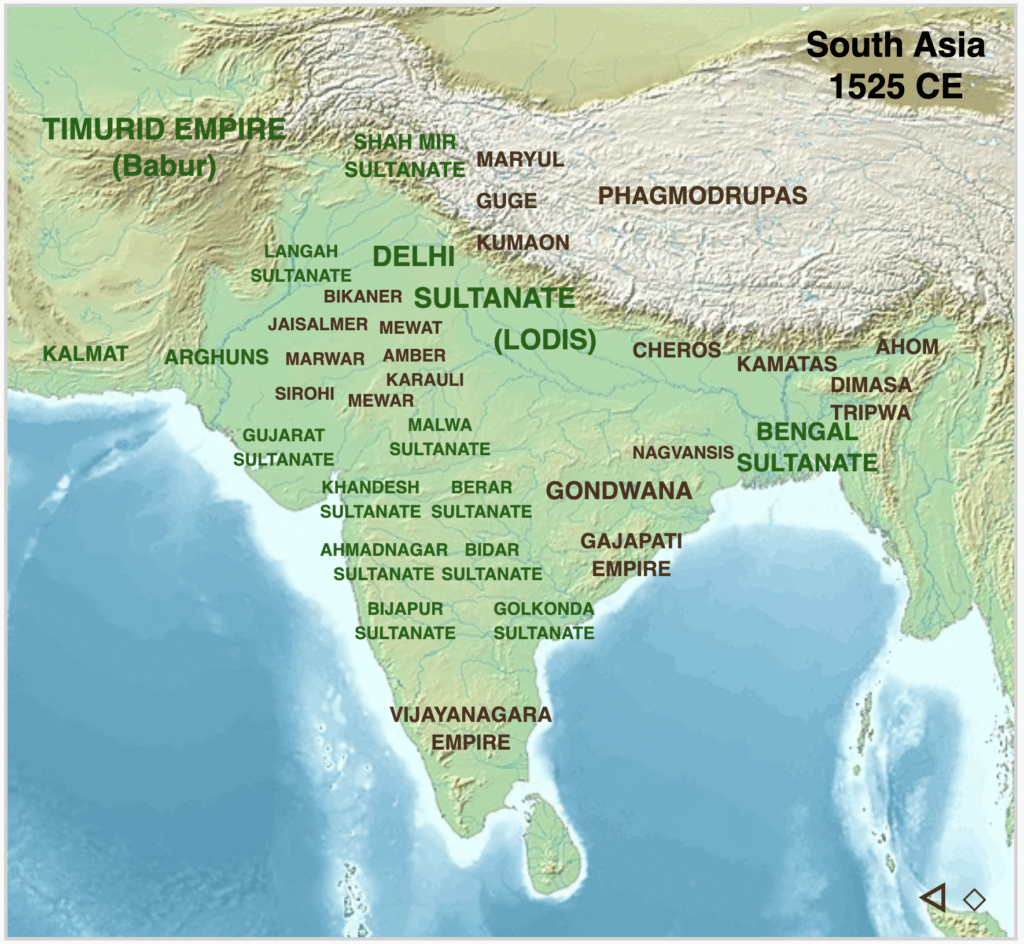
- In Central India, three kingdoms held sway — Gujarat, Malwa, and Mewar.
- The power of Sultan Mahmud Khalji II of Malwa was on the decline, while Gujarat was ruled by Muzaffar Shah II.
- Mewar, under the Sisodia ruler Rana Sanga, was the most powerful kingdom of the three. Rana Sanga had established control over eastern Malwa and was competing with the Lodis for eastern Rajasthan and the rest of Malwa.
- The rulers of Malwa remained under constant pressure from the Lodis, Mewar, and Gujarat, because:
- Malwa was the most fertile region and an important source of elephant supply.
- It provided a crucial trade route to Gujarat’s sea-ports.
- For both Gujarat and Mewar, it could serve as a buffer against the Lodis.
- The Sultan of Malwa was an incompetent ruler, and his prime minister, Medini Rai, could hardly hold the kingdom together for long amid internal strife.
- Eventually, Rana Sanga succeeded in extending his influence over both Malwa and Gujarat, and by the close of the 15th century, his sway over Rajputana was almost complete, with the occupation of Ranthambhor and Chanderi.
- In the south, the powerful Vijayanagar and Bahmani kingdoms held sway, while towards the east, Nusrat Shah ruled Bengal.
- Towards the closing years of Ibrahim Lodi’s reign, Afghan chieftains such as Nasir Khan Lohani and Ma’ruf Farmuli succeeded in carving out a separate kingdom of Jaunpur under Sultan Muhammad Shah.
- Besides these major powers, numerous smaller Afghan chieftaincies existed around Agra, such as Hasan Khan in Mewat and Nizam Khan in Bayana.
The Debate over a “Rajput Confederacy” and Religious Motivation
- In analysing the political set-up on the eve of Babur’s invasion, it is often argued that a confederacy of Rajput principalities, ready to seize control of Hindustan, existed at the time.
- It is held that had Babur not intervened, the Rajputs under their illustrious leader Rana Sanga would have captured power in northern India, and that this political division of the regional states was religious in nature — with the Rajput confederacy fired by religious zeal to establish a Hindu Empire.
- This assumption rests largely on a famous passage in the Baburnama, where Babur describes Hindustan as being governed by “five Musalman rulers” — the Lodis (at the centre), Gujarat, Malwa, Bahmani, and Bengal — and two “pagans,” Rana Sanga of Mewar and Vijayanagar. The fathnama issued after the Battle of Khanwa similarly suggests that the Rajput confederacy under Rana Sanga was inspired by religious zeal and organised to overthrow “Islamic power.”
- However, historians have questioned such observations on several grounds.
- Babur nowhere suggests that these powers were antagonistic towards each other on religious grounds; in fact, he himself admits that many rais and ranas were obedient to Islam.
- The confederacy itself included many Muslim chieftains — such as Hasan Khan Mewati and Mahmud Khan Lodi — who sided with Rana Sanga against Babur.
- It was, in fact, not Rana Sanga but Sultan Mahmud who proclaimed himself king of Delhi.
- Although Rana Sanga’s power was unquestionable, Babur was more anxious about the Afghan menace than about a religious threat — so the theory of purely religious consideration does not hold much ground.
Foundation of Mughal Rule in India
- Between 1517 and 1519, two apparently unconnected events took place that would profoundly affect the history of India: the death of Sikandar Lodi at Agra towards the end of 1517 (and the succession of Ibrahim Lodi), and Babur’s conquest of Bajaur and Bhira in the north-west Punjab frontier tract at the start of 1519.
- Much before the final showdown at Panipat (1526), Babur had already invaded India four times, these earlier skirmishes serving as trials of strength between Mughal arms and Lodi forces.
- The first to fall was the fort of Bhira (1519–1520), the gateway of Hindustan on the river Jhelum, followed by Sialkot (1520) and Lahore (1524).
- Babur put forward a vague claim that the territories once belonging to Timur be surrendered to him, and sent an envoy to Ibrahim Lodi to this effect. The governor of Lahore at the time, Daulat Khan Lodi, sent his own son, Dilawar Khan, to Babur at Kabul in 1521–22, inviting him to invade India on the grounds that Ibrahim Lodi was a tyrant, and claiming he had been sent by many nobles ready to submit to Babur.
- Babur also received an envoy from Rana Sanga, who reportedly proposed that while Babur attacked Delhi, Sanga would simultaneously attack Agra.
- Motives behind these invitations:
- The inviters apparently expected Babur to withdraw after his campaign, like Timur before him, having installed a weak titular ruler at Delhi dependent on them.
- They hoped this would allow them to continue ruling as before, while extending control over territories they coveted.
- The arrival of these envoys convinced Babur that the situation was ripe for undertaking the conquest of India.
First Battle of Panipat (20 April, 1526)
- In preparation for the conflict, Babur consolidated his position in Afghanistan by capturing Balkh from the Uzbeks and also securing Qandahar. With his rear and flank thus secured, he marched from Kabul in November 1525 for the conquest of Hindustan.
- Marching via Sialkot, which yielded without opposition, Babur reached Lahore, then under siege by Daulat Khan Lodi and his son Ghazi Khan — whose army melted away at Babur’s approach.
- Having conquered Punjab, Babur moved slowly towards Delhi, while Ibrahim Lodi made no move to contest his position in Punjab, instead advancing leisurely — marching only two to four miles a day and halting at each camp for two to three days.
- Although the two armies stood face to face for almost a week, with daily skirmishes, Ibrahim Lodi failed to carefully study Babur’s defensive formation.
- The two forces finally met at the historic battlefield of Panipat, where the battle lasted just a few hours, ending in Babur’s favour.
- The battle demonstrated Babur’s mastery of the art of warfare: his soldiers were fewer in number, but far better organised.
- Babur placed Ibrahim’s army at 100,000 men and 1,000 elephants; Afghan sources put Ibrahim’s effective strength at 50,000, against Babur’s mere 12,000 horsemen.
- The battle thus proved to be a triumph of generalship over numbers.
- Anticipating the risk of being surrounded by Ibrahim’s much larger army, Babur chose his ground carefully — resting his right flank on the city of Panipat, and digging a ditch reinforced with felled tree branches on his left to block cavalry movement.
- In front, he arranged 700 carts lashed together with ropes of raw hide, with short breastworks between every two carts, behind which matchlockmen could stand and fire. Babur called this method of stringing carts the Ottoman (Rumi) device, since it had been used, along with cannons, by the Ottoman Sultan.
- Babur held a poor opinion of Ibrahim Lodi as a strategist, remarking that “he was an unproved brave; he provided nothing for his military operations, he perfected nothing, nor knew how to stand, nor move, nor fight.”
- Applying the Rumi (Ottoman) method successfully, Babur pinned down the numerically superior Afghans, who could move neither forward nor backward.
- He sent his flanking parties (tulghuma) to wheel around in the Uzbek fashion and attack Ibrahim’s army from both sides and the rear, while his cavalrymen shot arrows from the front and his matchlockmen poured deadly fire into the huddled Afghan mass.
- Babur had hired two Ottoman gunners, Ustad Ali and Mustafa — appointing Ustad Ali as master of ordnance — who made effective use of the field cannons from the centre.
- With the Afghan army completely paralysed and surrounded from all sides, Ibrahim Lodi fought bravely and died fighting; Babur paid tribute to his courage by burying him on the spot with honour.
- Afghan casualties, as reported by Babur, were approximately 20,000, and Vikramajit, ruler of Gwaliyar, was among those who died fighting.
- As Babur himself acknowledged, it was not his artillery but his “superb tactics” and his “mounted archers” and cavalry that played the decisive role in the battle.
- The battle demonstrated Babur’s mastery of the art of warfare: his soldiers were fewer in number, but far better organised.
Significance of the Battle of Panipat
- The Battle of Panipat was undoubtedly one of the decisive battles of Indian history — it smashed the power of the Lodis and opened up the entire territory up to Jaunpur to Babur’s control.
- The rich treasures stored by the Lodi Sultans at Agra relieved Babur of his financial difficulties.
- However, while Panipat formally established Mughal rule in India, it was only the first among a series of battles Babur had to fight before consolidating his position.
- To secure this triumph, it was equally important to overcome Rana Sanga of Mewar and the chieftains around Delhi and Agra, while the Afghans in eastern India remained another important opponent, and problems were mounting within his own nobility.
- Thus, politically, the Battle of Panipat was not as decisive as it was militarily — though it did mark a new phase in the struggle for hegemonic political power in north India.
Babur and the Rajput Kingdoms
- Rana Sanga of Mewar remained a power to reckon with. In his Memoirs, Babur blamed Rana Sanga for breaking his promise by not siding with him against Ibrahim Lodi at Panipat, despite some prior understanding between the two to join hands against the Lodi ruler.
- Rana Sanga had expected Babur to return to Kabul, leaving him free to establish his own hegemony; Babur’s decision to stay back in India must have dealt a severe blow to these ambitions.
- Babur, for his part, was fully aware that consolidating his position in India would be impossible unless he first shattered the Rana’s power.
- This time, Rana Sanga succeeded in forging a confederacy against Babur with the help of Afghan nobles.
- He was joined by nearly all the leading Rajput rulers of Rajasthan — including Harauti, Jalor, Sirohi, and Dungarpur from the south and west, and Dhundhar and Amber from the east — along with Rao Medini Rai of Chanderi in Malwa.
- Mahmud Lodi, the younger son of Sikandar Lodi, whom the Afghans had proclaimed their Sultan, also joined the confederacy, as did Hasan Khan Mewati of Mewat, who played a crucial role in its formation.
- Several other Afghans joined Rana Sanga’s cause: Husain Khan Nuhani occupied Rapri, Rustam Khan prevailed over Koil, and Qutub Khan captured Chandawar. Pressure from these eastern Afghans was so intense that Sultan Muhammad Duldai had to abandon Qannauj and join Babur instead.
- The defeat of Babur’s commanders Abdul Aziz and Muhibb Ali at Bayana, combined with their own admiration for the valour of the Rajput army, further demoralised Babur’s forces.
- Ferishta and Badauni (Akbar’s contemporary) noted that the sense of defeatism ran so deep that a majority at a council of war proposed the Padshah should withdraw to Punjab — though the Baburnama itself makes no mention of such a proposal, even as it reflects the general mood of despair and frustration.
- Babur, however, prevailed over the situation through a fiery speech that touched the religious sentiments of his men.
- He declared the war against Rana Sanga a jihad, renounced wine — breaking flasks of choice Ghazni wine — and promised to remit the tamgha (toll) on all Muslims should he emerge victorious.
- Babur denounced the Afghans opposing him as kafirs and mulhids, showing that such terms were often used in a political as much as a religious sense. After the Battle of Khanwa, Babur assumed the title of ghazi.
- Sanga, in essence, represented a Rajput-Afghan alliance whose proclaimed objective was to expel Babur and restore the Lodi empire — hence the Battle of Khanwa can hardly be seen purely as a religious conflict between Hindus and Muslims, or as a Rajput bid for hegemony over north India.
Battle of Khanwa (16/17 March, 1527)
- Babur fortified his position near Sikri, at the village of Khanwa, once again organising his army along Ottoman lines.
- This time, he had the support of a tank on his left; his front was again defended by carts, but the ropes were now replaced with iron chains.
- He additionally deployed strong wooden tripods connected by ropes, which not only offered protection and rest for the guns but also allowed them to be moved forward and backward on wheels. Constructing this arrangement, under Ustad Mustafa and Ustad Ali, took around 20–25 days.
- In the battle, fought on 17 March, 1527, Babur made effective use of his artillery.
- Rana Sanga was severely wounded and carried to Baswa near Amber, while Hasan Khan Mewati was killed — the Rajputs suffering heavy losses. It was, in hindsight, a strategic error for Sanga to remain inactive for over three weeks before the battle, giving Babur time to strengthen himself and prepare.
- Babur’s disciplined army, mobile cavalry, and artillery together played the most decisive role in the outcome.
- Khanwa completed what Panipat had begun, and Babur’s position in the Gangetic doab was made largely secure.
Battle of Chanderi (1528)
- Though the Mewar Rajputs had received a severe shock at Khanwa, Medini Rai at Malwa remained a power to reckon with — Rana Sanga had bestowed Malwa upon him in 1520, when Medini Rai was chief noble to Mahmud II of Malwa.
- Despite the great valour with which the Rajputs fought at Chanderi (1528), Babur faced little difficulty in overcoming Medini Rai. With his defeat, resistance across Rajputana was effectively shattered, though Babur still had the Afghans to contend with.
Babur and the Afghan Chieftains
- The Afghans had surrendered Delhi, but remained powerful in the east — in Bihar and parts of Jaunpur — where the Nuhani Afghans, led by Sultan Muhammad Nuhani, were dominant.
- The Afghans of Chunar, Jaunpur, and Awadh were unwilling to cooperate with the Nuhanis in mounting united opposition to the Mughals, instead surrendering meekly to Humayun in 1527.
- Meanwhile, Sultan Muhammad Nuhani died in 1528, leaving the Nuhanis disjointed, since his son Jalal Khan was still a minor.
- The resulting vacuum was soon filled by Prince Mahmud Lodi, son of Sikandar Lodi and brother of Ibrahim, whose leadership was readily accepted even by the non-Nuhani Afghans who had earlier hesitated to side with the Nuhanis, and by Nuhani Afghans left leaderless after Jalal Khan’s desertion to Bengal.
- Nusrat Shah of Bengal, while outwardly professing friendship with Babur, secretly adopted hostile measures against him — viewing the Nuhani kingdom in Bihar as a useful buffer between the Mughals and his own possessions in parts of Bihar.
- Unable to ignore these developments, Babur mobilised his forces at Ghagra and inflicted a crushing defeat on Nusrat Shah’s army in 1529, ending the Afghan–Nusrat coalition and compelling Nusrat Shah to surrender the large number of Afghan rebels who had taken asylum in his territory.
- The Afghans were now thoroughly demoralised.
- Thus, within just four years, Babur succeeded in crushing the hostile powers ranged against him and could finally think of consolidating his rule at Delhi — though he had little opportunity to actually do so, as he died soon after, on 29 December 1530.
- The establishment of the Mughal Empire under Babur was, in this sense, highly significant. Although the Afghans and Rajputs could not be crushed completely — a task left to his successors — his two major victories at Panipat and Khanwa were certainly decisive, destroying the existing balance of power in the region and paving the way, perhaps, towards the establishment of an all-India empire.
Significance of Babur’s Advent into India
- Babur died at Agra on 30 December 1530, after a short illness — his health having failed over the preceding years due to hard campaigning and the hot Indian climate, to which he was unaccustomed.
- Although he greatly missed Afghanistan and found many aspects of India distasteful, Babur nonetheless considered India his home, and gave leave to depart to any of his begs who thought otherwise.
Inclusion of Afghanistan in an Empire Based on India
- This was a development of considerable importance. Although Afghanistan had been considered an integral part of India in antiquity, and was even called “Little India” in medieval times, politically it had not formed part of India since the downfall of the Kushan empire.
- Since ancient times, Afghanistan had served as the staging ground for invasions of India. By retaining control of Afghanistan and its two gateways to India — Kabul and Qandahar — Babur and his successors safeguarded India from foreign invasion for nearly 200 years.
India Became a Participant in Central Asian Politics
- The control exercised by Babur and his successors over Afghanistan made India a player in Central Asian politics. Powerful regional rulers — of Turan, Iran, Ottoman Turkey, and others — maintained close diplomatic contact with India and, on occasion, sought its support.
- In turn, Babur and the succeeding Mughal rulers kept a close watch on political developments in Central and West Asia through a constant exchange of envoys. Thus, with Babur’s arrival, a new phase began in India’s foreign policy and strategic perception.
Economic Significance
- Control over Kabul and Qandahar strengthened India’s foreign trade. As Babur notes in his Memoirs, “There are two trade-marts on the land-route between Hindustan and Khurasan; one is Kabul, the other, Qandahar.”
- Caravans came to Kabul from Kashgar, the trade mart for China, Transoxiana, and Turkistan, while Qandahar received trade from Khurasan — that is, Iran and West Asia. As Babur put it, “In Kabul can be had the products of Khurasan, Turkey, Iraq and China, while it is Hindustan’s own market.”
- The inclusion of Kabul and Qandahar within the empire thus created a favourable opportunity for India to increase its share in the great trans-Asian trade.
Emergence of a New Indian Empire
- Through his victories over Ibrahim Lodi and Rana Sanga, Babur paved the way for the emergence of a new Indian empire, sweeping away the balance of power that had gradually developed in the country over the course of the 15th century.
Introduction of Cannon and Muskets in India
- The introduction of cannon and muskets in India is generally credited to Babur.
- Gunpowder, of Chinese origin, had already been introduced into India from China and used for mining beneath fort walls from around the middle of the 13th century, but its use for cannons and muskets was of European origin, dated in Iran and Central Asia to the Ottomans at the Battle of Chaldiran (1514) against Shah Ismail.
- Babur quickly adopted this technology by employing two Ottoman master-gunners in 1516, first using them at Bajaur in 1519, and subsequently at the battles of Panipat and Khanwa, among others.
- The use of artillery further strengthened large states or empires against local petty rulers and zamindars who lacked the financial resources to employ such weapons meaningfully — strengthening the process of centralisation, even as it made warfare between states considerably more destructive.
New Military Tactics
- Babur also introduced new military tactics in India, borrowed from the Ottomans and the Uzbeks — namely, carts lashed together with iron chains and protected by ditches, and the flanking cavalry manoeuvre known as tulghuma.
- However, Babur’s victories cannot be attributed to new weapons and tactics alone, but equally to his skilful generalship, organisation, careful choice of battlefield, and effective deployment of his men.
Re-establishing the Prestige of the Crown
- The arrival of the Mughals helped re-establish the prestige of the Crown in India. Although Sikandar Lodi and Ibrahim Lodi had attempted to strengthen the position of the Crown, they achieved only limited success owing to strong Afghan tribal traditions of independence and equality.
- As a descendant of Chingiz and Timur — the two greatest warriors of Asia — Babur possessed high personal prestige and was also the beneficiary of the Mongol-Persian tradition that begs were merely servants of a Great Khan holding a divine mandate to rule; consequently, none of his begs could challenge his position or aspire to rule themselves.
- Babur was, in fact, surprised to learn that in Bengal hereditary succession was rare, and that anyone who killed the padshah and seated himself on the throne would be recognised at once by armies, wazirs, and soldiers as the rightful ruler.
- The distinction between the Timurids and their begs was reinforced by rigid court etiquette — all begs, regardless of status or age, were required to stand in the ruler’s presence.
- Even so, Babur treated his begs well: he consulted his leading begs on important decisions (and advised Humayun to do likewise), was liberal with stipends and gifts, and invited them to wine parties featuring music, dance, wit, and poetry, as well as gatherings where opium was consumed — even indulging in horseplay with them on occasion. He was also prepared to share hardships with his begs and soldiers.
- At the same time, Babur was a stern disciplinarian — begs who failed to show their mettle in battle could lose their ranks and positions, have their parganas confiscated, and be disgraced publicly.
A Largely Liberal Religious Policy
- As a pious Muslim, Babur was regular in his prayers and observed the fast of Ramzan without fail, and was a devotee of Shaikh Ubaidullah Ahrar, the Naqshbandi saint regarded as the Timurids’ patron saint, who emphasised strict observance of the sharia.
- Despite this, Babur was not concerned with narrow sectarian differences — the general atmosphere in Transoxiana was one of considerable individual freedom in religious matters rather than narrow orthodoxy, and wine-drinking was common, even among women on occasion.
- Babur mentions one Baba Quli, made his guardian, of whom he wrote: “he prayed not; he kept no fasts; he was like a heathen.”
- Regarding the Hindus, it is true that Babur declared the war against Rana Sanga a jihad, assumed the title of ghazi after his victory, forbade wine, and broke the wine-jars; the campaign against Medini Rao of Chanderi, a close associate of the Rana, was likewise declared a jihad. These were, however, probably politically motivated actions rather than expressions of genuine religious zeal.
- The erection of pagan skulls at Khanwa was intended not merely to record a great victory, but to strike terror among Babur’s opponents.
- There is no evidence of Babur destroying temples on a large scale. He visited the royal buildings and temples in the fort of Gwaliyar, noting the images there without ordering any damage or destruction — though the naked Jain deities in the Urwa valley were ordered destroyed on account of their nudity.
- At both Sambhal and Ayodhya, provincial headquarters at the time, mosques were built by demolishing Hindu temples on Babur’s instructions — inscriptions at both sites credit the local governors, Mir Hindu Beg at Sambhal and Mir Baqi at Ayodhya, with constructing the mosques “at the instructions” of Babur.
- Babur’s relative moderation in religious affairs is further evidenced by his attitude towards autonomous Hindu rajas.
- In Punjab, Hati Gakkhar, chief of the Gakkhars, was permitted to rule his ancestral lands after accepting Babur’s suzerainty, and Gakkhar troops even fought for Babur at Khanwa.
- Babur was also willing to strike political deals with Rana Sanga’s successors — when Rani Padmavati, Rana Sanga’s widow, sought his support for her son Vikramajit, who was being harassed by his brother, Babur received her envoy with honour.
- Babur’s liberalism in religious matters is also reflected in his fondness for painting, music, dance, and poetry.
- He praised Bihzad, the master painter at the court of Baisanqar Mirza at Herat, and, alongside the verses interspersed throughout his Memoirs, composed a Diwan in Turkish and a versified rendering of Shaikh Ubaidullah Ahrar’s famous work, the Waladiyah Risala. He also maintained contact with leading poets of his time, such as Ali Sher Navai.
- Babur’s Tuzuk-i Baburi (Memoirs of Babur) is regarded as a classic of world literature and forms the principal source for the details of his life.
- Written in Chaghtai Turkish, Babur’s own mother tongue — albeit with prose heavily Persianised in sentence structure, morphology, and vocabulary — his chaste style earned him recognition as the founder of modern Uzbeki Turkish.
- It was later translated into Persian as the Baburnama during the reign of Babur’s grandson, Akbar.
Cultural Significance
- Babur was deeply influenced by Persian culture, which shaped both his own actions and those of his successors, contributing to a significant expansion of the Persianate ethos across the Indian subcontinent.
- Beyond illuminating contemporary affairs, the Memoirs reveal Babur as someone keenly interested in nature — describing in detail the fruits, flowers, animals, and products of India, along with its social life and customs, and offering similarly rich observations on the other lands he lived in, including Farghana, Samarqand, and Kabul.
- Babur also drew skilful thumbnail sketches of his contemporaries, capturing both their good and bad points without sparing himself in the process.
- He described his father, Umar Shaikh Mirza, as “short and stout, rounded bearded and fleshy-faced,” with a tunic so tight it seemed ready to burst.
- Of Shaikh Mirza Beg, his first guardian, Babur wrote candidly that there was no greedier Shaikh than him, but “he was a vicious person and kept catamites” — noting that such practices were common in his time, and admitting that he himself, though generally free from this vice, had been “maddened and afflicted” by a boy in the camp bazaar while at Samarqand in 1499.
- Babur likewise recounted, without reservation, occasions when he had returned to camp dead drunk — yet he always took the responsibilities of rulership seriously, writing to Humayun towards the end of his life: “No bondage equals that of sovereignty; retirement matches not with rule.”
- In sum, Babur introduced a new concept of the state — resting on the Turko-Mongol theory of suzerainty, grounded in the strength and prestige of the Crown, the absence of religious and sectarian bigotry, and the fostering of fine arts and culture in a broad perspective, including the building of hamams (public and private baths) and gardens with running water.
Q. How does the Tuzuk-i-Baburi testify that Babur was a cultured man?
Ans: The Tuzuk-i-Baburi is the autobiography of Babur, founder of the Mughal Empire in India, written by him in the Turkish language. On Akbar’s instructions, it was translated into Persian as the Baburnama in 1589 by his noble, Mirza Abdur-Rahim. The work offers a faithful description of the world Babur lived in and the people he encountered. The following facts from the Tuzuk-i-Baburi testify to Babur’s cultured personality:
- Literary taste — Babur possessed a fine literary sensibility, being an accomplished writer and poet who composed beautiful verses; the Tuzuk-i-Baburi itself is written in chaste, delightful prose.
- Interest in architecture — He constructed numerous buildings at Samarqand and attempted the same in India, though the unconsolidated state of his Indian empire left him little time; he particularly disliked the non-symmetrical buildings he found in India.
- Interest in music, dance, and painting — Babur wrote works on music and held a deep interest in it; his wine parties regularly featured music, dance, wit, and poetry recitals, alongside a personal fondness for painting.
- Love of nature — A passionate lover of nature, Babur found pleasure in the streams, meadows, and pasture lands of his homeland, as well as its springs, lakes, plants, flowers, and fruits — a love of nature that fed his poetic genius. Writing on India, he offered a minute account of its mountains, rivers, jungles, streams, foodstuffs, fruits, and vegetables.
- Truthfulness — Babur wrote candidly of his own successes, failures, and shortcomings, recording historical events exactly as they occurred, with no trace of hypocrisy — leading one assessment to hold that if the testimony of any single historical document deserves to be accepted as sufficient proof unsupported by other evidence, it is Babur’s Memoirs, since no reader of “this prince of autobiographers” can doubt his honesty or competence as witness and chronicler.
- Liberal nature — There was comparatively less sectarianism and religious bigotry in Babur, though he did, on occasion, show ruthlessness and destroy temples.
Administration under Babur
- Babur had little inclination, and even less time, to plan and establish a new system of administration in India.
- Both in Afghanistan and in India, he sought instead to continue the established system of administration already in place.
- This meant leaving the day-to-day tasks of governance largely in the hands of his begs, who were granted large tracts of land in assignment, known as wajh.
- Within these tracts, the responsibilities of administration, land revenue collection, and the maintenance of troops for state service were left largely to the begs themselves.
In summary, Babur’s first phase of Mughal rule in India was won not through superior numbers but through superior organisation — the Ottoman-style cart-and-artillery formation, disciplined cavalry, and decisive generalship that carried the day at Panipat, Khanwa, and Chanderi. Yet the establishment of the Mughal Empire went well beyond military conquest: it drew Afghanistan permanently into an India-based empire, pulled India into the diplomatic and commercial currents of Central Asian politics, and — through Babur’s own liberal temperament, literary genius, and the enduring testimony of the Baburnama — left behind a cultural legacy that would shape the Mughal state for generations to come.




