Rise of Provincial Dynasties: Malwa

- The gradual decline of the Delhi Sultanate paved the way for the emergence of the independent kingdom of Malwa — one of the most strategically significant provincial dynasties of medieval India.
- This article traces the rise of the Malwa Sultanate — its geographical and strategic significance, the reigns of its principal rulers (Dilawar Khan Ghori, Hoshang Shah, Muhammad Shah, Mahmud Khalji, and Ghiyas Shah), and finally its eventual collapse at the hands of Gujarat and, later, the Mughals.
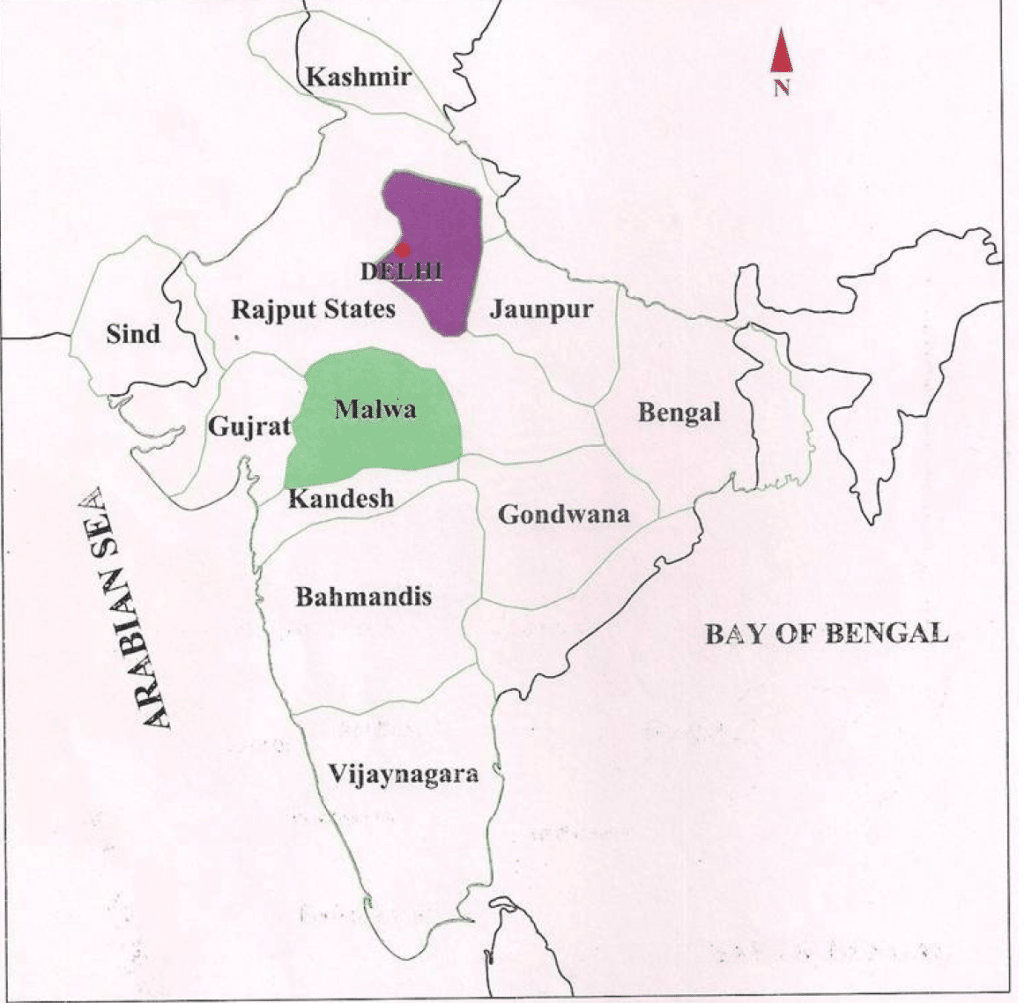
The Strategic Significance of Malwa
- Malwa was situated on the high plateau between the Narmada and Tapti rivers, commanding the vital trunk routes connecting Gujarat with northern India, as well as those linking north and south India.
- So long as Malwa remained strong, it functioned as a genuine barrier to the ambitions of Gujarat, Mewar, the Bahmanis, and the Lodi Sultans of Delhi.
- Given the broader geopolitical layout of northern India, any powerful regional state that succeeded in extending its control over Malwa would find itself well positioned to make a genuine bid for domination over the entire north.
- During the fifteenth century, the kingdom of Malwa stood at the height of its power.
- Its capital was shifted from Dhar to Mandu — a location both highly defensible and possessed of considerable natural beauty — where Malwa’s rulers constructed a large number of significant buildings.
- From its very inception, however, the kingdom of Malwa was troubled by persistent internal dissension.
- Recurring struggles over succession between rival claimants to the throne were compounded by ongoing factional fighting among different groups of nobles, each competing for power and profit.
- The neighbouring states of Gujarat and Mewar remained consistently ready to exploit this internal factionalism for their own strategic advantage.
Dilawar Khan Ghori (1401–1407)
- Dilawar Khan Ghori, the Tughluq governor of Malwa, formally declared his independence in AD 1401–2, proclaiming himself king of Malwa.
- He established a matrimonial relationship with Malik Raja Faruqi of Khandesh, an alliance that helped safeguard his south-eastern frontier.
- By maintaining friendly relations with Muzaffar Shah of Gujarat, he successfully protected Malwa from external attack.
- Soon after his death in AD 1407, however, Malwa fell prey to the imperialist ambitions of Muzaffar Gujarati.
Hoshang Shah (1406–1435)
- Hoshang Shah’s father, Dilawar, had already shifted the capital from Dhar to Mandu — a city Alauddin Khilji had earlier renamed Shadiabad, “the city of joy.”
- Hoshang Shah occupied Kherla and Gagraun, and had further ambitions toward Gwalior — though, recognising the strength of Mubarak Shah, he ultimately withdrew in 1423, after inflicting some damage on the surrounding countryside.
- Hoshang Shah entered into a matrimonial alliance with the Muslim ruler of Kalpi, using the latter as a buffer state between Jaunpur–Malwa and Delhi–Malwa.
- He pursued a broadly tolerant religious policy, actively encouraging numerous Rajputs to settle in Malwa, granting them rich land grants in the process.
- The Madhya Pradesh city of Hoshangabad was formerly known as Narmadapur, after the river Narmada, before Hoshang Shah renamed it in his own honour.
- Hoshang Shah extended particular patronage to the Jains, who served as the region’s principal commercial merchants and bankers.
- Nardeva Soni, a Jain merchant, served as Hushang Shah’s treasurer and one of his key advisers.
Muhammad Shah
- Hoshang Shah’s successor, Muhammad Shah, proved genuinely incompetent as a ruler.
- During his brief, one-year reign, the Malwa court became a hotbed of intrigue, with disastrous consequences.
- This chaos ultimately culminated in his murder in 1436, at the hands of his own noble, Mahmud Khalji — bringing an end to Ghorid rule in Malwa.
Mahmud Khalji (1436–1469)
- Mahmud Khalji is generally regarded as the most powerful of all Malwa’s rulers.
- At the outset of his reign, Mahmud Khalji’s position was seriously threatened by the entrenched old Ghorid nobility.
- Initially, he pursued a policy of appeasement, distributing iqtas and high office to these nobles — but this strategy failed to secure their genuine support, and he was forced to confront a series of revolts by high-ranking nobles. Mahmud Khalji ultimately succeeded in subduing this recalcitrant nobility.
- Having consolidated his internal position, Mahmud Khalji turned his considerable energy toward further territorial expansion.
- A genuinely restless and ambitious ruler, he fought against nearly all his neighbours in turn: the ruler of Gujarat, the rajas of Gondwana and Orissa, the Bahmani sultans, and even the Sultans of Delhi.
- His principal military energies, however, were devoted to overrunning southern Rajputana and attempting to subdue Mewar.
Mahmud Khalji against Mewar
- Mewar, under Rana Kumbha, pursued an aggressive policy of subduing and absorbing neighbouring Rajput chiefs — a development that posed a direct threat to the kingdom of Malwa.
- Mahmud Khalji first confronted the formidable Rana as early as 1437; at the Battle of Sarangpur (1437), Mahmud Khalji was defeated and taken prisoner.
- Later, taking advantage of the confusion that followed Ranmal’s death in Mewar, Mahmud Khalji attacked once more in 1442, though he was forced to retreat with little to show for the effort.
- From this point onward, Mahmud Khalji undertook near-annual campaigns against Rana Kumbha, though the Rana consistently managed to keep his territory intact and well-defended.
- Mahmud Khalji destroyed numerous temples during his sustained struggle against Rana Kumbha and other neighbouring Hindu rajas.
Mahmud Khalji against Jaunpur
- Kalpi remained the principal bone of contention between Malwa and Jaunpur.
- Nasir Khan Jahan, ruler of Kalpi, was soon expelled by Mahmud Sharqi — a development that considerably strengthened Jaunpur’s hold over Kalpi, much to the displeasure of Mahmud Khalji.
- This tension resulted in open conflict between the two powers in 1444, ultimately resolved through a formal treaty: Mahmud Sharqi agreed to hand Kalpi back over to Khan Jahan, restoring genuinely cordial relations between Malwa and Jaunpur.
Mahmud Khalji against Gujarat
- Muzaffar Gujarati had, on one earlier occasion, succeeded in imprisoning Hoshang Shah.
- Following Ahmad Shah’s death in 1442, Mahmud Khalji seized the opportunity presented by the weak position of Muhammad Shah Gujarati to occupy Sultanpur and Nandurbar (1451).
- While Mahmud Khalji was still actively campaigning against Muhammad Gujarati, the latter died — his successor, Sultan Qutbuddin, subsequently entered into a formal alliance with Mahmud Khalji.
- Both parties agreed to respect each other’s territorial boundaries, and reached a further understanding granting each a free hand in Mewar.
- This spirit of cooperation, however, could not be sustained across other contested areas — Mahmud Khalji’s repeated interventions in Bahmani politics, in particular, were consistently and severely countered by Mahmud Begarha.
Ghiyas Shah (1469–1500)
- Ghiyas Shah, the son and successor of Mahmud Khalji, focused his reign considerably more on consolidation than on further conquest.
- As a result, with the exception of a brief clash with the Rana of Mewar in 1473, his reign was marked by a long period of peace.
Collapse of Malwa
- Gujarat stormed Mandu in 1518.
- In 1531, Bahadur Shah of Gujarat captured Mandu, executed Mahmud II (1511–31), and shortly thereafter, the Malwa Sultanate collapsed entirely.
- The Mughal emperor Akbar subsequently captured Malwa in 1562, incorporating it as a formal subah of the Mughal Empire.
Conclusion
- The rise and fall of the Malwa Sultanate offers a revealing case study in the fragility of provincial power in medieval India — a kingdom whose genuine strategic centrality, commanding the crossroads between Gujarat, the Deccan, and northern India, was ultimately undermined by chronic internal factionalism and near-constant warfare on multiple fronts.
- From its founding under Dilawar Khan Ghori, through the religious tolerance and consolidation of Hoshang Shah, to the restless, ambitious, but ultimately overextended reign of Mahmud Khalji, Malwa’s history illustrates both the real opportunities and the deep vulnerabilities faced by regional Sultanates in the post-Tughluq political landscape — before its eventual absorption first into Gujarat, and finally into the Mughal Empire under Akbar.