Rise of Provincial Dynasties: Gujarat

- Western India — comprising Gujarat, Malwa, and Rajasthan — held enormous strategic and economic value throughout the medieval period, owing to its considerable size, rich and fertile land, and salubrious climate; Gujarat and Malwa, in particular, were always regarded as genuinely valuable prizes.
- Gujarat was famed for its excellent handicrafts and its flourishing sea-ports, through which much of North India’s maritime trade was conducted.
- Malwa and Rajasthan functioned as crucial transit centres, linking the products of the Ganga valley with Gujarat’s sea-ports.
- Given this, control over Malwa and Gujarat, together with the overland route across Rajasthan, remained a persistent concern for any imperial power based in either the north or south.
- During the 15th century, Malwa and Gujarat effectively balanced one another.
- While both kingdoms sought to bring the border states of Rajasthan under their influence, neither succeeded in making deep inroads there, owing largely to the rise of Mewar under Rana Kumbha.
- This balance, however, began to break down in the early decades of the 16th century.
- This article traces the rise of the provincial dynasty of Gujarat — from its foundation under the Delhi Sultanate, through its complex relationships with neighbouring Malwa, Rajputana, the Bahmani kingdom, and Khandesh, to its golden age under Ahmad Shah I and, above all, Mahmud Begarha.
The Founding of the Gujarat Sultanate
- In 1299, Ulugh Khan and Nusrat Khan — generals of Alauddin Khalji — succeeded in overthrowing Raja Karna Baghella, the reigning Chalukya ruler, laying the foundation for Sultanate rule in Gujarat.
- The Delhi Sultans retained supremacy over Gujarat throughout the 14th century, though clear symptoms of decline emerged from the reign of Feroz Shah onward, who entrusted the governorship of Gujarat to Shamsuddin Damghani.
- Timur’s invasion (1398) provided provincial governors across the empire with the opportunity they had long sought to break away from central control — Gujarat and Malwa effectively became independent in all but name.
- Soon afterward, in 1407, Zafar Khan — then Governor of Gujarat, who later assumed the title Muzaffar Shah — formally established an independent kingdom in Gujarat.
- Since its inception, the Kingdom of Gujarat found itself in near-constant conflict with its neighbouring territories: Malwa, Rajputana, Khandesh, and the Bahmani kingdom.
Relationship with Malwa
- From the very beginning, Gujarat and Malwa were bitter rivals — though the recurring warfare between them never produced any lasting change to their respective frontiers.
- In 1408, Muzaffar Shah defeated and imprisoned Hoshang Shah, who had succeeded Dilawar Khan as ruler of Malwa.
- Though Hoshang Shah was forced to accept Muzaffar Shah’s suzerainty, he remained deeply resentful of Gujarat’s rising power — Malwa’s rulers, accordingly, made a habit of allying with Gujarat’s enemies in an effort to undermine it. Ahmad Shah, however, ultimately succeeded in crushing Hoshang Shah’s power.
- Later, during the reign of Qutbuddin Ahmad Shah II (1451–59), Mahmud Khalji of Malwa attacked Gujarat, but was repulsed.
- Mahmud Khalji subsequently allied with Qutbuddin Ahmad Shah II against Rana Kumbha of Mewar — though this alliance was purely a matter of diplomatic convenience, since Mahmud Khalji never passed up an opportunity to undermine Gujarat’s own prestige.
- This sustained, bitter rivalry ultimately weakened both kingdoms, making it impossible for either to play a genuinely larger role in North Indian politics.
- In 1408, Muzaffar Shah defeated and imprisoned Hoshang Shah, who had succeeded Dilawar Khan as ruler of Malwa.
Relationship with Rajputana
- Rajputana was another formidable power with which Gujarat’s rulers remained in near-constant conflict.
- Idar was the first Rajput kingdom absorbed into Gujarat (1426); Ahmad Shah soon after overran Dungarpur (1433).
- Later, both Qutbuddin (1451–59) and Mahmud Begarha (1459–1511) had to contend directly with Rana Kumbha, ruler of Mewar.
- Rana Kumbha had occupied Sirohi, Abu, and Nagaur — the latter ruled by Ahmad Shah’s own uncle, Feroz Khan. As a result, the Rana found himself facing a combined attack from Gujarat, Sirohi, and Nagaur simultaneously.
- The eventual outcome forced the Rana to sue for peace, paying a substantial indemnity — though he retained his capital, Kumbhalgarh.
- The Rajput state of Champaner likewise remained in near-constant conflict with Gujarat, before finally being annexed by Mahmud Begarha in 1483–84, who renamed it Muhammadabad and made it his second capital.
- By the time of Mahmud Begarha’s reign, other smaller Rajput kingdoms — Junagarh, Sorath, Kutch, and Dwarka — had similarly been subjugated.
Relationship with the Bahmani Kingdom and Khandesh
- The Bahmani ruler Feroz Shah maintained genuinely cordial relations with Gujarat’s rulers.
- After his death (1397–1422), however, a radical shift occurred with the accession of Ahmad Bahmani (1422–1436), who formed a matrimonial alliance with the ruler of Khandesh.
- When Rai Kanha of Jhalawar fled in 1429, both the Khandesh and Bahmani rulers granted him asylum — a decision that infuriated Ahmad Shah Gujarati, who subjected them both to a crushing defeat.
- Relations subsequently revived during Mahmud Begarha’s reign.
- When Mahmud Khalji of Malwa attacked the Bahmani kingdom, Mahmud Begarha came directly to its rescue.
- Mahmud Begarha also maintained friendly relations with the rulers of Khandesh, until Adil Khan II ceased paying tribute and instead allied with Ahmadnagar and Berar.
- In response, Mahmud Begarha attacked Khandesh, ultimately compelling Adil Khan to accept his suzerainty — though Mahmud Begarha chose not to annex either Khandesh or Daulatabad outright, instead confirming their existing rulers in exchange for continued tribute.
Ahmad Shah I (1411–1442)
- The true founder of the Gujarat Sultanate, in practical terms, was Ahmad Shah I (1411–42), grandson of Muzaffar Shah.
- During his long reign, he brought the nobility firmly under control, settled the machinery of administration, and both expanded and consolidated the kingdom.
- He shifted the capital from Patan to the newly founded city of Ahmedabad, whose foundations he laid in 1413.
- He was notably strict in matters of justice — reportedly having his own son-in-law executed for murder.
- Ahmad Shah worked to extend his control over the Rajput states of the Saurashtra region, as well as those along the Gujarat–Rajasthan border.
- In Saurashtra, he defeated and captured the strong fort of Girnar, though he ultimately restored it to its raja upon a promise of continued tribute.
- He then attacked Sidhpur, a famous Hindu pilgrimage centre, razing many of its beautiful temples to the ground.
- Beyond the customary peshkash (annual tribute), Ahmad Shah imposed jizyah for the first time on Hindu rulers within Gujarat.
- Even so, he actively inducted Hindus into government service — Manik Chand and Motichand, both from the bania community, served as his ministers.
- He also fought against the Muslim rulers of neighbouring Malwa, Khandesh, and the Deccan, and brought the Rajput states of Jhalawar, Bundi, and Dungarpur, among others, under his control.
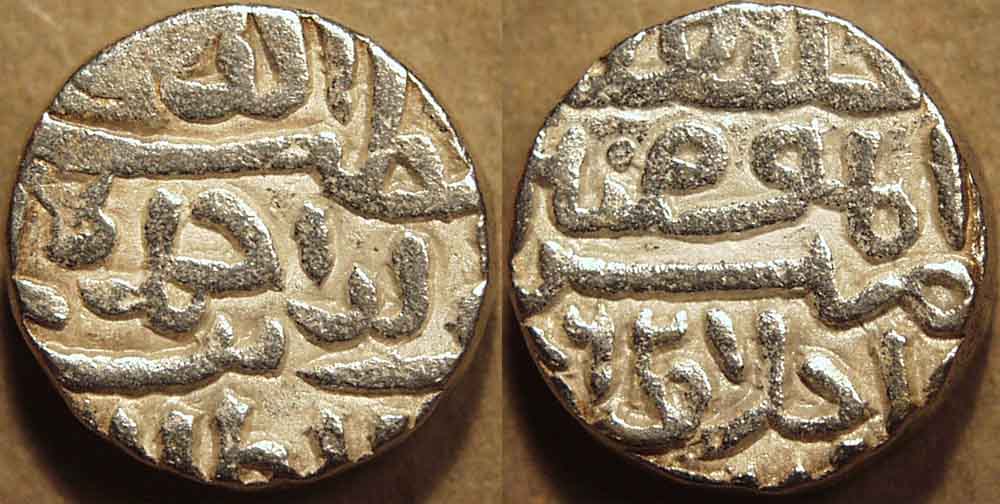
Silver tanka of Qutb ud-Din Ahmad Shah II (1451-1458) of Gujarat,
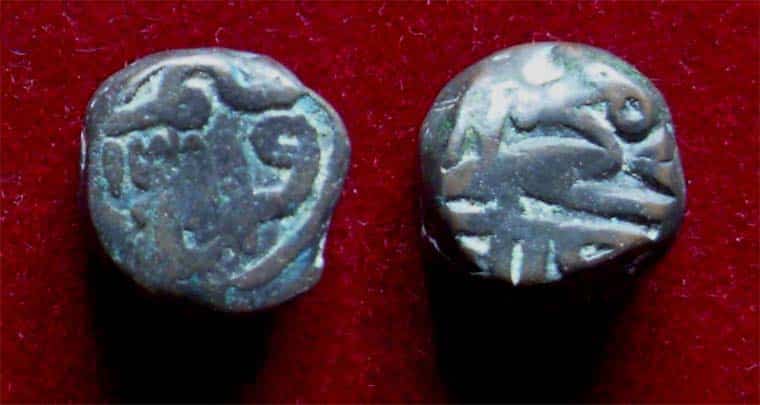
Copper coin of Muzaffir Shah
Mahmud Begarha (1459–1511)
- The successors of Ahmad Shah continued his broader policy of expansion and consolidation.
- The most celebrated Sultan of Gujarat was Mahmud Begarha, great-grandson of Ahmad Shah I.
- He earned the title “Begarha” for capturing two of the most powerful forts (garhs) in the region: Girnar in Saurashtra (now known as Junagarh) and Champaner in south Gujarat.
Girnar
- The ruler of Girnar had paid tribute regularly, but Mahmud Begarha nonetheless decided to formally annex his kingdom, as part of a broader policy of bringing Saurashtra under complete control.
- Saurashtra was a rich and prosperous region, with fertile tracts and flourishing ports — though it also remained plagued by robbers and sea-pirates, who preyed heavily on trade and shipping.
- The powerful fort of Girnar was considered ideally suited not only for administering Saurashtra, but as a base of operations against Sindh.
- After the fort fell, the raja himself embraced Islam, entering the Sultan’s own service.
- The Sultan founded a new town, Mustafabad (present-day Junagadh), at the foot of the hill, constructing many lofty buildings there and encouraging his nobles to do the same — Mustafabad accordingly became Gujarat’s second capital.
Dwarka
- Mahmud Begarha similarly sacked Dwarka, since the town harboured pirates who preyed on traders; the campaign was also used as an opportunity to raze the town’s famous Hindu temples.
Champaner
- The fort of Champaner (Pavagadh fort) was strategically vital to the Sultan’s broader plans of bringing Khandesh and Malwa under his control.
- Its ruler, though nominally a feudatory of Gujarat, maintained close relations with the Sultan of Malwa.
- Champaner finally fell in 1454, after its gallant raja and his followers, despairing of assistance from any quarter, performed the ritual jauhar and fought to the last man.
- Mahmud subsequently constructed a new town, Muhammadabad, near Champaner, laying out numerous gardens and making it his own principal place of residence.
Dealing with the Portuguese
- The Portuguese had begun interfering directly with Gujarat’s trade with West Asia.
- Mahmud Begarha received military assistance from the rulers of Egypt and the Ottomans, who sent their respective generals, Amir Hussain and Sulaiman Rais, to his aid.
- The combined force initially succeeded in defeating the Portuguese flotilla at Chaul in 1508 — but in 1509, Albuquerque decisively crushed them in turn.
- As a result, in 1510, Mahmud Begarha entered into a formal alliance with the Portuguese, securing assurances for the safety of Gujarati shipping in the Arabian Sea.
The Capture of Bombay
- Mahmud Begarha is also credited with capturing the island of Bombay from the Koli (fisherman) tribe, who had themselves been vassals of the Bahmani Sultanate.
- One of his later descendants, Bahadur Shah, would go on to hand the island over to the Portuguese in 1535.
Trade and Commerce
- During Mahmud Begarha’s long and largely peaceful reign, trade and commerce flourished.
- He constructed numerous caravan-sarais and inns for the comfort of travellers, and merchants benefited from consistently safe roads.
Education and Patronage
- Although Mahmud Begarha never received a systematic formal education, he acquired considerable knowledge through constant association with learned men.
- Numerous works were translated from Arabic into Persian during his reign; his own court poet, Udayaraja, composed in Sanskrit.
Appearance and Personal Habits
- Mahmud Begarha possessed a genuinely striking physical appearance — a flowing beard reaching to his waist, and a moustache so long he was obliged to tie it over his head.
- According to the traveller Barbosa, Mahmud had, since childhood, been nourished on a form of poison, such that if a fly settled on his hand, it would swell and die instantly.
- Mahmud was similarly renowned for his genuinely voracious appetite for food.
Matrimonial Relations with the Rajputs
- From the outset, Gujarat’s rulers pursued a deliberate policy of forming matrimonial alliances with subordinate Rajput rulers.
- The mother of Muzaffar Shah II was herself a Rajput, and he in turn married a number of Rajput princesses.
- Although numerous Hindus rose to high office under Gujarat’s rulers — such as Rajya Rayan, chief Hindu noble under Mahmud Begarha, and Malik Gopi, his chief minister — this policy of matrimonial alliance neither altered the sultans’ overall governing policies, nor drew the allied Rajput families into any genuinely closer political union with the state.
- In 1508, the Delhi Sultan Sikandar Lodi sent a formal embassy to Gujarat.
- The embassies of Sikandar Lodi and Ismail Safavi of Iran both significantly enhanced the prestige of the Gujarati ruler — a clear indication of the important place Mahmud Begarha occupied on both the national and international stage of his time.
Conclusion
- The Gujarat kingdom remained, throughout this period, a genuinely powerful, well-administered, and prosperous state — strong enough to prevent any serious Portuguese encroachment on its territories and ports, even as European maritime power grew across the Indian Ocean.
- Its later efforts under Bahadur Shah to extend dominance over Malwa and Rajasthan, however, ultimately brought Gujarat into direct conflict with the Mughals — a confrontation that would prove the kingdom’s eventual undoing.
- The rise of the Gujarat Sultanate, from its 1299 origins as a Delhi Sultanate province through its independent flowering under Ahmad Shah I and Mahmud Begarha, thus offers a revealing case study in the broader pattern of provincial dynasty formation that reshaped North and Western India following the weakening of central Sultanate authority.