

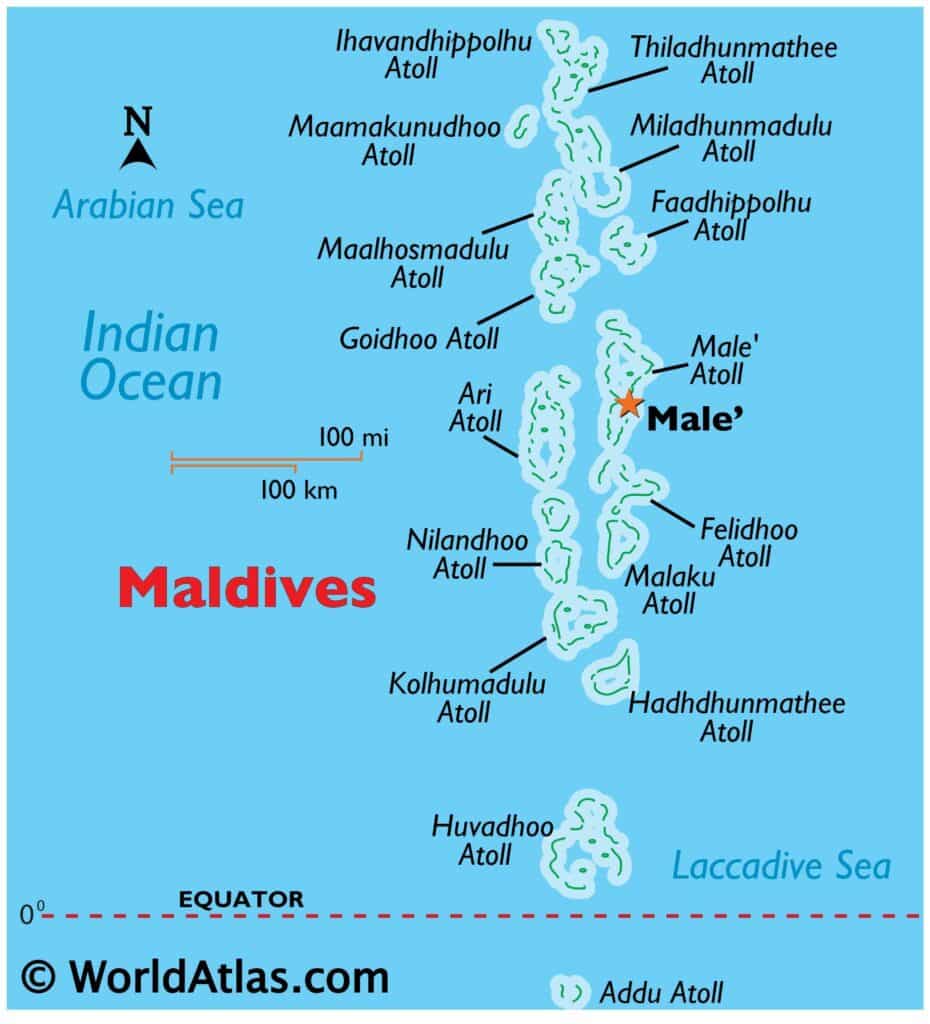
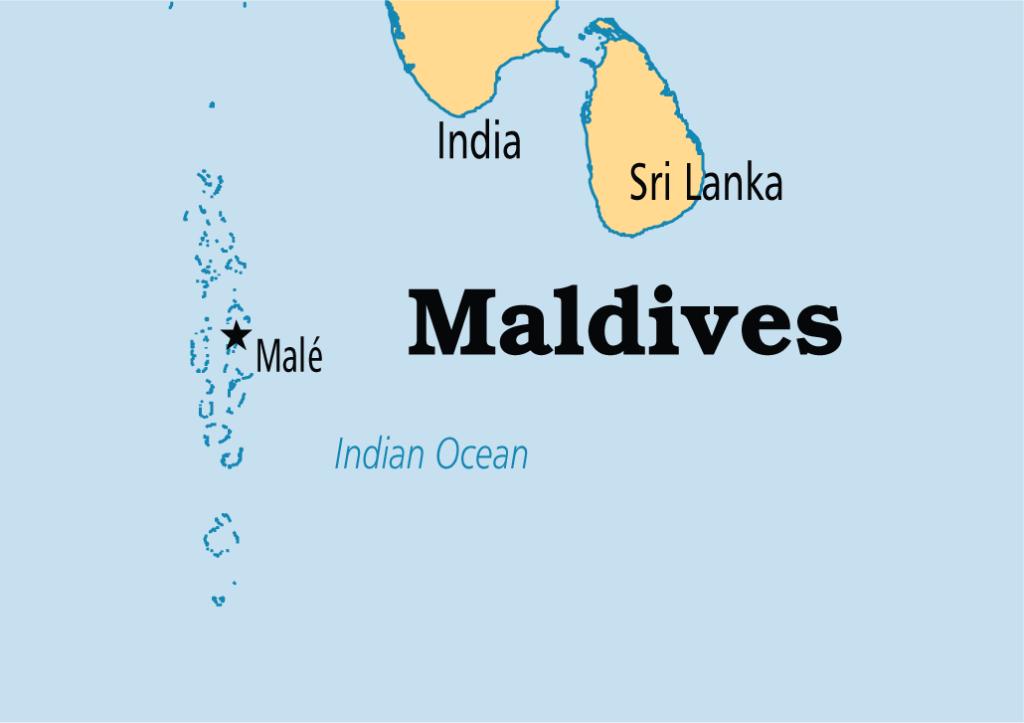
- Maldives is an archipelagic nation, situated in the middle of the Indian Ocean. It is located 300 miles from the southern coast of India and 450 miles southwest of Sri Lanka. It is an archipelago of over 1,000 islands, each unique in its own way. The primary religion in Maldives is Islam with the majority population practising Sunni Islam.
- Maldives is a low lying nation, and most parts of the country are barely a meter above sea level. This makes Maldives very vulnerable to the phenomenon of climate change and sea level rise.
- As close and friendly neighbours, India and the Maldives share ethnic, linguistic, cultural, religious and commercial links steeped in antiquity and enjoy cordial and multi-dimensional relations. India was among the first to recognise the Maldives after its independence in 1965 and to establish diplomatic relations with the country.
- India established its mission at Male in 1972. Since then, bilateral relations have been nurtured and strengthened by regular contacts at all levels. The Maldives opened a full-fledged High Commission in New Delhi in November 2004, at that time one of its only four diplomatic missions worldwide.
- Bilateral cooperation between India and Maldives is guided by a set of principles based on the framework of South-South cooperation, and building solidarity and partnership between developing nations in the post colonial phase. India’s developmental assistance, though small in amount, helped in building soft power leverage amongst its neighbours.
- As part of the government’s “Neighbourhood First” strategy, the Maldives are strategically significant to India because of their location in the Indian Ocean. Although the relationship between India and the Maldives has always been close, friendly, and multifaceted, recent regime instability in the country has presented significant challenges, particularly in the political and strategic spheres.
Historical Relations
1. Ancient and Medieval Foundations
- Ethnic Origins: The earliest settlers of the Maldives are believed to have been Giraavaru people, followed by migrations from the shores of modern-day Kerala and Sri Lanka. This is evidenced by the Dhivehi language, which bears a strong resemblance to ancient Elu (Sinhala) and Sanskrit.
- The Chola Influence: During the 11th century, the Rajaraja Chola’s Chola dynasty invaded and conquered the northern atolls to secure Indian Ocean trade routes. The islands were known as the “Twelve Thousand Ancient Islands” in Chola inscriptions.
- Conversion to Islam: While the Maldives was a Buddhist kingdom for centuries (with archaeological links to Indian Buddhist sites), it converted to Islam in 1153 AD. Despite this, the administrative and legal structures continued to mirror traditional South Asian systems.
2. The Path to Independence (1965)
- British Protectorate: The Maldives became a British Protectorate in 1887. Unlike many other colonies, it retained internal autonomy under its Sultan.
- First to Recognize: India was among the first nations to recognize the Maldives after it attained independence on July 26, 1965. Diplomatic ties were formally established in 1965, and India opened its resident mission in Malé in 1972.
3. The Gayoom Era and Strategic Milestones (1978–2008)
- Modernization: Maumoon Abdul Gayoom’s 30-year presidency saw the transformation of the Maldives into a global tourism hub, but it was also marked by internal dissent and coup attempts.
- Operation Cactus (1988): This remains the “gold standard” of bilateral trust. On November 3, 1988, about 80 armed militants from the People’s Liberation Organization of Tamil Eelam (PLOTE) attempted a coup. At the request of President Gayoom, the Indian Armed Forces launched ‘Operation Cactus’. Within hours, Indian paratroopers and naval ships restored the legitimate government without any civilian casualties.
- 2004 Tsunami: India’s “First Responder” status was solidified when it was the first to provide relief and financial aid (₹100 million) to the Maldives following the devastating Indian Ocean Tsunami.
4. Democratic Transition and Political Shifts
- The 2008 Reset: The Maldives transitioned to a multi-party democracy in 2008 with the election of Mohamed Nasheed. While Nasheed was traditionally “pro-India,” his resignation in 2012 triggered a period of political instability.
- The Yameen Shift (2013–2018): Under Abdulla Yameen, the relationship faced its greatest modern strain. The Maldives moved closer to China, joining the Maritime Silk Route and signing a Free Trade Agreement (FTA) with Beijing, which raised significant security concerns in New Delhi.
- The Solih Administration (2018–2023): The election of Ibrahim Mohamed Solih marked the formal implementation of the “India First” policy. This era saw the launch of the Greater Male Connectivity Project and a restoration of high-level defence and economic cooperation.
Current Political Dynamic (2024–2026): A Strategic Thaw
- Since late 2023, the relationship has navigated a complex path from diplomatic tension to a “pragmatic reset.”
- The “India Out” Campaign & Regime Change (2023–2024)
- The election of President Mohamed Muizzu in late 2023 marked a shift toward a “Pro-Maldives” or “Maldives First” stance.
- Troop Withdrawal: Initially echoing the “India Out” campaign, the Muizzu administration requested the withdrawal of Indian military personnel (who operated medical evacuation helicopters). By May 2024, these personnel were replaced by Indian civilian technical experts to maintain continuity of services.
- Diplomatic Row: Relations briefly hit “rock bottom” in early 2024 following derogatory remarks by Maldivian deputy ministers against the Indian Prime Minister, leading to a temporary decline in Indian tourist arrivals.
- The election of President Mohamed Muizzu in late 2023 marked a shift toward a “Pro-Maldives” or “Maldives First” stance.
- The Great Reset (2025–2026)
- Recognizing the economic and security realities of the Indian Ocean, both nations moved toward a “Timely Reset” in 2025.
- Modi’s 2025 Visit: In July 2025, Prime Minister Modi visited Male as the Guest of Honour for the Maldives’ 60th Independence Day celebrations. This was a major symbolic shift, turning the page on the previous year’s friction.
- Comprehensive Economic and Maritime Security Partnership: A new vision document was adopted to guide ties, emphasizing:
- Financial Support: India extended a new $565 million Line of Credit and helped stabilize the Maldivian economy with currency swap arrangements worth $400 million + ₹30 billion.
- FTA Negotiations: Both nations officially initiated talks for a Bilateral Free Trade Agreement (FTA).
- Local Currency Trade: Agreements were signed to settle trade in local currencies to reduce dependency on foreign exchange.
- Recognizing the economic and security realities of the Indian Ocean, both nations moved toward a “Timely Reset” in 2025.
- Current Strategic Outlook (2026)
- As of early 2026, the relationship is characterized by “Strategic Warmth” backed by development.
- High-Impact Projects: India continues to fund over 60 High-Impact Community Development Projects (HICDPs) across various atolls, focusing on health, education, and water networks.
- Colombo Security Conclave (CSC): The Maldives remains a committed member of the Colombo Security Conclave, cooperating with India and Sri Lanka on maritime safety and counter-terrorism.
- Balance of Influence: While the Maldives maintains a close relationship with China, the 2025-26 reset demonstrates that India remains the “First Responder” and indispensable economic anchor for the archipelago.
- As of early 2026, the relationship is characterized by “Strategic Warmth” backed by development.
Areas of Cooperation
Political
- Bilateral relations have been nurtured and strengthened by regular contacts at all levels. Since establishment of diplomatic relations, almost all Prime Ministers of India visited the Maldives.
- Former President Gayoom made a number of visits to India. President Mohamed Nasheed’s first visit abroad after assuming office was to India in December 2008. In October 2009, President Nasheed attended the Delhi High-Level Conference on Climate Change and Technology Transfer.
- In 2010, President Nasheed visited India twice, first in January for the CII-Partnership Summit in Chennai and in October to attend the Opening ceremony of the 19th Commonwealth Games in New Delhi. In the current year, President Nasheed made an official visit in February 2011.
- President Abdulla Yameen visited India with a high-level delegation on a State visit from January 1-4, 2014, which was his first official visit abroad. He also attended the swearing-in ceremony of the Prime Minister Shri Narendra Modi in May 2014.
- India and Maldives have consistently supported each other in multilateral fora such as the UN, the Commonwealth, the NAM and the SAARC. The Maldives was one of the first countries to convey its support for the candidature of Shri Kamalesh Sharma as the Commonwealth Secretary General.
- However, India’s relations with the Maldives had steadily deteriorated, as China cultivated ties with Abdulla Yameen.
- As a result, Prime Minister Modi visited the Maldives only in November 2018, after Ibrahim Mohamed Solih was sworn in as the new president of the Maldives. Maldives President Solih visited India in 2018 – the Maldives reaffirmed its India-first policy.
- The Home Ministers of both countries met each other in February 2020 – A discussion on security and law enforcement cooperation took place.
- In July 2022 Chief of Maldives National Defence Forces, Major General Abdulla Shamaal, visited India to expand the defence cooperation between the two neighbouring countries.
- The President of the Maldives visited India in August 2022, with the aim of tightening geopolitical, security, and economic ties between the two geographically and economically dependent South Asian neighbours.
- The visit happened in the backdrop of a tremulous time for both the nation’s common neighbour, Sri Lanka, which is facing an economic free-fall and political turmoil.
- In November 2023, President Mohamed Muizzu assumed office following a campaign heavily centred on the “India Out” platform, which called for the removal of Indian military personnel stationed in the Maldives to operate medical evacuation aircraft.
- Recognizing mutual economic and security dependencies, the two nations initiated a “Pragmatic Reset” in late 2024.
- President Muizzu’s State Visit (October 2024): In a major diplomatic reversal, President Muizzu visited India from October 6–10, 2024. Both leaders adopted a landmark vision document: “India-Maldives: A Vision for Comprehensive Economic and Maritime Security Partnership.”
- PM Modi’s Visit to Male (July 2025): Prime Minister Narendra Modi visited Male on July 25–26, 2025, as the Guest of Honour for the 60th anniversary of the Maldives’ Independence. This visit marked the 60th year of formal diplomatic ties.
- Recognizing mutual economic and security dependencies, the two nations initiated a “Pragmatic Reset” in late 2024.
- The “Pragmatic Neutrality” Shift: The 2024–2026 period illustrates a shift from the ideological “India Out” rhetoric to a policy of strategic pragmatism. Despite domestic political pressure, the Maldivian leadership has recognized that India remains the indispensable “First Responder” for economic stability and maritime security in the Indian Ocean Region (IOR).
Economic
- The Maldives has the highest per capita income among the South Asian nations. However, it does not translate in real terms because the laws, as they exist, favour the foreign investor in terms of expatriation of his earnings, which again are mostly from resort-tourism.
- India and the Maldives signed a trade agreement in 1981, which provides for the export of essential commodities.
- In 2024, despite diplomatic shifts, India renewed the quotas for essential items (eggs, potatoes, onions, sugar, rice, wheat flour, and pulses) at their highest ever levels since the agreement began.
- Growing from modest beginnings, India‐Maldives bilateral trade crossed the $300 mn mark for the first time in 2021, reaching an impressive $ 323.29 mn.
- India has consistently remained among the top trading partners for the Maldives. In 2023, bilateral trade reached record highs, having already surpassed the $500 million mark, a significant jump from the $323.29 million recorded in 2021.
- India has expressed its support for cooperation with the Maldives in the petroleum and natural gas sectors, particularly in oil exploration, as well as in the tourism and education sectors.
- Indian exports to the Maldives include agriculture and poultry produce, sugar, fruits, vegetables, spices, rice, wheat flour (Atta), textiles, drugs and medicines, a variety of engineering and industrial products, sand and aggregate, cement for building, etc.
- India imports scrap metals primarily from the Maldives. Under the bilateral agreement, India provides essential food items like rice, wheat flour, sugar, dal, onion, potato and eggs and construction material such as sand and stone aggregates to the Maldives on favourable terms.
Financial Stability and “Pragmatic Reset”
- Currency Swap Arrangements: To help the Maldives manage its foreign exchange reserves and avoid a debt crisis, the Reserve Bank of India (RBI) signed a $400 million and ₹30 billion currency swap agreement in late 2024. This has been instrumental in stabilizing the Maldivian Rufiyaa.
- Debt Management: India has demonstrated flexibility by extending the repayment periods for sovereign bonds and providing a $565 million Line of Credit to support ongoing infrastructure and budgetary needs.
- Bilateral Free Trade Agreement (FTA): In a major development in 2025, both nations officially initiated negotiations for a Bilateral Free Trade Agreement (FTA). This aims to reduce tariffs and move beyond the traditional “essential commodities” quota system toward a more open, competitive market.
Digital and Infrastructure Integration
- Introduction of UPI: In early 2025, India’s Unified Payments Interface (UPI) was formally launched in the Maldives. This allows Indian tourists—who constitute a major market—to make seamless payments in local currency, reducing the archipelago’s dependence on US Dollars for daily tourism transactions.
- Local Currency Trade Settlement: To strengthen the Rufiyaa and the Rupee, both nations have agreed to explore settling bilateral trade in their respective national currencies, bypassing the need for third-party intermediate currencies like the Euro or Dollar.
Development Assistance
- India’s development assistance to Maldives covers a wide range of areas, such as health, education, transport, skill and capacity building, waste management, and management of natural disasters. At present, bilateral cooperation is marked by “pragmatic and mutually beneficial initiatives and projects”.
- According to the Ministry of External Affairs, India, some of the important development cooperation initiatives taken by the Indian government over the years are:
- India provided a budgetary support of Rs. 100 million to Maldives after the Tsunami struck in 2004 and in May 2007, India again provided assistance of Rs. 100 million following tidal surges.
- Both the countries also signed a Framework Agreement on Cooperation for Development” in November 2011.
- In 2011, the Government of India extended a $100 million Standby Credit Facility to Maldives to stabilise its fiscal position.
- Maldivian diplomats have also received training in India under the Indian Foreign Service Institute for Professional Course for Foreign Diplomats (PCFD) programme.
- In January 2014, the Government of India promised to construct the Composite Training Centre for Maldives National Defence Force (MNDF).
- To promote infrastructure development, the Overseas Infrastructure Alliance (OIA) of India has been given a contract to construct 485 housing units.
- The State Bank of India has been playing a vital role in the economic development of the Maldives since 1974 by providing loan assistance for the promotion of island resorts, export of marine products and business enterprises, such as the Taj Group of India, which runs the Taj Exotica Resort.
- India’s support to the Greater Male Connectivity project includes a $400 million LoC & $100 million grant, renewal of essential commodities trade agreement, and financial assistance of USD 250 million.
- India had also announced an 800 million USD Line of Credit to the Maldives in December 2018.
- In 2010, GMR Infrastructure (India) and KLIA (Malaysia) consortium took over the Male International Airport on a 25 -year BOT contract to renovate and expand the largest and most important airport in the country.
- India signed an agreement for 25-MW solar energy project in the Upper Southern province.
- India has been the largest tourist source market for Maldives for two years in a row. A total of 291,787 Indian tourists travelled to the island nation in 2021, representing 22 per cent market share.
Financial Support and Economic Resilience
- Budgetary Assistance (2026–27): In the 2026–27 Union Budget, India allocated ₹550 crore (approx. $66 million) in financial assistance to the Maldives, maintaining Malé’s position as a top recipient of Indian external aid.
- Currency Swap Agreements: To stabilize the Maldivian economy, the Reserve Bank of India (RBI) approved a ₹30 billion currency swap facility in April 2026 under the SAARC framework. This follows the repayment of a prior $400 million swap, reflecting high levels of financial trust.
- Line of Credit (LoC): India continues to support the archipelago through an $800 million LoC and a separate $500 million package specifically for connectivity.
Landmark Infrastructure Projects
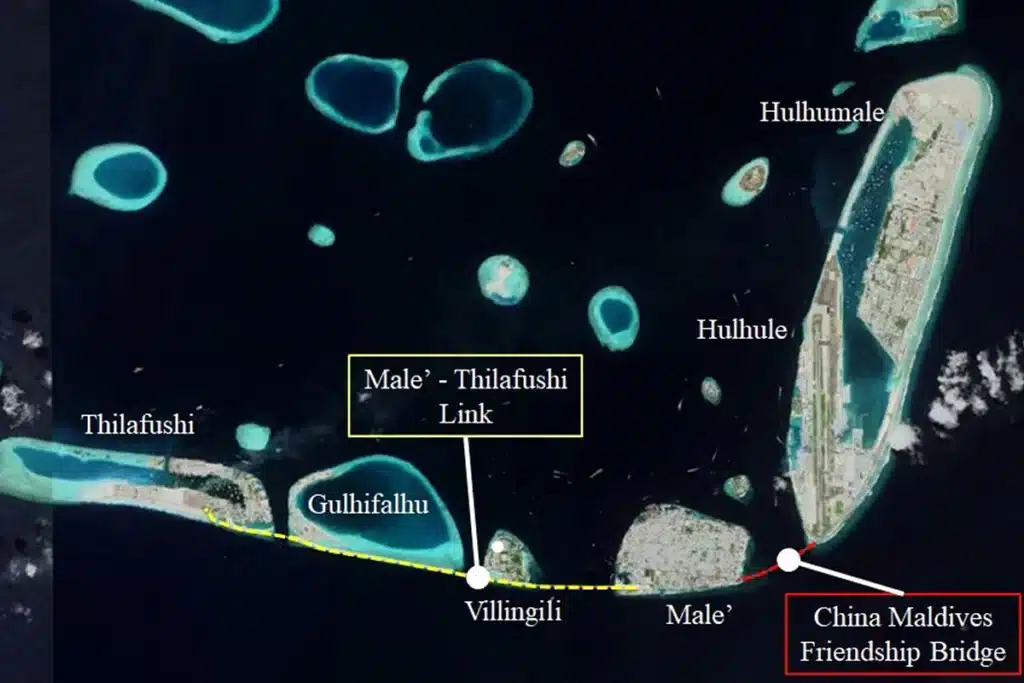
- Greater Malé Connectivity Project (GMCP): As of March 2026, the Thilamalé Bridge—the largest infrastructure project in Maldivian history—is roughly 52% complete. The 6.74 km link connecting Malé, Villingli, Gulhifalhu, and Thilafushi is now projected for full completion by 2027.
- Hanimaadhoo International Airport: A transformative project for the northern atolls, the redeveloped Hanimaadhoo International Airport was inaugurated in late 2025. It features extended runways and world-class terminals to boost regional tourism and trade.
- Addu Development Project: In August 2024, the Addu Reclamation and Shore Protection Project was completed, reclaiming 184.3 hectares of land and creating three new tourism islands, alongside the inauguration of a 4-lane detour link road.
Community and Social Development
- High Impact Community Development Projects (HICDPs): India is currently funding over 60 HICDPs across the islands. These are small-scale, quick-gestation projects that directly benefit local communities in areas like fish processing, eco-tourism, and drug rehabilitation.
- Water and Sewerage Projects: India-assisted water and sewerage networks are being implemented on 34 islands, significantly improving public health and sanitation standards across the archipelago.
Digital and Tourism Integration
- UPI Launch: In 2025, India’s Unified Payments Interface (UPI) was formally launched in the Maldives, facilitating seamless digital transactions for Indian tourists and reducing local dependency on foreign currency for daily trade.
- Tourism Leadership: India has consistently remained a top source market for Maldivian tourism. While arrivals fluctuated in early 2024, the “Pragmatic Reset” in late 2024 and 2025 saw a strong resurgence in Indian travel to the islands.
Greater Male Connectivity Project
- Afcons, an Indian company, has signed a contract for the largest-ever infrastructure project in Maldives which is the Greater Male Connectivity Project (GMCP).
- The project is the result of bilateral consultation between India and the Maldives and has been under discussion since the visit of India’s External Affairs Minister to Male in September 2019.
- Greater Male Connectivity Project will consist of a 6.74 km-long bridge and causeway link between Male and nearby islands of Villingli, Gulhifalhu and Thilafushi. It will use renewable energy.
- The project is funded by a grant of USD 100 million and a Line of Credit (LOC) of USD 400 million from India.
- It is not only the biggest project India is doing in the Maldives but also the biggest infrastructure project in the Maldives overall.
Significance:
- It is considered as the economic lifeline for the Maldives and will provide a major boost to connectivity between the four islands accounting for about half of the Maldivian population.
- It will add dynamism to the Maldivian transport and economic activities.
Defence
- The defence partnership between India and the Maldives is a cornerstone of regional stability, ranging from high-level strategic agreements to grassroots operational training.
- Strategic Framework and Security Pillars
- Bilateral Objectives: The partnership is vital for maintaining security in the Indian Ocean Region (IOR). Increased cooperation addresses the common threats of radicalism and terrorism, alongside combating the growing menace of drug trafficking and terror financing.
- Information Sharing: Security cooperation includes robust information exchange between security agencies and extensive training programs for the Maldives Police Service and Maldives National Defence Force (MNDF).
- Colombo Security Conclave (CSC): In November 2025, during the 7th NSA-level meeting in New Delhi, the Maldives reaffirmed its commitment to the CSC. The conclave focuses on five pillars: Maritime Safety, Counter-Terrorism, Combating Transnational Crime, Cyber Security, and Humanitarian Assistance (HADR).
- Joint Exercises and Interoperability
- Exercise DOSTI: The Coast Guards of India, Maldives, and Sri Lanka have conducted this trilateral exercise since 1991. The 17th edition (DOSTI-17) was successfully hosted by the Maldives in January 2026, focusing on anti-piracy, oil spill response, and search-and-rescue operations.
- Exercise EKUVERIN: This annual joint military exercise (meaning “Friends” in Dhivehi) began in 2009. The 14th edition was conducted in Thiruvananthapuram, India, in December 2025, enhancing synergy in counter-insurgency and counter-terrorism operations.
- Exercise EKATHA: A specialized naval exercise focused on diving and maritime combat, further strengthening the bonds between the two navies.
- Institutional Cooperation
- The Joint Commission: Established under the 1986 Agreement on Economic and Technical Cooperation, the Commission’s mandate was expanded in 2011 to include defence. The 5th Joint Commission meeting in 2015 marked the first formal discussion on the defence relationship at this level.
- Uthuru Thila Falhu (UTF) Project: India is assisting in the development of the Coast Guard Ekatha Harbour at UTF. Completed in 2025, this facility includes a naval dockyard and repair hub, significantly boosting the MNDF’s operational self-reliance.
- Historical Security Milestones
- Operation Cactus (1988): The Indian Army successfully foiled a coup attempt by a pro-Eelam group (PLOTE), establishing India as a reliable security guarantor.
- Naval Presence: At the request of the Maldives, India has maintained a supportive naval presence since 2009 to assist in Exclusive Economic Zone (EEZ) surveillance.
- Humanitarian Assistance (HADR):
- 2004 Tsunami: The Indian Coast Guard’s Dornier was the first to land at Ibrahim Nasir Airport with relief supplies.
- 2014 Water Crisis: India dispatched “water aid” to Malé via Operation Neer after a fire crippled the capital’s water treatment plant.
- Current Operational Shift (2024 Onwards)
- Personnel Transition: Following diplomatic discussions in early 2024, the Indian military personnel operating the gifted aviation platforms (two helicopters and one Dornier aircraft) were replaced by Indian civilian technical experts by May 2024.
- Asset Maintenance: Despite the change in personnel, India continues to provide technical support and maintenance for these platforms, which remain crucial for medical evacuations and maritime surveillance across the atolls.
Security Partnership
- To counter the threat of transnational crime, terrorism and drug trafficking in the Indian Ocean region, India will give 24 vehicles and one naval boat to the Maldives Security Force and help train the island-nation’s security personnel.
- India will also cooperate in building police facilities in 61 islands of Maldives.
- Recently, the National College for Policing and Law Enforcement (NCPLE) was inaugurated by India’s External Affairs Minister during his two day visit to Maldives in 2022.
- India and Maldives clearly have a responsibility to ensure stability and security in the Indian Ocean. India wants to see the Maldives embrace Quad’s Pacific strategy, which brings together India, the US, Japan, and Australia.
Diaspora and Culture
- The cultural bond between India and the Maldives is one of the oldest in the Indian Ocean, characterized by deep-rooted ethnic ties and a vibrant modern-day expatriate presence.
- The Indian Expatriate Community
- Demographics: Indians have grown to become the second-largest expatriate community in the Maldives. As of 2026, the approximate strength has risen to nearly 27,000–30,000, up from the previous 22,000.
- Professional Contribution: This community is a vital pillar of the Maldivian economy, consisting of both skilled professionals and workers. Indian doctors, teachers, accountants, managers, engineers, and nurses are spread across several islands, playing a crucial role in the country’s healthcare and education sectors.
- Preferred Destination: Conversely, India remains the preferred destination for Maldivians for higher education, specialized medical treatment, recreation, and business.
- Tourism and Connectivity
- The Tourism Surge: The proximity of the two nations and improved air connectivity have led to a massive increase in people-to-people contact. While historical figures stood at 45,000, India became the top source market for Maldivian tourism between 2020 and 2023.
- Digital Integration (2025): In a significant cultural and economic move, the Unified Payments Interface (UPI) was launched in the Maldives in 2025. This allows Indian tourists to make payments in local currency, further encouraging travel and business exchanges.
- Resurgence (2026): Following a brief diplomatic dip in 2024, Indian tourist arrivals have seen a strong resurgence in 2025-26 as bilateral ties returned to a state of “Strategic Warmth.”
- Cultural Linkages and Heritage Preservation
- Historical Restoration: Both countries share deep cultural links. A major milestone includes the successful restoration of three historical mosques—the Friday Mosque and Dharumavantha Rasgefaanu Mosque in Malé, and the Fenfushi Mosque in South Ari Atoll—by experts from the Archaeological Survey of India (ASI).
- Modern Exchanges: Cultural diplomacy has flourished through events such as the participation of a Maldivian Rock Band in the South Asian Bands Festival in New Delhi (2009) and subsequent youth exchange programs.
- Indian Cultural Center (ICC): Established in Malé in July 2011, the ICC (now often referred to as the Swami Vivekananda Cultural Centre) conducts regular courses in Yoga, classical music, and dance. These programs have become immensely popular among Maldivians of all ages, fostering a shared appreciation for South Asian heritage.
- Education and Capacity Building
- High Impact Projects: Under the current development framework, India is funding the construction of student centers and school digitisation projects across several atolls, ensuring that cultural cooperation translates into tangible benefits for the Maldivian youth.
- Scholarships: India continues to offer a large number of ICCR (Indian Council for Cultural Relations) scholarships to Maldivian students, further cementing the “Soft Power” influence India holds in the archipelago.
Global Support
- Multilateral Cooperation: India and the Maldives consistently support each other in international forums such as the UN, the Commonwealth, the Non-Aligned Movement (NAM), and SAARC.
- UNSC Candidature: The Maldives has historically supported India’s permanent membership in an expanded UN Security Council and supported India’s non-permanent seat candidature (such as the 2020-21 term).
- Regional Organizations: Both nations are active members of the South Asian Association for Regional Cooperation (SAARC) and the South Asia Subregional Economic Cooperation (SASEC), working toward regional economic integration.
Recent Developments (2020–2026):
Strategic and Security Milestones
- Colombo Security Conclave (2021–2026): In August 2021, at the Deputy NSA-level meeting, India, Sri Lanka, and the Maldives agreed on “four pillars” of security cooperation. By 2025-26, this evolved into a five-pillar framework under the Colombo Security Conclave, including maritime safety, counter-terrorism, and cyber security.
- Defence Visits: In July 2022, the Chief of Maldives National Defence Forces, Major General Abdulla Shamaal, visited India to expand defence cooperation.
- Vision Document 2024: Following President Muizzu’s visit to India in October 2024, both nations adopted the “India-Maldives: A Vision for Comprehensive Economic and Maritime Security Partnership,” marking a major pivot back toward strategic cooperation.
Diplomatic and Multilateral Highlights
- UNGA Presidency: In June 2021, India welcomed the election of Maldivian Foreign Minister Abdulla Shahid as the President of the 76th UN General Assembly (2021-22).
- MoUs and HICDPs: In November 2020, four MoUs were signed regarding High Impact Community Development Projects (HICDPs) and sports cooperation. As of 2026, over 60 such projects are active across the Maldivian atolls.
- 60th Anniversary (2025): Prime Minister Modi’s visit to Malé in July 2025 as the Guest of Honour for the Maldives’ 60th Independence Day celebrated six decades of formal diplomatic ties.
Pandemic Response and Economic Recovery
- Relief Package (2020): India committed a five-pronged package (air, sea, intra-island, and telecommunications) to help the Maldives mitigate the economic impact of Covid-19.
- Bilateral Bubble: The Maldives was the first South Asian country with which India established a bilateral air bubble during the pandemic to sustain the tourism sector.
- Financial Stabilization (2024–2026): To prevent a debt crisis, India provided the Maldives with a $400 million + ₹30 billion currency swap arrangement in late 2024 and extended the maturity of sovereign bonds in 2025.
Key Bilateral Visits
- 2018: Prime Minister Modi attended President Solih’s swearing-in ceremony; President Solih visited India in December 2018 to reaffirm the “India First” policy.
- 2020: The Home Ministers of both countries met in February to discuss law enforcement and security.
- 2022: President Solih’s August visit aimed at tightening ties amid the regional economic turmoil (Sri Lankan crisis).
- 2024: President Mohamed Muizzu’s State Visit in October marked the “Great Reset” of ties following a period of diplomatic friction.
- 2025: Prime Minister Modi visited Malé in July to solidify the new Comprehensive Partnership.
Significance of Maldives to India
- The Maldives holds a unique and indispensable position in India’s foreign policy architecture. Prime Minister Narendra Modi has described the Maldives as a “valued partner in the Indian Ocean neighbourhood,” noting that bilateral ties are built on a foundation of shared strategic, security, economic, and developmental goals.
1. Geo-Strategic Significance: The “Toll Gate” of the IOR
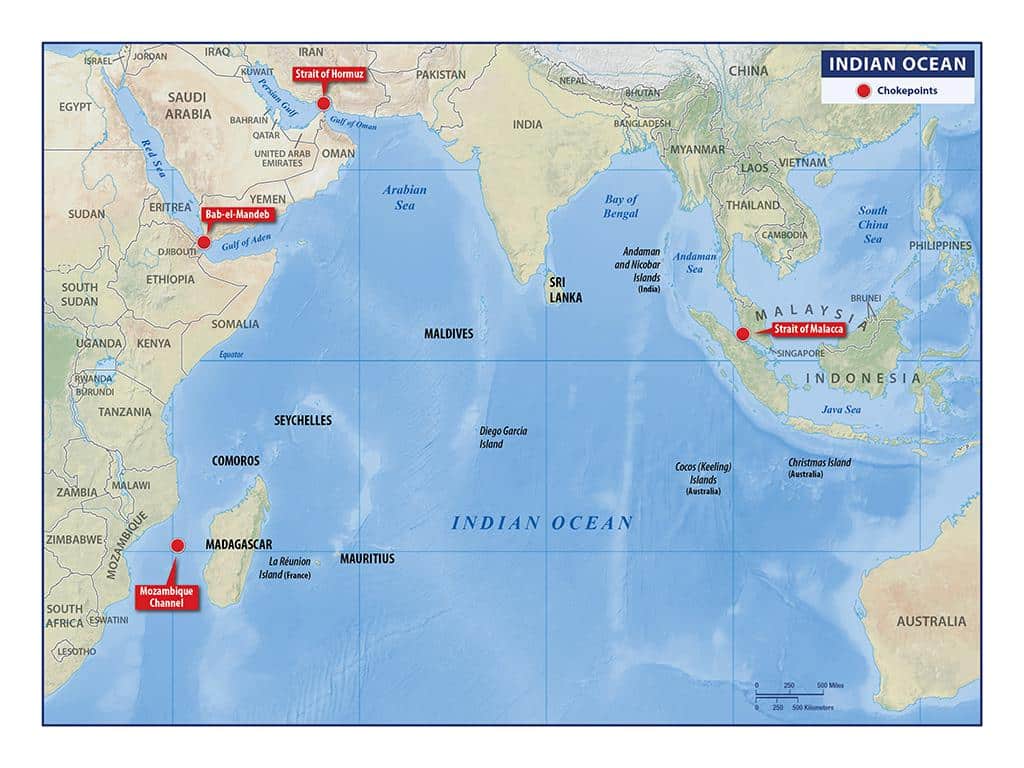
- Strategic Location: The Maldives is located at the crossroads of critical Sea Lines of Communication (SLOCs). It acts as a “toll gate” in the central Indian Ocean, through which a massive volume of global trade and energy supplies pass.
- Maritime Security: A stable and friendly Maldives is essential for India’s maritime domain awareness. Under the SAGAR (Security and Growth for All in the Region) vision, India views the Maldives as a key pillar in the Colombo Security Conclave to tackle piracy, terrorism, and transnational crimes.
- Net Security Provider: India’s quick response to crises in the Maldives (like Operation Cactus or the 2014 Water Crisis) cements India’s role as the primary security guarantor in the region.
2. Geopolitical Importance: Countering the “String of Pearls”
- Check on External Influence: With the increasing footprint of the Belt and Road Initiative (BRI) and Chinese naval presence, the Maldives’ sensitivity to India’s national interests is vital to prevent the encirclement of India.
- Political Stability: India has a direct stake in the democratic stability of its neighbors. Political turmoil in Malé often creates security vacuums that external powers might exploit, directly impacting India’s southern flank.
3. Economic and Developmental Synergy
- Investment Hub: The Maldives is an attractive destination for Indian investments, particularly in infrastructure, tourism, and healthcare. Projects like the Greater Male Connectivity Project represent India’s commitment to Maldivian prosperity.
- Export Market: India is a top trading partner, providing essential commodities (food, construction materials, medicines) that are the lifeline of the Maldivian economy.
- Blue Economy: Both nations have shared interests in the sustainable harvest of marine resources. Cooperation in the Blue Economy is essential for the future economic growth of both peninsular India and the archipelagic Maldives.
4. Multilateral and Diplomatic Support
- Platform for “Neighbourhood First”: The Maldives is a key member of SAARC and IORA (Indian Ocean Rim Association). Its support is crucial for India’s regional integration efforts.
- Global Fora: The Maldives has consistently supported India’s candidature for a permanent seat in an expanded UN Security Council and other multilateral bodies, acting as a reliable diplomatic ally on the world stage.
5. Cultural and Diaspora Links
- Human Bridge: The presence of nearly 30,000 Indians (doctors, teachers, engineers) in the Maldives makes them a vital “human bridge.” Their contribution to the Maldivian social fabric ensures deep-seated “Soft Power” for India.
Challenges in Relations
Political Instability & Domestic Polarization
- India has consciously avoided interfering in the Maldives’ internal affairs despite being invited to do so by the actors in the atoll state. India’s major concern has been the impact of political instability in the neighbourhood on its security and development.
- The February 2015 arrest of opposition leader Mohamed Nasheed on terrorism charges and the consequent political crisis have posed a real diplomatic test for India’s neighbourhood policy.
- The situation deteriorated further when the former President of Maldives declared emergency in February 2018, India has urged the Government of the Maldives to allow all institutions, including the Supreme Court and the Parliament, to function in a free and independent manner, and to permit genuine political dialogue between all political parties. This has also been the demand of the international community at large. India voiced that a democratic, stable and prosperous Maldives is in the interests of all its neighbours and friends in the Indian Ocean.
- Ideological Shifts: Maldivian foreign policy often fluctuates wildly with changes in government. The shift from the pro-India “India First” policy of Ibrahim Solih to the “India Out” campaign of Mohamed Muizzu illustrates how bilateral ties can become a casualty of domestic nationalist rhetoric.
- The “India Out” Campaign: Although the rhetoric has softened in 2025–2026, the underlying sentiment remains a tool for domestic political mobilization. This creates an environment of uncertainty for long-term Indian investments and security projects.
- Sensitivity to Sovereignty: Even under the current “Pragmatic Reset,” the Muizzu administration remains sensitive to the presence of Indian personnel. The replacement of military personnel with Indian civilian technical experts in May 2024 was a direct outcome of this challenge.
Relation with China
- China’s strategic footprint in India’s neighbourhood has increased. Maldives has emerged as an important ‘pearl’ in China’s ‘String of Pearls’ construct in South Asia.
- Given the Maldives’ strategic location in the Indian Ocean, China has been vying for a maritime base in the atoll with the primary motive of ensuring the security of its sea lanes, especially the unhindered flow of critically-needed energy supplies from Africa and West Asia through the Indian Ocean.
- Beijing has evinced a keen interest in developing infrastructure in the lhavandhoo, Marao and Maarandhoo Islands.
- During Chinese President Xi Jinping’s visit in 2014, the Maldives agreed to become a partner in China’s Maritime Silk Route.
- Chinese companies are involved in airport development and have now been handed islands for resort development.
- China has provided grant and loan assistance to the Maldives to build a bridge between the capital and the airport (called the China-Maldives friendship bridge)
- Amendments to the Maldivian Constitution in July 2015 allowed foreigners to own land, including investments of over US$ 1 billion for projects where 70 per cent of the land has been reclaimed. Looking at the parameters, China will be the obvious beneficiary. Chinese nationals now account for the largest tourist arrivals in the islands.
- China has also signed a Free Trade Agreement with Maldives while India doesn’t possess a similar arrangement with it.
- India’s concern stems from the increasing Chinese strategic presence in the Indian Ocean region. Though the Maldivian government has assured India that the Chinese presence is purely economic, the concern of ‘places turning into bases’ is genuine.
Radicalisation and Terrorism
- The Maldives has seen a rise in religious extremism, with concerns about Maldivians joining global terrorist groups. This poses a direct risk to regional coastal security and creates internal instability that could spill over into the Indian Ocean.
- The number of Maldivians drawn towards terrorist groups like the Islamic State (IS) and Pakistan-based madrassas and jihadist groups has been increasing. The political instability and socio-economic uncertainty are the main drivers fuelling the rise of Islamist radicalism in the island nation.
- The LeT, through its front organisation, Idara Khidmat-e-Khalq, has established a foothold, especially in the southern parts of the Maldives, in the garb of the post-2004 tsunami relief operations. The possibility of LeT using remote Maldivian islands as a launch pad for terror attacks against India and Indian interests has been a cause of concern.
- Influence of New Partners: The quiet pull of Turkey and Pakistan in Maldivian domestic politics is reinforcing a harder strand of political Islam. This “Islamic vocabulary” is sometimes used to justify strategic diversification away from India.
Indian Ocean Region
- Maldives is strategically located along major sea lanes in the Indian Ocean. A significant portion of world trade takes place through the Indian Ocean. All the energy supplies coming from Gulf nations pass through this area. The issues of piracy and stability in the region are of key concern to India.
Climate Change
- Maldives’ vulnerability to climate change was evident when Tsunami hit the Island in 2004. The Government of Maldives development plan of relocating and consolidating population on the larger islands is a risky and complex process and needs funds for the construction of houses. Moreover, dwelling units in these Atolls need better expertise in construction, so that these can withstand tidal surges and sudden environmental changes.
Development
- Complex geographical conditions coupled with high costs of service delivery and lack of funds to develop connectivity and infrastructure are some of the factors leading to unequal development among Atolls and in initiating various development projects in the region.
GMR Issue
- Relations between India and the Maldives came under strain after Male had terminated the agreement it entered into with GMR in 2010 for the modernisation of the Ibrahim Nasir International Airport. The Maldives government maintains that the reason for the cancellation of the project was that “the contract was illegally awarded” by the then-President Nasheed. The country’s anti-graft watchdog has ruled out any corruption in the leasing of the international airport to GMR.
- The airport expansion project was subsequently given to the Chinese company, which will plough in US $ 800 million. GMR, meanwhile, has won an arbitration against the Maldives. The quantum of damages to be paid by the Maldives is yet to be announced by the arbitration tribunal in Singapore.
Economic Vulnerabilities & Debt Pressures
- Fiscal Fragility: The Maldives faces significant economic pressure due to high external debt, low foreign exchange reserves, and upcoming large debt repayments in 2026.
- Dependence on India: While the Maldives has sought to diversify its partners, it remains structurally dependent on Indian supply chains for food, medicine, fuel, and construction materials. Any disruption in ties immediately impacts Maldivian food and energy security.
- Debt Default Risks: In 2024, India stepped in with a $400 million currency swap to help the Maldives avert a sovereign debt default. Managing this economic dependency while respecting Maldivian nationalist sentiments is a delicate balancing act for New Delhi.
Conclusion
- The partnership between India and the Maldives remains a critical pillar for the stability of the Indo-Pacific and the security of the Indian Ocean Region (IOR). As part of New Delhi’s “Neighbourhood First” strategy, India has proven to be a dedicated development and security partner. However, the sustainability of this bond depends on a mutual “Strategic Level of Comfort,” where the Maldives continues its “India First” approach while India respects Maldivian sovereignty.
- Strategic Vigilance
- Although India is an indispensable partner, it cannot afford to be complacent. The 2023–2024 period demonstrated how quickly domestic narratives can impact bilateral ties. India must remain hyper-attentive to Maldivian political developments and ensure that its role in the Indo-Pacific security space—designed to counter the influence of extra-regional powers like China—is perceived as collaborative rather than overbearing.
- Addressing Domestic Narratives
- The ‘India Out’ campaign, while currently managed through the 2025–2026 “Pragmatic Reset,” serves as a reminder that public perception is as important as government-to-government ties. New Delhi must proactively communicate the benefits of landmark projects like the Greater Male Connectivity Project to the Maldivian public to prevent domestic political shifts from creating future “ripples” in the relationship.
- The Path Ahead: 2026 and Beyond
- The evolution of ties into a “Comprehensive Economic and Maritime Security Partnership” provides a roadmap for the future. By integrating the Maldivian economy through initiatives like UPI and Local Currency Trade, India is moving beyond traditional diplomacy into deep structural integration.
- Regional Leadership
- India-Maldives relations offer vital lessons for managing other neighborhood relationships. Greater sensitivity, transparency, and people-to-people engagement are essential to yielding long-term dividends. Ultimately, India’s ambition to be a global power is inextricably linked to a friendly, peaceful, and prosperous South Asia. A secure Maldives is not just a foreign policy goal; it is a necessity for India’s own national security.