Iranian and Macedonian Invasions of India and Their Impact

Between the sixth and fourth centuries BCE, ancient India experienced two major waves of invasion from the west — first by the Achaemenid Persians under Cyrus and Darius, and later by Alexander of Macedon. Though neither invasion produced immediate political transformation within India, both left behind a lasting legacy in administration, art, script, coinage, and India’s growing contact with the Mediterranean world — setting the stage for the sustained Indo-Roman trade of the following centuries. For UPSC History Optional aspirants, tracing the course of the Iranian and Macedonian invasions and evaluating their political, economic, and cultural impact on ancient India is essential to understanding how India came to be integrated into the wider networks of the ancient world.

The Iranian (Achaemenid) Invasion of India (550–515 BCE)
Cyrus and the Conquest of Gandhara
- Cyrus, founder of the Achaemenid Empire in Persia, led campaigns to the east of Iran between 558 and 530 BCE. In the course of these campaigns, he invaded the Indian borderland and captured the Gandhara region.
Darius I and the Expansion of Persian Rule in India
- In the reign of Darius I (522–486 BCE), the Persians made real advances into India — he invaded and occupied the territories of the North-Western Frontier Province, Sind, and Punjab in 516 BCE; these regions remained under Iranian rule until Alexander’s invasion of India.
- The Bahistan (Behistun) Inscription mentions Gandhara as a province of Darius’s empire, inherited from Cyrus — a claim further confirmed by the Susa Palace Inscription of Darius, which records that teak was brought from Gandhara for the construction of the emperor’s palace. (Gandhara corresponds to the modern Peshawar and Rawalpindi regions of Pakistan.)
The Testimony of Herodotus
- According to Herodotus, Gandhara formed the twentieth satrapy of Darius’s empire, paying a tribute of 360 talents of gold dust — probably collected from the beds of the upper Indus and the gold mines of Dardistan — and was the most fertile and populous province of the Achaemenian Empire.
- Herodotus also records that Darius sent a naval expedition, probably in 517 BCE, to explore the Indus basin.
The Extent of Darius’s Indian Dominion
- The extent of the Persian Empire in India under Darius was not confined to Gandhara alone, but extended further towards the Indus, reaching its farthest limit under his reign.
- Darius’s Indian dominion included both the territories inherited from his predecessors and those he conquered himself — the territories of West Punjab and the Lower Indus valley came under Persian rule.
Persian Domination under Xerxes and His Successors
- Xerxes, successor of Darius I, kept his flag flying over the Indian territories he had inherited, but failed to make any further advance in India, being preoccupied with his commitments in Greece.
- Herodotus states that Xerxes requisitioned a large number of troops, including infantry and cavalry, from India for his invasion of Greece.
The Decline of Persian Power in India
- The defeat suffered by Xerxes in Greece led to a decline in Persian power in India; nonetheless, Achaemenid rule over India continued up to 330 BCE, when Darius III, the last Achaemenid ruler, summoned Indian troops to fight against Alexander the Great.
- With the fall of Persian power under the impact of Alexander’s invasion, Persian hold over India was lost entirely.
Iranian Influence on India
- Iranian contact with India lasted for about two centuries (516 to 326 BCE), producing several important results.
Political Impact
- The Persian invasion and hold over the north-western frontier regions of India did not affect Indian politics in any significant way; it merely exposed the weakness of Indian defences in that region, paving the way for the later conquest of Alexander.
- The Iranians were followed, in turn, by the Greeks, the Sakas, the Kushans, and the Huns. However, the satrapa system of administration introduced by the Persians in their Indian provinces served as a model for later dynasties, especially the Sakas and the Kushanas.
- India learnt the necessity of a strong and united empire to repel foreign invasions — it was for the first time that the small, scattered, and mutually quarrelling states of India realised how essential it was to join hands against a common enemy.
Encouragement to Trade
- Though the Persian invasion did not affect India politically to any great extent, contact between Indians and Persians continued even after the end of the Achaemenian Empire, leading to the establishment of trade relations between the two countries by both sea and land.
- The Persian rulers did much to promote geographical exploration, trade, and commerce — the exploration of the Indus and the Arabian Sea by Scylax opened up a new water route.
- With western and north-western India forming part of the Persian Empire, which extended as far as Asia Minor in the west, Indian trade naturally received a fresh impetus; Indian ivory and teak were popular in Persian markets, and Darius himself used them in the construction of his palace.
- Indian traders and merchants now reached distant places within the vast Persian Empire to dispose of their goods, while Persian goods began to flow smoothly into India in turn.
Settlement of Foreigners on Indian Soil
- A large number of foreigners — Greeks, Persians, Turks, and others — settled in the north-western parts of India, and with the passage of time became completely absorbed among the Indian population.
Impact on Art and Architecture
- According to Megasthenes, the Greek ambassador at the court of Chandragupta, the Mauryan ruler adopted certain Persian ceremonies and rituals; Mauryan art was influenced by Persian art to some extent.
- Traces of Persian influence can be seen in Mauryan sculpture and in the Ashokan pillars — the high polish of the Mauryan pillars manifests this Persian influence, since Persian masonry was similarly characterised by a high polish.
- Ashoka followed the Iranian custom of preaching ideals by inscribing them on stone pillars, and the architecture of his period was considerably influenced by Persian architecture.
The Kharoshthi Script
- The Aramaic form of writing, introduced by the Persians in north-western India after their conquest, gradually developed into the Kharoshthi script, written from right to left; all the Ashokan rock inscriptions of north-western India were engraved in this script.
- The idea of inscribing ethical exhortations on rocks in the form of royal proclamations may itself have been borrowed from Persia — certain resemblances have been discovered between the Achaemenid inscriptions and those of Ashoka, particularly in the style and construction of their opening sentences.
Interchange of Indo-Persian Culture
- Indian scholars and philosophers travelled to Persia and exchanged views freely with the intellectuals of that country — a contact that brought about a considerable change in outlook and drew the two peoples closer.
- This exchange is reflected in the fusion of Iranian/Persian features within Mauryan art, and in the impact of Buddhism on the Zoroastrian religion of ancient Persia.
- Even before Alexander’s invasion, the Persians served as catalysts between Indian and Greek cultures — Greek philosophers had come into contact with Indian philosophy long before Alexander’s campaign.
Influence on Coinage
- Persian silver coins circulated in India, affecting Indian coinage in turn. Persian coins were known for their refined minting and elegant appearance, and Indian rulers adopted similar techniques to mint their own coins on the Persian model.
Comparing Mauryan and Achaemenian Pillars
Similarities
- Both the Mauryan and Achaemenian pillars were built of stone and used polished stone finishes, sharing certain common sculptural motifs, such as the lotus; carved animals can be found in both traditions.
- Ashokan pillar edicts bear some similarity to the pillar edicts of Darius, and it has been suggested that Ashoka derived the idea of inscribing proclamations on pillars from the Achaemenids.
Differences
- Despite these similarities, the two traditions differ substantially in function, conception, style, design, and form.
- The stone columns of the Mauryan pillared hall lacked capitals, whereas the columns of the pillared halls of Persepolis had elaborate capitals.
- Achaemenian columns stood on bases — either bell-shaped (an inverted lotus) or plain rectangular/circular blocks — while independent Mauryan columns had no base at all; the bell form used as a supporting base in Persian columns instead served as a capital atop the shaft in Mauryan columns, creating an altogether different aesthetic effect.
- The shape and ornamentation of the Mauryan lotus differed from the Persian version — the characteristic bulge of the former is absent in the latter.
- The Achaemenian shaft was fluted in almost every case, whereas Mauryan columns were smooth; the Achaemenian shaft was built of separate segments of stone aggregated one above another — the work of a mason — while the Mauryan pillar shaft was monolithic, more characteristic of the work of a skilled wood-carver or carpenter.
- Hence, in technique, the Mauryan pillars partake of the character of a wood-carver’s or carpenter’s craft, while the Achaemenian pillars reflect that of a mason.
- Achaemenid pillars were generally part of a larger architectural scheme, composed of numerous components and appearing complex; Ashokan columns, by contrast, were intended as independent, free-standing monuments — simpler in design, more harmonious in conception and execution, and conveying a greater sense of stability, dignity, and strength.
- The capitals of Persian columns were crowned with a cluster of stylised palm leaves, along with two semi-bulls, lions, or unicorns seated back to back, or an upright/inverted cup with a double volute on top; the Mauryan type of abacus (the platform above the bell), together with independently carved animal motifs placed atop it, is absent in the Achaemenian context.
- While the pillars of Darius propagated the military victories and might of the Achaemenid monarch, Ashoka’s pillar edicts instead convey his quasi-benevolent message as a caring emperor.
The Macedonian Invasion of India
Alexander’s Rise to Power
- Alexander was born in 356 BCE in Macedonia, a kingdom of Greece; his father, Philip, was the ruler of Macedon. After his father’s death, Alexander ascended the throne at the age of just twenty, and within a few years of his accession, conquered Egypt, Syria, Asia Minor, and Persia.
- Alexander’s invasion of India is an important event in the history of ancient India, yet it created scarcely any impression on the Indian mind — a fact borne out by the absence of any reference to it in ancient Indian literature. It is only from Greek sources that we learn of the events relating to Alexander’s invasion of India, and these Greek accounts have been corroborated by archaeological evidence, particularly numismatic evidence.
India on the Eve of Alexander’s Invasion (326 BCE)
Political Condition
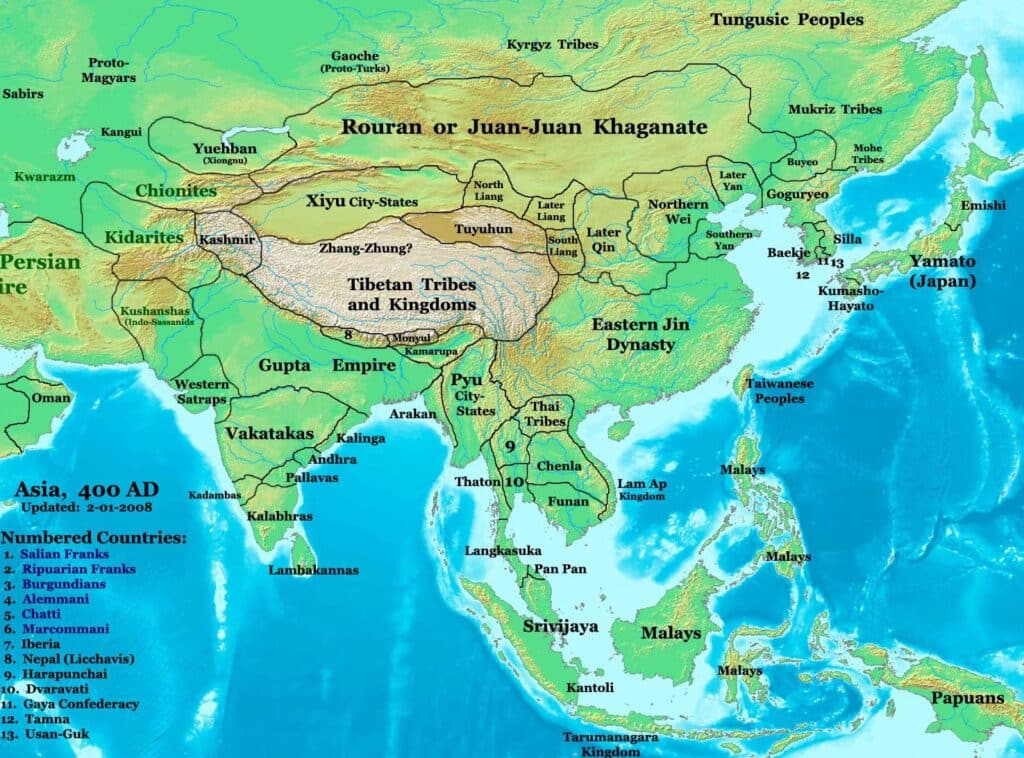
- At the time, there was no single mighty empire in India; the country was divided into several small republics and monarchical states, constantly at war with one another. Across the Beas River, the powerful Magadhan Empire had neither the will nor the time to intervene in the political changes occurring in the states lying to its west.
- In the Trans-Indus states, there were probably four hill-tribes to the west of the Indus:
- Ambhi’s kingdom: the kingdom of Taxila, lying between the rivers Indus and Jhelum, ruled by Ambhi, sworn enemy of his neighbouring ruler Porus.
- Porus’s kingdom: the territory between the Jhelum and the Chenab, ruled by Porus, who maintained a strong army that fought well against Alexander.
- The Younger Porus and the Glausai tribe: the territory between the Ravi and the Chenab was ruled by the Younger Porus, a relative of Porus, along with the tribesmen of the Glausai tribe, who held their own separate areas.
- The territory between the Ravi and Beas rivers: ruled by several independent tribes.
- To the east of the Beas lay the mighty Magadhan Empire, ruled by the Nandas, who commanded a huge and powerful army, with their capital at Pataliputra.
- In the southern parts of Punjab, which lay along Alexander’s return route to Greece, were the warlike tribal republics of the Sivi, Kshudrakas, and Malla, among others, who made Alexander’s retreat a difficult affair. There were also several independent tribes in the Indus valley.
Social Condition
- People generally led a simple life, and thefts were uncommon; however, the customs of sati, polygamy, and slavery were prevalent. Greek accounts record that some people were forced to sell their daughters owing to poverty, suggesting that a degree of moral decay had set into society.
- At the same time, the Indians had made considerable progress in art, architecture, literature, and education.
Economic Condition
- Agriculture, trade, and various crafts were practised widely, and trade itself was well developed; Indian traders travelled to distant countries, selling woollen blankets, hides, horses, elephants, and precious stones.
- Traders were prosperous, and trade was regulated by the state; coins were also in use as a medium of exchange.
Religious Condition
- The practice of image worship had been firmly established; rivers (especially the Ganga) and trees were also worshipped, and sacred trees were never cut or injured.
- The hold of Brahmanism remained supreme, though Buddhism and Jainism were also gaining ground; Brahmanas were held in high esteem, even by the rulers.
Why Alexander Invaded India
- Alexander the Great decided to launch his invasion of India after inflicting the finishing blow on Emperor Darius III of Persia. While historical writers have given detailed accounts of Alexander’s conquests in India, they say comparatively little about the reasons that provoked the invasion in the first place. The proximate causes may be summarised as follows:
- Alexander had conquered every province of the Persian Empire except its Indian satrapy; the easy conquest of Persia, and the plunder of its wealth and treasures, only increased his desire to invade India.
- The Indian satrapy had paid the Persian emperor a tribute of 360 talents of gold dust, and Alexander was drawn by the wealth and prosperity of India.
- The Indian soldiers who had fought under Xerxes in Greece had already awakened great interest among the Greeks about India; curiosity, a love of adventure, and a passion for conquest further inspired Alexander to march towards it.
- An embassy from an Indian king had sought Alexander’s help against the neighbouring king Porus, making Alexander aware of the internal rivalries among Indian rulers.
- Alexander also wished to surpass the heroism attributed to mythical heroes such as Heracles.
- Greek geographers had long been puzzled about the true extent of the Ocean, and one of the objectives of Alexander’s Indian campaign was to resolve this question by fixing the Ocean’s actual limits.
Alexander’s Conquest of India
- Alexander’s Indian campaign began in 326 BCE. After conquering the Achaemenid Empire of Persia, the Macedonian king launched a campaign into the north-western Indian subcontinent (modern Pakistan). In the spring of 327 BCE, Alexander decided to cross the Hindukush mountain range and advance into India, accompanied by a large army.
- The army of Alexander marched towards the Indus; the Macedonian troops, with their glittering spears and shining helmets, caused terror among the local tribes, who offered almost no resistance until the invaders reached the Indus itself.
First Opposition: Pushkalavati
- The first ruler to oppose the Macedonians was the King of Pushkalavati, who resisted their attack for several days and died a hero’s death defending his capital, though the fort was ultimately taken by the invaders. Overcoming this resistance, Alexander reached the Indus.
Taxila: The Surrender of Ambhi
- In 326 BCE, Alexander crossed the Indus. Ambhi, king of Taxila, entered into a treaty with Alexander and personally came forward to greet him, throwing open the gates of Taxila to the Macedonians.
- The surrender of Ambhi opened the gates of Punjab to Alexander’s forces — perhaps Ambhi did this to take revenge against his neighbouring rival, king Porus.
War with Porus: The Battle of Hydaspes
- King Porus, ruler of the Paurava kingdom situated between the Jhelum and Chenab rivers, was not prepared to surrender, and made ready to meet Alexander’s army.
- The historic battle between Porus and Alexander was fought on the banks of the Jhelum river in 326 BCE. Porus’s army was huge, and though Alexander carefully laid his plans, Porus fought bravely, receiving several wounds on his body; after a tough battle, his army was ultimately defeated, and Porus himself surrendered.
- Alexander, deeply impressed by Porus’s bravery, appointed him satrap not only of his own kingdom but granted him additional territories besides. Alexander went on to conquer several other territories near the river Indus.
The March Towards the Beas and the News of the Nanda Empire
- After his great victory at the Battle of Hydaspes, Alexander undertook a sweeping march up to the Beas river. The Magadha Empire lay to the east of Porus’s kingdom, ruled at the time by Dhana Nanda, son of Mahapadma Nanda and the last ruler of the Nanda dynasty.
- The Magadhan army was vast — its infantry alone numbered more than two lakh, in addition to large numbers of elephants, chariots, and cavalry. Alexander’s own army, by contrast, was exhausted, and could not gather the courage to confront such an immense force.
The Return from the Beas
- Upon reaching the river Beas, Alexander’s army refused to proceed further, despite his repeated appeals. Alexander, relying on the inaccurate maps of the Greeks, believed the world ended a mere 1,000 km away, at the edge of India, and tried to persuade his army to press on regardless — but his generals pleaded with him to reconsider and return.
- Seeing the unwillingness of his men, Alexander finally agreed and turned back, marching to the Jhelum, where he assembled a fleet of boats and sailed down the Jhelum (Hydaspes) and the lower Indus, while the rest of his army marched along both banks of the river.
Conquest of the Lower Indus and Local Tribes
- During this voyage towards the lower Indus, Alexander faced fierce opposition from the republican tribes of the region, suffering heavy losses, though he ultimately conquered the country. His army defeated the Malli clans (in modern-day Multan), and Alexander sailed further downriver, receiving the submission of other republican tribes along the way.
Conquest of Sind
- The rulers of Sind strongly resisted the Macedonian army but were ultimately defeated, and the region came under Alexander’s control.
The Return of Alexander and His Death
- The Macedonian army returned to Persia in 324 BCE, with Alexander leaving several of his generals behind in the conquered territories to rule the region for some years. While encamped at Babylon, Alexander succumbed to a fatal attack of fever in 323 BCE.
Ineffectiveness of Alexander’s Invasion of India
- Alexander’s invasion is generally considered an unimportant event in the history of India, leaving no permanent mark on its civilisation, for several reasons:
- His untimely death: Alexander had ambitions to annex his Indian conquests to his Greek empire, and left several governors and a large part of his army behind in India for this purpose — but his untimely death put an end to all such plans.
- Short stay in India: Alexander remained in India for only a short period of nineteen months, almost all of it spent fighting battles; in such an atmosphere of war and distrust, neither the Greeks nor the Indians could have had an open enough disposition to truly understand one another, limiting any possibility of Greek civilisation influencing that of India.
- Merely a border invasion: Alexander could not penetrate deep into the country, and his invasion remained, in effect, little more than a border raid — leaving only a remote possibility of it influencing Indian civilisation.
- India’s civilisation was already well-developed: Indian civilisation was already highly advanced, and Indians did not lag behind any other people of the world in any field; they therefore found little of worth to learn from the Greek invaders.
- The founding of the Mauryan dynasty: No sooner had Alexander turned back than all his Indian territories were occupied by Chandragupta Maurya, obliterating even the last vestiges of the Greek invasion.
Consequences of Alexander’s Invasion
- Though Alexander failed to plant Greek civilisation in India, and his invasion produced no direct consequences of a permanent nature, it cannot be dismissed as a total failure, or a “non-event,” in Indian history — it produced several indirect consequences, described below.
Political Impact
- Alexander’s invasion carried both a political lesson and a political result. The lesson was that a North-West India divided into small kingdoms, republics, and tribal units suffered badly at the hands of foreign invaders — unity, rather than disunity, became the need of the hour.
- The political result was equally noteworthy: Alexander destroyed the power of many existing states and wiped out the independent existence of some of them. When, soon after his departure, the process of building a powerful Indian empire began, the states of the North-West were easily conquered and absorbed into that empire.
- Alexander, in effect, made the task of Chandragupta Maurya simpler, paving the way for Mauryan imperial power in the Greek-invaded areas. Notably, Alexander never fought the real political power of India — the Nanda Empire — but only much smaller powers, even though a small king like Porus still demonstrated the courage of the Indian side.
- The political myth, propagated by Greek writers, that the Western army was inherently superior to the Indian, proved meaningless when Chandragupta Maurya not only drove the Greeks out of Indian soil but also defeated the most powerful Greek ruler after Alexander, Seleucus Nikator, forcing him to surrender a large part of his territory. Politically, therefore, India rose as a mighty power of Asia soon after Alexander’s invasion.
Commercial Impact
- Alexander’s invasion opened up land routes between the Greek world in the West and the Indian subcontinent — he is said to have opened as many as five different lines of communication between India and the West during his campaigns, four by land and one by sea; his voyages and campaigns enlarged the geographical horizons of both Western and Eastern peoples.
- As a result, overland trade and maritime commerce began to develop between India and the West. After the destruction of the Persian Empire, over which the Greeks began to rule, the lines of contact between India, Western Asia, and — through them — Europe, became more effective and direct, considerably reducing the geographical separation between East and West.
- Several Indian traders, artisans, and religious scholars travelled to other countries, while people from other lands came to India in turn, rapidly developing Indian contacts with Europe.
- The land routes to the West ran mainly through Kabul, the Mulla Pass of Baluchistan, and Gedrosia. In his conquered territories, Alexander founded cities, military posts, and Greek settlements, which in time developed into centres of trade.
Help in Building Indian Chronology
- Alexander’s invasion — dated to 326 BCE — proved valuable in helping historians construct a reliable chronology of Indian history, since Indian texts, particularly the Puranas, largely neglected to record events in chronological order.
- Megasthenes and other Greek writers wrote extensively about contemporary Indian society, and their descriptions have proved valuable in this respect; the historians who accompanied Alexander likewise provided important information on India’s social and economic conditions, corroborated by archaeological, particularly numismatic, evidence.
Foundation of Greek States and Cultural Impact
- After Alexander’s departure, the Greek generals left behind in India established independent states along its north-western frontiers, bringing Indians and Greeks into sustained contact, to their mutual benefit.
- India, at the time of the Greek invasion, was rich in religion and philosophy, while the Greeks were themselves pioneers of Western civilisation with a rich philosophical tradition of their own; the historians, scholars, and writers who accompanied Alexander closely observed Indian philosophical systems and recorded them in their writings. Alexander himself was curious to learn about the most difficult systems of Indian ascetics and philosophers, and the accounts left behind by Greek writers caused much curiosity among advanced Greek minds, both then and in later periods.
- Hindu and Buddhist religious faiths and philosophies came to have an impact on the Greek world of philosophy following Alexander’s time.
- The Indians, for their part, are supposed to have been impressed by Greek coinage — King Saubhuti struck coins in imitation of Greek designs. Similarly, Indians came to learn of Greek astronomy, and later came to appreciate Hellenistic art.
- Long after Alexander, this influence reached its most admirable expression in the form of the Gandhara School of Art, whose images of the Buddha showed a remarkable fusion of Greek and Indian traditions of image-making — an art that was perfected in the time of Emperor Kanishka, who brought sculptors from the Greek settlements of Bactria for the purpose, though this was far removed from the days of Alexander himself.
Causes for the Defeat of the Indians by Alexander
- Alexander demonstrated the tremendous superiority of a trained army over the vast and unwieldy armies of the Indian kingdoms; having discovered routes to India by both land and sea, he completely altered the balance of power and political composition of north-western India. Among the main causes of the Indian defeat were:
- The chief cause was the lack of unity among Indian rulers — their mutual jealousy made them utterly selfish, unable to pool their resources even at a moment of national crisis.
- Alexander was, without doubt, a great general, perhaps one of the greatest the world has ever produced, and the Greek army was far more disciplined and better organised than the unwieldy, untrained, and undisciplined Indian armies; Greek soldiers were also familiar with the latest military tactics.
- The elephants used by the Indians proved more a liability than an asset — when wounded by Greek archers, they ran amok and trampled their own soldiers.
- Nature itself seemed to favour the Macedonians: rain and storm prevented Indian archers from using their bows effectively on the slippery battlefield, while Indian chariots, unable to move quickly, became stuck in the rain-soaked mud — a slowness of movement that proved highly detrimental to the Indian side.
- The Indians were taken by surprise when Alexander attacked suddenly; the belief that no one could cross the flooded Jhelum had rendered Indian soldiers inactive and careless.
Early Greek and Latin Historians and Geographers on India
- The name “India,” as far as is known, first appears in Greek literature in the fifth century BCE, in the works of Hekataios and Herodotos. The word derives from the river Indus (Sanskrit sindhu, meaning “river”), and in both Greek and Persian usage, “India” originally denoted only the Indus region, which then belonged to the Persian Empire.
- Herodotos, however, already used the term in a wider sense to denote the whole country, and classical Greek usage followed his example.
Herodotus
- Herodotus, a Greek historian widely referred to as “the Father of History,” was the first historian known to have collected his materials systematically and critically, arranging them into a historiographic narrative — his masterpiece, The Histories, is the only work he is known to have produced.
- His accounts of India are among the oldest surviving records of Indian civilisation by an outsider. Although Herodotus never visited India himself, he was an indefatigable collector of anecdotes from many sources, and knew, for instance, that India embraced diverse peoples of widely varying physical appearance, customs, and language.
- Herodotus reports that a species of fox-sized “ants” lived in one of the far eastern Indian provinces of the Persian Empire, a sandy desert region whose sand contained a wealth of fine gold dust — these giant ants, he claims, would unearth the gold dust, which local people would then collect (a claim later denied by the historian Pliny).
- Although Herodotus considered his “inquiries” a serious pursuit of knowledge, he was not above relating entertaining tales drawn from myth, though he did so judiciously, corroborating stories through inquiry and testing their probability.
- His notions of geography were, understandably, inaccurate — for instance, his belief that the Indus flowed eastward, and that India constituted the easternmost inhabited region of Asia.
Ktesias
- Ktesias was the last of the Greeks before Alexander known to have written about India. He served for eight years (405–397 BCE) as personal physician to the Persian king, and living at the Achaemenid court, had unparalleled opportunities to communicate with high-ranking Persians and gain insight into the workings of the Persian Empire.
- Upon returning to Greece, Ktesias wrote a book called Persika, covering the entire history of the Near East from its beginnings to his own time, as well as a smaller work called Indika — both of which have since disappeared.
Megasthenes’s Indica
- Already discussed in a separate chapter.
Ptolemy I Soter
- Ptolemy (367–283 BCE) was a Macedonian general under Alexander the Great. He wrote a history of Alexander’s campaigns, now lost, long considered an objective work distinguished by its straightforward honesty and sobriety.
- Arrian, author of the most widely read account of Alexander the Great, noted that he relied most heavily on Ptolemy’s history.
Claudius Ptolemy
- Claudius Ptolemy was a Greco-Egyptian writer of Alexandria, known as a mathematician, astronomer, geographer, astrologer, and poet, who lived in Alexandria in the Roman province of Egypt, wrote in Greek, and held Roman citizenship.
- His main work, The Geography (Geographia), was regarded as the standard work of world geography in the second-century Roman Empire; Ptolemy relied chiefly on the work of an earlier geographer.
Arrian
- Arrian was a Greek historian, public servant, military commander, and philosopher of the Roman period. His best-known work, The Anabasis of Alexander, is generally considered one of the best sources on the campaigns of Alexander the Great.
- Arrian drew on sources now mostly lost — most importantly, the biography of Alexander written by Ptolemy, one of Alexander’s leading generals and a friend from childhood until Alexander’s death. Nonetheless, Arrian is considered a secondary source for Alexander’s biographical data, being prone to misreading and misinterpreting his primary sources, leading to errors; his principal source, Ptolemy, is also thought to have inserted his own propaganda, exaggerating his personal achievements and discrediting his rivals — leading Arrian, in turn, to exaggerate many of Alexander’s own achievements in an effort to make his life into a legend.
- Arrian’s other works include Indica, which deals with the period of Alexander the Great.
- After conquering the Indus valley, Alexander planned to return to Babylon, the centre of his empire, travelling overland himself while sending one of his officers, Nearchus, to explore the mouth of the Indus and the sea route between India and Babylon and report back on what he saw; Indica mostly describes what Nearchus witnessed on that voyage.
- Indica begins with a description of India’s geography, focusing in particular on the size of the rivers Indus and Ganges together with their tributaries. Arrian’s main source for the work was the account written by Nearchus himself, though he also drew on other ancient writers, including Megasthenes (whose own book was likewise titled Indica).
Diodorus Siculus
- Diodorus Siculus was a Greek historian who wrote about Alexander’s invasion of India, his war with Porus, and the Nanda and Gangaridai states beyond the Ganges.
Strabo (64 BCE – 24 CE)
- Strabo was a Greek geographer, philosopher, and historian. Though he never visited India himself, he was an extensive traveller in distant lands, qualifying him to judge the general characteristics of countries described by others; his account of India draws chiefly on Greek records of Alexander’s campaigns.
- Strabo is best known for his work Geographica (“Geography”), which presented a descriptive history of the peoples and places of the regions of the world known in his era — a valuable source of information on the ancient world, especially where corroborated by other sources.
Plutarch (46 – 120 CE)
- Plutarch was a Greek historian, biographer, and essayist, best known for his Parallel Lives, who later became a Roman citizen. He too wrote about Alexander’s invasion of India, his war with Porus, and the Nanda and Gangaridai states beyond the Ganges.
- His Life of Alexander is one of the key sources on the Macedonian conqueror, including anecdotes and descriptions of events found in no other source — Plutarch devotes considerable space to Alexander’s drive and ambition, noting his scorn for luxury: “He desired not pleasure or wealth, but only excellence and glory.”
- As Plutarch explains in the opening of his Life of Alexander, he was concerned less with history as such than with the influence of character — good or bad — on the lives and destinies of men, making him, in many ways, one of the earliest moral philosophers.
Quintus Curtius
- Quintus Curtius was a Roman historian, probably of the first century CE, author of his only known and surviving work, Histories of Alexander the Great.
- Curtius does not generally identify his sources in the surviving text — these were perhaps stated in the now-missing books — though he does mention Cleitarchus, a historian who accompanied the camp, and Ptolemy; both men participated in Alexander’s campaign and are therefore counted as eyewitnesses, or primary sources.
Pliny the Elder (23 – 79 CE)
- Pliny the Elder was a Roman author, naturalist, and natural philosopher, as well as a naval and army commander of the early Roman Empire. His encyclopaedic work, Naturalis Historia (“Natural History”), became a model for all subsequent encyclopaedias, covering topics including astronomy, mathematics, geography, ethnography, anthropology, human physiology, zoology, botany, agriculture, horticulture, pharmacology, mining, mineralogy, sculpture, painting, and precious stones.
- Natural History describes the voyage from Alexandria to South India — via the Nile, the Red Sea, and across the Indian Ocean to Muziris, near Cochin — based on earlier and contemporary reports, and contains valuable details such as Rome’s drain of gold through its trade with India, and the existence of piracy in the Indian Ocean.
- So much gold was used in Indo-Roman trade, and apparently recycled by the Kushan Empire for its own coinage, that Pliny complained about the drain of gold to India, lamenting how India, “the sink of precious metals,” was draining Rome of its gold.
The Periplus of the Erythraean Sea
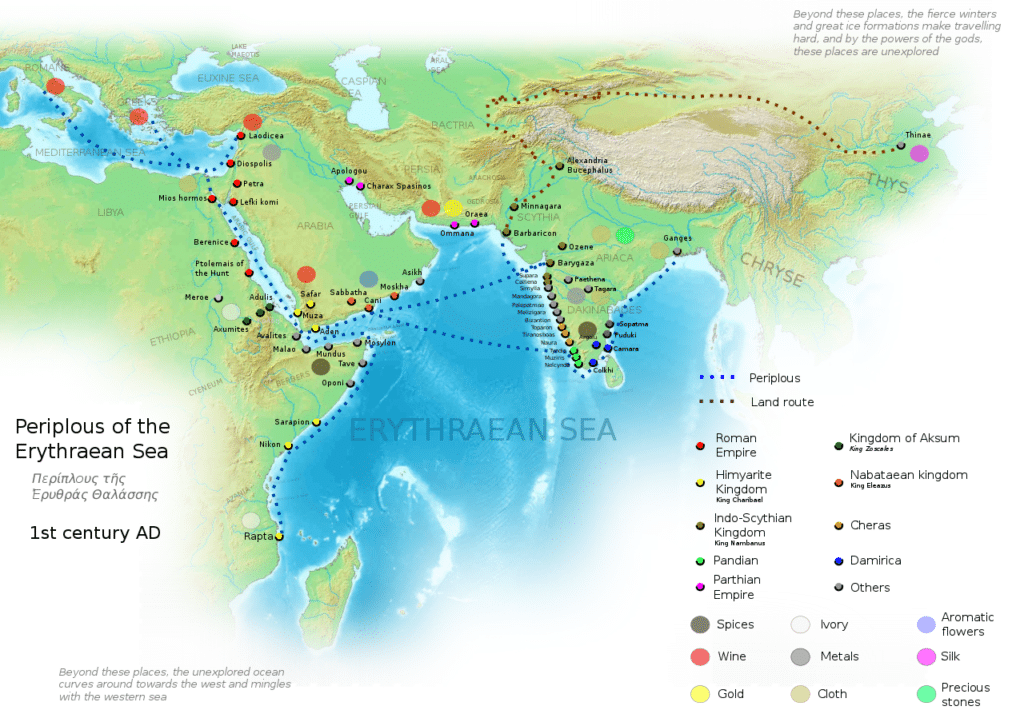
- The Periplus of the Erythraean Sea (or Periplus of the Red Sea) is a Greco-Roman text, written in Greek and dated to around the mid-first century CE, of unknown authorship, describing navigation and trading opportunities from Roman Egyptian ports along the coast of the Red Sea and elsewhere along north-east Africa and the Indian subcontinent. The term “Erythraean Sea” literally means “Red Sea,” though for the Greeks, it also encompassed the Indian Ocean and the Persian Gulf.
- The Periplus locates Gangaridai on the Bay of Bengal, north of a port city in Kalinga (ancient Orissa), and describes Gangetic spikenard, pearls, muslin, and gold mines found near these places.
- It also mentions the lost port city of Muziris (near present-day Cochin), in the Chera kingdom, along with the early Pandyan Kingdom, as major centres of trade in pepper, spices, metalwork, and semi-precious stones between South India and the Roman Empire; the text further describes an annual fair held in present-day north-east India, on the border with China.
- Trade with the Indian harbour of Barygaza is described extensively in the Periplus. Nahapana, ruler of the Indo-Scythian Western Satraps, controlled the area around Barygaza — under the Western Satraps, Barygaza (Bharuch) was one of the main centres of Roman trade in the subcontinent, and the Periplus describes the many goods exchanged there, some of which were brought down in quantity from Ujjain, the Western Satraps’ capital.
- The Periplus describes numerous Greek buildings and fortifications at Barygaza, falsely attributing them to Alexander the Great, who in fact never travelled that far south; it also mentions the Greek city of Alexandria on the Jhelum River, and testifies to the circulation of Indo-Greek coinage in the region, bearing Greek inscriptions and the devices of rulers who reigned after Alexander and Menander.
Indo-Roman Trade and the Drain of Roman Gold
- In the closing centuries before Christ, South Indian trade in spices such as ginger, turmeric, and pepper assumed great prominence, with the Greeks and Romans of the period carrying on extensive trade with South India.
- During the first three centuries of the Christian era, trade between the Roman Empire and the East became quite extensive, both by land and by water, for several reasons:
- With the Roman conquest of Egypt in the mid-first century BCE, the Romans actively entered the spice trade, breaking up the earlier Arab monopoly.
- In 45 CE, Hippalus’s discovery of the monsoon winds blowing regularly across the Indian Ocean gave a great impetus to trade between South India and the West, as coastal voyages gave way to direct oceanic voyages to Muziris and other South Indian ports.
- South Indian spices — ginger, turmeric, pepper — and luxury goods assumed great prominence, being in high demand across the Western world, including Rome; Pliny records the widespread use of eastern aromatics in Roman society.
- Roman women, in particular, were passionate about Indian pearls and muslin, and Chinese silk, for which India served as an intermediary, was likewise in high demand in the Roman world.
- Cardamom, ginger, turmeric, and pepper are among the spices mentioned by Dioscorides (40–90 CE), the Greek physician and contemporary of Pliny, in his Materia Medica, as possessing medicinal virtue — so Indian spices were also in demand for medicinal purposes.
- Roman products, by contrast, were not especially attractive in the East; Roman merchants exported glass and wine, but the bulk of the exchange was paid for in precious metals — gold and silver.
Pliny’s Claim of Rome’s Gold Drain to India
- Ancient authors, including Pliny the Elder, believed that this unequal balance of trade caused a drain of gold from Rome to India, lamenting the loss of Roman gold in exchange for what he considered unproductive luxuries and spices. In his Natural History, Pliny supplies some figures:
- In one passage, echoing the Periplus of the Erythraean Sea, he refers to the sea trade between Egypt and India, claiming that no less than 50 million sesterces (an ancient Roman coin) was drained off by India each year, which sent back goods sold at a hundred times their original value.
- In another passage, Pliny states that the women’s and luxury trade with India, China, and the Arabian Peninsula cost no less than 100 million sesterces per year — a figure probably already included within the estimate for India (50 million sesterces).
- There is no way of confirming whether these figures are accurate; both passages are somewhat alarmist and may have been exaggerated by Pliny, and neither statement, in fact, specifies gold or silver directly, giving only values in sesterces.
Evidence Supporting Pliny’s Claim
- Pliny’s claims cannot simply be dismissed. However curious its concerns may seem, his Natural History represents the most intensive exploration, known from antiquity, of humanity’s relationship with its physical environment in the broadest sense — if he expresses concern over the cost of luxury trade with the East, this suggests that such trade was both well known in Rome and considered a matter of some importance.
- The Periplus of the Erythraean Sea likewise suggests that Roman ships sailing to southern India carried “mainly a great amount of money,” a claim supported by the discovery of dozens of imperial coin hoards in the region.
- Pepper (black and white) was clearly imported in large quantities, being valued by the Romans as highly as gold and silver — hence the name yavana priya (“dear to the Romans”) given to it by Indian Sanskrit writers; special storehouses in Rome could hold thousands of pounds of pepper, and at the Roman customs house in Alexandria, imported spices were scrutinised and taxed. When Constantinople became the capital of the Roman Empire (in 330 CE), that city too developed into a centre of trade in oriental spices.
- That eastern trade drained bullion resources from the Roman Empire is further evidenced by the stress placed on the Roman currency system owing to the scarcity of bullion — at one point, Rome had to ban trade in silk, cutlery, and other goods imported from the East.
- Inscriptions from western India mention foreign perfume merchants (yavanagandhika), who probably maintained their own quarters in the port towns of western India, further evidence of large-scale trade in spices.
- Excavations have also revealed the remains of a Roman trading station and a large number of Roman coins minted in the early centuries of the Christian era, buried along the length of Tamil India, from Malabar to the east coast; the mention of a Temple of Augustus at Muziris further attests to the presence of Roman traders in South India.
- Ancient Indian texts emphasise that the basis of foreign trade with the West lay in earning profits; though reliable evidence of the price of silk in the Roman Empire is lacking, one ancient source claims it was worth its weight in gold.
- The introduction of gold coinage on a significant scale by Vima Kadphises (a Kushana ruler) in the first century CE further indicates that India enjoyed a favourable balance of trade with the Roman world, including by land.
Nature and Impact of India’s Contact with Western Asia and the Mediterranean World
- India’s contact with Western Asia and the Mediterranean world during this period took several distinct forms:
- Diplomatic relations — as evidenced by the Greek ambassador Megasthenes at the court of Chandragupta, and the Syrian ambassador Deimachus and Egyptian ambassador Dionysius at the court of Bindusara.
- Cordial relations — as illustrated by the story of Bindusara requesting Antiochus to send him sweet wine, dried figs, and a sophist, often cited as evidence of the good relationship between India and Syria.
- Trade relations — flourishing trade between India, Western Asia, and the Mediterranean world is attested by finds of Greek and Persian coins, as well as the accounts of Megasthenes and Arabian writers, among others.
- Dhamma-vijaya — Ashoka sent Dhamma missions to various countries, claiming to have attained Dhamma-vijaya in the dominions of Antiochus II, Ptolemy II Philadelphus of Egypt, Magas of Cyrene (North Africa), Antigonus Gonatas of Macedonia, and Alexander of Epirus.
- Matrimonial relations — according to the Roman historian Appian, Seleucus entered into a marriage alliance with Chandragupta Maurya, though this account is not considered entirely reliable.
Persian Impacts
- The Achaemenid rulers Cyrus and Darius annexed parts of Punjab and Sindh, and Indian subjects came to be enrolled in the Achaemenid army; Persian rule over these regions lasted about two centuries, accompanied by flourishing trade and commerce between Persia and India — some Persian gold and silver coins have been found in Punjab.
- Persian rule also left its mark on the administrative structure of the Mauryan Empire — for instance, the Persian title of satrapa (governor) continued in use among Indian provincial governors as Kshatrapa, and the Kharoshthi script was adopted for Ashokan inscriptions.
- Persian influence is likewise visible in Ashokan edicts and in Mauryan art and culture, such as the Ashokan pillars; Chandragupta Maurya is said to have taken a ceremonial hair bath in typical Persian style, and the presence of a sacred fire at his court reflects Zoroastrian influence.
Greek Impact
- Alexander’s conquest of north-western India brought the region under Seleucus Nikator, who declared himself king after Alexander’s death; this later paved the way for the unification and conquest of north-western India by Chandragupta Maurya.
- The Greek presence led to the discovery of new sea and land routes between India and Europe, boosting trade and commerce, and introduced to India the art of minting well-shaped, beautifully designed gold and silver coins; Greek influence can also be traced in Indian astrology.
- Greek accounts, such as those of Megasthenes and Arrian, provide valuable information on India’s socio-economic life, including crafts such as carpentry, brisk trade, and prosperity, while Indian ideas and notions of philosophy and religion travelled in turn to the Western world.
- Greek accounts also proved invaluable in framing the chronology of ancient Indian history — for instance, the date of Alexander’s victory over Porus in 326 BCE remains a key chronological anchor for the period.
Conclusion
Neither the Iranian nor the Macedonian invasion of India brought about immediate political transformation, yet together they drew India firmly into the orbit of the wider ancient world — through the administrative vocabulary of the satrapa system, the Kharoshthi script, the artistic idiom of the Ashokan pillars, and, above all, the trade and diplomatic contacts that would flourish for centuries afterward, from the embassies of Megasthenes and Deimachus to the flourishing Indo-Roman trade recorded by Pliny and the Periplus of the Erythraean Sea. For UPSC History Optional aspirants, these invasions and their long chain of consequences illustrate how ancient India, far from being isolated, remained in continuous and consequential dialogue with Persia, Greece, and Rome across the centuries.