

What Is Power? The Definitional Quarrel

- Power is one of sociology’s most contested concepts. Every major theorist agrees that human relationships are structured by unequal capacities to make things happen, but they disagree sharply on what power actually is — a possession, a relationship, a systemic capacity, or something that cannot be “held” at all.
- Dowse and Hughes capture why the concept carries so much weight: politics, in their formulation, exists wherever there are differentials of power, so any social relationship marked by an unequal capacity to prevail is, in that sense, political.
- A preliminary distinction is worth holding onto through the rest of this note. Power is the raw capacity to make others comply, whether or not they accept the right of the more powerful party to command them. Authority is power that has been accepted as rightful — legitimate — by those subject to it. Coercion is power exercised without that acceptance.
- Five thinkers — Weber, Marx, Parsons, Arendt and Foucault — give five genuinely different answers to “what is power,” and each is really answering a slightly different question rather than offering competing solutions to the same one.
Weber: Power as a Probability Against Resistance
- Max Weber‘s definition is the one most accounts of power start from.
“The probability that one actor within a social relationship will be in a position to carry out his own will despite resistance, regardless of the basis on which this probability rests.” — Max Weber
- Three features of this definition matter more than the wording itself.
- Power is a probability, not a fixed possession — it can rise or fall with circumstance rather than being something a person simply “has” once and for all.
- Power is located in a social relationship, not inside a person — it makes no sense to ask how much power someone has in complete isolation from others.
- Resistance is built into the definition, which is exactly what makes Weber’s power constant-sum: for one actor’s will to prevail over resistance, some other actor’s will must be defeated, so a gain for one side is necessarily a loss for the other.
- Weber’s more precise and more useful concept is authority (Herrschaft, legitimate domination): the probability that a specific command will be obeyed by a given group of people. Power succeeds even against active resistance; authority succeeds because those commanded believe they ought to comply — a distinction developed fully in the next section.
Weber’s Three Bases of Power: Class, Status and Party
- Weber refused to restrict power to a single economic axis the way Marx did, identifying three separate, cross-cutting bases from which power can flow, each able to influence the others without being reducible to them.
- Class is a person’s market situation — access to goods, skills and property that command a price in a competitive market. Like Marx, Weber treats ownership versus non-ownership of property as the single most important class division, but for Weber this is one basis of power among three, not the only one.
- Status is social honour or prestige, expressed through a shared style of life, and it can exist with or without economic power — an impoverished aristocrat may hold high status with little class power, and a newly wealthy trader may hold class power with low status.
- Party is any organisation striving, in a planned way, to secure directive control in order to implement particular policies — political parties, trade unions, professional associations — representing power organised at the level of an association rather than of individuals or amorphous status groups.
- Because these three bases are analytically separate, Weber’s picture of power is far less polarised than Marx’s: inequality runs along multiple, cross-cutting hierarchies rather than a single line of ownership, which is also why Weber expected class conflict to stay less sharply focused than Marx predicted.
Marx: Power Rooted in Ownership of the Means of Production
- For Marx, power is not autonomous; it is anchored in the economic infrastructure — specifically, in who owns the means of production and who does not.
- The class that owns productive property is the ruling class, and it uses its economic dominance to secure political and ideological dominance as well, which is why Marx and Engels reduce the state, in the Communist Manifesto, to a committee managing the ruling class’s shared affairs.
“The executive of the modern state is but a committee for managing the common affairs of the whole bourgeoisie.” — Karl Marx and Friedrich Engels
- Marx’s power is therefore constant-sum and class-based: the ruling class exercises power to further its own interest at the direct expense of the subject class. Marx calls this forcing of compliance against the subject class’s own interest coercion — an illegitimate use of power, not a neutral or shared good.
- Domination in the economic base does not stay confined there — it is reproduced in the superstructure (law, education, the family, the media), so the subject class comes to see an exploitative arrangement as natural, fair or inevitable. Later interpreters call this false consciousness (a term coined by Engels, not Marx himself).
- Because power for Marx is ultimately about the relation between the propertied and the propertyless, the only way to genuinely return power to the whole of society is communal ownership of the means of production: once everyone stands in the same relationship to production, power ceases to be a possession of one class held against another.
- Two later refinements matter for a fuller picture without collapsing back into an orthodox Marxist account.
- Antonio Gramsci‘s concept of hegemony answers a question Marx leaves under-explained — how does a ruling class secure consent, not just obedience? Gramsci argues the ruling class governs as much through civil society’s institutions (schools, churches, media, everyday common sense) as through the coercive machinery of the state, so its worldview comes to feel like plain common sense rather than one contestable option among others.
- Louis Althusser gives this a more structural cast: the state is “relatively autonomous,” functioning through both Repressive State Apparatuses (army, police, courts, which work mainly by force) and Ideological State Apparatuses (schools, family, religion, media, which work mainly by ideology) to reproduce the conditions capitalism itself needs in order to survive.
Parsons: Power as a Variable-Sum System Facility
- Talcott Parsons rejects the premise that power is a fixed quantity to be divided up. In On the Concept of Political Power, he treats power as a generalised capacity of the social system as a whole to mobilise resources toward collective goals that society’s members have already agreed are worth pursuing.
- His organising analogy is money: power circulates through the political system the way money circulates through the economy, and like credit, the total supply can expand. This is why Parsons’s view is called variable-sum (or positive-sum) — society as a whole can have more power, not merely a different distribution of a fixed amount, in sharp contrast to Weber’s and Marx’s constant-sum accounts.
- Because value consensus underlies everything in Parsons’s model, power differentials are treated as inevitable and functional: those positioned to direct collective action toward shared goals are granted authority, and authority is legitimate exactly to the degree it serves those shared goals. On this definition there is strictly no such thing as illegitimate power, since legitimacy is already built into the concept.
- The standard critique, sharpened by Anthony Giddens, is that Parsons’s model smuggles in the very consensus it needs to demonstrate: by defining power as necessarily goal-attaining and legitimate, he writes coercion, domination and sectional interest out of the concept before analysis even begins — the theory ends up sounding like a rationalisation the powerful might offer for their own position, rather than a neutral account of what power is.
Arendt: Power as Concerted Action, the Opposite of Violence
- Hannah Arendt, in On Violence, supplies a third position that is neither Weber’s individual-versus-individual struggle nor Parsons’s system-wide facility. For Arendt, power belongs to a group, springing up whenever people act together, and it survives only for as long as that group stays together — it is never the private property of one person, however commanding.
- Her sharpest and most counter-intuitive claim reverses a common assumption: violence is not power in its purest, most concentrated form. The two are opposites.
“Power and violence are opposites; where the one rules absolutely, the other is absent.” — Hannah Arendt
- On this view, a regime’s turn to naked violence is a symptom that its power — the willing, concerted support of a group — is already collapsing, not a display of power at its height. This reframes the relationship between force and legitimacy taken up in the next section: coercion is what remains once genuine authority has failed, not a more intense version of authority.
Foucault: Power as Relation, Not Possession
- Michel Foucault rejects the shared premise of every theorist discussed so far — that power is a thing some actor (A) holds and exercises over another (B). For Foucault, power is not a possession, a commodity, or a right that can be held, seized or shared out; it is exercised, relational, and circulates through a net-like organisation reaching into the smallest gestures, practices and relationships — what he calls capillary power.
- Power, for Foucault, is also productive rather than merely repressive: it does not simply say “no” to pre-existing desires, it produces the very domains of knowledge, the categories of normal and abnormal, and even the subjects who then act within them. This inseparability of power from knowledge is condensed into his term power/knowledge — the sciences that claim merely to describe people (psychiatry, criminology, sexology) are simultaneously the instruments through which people are classified, normalised and governed.
- Four specific mechanisms are worth naming individually.
- Disciplinary power works through hierarchical observation, normalising judgement and the examination, drilled into the body inside the prison, school, barracks, factory and hospital — training bodies to a required standard rather than simply forbidding acts.
- The Panopticon, Bentham’s design for a prison in which a single unseen watcher can observe every cell, becomes for Foucault the diagram of modern power generally: an inmate who can never verify whether he is being watched at any given moment starts watching himself, and surveillance becomes self-surveillance — power that runs automatically, without needing to be constantly and visibly applied.
- Governmentality is the “conduct of conduct” — the accumulated arts, calculations and techniques by which populations are governed at a distance, through incentives and norms rather than direct command.
- Biopower is power that takes the population and life itself as its object, working through statistics, public health measures and the regulation of birth, death and reproduction, rather than through punishment of the individual body alone.
- One clarification is worth stating precisely: Foucault does not add a “fourth face” of power after Lukes’s three (discussed below). Lukes’s three dimensions all still assume an A who exercises power over a B against B’s interest; Foucault’s framework rejects that premise altogether, so it poses a different question about power rather than refining the same one.
Foucault’s Biopower in the Age of Algorithmic Governance
- Foucault’s tools have found direct application in recent scholarship on algorithmic governance: platforms, credit-scoring systems and predictive-policing tools now perform many of the functions Foucault assigned to disciplinary institutions and biopolitical administration, but through data rather than walls.
- Recent work reframing Foucault’s disciplinary subject for the era of big data and real-time behavioural modulation argues that algorithmic control intensifies rather than replaces the older security-based rationality Foucault described: it works through probabilistic, anticipatory intervention — predicting and pre-empting behaviour — rather than through the fixed, visible rules of the prison or the school.
- The Panopticon analogy updates cleanly: a platform user who cannot know exactly which behaviours are being scored, or by which algorithm, begins to self-regulate in anticipation — precisely Foucault’s point about self-surveillance becoming the ordinary condition of modern power rather than an exceptional one. This literature treats governmentality and biopower as needing extension to data infrastructure and population-level analytics, not abandonment — the same conceptual move seen elsewhere in updating Marxian alienation for the platform economy.
Giddens and Bourdieu: Two Further Refinements
- Anthony Giddens distinguishes power in a broad sense — the transformative capacity to make a difference to outcomes directly — from power in a narrow sense, where one actor’s ability to achieve an outcome depends on securing the compliance of another. The narrow sense is where domination properly belongs, since it requires one party to prevail over another rather than simply act effectively on its own.
- Pierre Bourdieu widens the resource base of power beyond Marx’s ownership and Weber’s market position by naming three forms of capital that structure a society’s controlling classes: economic capital (wealth and property), social capital (networks and connections), and cultural capital (education, credentials, taste and manners). Power accrues to those who can convert capital of one kind into another, not only to those who own material wealth.
Comparing the Theories of Power
| Theorist | What power is | Where it is located | Sum character |
|---|---|---|---|
| Weber | Probability of prevailing despite resistance | Social relationships; legitimated as authority | Constant-sum |
| Marx | Capacity rooted in ownership of the means of production | Class structure; the state serves the ruling class | Constant-sum, class-based |
| Parsons | Generalised system capacity to mobilise resources for collective goals | The social system, legitimated by shared values | Variable-sum (positive-sum) |
| Arendt | The human capacity to act in concert | The group, only while it coheres | Collective; opposite of violence |
| Foucault | A relation exercised, not a thing held; productive of subjects and truth | Everywhere; capillary, in practices and discourses | Neither — the question is framed differently |
| Elite theorists | Organised control of key institutional or social positions | A cohesive minority | Constant-sum |
| Pluralists (Dahl) | Capacity to prevail in actual decisions | Dispersed across competing groups | Dispersed, shifting |
| Lukes | Capacity to affect another against their real interests, including by shaping their wants | All three faces: decisions, agendas, preferences | Constant-sum, but often invisible |
- No single model is simply “correct” for every setting. Pluralism describes the formal, competitive machinery of advanced liberal democracies reasonably well — multi-party competition, organised interest groups, judicial and electoral checks — but elite theory and Mills’s power-elite thesis capture what pluralism’s own method is least equipped to see: a concentration of consequential decisions inside a small set of interlocking corporate, military, bureaucratic and political command posts that persists underneath the formal competition. In advanced industrial societies, the two are best read as correctives to each other rather than as rival final answers.
Authority, Legitimacy and Weber’s Types of Domination
- The concept of authority implies a right to command, not merely a capacity to compel — parental authority, the authority of tradition, legal authority and constitutional authority are all expressions of power woven into a recognised, rule-governed pattern, rather than power asserted afresh in every instance.
- Legitimacy is the belief, held by the ruled, that the command-and-obedience relationship they are part of is rightful. Weber’s crucial move is that legitimacy is a property of the beliefs of the subordinate, not an inherent quality the ruler possesses — which is exactly why every system of domination, however it was originally established, works continuously to cultivate belief in its own rightfulness.
- Political authority specifically defines how power is to be exercised and what relationship exists between government and governed; the doctrine of legitimacy requires that power be used according to an accepted, recognised pattern rather than arbitrarily.
- Force and coercion are not, by themselves, legitimate. They are used either to establish a legitimacy that does not yet exist, or by an already-legitimate authority in pursuit of a legitimate purpose — the distinction matters because legitimacy is what converts naked power into authority.
- An authority that persistently fails in its objectives can be challenged and displaced by a revolutionary authority, which then faces exactly the problem its predecessor did: it must go on to establish its own legitimacy, including, where relevant, international recognition, or it in turn becomes vulnerable to counter-revolution.
Weber’s Three Types of Legitimate Domination
- Weber’s typology answers a specific question: on what basis do the ruled come to believe a command deserves obedience? He names three pure types, each with its own basis of legitimacy, its own reason obedience is owed, and its own administrative apparatus — real systems typically mix these, but the pure types isolate the logic of each.
| Type | Basis of legitimacy | Obedience owed to | Administrative apparatus | Stability |
|---|---|---|---|---|
| Traditional | The sanctity of immemorial custom | The person of the chief, by inherited status | Patrimonial staff, personal retainers (feudalism as a sub-type) | Stable but resistant to change |
| Charismatic | Devotion to a leader’s exceptional, near-supernatural qualities | The person, because of his charisma | An informal band of disciples | Inherently unstable and revolutionary |
| Rational-legal | Belief in the legality of consciously enacted rules | The impersonal office, not the office-holder | Bureaucracy | Highly stable, routine |
- Traditional authority rests on long-established custom; obedience is a matter of inherited loyalty and obligation to a position that has “always” commanded respect — patriarchal authority within a household is Weber’s own example.
- Charismatic authority rests on the extraordinary personal qualities attributed to a leader, treated by followers as supernatural, superhuman, or at least wholly exceptional; such leaders command through direct emotional appeal rather than office or custom, which is exactly what makes this type unstable — it depends entirely on one irreplaceable person.
- Rational-legal authority rests on belief in impersonal rules consciously designed to achieve a specified goal by specified means; commands are obeyed because the legal framework authorising them is accepted, not because of who currently occupies the office. Bureaucracy is this type’s characteristic apparatus.
The Routinisation of Charisma
- Charisma, by its nature, is extraordinary, unstable and hostile to routine — a charismatic movement cannot simply carry on unchanged once its founder dies, so it must be transformed if it is to survive at all.
- Weber calls this transformation the routinisation of charisma: charisma is converted into hereditary charisma (the leader’s qualities are assumed to pass to designated descendants) or charisma of office (the qualities are assumed to attach to whoever occupies a particular office, regardless of person), at which point the movement settles into either a traditional or a rational-legal form.
- The underlying insight is double-edged: charisma is the one genuinely revolutionary force in Weber’s typology, capable of breaking entirely with existing custom and law — but it can only survive its own founder by becoming exactly the kind of routine authority it originally broke away from.
Weber’s Types of Social Action and the Roots of Authority
- Weber’s broader theory of social action supplies the psychological ground each type of domination grows out of, since each form of authority corresponds to a distinct way social actors orient their conduct.
- Traditional action — conduct guided by ingrained habit and custom — underlies traditional authority.
- Affective action — conduct guided by emotion — underlies charismatic authority, since a charismatic leader’s hold on followers works through direct emotional devotion rather than calculation.
- Zweckrational action (instrumentally rational action, chosen because it efficiently achieves a given goal) underlies rational-legal authority, whose entire apparatus is built to achieve specified ends by specified, calculable means.
- Wertrational action (value-rational action, chosen because it expresses a value regardless of the practical outcome) does not map onto one single type of domination as neatly, but explains why individuals often obey any of the three types out of conviction rather than mere calculation or habit.
Sources and Instruments of Power
- Beyond asking what power is, a separate question is where power actually comes from and through what mechanisms it is exercised. John Kenneth Galbraith‘s framework answers both halves together.
- Galbraith names three instruments through which compliance is won.
- Condign power wins compliance by threatening or inflicting an unpleasant consequence — the coercive end of the spectrum.
- Compensatory power wins compliance by offering a reward substantial enough that the other party sets aside its own preference to obtain it.
- Conditioned power wins compliance by changing what the other party actually believes or wants, through persuasion, education or social conditioning. Galbraith treats this as the most pervasive form in modern society precisely because it is the least visible: a person conditioned to want what power-holders want does not experience any compliance at all.
- Galbraith traces these instruments to three sources: personality (an individual’s leadership qualities, including charisma), property (wealth and ownership), and organisation (the capacity of a structured group to act in concert). The framework maps cleanly onto the rest of this unit — personality recalls Weber’s charisma and Pareto’s psychological elite, property recalls Marx’s class, and organisation recalls Mosca’s and Michels’s structural account of elite rule.
- Tumin locates the contexts in which power is actually exercised and can therefore be observed: political affairs (formal government and law-making), institutional patterning (control over the internal rules of organisations such as firms, universities or religious bodies), the shaping of life chances (control over who gets access to scarce opportunities), and personal relations (power within families and informal groups).
- On the separate question of how power’s presence can be verified, Westergaard and Resler‘s argument is the sharpest available: power should be judged by its results, not by declared intentions. If scarce and valued resources remain concentrated in the hands of a minority despite repeated formal reforms aimed at redistribution, that persistence of outcome is itself the evidence that the minority holds effective power, whatever any given policy claims to achieve.
The Pluralist–Elite Debate: The Faces of Power
- This debate organises much of the rest of the unit, because the argument between pluralists and elite theorists is a methodological argument as much as a substantive one: what a researcher finds about who holds power depends heavily on the method used to look for it — asking about reputations, tracing decisions, or examining what never becomes a decision at all yield three different pictures of the same city.
Liberal Theory and the Rise of Pluralism
- The liberal theory of power traces back to the social-contract theorists Hobbes and Locke, who argued that society arises from a voluntary agreement among individuals who recognise that only a sovereign power can protect them from the insecurity of a pre-social “state of nature.” On this account the state is a neutral arbiter, standing above competing groups and protecting each citizen’s interests against every other’s encroachment.
- Modern pluralist theory elaborates this liberal starting point into a fuller account of how power actually operates in a developed democracy. Robert Dahl, Arthur Bentley, David Truman, Arnold Rose, Harold Laski and Neil Smelser are among its key proponents, and its core claims run as follows.
- Political power is dispersed among a wide variety of social groups rather than monopolised by a single elite or ruling class — decentralised, diffused, and drawn from many independent sources rather than one.
- Competition between two or more political parties is an essential feature of representative government, giving the electorate a genuine choice of leadership and policy direction.
- Interest groups and pressure groups play a major role in shaping government decisions, and a rough equality of access exists among organised groups, so government is expected to listen impartially rather than permanently favour one interest.
- The state’s primary task is to balance the interests of competing groups, functioning as a set of competing institutions rather than a monolithic actor working against the rest of society.
- Dahl termed rule by many competing minorities a polyarchy, reserving the term precisely to mark the gap between the democratic ideal (rule by the people) and the observed reality (rule by multiple, overlapping, competing organised minorities).
Landmark Community Power Studies
| Study | Researcher | Setting and method | Key finding |
|---|---|---|---|
| Community Power Structure (1953) | Floyd Hunter | Atlanta (“Regional City”); reputational method — asking informed residents who really runs the city | A small, cohesive business elite dominated a compliant political leadership |
| Who Governs? (1961) | Robert Dahl | New Haven; decisional method — tracing who actually prevailed in concrete decisions | Dispersed inequalities — different groups won in different issue-areas, with almost no overlap |
| Dominant caste studies | M.N. Srinivas | Rampura village, Mysore; participant observation | Local power rested with the numerically largest, land-owning caste, regardless of its ritual rank in the varna order |
Floyd Hunter and the Reputational Method
- Hunter’s Community Power Structure used the reputational method — asking a panel of well-informed residents to name who actually ran the city — rather than examining decisions directly, on the reasoning that a reputation for influence is itself a reliable proxy for real influence.
- His finding, for the city he called “Regional City” (widely understood to be Atlanta), was a small, cohesive business elite ruling through “persuasion, intimidation, coercion and, if necessary, force” — controlling local political parties through campaign finance, and shaping urban-renewal and taxation decisions that politicians then simply translated into legislation.
- Hunter’s study launched an entire community power studies tradition asking whether local power is concentrated (his own conclusion) or dispersed — the conclusion Dahl would soon reach using a different method in a different city.
Robert Dahl and the Decisional Method
- Dahl‘s Who Governs? directly challenged Hunter’s method and reversed his finding. Studying New Haven with the decisional method — examining who actually prevailed across a series of concrete decisions in urban redevelopment, public education and political nominations — Dahl found different groups winning in different issue-areas, with almost no single group dominating across all of them.
- His conclusion, dispersed inequalities, holds that resources (money, votes, organisation, expertise, access) are unequally distributed across society, but no single group holds all the resources that matter, and different resources are decisive for different kinds of issues — so no cohesive ruling minority exists even though inequality clearly does.
- Dahl’s pluralism adds one further, subtler claim: even the unorganised retain a form of latent power through the rule of anticipated reactions — elected leaders shape policy in anticipation of how voters would react if consulted directly, so influence need not be organised or even actively exercised to matter. This is the strongest pluralist answer to whether unorganised masses can shape outcomes in a democracy: indirectly, through the fear of electoral consequence, even without forming a pressure group.
Bachrach and Baratz: The Second Face — Non-Decision-Making
- Bachrach and Baratz, in Two Faces of Power, argue that Dahl’s method has a structural blind spot: it can only see power exercised in decisions that actually reach the point of choice, but power is equally exercised by keeping issues off the agenda in the first place.
- This is non-decision-making — confining the scope of actual decision-making to “safe” issues that will not seriously threaten anyone with real influence, so whole categories of grievance never even arrive at the point where Dahl’s decisional method could detect them.
- Their supporting concept, adapted from E.E. Schattschneider, is the mobilisation of bias: political institutions are never neutral arenas, as pluralism assumes, but are built with a systematic tilt that organises some conflicts in to the political process and organises other conflicts out of it before they can even be raised.
Steven Lukes: The Third Dimension — Shaping Preferences
- Steven Lukes, in Power: A Radical View, adds a third dimension that neither Dahl’s decisions nor Bachrach and Baratz’s non-decisions can capture. Both of the first two dimensions still require some form of observable conflict — over a decision, or over what gets onto the agenda.
- Lukes argues the most effective form of power operates by preventing conflict from ever arising, by shaping people’s perceptions, cognitions and preferences so thoroughly that they accept their position in the existing order as natural, unchangeable, or even actively desirable.
“Is it not the supreme exercise of power to get another or others to have the desires you want them to have — that is, to secure their compliance by controlling their thoughts and desires?” — Steven Lukes
- The concept this rests on is real interests: Lukes defines power as A affecting B in a manner contrary to B’s real interests, which lets him say a person can be under another’s power even where there is no visible conflict and the person reports being entirely content. A latent conflict exists between the interests of the powerful and the real interests of those excluded, whether or not either side is aware of it.
- The standard objection is unavoidable and worth stating directly: who decides what a person’s “real” interests are, if not the person themselves? The concept requires an outside analyst to overrule the subject’s own stated preferences, which risks being either paternalistic or unfalsifiable, since a total absence of visible conflict is equally consistent with genuine contentment and with successfully manufactured consent — Lukes himself later conceded this is a genuine difficulty.
- Locating the three faces together is useful: Dahl occupies the first, Bachrach and Baratz the second, and Lukes the third — and Lukes’s third face is, in substance, Gramsci’s hegemony and Marx’s false consciousness restated in the vocabulary of behavioural political science, which is exactly why Lukes calls his own position “the radical view.”
Elite Pluralism and Neo-Pluralism
- Elite pluralism softens classical pluralism’s claim of rough equality among groups: it still sees Western societies as basically democratic and government as a process of compromise, but concedes that not all participants hold equal power, and that some interests may go unrepresented, at least temporarily. Its own weakness is that it never quite explains why some elites should be trusted not to monopolise power once their advantage over other groups is admitted.
- Neo-pluralism, developed by J.K. Galbraith and Charles Lindblom, goes further: the modern industrial state, they argue, is both more complex and less responsive to popular pressure than classical pluralism assumes. Democracy comes to mean competition between and within elites to control the state, rather than direct popular rule, and corporate elites in particular are seen as wielding disproportionately greater influence over government policy than other organised groups, constraining what other interests can achieve even within a formally pluralist system.
- Colin Crouch‘s finding that transnational corporations exert far greater influence on government than any comparable group, and John Dewey‘s older observation, both anticipate this correction to classical pluralism.
“Politics is the shadow cast on society by big business.” — John Dewey
Critiques of Pluralism
- Pluralism’s core weakness, shared by Dahl’s own method, is that it studies only overt decisions, leaving it structurally blind to non-decision-making and to the shaping of preferences described above.
- It treats the state as a neutral referee, but this ignores that state managers and institutions have interests of their own, and that institutions are rarely as neutral as the referee metaphor implies.
- Mancur Olson‘s work on collective action explains a bias pluralism cannot: small, concentrated interests (a handful of large firms) organise easily because each member has a large individual stake and can be monitored, while large, diffuse interests (consumers, the unorganised poor) face a free-rider problem and struggle to organise at all — so pluralism’s picture of “roughly equal competing groups” understates a systematic advantage held by concentrated business interests.
- Not every interest is even organisable in principle: the unemployed, refugees and other diffuse or transient populations frequently have no group speaking for them at all, which pluralism’s group-based picture of politics has no ready way to register.
- The methodological gain pluralism does retain over elite theory is genuine: it insists power be demonstrated through evidence — actual decisions, actual outcomes — rather than inferred from a theory about how organisations or psychology must work, a discipline the classical elite theorists, taken up next, do not always observe.
Anarchist Theory: Power and the State as Inherent Oppression
- Anarchist theory takes a position outside the entire pluralist-versus-elite debate by rejecting the premise both share — that the state, however power within it is distributed, can ever be a legitimate arbiter.
- Anarchists hold that the state and all forms of political authority are both evil and unnecessary, viewing the state as a concentrated, institutionalised form of oppression that lets whoever currently controls it — loosely, a “ruling class” — subordinate everyone else for its own benefit, regardless of whether that control is exercised by one elite, by competing elites, or nominally by “the people.”
Classical Elite Theory: Pareto, Mosca and Michels
- Classical elite theory was constructed explicitly against Marx. Its founding claim is that a divide between a ruling minority and a ruled majority is a permanent, universal feature of every society, so a genuinely classless society is not a real historical possibility — socialism, on this view, would simply install a new elite in place of the old one, not abolish elite rule as such.
- The three classical theorists ground the same basic claim in three genuinely different mechanisms, and treating them as interchangeable pieces of one undifferentiated “elite theory” loses exactly what each one is arguing: Pareto grounds elite rule in psychology, Mosca in organisation, and Michels in the structural logic that any large-scale association is forced to obey.
Vilfredo Pareto: Residues, Derivations and the Circulation of Elites
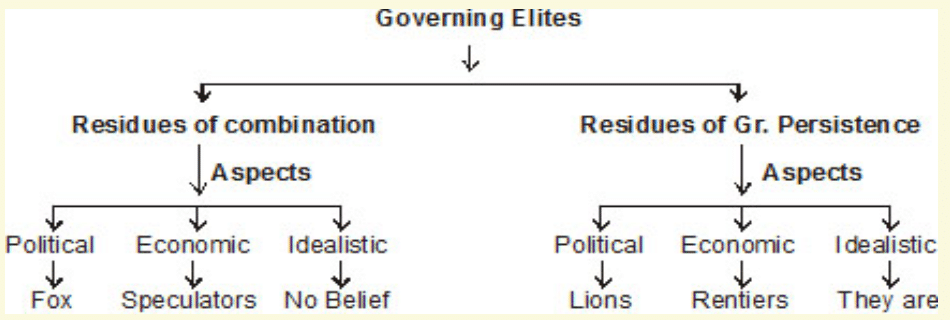
- Pareto defines the elite formally and value-neutrally: those who score highest in their own particular branch of activity, whatever it may be. Within this broad elite he separates the governing elite (those who directly or indirectly play a part in government) from the non-governing elite (those who excel in some other field — business, the arts, a profession — without holding political power), and both from the non-elite mass.
- Because Pareto defines the elite by superior personal qualities rather than by structural position, his theory is fundamentally psychological, not structural — the crucial point of contrast with Mills, taken up later.
- Residues are the enduring, non-logical sentiments that underlie human conduct even when people dress their actions up as reasoned argument; derivations are exactly those rationalisations — the ideologies, doctrines and justifications people invent after the fact to make residue-driven conduct look like the outcome of logical reasoning.
- Class I residues — the instinct for combinations — produce cunning, innovation and a taste for manipulation; Pareto, borrowing the image from Machiavelli, calls their bearers foxes.
- Class II residues — the persistence of aggregates — produce conservatism, loyalty, solidarity and a readiness to use force rather than guile; their bearers are lions.
- Circulation of elites carries two distinct meanings, and a complete account of the concept needs both.
- At the individual level, it is the constant movement of able individuals from the non-elite into the elite, and of incompetent members out of the elite and down into the mass — a continuous process of recruitment and shedding.
- At the level of whole elites, it is the periodic replacement of one governing elite by another as the balance between the two residues shifts within the ruling group: fox-dominated regimes rule through manipulation and consent but grow decadent as they lose the will and capacity to use force, and are eventually overthrown by lion-type challengers; lion-dominated regimes rule through force and conviction but grow rigid and closed, and are eventually subverted by rising foxes. History, in Pareto’s own image, is “a graveyard of aristocracies.”
“History is a graveyard of aristocracies.” — Vilfredo Pareto
- Pareto’s account of revolution follows directly from this: revolutions occur not because the masses rise up on their own initiative, but because the governing elite has degenerated — closing itself to fresh talent while superior individuals accumulate, unused, in the lower strata. The masses supply the muscle for a change of masters; they are not themselves the authors of the change. This is the sharpest anti-Marxist edge of the whole theory.
- On whether lions and foxes are genuinely distinct types or two labels for the same elite psychology under different circumstances: Pareto does present them as two really different clusters of residues (combination versus persistence), but the same governing group typically shifts its own balance of residues over time in response to circumstance rather than staying permanently fixed as one type or the other — and it is exactly this fluidity, not a rigid difference between the two, that makes circulation possible at all. Read this way, lion and fox describe two poles on a spectrum of ruling strategy — force and conviction at one end, guile and manipulation at the other — rather than two biologically fixed categories of person.
Gaetano Mosca: The Ruling Class, the Political Formula and the Sub-Elite
- Mosca shifts the ground from psychology to organisation, and his version of elite theory is generally the more defensible of the two. His starting claim: in every society, two classes of people appear — a class that rules, always the less numerous, which monopolises political power and its advantages, and a class that is ruled, more numerous, directed and controlled by the first.
- The ruling class prevails not because its members are individually superior, but because it is an organised minority facing a disorganised majority — organisation itself is the decisive resource, since an organised few can always act with more coordination and speed than an unorganised many, whatever the numerical odds.
- The political formula is Mosca’s most important concept: no ruling class ever justifies its power by admitting it rests on naked force. It always offers a moral or legal principle instead — the will of God, the will of the people, the mandate of history, the rule of law — and this formula answers a genuine need in human psychology to be governed on a recognised principle rather than by force alone. This is, in effect, Gramsci’s hegemony arriving from the political right several decades early.
- Mosca is more open than Pareto in three specific ways.
- He gives real weight to the sub-elite (or second stratum) — the wider layer of civil servants, managers, professionals and intellectuals through whom the ruling class actually governs day to day, and from whom it draws its own recruits.
- He allows genuine social forces — new interests thrown up by economic and social change — to press their way into the ruling class over time, rather than treating the elite as a permanently closed group.
- He came, over his career, to accept that representative institutions and parliament place real constraints on elite behaviour, which is why Mosca ends up a defender of liberal, representative democracy in a way Pareto never does.
- Mosca also compares closed systems (caste, feudal societies) with open representative democracies: in the latter, the ruling elite draws recruits from a much wider range of social backgrounds, giving diverse social groups at least some indirect representation in elite decisions.
Robert Michels: The Iron Law of Oligarchy
- Michels, in Political Parties (1911), supplies a third and structurally distinct mechanism: who says organisation, says oligarchy.
“Who says organisation, says oligarchy.” — Robert Michels
- His case study is deliberately the hardest possible test: the German Social Democratic Party, the most internally democratic mass party of its era, explicitly committed to working-class self-rule — and yet, Michels found, it developed exactly the same concentration of leadership power any conservative organisation would.
- The mechanisms behind the iron law are structural, not accidental to any one organisation’s personnel.
- Large organisations require specialised leadership, delegation and technical expertise that ordinary members do not have the time or training to match.
- Leaders accumulate irreplaceable skills and control of information and communication, which the rank and file increasingly depend on and cannot easily replicate or challenge.
- The mass membership tends to be apathetic and psychologically disposed to defer to leaders it has come to see as indispensable.
- Leaders, once established, develop an interest in preserving their own position distinct from — and sometimes in conflict with — the organisation’s original goals, so organisational survival gradually displaces the founding aim. Michels calls the resulting tendency for leaders to grow cautious and self-protective the embourgeoisement of leaders.
- Michels’s conclusion is structural, not a claim about any particular leader’s character: any large-scale organisation, however democratic its stated aims, will necessarily generate a self-perpetuating oligarchic leadership, simply because of what organising at scale requires.
Pareto, Mosca and Michels Compared
| Pareto | Mosca | Michels | |
|---|---|---|---|
| Basis of elite rule | Psychological — superior residues (cunning or force) | Organisational — a cohesive minority against a disorganised majority | Structural/technical — the necessities of running any large-scale organisation |
| Mechanism of dominance | Residues (Class I combinations, Class II persistence) | Organisation plus the political formula | Specialised leadership, control of information, mass apathy |
| View of change | Cyclical — circulation of elites, no overall direction | Gradual — social forces and the sub-elite widen entry over time | Convergent — oligarchy re-emerges regardless of an organisation’s founding ideals |
| View of democracy | Another form of elite domination; no real difference from other regimes | More open than caste or feudal systems; parliament offers genuine constraint | Democratic and socialist organisations are just as prone to oligarchy as any other |
| Best-known device | Lions and foxes; “graveyard of aristocracies” | The political formula; the sub-elite | The iron law of oligarchy; the SPD case study |
- What unites all three despite these differences: each identifies a permanent minority-rule tendency operating independently of a society’s proclaimed ideology, which is exactly why all three were read — accurately for Pareto and Michels, more ambivalently for Mosca — as standing against both Marxist and liberal-democratic optimism about a genuinely popular or classless order.
Critiques and the Question of Relevance
- Pareto’s residues are essentially unfalsifiable: almost any observed behaviour can be assigned, after the fact, to one residue or another, which makes the theory difficult to test rather than simply difficult to prove. His psychological reductionism also ignores the economic and institutional structures that actually select who rises into an elite in the first place — a gap Mosca’s organisational account and Mills’s institutional account both address directly.
- Pareto’s cyclical model of history has no theory of direction: it can describe oscillation between fox-type and lion-type elites, but nothing in it explains cumulative change, and his evident hostility to both democracy and socialism, together with the later appropriation of his ideas by Italian fascism, gives the theory an ideological edge that should be registered without over-stating Pareto’s own political commitments.
- Empirically, elites in developed democracies rarely resemble the tightly cohesive, self-conscious minority classical elite theory requires — genuine institutional constraints operate through elections, courts and a free press, exactly as Mosca himself came to concede.
- Against these criticisms, the theory retains real explanatory power. Elite circulation describes a genuine, recurring phenomenon: political dynasties do open and close over time, established elites do co-opt rising talent specifically to defuse challenges to their own position, and Theda Skocpol‘s comparative work on France, Russia and China shows that major revolutions have often amounted, in practice, to one elite formation replacing another rather than to rule passing directly into the hands of the previously excluded masses.
- In India, the succession from a relatively homogeneous, English-educated national elite at Independence to increasingly regional, agrarian and caste-based political elites — accelerated sharply by Mandal-era political mobilisation — is a genuine instance of elite circulation in exactly Pareto’s second sense; and Michels’s iron law describes the internal life of most Indian political parties with uncomfortable precision, since genuinely internally democratic mass parties remain rare and control typically concentrates in a leadership that owns the party’s organisational machinery.

C. Wright Mills’s Theory of the Power Elite
- C. Wright Mills, in The Power Elite (1956), gives the American, structural and explicitly radical version of elite theory — and confusing his account with Pareto’s psychological one is the single most common error in this area. Mills’s elite is not a class in Marx’s sense (it has no independent theory of ownership) and not a natural aristocracy in Pareto’s sense (its members are not superior individuals); it is a set of positions that happen, at a given historical moment, to be occupied by an interlocking group of people.
The Three Interlocking Institutional Orders
- Mills’s core thesis: mid-century power in the United States is concentrated in three interlocking institutional orders, each commanding a domain that had grown large and centralised enough to matter at the national level.
- The corporate rich, commanding a small number of giant corporations that between them held the keys to major economic decisions.
- The military warlords, commanding a vastly expanded, centrally directed military establishment.
- The political directorate, commanding the executive branch of an increasingly centralised federal government.
- These three orders were historically separate: in the nineteenth century economic power was fragmented among many small businesses, political power was localised in largely autonomous state legislatures, and the military was similarly local and small in scale. A twentieth-century process of institutional centralisation — concentrating economic power in a few hundred giant corporations, eroding state autonomy in favour of the federal government, and building a permanent, centrally directed military — drew the three orders into a genuine coincidence of interest they had not previously shared.
Institutional, Not Psychological: Mills’s Break from Pareto
- Mills states his central methodological claim directly: elites rule in institutional, not psychological, terms. Members of the power elite are not powerful because they possess exceptional personal qualities; they are powerful because they occupy the command posts of the major institutional hierarchies, and it is the pivotal position itself — not the personal quality of whoever currently fills it — that confers the power.
- The test of this claim is straightforward: on Mills’s account, almost anyone placed in that same chair would wield comparable power, because the power belongs to the structure of positions, not to the psychology of the individual filling any one of them at a given time. This is precisely the point at which Mills breaks from Pareto, for whom elite membership follows from an individual’s superior residues rather than from the position that individual happens to occupy.
Coincidence of Interest, Not Conspiracy
- Mills is explicit that the power elite’s unity is not a conspiracy — no secret plot is needed when the same structural forces produce a shared outlook among everyone who rises to the top of these three orders. He identifies three sources of cohesion.
- Interchangeability of positions — a general becomes a corporate director, a corporate executive becomes a cabinet secretary, and individuals routinely hold footholds in more than one of the three orders at once, producing what Mills calls a heavy overlapping among the members of these elites on corporate boards and government commissions alike.
- Common social origin — members are disproportionately drawn from the upper strata of society, sharing similar prep-school and Ivy League educations and mixing socially in the same high-prestige clubs, which builds a basis for mutual trust that has nothing to do with formal agreement.
- Psychological similarity and a shared worldview, produced by this common formation, which lets the three orders act in concert on major decisions without any need for explicit coordination.
- Mills also distinguishes between segmental elites — those who lead in fields such as entertainment, organised religion or the professions, whose influence stays largely confined to their own domain — and the system elites: the corporate, military and political command posts whose decisions genuinely reach the level of national consequence. Only the latter group constitutes the power elite proper.
“In so far as national events are decided, the power elite are those who decide them.” — C. Wright Mills
From Public to Mass: The Three-Tier Model of American Society
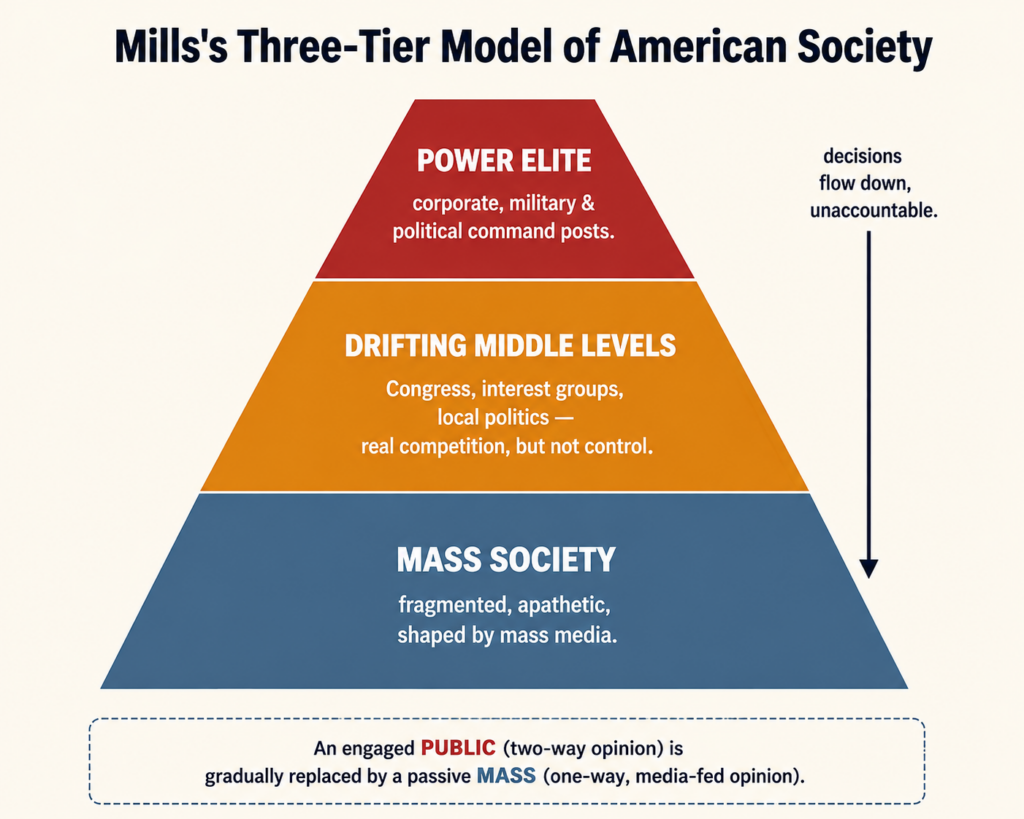
- Mills pictures American society as a three-tier structure.
- At the top, the power elite makes the genuinely consequential decisions — war and peace, boom and slump — often with little or no reference to the wishes of the wider population; Mills cites the decisions to enter the Second World War and to drop the atomic bomb on Hiroshima as decisions of exactly this magnitude, taken by a narrow elite unaccountable to any body representing the broader public interest.
- At the middle level, a shifting, drifting set of “balancing” powers — Congress, organised interest groups, local and state politics — is where pluralist researchers such as Dahl focus their attention, correctly finding real competition there, but mistaking activity at this level for control over the decisions that actually matter.
- At the bottom, a fragmented, largely powerless mass society — politically apathetic, and manipulated through mass media that tell it “what to think, what to feel, what to do and what to hope for.”
- The most underused piece of Mills’s argument is his distinction between a public and a mass, since it is the sociological engine of the whole book. In a genuine public, roughly as many people express opinions as receive them, communication runs in both directions, opinion finds real outlets in effective action, and the public retains autonomy from institutional authority. In a mass, far fewer people express opinion than passively receive it, the media dominate the flow of information, opinion has no functioning channel into action, and institutional authority penetrates the mass rather than answering to it. On this reading, democracy is not lost through any single dramatic event; it erodes gradually, through the transformation of an engaged public into a manipulated mass.
Critics of the Power Elite Thesis
- Robert Dahl‘s objection is methodological, and the most damaging one on record: Mills demonstrates that certain men occupy positions from which they could exercise decisive power, but never demonstrates that they actually prevail in specific, contested decisions — a potential for control is not the same as control actually exercised, and Dahl regards Mills’s claims as suggestive rather than empirically established.
- Arnold Rose and David Riesman (in The Lonely Crowd) counter with the concept of veto groups: America, on this view, has no single ruling elite but a plurality of organised groups, each powerful enough to block outcomes it dislikes while none is powerful enough to command outcomes it wants — producing a picture of drift and stalemate among competing blocs, not the concentrated domination Mills describes.
- Marxist critics attack from the opposite direction: Mills has no theory of class or of the economy, so his account amounts to a description of a coalition of institutional orders without ever explaining why the corporate order should be assumed to dominate the other two — treating the military and political orders as fully co-equal with the corporate order, on this reading, actually obscures capital’s underlying primacy rather than clarifying it.
- This concern sharpens into the Miliband–Poulantzas debate. Ralph Miliband‘s instrumentalist account, close in spirit to Mills, holds that the state serves capital because it is staffed, at every senior level, by people drawn from or aligned with the capitalist class — personnel is destiny.
- Nicos Poulantzas‘s structuralist reply is that personnel is beside the point: the state serves capital by virtue of its structural position within the capitalist mode of production, and must retain a degree of relative autonomy from any individual capitalist or faction of capital precisely so it can serve the long-run interests of capital as a whole, even against the short-run wishes of particular capitalists. Poulantzas’s sharper point against Miliband is that arguing about who staffs the state implicitly concedes the pluralists’ own terrain — that outcomes are decided by which individuals hold which offices, rather than by the structure those offices sit inside.
- A balanced reading of the whole debate: Mills’s concept illuminates a real and durable tendency — the concentration of consequential decision-making in a small set of institutional command posts, even inside a formally democratic system — and it travels well to the modern corporate-media-political nexus and to debates over election finance. But it understates the genuine constraint exercised by courts, competitive elections, federalism and a free press, offers no account of conflict within the elite, and provides no explanation of why the excluded majority ever wins anything at all. It functions best as a corrective to pluralism’s blind spots, not as a complete, stand-alone description of how democratic power actually works.
The Power Elite in the Twenty-First Century

- Mills’s own three orders have not simply persisted unchanged. The tightly interlocked “inner circle” he described — corporate directors sitting on five or more of the largest 500 boards simultaneously — has itself thinned dramatically: researchers tracing corporate board networks have found such heavily interlocked figures numbered over ninety in the mid-1970s but had fallen to essentially one by the early 2010s, meaning the specific mechanism of cohesion Mills relied on has weakened even where concentrated wealth has not.
- What has taken its place, on this reading, is less a single cohesive “inner circle” moderating the more reactionary elements of business — the role Mills assigned to post-war “business liberals” — and more a fragmented landscape of billionaire-funded political influence: a 2010 Supreme Court ruling opening the door to unlimited independent political spending has let a small number of individual mega-donors exercise outsized influence directly, rather than through the older institutional channels of corporate boards, trade associations and bipartisan policy committees. Commentators have pointed to figures such as Elon Musk — whose companies have been direct beneficiaries of government contracts for close to two decades, and whose private wealth has translated into a role approaching co-governance — as illustrating a newer, more individualised and more overtly transactional version of the corporate-political fusion Mills first named.
- G. William Domhoff‘s long-running empirical research programme (Who Rules America?) traces exactly the kind of corporate-policy networks — organisations functioning as revolving doors between the power elite and successive administrations — that provide an institutional through-line from Mills’s original 1950s snapshot to the present, and more recent full-length updates of the thesis (such as Heather Gautney’s The New Power Elite) apply the same institutional logic to today’s high-level decision-makers. The continuity Mills identified is structural — concentrated command posts, not personal merit, generate outsized influence — even where the specific personnel, industries and mechanisms of interlock have changed considerably since 1956.
The Indian Application: Community Power and Elite Circulation
Community Power Structure in Indian Society
- The Hunter-versus-Dahl debate over whether local power is concentrated or dispersed has a close Indian parallel in the study of village power structures. M.N. Srinivas‘s concept of the dominant caste — developed from his fieldwork in Rampura village, Mysore — found that real local power rested with the caste that was numerically preponderant and controlled the most land, not necessarily with the caste ranked highest in the ritual varna hierarchy; economic and numerical strength, not ritual purity, determined who actually governed village affairs, a finding that functions as India’s own version of Hunter’s study of who “really runs” a locality.
- The pattern of local power distribution has shifted substantially since Independence, driven by land reform (however incomplete), the spread of adult franchise, and above all the constitutional decentralisation of the 73rd and 74th Amendments, which created elected panchayats and urban local bodies with genuine, if still contested, budgetary and decision-making powers. This has measurably broadened the base of formal local political power beyond the traditional dominant-caste landholding elite, even where informal economic and social power has proven far slower to follow.
The Changing Political Elite: From National to Regional and Caste-Based
- Yogendra Singh‘s account of India’s political elite documents a clear historical shift: at Independence, the national elite was relatively homogeneous — English-educated, upper-caste, urban, and formed through a shared colonial-era institutional experience. Universal adult franchise, the political rise of numerically dominant peasant castes, and the Mandal-era mobilisation of the Other Backward Classes progressively fragmented this homogeneous elite into a plural, increasingly regionalised and caste-differentiated political class.
- The honest reading of this shift is that circulation has been real but uneven: substantial and fast-moving in the political elite specifically (state legislatures and Parliament today look far less socially homogeneous than in the 1950s), but much slower in the bureaucratic, corporate, judicial and media elites, which continue to recruit from a comparatively narrow social base. That asymmetry across different elite sectors, not simply the fact that some circulation has occurred, is the substantive claim worth making.
The New Corporate–Political–Media Elite
- A Mills-style reading of contemporary India would point to the growing overlap between big corporate houses, dominant media ownership, and political power — visible in cross-holdings between business groups and media outlets, and in the scale of corporate financing that flows into electoral politics — as a structural concentration of influence operating independently of which party is nominally in office, echoing Mills’s point that command posts, not any single administration’s personnel, generate durable power.
- Against this, India’s formal institutional checks — an independent judiciary, a competitive multi-party system even at the state level, a still-vigorous (if pressured) press, and regular, closely contested elections — supply exactly the kind of constraint that Mills’s American case somewhat understated. The balanced assessment offered earlier for the power-elite thesis in general — real concentration of consequential decision-making, alongside incomplete but genuine institutional constraint — applies to India with at least as much force as it does to the country Mills was originally writing about.
Previous Year Questions
- What would you identify as the similarities and differences in the elite theories of Mosca, Michels and Pareto? Discuss their main/crucial issues. (2025)
- How is ‘power’ different from ‘authority’? Discuss various types of authorities as theorized by Max Weber. (2024)
- What, according to Robert Michels, is the iron law of oligarchy? Do lions and foxes in Vilfredo Pareto’s theory, essentially differ from each other? Substantiate. (2023)
- Critically examine the relevance of Vilfredo Pareto’s theory of Circulation of Elites in the present scenario. (2021)
- According to Mills, “Elite’s rule in institutional terms rather than psychological terms.” Comment. (2020)
- What are the theoretical models of societal power? Which one of them is most applicable in advanced industrial societies? (2019)
- Discuss the concept of circulation of elite. (2019)
- What, according to Pareto, are the basic characteristics of elites? Discuss. (2018)
- Discuss the importance of ‘power elite’ in democracy. (2016)
- “Power is not a zero-sum game”. Discuss with reference to Weber’s and Parsons’s views. (2014)
- Write short note on Power Elite from a sociological perspective. (In about 150 words) (2011)
- List the sources of power and explain the various indicators based on which power can be measured. (2010)
- Write short note on C. W. Mills’ Power Elite. (2009)
- Write short note: Power elite in society and the emergence of new elite in power structure. (2005)
- Write short note: Authority and Legitimacy. (2004)
- Write short note: Community Power. (2002)
- Write short note: Sources of legitimacy of power. (2001)
- Explain the concept of power. Distinguish between power and authority. (1998)
- What role can the power of unorganised masses play in bringing about social change in a democratic society? (1991)
- Write short note: Community power structure. (1990)
- Write short note: Power of the Elite. (1989)
- What do you understand by community power structure? Discuss the major changes in recent times in the pattern of the distribution of power in Indian society. (1988)
- Critically examine the statement, ‘A study of power inevitably involves an investigation of social class’. (1987)
- Write short note: Legitimacy. (1987)
- Write short note: Power. (1985)
- Explain the role of community power structure in the political decision-making processes in the society. Are power and authority getting broad based in India today? (1984)
- Write short note: Power of the elite and the masses in democratic societies. (1983)
