

Parsons’s Intellectual Project

- Talcott Parsons (1902–1979) was born in Colorado Springs to a family steeped in academic and religious life — his father taught English and served as vice-president of Colorado College.
- He studied biology, philosophy, and sociology at Amherst College, then moved to the London School of Economics, and finally earned his doctorate at the University of Heidelberg in 1927.
- His doctoral dissertation examined the concept of capitalism in the work of Werner Sombart and Max Weber — the seed of the lifelong engagement with Weber that would shape his entire theoretical project.
- He joined Harvard’s economics department in 1927, moved into its newly created sociology department in 1931, and in 1946 founded and chaired the interdisciplinary Department of Social Relations, merging sociology, anthropology, and psychology.
- Parsons became the most influential American sociologist of the mid-twentieth century, building a single, ambitious theoretical system that came to be called structural functionalism.
- His career shows one decisive shift: he began as a theorist of action, with a choosing actor at the centre, and ended as a theorist of systems, with the system itself as the unit of analysis and the actor reduced to an occupant of roles.
- Nearly every serious criticism of Parsons — that he lost sight of the individual, that he cannot explain change, that his model is conservative — traces back to this shift from 1937 to 1951.
The Voluntaristic Theory of Social Action
- In The Structure of Social Action (1937), Parsons argued that four apparently unconnected European thinkers — Alfred Marshall, Vilfredo Pareto, Émile Durkheim, and Max Weber — had independently converged on a common alternative to the dominant models of action in social thought.
- This is his convergence thesis: working in different disciplines and different countries, all four had found their way to what Parsons called a voluntaristic theory of action.
- Notably absent from this convergence is Karl Marx — an omission conflict theorists have long treated as evidence that Parsons’s entire synthesis was built to sideline the conflict tradition from the start.
- Parsons acknowledged Marx as a major thinker but argued he remained trapped inside a nineteenth-century mode of thought that Weber and Durkheim had already begun to break down.
Three Rival Models Parsons Rejected
- Utilitarianism, epitomised by Thomas Hobbes, treats human beings as rational calculators pursuing given, essentially random ends with scarce means.
- Hobbes’s own logic pushed this to its conclusion: if every actor reasons this way, competition for scarce satisfactions produces a “war of all against all” — solved, for Hobbes, only by ceding autonomy to a sovereign.
- Parsons’s objection was that this model treats people’s wants as unpatterned and asocial, when Durkheim and Weber had shown that wants are socially acquired and systematically related to one another — Durkheim’s study of anomic suicide, for instance, traces how socially patterned wants can outrun the means available to satisfy them.
- Positivism assumes actors have complete, accurate knowledge of their situation, leaving no room for error, variation, or genuinely held values — a scheme with only one correct way to act.
- Idealism goes the other way, treating social action as simply the unfolding of a society’s spirit or ideas, and paying too little attention to the practical, material constraints that obstruct the realisation of those ideas.
- Parsons placed Weber partly in this camp too: the Protestant Ethic thesis elaborates the values of ascetic Protestantism at length but underplays the material search for utility that utilitarianism, at least, took seriously.
The Unit Act
- Parsons’s basic building block is the unit act, composed of four elements: an actor; an end the actor pursues; a situation, itself split into conditions (unalterable features) and means (alterable ones the actor can select among); and a normative orientation governing which means and ends are legitimate.
- Behaviour becomes action, in this scheme, only when four conditions hold together: it is oriented to a goal, it occurs within a situation, it is regulated by social norms and values, and it involves an expenditure of energy or effort.
- A driver on her way to a temple illustrates this cleanly: the prayer is her goal, the road and car are her situation, social norms make offering prayer a recognised, legitimate thing to do, and the act of driving itself consumes attention and effort.
- The actor chooses within conditions and under norms — this is precisely what “voluntaristic” means for Parsons, a narrower and more sociological idea than free will in the philosophical sense.
The Problem of Order
- Parsons’s central puzzle, inherited from Hobbes, is the problem of order: if individuals rationally pursue self-interest, why does social life not collapse into a war of all against all?
- A contractual solution does not work on its own terms, because every contract presupposes a non-contractual element of prior trust — a point Parsons drew directly from Durkheim’s critique of contract theory.
- Parsons’s own answer is a common value system, internalised through socialisation, that gives actors shared standards well before they ever negotiate a specific exchange — value consensus is the solution he builds, not an unexamined assumption he starts from.
- This connects to double contingency: my action depends on what you will do, and yours on what I will do, so interaction should in principle be radically indeterminate.
- Shared symbols and common value orientations resolve this by giving each actor stable expectations of how the other will behave — this is the micro-level foundation on which Parsons later erects the entire social system.
The Social System: From Action to Structure
- In 1951 Parsons published The Social System alongside the collaborative Toward a General Theory of Action, drawing contributors from psychology, economics, and political science to lay out a single framework for all the “sciences of action.”
- His own definition of the social system is precise and worth holding onto exactly:
“A social system consists in a plurality of individual actors interacting with each other in a situation… whose relation to their situations, including each other, is defined and mediated in terms of a system of culturally structured and shared symbols.” — Talcott Parsons
- Parsons distinguishes three (later four, adding the behavioural organism) systems of action that together make up any concrete social situation.
- The cultural system — abstract patterns of ideas and values prescribing what people ought to do, such as a highway code prescribing safe driving.
- The social system — the actual, ongoing pattern of activity and relationship among real people, such as drivers on a real road adjusting to one another.
- The personality system — the psychic make-up, temperament, and characteristic reactions of individuals carrying out these patterns, such as some drivers being more aggressive or more calm than others.
- These three elements are never automatically or perfectly integrated — Parsons is explicit that integration is problematic, not guaranteed, and that any real society will show discontinuities between what its culture prescribes, how its social system is organised, and what its members’ personalities can tolerate.
- What integration does require, at minimum, is that culture prescribe things that are practically followable, that the social system allow the culture’s prescriptions to actually be carried out, and that personalities be able to associate, cooperate, and accept the demands the culture places on them.
- Because integration is only ever partial, systems also develop tendencies to contain and channel dissent — isolating dissidents, redirecting deviation into harmless outlets — without any theoretical guarantee that disturbance will never overwhelm the system.
Status-Role: The Unit of the Social System
- The basic unit of the social system is not the individual person but the status-role: status is a structural position, role is the behaviour expected of whoever occupies it.
- A single person holds many status-roles simultaneously — the same man is a father, an employee, and a voter — which is precisely why Parsons refuses to treat the person, rather than the role, as the analytic unit.
- Institutionalisation is the process by which a role’s expectations, values, and motivational requirements become integrated into a society’s shared culture, so that performing the role in the expected way becomes the socially recognised standard.
- Internalisation is the complementary process on the personality side: individuals take these role requirements and build them into their own convictions about how they ought to act, which is why people can feel personally affronted when a stranger breaks a traffic rule that does not affect them at all.
Orientations of Action
- Every actor orienting to a role faces two intertwined kinds of orientation.
- Motivational orientation — the psychological side, split into the cognitive (understanding the situation objectively), the cathectic (emotional attachment to the object), and the evaluative (organising effort toward the most satisfying outcome).
- Value orientation — the cultural side, split into the cognitive (standards of valid judgment), the appreciative (standards of emotional appropriateness), and the moral (the actor’s value commitments).
- A woman choosing vegetables at a market illustrates the motivational triad concretely: cognitively judging quality against price, cathectically preferring some vegetables to others, and evaluatively picking the combination that maximises her satisfaction — while the value orientation is supplied by the surrounding culture, for instance the norms that define a son’s role differently in a patriarchal versus a matriarchal household.
The AGIL Framework and the Cybernetic Hierarchy of Control
- Working with the social psychologist Robert Bales, who had studied task-oriented small groups moving through phases of gathering resources, organising for a task, managing internal relations, and relaxing once the task was done, Parsons generalised these four phases into a scheme every social system must solve to survive: the AGIL functional imperatives, or functional prerequisites.
The Four Functional Imperatives
| Function | Problem it solves | Societal subsystem | Axis | Medium of exchange |
|---|---|---|---|---|
| Adaptation | Securing and distributing resources from the external environment | Economy | External, instrumental | Money |
| Goal attainment | Setting collective goals and mobilising members and energy to pursue them | Polity | External, consummatory | Power |
| Integration | Coordinating the parts and maintaining solidarity | Societal community (law, norms) | Internal, consummatory | Influence |
| Latency (pattern maintenance) | Renewing motivation and cultural patterns; managing tension | Fiduciary system (family, school, religion) | Internal, instrumental | Value-commitments |
- Two crossing axes turn this list into an actual analytical scheme: external versus internal (A and G face outward to the environment, I and L face inward to the system itself) and instrumental versus consummatory (A and G are means-oriented, I and L are ends-oriented).
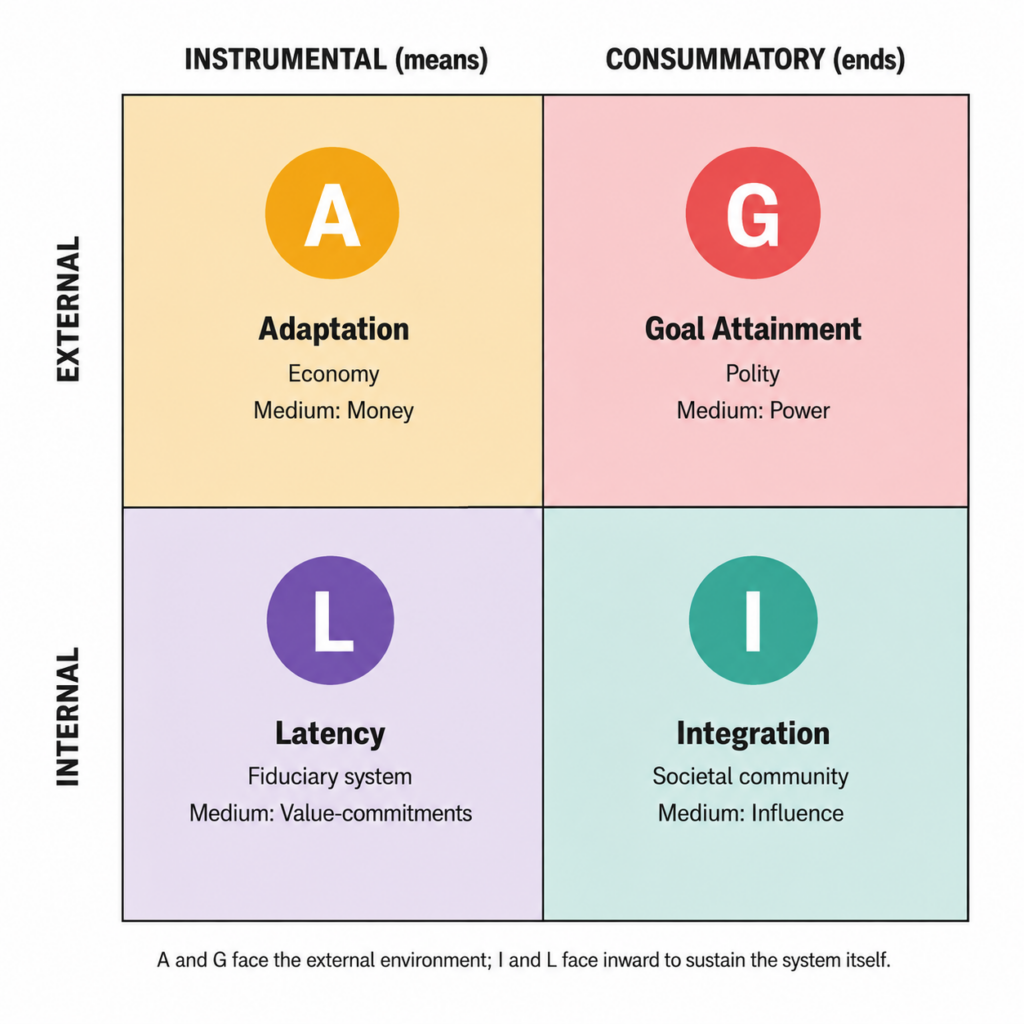
- Each function corresponds to one of the four action systems: the behavioural organism performs adaptation, the personality system performs goal attainment, the social system performs integration, and the cultural system performs latency/pattern maintenance.
- AGIL is recursive: every subsystem, down to a two-person interaction, has its own internal AGIL cycle, which is what lets the same scheme scale from a family to an entire civilisation — and is also why critics have called it an all-purpose filing cabinet that can classify anything without explaining much.
The Cybernetic Hierarchy of Control
- Parsons ranks the four action systems in a cybernetic hierarchy of control: culture, then the social system, then personality, then the behavioural organism.
- The direction of control runs from high information, low energy levels down to low information, high energy levels — culture controls through information (norms, symbols, values), while the organism energises or conditions the levels above it without controlling them.
- Getting this direction right matters: it is not that the organism’s biological drives determine culture, but that culture regulates and channels the energy the lower levels supply, the way a thermostat’s low-energy setting controls a furnace’s high-energy output.
Generalised Media of Exchange
- Parsons modelled the interchange between subsystems on economic exchange, proposing that each subsystem trades through its own generalised medium rather than dealing directly in physical resources: money for adaptation, power for goal-attainment, influence for integration, and value-commitments for latency.
- For example, government (the goal-attainment subsystem) must hand resources to the economy in the form of policy and infrastructure, and the economy (the adaptive subsystem) must hand over resources to government in the form of taxation — a continuous, balanced exchange, not a one-way flow.
Using AGIL to Analyse a Real Problem
- The scheme’s practical use is to locate where a system’s failure originates and trace how it spreads to other subsystems.
- Agrarian distress begins as an adaptation failure (the economy cannot secure or distribute resources adequately), which becomes a goal-attainment failure once the polity cannot respond, and an integration failure once the resulting grievance produces protest and unrest.
- Communal conflict is best read as a primary integration failure — the societal community’s norms and law fail to coordinate distinct groups.
- A collapse of public trust in institutions is a latency failure — the fiduciary subsystems that renew motivation and cultural commitment stop doing their job.
- The payoff of this exercise is that it forces a precise question — which function is failing, and which subsystem should have discharged it. Its limit is equally clear: the scheme describes functional failure without saying who benefits from the existing arrangement or who is responsible for the failure.
Pattern Variables
- Parsons developed the pattern variables to explain the choices available to actors within the social system as a collectivity — the dilemmas every actor must resolve before he or she can act meaningfully at all.
- Role performance generates strain because, at the point of acting, an actor faces a dichotomous choice: the pattern variables model this as genuine either/or dilemmas, not matters of degree.
- These dilemmas operate at three levels simultaneously — an individual actor’s orientation in a specific moment, an entire role relationship, and a whole society’s dominant value pattern — which is exactly why the scheme became, in Parsons’s hands, a theory of modernisation and not just a theory of individual choice.
The Five Pattern Variables
| Dilemma | Traditional / particularistic pole | Modern pole | Illustration |
|---|---|---|---|
| Gratification | Affectivity — immediate gratification | Affective neutrality — disciplined deferral of gratification | Mother-child bond versus doctor-patient relationship |
| Interest served | Collectivity-orientation — the group’s interest first | Self-orientation — private interest first | Priest or civil servant versus businessman |
| Standard of judgement | Particularism — judged by one’s specific relation to the other | Universalism — judged by standards applying to everyone | Family or caste panchayat versus a court of law or exam hall |
| Basis of evaluation | Ascription — valued for who one is (birth, sex, age, caste) | Achievement — valued for what one does | Status by caste at birth versus professional attainment |
| Scope of relationship | Diffuseness — a broad, open-ended range of the other’s life | Specificity — a narrow, contractually bounded segment | Kin and friends versus a ticket clerk |
- Parsons himself notes affectivity versus affective neutrality most sharply: “no actor can subsist without gratifications, while at the same time no action system can be organized or integrated without the renunciation of some gratifications which are available in the given situation.”
- A single relationship can straddle a dilemma rather than settling it cleanly — a mother must be predominantly affective toward her child but has to switch into affective neutrality when discipline is required, while a doctor’s affective neutrality is precisely what makes competent surgical care possible.
- In his later work, Parsons folded the self-orientation/collectivity-orientation pair into the broader AGIL scheme and treated it as less independent than the other four — which is why some formulations of the pattern variables list only four pairs; the five above remain his original and most widely used formulation.
Pattern-Variable Profiles: Four Types of Society
- Parsons argued whole societies cluster around dominant combinations of these variables, producing four recognisable structural types.
- Universalistic-achievement: legal-rational, achievement-based values dominate, caste and ethnicity carry little weight — his example was American society, built on equality, democracy, and open competition.
- Universalistic-ascription: legal-rational, scientific methods govern work and production, but authority and status are distributed on ascriptive grounds such as party or ideological membership rather than equally or democratically — his example was Nazi Germany.
- Particularistic-achievement: strong kinship ties and ancestor-veneration coexist with real emphasis on achievement and a legal-rational-like “code of propriety” — his example was classical Confucian China, where bureaucratic recruitment blended universalistic examination with particularistic party or clan loyalty.
- Particularistic-ascription: roles organised almost entirely around kinship and birth, with little incentive to disturb tradition and work treated as a necessary evil rather than a value in itself — his example was Spanish-American communities within the United States.
- Parsons and Neil Smelser extended this logic directly into a theory of economic development in Economy and Society (1956): a society’s cluster of pattern variables — how far it has moved toward universalism, achievement, and specificity — was treated as a social determinant of economic development, since these orientations are what let a modern industrial and bureaucratic economy actually function; a persistently particularistic-ascriptive cluster, on this view, retards industrial capitalism the way Weber’s traditionalism once did.
- The scheme restates two older classic distinctions as continuous variables rather than a rigid binary: Ferdinand Tönnies’s Gemeinschaft-Gesellschaft and Durkheim’s mechanical-organic solidarity — which lets an analyst describe mixed or transitional cases rather than forcing every society into one box.
- India supplies a working illustration: caste is the paradigm case of an ascriptive, particularistic, diffuse ordering, while the modern occupational and legal order is achievement-based, universalistic, and specific.
- But ascription persists inside formally universalistic institutions — family-run business groups, caste networks operating inside modern recruitment processes, and ascriptive identity used for political mobilisation within a democratic, universalistic constitutional order.
- This shows the pattern variables describe coexisting alternatives within one society, not an escalator that a society climbs once and for all — which is itself a criticism of the modernisation theory the scheme was built to support.
Critiques of the Pattern Variables
- They are presented as exhaustive dichotomies, when real orientations lie along continua and can mix within a single act — a doctor can be affectively neutral toward a patient’s illness while being warmly affective in bedside manner.
- The “modern” cluster Parsons describes is really mid-twentieth-century America dressed up as a universal historical endpoint, which built an ethnocentric assumption into the very structure of the scheme.
- The scheme classifies without explaining: it tells an analyst where a society or role sits on each dimension, not why it moved there or which actors and interests drove the move.
Equilibrium, Moving Equilibrium, and the Sick Role
- Parsons treats every social system as tending toward equilibrium, but equilibrium here does not mean stasis or a frozen state.
- Equilibrium is actively maintained through two mechanisms working together.
- Socialisation — internalising values so that individual motivation lines up with what the social structure actually requires.
- Social control — managing whatever deviance socialisation fails to prevent, so disturbances are absorbed rather than allowed to spread.
- Parsons calls this a moving equilibrium, borrowing the image of a living organism: an organism can be in perfect health, with all its organs functioning well, while still growing and ageing — equilibrium describes internal balance, not the absence of change.
- Change, on this reading, does not destroy the system’s equilibrium; it shifts the system to a new equilibrium point, a subtly different but still stable state.
- The sick role is Parsons’s showcase illustration of the whole apparatus at work.
- Illness is treated as a form of institutionalised deviance, not merely a biological fact, because it withdraws a person from their normal role obligations.
- The sick person receives two rights — exemption from normal duties, and non-responsibility for having become ill.
- In exchange, the sick person carries two duties — a genuine obligation to want to get well, and an obligation to seek competent medical help and cooperate with treatment.
- By institutionalising illness this way, society prevents sickness from becoming a route to permanently escaping role obligations, keeping the system’s equilibrium intact even as individual members temporarily step outside it.
Social Change: Differentiation and Evolution
- Parsons’s system rests on assumptions that push it toward emphasising order: systems are interdependent, they tend toward equilibrium, allocation and integration matter most at any given point of equilibrium, and systems are self-maintaining — but this does not mean he offered no theory of change at all.
- He distinguished two levels of change: change occurring within an existing social system, and change of the social system itself, a shift to a qualitatively different kind of system.
- Change within a system arises from strains generated by demographic shifts (population growth and density), changes in the physical environment, new technology, and new cultural or religious configurations — these factors work in independent plurality rather than through a single master cause.
- Change of the system itself proceeds through four linked processes, laid out in Societies (1966) and The System of Modern Societies (1971).
- Differentiation — one undifferentiated structure splits into several specialised ones, as the family lost its productive function to the factory.
- Adaptive upgrading — the newly specialised units perform their narrower function more effectively than the old undifferentiated structure did.
- Inclusion — previously excluded groups are brought into the now-enlarged system, which is how Parsons read the American civil rights movement.
- Value generalisation — values become more abstract so they can legitimate a more differentiated and diverse society than the old, narrower values could cover.
- The family again supplies his working example: as society grows more complex, schools and factories take over education and production respectively, while new norms and values develop to integrate these newly separate institutions back into a coherent whole.
- Parsons also proposed evolutionary universals: innovations — stratification, bureaucracy, money and markets, democratic association — that raise a society’s adaptive capacity so decisively that they tend to appear independently across very different lines of historical development, and that let a society leapfrog stages if it adopts them early, as Parsons argued Europe did relative to India and China after the Enlightenment.
- He mapped this onto five evolutionary stages, ranked by increasing differentiation and integration: primitive societies (Australian aborigines), archaic societies (Mesopotamia), historic societies (China and India), seedbed societies (classical Greece), and modern societies (the United States and Western Europe).
- The precise, defensible criticism of this scheme is not that Parsons ignored change but that his change is always endogenous, gradual, adaptive, and system-serving.
- Differentiation simply happens; no one makes it happen — there are no specified agents, no interests, and no winners or losers in the process.
- Revolution, conquest, colonialism, and class struggle find no real place in the model, because it has no mechanism for change that some groups impose on others against their interest.
The Nuclear Family: Instrumental-Expressive Roles
- Parsons argued the isolated nuclear family, stripped of many functions it once held under industrialisation, retains two functions he calls “basic and irreducible”: the primary socialisation of children, and the stabilisation of adult personalities — sometimes called the family’s “warm bath” function, restoring adults after the stresses of work.
- For the family to operate effectively as a social system, Parsons argued it needs a clear division of labour between an instrumental role, oriented to external, goal-directed, breadwinning tasks, and an expressive role, oriented to warmth, emotional support, and internal harmony.
- He assigned the instrumental role to the husband/father and the expressive role to the wife/mother, arguing the latter’s warmth and emotional labour relieves the tension the former accumulates in his externally oriented work.
- Parsons drew on cross-cultural evidence to back this claim: George Murdock’s survey of 221 societies found some form of sexual division of labour present in every one he examined, and John Bowlby’s attachment research argued infants have a near-biological need for a continuous, intimate relationship with a primary caregiver.
- Ann Oakley mounted the sharpest feminist rebuttal: the sexual division of labour is not universal or biologically dictated but culturally variable, since human cultures are the product of human invention rather than fixed biological forces.
- She charged Murdock with reading other cultures through a Western and male lens, and argued Parsons’s “expressive housewife” role is not a neutral functional necessity at all but ideology dressed up as function — a description that quietly naturalises and legitimates women’s subordination and confinement to unpaid domestic labour.
- This directly bears on whether Parsons’s defence of the nuclear family as functional for industrialisation is universally valid: it explains a mid-twentieth-century American middle-class arrangement rather than a structural necessity, and it says nothing about dual-income households, single-parent families, or non-nuclear kin arrangements that perform the same socialisation and stabilisation functions without the instrumental-expressive split.
The Charge of Conservatism: Is Structural Functionalism Status-Quoist?
- The recurring charge against Parsons is that reading the mere persistence of a structure as evidence that it meets some functional need builds a conservative bias directly into the method — whatever exists gets read as necessary, and existing arrangements are harder to challenge as a result.
Stratification as the Test Case
- Kingsley Davis and Wilbert Moore, working from a functionalist standpoint close to Parsons’s own, argued stratification is functionally necessary in any society because unequal rewards are what motivate the most talented people to fill the most demanding and important positions.
- Parsons went further, citing the stratified Sioux tribal society as evidence against the claim that “primitive communism” was ever genuinely classless — a direct rebuttal aimed at Marxist stage theory.
- Melvin Tumin’s rebuttal identifies three weak points: it never explains who decides which positions count as “important”; it ignores how inherited advantage and untapped talent in lower strata undercut any claim that rewards track ability; and it cannot explain rewards (inherited wealth, for instance) that track power rather than function.
Parsons’s Own Defence
- Parsons never claimed society is a perfect, conflict-free harmony — his own framework treats the integration of culture, social system, and personality as inherently problematic, never automatic or complete.
- The moving equilibrium concept was itself meant to answer the charge that his model cannot accommodate change: a healthy, stable system can still grow and age, the way a living organism does, without that growth threatening its stability.
- Even granting this defence, the deeper problem remains: Parsons’s model can only accommodate change that is gradual and system-serving; it still has no mechanism for change that one group imposes on another through conflict or force.
Critics From Outside Functionalism
- C. Wright Mills, in The Sociological Imagination (1959), attacked Parsons’s work as “grand theory” — abstraction pursued for its own sake, so detached from concrete social reality that Mills famously translated several dense pages of The Social System into a handful of plain sentences to show how little substantive content survived the translation.
- Ralf Dahrendorf argued Parsons offers only a utopian integration theory, and that sociology equally needs a coercion theory built around conflict and constraint rather than consensus.
- David Lockwood distinguished social integration (relations between actors) from system integration (relations between the parts of a system), arguing Parsons collapsed the two and ignored the underlying substratum of material interests that actually drives conflict.
- John Rex made conflict over scarce resources, rather than value consensus, the starting point for a rival general theory.
- Dennis Wrong (1961) diagnosed the deepest problem as the oversocialised conception of man: the actor of 1951 does little more than internalise and enact the surrounding culture, so the genuine voluntarism — the real element of choice — that defined the 1937 actor quietly disappears.
- Harold Garfinkel, one of Parsons’s own students, gave this figure a memorable label: the “cultural dope” — an actor with no room for interpretive, moment-to-moment judgment, merely executing pre-given norms.
Critics From Within Functionalism
- The teleology problem: explaining a structure by the function it performs treats an effect as if it were its own cause, without ever specifying the actual mechanism by which the consequence produced the structure — that the family socialises children explains nothing about why the family came to exist in the first place.
- George Homans, in “Bringing Men Back In” (1964), and Alvin Gouldner, in The Coming Crisis of Western Sociology (1970), both press this same objection.
- The most constructive critique came from inside functionalism itself: Robert Merton, Parsons’s own student, challenged three postulates he found built into classical functionalist theory.
- Functional unity — the assumption that every part of a society is functionally integrated with every other part; Merton argued this cannot simply be assumed of large, complex, differentiated societies.
- Universal functionalism — the assumption that every standardised social practice serves a positive function; Merton’s concept of dysfunction shows some practices can actively work against a system’s stability or adaptation.
- Functional indispensability — the assumption that a given function can only be performed by one particular structure; Merton’s corrective concept of functional alternatives (or functional equivalents) shows that different societies can, and do, use entirely different structures to perform the same function, so no single structure is ever strictly indispensable.
- These postulates matter for the pattern variables and AGIL scheme too, since both implicitly treat certain structures — the instrumental-expressive nuclear family, for instance — as the necessary way to solve a functional problem, when Merton’s own logic suggests functionally equivalent alternatives could exist.
Parsons’s Legacy: Neofunctionalism and Contemporary Relevance
The Neofunctionalist Revival
- Jeffrey Alexander led a formal revival of Parsonian theory beginning with sessions at the 1984 American Sociological Association conference, building on his four-volume Theoretical Logic in Sociology (1982–83) and consolidated in his edited volume Neofunctionalism (1985).
- Alexander’s neofunctionalism reconstructs Parsons along several corrective lines: it is explicitly multidimensional, working at micro and macro levels together rather than only at the level of the total system; it insists that functional analysis include real actors and the meanings they attach to their action; it allows genuinely for conflict and contingency rather than assuming consensus; and it treats culture as an autonomous causal force rather than a mere reflection of social structure.
- Alexander later developed this last strand into cultural sociology and the “strong program,” which studies meaning-systems as independently powerful — arguably the most direct living descendant of Parsons’s own insistence, against both Marxist economism and crude behaviourism, that values and symbols do real causal work.
- Niklas Luhmann, who studied under Parsons at Harvard, took the systems side of the inheritance in a different direction, developing autopoietic systems theory in Europe partly by extending, and partly by breaking from, the AGIL scheme — evidence that the systems-theoretic strand of Parsons’s project remains a live research programme well outside American sociology.
AGIL in the Platform Era
- Recent scholarship has applied the AGIL scheme to digital-platform ecosystems that Parsons could never have anticipated but that still have to solve his four functional problems to survive.
- In gig-economy platforms, adaptation shows up as workers learning new technologies and skills to secure income; goal attainment as the motivation to earn and, for some, to achieve a sense of self-actualisation through the work; integration as the rating systems, feedback loops, and community norms that hold dispersed workers together without face-to-face contact; and latency as the platform’s own culture and messaging sustaining participant motivation over time.
- Similar analyses have been extended to decentralised, leaderless online networks with no central authority at all, showing that even an informal, illicit digital formation still has to solve adaptation, goal-attainment, integration, and latency problems to persist.
- The limitation these newer applications keep rediscovering is the same one Tumin and Dahrendorf raised decades earlier: AGIL describes how a system achieves functional coherence but stays silent on who captures the value or power generated — a gap that matters just as much for platform capitalism as it did for mid-century American stratification.
Parsons’s Contribution to Sociology
- Parsons gave English-language sociology its first systematic, integrated presentation of Weber and Durkheim, alongside Marshall and Pareto, and in doing so founded the structural-functionalist or consensus tradition that stands opposite the conflict tradition built on Marx and later extended by Dahrendorf.
- He supplied a working vocabulary — AGIL, pattern variables, role, status-role, socialisation, social system — that sociology continues to use even where the larger theoretical synthesis around it has been rejected.
- His Harvard seminars trained a remarkable cohort of American sociologists who went on to build their own distinct programmes, including Robert Merton, Kingsley Davis, Wilbert Moore, Marion Levy, Neil Smelser, and Harold Garfinkel — several of whom (Merton and Garfinkel above all) built their most important work by directly correcting Parsons’s own framework.
- His larger achievement was breaking American sociology’s earlier tendency toward narrow, atheoretical empiricism by insisting on a general conceptual apparatus for the whole discipline — but that same ambition made his theoretical model so abstract that it struggled to generate testable, empirical propositions of its own.
- Parsons’s own long-term account of Western social evolution — traced from ancient Greek and Judaic origins through to modern industrial society, and heavily indebted to Weber’s own comparative-historical method — remained his final preoccupation, an attempt to show that a systems framework built around order could still narrate large-scale historical change.
Previous Year Questions
- Does the structural-functionalist perspective on social stratification promote a status quo? Give reasons for your answer. (2025)
- Critically analyse Parsons’ views on society as a social system. (2022)
- Analyse the relevance of ‘Pattern Variables’ in the study of Social change. (2020)
- How can Parsons’ AGIL framework be used to analyse key problems in a society? Discuss (2018)
- Critically analyse Talcott Parsons’ conception of ‘Pattern Variables’. (2017)
- Describe the functional prerequisites of social system as given by Talcott Parsons. Examine in the context of a university as a social system. (2016)
- How is social equilibrium maintained in Parsonian framework? (2015)
- Examine the relevance of Parsonian Social System in the present society. (2015)
- Write short note: Universalism vs. Particularism. (2012)
- Give conceptual meaning of social system. What is cognitive consonance between ‘pattern variables’ and ‘paradigm’? (2011)
- Write short note on Cybernetic Hierarchy of Control. (2010)
- Write short note on Talcott Parsons’ idea of ‘moving equilibrium’. (2009)
- Write short note: Relevance of pattern variables in the study of social change. (2008)
- Write short note: Talcott Parsons’ concept of social system. (2007)
- Bring out a comparative analysis of Marxian and Parsonian views of social change and examine the relevance of each view for social development in the contemporary India. (2004)
- Write short note: Social system and the Pattern Variables. (2003)
- Write short note: Functional problems of the social system. (1999)
- Discuss Talcott Parsons’ contribution to the analysis of social system. (1997)
- Discuss Talcott Parsons’ contribution to the analysis of social change. (1996)
- Write short note: The idea of functional indispensability. (1996)
- State Talcott Parsons’ contribution to theory of social action. What are the limitations of this theory? (1994)
- Critically examine AGIL model of Talcott Parsons. How far is this model capable of explaining social changes in society? (1993)
- Write short note: Concept of functional alternatives. (1993)
- Write short note: Social determinants of economic development. (1993)
- Write short note: Parson’s idea of equilibrium. (1992)
- How does Parsons defend the nuclear family in promoting industrialisation? Is his thesis universally valid? (1991)
- Talcott Parsons’ theory of social system has been criticised as a veiled status quoist ideology. Critically examine how valid and justified is this criticism. (1990)
- Do you think that in T. Parsons there has been a ‘transition from the analysis of the structure of social action as such to the structural-functional analysis of social systems’? Discuss in detail. (1987)
- What is ‘social action’? What is its place in the analytical frameworks of Max Weber and Talcott Parsons? (1986)
