

- Natural gas, also called fossil gas, is a naturally occurring hydrocarbon mixture, mainly methane. It usually accompanies petroleum in the same geological structures.
- India’s estimated reserves were 1,073.01 billion cubic metres (BCM) on 1 April 2025. The Western Offshore (32.50%) and Eastern Offshore (25.23%) hold more than half.
- Gross output in 2025-26 was 34.78 BCM, against consumption of 68.54 BCM, so LNG imports meet about half of demand.
Nature and Uses
What Natural Gas Is
- Composition: methane, varying amounts of higher alkanes, and sometimes a little carbon dioxide, nitrogen, hydrogen sulphide or helium.
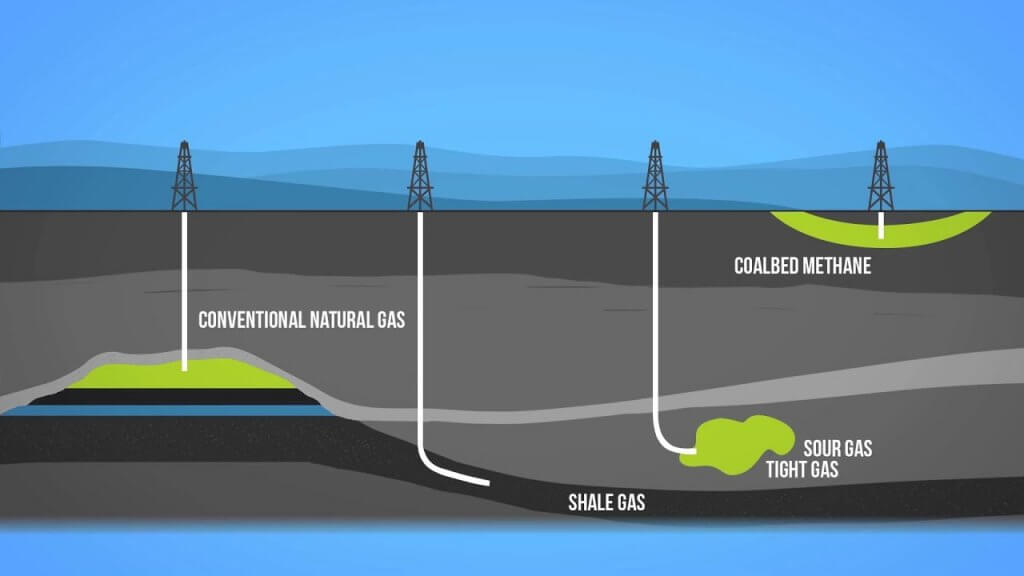
- Types by occurrence:
- Associated or wet gas occurs with oil, and its pressure can push oil to the surface.
- Non-associated or dry gas occurs in reservoirs without oil.
- Types by sulphur:
- Sour gas holds substantial hydrogen sulphide or other organic sulphur compounds.
- Sweet gas lacks hydrogen sulphide, and coalbed methane is the usual example.
- Smell: the gas itself is colourless and odourless. The sour smell at a stove comes from mercaptan compounds added so that leaks can be noticed.
- Trade: it is sold by calorific value, not volume. Deals are usually in MMBTU (million British thermal units), about 1,000 cubic feet of gas.
Formation
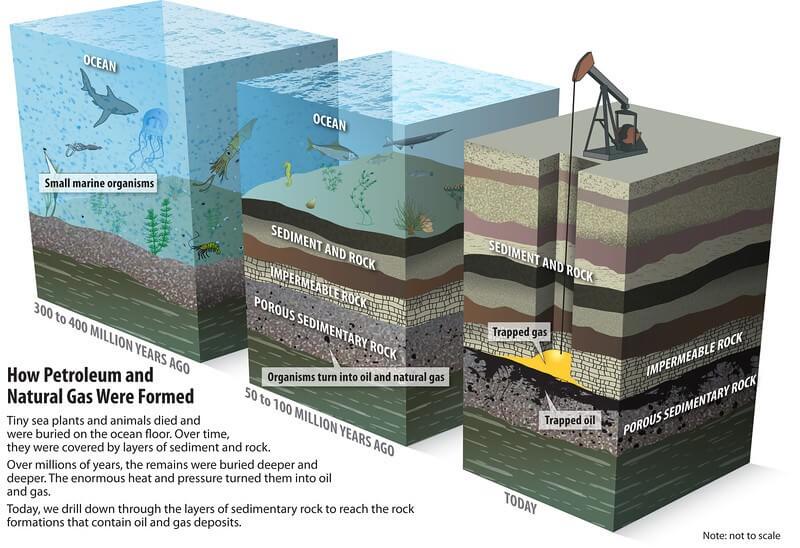
- Layers of decaying plant and animal matter were exposed to intense heat and pressure underground over millions of years.
- Energy that plants first took from the sun remains stored in the chemical bonds of the gas.
- In a well, gas lies above oil, so the drill generally meets gas first.
Beginnings in India
- Commercial production started late, in 1961. The industry grew out of gas finds in Assam and Gujarat in the 1960s.
- Gas Authority of India Limited (GAIL), formed in August 1984, gave the sector a strong push. Discoveries multiplied after 1985.
Uses of Natural Gas
- Early use: street and household lighting in the 19th and 20th centuries.
- Today: a wide range of domestic and industrial uses.
- Backing renewables: fast-starting gas turbines balance wind and solar power, which vary with weather.
- Household fuel: stoves, heaters, ovens and boilers.
- Compressed Natural Gas (CNG), stored at high pressure:
- Some households use it for heating and cooking.
- It is a cheap, cleaner fuel for low-load vehicles needing high fuel efficiency.
- Many buses and commercial fleets now run on it.
- Liquefied Natural Gas (LNG) powers off-road trucks and trains.
- Electric power generation.
- Industry: an ingredient in dyes and inks, and in rubber compounding.
- Fertiliser and chemicals: hydrogen from methane makes ammonia, the base of hydrogen cyanide, nitric acid, urea and many fertilisers.
Importance to India
| Sector | Older share (%) | 2024-25 share (%) |
|---|---|---|
| Fertiliser | about 40 | 31.35 |
| Road transport (mainly CNG) | – | 23.04 |
| Power | about 30 | 14 |
| Petrochemicals | – | 5.14 |
| Pipeline transport | – | 3.01 |
| Sponge iron | – | 2.04 |
| LPG shrinkage | about 10 | 1.41 |
- Older pattern: consumption was once dominated by fertiliser, power and LPG, which grew together with gas output. Output rose many times over after 1971.
- New pattern: road transport has grown fastest, so city gas now ranks close behind fertiliser.
- Gas in electricity:
- Gas stations once made up nearly 10% of India’s electricity capacity. On 31 March 2026, they had 20,122 MW, about 3.8% of the total.
- 4,400.84 MW of gas capacity was under outage then.
- Many plants have long stood idle or run below capacity for lack of cheap feedstock, as imported LNG is costly.
- Supply security:
- India’s oil reserves fall well short of its needs, and slow project clearances have added to the problem.
- A more diverse energy basket softens external shocks, and gas is a cleaner choice for replacing naphtha, fuel oil and coal.
- Share in the energy mix:
- Gas supplies about a quarter of global energy but far less in India: about 6% in older counts, and 7.12% of primary energy supply in 2024-25.
- The government’s target is 15% by 2030.
- Pricing: since April 2023, gas from old nomination fields has been priced at 10% of the Indian crude basket, within a floor and a ceiling. This followed the Kirit Parikh committee’s review.
Reserves, Distribution and Production
Distribution of Natural Gas
- Main areas: Gulf of Kachchh, Gulf of Khambhat, Bassein field, Mumbai High (Bombay High), Barmer in Rajasthan, Krishna-Godavari basin, Cuddalore district of Tamil Nadu, Odisha, Assam and Tripura.
- Recoverable reserves were about 700 BCM on 1 April 2003. Older estimates by area included:
- 541 BCM economically viable onshore, in Assam and Gujarat.
- 190 BCM offshore in the Gulf of Khambhat (Bay of Cambay), and 190 BCM in Bombay High.
- 400 BCM reported in the Tripura basin, and 72 BCM in the Ravva structure.
- Andaman and Nicobar Islands:
- Older estimates vary greatly, from a 1997 survey figure of 1,700 billion cubic feet to a remote-sensing figure of 1,700 BCM. Claims that this could meet India’s needs for 100 years remain unproved, and no reserve has been established.
- First confirmed occurrence: Oil India found gas in the Sri Vijayapuram-2 well, 17 km off the east coast of the islands, reported in September 2025. Samples were 87% methane, but the size of the pool and commercial viability remain undetermined.
- If proved, such gas could transform the economy of eastern India.
| Region | Reserves, 1 April 2025 (BCM) | Share (%) |
|---|---|---|
| Western Offshore | 348.70 | 32.50 |
| Eastern Offshore | 270.67 | 25.23 |
| Assam | 163.33 | 15.22 |
| Andhra Pradesh | 60.60 | 5.65 |
| Gujarat | 54.74 | 5.10 |
| West Bengal (coalbed methane) | 44.93 | 4.19 |
| Tamil Nadu | 38.39 | 3.58 |
| Tripura | 27.73 | 2.58 |
| Rajasthan | 27.12 | 2.53 |
| Madhya Pradesh (coalbed methane) | 23.15 | 2.16 |
| Others | 13.65 | 1.27 |
| Total | 1,073.01 | 100 |
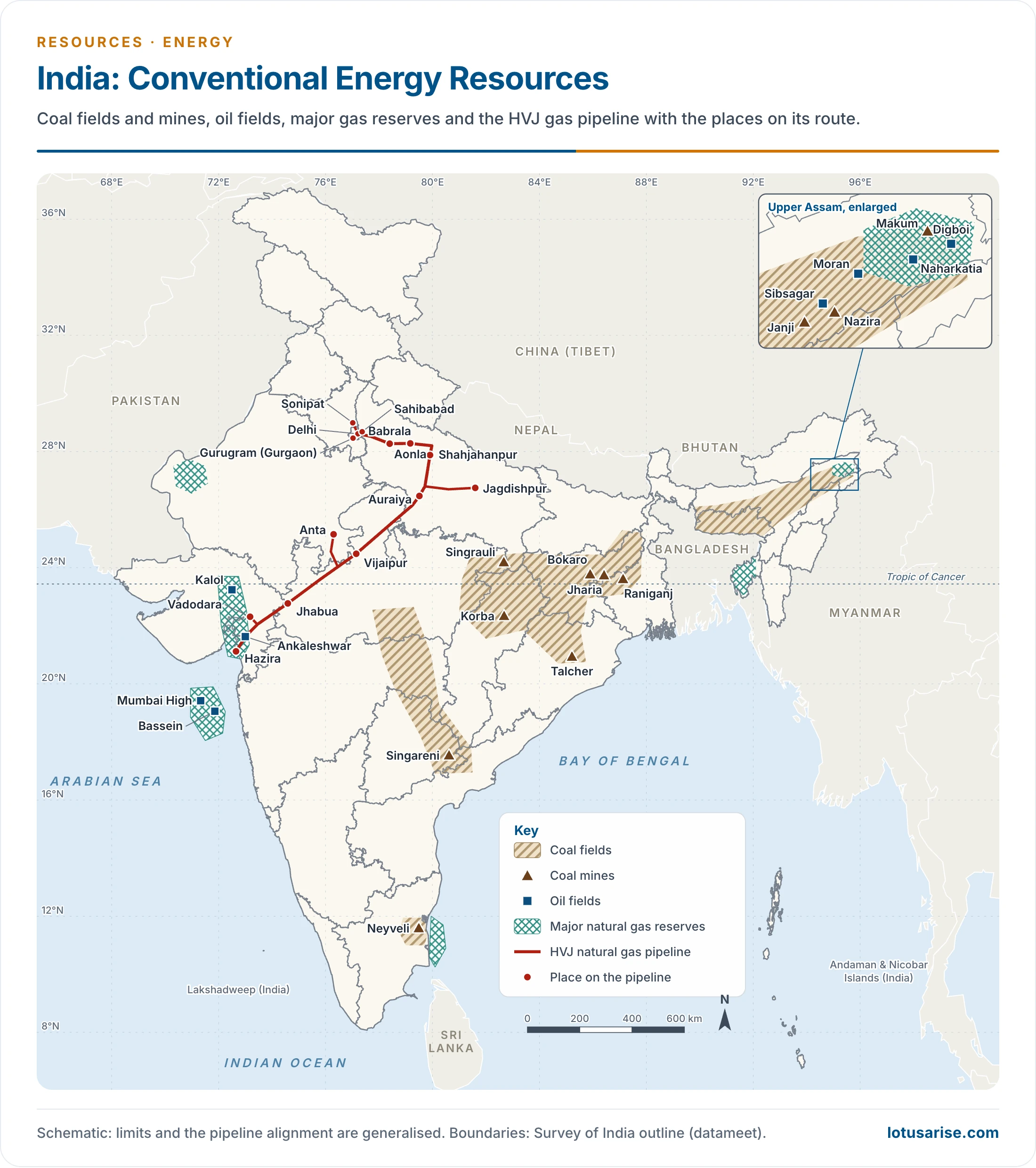
- This map shows only the original gas pipeline, with no eastern gas fields.
Some Milestones
- 1987: ONGC finds the Ravva field in the Krishna-Godavari basin.
- 1988: the South Bassein gas field starts production in September.
- 1988-89: major finds include oil at Cauvery offshore and Nanda in the Khambhat basin, and gas at Tanot in the Jaisalmer basin of Rajasthan.
- 1989-90: oil and gas structures at Adiyakkamangalam (Tamil Nadu), Andada (Gujarat), Khovaghat (Assam) and Lingla (Andhra Pradesh), and in Mumbai and Kachchh offshore.
- 2002: Reliance Industries finds gas in the deep waters of the Krishna-Godavari offshore, the D6 block.
- It was reported as the world’s largest gas find of 2002, comparable with finds in the Gulf and at Sakhalin Island.
- Reserves were put at 14 trillion cubic feet, with an expected 60–80 million cubic metres a day.
- Older accounts place it 200 km from Visakhapatnam, in water that made it India’s deepest exploration at the time.
- The block is geologically complex, shaped by the sand and silt of two great rivers.
- 2003: gas found with crude in Barmer, Rajasthan.
- 2004: Reliance strikes gas off the Odisha coast in June, with an estimated 4–5 trillion cubic feet.
- 2005: ONGC makes a major find in June, in shallow Krishna-Godavari waters south-west of Ravva, about 12 km from the Amalapuram coast.
- 2009 onward: the D1 and D3 fields start in April 2009 and reach about 61.5 million cubic metres a day in March 2010, before water and sand problems cut output.
- Output from the block averaged 24.8 million cubic metres a day in April–June 2026.
- 2025: the Andaman offshore occurrence.
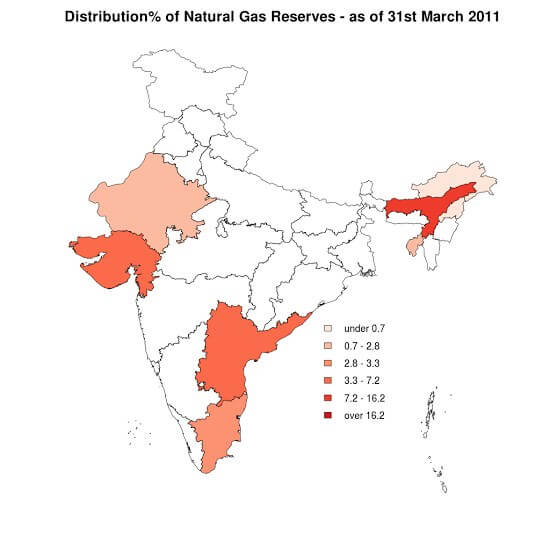
- This map shows State shares on 31 March 2011. It omits offshore areas, which hold most of the gas, and shows Andhra Pradesh undivided.
Production
- Trend: 46.58 BCM in 2011-12, 32.25 BCM in 2015-16, 28.67 BCM in 2020-21, 36.11 BCM in 2024-25 and 34.78 BCM in 2025-26.
- 2011-12 pattern: offshore 81.21%, Assam 5.85%, Gujarat 4.50%, Andhra Pradesh 2.93%, Tamil Nadu 2.74% and others 2.77%.
- Who produces, 2025-26: nomination fields of the national companies gave 21.58 BCM, and private and joint-venture fields 13.20 BCM.
- Gap and imports:
- LNG imports were 34.22 BCM in 2025-26, at a cost of $13.3 billion, and import dependence was 49.9%.
- West Asian conflict reduced LNG arrivals sharply in March 2026.
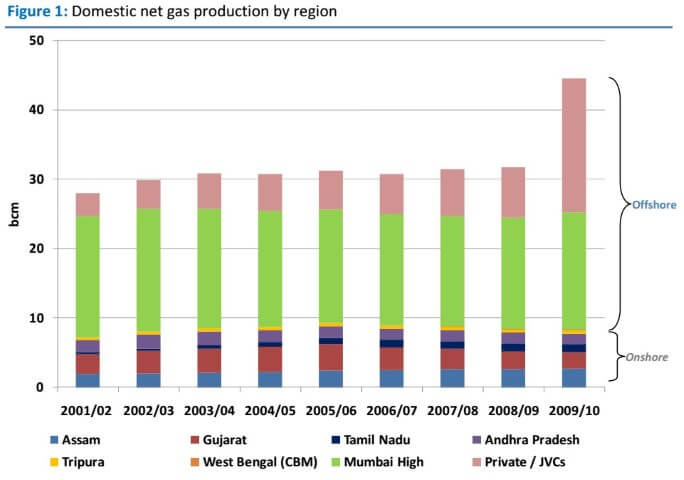
- This chart ends in 2009-10. Output reached 46.58 BCM in 2011-12 and fell to 34.78 BCM by 2025-26.
Companies, Pipelines and Terminals
Oil and Natural Gas Corporation (ONGC)
- ONGC is a Maharatna public sector undertaking under the Ministry of Petroleum and Natural Gas.
- Origin: it began as an oil and gas division of the Geological Survey in 1955, and became a commission in 1956. It became a corporation in the 1990s.
- Standing: it remains India’s largest oil and gas producer, with about 70% of domestic output in older counts. It has been listed as India’s highest profit-making company in the past (USD 5 billion), a rank that changes year to year.
- ONGC Videsh Ltd is its overseas arm, with a presence in about 15–16 countries, especially in Latin America, Africa, the Middle East, the CIS and the Far East.
- First overseas project: the Rostam and Raksh fields in Iran.
- First major oil find: the Lan Tay and Lan Do fields in Vietnam.
GAIL and Gas Pipelines
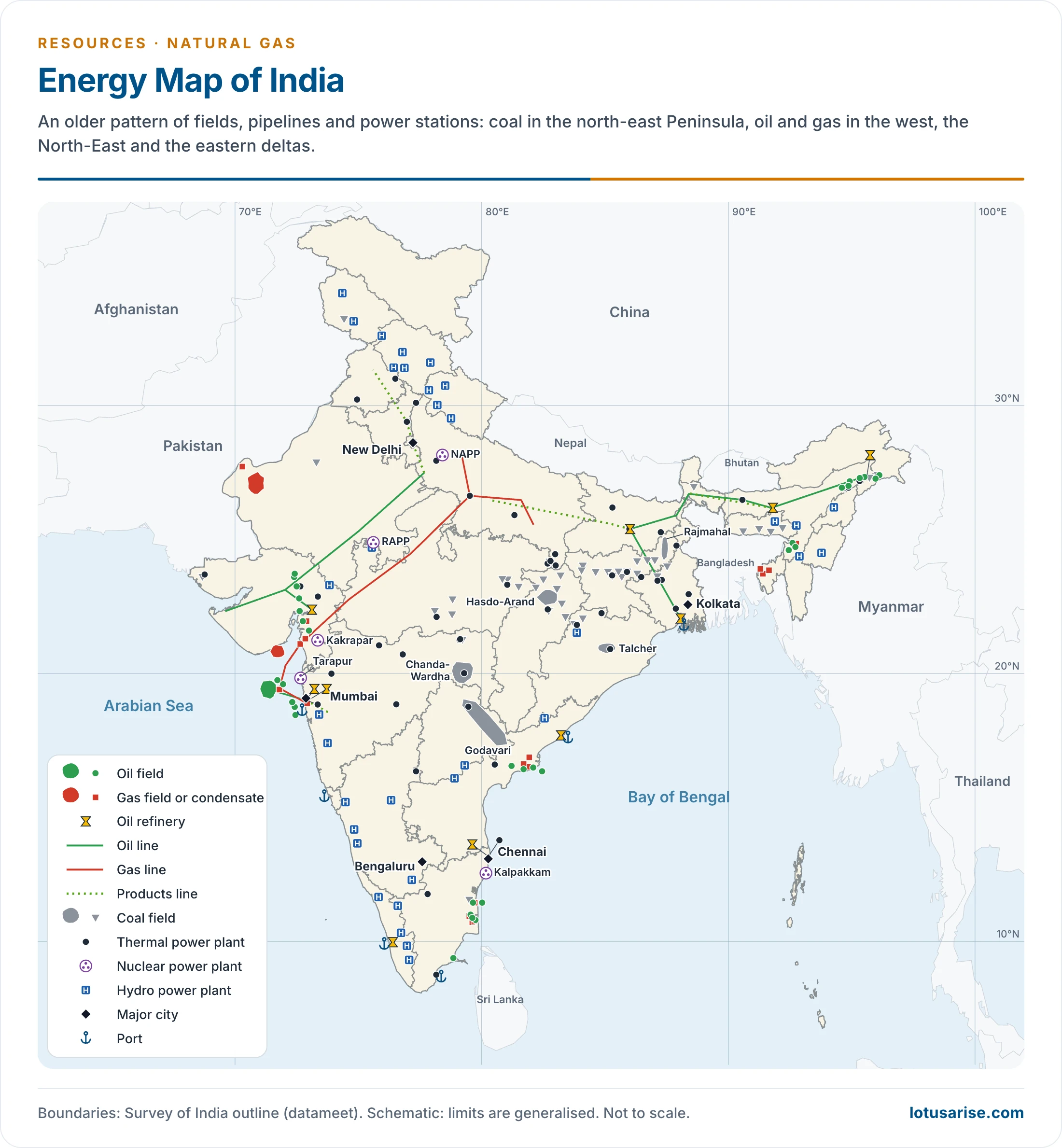
- GAIL was created to build the Hazira-Vijaipur-Jagdishpur (HVJ) pipeline, and is India’s largest gas transmission company.
- It has also joined city gas ventures such as Mahanagar Gas in Mumbai and Indraprastha Gas in Delhi.
- HVJ was India’s first cross-country gas line, about 1,750 km long and commissioned by 1991. Hazira lies in Gujarat and Vijaipur in Madhya Pradesh.
- It served power stations at Kawas, Anta and Auraiya, and fertiliser plants at Vijaipur, Sawai Madhopur, Jagdishpur, Shahjahanpur, Aonla and Babrala.
- National Gas Grid, 31 March 2026: total operational length, including tie-ins and dedicated lines, was about 27,905 km, with GAIL’s common-carrier network at 18,302 km.
- Major additions:
- Jagdishpur-Haldia-Bokaro-Dhamra (over 2,096 km), taking gas to eastern India.
- Kochi-Mangaluru (450 km), dedicated on 5 January 2021.
- North East Gas Grid (about 1,656 km), with Phase I opened on 13 March 2026.
- Regional impact: these lines carry gas to regions far from the coast, feeding fertiliser, power and city gas networks along the way.
- Cross-border projects:
- Iran-Pakistan-India: a 7,600 km plan, from which India withdrew around 2009, citing security and pricing.
- TAPI: Turkmenistan’s priority for 2026 is its Serhetabat-Herat section, and the line has yet to reach India.
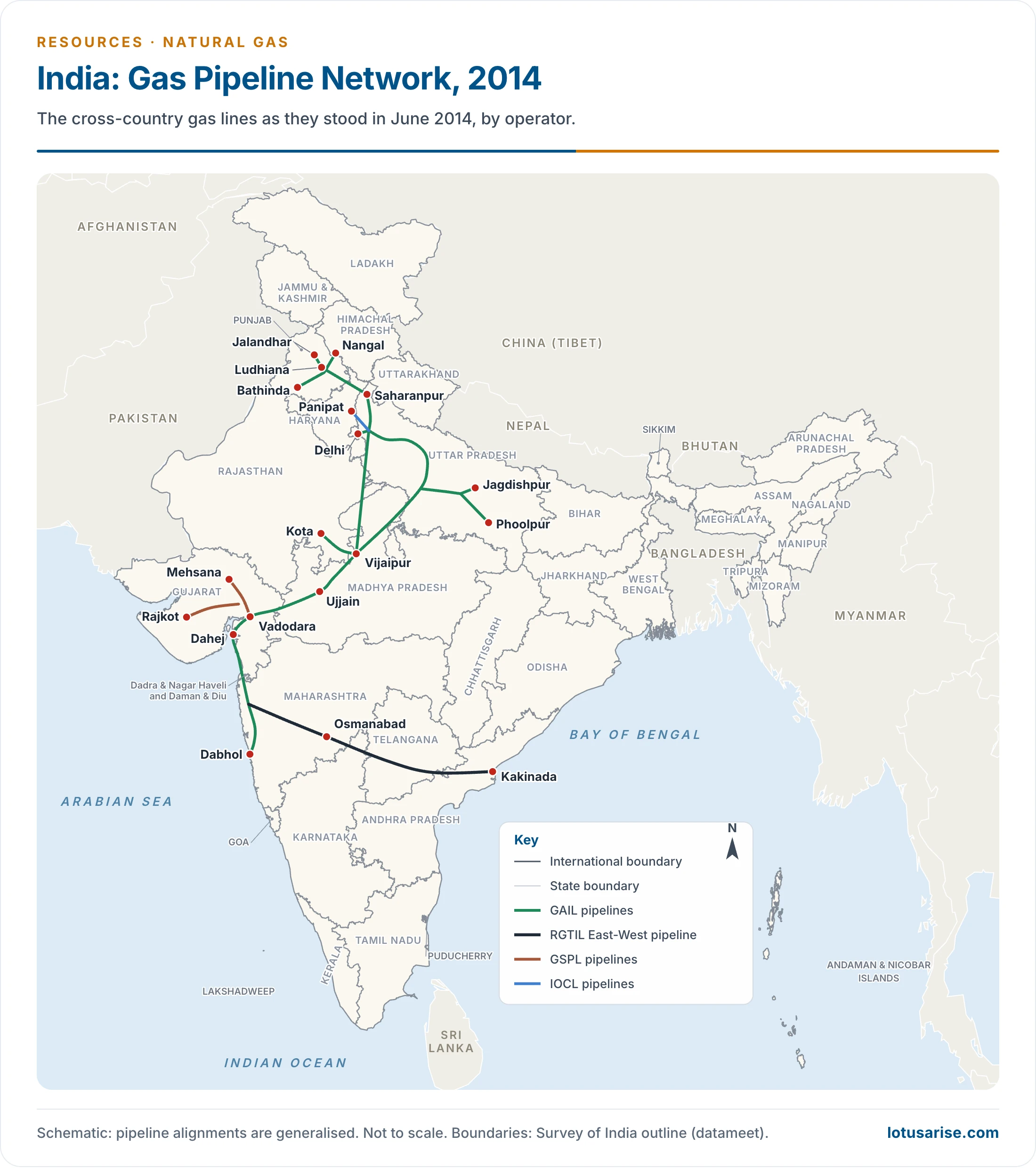
- This map shows the 2014 network. Jagdishpur-Haldia, Kochi-Mangaluru and the North East grid came later.
LNG Terminals
| Terminal | Promoter | Capacity, 1 September 2026 (million tonnes a year) |
|---|---|---|
| Dahej | Petronet LNG | 22.5 |
| Hazira | Shell Energy India | 6 |
| Dabhol | Konkan LNG | 5 |
| Kochi | Petronet LNG | 5 |
| Ennore | Indian Oil LNG | 5 |
| Mundra | GSPC LNG | 5 |
| Dhamra | Adani Total | 5 |
| Chhara | HPCL LNG | 5 |
| Total | 58.5 |
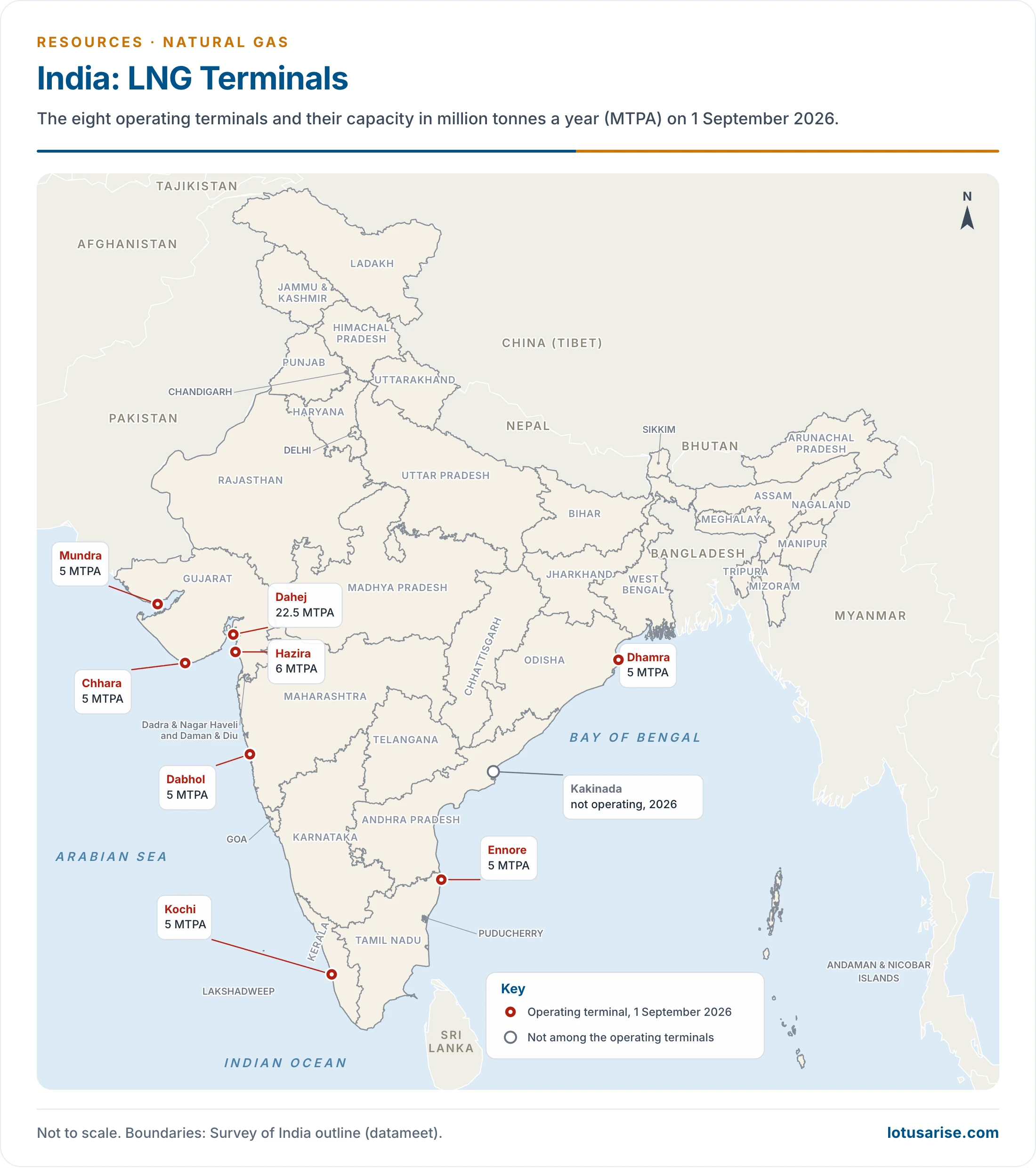
- Kakinada is not among the operating terminals of 2026.
Unconventional Gas
- Coalbed methane (CBM) is gas held in coal seams.
- Resources: prognosticated at 91.8 trillion cubic feet, with 12.1 trillion cubic feet established.
- Areas: the Gondwana coalfields, chiefly Raniganj and Jharia, and parts of Madhya Pradesh. Reserves stood at 44.93 BCM in West Bengal, 23.15 BCM in Madhya Pradesh and 5.67 BCM in Jharkhand on 1 April 2025.
- Output: small, at 347.22 million cubic metres in April–August 2026.
- Policy: 40 blocks have been awarded, and marketing and pricing freedom came in March 2017.
- Shale gas is trapped in fine-grained shale, and needs horizontal wells and fracturing.
- Resources: about 96 trillion cubic feet technically recoverable, by the US Energy Information Administration’s estimate. ONGC’s own 2013 estimate was 187.5 trillion cubic feet across five basins.
- Basins: Cambay, Krishna-Godavari, Cauvery, Ganga-Assam, Assam-Arakan and Damodar.
- Policy: guidelines for ONGC and Oil India came in October 2013. A pilot produced gas from Permian shales in the Damodar basin.
- Tight gas lies in low-permeability rock.
- Gas hydrates are ice-like methane compounds in deep seabed sediments.
- The National Gas Hydrate Programme drilled 21 sites in its first expedition, in 2006.
- Hydrates are established in the Krishna-Godavari, Mahanadi and Andaman deep waters. None yet produces commercially.
Previous Year Questions
2026Describe the role of energy pipelines in the industrial development and in reducing the regional imbalances in India.2018Explain the pipeline network across India and its impact on regional development.2014Map item: Hazira2002Discuss the oil and natural gas pipeline networks in India. Highlight their complementary role in regional development.





VERY HANDY MATERIAL…THANK U SO MUCH FOR A KIND HEARTED SIR AND WHOLE TEAM
Most Welcome, Imran S
Thank you for this information
Really inclusive article. Would prefer using some inputs for preparing my lectures for Oil executives