

- Lead and zinc occur together in India, and all mine output now comes from Rajasthan.
- India is self-sufficient in zinc, while lead falls short of demand and leans on recycling.
- Tungsten and pyrites have resources but no reported mine output. Tungsten is on India’s June 2023 list of 30 critical minerals.
Lead
- Free lead is scarcely known in nature. Galena, a cubic sulphide, is its only commercial source.
- Occurrence: in veins and masses in many crystalline rocks (schists), in Pre-Cambrian rocks and in Vindhyan limestones. It also occurs in calcareous slates and sandstones.
- Properties: malleable (it can be hammered into thin sheets), soft, heavy, and a poor conductor of heat. It is toxic.
- Uses:
- The largest single use in the world today is in lead-acid storage batteries, about 74%.
- A constituent of bronze alloy, and an anti-friction metal.
- Lead oxide goes into cable covers, ammunition, paints, glass making and the rubber industry.
- Sheets, tubes and pipes serve as sanitary fittings in buildings.
- Use in automobiles, aeroplanes and calculating machines has grown.
- Dyeing and printing use lead nitrate.
Lead Reserves
- Ores of lead occur at many places, including the Himalaya, Tamil Nadu, Rajasthan and Andhra Pradesh.
- Lead-zinc ore resources: 766.49 million tonnes (1 April 2020), against 685.59 million tonnes in an earlier estimate. Of these, 103.27 million tonnes (13.47%) are reserves.
- Metal content: 12.87 million tonnes of lead and 33.17 million tonnes of zinc. Reserves hold 1.90 million tonnes of lead and 7.44 million tonnes of zinc.
| State | Ore (million tonnes, 2020) | Share |
|---|---|---|
| Rajasthan | 684.66 | 89.32% |
| Andhra Pradesh | 22.69 | 2.96% |
| Madhya Pradesh | 19.07 | 2.48% |
| Bihar | 11.44 | 1.49% |
| Maharashtra | 9.27 | 1.20% |
- Smaller resources lie in Gujarat, Meghalaya, Odisha, Sikkim, Tamil Nadu, Uttarakhand and West Bengal.
Lead Mines
- Rajasthan’s share of output stood at about 94% in older counts. In 2023-24 it gave the whole of India’s lead concentrate, 3,80,800 tonnes.
- All mines are run by Hindustan Zinc Ltd, a private sector company.
- Zawar in Udaipur has long been a major producer. Debari, also in Udaipur, is known for its zinc smelter.
- Current mines:
- Rampura Agucha (Bhilwara), whose ore had the highest metal content in 2023-24, at 12.41%.
- Kayad (Ajmer).
- Rajpura Dariba and Sindesar Khurd (Rajsamand).
- Zawar group (Mochia, Balaria, Zawarmala, Baroi) in Udaipur.
- Older lists also name Dungarpur, Banswara and Alwar in Rajasthan, and Kurnool and Nalgonda in Andhra Pradesh and Telangana. None of these reported output in 2023-24.
Lead Trade
- Refined lead output was 216 thousand tonnes, 10th in the world in 2023.
- Shortfall: lead is in short supply against demand, and scrap recycling fills much of the gap.
- Globally about 56% of refined lead comes from recycled material, using about one-third of the energy of extraction from ore.
- The Battery Waste Management Rules, 2022 aim to bring more scrap into the organised sector.
Zinc
- The chief ore of zinc is sphalerite (ZnS), found in veins with galena, chalcopyrite, iron pyrites and other sulphide ores.
- Lead-zinc ores are mixed ores, containing both metals, and often silver and cadmium. Silver at Zawar comes as a by-product.
- Uses:
- Alloying, and above all galvanised sheets: galvanising is the largest single use, at about 50% worldwide.
- Zinc dust is used to prepare zinc compounds and salts.
- Zinc oxide goes into paints, ceramic material, inks and matches.
- Dry batteries, electrodes, textiles, die-casting, the rubber industry, and collapsible tubes for drugs and pastes.
- Zinc is the fourth most widely used metal in the world, after steel, aluminium and copper.
Zinc Reserves and Production
- Rajasthan gave more than 99% of output in older counts, and all of the zinc concentrate in 2023-24: 17,10,144 tonnes.
- The Zawar mines of Udaipur were long the main source. Rampura Agucha and Sindesar Khurd now lead. Some deposits also occur in Sikkim.
- Ore output was 16.52 million tonnes in 2023-24.
- Smelters at Chanderiya, Dariba and Debari make India 3rd in the world in slab zinc, with 817 thousand tonnes.
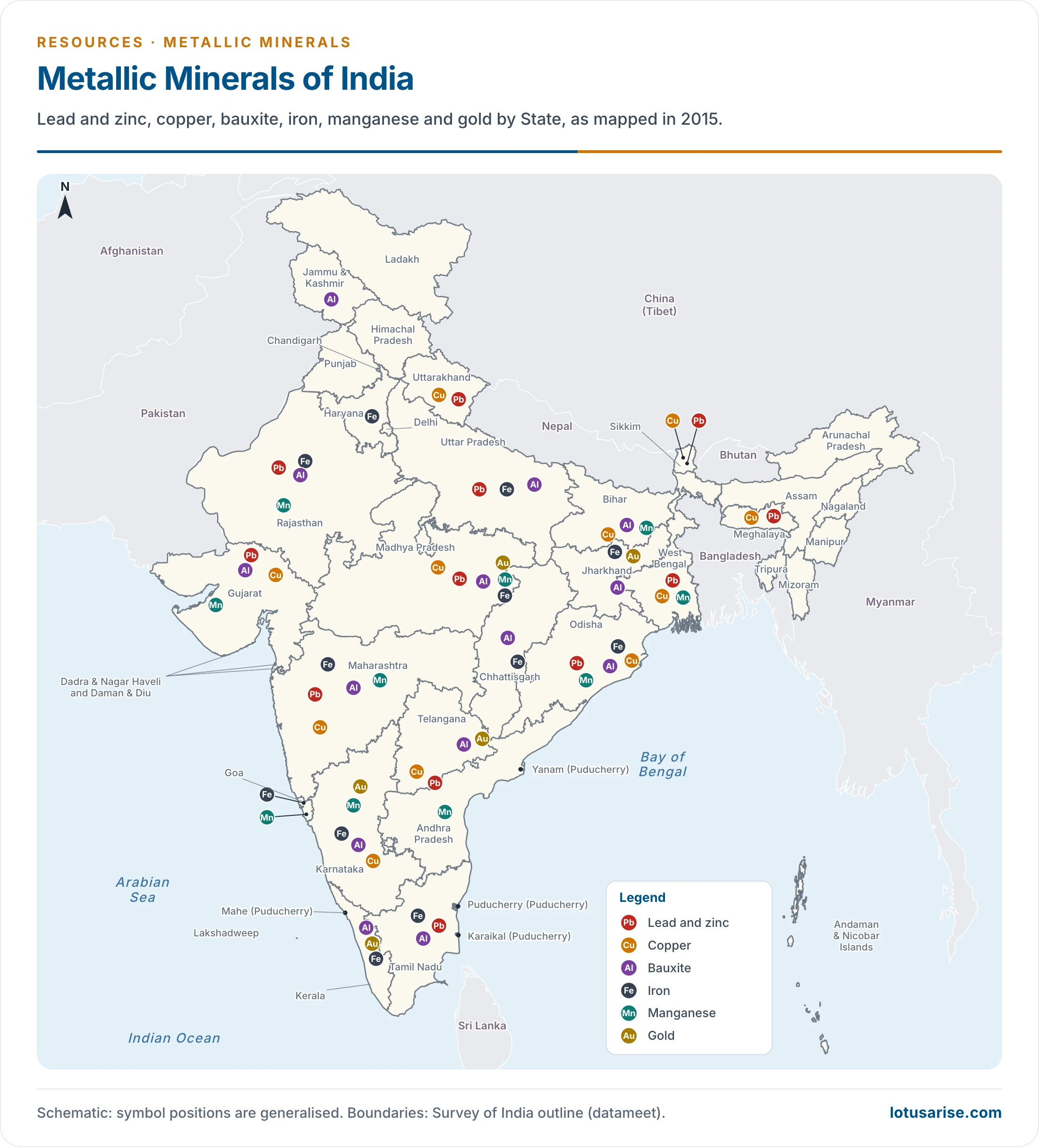
- This 2015 map shows lead and zinc in many States, but only Rajasthan reported output in 2023-24. Jammu and Kashmir and Ladakh have been separate Union Territories since the 2019 reorganisation.
Zinc Imports
- Older lists of zinc concentrate suppliers named the USA, Canada, Zimbabwe, Japan and Mexico, along with Australia, Peru, Russia and Zaire, now the Democratic Republic of the Congo.
- Imports of zinc ores and concentrates in 2023-24 were mainly from Malaysia (52%) and the USA (48%). Imports of zinc and alloys were 2,28,045 tonnes.
- Exports: 19,902 tonnes of ores and concentrates, mainly to the Republic of Korea, and 2,63,373 tonnes of zinc and alloys.
Tungsten
- Tungsten ore is a rock from which the element tungsten (wolfram) can be economically extracted.
- Ore minerals: wolframite [(Fe,Mn)WO₄], scheelite (CaWO₄) and ferberite, predominantly hydrothermal in origin.
- Properties:
- Its melting point of 3,422°C is the highest of all metals.
- It resists all acids at ordinary temperatures.
- Its most important property is the self-hardening it gives to steel.
- Uses:
- Classical accounts put over 95% of wolfram in the steel industry.
- It is used mainly as ferrotungsten in special and alloy steels. Ferrotungsten typically has 25–75% tungsten.
- Tungsten carbide, among the hardest synthetic materials, is now a second principal use, in cutting tools, mining and drilling.
- Tungsten steels make ammunition, armour plates, heavy guns and hard cutting tools.
- It alloys easily with chromium, nickel, molybdenum and titanium, giving hard-facing, heat-resistant and corrosion-resistant alloys.
- Other uses are electric bulb filaments, paints, ceramics and textiles.
Tungsten Resources
- Total: 89.43 million tonnes of ore, with 1,44,650 tonnes of WO₃ (1 April 2020), all in the remaining resources class. An earlier count was 87.4 million tonnes.
| State | Older share | Share, 2020 |
|---|---|---|
| Karnataka | 42% | 41% |
| Rajasthan | 27% | 27% |
| Andhra Pradesh | 17% | 17% |
| Maharashtra | 9% | 11% |
| Haryana, Tamil Nadu, Uttarakhand, West Bengal | 5% | 4% |
- Rajasthan holds most of the metal: 93,708 tonnes of the WO₃, against just 6,235 tonnes in Karnataka, whose ore is very low grade.
- Named occurrences:
- Degana in Rajasthan, with 0.09–1.62% WO₃, and Balda in Sirohi.
- Bankura in West Bengal, about 0.1%.
- Kuhi-Khobana-Agargaon belt in the Sakoli basin of Bhandara and Nagpur, Maharashtra.
- Kolar tailing dumps, and the Mysore gold mine as a potential source of scheelite.
- Production: no mining lease exists and no output was reported in 2023-24. Degana and Chendapathar in West Bengal once gave small quantities, but closed as uneconomic.
Tungsten Trade
- Domestic requirements are met entirely by imports.
- Imports: earlier mainly from Singapore, the USA and the UK. Ores and concentrates in 2023-24 came mainly from the Netherlands (78%), Lithuania (15%) and Canada (7%).
- Exports: earlier mainly to Germany, the USA, Israel, the UK, Japan and Sweden. Exports of tungsten and alloys, including scrap, fell to 624 tonnes in 2023-24.
- World (2023): China gave 72% of mine output and holds 52% of reserves.
Pyrites
- Pyrite, an iron sulphide (FeS₂), is brass-yellow. Rocks of nearly every age host it, crystalline and sedimentary alike.
- It is valued as a source of sulphur, not as an ore of iron.
- The high proportion of sulphur is injurious to iron. It is therefore removed and used to produce sulphur.
- Uses of sulphur:
- Sulphuric acid, which serves fertilizer, chemicals, rayon, petroleum and steel industries.
- Elemental sulphur goes into explosives, matches, insecticides and fungicides, and is used for vulcanising rubber.
Pyrites Distribution
- Main deposits: Amjhore in the lower Son Valley of Bihar; Chitradurga and Uttara Kannada in Karnataka; and pyrite-bearing coal and shale in Assam’s coalfields.
- It is widely scattered elsewhere:
- Sikar in Rajasthan; Salem, Coimbatore and the Nilgiri in Tamil Nadu; Shimla in Himachal Pradesh.
- The Khasi and Jaintia Hills in Meghalaya; Chhindwara in Madhya Pradesh; Bilaspur, Durg and Surguja in Chhattisgarh.
- Mayurbhanj and Sundargarh in Odisha; Garhwal and Almora in Uttarakhand; Jalpaiguri in West Bengal; Lower Subansiri in Arunachal Pradesh.
- Resources: 1,674 million tonnes (1 April 2020), with no reserves. An older figure was 85.48 million tonnes of recoverable reserves.
- Bihar has 94% and Rajasthan 5%.
- Low grade dominates, at 1,555 million tonnes.
- Production has collapsed: output of 1.4 lakh tonnes (1996-97) dwindled away, and the Indian Bureau of Mines records none since 2003.
- Sulphur today comes as a by-product of petroleum refineries and fertilizer plants, and sulphuric acid from metal smelters. India has no mineable elemental sulphur reserves.
- Native sulphur of about 0.21 million tonnes is estimated at Puga Valley in Ladakh.
Previous Year Questions
- No direct PYQ has been asked on this sub-topic yet.




Good
very informative