

- Bauxite is the principal ore of aluminium, and India has large resources of metallurgical grade.
- Output is dominated by Odisha (about 73% in 2023-24), and the east coast deposits of Odisha and Andhra Pradesh form the country’s main bauxite province.
Bauxite
- Strictly, bauxite is a rock rather than one mineral. Hydrated aluminium oxides dominate it, with iron oxide, silica and titania as minor constituents.
- It is a clay-like substance, pinkish, whitish or reddish according to its iron content. The name comes from Les Baux in France.
- Deposits are mainly associated with laterites and occur as cappings on hills and plateaus. The coastal areas of Gujarat and Goa are the exception.
- Uses: about 80% goes to aluminium. It is also an essential ore for refractory and chemical industries.
Production of Aluminium from Bauxite
- The industry has two segments, and each has its own location logic:
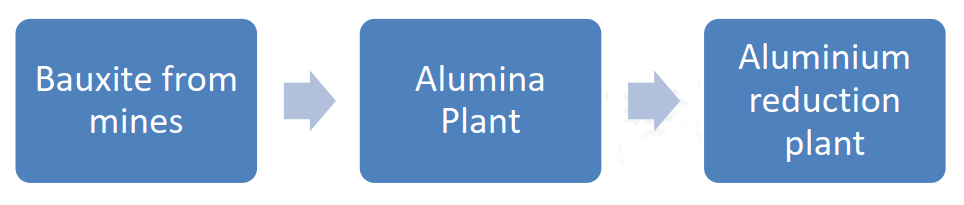
- Alumina plants extract alumina from bauxite and sit near the mines, because the ore loses much weight.
- Reduction plants turn alumina into aluminium and sit near cheap electricity, because reduction is power-hungry.
- Ratio: 1 ton of aluminium needs about 2 tons of alumina, which takes about 6 tons of bauxite.
- Refining (the Bayer process):
- The ore is treated with concentrated sodium hydroxide, which forms soluble sodium aluminate.
- The liquid is filtered, and aluminium hydroxide then separates from it on dilution.
- Strong heating of the hydroxide gives alumina.
Bauxite Reserves and Production
- Resources: 4,958 million tonnes (1 April 2020), up from 3,480 million tonnes in 2010. Of these, 646 million tonnes are reserves.
- By grade: about 79% is metallurgical grade, and refractory and chemical grades together are about 4%.
| State | Share of resources, 2010 | Share of resources, 2020 | Output, 2011-12 | Output, 2023-24 (million tonnes) | Share of output, 2023-24 |
|---|---|---|---|---|---|
| Odisha | 52% | 41% | 39.18% | 17.59 | 73.4% |
| Jharkhand | 4% | 6% | 14.22% | 2.04 | 8.5% |
| Gujarat | 7% | 8% | 6.55% | 1.64 | 6.9% |
| Maharashtra | 5% | 5% | 15.05% | 1.06 | 4.4% |
| Chhattisgarh | 5% | 20% | 18.35% | 1.03 | 4.3% |
| Madhya Pradesh | 4% | 4% | 4.99% | 0.60 | 2.5% |
| Andhra Pradesh | 18% | 12% | – | – | – |
- Output: 23.97 million tonnes in 2023-24, and 24.71 million tonnes in 2024-25 (provisional). It was just 1.93 million tonnes in 1980-81.
- World rank: India was 6th in 2023, with about 6% of output, behind Guinea (30%), Australia (25%), China (16%), Brazil (8%) and Indonesia (7%).
- NALCO is the leading miner, with 31% of output. Public sector mines give about 46%.
Bauxite Distribution (Mining Centres) in India
Odisha
- Odisha (Orissa until 2011) is the largest producer. Older counts put its share at about 50% and at more than a third, and it reached about 73% in 2023-24.
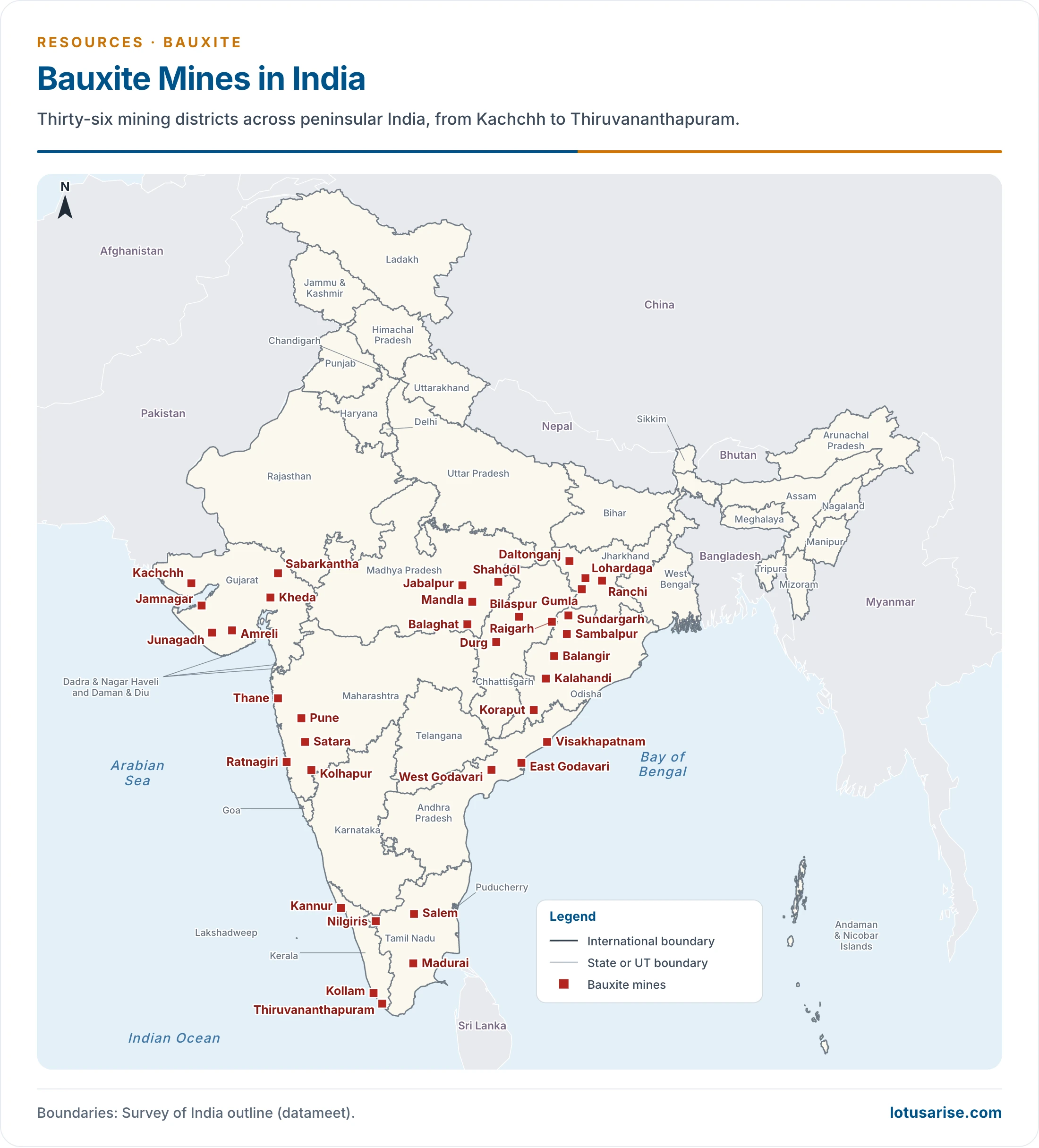
- The main belt lies in Kalahandi, Koraput and Bargarh, continuing into Andhra Pradesh, and no other bauxite tract in India is as large.
- Its dimensions: about 300 km by 40–100 km, at 950–1,300 metres above sea level.
- Main deposits: Kalahandi, Koraput, Rayagada, Sundargarh, Bolangir and Sambalpur.
- Two very large high-grade deposits:
- Panchpatmali (Koraput), considered the largest in India, is mined by NALCO and feeds its alumina refinery at Damanjodi.
- Gandhamardan (Bargarh) drew a lease to BALCO in the 1980s. A local movement forced the plan to be abandoned, and the State said in November 2024 that it had no plan for mining there.
- Other mining areas named in Kalahandi and Koraput are Chandgiri, Baphlimali, Kathakal, Manjimali, Pasenmali, Kunnumali, Kodingandi and Pottangi.
Gujarat
- Its share has moved a good deal: second largest with over 15% in older counts, 6.55% in 2011-12, and 6.9% in 2023-24, when it ranked third.
- The chief deposits form a strip of 48 km by 3–4.5 km, from the Gulf of Kachchh to the Arabian Sea, through Bhavnagar, Junagadh and Amreli.
- It also produces from Jamnagar, Kheda, Kachchh and Sabarkantha.
- Gujarat held about 85% of national mine-head stocks at the end of 2023-24, nearly all of cement grade.
Jharkhand
- Second in output in 2023-24 (8.5%). The Jharkhand resource figure has risen from an older 63.5 million tonnes of recoverable bauxite to 289 million tonnes (2020).
- Bauxite spreads widely over Ranchi, Lohardaga, Palamu and Gumla, with lesser amounts in Dumka and Munger.
- Lohardaga and its surroundings hold the best ore.
Other Areas of Bauxite Production
- Maharashtra: the largest deposits are in Kolhapur, capping the plateau basalts, with alumina at 52–89% in Udgeri, Dhangarwadi, Radhanagari and Inderganj. Thane, Ratnagiri, Satara and Pune also have deposits.
- Chhattisgarh: the Maikala range in Bilaspur and Durg, and the Amarkantak plateau of Surguja, Raigarh and Bilaspur, have rich deposits. It now holds 20% of resources.
- Tamil Nadu: Nilgiri and Salem gave slightly more than 2% of India’s bauxite in older counts. No output was reported in 2023-24.
- Madhya Pradesh: the Amarkantak plateau, the Maikala range through Shahdol, Mandla and Balaghat, and Katni (formerly part of Jabalpur district).
- Smaller sources:
- Andhra Pradesh: Visakhapatnam, East Godavari, West Godavari.
- Keralam (Kerala): Kannur, Kollam, Thiruvananthapuram.
- Rajasthan: Kota.
- Uttar Pradesh: Banda, Lalitpur, Varanasi.
- Jammu and Kashmir: Jammu, Poonch, Udhampur.
- Goa and Karnataka have minor output.
Trade in Bauxite
- As much as 80% of bauxite goes to aluminium, so home demand has kept reducing the surplus for export.
- Older buyers: Italy (60%), the UK (25%), Germany (9%) and Japan (4%).
- Exports in 2023-24 were 164 thousand tonnes, mainly to Nepal (67%) and Kuwait (31%).
- Imports in 2023-24 were 4.49 million tonnes, with Guinea at 96%. India’s refineries now buy ore abroad in spite of the large domestic resource.
Aluminium Plants in India
- The aluminium industry had 41.45 lakh tonnes of smelter capacity and 74.75 lakh tonnes of alumina capacity in 2023-24. It produced 4,159 thousand tonnes of aluminium, 2nd in the world.
| Plant | State | Company | Smelter capacity, 2023-24 (thousand tonnes) |
|---|---|---|---|
| Jharsuguda | Odisha | Vedanta | 1,750 |
| Korba | Chhattisgarh | BALCO | 590 |
| Angul | Odisha | NALCO | 460 |
| Renukoot | Uttar Pradesh | Hindalco | 410 |
| Aditya | Odisha | Hindalco | 360 |
| Mahan | Madhya Pradesh | Hindalco | 359 |
| Hirakud | Odisha | Hindalco | 216 |
Renukoot
- Hindalco’s largest aluminium plant, in Uttar Pradesh.
Hirakud
- The plant stands by the Hirakud Dam, 320 km from Bhubaneswar in Odisha.
- The dam has often been called the longest earthen dam in the world. Its main section is 4.8 km long, and it runs 25.8 km with its dykes.
- Indal set it up in 1959, as India’s second aluminium smelter, operating on grid power. Indal merged into Hindalco in 2004.
Alupuram
- This Hindalco smelter in Ernakulam district, Kerala, produced India’s first aluminium ingot, in 1943.
- The smelter was de-energised in August 2003, and the extrusion unit still runs.
Angul
- The National Aluminium Company Ltd (Nalco) runs this smelter in Odisha. It draws alumina from Damanjodi.
Korba
- The Bharat Aluminium Company Ltd (Balco) plant is in Chhattisgarh.
- It was set to reach 1 million tonnes a year, and was billed as the largest single-location plant in the world. Its capacity in 2023-24 was 590 thousand tonnes, and Jharsuguda is now far larger.
Mettur
- The Madras Aluminium Company Ltd (Malco) plant lies in the Mettur Dam complex, Tamil Nadu.
- Its smelter has been closed since December 2008.
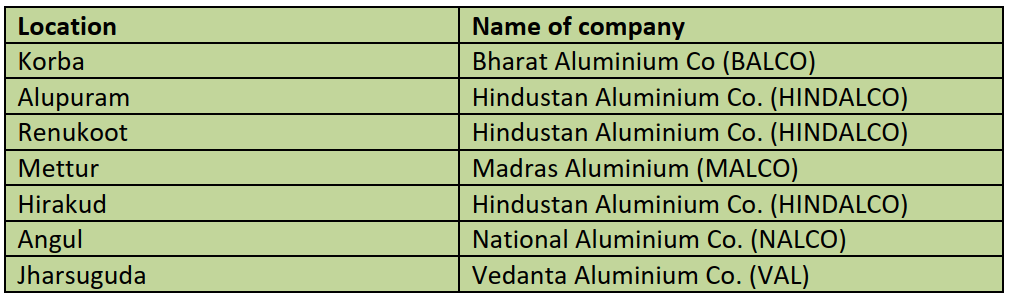
- Malco’s Mettur smelter and Hindalco’s Alupuram smelter in this table no longer produce metal.
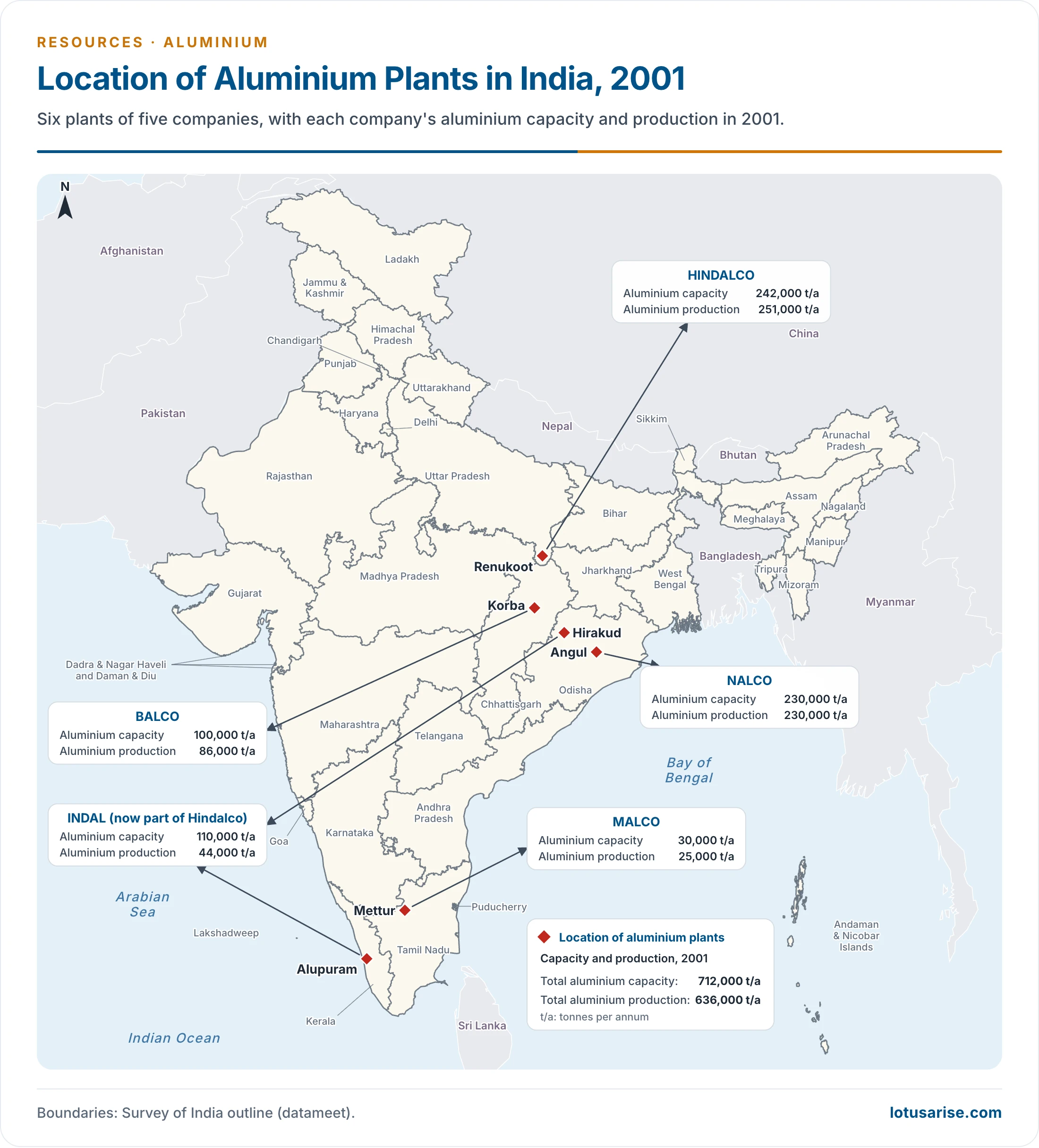
- The capacities on this map are for 2001, when the total stood at 7.12 lakh tonnes. Capacity was 41.45 lakh tonnes in 2023-24, and INDAL is now part of Hindalco.
Previous Year Questions
1998Examine the patterns of distribution and mode of exploitation of bauxite in India.




I am searching something on google and landed up here. Nice article. I gone through this website.
So kind of you
Thankyou for making this opensource
Thank you so much LOTUS ARISE! You did a great job. These readings are so informative.
This is great work. Please keep sharing more of such stuff.
Thanku
Keep Reading
i am in love with this website .
Keep Reading
Thanku sir
Best article
Fall in love with lotusarise
Thanks for your kind words 😊
Your content is very good and free of cost but some coaching institutes directly copy your content and sell this as notes
One of such institute is @live3gurukul Ranchi