

- The atmosphere is the envelope of gases held to the Earth by gravity; the air we breathe today is the third atmosphere the planet has had.
- None of it is left over from the planet’s birth. It was released from the Earth’s interior by volcanism and then reworked by life, chiefly by photosynthesis.
- The story runs from a hydrogen–helium envelope (lost), through a volcanic CO₂–water–nitrogen atmosphere (secondary), to the nitrogen–oxygen atmosphere of today (biogenic).
- Venus kept a thick CO₂ atmosphere and Mars lost most of its air. The Earth’s air is unique because liquid oceans and life removed CO₂ and added oxygen.
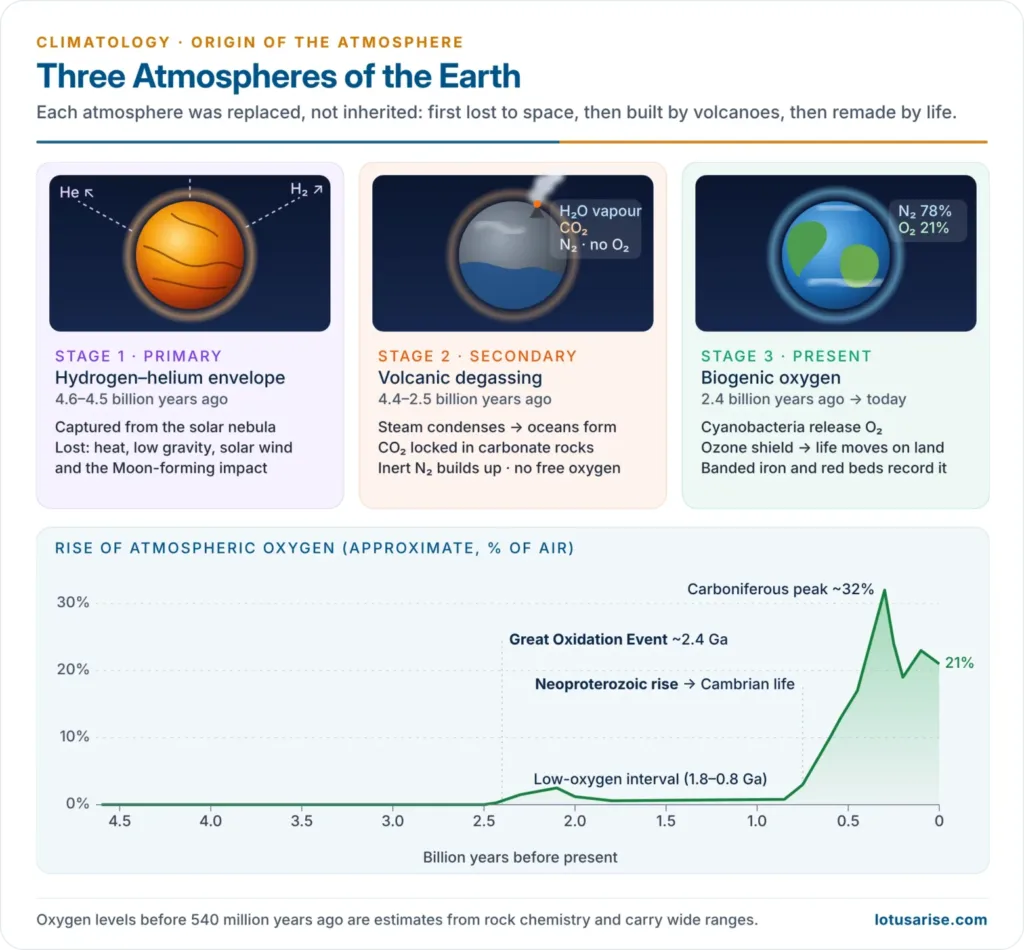
Stages in the Evolution of the Atmosphere
Primary Atmosphere: Hydrogen and Helium (about 4.6–4.5 billion years ago)
- The Earth accreted from the solar nebula about 4.54 billion years ago, and its first gaseous cover was hydrogen (H₂) and helium (He) captured from that nebula.
- This primary atmosphere was lost early:
- Light, fast molecules: H₂ and He move fast enough at high temperature to reach escape velocity.
- Solar wind of the young, active Sun swept the gases away before a strong magnetic field had formed.
- The Moon-forming giant impact (about 4.5 billion years ago) heated and stripped the early envelope.
- Evidence: noble gases such as neon are far scarcer on Earth than in the Sun. A captured atmosphere would have kept them in solar proportions.
- Differentiation of the molten Earth sent iron to the centre and formed the core. The convecting core later generated the geomagnetic field, which now shields the atmosphere from erosion by the solar wind.
Secondary Atmosphere: Degassing (about 4.4–2.5 billion years ago)
- As the crust solidified, gases trapped in the interior escaped through countless volcanoes and fissures. This process is called degassing (outgassing).
- Main gases: water vapour (most abundant), carbon dioxide (CO₂) and nitrogen (N₂).
- Lesser gases: sulphur dioxide, hydrogen sulphide, carbon monoxide, hydrogen and some methane.
- Comets and water-rich meteorites added further volatiles during late bombardment.
- The oceans formed when the surface cooled below the boiling point and the water vapour condensed and fell as rain for long periods.
- Zircon crystals about 4.4 billion years old from Western Australia indicate that liquid water existed very early.
- The oceans then began to draw down CO₂:
- CO₂ dissolved in sea water and reacted with weathered rock to form carbonate rocks (limestone). This is the carbonate–silicate cycle, still the planet’s long-term thermostat.
- Nitrogen, chemically inert and poorly soluble, accumulated and became the dominant gas.
- The early atmosphere had no free oxygen, so it was a reducing (anoxic) atmosphere.
- Evidence: rocks older than about 2.4 billion years contain detrital pyrite and uraninite, minerals that cannot survive weathering in oxygenated air.
- Faint young Sun paradox: the young Sun was only about 70% as bright as today, yet the oceans did not freeze.
- Carl Sagan and George Mullen (1972) explained this by a strong greenhouse effect of CO₂ (and probably methane) in the secondary atmosphere.
Tertiary (Present) Atmosphere: Biogenic Oxygen (from about 2.4 billion years ago)
- Cyanobacteria (blue-green algae) developed oxygenic photosynthesis, possibly by 3.0–2.7 billion years ago, splitting water and releasing O₂:
- 6CO₂ + 6H₂O + sunlight → C₆H₁₂O₆ + 6O₂
- For hundreds of millions of years the oxygen produced was consumed by sinks:
- Dissolved ferrous iron in the oceans was oxidised and precipitated as banded iron formations (BIFs). India’s iron ores of Singhbhum–Keonjhar (Odisha–Jharkhand) and Bailadila (Chhattisgarh) belong to this family.
- Reduced volcanic gases also absorbed oxygen.
- Great Oxidation Event (GOE), about 2.4–2.1 billion years ago: once the sinks were saturated, free O₂ began to accumulate in the air.
- Evidence: red beds (iron-oxide-stained continental sediments) appear, detrital pyrite disappears, and sulphur-isotope signatures of an oxygen-free atmosphere vanish about 2.4 billion years ago.
- Oxygen was toxic to the anaerobic organisms of the time, which retreated to oxygen-free niches.
- A long low-oxygen interval (about 1.8–0.8 billion years ago) followed, with oxygen only a small fraction of today’s level.
- Neoproterozoic Oxygenation Event (about 800–540 million years ago): oxygen rose towards modern levels, setting the stage for the Cambrian explosion of animal life (about 540 million years ago).
- Lloyd Berkner and Lauriston Marshall (1965) tied biological milestones to oxygen thresholds:
- about 1% of the present level for aerobic respiration and the spread of marine life
- about 10% for an ozone shield strong enough to allow life on land
The Ozone Shield and Life on Land
- Ultraviolet rays split some O₂ molecules into single oxygen atoms. These atoms join other O₂ molecules to form ozone (O₃):
- O₂ + UV → O + O
- O + O₂ → O₃
- Ozone absorbs ultraviolet radiation (wavelengths about 200–315 nm) that is lethal to cells and DNA. As oxygen rose, the ozone layer thickened in the stratosphere.
- Until the shield was effective, life was confined to water, which also absorbs UV. With it, plants colonised land by about 470 million years ago (Ordovician), followed by animals.
- Oxygen has not stayed constant since:
- It peaked at about 30–35% in the Carboniferous (about 300 million years ago), when giant insects flourished and coal-forming forests buried huge amounts of carbon.
- It has settled near 21% in recent geological time.
The Atmosphere as a Product of Life
- The modern atmosphere is a dynamic balance, not a fixed inheritance:
- Photosynthesis adds O₂ and removes CO₂.
- Respiration, decay and combustion do the reverse.
- Rock weathering and ocean uptake lock carbon away over long periods, and volcanoes return it.
- Nitrogen (about 78%) is the residue of degassing kept by its inertness. Oxygen (about 21%) is almost entirely biological. Argon comes from the radioactive decay of potassium-40 in the crust.
- James Lovelock’s Gaia hypothesis (1970s) used this chemical disequilibrium to argue that life regulates the atmosphere. The idea is debated, but it captures the role of the biosphere.
- The human imprint: CO₂ has risen from about 280 ppm before industrialisation to about 430 ppm (2025–26). That is the highest level in at least 800,000 years of ice-core record, and the human era now rivals volcanism and weathering as a control on the atmosphere’s make-up.
| Stage | Approximate time | Main gases | Source | Fate or key change |
|---|---|---|---|---|
| Primary | 4.6–4.5 billion years ago | H₂, He | Captured from solar nebula | Lost to space |
| Secondary | 4.4–2.5 billion years ago | H₂O, CO₂, N₂ (no free O₂) | Volcanic degassing, comets | Oceans formed; CO₂ locked in carbonates |
| Tertiary | 2.4 billion years ago to present | N₂, O₂, Ar, traces of CO₂ | Photosynthesis, inert N₂ build-up | GOE; ozone layer; life on land |
Previous Year Questions
- No direct PYQ has been asked on this sub-topic yet.





very nice…thank you
More details related to the origin and evolution of the atmosphere is required.
This is what called content…
Thank you so much for this 🤗
Awesome Content ❤
Very helpful
thank u very much
👍👍👌👌🥰🥰
As a Geography teacher we may have content but we have to get proper order and chronology in order to make students comfortable, so really this content gave me strength and confidence to guide students about given topic. 🙏🙏🙏
Please provide economy notes also
nice job