

Schools of Buddhism: Pratītyasamutpāda; Kṣaṇikavāda, Nairātmyavāda
Official Syllabus: Paper I, Section B, Unit 14
Yogācāra, also called Vijñānavāda (“the doctrine of consciousness”), is the idealist school of Mahāyāna Buddhism. Its central claim is vijñapti-mātratā — “representation-only” or citta-mātra, “mind-only“: what we take to be an external world of independent material objects is really a projection of consciousness. The school does not deny experience; it denies that objects exist outside and independently of the experience of them. To explain why we nevertheless experience an orderly, shared world, it introduces the storehouse-consciousness (ālaya-vijñāna), which holds the seeds (bīja) of past actions that ripen into experience; to explain how illusion and liberation work, it teaches the three natures (trisvabhāva). Founded by Maitreyanātha, Asaṅga and Vasubandhu (4th–5th century CE), and continued by Dignāga and Dharmakīrti, it was attacked by the realists — above all Śaṅkara and Kumārila — and by its Mahāyāna rival, the Mādhyamika.
In simple words
In a dream you walk through a market, smell food, talk to a shopkeeper, feel afraid of a dog. While dreaming, all of it seems out there — solid, separate from you, obeying its own rules. On waking you realise that the market, the shopkeeper and the dog were made of mind all along. Yogācāra asks a disturbing question: what if waking experience is like this too — orderly, shared, convincing, and yet mind-made?
Context & Problem
Where Yogācāra Came From
- From meditation. The name means “practice of yoga“. Meditators found that the objects of deep concentration — coloured discs, visualised Buddhas — are produced by the mind, yet appear vividly external. The Yogācāras “came to realise the sole reality of mind… dispelling all belief in the external world“. (Another explanation: they combined critical inquiry (yoga) with good conduct (ācāra).)
- From the Sautrāntika. If all we ever perceive are mental images (Article 7), and we can never check them against the originals, the “external object” becomes an idle hypothesis. Dropping it gives idealism.
- Against the Mādhyamika. The Mādhyamikas held that everything, mind included, is empty of own-nature. The Yogācāras replied that the mind cannot be unreal: “for then all reasoning and thinking would be false, and the Mādhyamikas could not even establish that their own arguments were correct. To say that everything, mental or non-mental, is unreal is suicidal.” (Compare Descartes: denying one’s own thinking is self-refuting.)
- Texts. The Laṅkāvatāra Sūtra and Saṃdhinirmocana Sūtra; Asaṅga’s Yogācārabhūmi and Mahāyānasaṃgraha; Vasubandhu’s Viṃśatikā (Twenty Verses), Triṃśikā (Thirty Verses) and Trisvabhāvanirdeśa; Dignāga’s Ālambanaparīkṣā (“Examination of the Object”).
The Problem It Addresses
- Is the external world real? Common sense and the realist schools say yes. Yogācāra asks: what evidence do we have of an object apart from our consciousness of it?
- If not, why is experience so orderly? Why do objects appear at fixed places and times, why do many people see the same thing, and why does the world resist our wishes? Any idealism must answer these questions.
Core Doctrine
1. Vijñapti-mātratā: Consciousness Only
- The thesis. “Mind is the only reality. Things that appear to be outside the mind — our body as well as other objects — are merely ideas of the mind.” The mind is “a stream of different kinds of ideas” (momentary, not a soul).
- What is denied and what is not. “The school does not deny experience; it denies the objective reality of external matter.” Blue, hardness, the shopkeeper’s face — all are really experienced; what is unreal is their existence as independent, mind-external substances.
- Subject and object as two faces of one consciousness. Ordinary knowing assumes “I, the subject, know that, the object”. In reality “both subject and object are just two aspects of the same consciousness-event“: the grasper (grāhaka) and the grasped (grāhya) arise together from the same seed.
- Positive emptiness. Yogācāra accepts emptiness, but gives it a positive sense: emptiness is the absence of subject–object duality; what remains is non-dual awareness (advaya-jñāna).
2. The Arguments Against the External World
(a) The Argument from Simultaneous Apprehension (Sahopalambha-niyama)
- Dharmakīrti: “Blue and the consciousness of blue are not different, because they are invariably apprehended together” (sahopalambha-niyamād abhedo nīla-tad-dhiyoḥ).
- The reasoning.
- We never find blue without the awareness of blue.
- “It cannot be shown that the object is different from the consciousness of the object.”
- What is always found together and never found apart cannot be shown to be two.
- “Though really one, they appear as two owing to illusion, just as the moon appears as two owing to defective vision.”
- Conclusion. “As an object is never known without the consciousness of it, the object cannot be proved to have an existence independent of consciousness.”
(b) The Argument from Atoms (Neither One Nor Many)
- An external object, if real, must be either partless (an atom) or composite (made of parts).
- Atoms cannot be perceived — they are too small.
- A composite cannot be perceived as a whole, “because it is not possible to perceive simultaneously all the sides and parts of the object”.
- Nor part by part: if the parts are atomic they are too small; if they are composite, the problem repeats.
- Vasubandhu’s sharper form. Can partless atoms combine? If an atom touches others on its six sides, it has six parts — and is not partless. If it touches them with its whole self, all the atoms occupy one point, and no extended body can be built. So atoms are impossible, and so is matter made of atoms.
- No such problem for consciousness: “the question of parts and whole does not arise with regard to consciousness”.
(c) The Argument from Time
- If the object is external and momentary, consciousness of it must arise before, after, or together with it:
- Not before — there is nothing yet to be conscious of.
- Not after — the momentary object “vanishes as soon as it arises“, so there would be no present object to perceive.
- Not together — the object is supposed to be the cause of the consciousness, and a cause cannot be simultaneous with its effect.
- So “perception of present objects… remains unexplained if objects are supposed to be external to the mind”. (This turns the Sautrāntika’s own time-lag argument against it.)
(d) The Argument from Dreams, Illusions and Hallucinations
- “Just as in dreams and hallucinations a man fancies to perceive things outside, though they do not really exist there, similarly the objects which appear to be out there are really ideas in the mind.”
- A person with diseased eyes sees hairs or flies in the air, or a double moon: vivid appearances with no external object.
Vasubandhu’s Four Objections and Replies (the Twenty Verses)
| Realist objection | Vasubandhu’s reply |
|---|---|
| 1. Spatial determination — objects appear only in certain places (the mountain is always there) | In dreams too, things appear in definite places — a dream-city has its streets |
| 2. Temporal determination — they appear only at certain times | In dreams too, things appear at definite times |
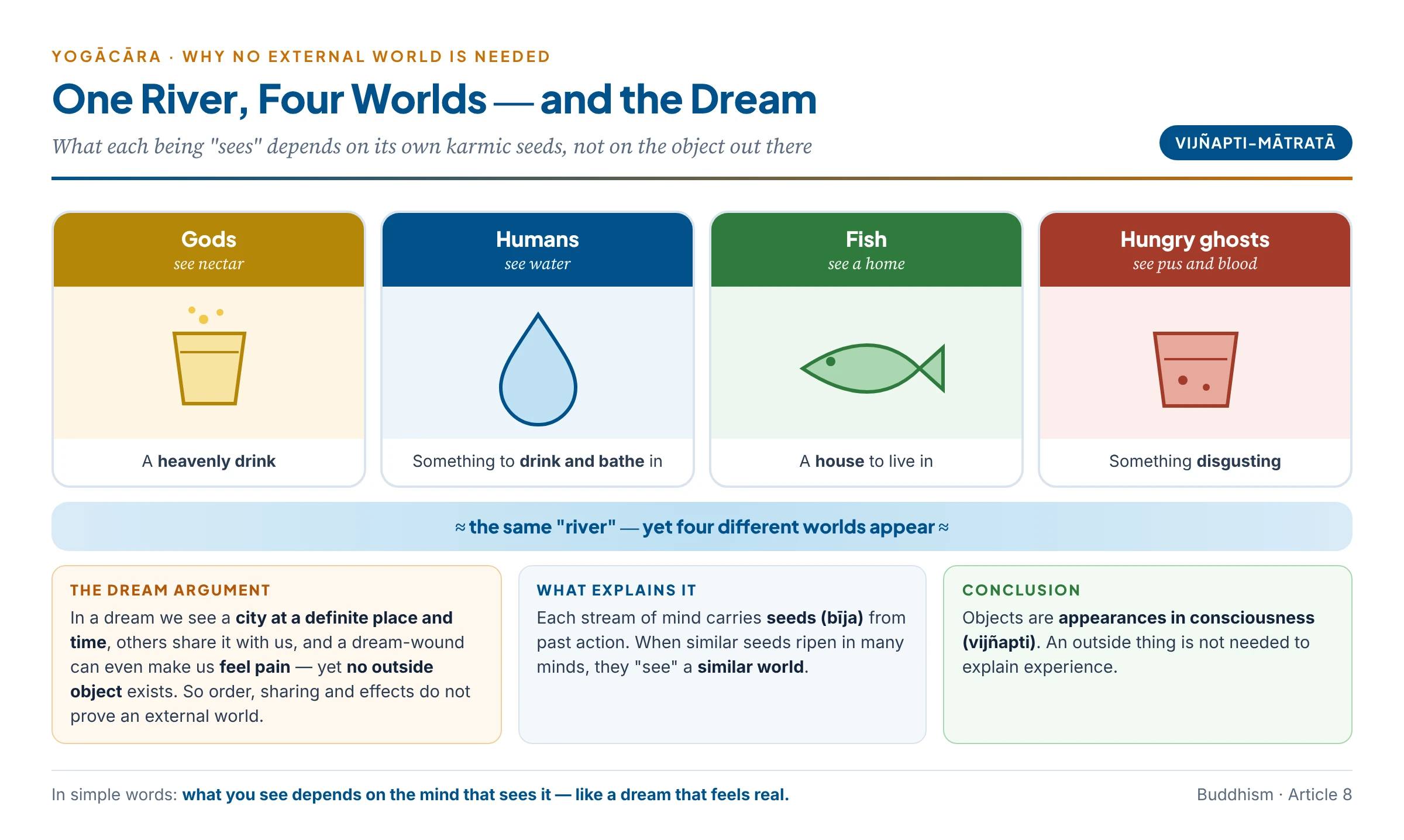
| 3. Intersubjective agreement — many people see the same thing | Hungry ghosts (pretas), because of shared karma, all see a river as pus and blood; beings in hell all see the same hell-guardians — shared appearance needs only shared karmic seeds, not an external object |
| 4. Causal efficacy — real objects do things; dream-food does not nourish | Dream-objects too have real effects: an erotic dream produces a real emission; a nightmare makes the heart race |
(e) The Argument from Different Perspectives
- The same river is seen as nectar by gods, water by humans, a home by fish, and pus and blood by hungry ghosts. There is no one “real river” independent of perceivers; each world is shaped by the karma of its perceivers.
Why Can We Not Create Objects at Will?
- The objection. “If an object depends for its existence solely on the subject, how is it that the mind cannot create at will any object at any time?”
- The reply. “The mind is a stream of momentary conscious states, and within the stream there lie buried the impressions (saṃskāra, vāsanā) of all past experience. At a particular moment, that latent impression comes to the surface for which the circumstances are most favourable; it attains maturity (paripāka) and develops into perception” — just as, though all memories are in the mind, only some are remembered at a time.
In simple words
Think of a film projector. The pictures on the screen are not chosen by the audience’s wishes; they come in a fixed order because they are already printed on the reel. Yogācāra says experience is like this: the “reel” is the storehouse of seeds laid down by past actions. That is why the world feels given, stable and shared — not because it exists outside, but because the seeds ripen in their own order.
3. Ālaya-vijñāna: The Storehouse-Consciousness
- Meaning. Ālaya = storehouse, receptacle, home; vijñāna = consciousness. The ālaya is the deepest, subtle, mostly unconscious layer of mind, “a foundational stratum… that contains seeds (bīja) of past actions and impressions”.
- Why it was introduced — to answer two questions:
- Continuity without a self. “If the self is not permanent, what ensures continuity of experience, memory and rebirth?” — and, as Vasubandhu asked, what keeps a meditator’s body alive, and how does consciousness restart, when all six ordinary consciousnesses are cut off in deep trance?
- A world without matter. “If the world is mind-only, how do individual and shared experiences arise?”
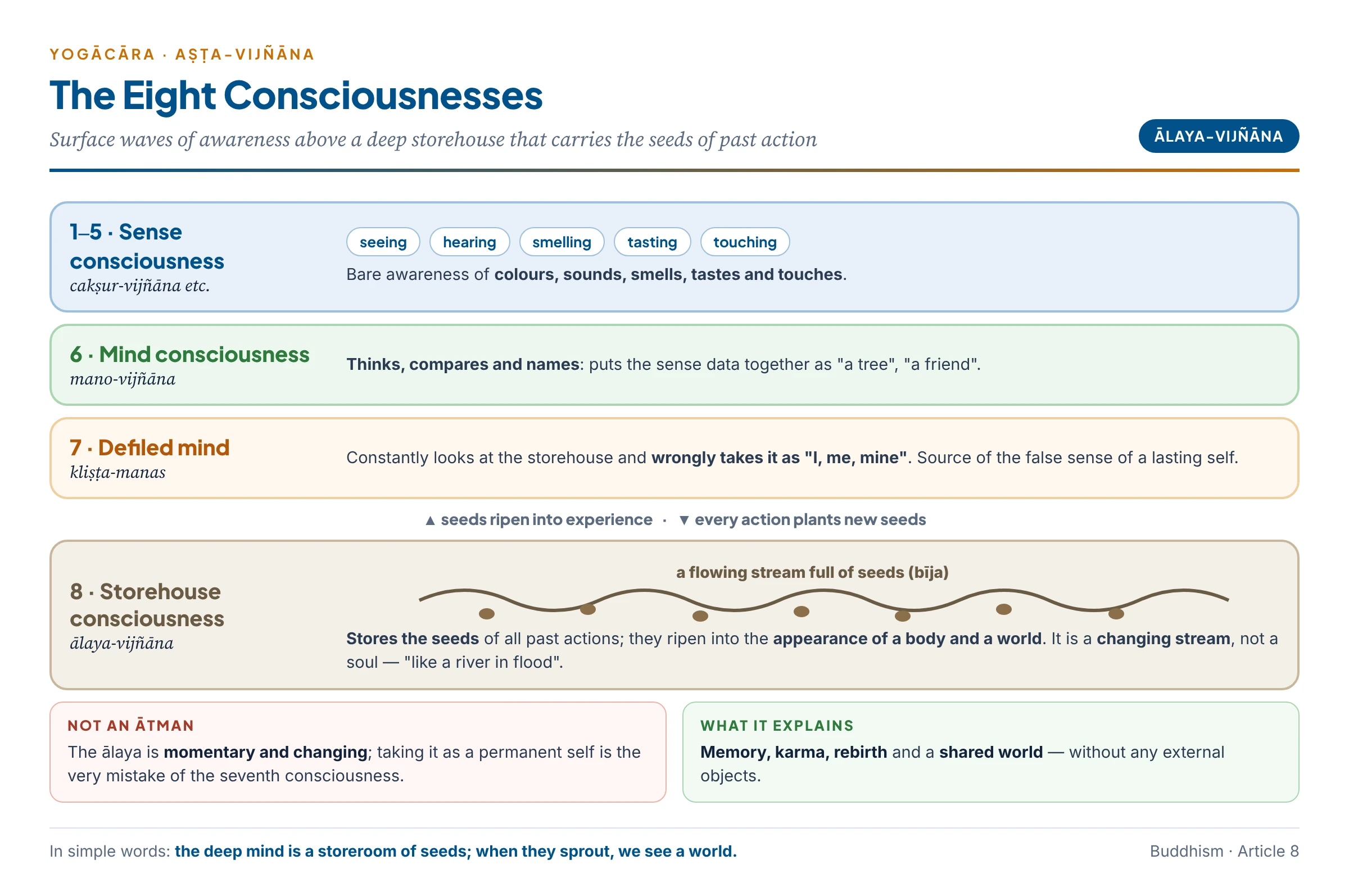
- The eight consciousnesses. Yogācāra expands the early Buddhist six into eight:
- Five sense-consciousnesses — visual, auditory, olfactory, gustatory, tactile.
- Mind-consciousness (mano-vijñāna) — ordinary thinking that integrates the senses.
- Defiled mind (kliṣṭa-manas) — which clings to the ālaya as “I”, generating egoism.
- Storehouse-consciousness (ālaya-vijñāna) — the ground of all the others.
- Seeds and ripening. “Every experience, action and thought leaves behind a trace or seed in the ālaya. These seeds accumulate and condition future experiences, perceptions and rebirths. When circumstances are favourable they ripen (vipāka) as new mental states or external appearances.” Two people in the “same” situation experience it differently because their seeds differ.
- A stream, not a soul. The ālaya “is not static or eternal; it is a dynamic continuum, ever-changing as seeds are deposited and ripen” — Vasubandhu says it “flows on like a torrent“. It “answers to the soul or ātman of other systems, with the difference that it is not one unchanging substance… but a stream of continuously changing states“.
- Significance.
- Metaphysical — continuity without self; the ground of phenomena; a dynamic process.
- Epistemological — “what we see is shaped by past impressions“; knowledge is never neutral; errors are projections of karmic imprints.
- Ethical — “karma is not stored in an eternal soul but in this stream of consciousness“: the mechanism of karma.
- Transformation and liberation. Liberation is “transformation of consciousness” (vijñāna-pariṇāma, āśraya-parāvṛtti — “turning around of the basis”). Through meditation and wisdom, defiled seeds are destroyed; at enlightenment the ālaya becomes “great mirror-like wisdom” (ādarśa-jñāna) — “clear, unobstructed awareness that reflects reality without distortion”. “The mind, the only reality, is truly its own place; it can make heaven of hell and hell of heaven.”
4. The Three Natures (Trisvabhāva)
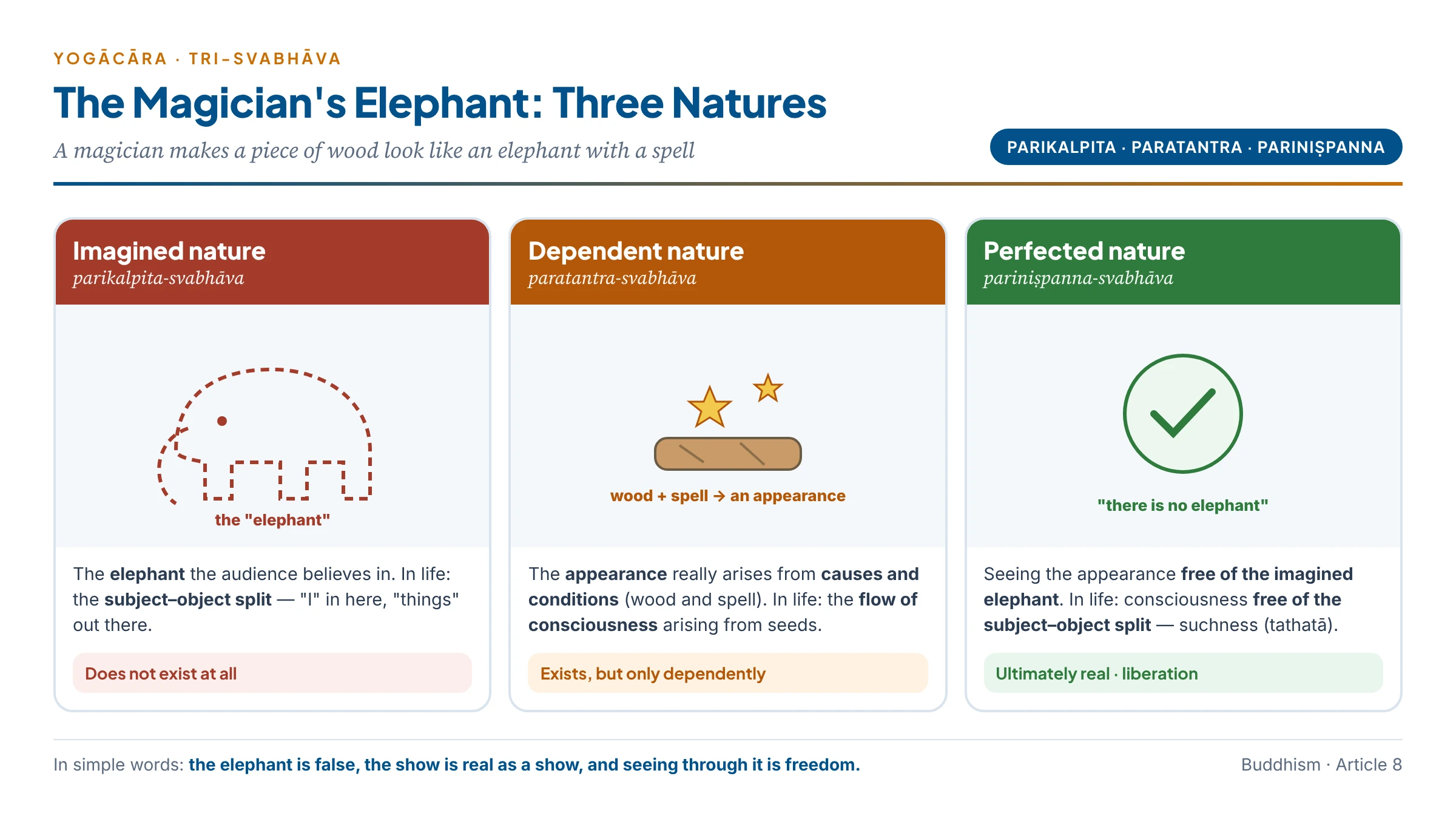
Every experience has three natures:
- The imagined nature (parikalpita-svabhāva) — the world as it falsely appears: split into subject and object, “I” and “things out there”, each with its own fixed essence. Example: taking oneself as a permanent self, or treating external objects as inherently real.
- The dependent nature (paratantra-svabhāva) — the flow of conscious events arising from causes and conditions (karmic seeds) — dependent origination itself. This is what actually appears.
- The perfected nature (pariniṣpanna-svabhāva) — the dependent nature free from the imagined duality; “realisation that the subject–object duality is an illusion and that everything is only consciousness”. This is emptiness understood positively, suchness (tathatā).
- Vasubandhu’s magic elephant. A magician, using a piece of wood and a spell, makes an audience see an elephant.
- The elephant = the imagined nature (it does not exist at all).
- The appearance of an elephant = the dependent nature (it really appears, through causes).
- The absence of the elephant in that appearance = the perfected nature.
- The spell = the storehouse-consciousness; the wood = suchness.
- The rope and the snake (a common teaching image). The snake seen in the dusk is imagined; the rope that appears is dependent; seeing the rope as rope, with no snake in it, is perfected.
- The path. The three natures “map the path from illusion (imagined), through dependent arising (dependent), to ultimate realisation (perfected)”. They do for Yogācāra what the two truths do for the Mādhyamika.
5. Self-Awareness (Svasaṃvedana)
- The claim. Every cognition is self-revealing: it is aware of its object and of itself. “When I feel pain, I don’t need a second act of knowing to know that I am aware of pain.”
- Why it is needed. If a cognition needed a second cognition to be known, that one would need a third — an infinite regress. And we can later remember not only what we saw but that we saw it, which shows the seeing was self-aware at the time.
- Role. Self-awareness lets Yogācāra explain knowledge without an external object and without a separate self: consciousness is its own witness.
6. Is Vijñānavāda Solipsism?
- The charge. If objects exist only as my ideas, then only I exist — solipsism.
- The reply.
- Yogācāra accepts many streams of consciousness, each with its own seeds.
- “We all perceive a common world because sentient beings carry similar karmic impressions.” Experience is intersubjectively coherent, not private fantasy.
- Its claim is “not ‘only I exist‘, but ‘all that appears exists only as consciousness, without external substance'”.
- Its aim is practical: to stop clinging to an imagined external world.
Common confusion
Does “mind-only” mean that the world is my imagination and I can wish it away? No. Yogācāra is not the view that my thoughts create the world at will. The “mind” in “mind-only” is the whole karmically conditioned stream of consciousness, including the deep storehouse, whose seeds ripen lawfully — which is why the world is stable, shared and resistant to wishes. Nor does Yogācāra deny other minds. It denies only that there is matter existing independently of all consciousness.
7. Subjective or Absolute Idealism?
- The subjective reading. “They are treated as subjective idealists by many of their contemporaries” — “because according to it the existence of an object perceived is not different from the subject or perceiving mind”. This fits especially the logicians Dignāga and Dharmakīrti (the “Svatantra-vijñānavāda“), for whom reality is a flux of momentary ideas. “The charge of subjective idealism can be raised only against” them.
- The absolute reading. For Asaṅga, Vasubandhu and the Laṅkāvatāra, momentariness applies “to phenomena only“; ultimate reality is pure consciousness, “the storehouse of consciousness”, which “transcends the dualism of the knower and the knowable”. “Just like the Brahman of the Upaniṣads, consciousness is the only reality which is the ground of all phenomena.” On this reading Yogācāra is absolute idealism.
- Comparison.
- Berkeley (subjective idealism): esse est percipi — to be is to be perceived; ideas are caused in finite minds by God. Yogācāra puts karmic seeds where Berkeley puts God.
- Hegel (absolute idealism): reality is the self-unfolding of Absolute Spirit. The absolute reading of Yogācāra is closer to this — and to Advaita.
Critical Evaluation
A. The Realist (Sautrāntika and Nyāya) Critique
- “Like an external object” presupposes external objects. The idealist says consciousness appears “as if external”; if nothing external was ever perceived, this phrase is as meaningless as “like the son of a barren mother“.
- The pot is felt as external. In perceiving a pot, “the pot is felt as external and consciousness of it as internal“.
- “I am the pot”? If the object were identical with the subject, we would say “I am the pot“; we say “I am conscious of the pot”.
- Pot and cloth. Consciousness as consciousness is the same; “the distinction between ‘consciousness of a pot’ and ‘consciousness of a cloth’ could not be explained” without different objects.
- Many perceivers. “Different individuals perceive the same object simultaneously.”
- Not at will. “The mind at will cannot create any object.”
- Sahopalambha proves too little. Things that always occur together (a sound and its echo-chamber, a flame and its heat) need not be identical; and an object known only with its cognition may still exist without it, unperceived.
B. Śaṅkara’s Critique
Śaṅkara treats Vijñānavāda as subjective idealism — “and the tragedy is heightened by the fact that ideas are regarded as momentary“. His standpoint is “psychological realism compatible with absolute idealism“.
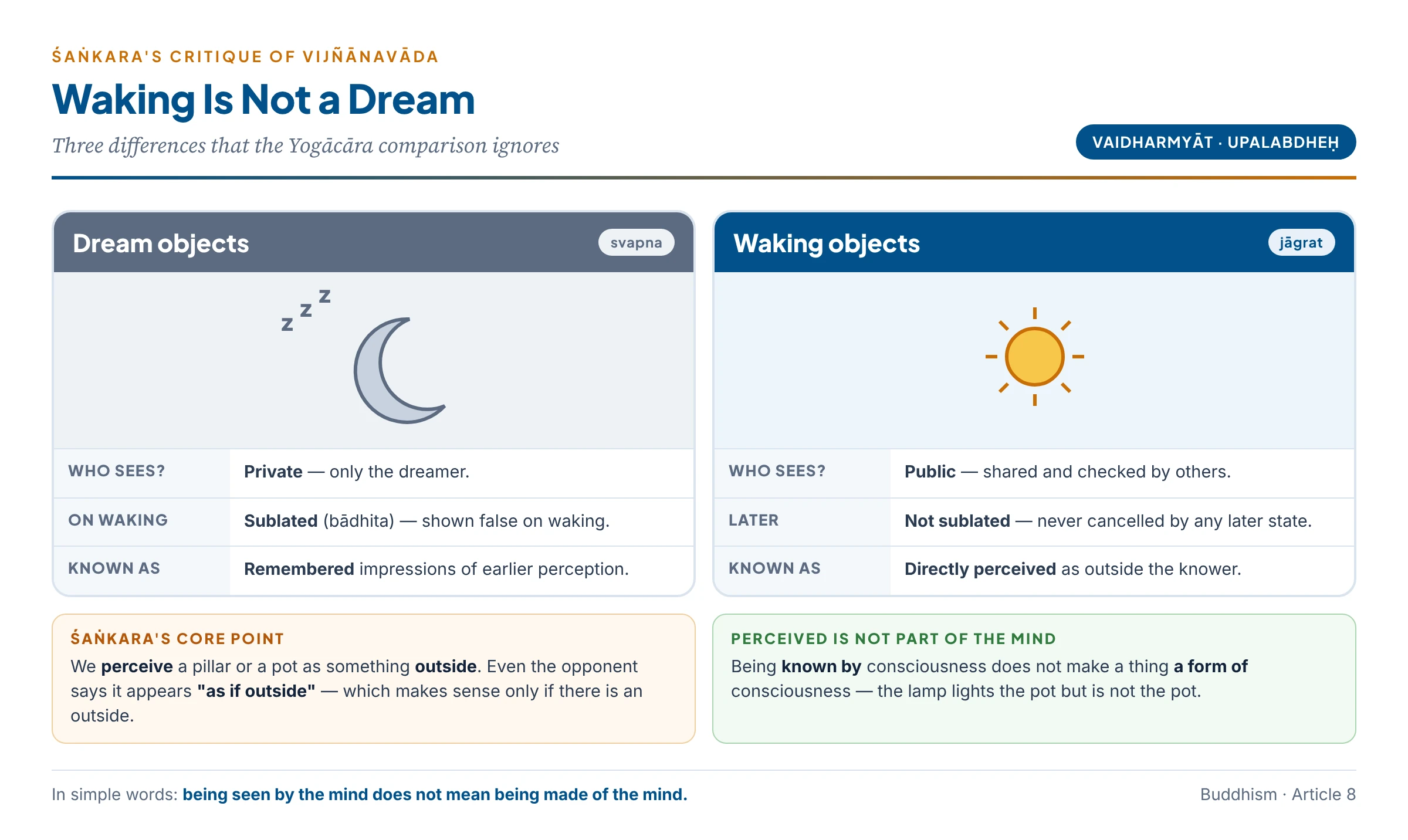
- The external world must exist, because we perceive it. “If things and ideas are presented together, it does not mean they are identical. If objects depend on the mind, it does not mean they are a part of the mind. To be perceived by the mind is not to be a portion of the mind.”
- Eating and denying. Denying the external world while experiencing it is “like the words of a person who, while he is eating and feeling satisfied, says he is not eating“.
- Black cow, white cow. “We perceive a black cow and a white cow. The attributes differ but cowness remains the same. Similarly in ‘cognition of a jar’ and ‘cognition of a cloth’, jar and cloth differ while consciousness remains the same.” So ideas and objects are distinct.
- “No one perceives his own perception.” “Nobody is conscious of his perception only, but everybody perceives external objects like a post, a wall.”
- “As if external” gives the game away. Dignāga says “internal consciousness itself appears as if it were something external”. “If there is no external world, how can he say that consciousness appears as if it is something external? No sane person says that Viṣṇumitra appears like the son of a barren woman.” “There can be no hypothetical without a categorical basis.”
- Possibility is decided by the pramāṇas. “That is possible which can be proved by a valid means of cognition; external objects are apprehended by all valid means. How can their existence be denied?”
- Dream and waking are not on a par.
- Dream-objects are sublated on waking; waking objects (posts, walls) are not so contradicted.
- “Dreams are private; waking life is public.“
- “Dreams are remembered; things in waking life are directly perceived.”
- Impressions need objects and a substratum. If there are no external objects, impressions could never arise; calling them beginningless is “a series of the blind” — infinite regress. And impressions, being mental modifications, need a substratum; a momentary ālaya cannot be one.
- Momentary ideas cannot know themselves. “Momentary ideas cannot ideate themselves. There must be a permanent self to synthesize the fleeting ideas.”
- Śaṅkara’s own position. He too holds that the subject–object universe is ultimately an appearance of pure consciousness (Ātman), but insists on the empirical reality of the external world. His quarrel is with subjective idealism, not with absolute idealism.
C. Kumārila and the Mīmāṃsā
- Cognition is formless. For Kumārila, a cognition has no form of its own (nirākāra); blueness belongs to the object. Remove the object and nothing is left to make one cognition differ from another.
- Dreams use real material. Even dream-objects are real things perceived elsewhere, wrongly placed in time and space; so dreams prove nothing about waking.
D. The Mādhyamika Critique
- Consciousness reified. Yogācāra “risks making consciousness an absolute substance“, contrary to emptiness. Candrakīrti: if there is no object, there is no consciousness of it either — the two are mutually dependent and equally empty.
- Self-awareness impossible. “A sword cannot cut itself, a fingertip cannot touch itself, fire cannot burn itself, an eye cannot see itself“; a cognition cannot know itself.
- The ālaya as a hidden self. The storehouse “risks becoming a hidden ātman“.
E. Yogācāra Replies (Summary)
| Criticism | Raised by | Reply |
|---|---|---|
| Solipsism | Nyāya, Vaiśeṣika, some Mādhyamikas | Many streams; shared seeds produce a common world |
| Contradicts common sense (a pot seen by all) | Nyāya realists | Shared karmic impressions project similar appearances; the world appears external through collective conditioning |
| Error vs truth | Nyāya, Jainas | Distinguishes conceptual error from direct perception; validity is tested by sublation and success |
| Reification of consciousness | Mādhyamika (Candrakīrti) | Consciousness is dependently arisen and empty too; Yogācāra stresses its flow, not permanence |
| Ālaya = ātman? | Nyāya, Mīmāṃsā, Mādhyamika | The ālaya is not eternal; a conditioned continuum that ceases at liberation; a tool to explain karma |
| Ethics without a real world? | Opponents in general | Karma works as seeds ripening in consciousness; no external matter is needed |
Critics and Defenders
Criticism — Critics
- Sautrāntika: “as if external” presupposes the external; pot is felt outside; pot vs cloth; “I am the pot”.
- Śaṅkara: eating while denying eating; dreams are private and sublated, waking public; momentary ideas cannot know themselves.
- Kumārila: cognition is formless; dreams borrow real objects.
- Candrakīrti (Mādhyamika): no object, no consciousness; a sword cannot cut itself; the ālaya is a self in disguise.
- Nyāya: idealism cannot tell truth from error.
Defence — Defenders and strengths
- Sahopalambha: object and awareness are never found apart.
- Atoms: partless atoms cannot combine — matter is incoherent.
- Vasubandhu’s dream replies: place, time, shared appearance and effects all occur in dreams.
- Ālaya and seeds: explain continuity, karma, and why the world resists our wishes — without a self or matter.
- Not solipsism: many streams, common karma; liberation as transformation of consciousness.
Cross-Tradition Comparison
| Thinker | View | Compared with Yogācāra |
|---|---|---|
| Berkeley | Esse est percipi; ideas in finite minds caused by God | The closest parallel (subjective idealism); Yogācāra replaces God by karmic seeds and has no permanent soul |
| Hegel | Absolute idealism: reality as Spirit | Fits the “absolute” reading (pure consciousness as ground) |
| Kant | The world of experience is shaped by the mind; things-in-themselves exist but are unknowable | Yogācāra goes further: no thing-in-itself outside consciousness |
| Husserl | Consciousness is always consciousness of something; the “epoché” brackets the external world | Methodological suspension in Husserl; metaphysical denial in Yogācāra |
| Moore | “Refutation of Idealism”: the act of awareness is distinct from its object | Repeats the Sautrāntika and Śaṅkara replies: “blue” and “awareness of blue” differ |
| Freud / Jung | An unconscious layer shaping conscious life; Jung’s collective unconscious | Strikingly like the ālaya and its shared seeds |
Indian Connect
- Gauḍapāda (Śaṅkara’s teacher’s teacher) used the dream argument to show that the waking world is unreal; critics therefore called Advaita “crypto-Buddhism” (pracchanna-bauddha). Śaṅkara answered by insisting on the empirical reality of the world and the difference between dream and waking.
- The Advaitic sākṣin (witness-consciousness) and the Yogācāra svasaṃvedana both make consciousness self-luminous; Advaita makes it eternal, Yogācāra momentary or dependently arisen.
- The Sautrāntika was the bridge: once only mental images are known, Yogācāra simply drops the inferred object.
Synthesis (Siddhānta)
- The doctrine. Only consciousness is real; the external world is the projection of a karmically conditioned stream of mind. Subject and object are two faces of one event; liberation is the transformation of consciousness into non-dual wisdom.
- Its arguments. Simultaneous apprehension of object and awareness; the incoherence of atoms; the time problem; dreams and illusions; the same river seen differently by different beings.
- Its explanatory machinery. The storehouse-consciousness with its seeds explains continuity, karma, the givenness and sharedness of the world; the three natures explain illusion and liberation; self-awareness explains knowledge without an external witness.
- Its critics. Realists (Sautrāntika, Nyāya, Śaṅkara, Kumārila) say perception testifies to an external world and that dreams and waking are not on a par; the Mādhyamika says Yogācāra reifies consciousness.
- Its value. It gave Indian philosophy its most sophisticated philosophy of mind — an analysis of the unconscious, of how karma shapes perception, and of how the sense of an “I” is constructed.
- Contemporary relevance.
- Neuroscience of perception. The brain constructs the experienced world from limited signals; “predictive processing” theories describe perception as controlled hallucination — a modern echo.
- Psychology of bias. Past experiences (seeds) shape how we see situations; cognitive-behavioural therapy works on these patterns.
- Virtual reality. Immersive, shared, rule-governed virtual worlds make the Yogācāra question — what makes a world “real”? — concrete.
- Ethics of perception. If how we see depends on our conditioning, changing the mind changes the world we live in — the practical core of the school.
“Blue and the awareness of blue are not different, since they are always apprehended together.” — Dharmakīrti
Previous Year Questions
- 2019How do the Yogacăra Buddhists deny the existence of the external world? Discuss.
- 2017How do Madhyamika, yogacaravadins and sarvastivadins differ among themselves in concerning the nature of reality? How do Sarvastivadins differ among themselves with regard to knowledge of reality?
- 2015Write short note on Alayavijnana.
- 2012Explain the theory of illusion accepted by Buddhist. Is it consistent with their philosophy? Give reasons for your answer.