

Yoga: Citta; Cittavṛtti; Kleśas; Samādhi; Kaivalya.
Official Syllabus: Paper I, Section B, Unit 17
“Yoga is samādhi,” says Vyāsa in the very first line of his commentary. Samādhi — absorption, concentration in which the mind becomes one with its object — is both the eighth limb of the path and the name for yoga itself. Patañjali distinguishes two great kinds. In samprajñāta samādhi (“absorption with awareness”), the mind is still fixed on an object — first gross, then subtle, then on the joy of the purified mind, and finally on the bare sense “I am”. It still carries seeds of future mental activity, so it is also called sabīja (“with seed”). In asamprajñāta samādhi (“absorption beyond awareness”), even that last object is dropped through supreme detachment; no modification remains, only latent impressions, and the seer stands in its own nature. It is nirbīja (“seedless”) and is the doorway to kaivalya. This article explains both kinds, each level of the first and how it leads to the second, the two ways of reaching the higher state, the role of Īśvara, the “cloud of virtue” (dharma-megha), and the philosophical debate about whether the whole progression makes sense.
In simple words
Imagine focusing a camera. First you see a whole crowded street (gross object). You zoom to one face (subtler). You zoom further to the light in the eye (subtler still). Finally you are aware only of the act of looking itself. Samprajñāta samādhi is this zooming in. Asamprajñāta is when even the act of looking is let go — the camera is switched off, and only the photographer remains.
Context & Problem
- Samādhi in all levels, yoga only in two. Absorption is “a quality of citta in all its five levels” — even a restless mind is absorbed in something for a moment. But yoga proper exists only in the one-pointed (ekāgra) and restrained (niruddha) levels (Article 2).
- Two senses of samādhi.
- Samādhi as the eighth limb — absorption on an object, where “the object alone shines” (Article 5).
- Samādhi as the goal — yoga as “cessation of mental modifications” (cittavṛtti-nirodha). “The former is but the means for the attainment of the latter, which is its end.”
- The two main kinds.
- “Ekāgra, the state of concentration, when permanently established, is called samprajñāta yoga or the trance of meditation, in which there is a clear and distinct consciousness of the object of contemplation.”
- “The state of niruddha is called asamprajñāta yoga, because all mental modifications being stopped, nothing is known or thought of by the mind.”
- “Both these kinds of samādhi are known by the common name of samādhi-yoga, since both conduce to self-realisation.”
- The problem. How does a mind move from the deepest concentration on something to a state with no object at all — and why should that objectless state be liberation rather than a blank?
Core Doctrine
1. Samprajñāta Samādhi: Absorption with Awareness of an Object
- Definition. Samprajñāta samādhi is “accompanied by the forms of reasoning (vitarka), reflection (vicāra), joy (ānanda) and I-am-ness (asmitā)”.
- Its marks.
- “The mind remains conscious of the object.” The citta “is single in intent and fully illumines a distinct and real object”.
- “There is a union between the knower and the known; the thought and the object of thought are the same” — yet “the consciousness of meditation persists“; the distinction between subject and object “is yet to disappear”.
- It “removes the afflictions, slackens the bonds of karma, and has for its goal the restraint of all modifications”.
- It is sabīja — “with seed”: since it still rests on an object, it leaves seeds of future mental activity.
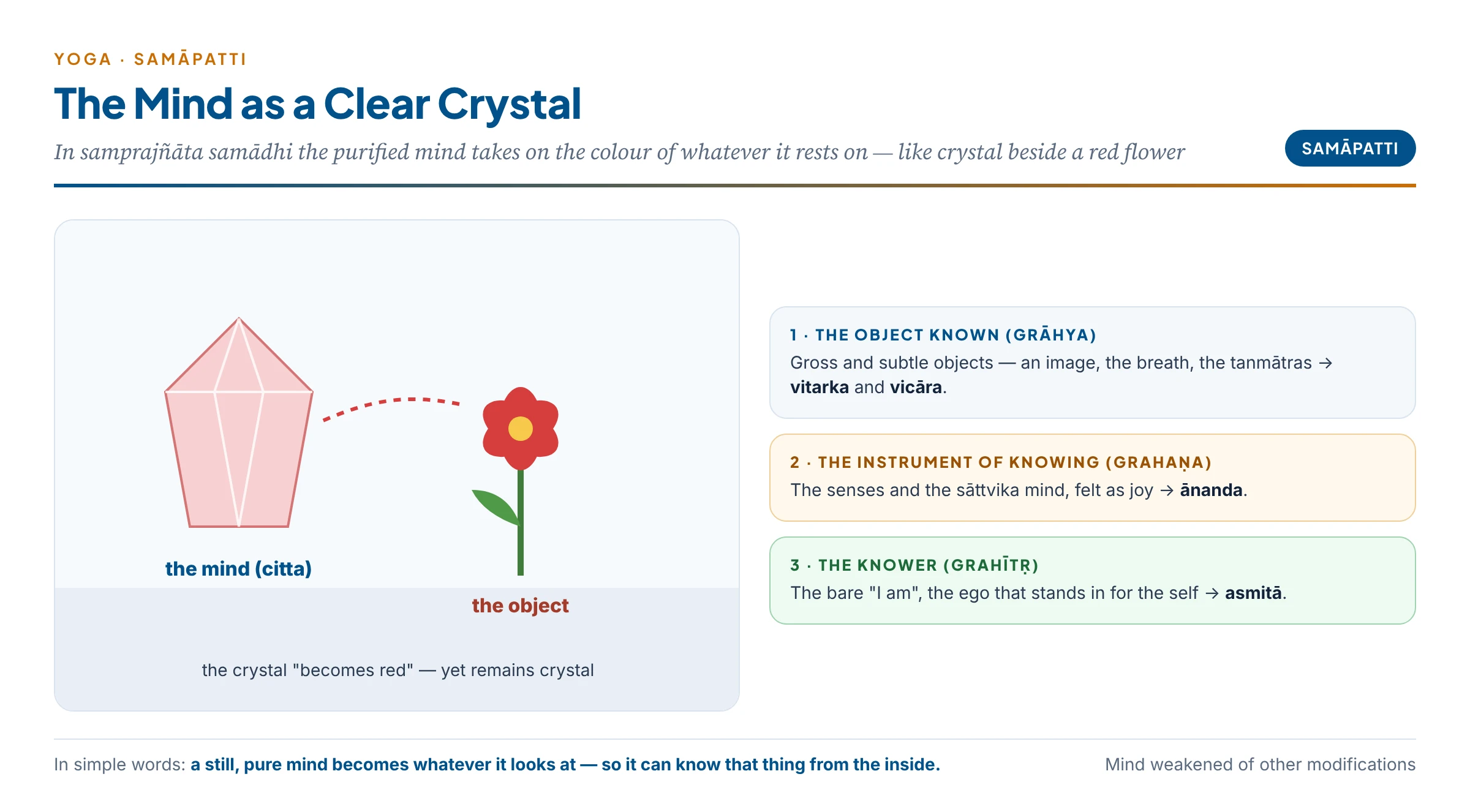
- Samāpatti — the clear crystal. In this state the purified mind is like a transparent crystal: placed next to a red flower, it takes on the flower’s colour. So the mind, “with its modifications weakened”, takes on the form of whatever it rests on — the object known (grāhya), the instrument of knowing (grahaṇa) or the knower (grahītṛ). This “taking the colour of the object” is called samāpatti.
2. The Four Levels of Samprajñāta
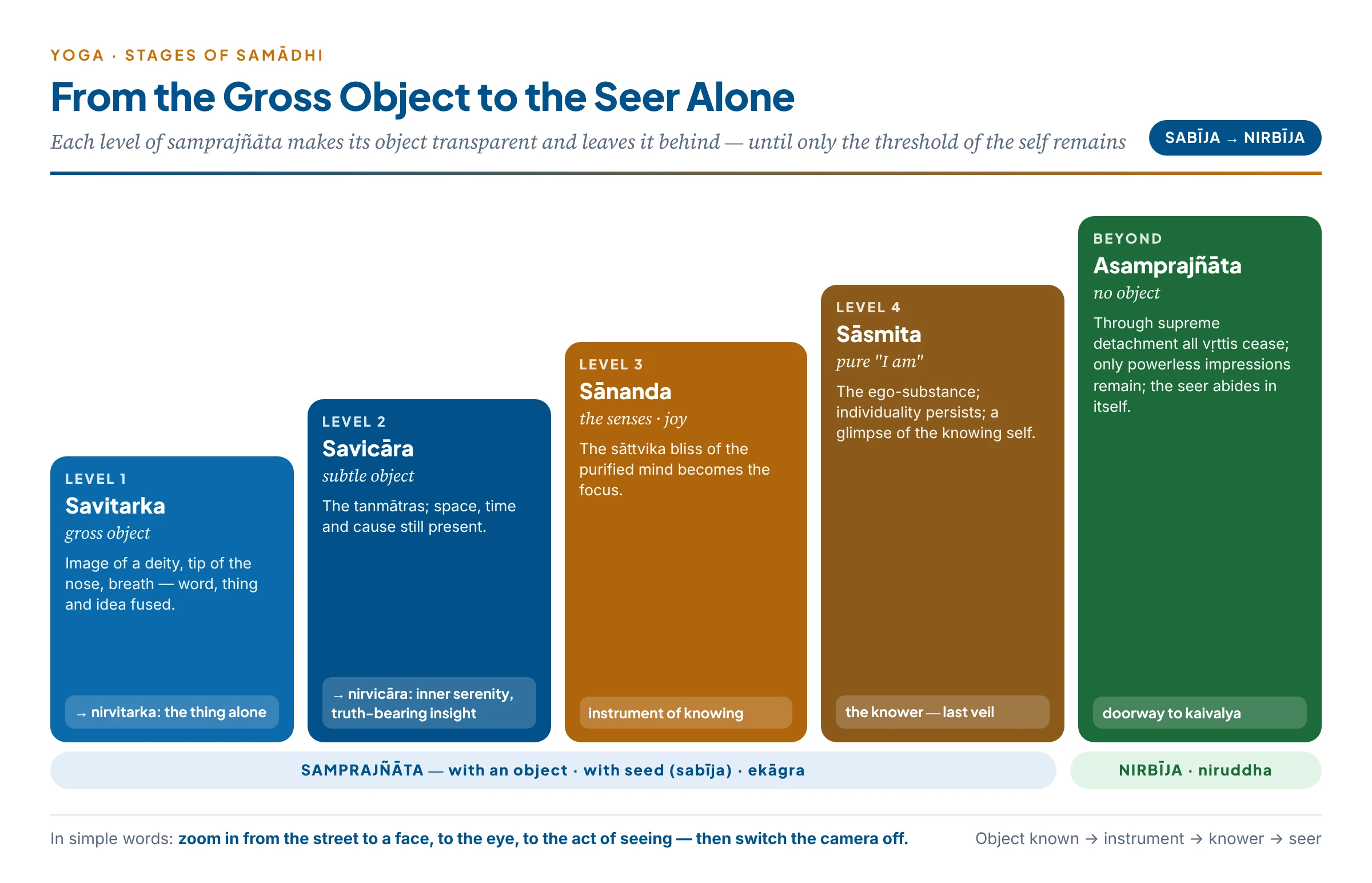
The levels follow the objects, from gross to subtle — from the object known, to the instruments of knowing, to the knower.
1. Savitarka — absorption with reasoning on a gross object.
- Object: a gross physical object — “the image of a god or goddess”, the tip of the nose, the body, the breath, an external symbol.
- Nature: the mind is mixed with the word, the object and the idea of the object. Example: in meditating on a cow, the word “cow”, the animal cow and the mental image of a cow are fused together in one cognition.
- Nirvitarka — without reasoning. When memory is purified and the word and concept fall away, “the object alone shines, as if empty of the mind’s own form”. The meditator sees the bare thing, free of labels.
- “Suitable for beginners,” it involves “discursive thought — reasoning about the object, analysing its nature”.
2. Savicāra — absorption with reflection on a subtle object.
- Object: subtle things — the tanmātras (subtle essences of the elements), inner principles. “Having realised the nature of the gross object, one should concentrate on subtle objects.”
- Nature: “discursive thought quiets down, leaving subtle reflection”; one perceives the object “as actually consisting of more subtle ingredients”. Savicāra still has awareness of space, time and cause.
- Nirvicāra — without reflection. The subtle object is grasped beyond space, time and causality.
- Its fruit. “In the clarity of nirvicāra arises inner serenity (adhyātma-prasāda).” There the insight is “ṛtambharā” — “bearing truth”: it knows the particular nature of things directly, which testimony and inference (which deal with general features) cannot do. The impressions produced by this insight block other impressions.
3. Sānanda — absorption in joy.
- Object: “still subtler objects like the senses“, the instruments of knowing; the mind passes beyond objects to the sāttvika joy that arises from its own stillness.
- Nature: “The yogī experiences deep contentment, inner light and serenity. Joy becomes the focus of consciousness rather than external forms.” This is because “sattva predominates in ahaṅkāra and buddhi, and sattva is the source of bliss”.
4. Sāsmita — absorption in pure I-am-ness.
- Object: “asmitā, the ego-substance with which the self is ordinarily identified” — the bare feeling “I am”.
- Nature: “the most refined form of samprajñāta”. It is “a direct intuition of the subtle ego, not yet transcending it”. “Here we have conscious ecstasy where individuality persists.”
- Its fruit. It reveals “the true nature of the ego” and gives “a glimpse of the knowing self as something almost indistinguishable from the ego”. It is the last veil of Prakṛti before Puruṣa.
| Level | Object | Pair | Fruit |
|---|---|---|---|
| Savitarka | Gross object — image, nose-tip, breath | With / without word-object-idea fusion (nirvitarka) | Clear knowledge of the gross thing |
| Savicāra | Subtle object — tanmātras | With / without space-time-cause (nirvicāra) | Inner serenity; truth-bearing insight |
| Sānanda | The senses; sāttvika joy | — | Bliss of the purified mind |
| Sāsmita | Pure “I am” (ego-substance) | — | Glimpse of the self, almost indistinguishable from ego |
3. How Each Level Leads to the Next — and to Asamprajñāta
- From gross to subtle. “Thus the mind realises the nature of different objects within or without the body and leaves them behind, one after the other.” Mastery of one level makes its object transparent, so the mind is free to move to a subtler one.
- From object to instrument to knower. The movement goes from what is known (gross, then subtle objects), to the means of knowing (the senses, in sānanda), to the knower as ego (in sāsmita) — each step closer to Puruṣa.
- New impressions block old ones. The insight born of nirvicāra produces impressions that obstruct the old, distracting impressions. The mind is gradually reprogrammed towards stillness.
- Sāsmita is the threshold. When the ego itself is seen as an object — “this ‘I’ too is a product of Prakṛti” — there is nothing left in Prakṛti to identify with.
- Supreme detachment makes the leap. “Becoming completely free from thoughts of all objects”, even from the subtle ego, through higher detachment (para-vairāgya), the mind attains “asamprajñāta samādhi or yoga par excellence”.
In simple words
A mountaineer climbs from the plains to the foothills, to the snow line, to the summit ridge. Each camp makes the next one reachable. But at the summit there is one last step that is not “more climbing” — he simply stops and stands. The four levels of samprajñāta are the camps; asamprajñāta is the standing still at the top.
4. Asamprajñāta Samādhi: Absorption beyond Awareness
- Definition. “The other (samādhi) is preceded by the practice of the cause of cessation, and has only latent impressions remaining” (virāma-pratyaya-abhyāsa-pūrvaḥ saṃskāra-śeṣo ‘nyaḥ).
- What happens. “There is complete cessation of mental modifications … and only latent impressions remain. It is a meditative absorption without support of any object.” “Even that awareness ceases. What remains is pure consciousness resting in itself.”
- Seedless. “When even that (the impression of insight) is restrained, everything being restrained, there is seedless samādhi” (nirbīja samādhi).
- Its characteristics.
- No object-consciousness — not engaged with gross or subtle objects; beyond reasoning, reflection, joy and ego.
- Seedless — “no seed of mental activity is left to generate further fluctuations”.
- Latent impressions remain — but they are “powerless in the stillness of this state”, like roasted seeds (dagdha-bīja) that cannot sprout.
- Beyond the guṇas — the mind is no longer coloured by sattva, rajas or tamas; “consciousness abides in its pure form”.
- Hard to describe and to attain. It is “the highest form of yoga, divine ecstasy”; “difficult to describe, difficult to attain and still more difficult to control”. Its marks recall the descriptions of mystical experience by Rudolf Otto and William James: passivity, ineffability (it cannot be put into words) and a noetic quality (it feels like knowledge).
- Afterwards. “In this state the self abides in its own essence as pure consciousness.” “Immediately or after a while the body breaks and liberation is obtained.”
In simple words
A pond with no ripples looks empty — yet it is full of water, and the moon shines in it perfectly. Asamprajñāta is like that pond: from outside it may look like “nothing is happening”, but for Yoga it is the fullest state — consciousness resting in itself, with nothing to distort it.
- Relapse is possible. “Even if it be possible for a self to attain once the state of samādhi and thereby release from pain, there is the possibility of a relapse … so long as all the impressions and tendencies of the mind are not wiped out.” Hence long, devoted practice is needed to stay established.
Common confusion
Is samprajñāta samādhi “liberation in this life” and asamprajñāta “liberation after death”? No. Some lecture notes equate samprajñāta with jīvanmukti and asamprajñāta with liberation after the body dies. Both are states of meditation attained by a living yogī. Samprajñāta has an object; asamprajñāta has none. Liberation in life (jīvanmukti) comes after asamprajñāta has burnt the seeds, and final isolation (kaivalya) comes when the body falls (Article 8). Similarly, the Vedāntic words savikalpa and nirvikalpa are often used for these two states, but Patañjali’s own terms are samprajñāta/sabīja and asamprajñāta/nirbīja.
5. Samprajñāta and Asamprajñāta Compared
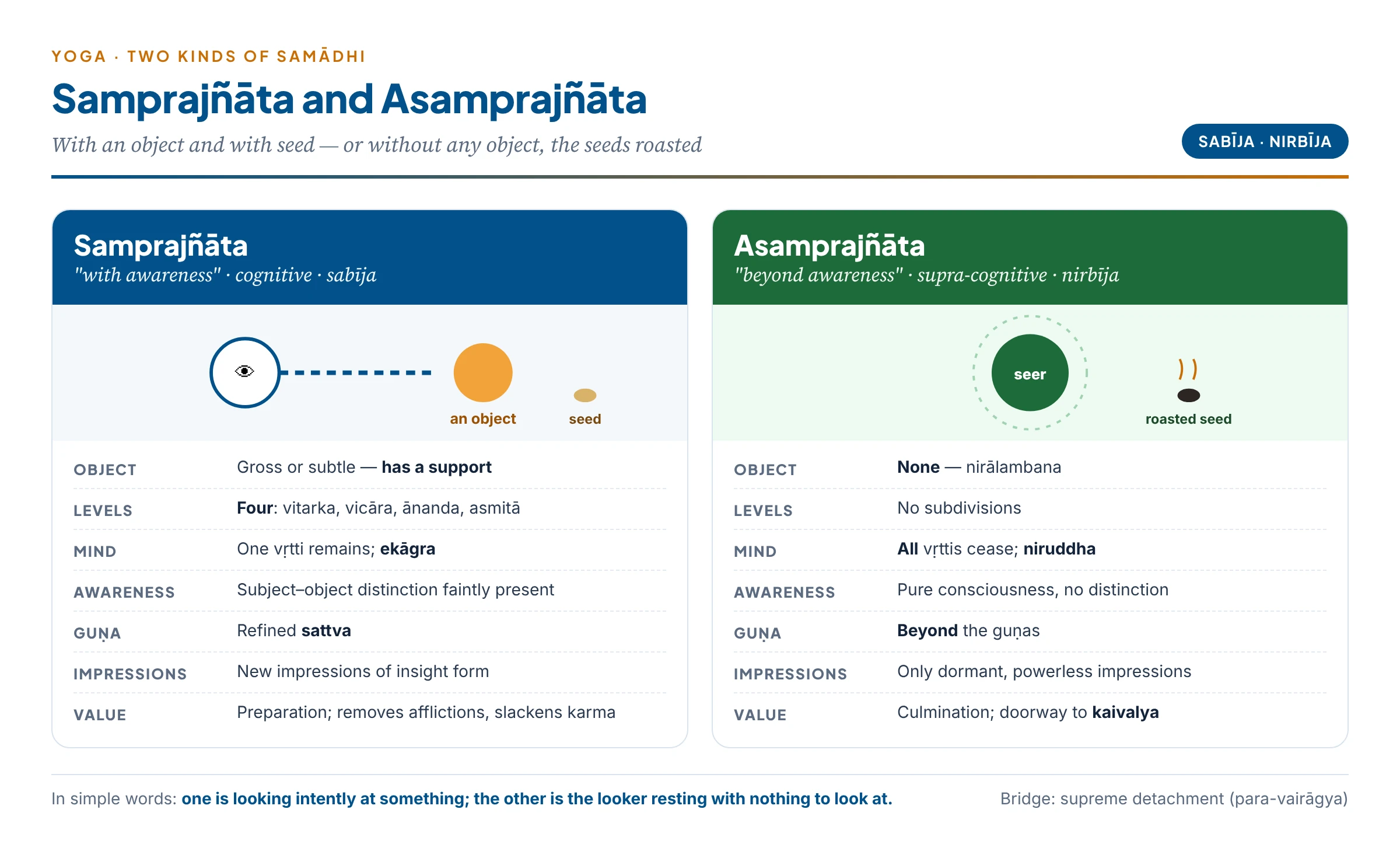
| Aspect | Samprajñāta | Asamprajñāta |
|---|---|---|
| Meaning | “With awareness”; cognitive; sabīja (with seed) | “Beyond awareness”; supra-cognitive; nirbīja (seedless) |
| Object | Has an object (gross or subtle) | No object — nirālambana |
| Kinds | Four: vitarka, vicāra, ānanda, asmitā | No subdivisions |
| Mental activity | Some vṛtti remains (on one object) | Complete cessation of vṛttis |
| Awareness | Subject–object distinction still faintly present | Pure awareness without distinction |
| Guṇa | Refined sattva predominates | Beyond the guṇas |
| Impressions | New subtle impressions of insight may form | Only dormant impressions; no new karmic seeds |
| Corresponding mind-level | Ekāgra (one-pointed) | Niruddha (restrained) |
| Means | Practice (abhyāsa), lower detachment | Higher detachment (para-vairāgya), practice of cessation |
| Value | Preparation for higher absorption | Culmination of yoga; doorway to kaivalya |
6. Two Ways to the Higher Samādhi: Bhava-pratyaya and Upāya-pratyaya
- Bhava-pratyaya — “caused by birth”. For the videhas (beings without gross bodies, such as certain gods) and the prakṛti-layas (those absorbed in Prakṛti), a samādhi-like state arises by nature, not by effort. But their ignorance is not destroyed; when the merit runs out they return to the world. It is a resting state, not liberation.
- Upāya-pratyaya — “caused by means”. For others, it is preceded by faith (śraddhā), vigour (vīrya), mindfulness (smṛti), samādhi and insight (prajñā). Here ignorance is destroyed, the kleśas are removed, and the result is real liberation.
- Speed depends on intensity. “It is near for those whose desire is intense”, and among them it differs according as their effort is mild, moderate or intense.
- Or by devotion to Īśvara. “Or (samādhi is attained) by devotion to Īśvara” — an alternative route (Article 7).
In simple words
Two people fall asleep in a fragrant garden. One is a tired traveller who simply dozed off — when he wakes, he is the same restless man (bhava-pratyaya: a rest that comes by itself and changes nothing). The other is a gardener who, through years of work, built and cleared the garden — his peace is earned and lasting (upāya-pratyaya: a state reached by effort that removes the cause of restlessness).
Common confusion
Does bhava-pratyaya mean that “only the impressions of passion remain” and upāya-pratyaya that “supernormal powers emerge”? No. Some notes describe them this way. In Patañjali, bhava-pratyaya is the samādhi-like state that comes by birth to disembodied beings and those merged in Prakṛti — a state in which ignorance survives, so they return to the world. Upāya-pratyaya is samādhi reached by means — faith, vigour, mindfulness, concentration and insight — which destroys ignorance. Powers are a separate matter (Article 5).
7. The Role of Īśvara in Samādhi
- Īśvara as special Puruṣa. Patañjali defines Īśvara as a Puruṣa “untouched by afflictions, karma, its fruits and impressions” (Article 7).
- Devotion as a path. “Samādhi is perfected through devotion to Īśvara.” By surrendering to Īśvara, “the yogī cultivates humility, faith and detachment”; devotion “calms the mind, reduces ego and dissolves personal desires”.
- Īśvara as guru. “The yogī who seeks guidance and attunes to Īśvara’s wisdom can overcome obstacles on the path.”
- Īśvara and grace. “Asamprajñāta samādhi is challenging to achieve solely through personal effort. Surrender to Īśvara allows the yogī to receive divine grace, which may catalyse the final stages.”
- Īśvara as object. The repetition of Om and meditation on its meaning bring “inward awareness and the removal of obstacles”; Īśvara, eternally pure, is the most fitting object for one-pointed meditation.
- But optional. The word “or” (vā) shows that devotion is an alternative, not the only way; practice and detachment also lead there.
8. Dharma-megha Samādhi: The Cloud of Virtue
- What it is. “When one has no interest even in the highest knowledge, there arises, from constant discriminative insight, the samādhi called the cloud of dharma” (dharma-megha).
- Its effect. “From that comes the cessation of afflictions and karma.” Knowledge becomes infinite and “what remains to be known is little”.
- Why “cloud”? It showers the blessing of self-realisation on the yogī “like rain”, washing away the last kleśas and karmic deposits.
- Its place. It is the culmination of discrimination — some texts call it the final stage of samprajñāta, others place it at the transition into asamprajñāta and kaivalya. Either way, it is where the seeds are finally burnt and the guṇas, their purpose fulfilled, begin to withdraw.
Critical Evaluation
1. Is the Transition from Samprajñāta to Asamprajñāta Coherent?
- The internal logic — gradual refinement. Each stage removes a grosser support: gross object → subtle object → bliss → ego-sense. When even the “I-am” vṛtti dissolves, no vṛtti remains, so the mind must pass into a state without vṛttis. Within Yoga’s own theory, the progression is coherent.
- The “jump” problem. Critics argue that removing supports one by one does not logically entail a non-cognitive state. Samprajñāta is a refinement of vṛttis; asamprajñāta is their absence. How does refinement suddenly become cessation? The step may be discontinuous.
- Nyāya objection. A cognition cannot erase itself; the absence of all cognition is not a cognition. And liberation needs true knowledge, not the stopping of knowledge.
- Buddhist objection. A state without any momentary cognition is indistinguishable from unconsciousness — like deep sleep or a swoon.
- The agency problem. Puruṣa is inactive and citta is unconscious. Who makes the transition? Who “practises” the cessation?
- Who knows asamprajñāta? If all vṛttis cease, there is no cognition by which the state can be known or later reported. What, then, is the evidence for it?
- The blank or the light? Is the result a positive state of pure consciousness or merely the absence of mental content?
2. Yoga’s Replies
- Para-vairāgya is the bridge. The jump is made not by more concentration but by supreme detachment, which arises from the glimpse of Puruṣa in sāsmita; it is a letting go, not a further effort.
- Not sleep. Sleep (nidrā) is a tamas state and itself a vṛtti; asamprajñāta is beyond all guṇas and vṛttis. Sleep leaves us unchanged; asamprajñāta burns the seeds of kleśa and karma.
- Puruṣa is self-revealing. The witness does not need a vṛtti to be conscious; consciousness is its nature. When the vṛttis cease, what remains is not darkness but the seer itself.
- Experience as test. Like all mystical claims, it is to be verified by those who practise, as a scientist’s claim is checked by repeating the experiment.
Critics and Defenders
Criticism — Critics
- The jump problem: refinement of thought does not entail its cessation.
- Nyāya: cessation of cognition is not liberating knowledge.
- Buddhists: an objectless state is no different from unconsciousness.
- Agency: an inactive Puruṣa and unconscious citta cannot “make” the transition.
- Unverifiable: without any vṛtti, the state cannot be known or reported.
Defence — Defenders and strengths
- Graded logic: each level removes a grosser support until none is left.
- Detachment, not effort: para-vairāgya, born of the glimpse of Puruṣa, makes the final step.
- Not sleep: asamprajñāta is beyond tamas and burns the seeds that sleep leaves untouched.
- Self-luminous seer: consciousness needs no object to be conscious.
- Testable by practice: reported consistently by contemplatives across traditions.
Cross-Tradition Comparison
Samādhi in Buddhism and Advaita
| Point | Yoga | Buddhism | Advaita Vedānta |
|---|---|---|---|
| Stages | Vitarka, vicāra, ānanda, asmitā → asamprajñāta | Four meditative absorptions (jhānas): applied thought, sustained thought, joy, happiness, one-pointedness → equanimity; and the “cessation” attainment | Savikalpa → nirvikalpa samādhi |
| What is realised | Puruṣa distinct from Prakṛti | Impermanence, no-self | Identity of Ātman and Brahman |
| Is samādhi itself liberating? | Yes, through discrimination and burning of seeds | Only with insight (vipassanā); concentration alone is not enough | No — knowledge liberates; samādhi is an aid |
| Final state | Kaivalya — the seer alone | Nirvāṇa | Mokṣa — oneness with Brahman |
Indian Connect — Key takeaways
- Yoga’s vitarka and vicāra are the same words used in the first Buddhist jhāna (applied and sustained thought); ānanda parallels the joy and happiness of the jhānas — a sign of a shared meditative culture.
- Buddhism warns that concentration without insight does not liberate; Yoga makes insight (viveka-khyāti, ṛtambharā prajñā) the fruit of samādhi.
- Advaita accepts samādhi as a useful discipline (and calls the states savikalpa and nirvikalpa) but holds that liberation comes from knowledge of Brahman, not from the cessation of thought.
Western Parallels
- Plotinus. The soul rises through ever higher levels — body, soul, Intellect — to an ecstatic union with the One, beyond thought. Like asamprajñāta it is beyond subject–object duality; unlike it, it is union, not isolation.
- Christian mystics. Meister Eckhart’s “releasement” and the “cloud of unknowing” describe a letting go of all images and concepts — close to para-vairāgya.
- William James. His marks of mystical states — ineffability, noetic quality, transiency, passivity — fit asamprajñāta remarkably well.
- Husserl. The epoché — suspending all judgements about the world — is a methodical stepping back from objects that faintly echoes the movement from object to knower in samprajñāta, though it stays within reflective consciousness.
Synthesis (Siddhānta)
- Samādhi is both the eighth limb (absorption on an object) and the goal of yoga (cessation of all modifications).
- Samprajñāta (sabīja) is absorption with an object; the clear mind takes the object’s colour like a crystal (samāpatti). Its four levels — vitarka, vicāra, ānanda, asmitā — move from gross objects to subtle elements, to the joy of the purified mind, to the bare “I am”. Nirvicāra yields truth-bearing insight (ṛtambharā prajñā) whose impressions block others.
- Each level leads to the next by making its object transparent; sāsmita brings the mind to the threshold of the self.
- Asamprajñāta (nirbīja) arises through supreme detachment and the practice of cessation: no object, no vṛtti, only powerless impressions — the seer in its own nature, the doorway to kaivalya.
- It may be reached by means (faith, vigour, mindfulness, concentration, insight) — not merely by birth — or by devotion to Īśvara. The cloud of virtue ends the kleśas and karma.
- A balanced view. The progression is coherent within Yoga’s own theory; the “jump” to objectless absorption and its difference from unconsciousness remain the classic philosophical difficulties, answered by detachment and the self-luminous nature of Puruṣa.
- Contemporary relevance.
- Neuroscience of meditation studies deep absorption and reports measurable changes in attention and emotional regulation — giving fresh interest to Yoga’s careful map of stages.
- Flow states. Modern psychology’s “flow” — total absorption in a task where self-consciousness fades — is a secular cousin of samprajñāta.
- Mental health. Graded concentration, from gross objects such as the breath to subtler ones, is the backbone of many evidence-based meditation programmes.
“When even that is restrained, everything being restrained, there is seedless samādhi.” — Patañjali, Yoga Sūtra
Previous Year Questions
- 2026Explain, as per Yoga philosophy, the nature of Samādhi with special reference to the difference between Samprajñāta Samādhi and Asamprajñāta Samādhi.
- 2022Discuss the nature and different stages of Samādhi as per Patañjali Yoga and examine the role of Īśvara in it.
- 2020Explain the difference between Samprajñāta Samādhi and Asamprajñāta Samādhi.
- 2014Explain the nature and levels of samprajñāta samādhi. How does each level lead more towards asamprajñāta samādhi?