Best UPSC Geography Optional Courses (Online)

Learn from Himanshu Sharma Sir (Mentor of 300+ scorers) with a complete April–December structured coaching program of Geography Optional for UPSC 2027-28.

21st April 2026

Date of Commencement

35 Weeks

Duration

Online

Mode

8:00 AM -11:00 AM

Course Time

Rs. 36900

Course Fee

Master Geography Optional with a structured, result-oriented program led by Himanshu Sharma Sir, mentor of multiple 300+ scorers. Designed for UPSC 2027 aspirants, this course offers complete coverage of Paper I & II with a unique long-duration approach (April–December), ensuring deep conceptual clarity, strong answer-writing skills, and continuous revision. With integrated PYQ analysis, case studies, maps, and mentorship support, this program is built to help you move from preparation to performance and achieve 300+ marks in Geography Optional.

Geography Optional is a popular choice in UPSC CSE. Its scientific nature, overlap with General Studies, and scoring potential make it appealing. In recent years, questions have changed from static and descriptive to analytical and application-based. This shift means that aspirants need to use a structured and strategy-driven approach to prepare effectively.

📚 Geography Optional Course (Overview)

  • The Geography Optional Course is a structured, comprehensive, and exam-oriented program designed to cover the entire UPSC Geography Optional syllabus (Paper I & Paper II) in a systematic and integrated manner, ensuring that aspirants move from basic conceptual clarity to advanced answer-writing proficiency required to score 280–320+ marks in UPSC Mains.
  • Unlike fragmented preparation through multiple sources, this course provides a clear roadmap where every topic is taught with a focus on conceptual understanding, application in answers, and alignment with UPSC question demand, thereby eliminating confusion and saving valuable preparation time.
  • The course follows a long-duration, scientifically designed structure (April–December), allowing aspirants to learn gradually, revise multiple times, and build strong retention, instead of rushing through the syllabus in a short span without proper understanding.
  • It integrates all essential components of Geography Optional preparation, including concept building, answer writing, PYQ analysis, diagrams, maps, case studies, and current affairs, making it a complete ecosystem rather than just a classroom program.
  • The program is suitable for both beginners and repeat aspirants, as it starts with foundational clarity and gradually advances towards high-level answer writing and performance improvement, ensuring that every aspirant can progress at their own pace.

🎯 Why You Should Join This Geography Optional Course

  • Structured and Guided Preparation That Eliminates Guesswork and Saves Time: Instead of spending months figuring out what to study, what to skip, and how to approach the syllabus, this course provides a clear, step-by-step roadmap aligned with UPSC requirements, allowing aspirants to focus entirely on preparation without confusion or directionless effort.
  • Strong Focus on Marks Maximization, Not Just Syllabus Completion: Every topic is taught with the objective of improving answer quality and scoring potential, ensuring that aspirants understand how UPSC evaluates answers and how to present content in a way that fetches higher marks.
  • Integrated Answer Writing Practice from the Beginning: One of the biggest advantages of joining this course is that answer writing is not treated as a separate phase but is integrated throughout the program, helping aspirants develop structure, clarity, and analytical ability over time, which is essential for achieving 300+ marks.
  • PYQ-Based Preparation That Aligns with UPSC Trends: The course emphasizes continuous analysis of Previous Year Questions, enabling aspirants to identify important themes, understand question patterns, and focus on relevant topics rather than wasting time on low-priority areas.
  • Conceptual Depth Through Standard Sources and Book-Based Teaching: Instead of superficial notes-based teaching, the course builds a strong conceptual foundation through standard books and analytical explanation, ensuring aspirants develop a deep understanding that can be applied across multiple questions.
  • Use of Diagrams, Maps, Case Studies, and Thinkers for Value Addition: Aspirants are trained to enrich their answers with diagrams, geographical maps, real-world examples, and theoretical models, which significantly improves answer quality and helps in gaining extra marks in Mains.
  • Balanced Coverage of Human, Physical, and Indian Geography: The course ensures equal focus on all parts of the syllabus, including theoretical (Human Geography), scientific (Physical Geography), and applied (Indian Geography), enabling aspirants to develop a holistic understanding and write multi-dimensional answers.
  • Continuous Mentorship and Doubt-Clearing Support: Regular interaction, doubt-clearing sessions, and guidance help aspirants stay consistent, resolve conceptual issues, and maintain the right preparation strategy throughout the journey.
  • Designed for Both Beginners and Repeat Aspirants: Whether you are starting from scratch or aiming to improve your previous score, the course is structured to address both needs by building fundamentals first and then focusing on answer-writing refinement.
  • Proven Approach Backed by Topper Results (300+ Scorers): The teaching methodology is validated by consistent results, with multiple aspirants scoring in the range of 280–320+, demonstrating that the system works when followed with discipline and consistency.

🧩 COMPLETE COURSE STRUCTURE

👉 Designed using your actual schedule logic (foundation → human → thinkers → physical → revision) and aligned with UPSC syllabus + PYQ demand.

📌 Phase 1: Foundation, Orientation & Answer Writing Basics

  • The course begins with a dedicated orientation and foundation phase where aspirants are not rushed into topics but are first trained to understand the nature of Geography Optional, including syllabus decoding, PYQ trend analysis, and how UPSC frames questions, ensuring that students start preparation with clarity rather than confusion.
  • Core fundamentals of answer writing are introduced at the beginning itself, covering:
    • Directive words (Discuss, Analyse, Critically examine)
    • Introduction–Body–Conclusion structuring
    • Use of diagrams, maps, and flowcharts
    • How to convert theoretical content into marks
  • Basic geographical concepts and tools are strengthened, including:
    • Map orientation and location-based understanding
    • Use of atlas in answers
    • Building habit of interlinking topics
  • 👉 This phase ensures that aspirants build a strong base + correct approach from Day 1, which most coaching programs ignore.

🌍 Phase 2: Human Geography + Indian Geography (Core Scoring Segment)

  • Human Geography is covered in a detailed, conceptual, and application-oriented manner, as it forms the backbone of high-scoring answers in Paper I, including:
    • Population Geography: Demographic transition theory, migration patterns, population-resource relationships, and contemporary issues like ageing and urban population growth
    • Settlement Geography: Rural and urban settlements, morphology, hierarchy, rank-size rule, primate city concept, and urbanization challenges with real-world examples
    • Economic Geography: Agriculture systems, industrial location theories (Weber), resource distribution, transport networks, and globalization impacts
    • Cultural & Social Geography: Cultural regions, diffusion, and human-environment interaction
  • Indian Geography (Paper II) is taught alongside Human Geography, ensuring strong interlinking, including:
    • Physical base of India: Relief, drainage, climate (monsoon system)
    • Agriculture: Cropping patterns, food security, irrigation
    • Industry & Resources: Industrial location, minerals, energy resources
    • Transport & Trade: Infrastructure, regional connectivity
    • Population & Settlement: Urbanization, migration, regional imbalance
    • Regional Planning: Planning regions, development disparities
  • 👉 This integrated approach helps aspirants write multi-dimensional answers combining theory + Indian examples, which is key to scoring high.

🧠 Phase 3: Geographical Thought, Models & Theoretical Frameworks

  • Dedicated coverage of Geographical Thought ensures clarity in thinkers and schools of thought, including:
    • Determinism, Possibilism, Neo-determinism
    • Contributions of major geographers (Humboldt, Ritter, Hartshorne)
    • Evolution of geographical ideas
  • Models and theories are taught with application focus, not rote learning, including:
    • Von Thunen Model (Agriculture)
    • Weber’s Industrial Location Theory
    • Christaller’s Central Place Theory
    • Losch Model and other spatial theories
  • Students are trained to apply these models in answers, rather than just explaining them, which significantly enhances answer quality and helps in scoring higher marks.
  • 👉 This phase acts as a value addition layer, differentiating:
    • Average answers → Topper-level answers

🌋 Phase 4: Physical Geography (Advanced Conceptual Phase)

  • Physical Geography is covered in a dedicated later phase to ensure strong conceptual absorption, as it requires scientific understanding and clarity, including:
    • Geomorphology:
      • Earth’s structure, plate tectonics, continental drift
      • Geomorphic processes (weathering, erosion, deposition)
      • Landforms (fluvial, glacial, desert, coastal)
      • Cycles of erosion and slope development
    • Climatology:
      • Atmospheric structure and composition
      • Insolation, heat budget, temperature distribution
      • Pressure belts, wind systems, jet streams
      • Cyclones, monsoons, and climate classification
    • Oceanography:
      • Ocean relief and bottom topography
      • Temperature and salinity distribution
      • Ocean currents (surface + deep circulation)
      • Marine resources and ocean dynamics
    • Biogeography & Environmental Geography:
      • Ecosystems, biodiversity, and biomes
      • Environmental degradation, climate change
      • Conservation strategies and sustainability
  • 👉 This phase ensures:
    • Strong conceptual clarity
    • Ability to draw diagrams
    • Analytical answer writing

🔁 Phase 5: Continuous Answer Writing, PYQ Integration & Revision Cycles

  • Answer writing is integrated throughout all phases, where students regularly practice:
    • Topic-wise questions
    • PYQ-based answers
    • Case study-based responses
  • PYQs are continuously analysed and discussed, ensuring that preparation remains aligned with:
    • UPSC trends
    • Important topics
    • Repeated themes
  • Regular revision cycles and reserve days are built into the schedule, allowing:
    • Concept reinforcement
    • Backlog recovery
    • Improvement in weak areas
  • Focus on value addition techniques, including:
    • Diagrams and maps
    • Case studies
    • Thinkers and models
  • 👉 This phase ensures that aspirants move from: Learning → Practicing → Mastering

⚡ WHAT YOU GET IN THESE COURSES

  • 📚 Complete Coverage of Geography Optional (Paper I & Paper II) with Structured Approach
    The course ensures comprehensive and systematic coverage of the entire syllabus, including Physical, Human, and Indian Geography, where each topic is taught in a logical sequence—from fundamentals to advanced application—so that aspirants develop deep conceptual clarity and exam-ready understanding rather than fragmented knowledge.
  • 🎥 Live Interactive Classes + Recorded Access for Flexible Learning
    Students get the benefit of live classes for real-time interaction and doubt solving, along with recorded lectures that allow multiple revisions, flexible scheduling, and uninterrupted preparation, especially useful for working aspirants and those managing multiple subjects.
  • ✍️ Integrated Answer Writing Practice from the Beginning
    Answer writing is not treated as a separate phase but is embedded throughout the course, where aspirants regularly practice topic-wise questions, learn structuring techniques, and gradually improve their ability to write analytical, well-structured, and high-scoring answers.
  • 📄 PYQ-Based Preparation Aligned with UPSC Trends
    The course continuously integrates Previous Year Questions (PYQs) into teaching, enabling aspirants to understand:
    • What UPSC actually asks
    • Which topics are most important
    • How to approach questions effectively
      👉 This ensures preparation remains focused, relevant, and exam-oriented.
  • 🗺️ Diagrams, Maps & Case Studies for Value Addition
    Special emphasis is given on incorporating maps, diagrams, flowcharts, and real-world case studies into answers, which enhances presentation quality and helps aspirants gain extra marks in Mains by making answers more analytical and impactful.
  • 🧠 Conceptual Clarity Through Book-Based & Analytical Teaching
    Instead of superficial note-based teaching, the course focuses on deep conceptual understanding using standard sources, ensuring that aspirants develop the ability to:
    • Apply concepts
    • Interlink topics
    • Write answers with depth and clarity
  • 🔁 Regular Revision Cycles & Reserve Days for Consolidation
    The program includes built-in revision phases and buffer/reserve days, allowing aspirants to:
    • Reinforce concepts
    • Clear backlogs
    • Improve weak areas
      👉 This ensures long-term retention and consistent progress.
  • 💬 Dedicated Doubt-Clearing & Mentorship Support
    Continuous support through doubt-solving sessions and mentorship guidance helps aspirants stay on track, resolve conceptual issues quickly, and maintain the right strategy throughout preparation.
  • 📊 Focus on Marks Maximization (280–320+ Approach)
    Every component of the course is aligned with the ultimate goal of improving marks, where aspirants are trained to understand answer demand, improve presentation, and move from average scores (230–260) to top scores (280–320+).
  • 🚀 Structured, Long-Duration Preparation Model (April–December)
    Unlike short-term crash courses, this program follows a long-duration, scientifically designed schedule, ensuring:
    • Gradual learning
    • Multiple revisions
    • Strong conceptual depth
      👉 This approach mirrors the preparation strategy followed by top rankers in UPSC.

👨‍🏫 FACULTY & 📊 RESULTS

  • 👨‍🏫 Learn from Himanshu Sharma Sir – One of the Most Trusted Mentors in Geography Optional: The course is led by Himanshu Sharma Sir, widely recognized for his result-oriented teaching approach, deep conceptual clarity, and consistent track record in producing high scorers (280–320+ marks) in Geography Optional. His expertise lies in simplifying complex topics, especially in Human Geography, Geographical Thought, and answer-writing frameworks, enabling aspirants to convert knowledge into marks effectively.
  • 🧠 Teaching Approach Focused on Marks, Not Just Content: Unlike traditional coaching methods that emphasize syllabus completion, Himanshu Sir’s pedagogy is built around:
    • Understanding UPSC question demand
    • Developing answer-writing skills from Day 1
    • Integrating case studies, thinkers, diagrams, and current affairs
      👉 This ensures aspirants are trained to score higher marks, not just complete the syllabus.
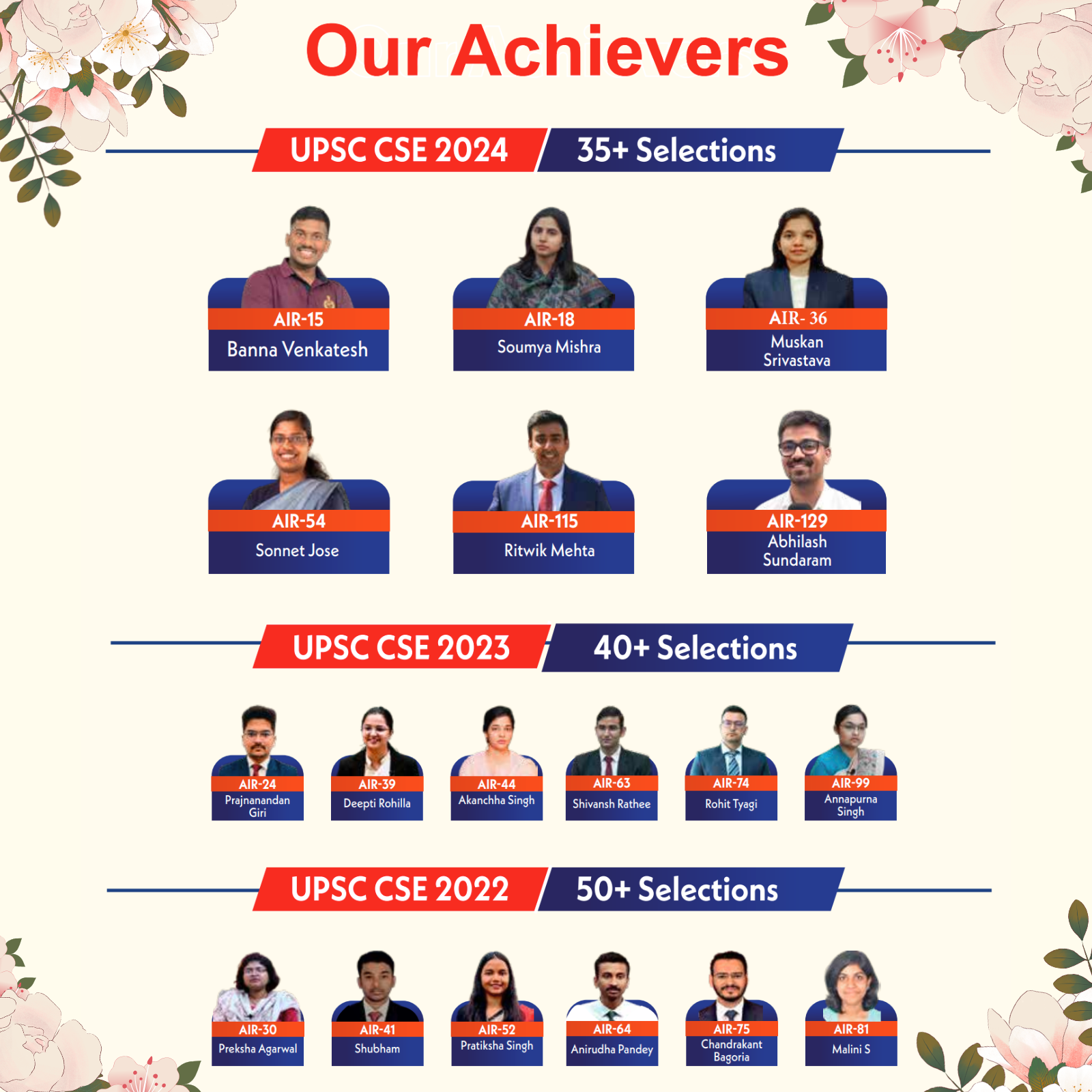
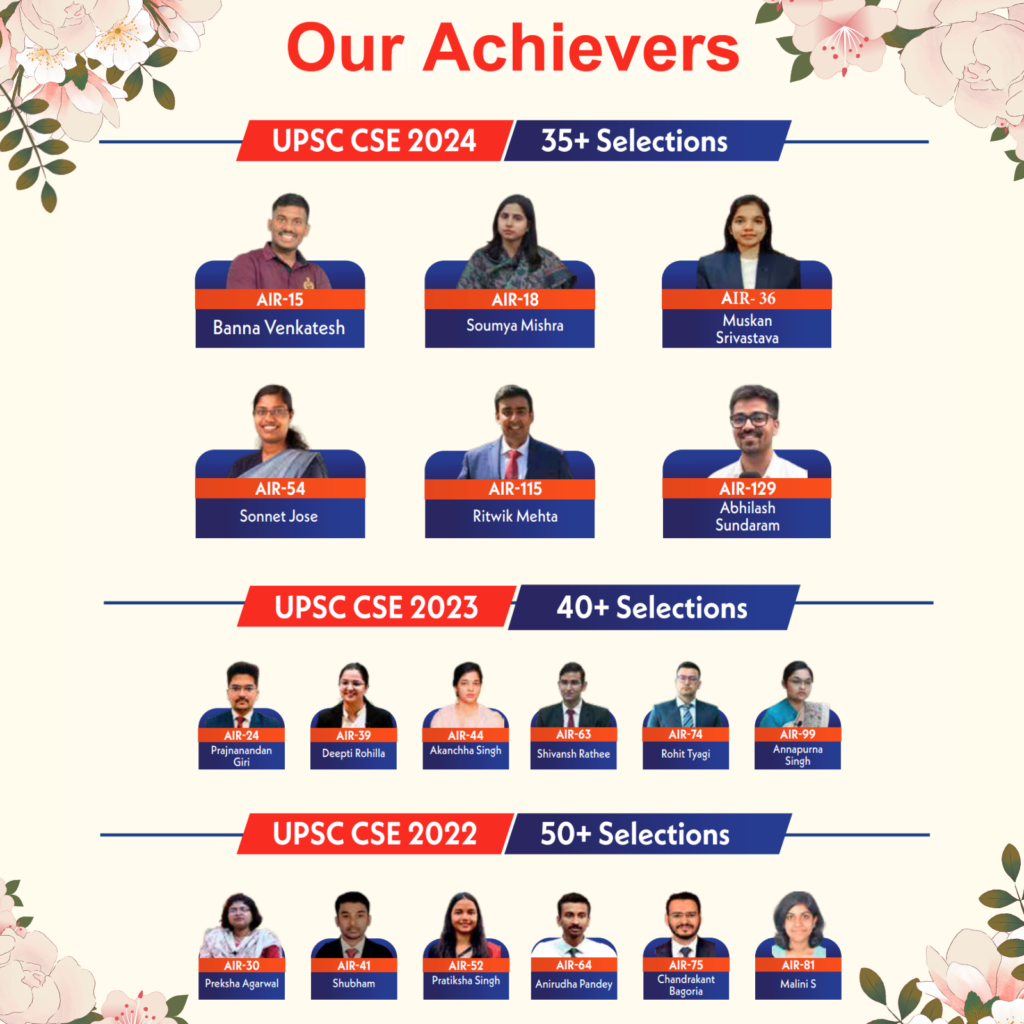
  • 🏆 Proven Track Record with Consistent Top Rankers Across Years: The results reflect a strong and repeatable system, not isolated success stories. Under his mentorship, students have consistently secured top ranks and high scores:
    • Banna Venkatesh (AIR 15)
    • Soumya Mishra (AIR 18)
    • Muskan Srivastava (AIR 36)
    • Sonnet Jose (AIR 54)
    • Ritwik Mehta (AIR 115)
    • Abhilash Sundaram (AIR 129)
    • 👉 Along with 35+ selections in UPSC CSE 2024, showcasing strong performance at the top level.
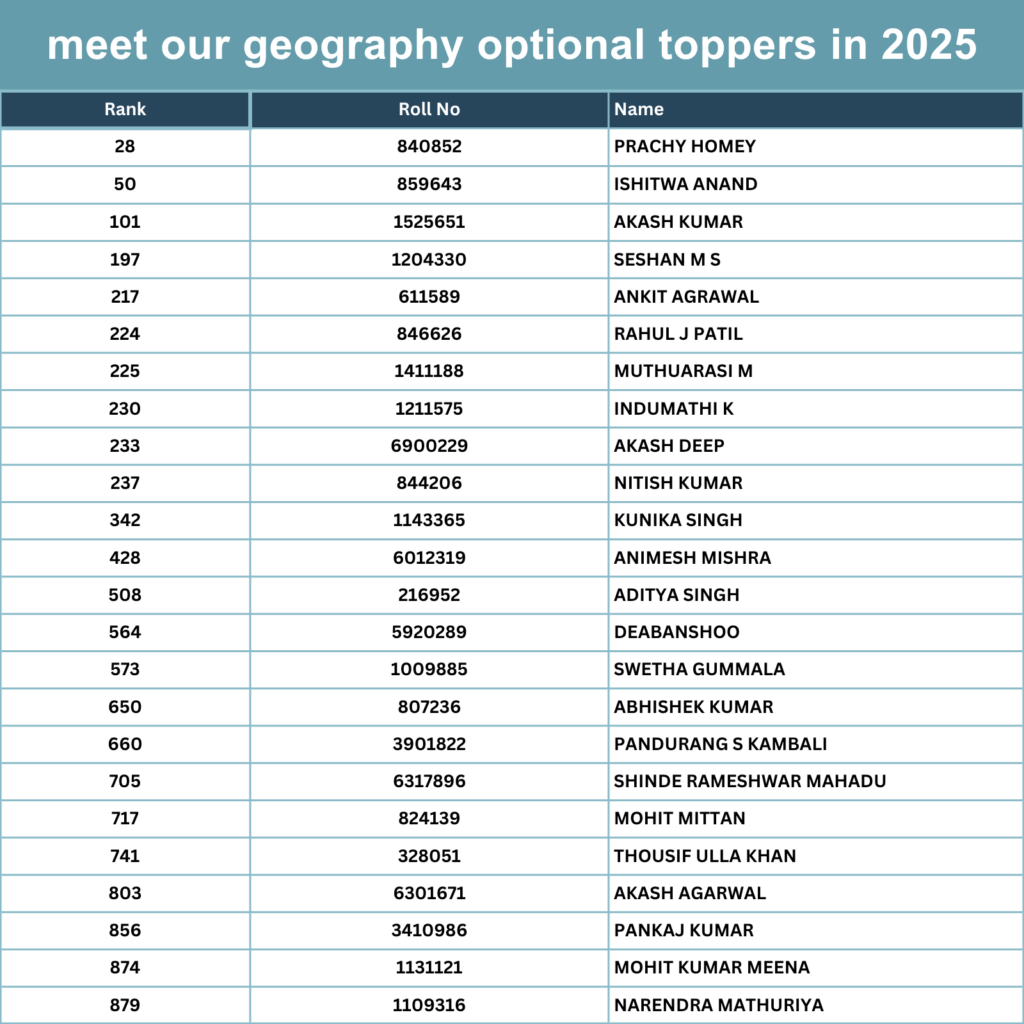
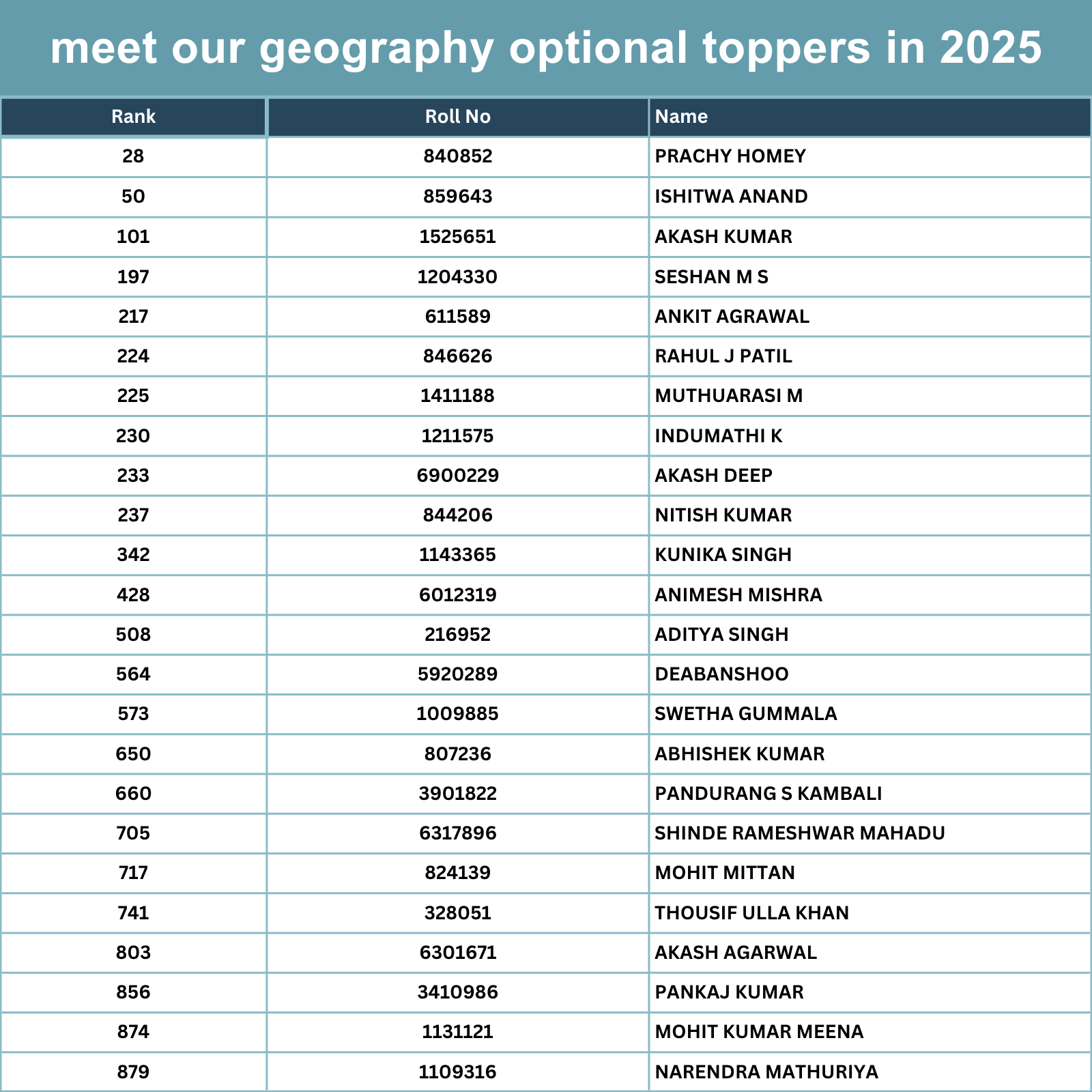
  • 📈 Strong Results in UPSC CSE 2025 with Wide Rank Distribution: The results are not limited to top ranks but spread across the list, showing consistency and scalability of the teaching system:
    • Prachi Honey (Rank 28)
    • Ishitwa Anand (Rank 50)
    • Akash Kumar (Rank 101)
    • Multiple selections across ranks up to 800+, indicating that the approach works for:
      • Beginners
      • Average aspirants
      • Top rankers alike
  • 📊 Consistent Performance Across Multiple Years (Long-Term Credibility): The success is not limited to a single year but spans across multiple UPSC cycles:
    • 40+ selections in UPSC CSE 2025
    • 35+ selections in UPSC CSE 2024
    • 50+ selections in UPSC CSE 2022
    • 60+ selections in earlier years (2019–2021)
    • 👉 This demonstrates a proven, time-tested preparation system rather than short-term success.
  • 🎯 High Scores in Geography Optional (300+ Benchmark Achieved)
    Several students have achieved exceptional marks in Geography Optional, validating the effectiveness of teaching methodology:
    • Pratham Kaushik – 327 marks
    • Deepti Rohilla (AIR 39) – 323 marks
    • Vijay Raghav Goyal – 312 marks
    • Multiple students consistently scoring in 280–300+ range
    • 👉 This highlights that the focus is not just on selection, but on maximizing optional marks, which is critical for top ranks.
  • 💬 Trusted by Toppers for Concept Clarity & Answer Writing Mastery
    Students consistently highlight:
    • Strong conceptual foundation through book-based teaching
    • Unique case study and synopsis approach
    • Continuous improvement in answer structure and presentation
    • 👉 This combination helps aspirants move from:
  • Content knowledge → Answer writing → High scores → Top ranks
  • 🚀 A Replicable System That Works for Every Serious Aspirant
    The biggest strength of Himanshu Sharma Sir’s mentorship is that it is not dependent on individual brilliance, but built as a structured system that works for:
    • Beginners starting from scratch
    • Repeat aspirants improving scores
    • Serious candidates targeting 300+ marks and top ranks
🚀 COURSES

🎯 Who Should Enroll in These Courses?

  • Aspirants choosing Geography Optional for UPSC CSE 2027 who want a clear, structured roadmap from Day 1, instead of struggling with scattered resources, random YouTube content, and unorganized preparation, ensuring that their effort is directed towards maximum output and marks.
  • Beginners starting Geography Optional from scratch who need strong conceptual clarity and guided preparation, as the subject requires understanding of both scientific (Physical Geography) and theoretical (Human Geography) components, along with the ability to interlink them effectively in answers.
  • Repeat aspirants who are stuck in the 230–260 marks range and want to break the plateau, by improving answer-writing skills, structuring ability, and value addition (diagrams, thinkers, case studies), which are essential to move into the 280–320+ marks bracket.
  • Aspirants who have covered the syllabus but struggle with answer writing and presentation, and need a system that teaches:
  • How to structure answers
  • How to use diagrams and maps
  • How to write analytical, multi-dimensional responses
  • Candidates targeting top ranks (AIR under 100) who understand that optional marks are decisive, and are looking for a program that focuses not just on completion of syllabus but on maximizing marks through strategy, practice, and mentorship.
  • Working professionals and time-constrained aspirants who require a structured, long-duration program with flexibility, including live classes for interaction and recorded lectures for revision, allowing them to maintain consistency alongside other commitments.
  • Aspirants who want to avoid common mistakes such as resource overload, lack of direction, and poor revision strategy, and instead follow a proven, streamlined approach that has consistently produced toppers and high scorers in Geography Optional.
  • Serious UPSC candidates who are willing to follow a disciplined, structured preparation system, where consistency, answer writing, and continuous improvement are prioritized over shortcuts and last-minute preparation.