

Official syllabusPaper I · Unit 2 · Methods of Psychology
Types of research: descriptive, evaluative, diagnostic and prognostic; Methods of research: survey, observation, case-study and experiments.
Definition
“Scientific research is a systematic, controlled, empirical and critical investigation of hypothetical propositions about the presumed relations among natural phenomena.”
Kerlinger (1973)
Psychology’s claim to be a science rests on method, so the question “which method?” is never merely technical. Each method buys one kind of knowledge at the cost of another: the experiment buys causal certainty by sacrificing context, the survey buys breadth by sacrificing depth, the case study buys depth by sacrificing generality. Choosing a method is choosing what you are willing to lose.
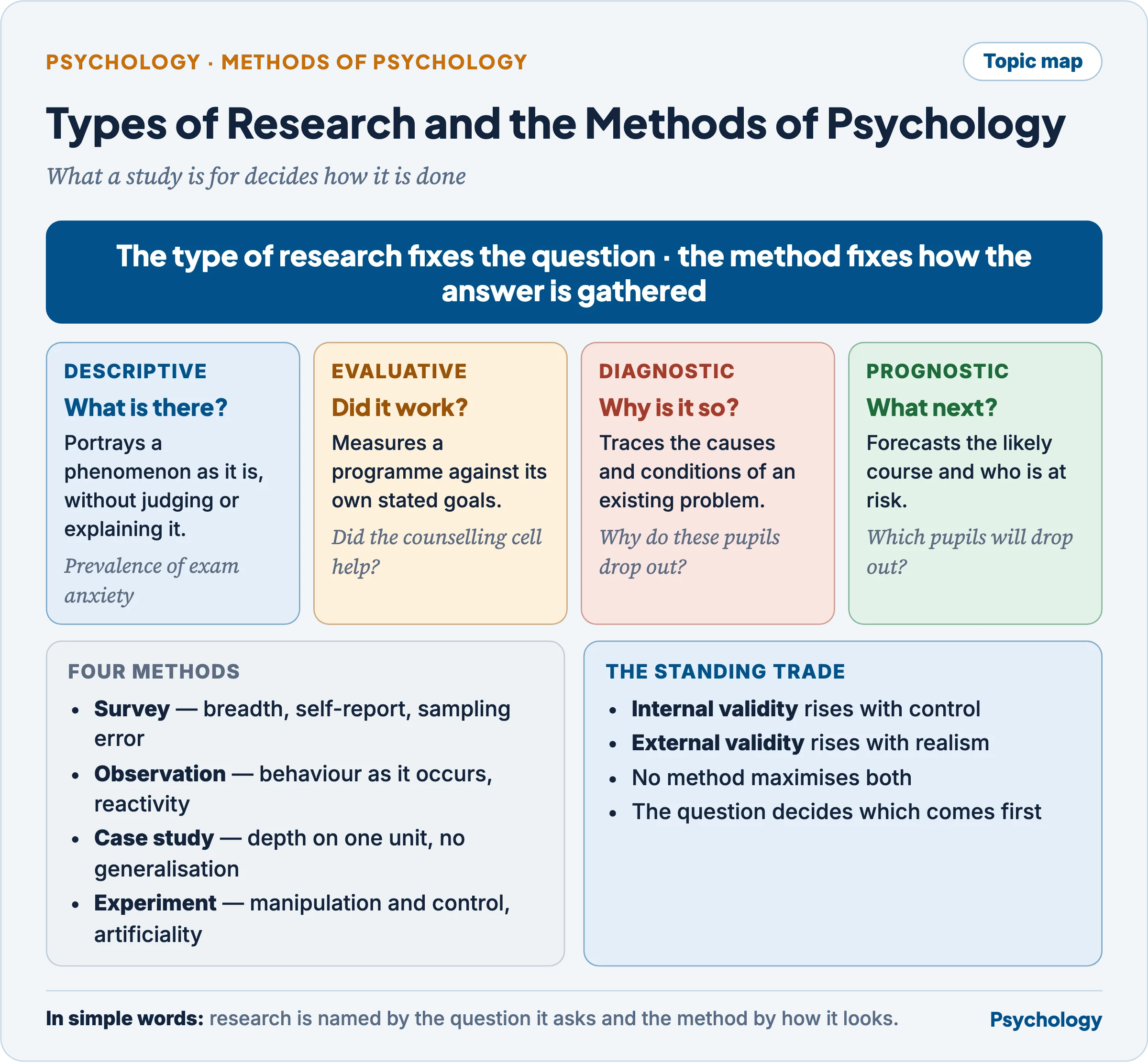
Every method on the map buys one kind of knowledge with another, so the column a method sits in is also a list of what it cannot tell you.
Types of research: descriptive, evaluative, diagnostic and prognostic
Research is classified in several ways at once — by purpose, by method, by setting. The syllabus names the classification by purpose, which asks what the investigator wants the findings to do.
- Descriptive research answers what is the case. It establishes the characteristics, frequency and distribution of a phenomenon without manipulating anything and without asking why.
- Typical questions: how common is examination anxiety among adolescents; what are the study habits of first-generation learners.
- Methods: survey, naturalistic observation, correlational study, normative study.
- It cannot establish cause, and it is often the necessary first stage: a phenomenon must be described before it can be explained.
- Diagnostic research answers why it is the case. It seeks the causes, correlates and conditions of a condition already identified, usually in order to act on it.
- Typical questions: why do these particular children show reading failure; what accounts for absenteeism in this workplace.
- It is explanatory and causal in intent, and it usually follows descriptive work that has established there is something to explain.
- The relation to description is sequential: description finds the problem, diagnosis locates its source.
- Prognostic research answers what will happen. It predicts the future course of a condition and the likely outcome of leaving it alone or intervening.
- Typical questions: which students will drop out; which patients will relapse; what is the likely course of a developmental delay.
- It depends on longitudinal data and on established predictive relationships, which makes it slow and costly to do well.
- Evaluative research answers did it work. It judges the worth, effectiveness or efficiency of a programme, intervention or policy against its stated objectives.
- Formative evaluation runs during a programme to improve it; summative evaluation runs at the end to judge it. Scriven (1967) introduced the distinction for curriculum evaluation.
- Typical questions: did the remedial teaching raise achievement; is the counselling service reducing distress.
- It is the type most used in applied and policy settings, and it needs a comparison condition to mean anything.
[Descriptive]  -> What is the case?
      |
[Diagnostic]   -> Why is it the case?
      |
[Prognostic]   -> What will happen next?
      |
[Evaluative]   -> Did the intervention work?
Each stage presupposes the one above it: you cannot diagnose what you have not described.
- Diagnostic and prognostic research are complementary.
- Diagnosis identifies the causes operating now; prognosis projects the course those causes will produce. One looks backward to origin, the other forward to outcome.
- Prognosis depends on diagnosis: a prediction about a condition requires knowing what is producing it, since the forecast changes entirely with the cause.
- Diagnosis is incomplete without prognosis in applied work, because identifying a cause without knowing its likely trajectory gives no basis for deciding whether to intervene or how urgently.
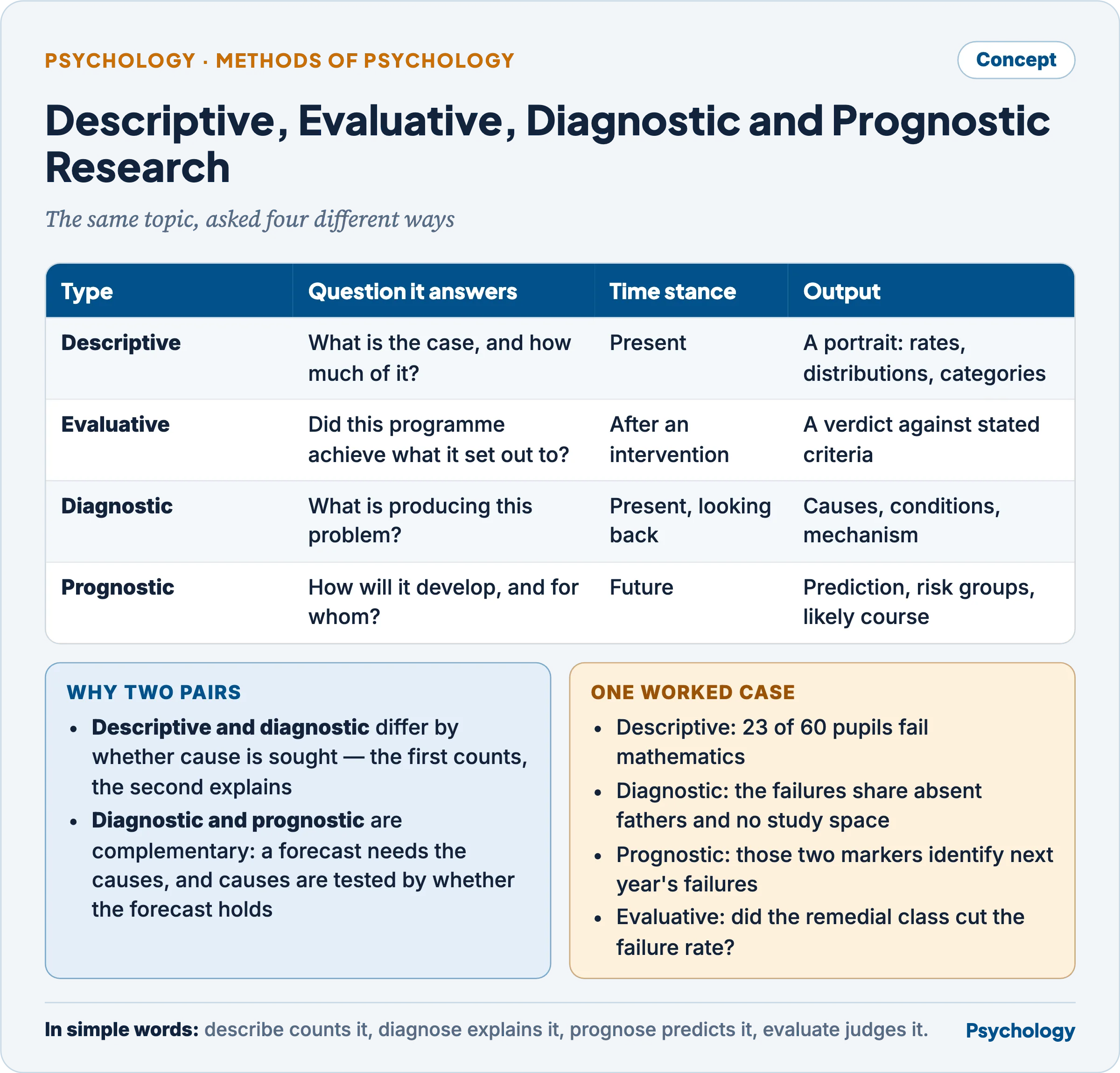
The same topic, asked four different ways.
Methods of research
The syllabus names four: survey, observation, case study and experiment. They differ along two dimensions that decide everything else — how much the investigator controls, and how many cases are studied in how much depth.
- Data-collection techniques serve all four: interview, questionnaire, psychological tests, ratings and records. Group and qualitative methods are treated in Focussed Group Discussions, Brain Storming and the Grounded Theory Approach.
- Theory-testing research is hypothetico-deductive, deriving predictions and checking them; theory-developing research is inductive, building categories from data, as in Glaser and Strauss (1967).
The survey
- A survey collects standardised information from a sample, usually by questionnaire or structured interview, in order to describe a population.
- Strengths: it reaches large and geographically spread samples economically; with probability sampling it supports generalisation to the population; it can cover attitudes, beliefs and reported behaviour that observation cannot reach; and it produces quantifiable data suited to statistical analysis.
- Limitations: it yields self-report, which is subject to social desirability, acquiescence, faulty memory and the respondent’s limited insight; non-response biases the sample in ways that are hard to detect; responses are shallow, since the schedule cannot follow up; and it establishes association, never causation.
Observation
- Observation records behaviour as it occurs, without relying on what the person reports. Its basic elements are the unit of behaviour to be recorded, the sampling of time or events, the recording system, and a check on inter-observer reliability.
- The dimension of participation is the axis that most changes what the method yields:
- Non-participant observation keeps the observer outside the group. It preserves detachment and reduces the observer’s effect on the behaviour, but limits access to meaning and to private settings.
- Participant observation places the observer inside the group as a member. It gives access to meanings, private behaviour and the group’s own categories, which no external record reaches.
- The costs of participation are specific: reduced objectivity as the observer is socialised into the group’s view; altered behaviour among those observed; a recording problem, since notes usually cannot be made at the time; and ethical difficulty where participation is covert and consent impossible.
- Gold (1958) named the four field roles — complete participant, participant-as-observer, observer-as-participant, complete observer — ordered by how far the observer’s identity and purpose are disclosed.
- Festinger, Riecken and Schachter (1956) joined a doomsday group covertly to watch a prophecy fail: the role’s richest access, with its ethical and reactivity costs, in one study.
- Naturalistic and laboratory observation differ in setting:
| Dimension | Naturalistic observation | Laboratory observation |
|---|---|---|
| Setting | The behaviour’s own environment | A controlled, arranged setting |
| Control over variables | Minimal | Substantial |
| Ecological validity | High — behaviour is as it ordinarily occurs | Lower — the setting may itself alter behaviour |
| Internal validity | Low — extraneous influences uncontrolled | High |
| Reactivity | Lower if observation is unobtrusive | Higher; participants know they are studied |
| Replication | Difficult; conditions do not recur | Straightforward |
| Typical use | Discovery, hypothesis generation, rare or social behaviour | Precise recording, testing a specified relation |
- Ainsworth and Bell (1970) watched one-year-olds through a one-way mirror across eight short episodes — the Strange Situation — the standard case of laboratory observation yielding attachment categories.
- Can the two be reconciled? They can, and the reconciliation is methodological rather than a compromise.
- The usual sequence is naturalistic first, laboratory second: field observation identifies the phenomenon and generates hypotheses in a form the laboratory can test precisely.
- Converging operations (the term is Garner, Hake and Eriksen’s, 1956) reconcile them at the level of conclusions: a finding that appears both in the field and under control is far better established than either alone, because the two methods’ weaknesses do not overlap.
- Field experiments partially combine them, applying manipulation within a natural setting, trading some control for ecological validity.
- What cannot be reconciled is the underlying tension: control and naturalness vary inversely, so each study must choose its position, and the discipline achieves both only across studies.
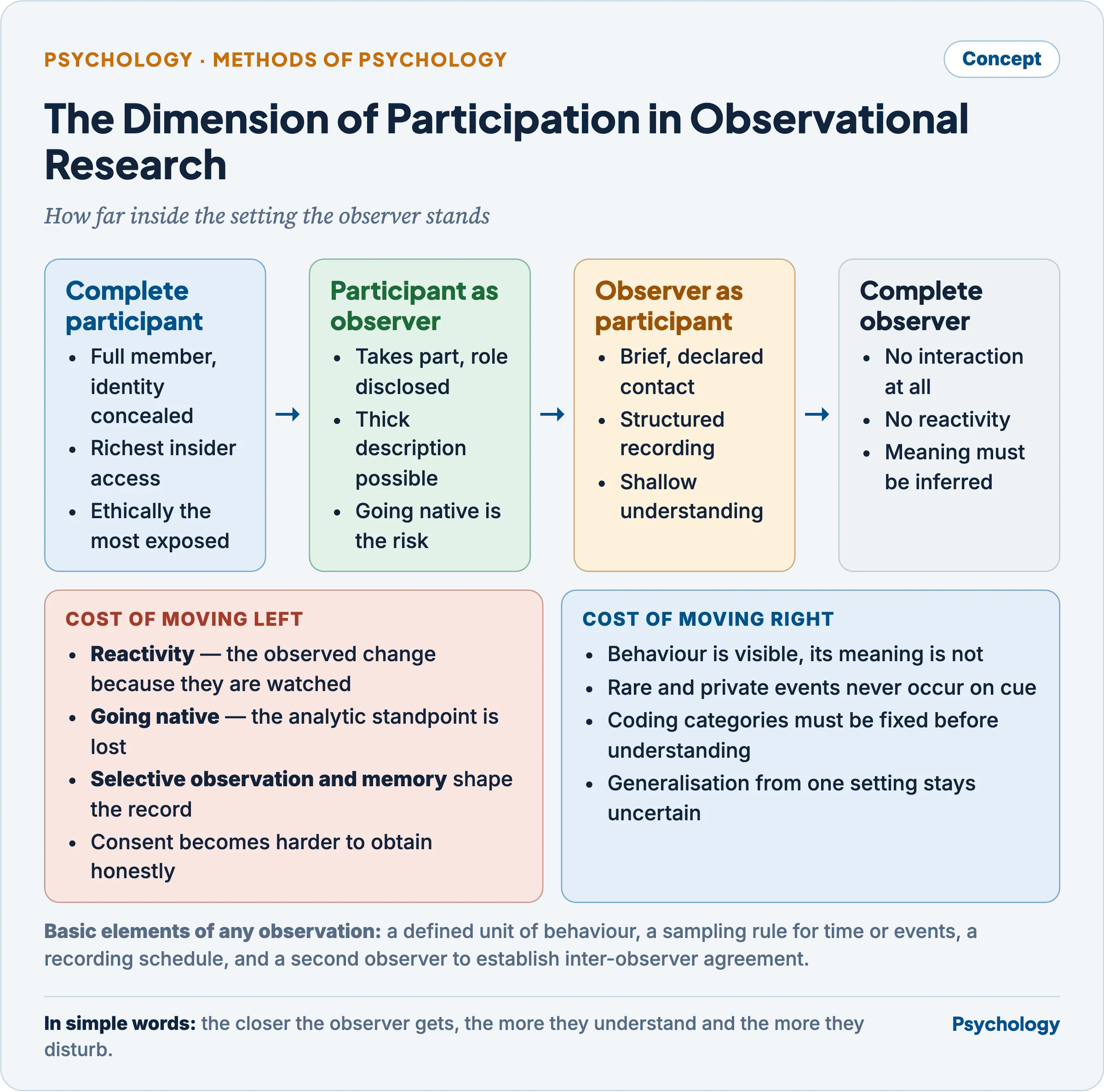
The closer the observer stands, the more they understand and the more they disturb.
The case study
- A case study is an intensive investigation of a single individual, group, institution or event, drawing on interview, observation, test data, records and informants’ accounts.
- Strengths: it reaches depth and context no other method achieves; it is the only practical approach to rare conditions where a sample cannot be assembled; it preserves the complexity and sequence of a life or an episode.
- Further strengths: it is a fertile source of hypotheses; and it can disconfirm a universal claim, since a single genuine counter-example refutes a law.
- Limitations: it supports no generalisation from one case to a population; the investigator’s interpretation shapes what is recorded; it often depends on retrospective report, which memory distorts; and it cannot establish cause, since nothing is controlled.
- Its standing rests on cases that changed theory. Scoville and Milner (1957) reported H.M., whose bilateral medial temporal resection left intellect intact but abolished new memory formation — one patient separating memory from intelligence, which no group study could have shown.
The experiment as a method of research
- An experiment manipulates an independent variable, measures a dependent variable, and controls extraneous variables, so that a difference in outcome can be attributed to the manipulation.
- Its essential features are manipulation, random assignment and comparison, together securing control of extraneous variables:
- Manipulation of at least one variable by the investigator, rather than observation of variation that already exists.
- Control is the purpose they serve: extraneous variables are held constant, randomised or counterbalanced.
- Random assignment of participants to conditions, which equates the groups on everything the investigator has not thought of — the single feature that licenses causal inference.
- Comparison against a control or alternative condition, without which a change means nothing.
- Bandura, Ross and Ross (1961): 72 nursery children saw an aggressive adult model, a non-aggressive one, or none; those who saw aggression reproduced it — manipulation, control group and comparison in one design.
- Its limitations are equally specific:
- Artificiality. The laboratory setting and the task may bear little resemblance to the behaviour outside it, so findings may not transfer.
- Reactivity. Participants pick up cues to what is expected — demand characteristics, which Orne (1962) defined as “the totality of cues which convey an experimental hypothesis to the subject” — and behave accordingly.
- Investigators unconsciously influence outcomes, producing experimenter effects (Rosenthal, 1966); both are treated fully in Quasi-Experimental and Non-Experimental Designs, as is the correlational method.
- Ethical limits. The most informative manipulations — deprivation, trauma, prolonged stress — cannot be performed, so the strongest design is unavailable where causal questions matter most.
- Narrowness. Only variables that can be manipulated and measured can be studied, which excludes much of what matters in human life.
- Sample limits. Volunteer and student samples restrict generalisation.
Choosing a method for a question
The method follows from the question, and the reasoning should be made explicit rather than asserted.
- For a causal question with a manipulable variable — does this teaching method raise achievement — the experiment or quasi-experiment is the only adequate choice.
- For prevalence and distribution — how widespread is a belief — the survey, with probability sampling.
- For a rare or unique phenomenon — a single unusual patient — the case study.
- For behaviour that self-report will distort — aggression, conformity, prejudice — observation, because people under-report what reflects badly on them.
- For a question where the variable cannot be manipulated — gender differences in workplace aggression, for instance — the honest answer names the constraint: gender cannot be assigned, so a true experiment is impossible.
- Non-participant observation with operationally defined aggression categories is the strongest available approach, avoiding the self-report bias that distorts surveys on disapproved behaviour; a multi-method design adds records and ratings.
- Archer (2004), meta-analysing real-world studies, found direct physical aggression higher in males at every age, indirect aggression higher in females only in later childhood and adolescence, and results varying with measurement method.
- The sub-fields differ in their characteristic orientation, which is a matter of what their subject matter permits:
- Physiological psychology is predominantly experimental and laboratory-based, using measurement of neural and bodily variables, animal models and neuropsychological case studies, because its variables are manipulable and measurable.
- Social psychology combines laboratory experiment with field experiment, survey and observation, because its phenomena are powerfully context-dependent and often cannot be reproduced in a laboratory without destroying them.
- Counselling psychology relies chiefly on case study, interview and qualitative methods, with outcome research using quasi-experimental and controlled trial designs, because the relationship it studies is individual and cannot ethically be manipulated.
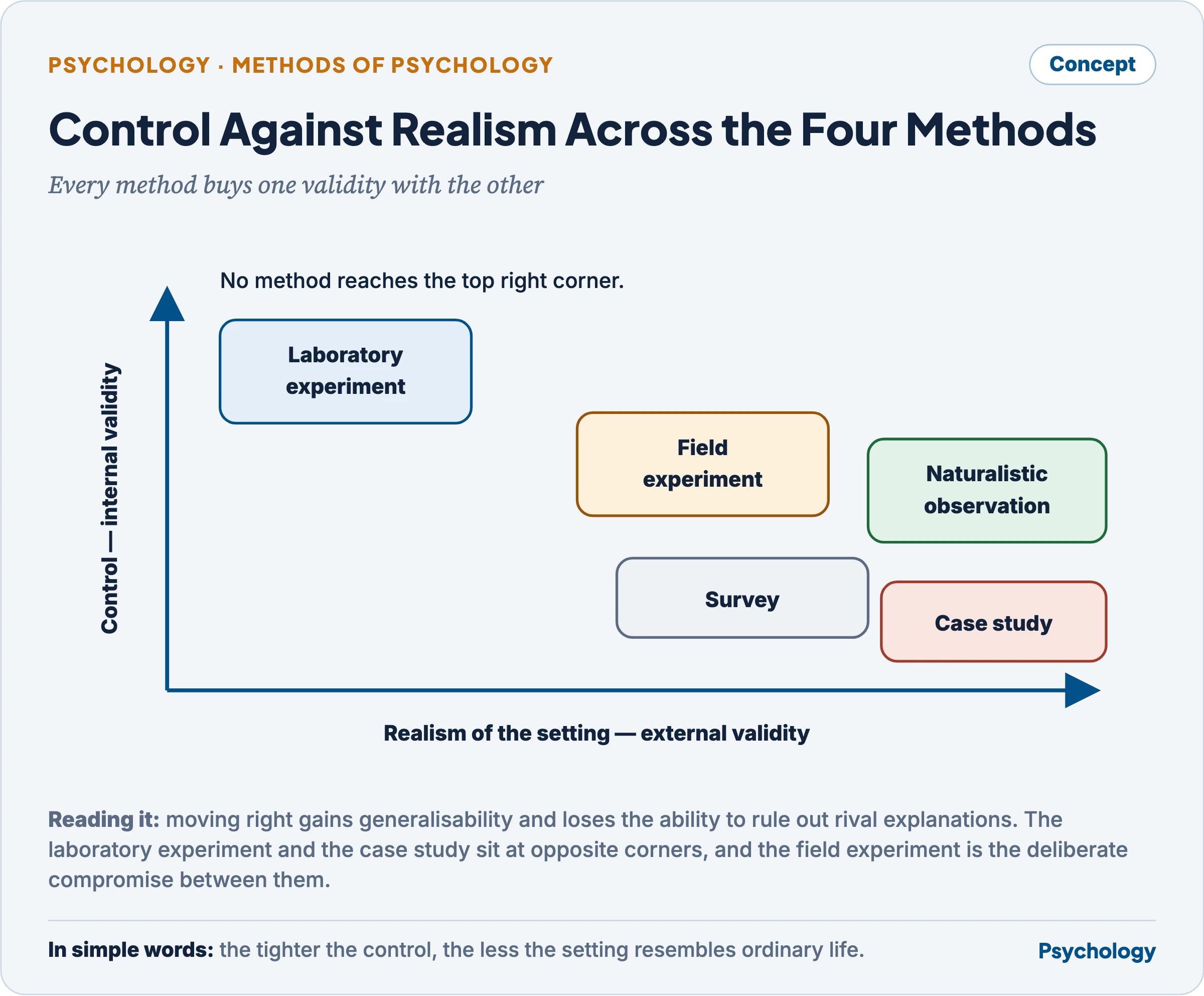
No method reaches the top right corner.
Criticisms and limitations
- No method is adequate alone. Each buys one kind of validity at the cost of another, which is why triangulation across methods is the discipline’s practical answer. The Open Science Collaboration (2015) re-ran 100 published studies: 36% of replications reached significance against 97% of originals.
- The internal-external validity trade-off is structural, not a defect to be fixed; Campbell and Stanley (1963) called internal validity the sine qua non of experiments, and the laboratory–field comparison is in Experimental Designs and the Control of Variance.
- The controls that secure internal validity are the same features that reduce resemblance to ordinary life.
- Classification by purpose is not clean. A single study is often descriptive, diagnostic and evaluative in different parts, so the four types describe emphases rather than mutually exclusive categories.
- Quantification has limits. Reducing experience to a score discards meaning, which is the standing qualitative objection and the reason interpretive methods coexist with experimental ones.
- Ethical constraint is permanent. Consent, deception, debriefing and the right to withdraw restrict what may be studied, and these are not obstacles to be engineered around but conditions of doing the work.
Indian context
- Measurement equivalence is the recurring methodological failure in Indian psychological practice. A survey instrument translated but not re-standardised, carrying foreign norms, produces numbers that look comparable and are not.
- That is a validity problem, and therefore a scientific one rather than a political complaint.
- Survey research in India faces conditions the textbook method does not anticipate: multilingual administration, variable literacy requiring oral delivery, and respondents’ reluctance on socially sensitive items, all of which alter what a standardised schedule actually measures.
- Large-scale survey infrastructure now exists. The National Mental Health Survey 2015–16 (NIMHANS) interviewed 34,802 adults in 12 states — descriptive and diagnostic research in one instrument.
- The National Family Health Survey, the Periodic Labour Force Survey and NCRB compilations supply other Indian baselines.
- Evaluative research has a policy home. Programme evaluation under schemes administered by NITI Aayog and the line ministries is where psychologists’ evaluation methods meet Indian practice.
- A common weakness is evaluation by coverage — how many were reached — rather than by outcome against a baseline.
- Durganand Sinha (1986), in Psychology in a Third World Country, made the central methodological argument for Indian psychology: a study can be rigorous and still irrelevant if its problems and categories are imported, so method and content cannot be separated.
Previous Year Questions
- 2026Differentiate among descriptive, evaluative, diagnostic and prognostic research.
- 2024Describe data collection methods in psychology with special reference to observation and survey methods.
- 2023How is descriptive type of research different from diagnostic research? Answer the question giving suitable example of each.
- 2022Compare and contrast naturalistic observation and laboratory-based observation as methods of psychological research. Can they be reconciled? Discuss.
- 2021Which method is most appropriate to investigate gender differences in aggressive behaviour at the work place? Elaborate.
- 2019“Diagnostic and prognostic researches are complementary to each other.” Explain with suitable examples.
- 2013Describe the basic elements of observation and bring out the implications of the dimension of participation in observational research.
- 2007How do psychologists use case study and survey to describe behaviour? Indicate their advantages and disadvantages.
- 1997What would be the major methodological orientation for doing research in Physiological psychology, Social Psychology and Counselling Psychology?
- 1995Describe the essential features of an experiment in psychology giving suitable examples. Discuss the limitations of the experimental method.
