

8 (c, d) Research methods in Anthropology: Tools of data collection: observation, interview, schedules, questionnaire, Case study, genealogy, life-history, oral history, secondary sources of information, participatory methods. Analysis, interpretation and presentation of data.
Official Syllabus: Paper I, Unit 8
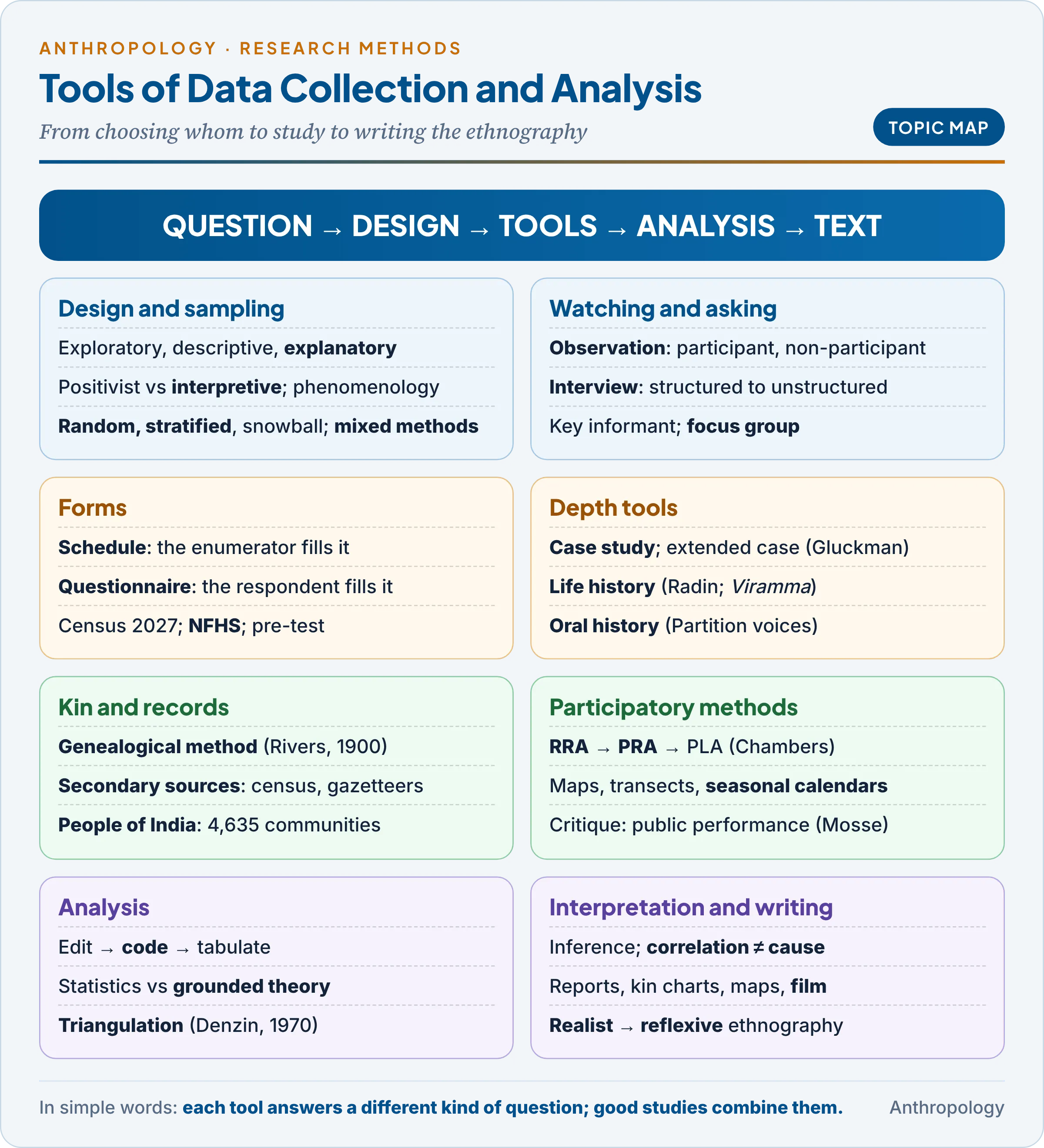
Unit 8a traced how anthropology moved from the armchair to long-term fieldwork (the Torres Strait expedition of 1898, Malinowski in the Trobriands), separated technique, method and methodology, and examined participant observation, reflexivity and fieldwork ethics. This article takes up the tools a fieldworker carries into the village, and what happens to the data afterwards: how it is analysed, interpreted and written up.
1. Before the Tools: Research Design, Sampling and Mixed Methods
In simple words
Before collecting anything, a researcher decides what question to ask, whom to study and which tools fit the question. Some questions need numbers from many people; others need deep understanding of a few. Good research often uses both.
1.1 Research design and the two traditions
A research design is the plan that links a question to the data needed to answer it. It fixes the unit of study (a household, a clan, a village), the tools, and whether a hypothesis (a tentative answer to be tested) is set in advance.
- Exploratory design: used when little is known; it ends in hypotheses, not proof, as most first ethnographies do.
- Descriptive design: records features accurately, as the People of India survey did (§7).
- Explanatory (diagnostic) design: tests why something happens, such as why some households migrate and others do not.
Behind designs lie two traditions of knowing: positivist and non-positivist (interpretive) research.
| Positivist (quantitative) | Interpretive (qualitative) | |
|---|---|---|
| Assumption | Social facts can be measured like natural facts | Meaning must be understood from the inside |
| Roots | Comte, Durkheim | Weber’s Verstehen (interpretive understanding), phenomenology |
| Typical tools | Schedule, questionnaire, census, statistics | Participant observation, unstructured interview, life history |
| Strength | Generalisation, comparison, replication | Depth, context, the people’s own view (emic) |
| Weakness | Misses meaning; imposes the researcher’s categories | Small samples; harder to check; researcher’s subjectivity |
The table shows a trade-off, not a winner. Numbers say how often; meanings say why. Anthropology has long been mainly interpretive, but it uses counting wherever counting helps, as the genealogical census (§6) shows.
- Subjectivity (the researcher’s own background shaping what is seen) cannot be removed, only disclosed and controlled: by reflexivity (writing openly about one’s own position, Unit 8a), by triangulation (checking one source against another, §9.3), and by long residence that lets first impressions be corrected.
- Phenomenology, founded by the German philosopher Edmund Husserl and carried into social science by the Austrian-American sociologist Alfred Schutz, studies lived experience. As a method it asks the fieldworker to suspend prior theories (“bracketing”) and describe how illness, pain or ritual feels to participants; the American anthropologist Thomas Csordas (1990) built on it to treat the body as the ground of culture (embodiment). Its value is depth of meaning; its limit is that experience is hard to verify or compare.
1.2 Sampling: whom to study
When a population is too large to study whole, a researcher studies a sample: a part chosen to stand for the whole. The question is how it is chosen.
| Type | How the sample is drawn | Example of use |
|---|---|---|
| Simple random | Every unit has an equal chance (lottery, random numbers) | Households from a complete village list |
| Systematic | Every k-th unit after a random start | Every 10th house on a census list |
| Stratified | Population split into strata (caste, sex, age, landholding), then random sampling within each | Ensuring landless and landowning households both appear |
| Cluster | Whole groups (villages, blocks) chosen at random | Large district surveys |
| Multistage | Random choice at several levels: districts → villages → households | NFHS (two-stage design) |
| Purposive (judgement) | Researcher picks typical or information-rich cases | Choosing a village with a new dam |
| Snowball | Each informant names the next | Hidden groups: migrant workers, healers |
| Quota | Fixed numbers from each category, chosen non-randomly | Quick opinion studies |
The first five are probability samples, which allow statistical generalisation; the last three are non-probability samples, which suit exploration and hard-to-reach groups. Ethnographers also use theoretical sampling: choosing the next case because it can test an emerging idea.
Worked example (systematic sample). A village list has N = 400 households and the researcher needs n = 40. The interval is k = N/n = 10. A random start of 7 gives households 7, 17, 27 … 397. The danger is periodicity: if every tenth house on the list happened to be a corner shop, the sample would be biased.
1.3 Mixed methods
Mixed methods research combines quantitative and qualitative tools in one study, so that each covers the other’s blind spot.
- Convergent design: survey and ethnography run side by side and are compared.
- Explanatory sequential: a survey finds a pattern (say, low uptake of a health scheme); in-depth interviews then explain it.
- Exploratory sequential: fieldwork first discovers local categories; a schedule then counts them across many villages.
The approach is old in anthropology even if the label is new: Malinowski combined statistics, maps and genealogies with participant observation.
2. Observation
In simple words
Observation means watching what people actually do, not only listening to what they say they do. The watcher may join in the activity or stand apart. Joining in gives depth; standing apart gives a cooler, more checkable record.
When the British-born anthropologist Verrier Elwin lived for years among the Baiga (Madhya Pradesh) and wrote The Baiga (1939), he saw how shifting cultivation, myth and taboo fitted together in daily life, which no questionnaire could have shown. That is the promise of observation: it records behaviour in its setting.
2.1 Types of observation
| Basis | Types | What differs |
|---|---|---|
| Role of observer | Participant, non-participant, quasi-participant | Whether the observer joins the activity |
| Setting | Uncontrolled (natural setting) vs controlled (planned or laboratory) | Whether the situation is arranged by the researcher |
| Procedure | Structured vs unstructured | Whether the units to record are fixed in advance |
| Directness | Direct vs indirect (traces, records, recordings) | Whether behaviour is watched as it happens |
- Participant observation: the researcher shares the life of the group, learns the language and takes part in work and ritual. Its logic, history and ethics are the subject of Unit 8a: in short, it reaches the “imponderabilia of actual life” (Malinowski’s phrase for the small, unrecorded details of daily routine) and the gap between what people say and what they do.
- Non-participant observation: the researcher watches without joining, as when recording seating order at a caste panchayat (council); it suits structured recording with an observation schedule (§4.3).
- Quasi-participant observation: the realistic middle position. In a phrase from the methods literature, the long-staying fieldworker becomes a “friendly and curious outsider“: present at everything, a member of nothing.
2.2 Merits and problems
- Merits: records natural behaviour in context; checks words against action; reaches the non-literate; and is open-ended, so unexpected themes surface.
- The observer effect: people change behaviour when watched, the Hawthorne effect, named after the Western Electric factory studies near Chicago (1924–32), where output rose whatever was changed, apparently because workers knew they were studied. Long residence reduces it: people stop performing for a familiar face.
- Over-involvement: a participant in an important role may change the group, and strong emotion can cloud judgement; “going native” (losing analytic distance) is the extreme case.
- Limited reach: sexual life, family crises and sorcery accusations are seldom seen directly, so the observer relies on interview and case material.
3. Interview
In simple words
An interview is a planned conversation in which the researcher asks and the other person answers. It can follow a fixed list of questions or flow freely. It reaches thoughts, memories and meanings that cannot be watched.
An interview is often described as a conversation with a purpose: an intentional process steered toward planned content. It is indispensable because beliefs, motives and past events cannot be observed; they must be told.
3.1 Types of interview
| Type | Form | Best use |
|---|---|---|
| Structured (formal) | Same questions, same order, often with an interview schedule | Comparable answers from many people |
| Semi-structured | A guide of topics; order and wording flexible | Most ethnographic interviewing |
| Unstructured (informal, depth) | Free conversation, follow-up on what emerges | Life histories, sensitive topics |
| Key-informant | Repeated long interviews with a knowledgeable person | Ritual specialists, elders, headmen |
| Focus group | 6–10 people discuss a topic together, guided by a moderator | Shared norms, contested views |
| Group interview | Several people answer together, often in public | Village histories, collective decisions |
Two points follow. Structure trades depth for comparability: the more fixed the questions, the easier the counting and the thinner the meaning. And who is in the room shapes the answer: a focus group shows what can be said in public, a private interview what cannot.
- Focus group: grew from the “focused interview” of the American sociologist Robert Merton and colleagues (The Focused Interview, 1956), first used on audience reactions to wartime propaganda. Participants react to one another, exposing disagreement, but dominant voices (elders, men, upper castes) may silence others.
- Key informant: a person with special knowledge who becomes the fieldworker’s long-term teacher; the danger is taking one (often elite male) view for the whole culture, so informants are cross-checked.
3.2 Technique, merits and limits
- Technique: explain the purpose; start with easy factual questions; listen more than talk; avoid leading questions (“You must dislike the moneylender, don’t you?”); probe (“Tell me more”); note silences; record only with consent.
- Merits: flexible; works with the non-literate; allows on-the-spot clarification and follow-up of contradictions.
- Limits: depends on the interviewer’s skill; answers may be what the informant thinks is wanted; recall is selective; interviewer bias (caste, gender, outsider status) shapes replies.
4. Schedule and Questionnaire
In simple words
Both are printed or digital lists of questions. A schedule is filled in by the researcher while talking to the person; a questionnaire is filled in by the person alone. The difference decides who can be studied and how good the answers are.
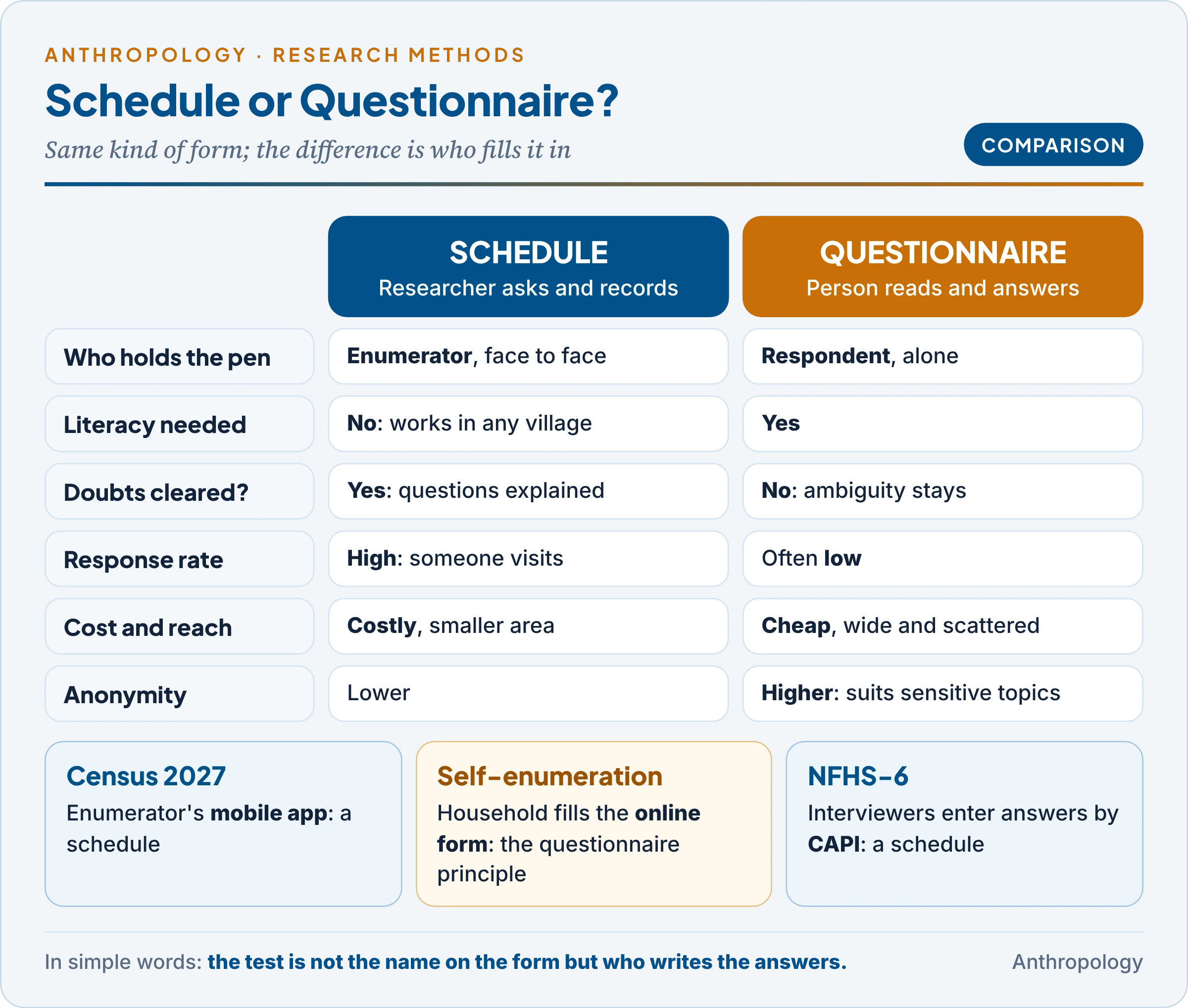
In Census 2027, an enumerator visits every household with a mobile app and asks the notified questions (33 in the houselisting phase; 40 in population enumeration), entering the answers herself: that is a schedule. For the first time, households could instead fill the same form online through a self-enumeration portal and hand the enumerator an ID to confirm: that is the questionnaire principle. The two tools differ less in their questions than in who holds the pen.
4.1 Origin in anthropology
- The American lawyer-anthropologist Lewis Henry Morgan circulated a printed schedule of kinship terms from 1859, through missionaries and officials, to collect terminologies worldwide; many forms never came back, and the replies became Systems of Consanguinity and Affinity of the Human Family (1871).
- The British Association’s Notes and Queries on Anthropology (first edition 1874) was in effect a giant guide-questionnaire for travellers and administrators.
4.2 The distinction
| Point | Schedule | Questionnaire |
|---|---|---|
| Filled by | Researcher or enumerator, face to face | Respondent himself or herself |
| Literacy needed | No; works among non-literate groups | Yes |
| Clarification | Questions explained, answers probed | None; ambiguity cannot be resolved |
| Response rate | High: the enumerator visits | Often low (mail, online) |
| Cost and reach | Costly, slow, limited area | Cheap; reaches large, scattered samples |
| Anonymity | Lower: the respondent faces the enumerator | Higher: suits sensitive topics |
| Interviewer bias | Possible | Absent |
| Who answers | The enumerator knows who replied | Unknown: someone else may fill it |
The table explains why anthropologists working in villages favour the schedule: it works where literacy is low and lets the investigator see the household. The questionnaire suits literate, dispersed or urban groups and topics where anonymity matters more than probing.
Common confusion
Is the NFHS a questionnaire or a schedule? In practice, a schedule. NFHS-6 (2023–24) calls its four instruments (household, woman’s, man’s and biomarker) both “questionnaires” and “schedules”, but trained interviewers read the questions aloud and enter the answers on a tablet (Computer Assisted Personal Interviewing, CAPI). The test is not the name printed on the form but who fills it in.
4.3 Kinds of schedule and questionnaire
- Schedules: observation schedule (records behaviour uniformly; a “memory tickler”); document schedule (extracts the same items from records such as land registers); evaluation or institutional survey schedule (assesses a programme); interview schedule (the structured interview’s list).
- Questionnaires: structured, with closed answers (easy to count) or open answers (richer, harder to classify); unstructured (an interview guide for a few intensive cases); pictorial (pictures for children and non-literate respondents).
4.4 Framing good questions
- Wording: simple words, no jargon; ask “How will the respondent understand this?”; no leading questions; one idea per question; stay within the respondent’s knowledge.
- Order: easy factual questions first; group by subject; keep time sequence; stop early questions colouring later ones.
- Pre-test (pilot): try the form on a few people and revise; it exposes superfluous and missing questions.
- Limits of both tools: uniform questions may not fit varied cultures; answers can be perfunctory; attitudes measured by forms have low reliability. Hence they work best as supplements to observation and interview.
5. Case Study, Life History and Oral History
In simple words
These three tools go deep rather than wide. A case study examines one unit (a person, family, village or dispute) in full detail. A life history follows one person’s life through time. An oral history records what people remember and tell about the past.
5.1 Case study
A case study is an intensive, all-round study of a single social unit: a person, family, institution, community or event. The American sociologist Ernest Burgess called it “the social microscope”, because it shows in fine detail the forces that shape the unit.
- Origin: the French sociologist Frédéric Le Play used family budgets as cases (Les Ouvriers européens, 1855); W.I. Thomas and Florian Znaniecki (The Polish Peasant in Europe and America, 1918–20) made personal documents the core of evidence. Anthropological classics include Robert Redfield‘s Tepoztlán (1930), Oscar Lewis‘s restudy (1951) and Cora Du Bois‘s The People of Alor (1944).
- Indian example: the British anthropologist F.G. Bailey‘s Caste and the Economic Frontier (1957) traced how a new cash economy reshuffled caste ranks in one Odisha village, Bisipara: one case, studied in depth, illuminated a process found across India.
- Extended case method: the Manchester school, led by the South African-born Max Gluckman (“Analysis of a social situation in modern Zululand”, 1940, built around the opening of a bridge) and Jaap van Velsen (1967), followed one dispute or event over time to show how people manipulate rules, rather than treating rules as fixed. Victor Turner’s social drama grew from this approach.
- Characteristics: one or a few units; holistic; usually long; qualitative; traces natural history (how the unit came to be); generates hypotheses.
- Merits: depth and context; captures process and change; reveals motives; helps design better schedules. The American sociologist Charles Horton Cooley said it “deepens our perception and gives us a clearer insight into life”.
- Limits: cases are hard to compare; generalising from few units is risky; slow and costly; and, as the American sociologist Read Bain objected, greater rapport can mean greater subjectivity. Combining cases with statistics reduces these risks.
5.2 Life history
A life history is a person’s account of his or her own life, recorded and set in its social and historical context. It differs from a biography in focus: the question is not only what happened but what the person’s choices and turning points reveal about the culture.
- Classic works: the American anthropologist Paul Radin‘s Crashing Thunder: The Autobiography of an American Indian (1926), about a Winnebago man; Oscar Lewis’s The Children of Sánchez (1961), which let a poor Mexico City family speak in their own voices.
- Indian example: Viramma: Life of an Untouchable (1997), recorded over years by Josiane and Jean-Luc Racine, presents a Dalit (Paraiyar) agricultural labourer and midwife of Tamil Nadu telling her own life, and shows caste, work, ritual and womanhood from below.
- Criteria (the American social scientist John Dollard, Criteria for the Life History, 1935): see the person as a member of a cultural group; treat behaviour as socially relevant; show the family as transmitter of culture; trace experience from childhood to adulthood; study the social situation; and conceptualise the material, not merely transcribe it.
- Merits and the typicality problem: it shows social change through one life and the insider’s turning points, but is one life representative? Careful choice of narrators and comparison with other sources answer the doubt.
5.3 Oral history
Oral history is the recording, preservation and interpretation of the past as remembered and spoken by those who lived it. It includes eye-witness accounts and also oral tradition: myths, songs, genealogies and stories passed down the generations. The Belgian historian-anthropologist Jan Vansina (Oral Tradition as History, 1985) showed how such traditions can be tested as historical evidence.
- Indian example: the Indian writer and publisher Urvashi Butalia‘s The Other Side of Silence (1998) used interviews with survivors, especially women, to recover Partition experiences absent from official records.
- Merits: gives voice to the non-literate and marginal, and the source can be questioned: for the British oral historian Trevor Lummis (Listening to History, 1987), the “closed door” of the document becomes the “open door” of the interview.
- Problems and safeguards: memory fades and is reshaped; so oral historians interview many people about one event, seek agreement, treat how a community remembers as data, and obtain informed consent for recording and archiving.
| Case study | Life history | Oral history | |
|---|---|---|---|
| Unit | Person, group, event or institution | One individual’s life | An event or period, through many tellers |
| Time | Natural history of the unit | Childhood to present | The remembered past |
| Main source | All methods combined | Long interviews, personal documents | Recorded testimony, oral tradition |
| Key example | Bailey’s Bisipara | Radin’s Crashing Thunder; Viramma | Butalia on Partition |
6. The Genealogical Method
In simple words
The genealogical method records a person’s family tree: parents, brothers and sisters, spouses, children and their links, going back as far as people remember. From these trees the researcher learns the kinship terms, marriage rules, inheritance and even population facts of a community.
During the Cambridge expedition to the Torres Strait (1898), the British physician-anthropologist W.H.R. Rivers found that islanders could recite their ancestry for several generations. By recording it systematically he could check marriage rules, name kin terms precisely and count births and deaths. He published the technique as “A Genealogical Method of Collecting Social and Vital Statistics” (Journal of the Anthropological Institute, 1900) and used it for almost the whole population in The Todas (1906), on the polyandrous Toda of the Nilgiri Hills.
6.1 Technique
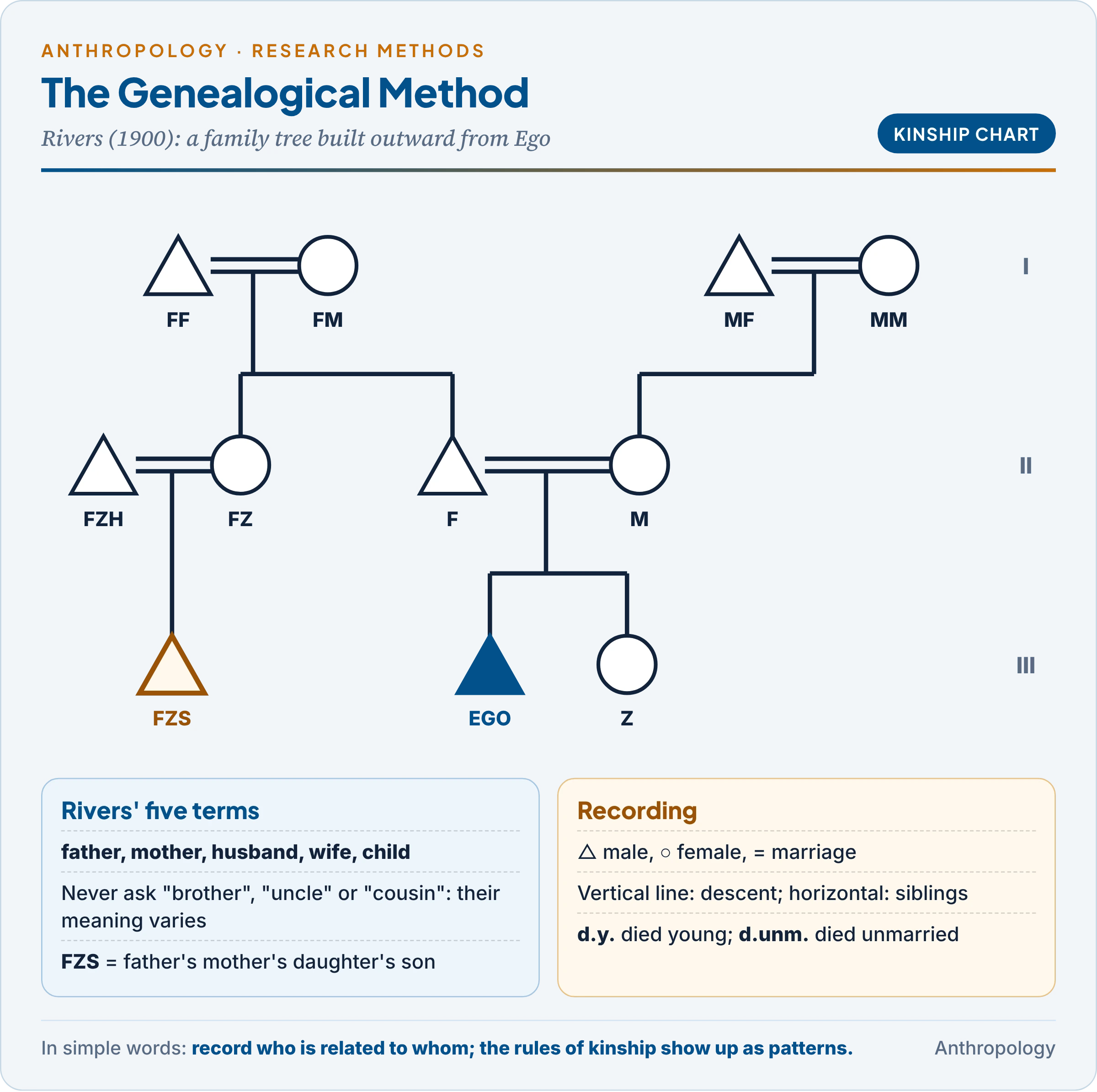
- Start with Ego: ask the name of the informant’s mother (“the woman from whose womb you were born”) and father (“the man who begot you”), then how Ego addresses each and how each addresses Ego.
- Use only five terms: father, mother, husband, wife, child. Rivers forbade words like “brother”, “uncle” or “cousin” in questions, because their meanings vary between cultures; every other relative is reached as a chain of these five (“your father’s mother’s child”).
- Extend outward: each parent’s other spouses and children (to reveal half-siblings), then the parents’ parents and their children, for as many generations as remembered; then the spouse’s genealogy.
- Record: in Rivers’ convention, male names in capitals and female in lower case; husband to the left of wife; d.y. (died young) and d.unm. (died unmarried); the living underlined. Today the chart uses △ male, ○ female, = marriage, vertical line for descent, horizontal line for siblings.
- Cross-check: the same family appears in many informants’ trees, so accounts can be corroborated. Young informants are trusted only for their own generation.
6.2 Uses
- Kinship and social organisation: the exact meaning of each kin term (Unit 2.5); rules of marriage, descent, inheritance and succession, which show up as patterns in the chart.
- Demography: a genealogical census gives fertility, mortality, sex ratio and migration across generations: Rivers’ “vital statistics”.
- Field rapport: knowing everyone’s name and relations shows who gathers at a birth, wedding or funeral, and why.
- Genetics: the same chart, marked for a trait, becomes a pedigree (Unit 9.1).
6.3 Difficulties
- Name taboos on the dead or certain affines; adoption and fictive kinship blurring biological and social links (Rivers advised treating each difficulty as data about the society); suspicion that the record is for tax; and memory, which rarely reaches beyond a few generations and may “add” prestigious ancestors.
Common confusion
Is a genealogy the same as a pedigree? No. A genealogy is a social record: it maps relationships as people recognise them, including adoption and terms of address, to study kinship and social structure. A pedigree is a biological record: it maps descent to follow the transmission of a trait or disease, using fixed clinical symbols (squares for males, shaded symbols for affected persons). The genealogical method supplies the raw family tree; pedigree analysis is its genetic use (Unit 9.1).
7. Secondary Sources of Information
In simple words
Secondary sources are records made by someone else for another purpose: census tables, old government reports, earlier ethnographies, archives and surveys. They give the background and long-term picture that one fieldworker cannot collect alone, but they must be checked for errors and bias.
Primary data are collected by the researcher; secondary data already exist.
- Census of India: the first synchronous census was 1881; colonial censuses up to 1931 recorded caste; from 1951 only Scheduled Castes and Tribes were counted, until Census 2027 again enumerates caste.
- Colonial surveys: H.H. Risley‘s The Tribes and Castes of Bengal (1891), Edgar Thurston‘s Castes and Tribes of Southern India (1909), R.V. Russell and Hira Lal on the Central Provinces (1916); district gazetteers.
- Anthropological Survey of India (ASI, founded 1945): People of India project. Launched on 2 October 1985 under its Director-General K.S. Singh, it identified and studied 4,635 communities (from about 6,748 first listed) in every state, using a common schedule guideline, about 24,951 key informants and some 26,510 field-days, and published national and state volumes from 1992.
- Others: NFHS and National Sample Survey rounds; archives, museum collections, maps, photographs, and personal documents (letters, diaries).
- Uses: context and sampling frames; historical depth; regional comparison; checking field findings.
- Cautions: sources were made for administrative purposes; categories may be imposed (the colonial census ranking of castes is held by critics to have hardened caste identities); errors of enumeration; and outdated or politically shaped figures. Every secondary source must be read for who produced it, why and with what categories.
8. Participatory Methods: RRA, PRA and PLA
In simple words
Participatory methods let villagers themselves map, count, rank and analyse their own situation, often by drawing on the ground with sticks, seeds and powder. The outsider becomes a facilitator instead of a questioner. The aim is better knowledge and also giving people a say in the plans that affect them.
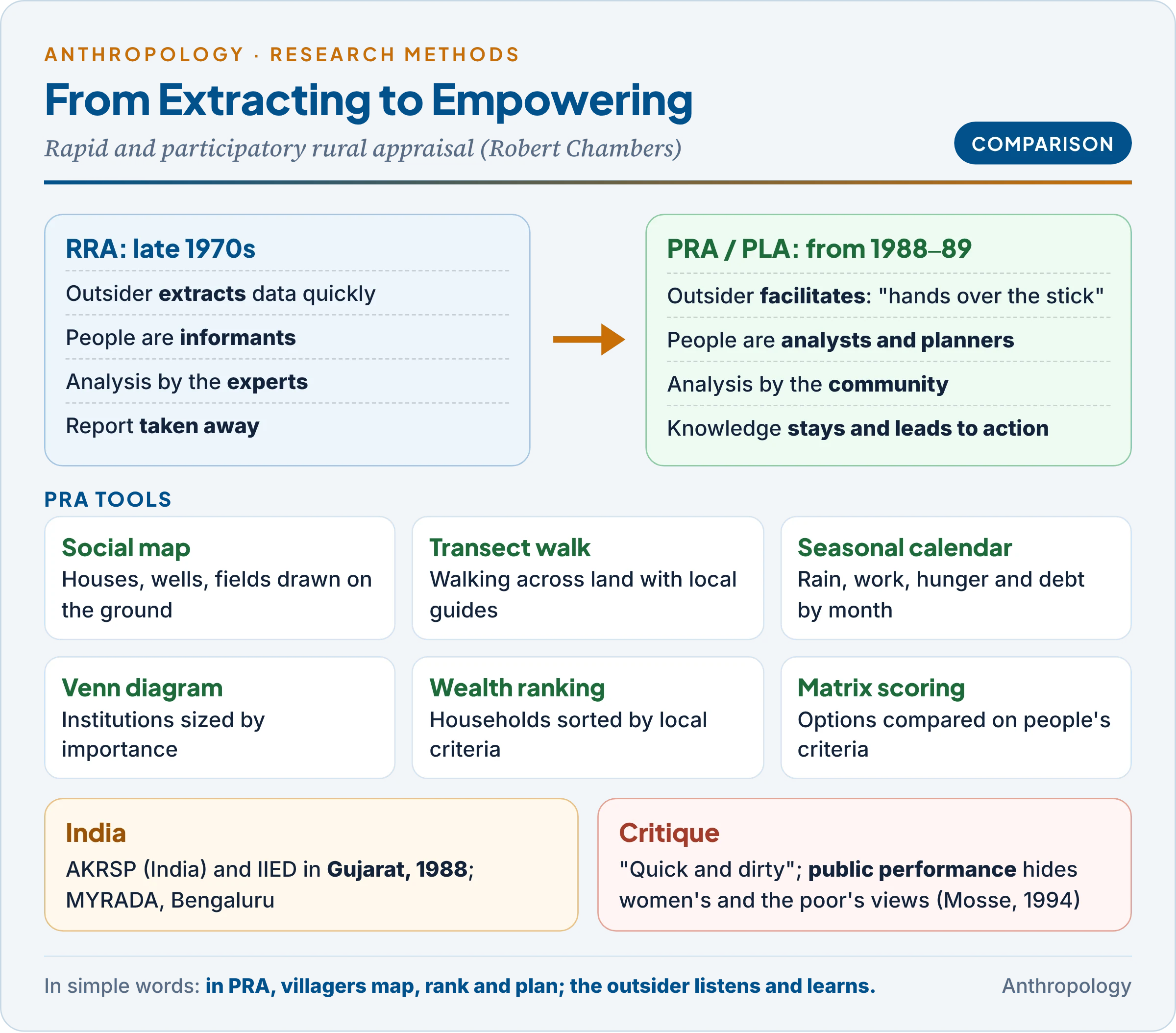
In 1988, the Aga Khan Rural Support Programme (India) and the London-based International Institute for Environment and Development ran what they called a “participatory rapid rural appraisal” in Gujarat: villagers drew maps of their land, water and households and discussed priorities themselves. Indian NGOs, with MYRADA of Bengaluru prominent, soon made Participatory Rural Appraisal (PRA) a national movement.
8.1 Robert Chambers and the critique of “rural development tourism”
The British development scholar Robert Chambers (Rural Development: Putting the Last First, 1983; Whose Reality Counts? Putting the First Last, 1997) argued that experts on short rural visits saw a distorted picture. He named the biases of this “rural development tourism”:
- Spatial (villages near roads), project (places already showing success), person (men and the elite rather than women and the poor), seasonal (dry, cool months, missing the hungry wet season) and diplomatic (politeness that avoids the worst conditions).
Together with frustration at long, costly questionnaire surveys and growing respect for indigenous technical knowledge, these criticisms produced Rapid Rural Appraisal (RRA) in the late 1970s, and from about 1988–89 (in Kenya and India) PRA. When the journal RRA Notes was renamed PLA Notes in the mid-1990s, Participatory Learning and Action (PLA) became the umbrella term, stressing that the process continues into action.
| RRA | PRA / PLA | |
|---|---|---|
| Period | Late 1970s–1980s | From about 1988–89 |
| Purpose | Quick, cost-effective learning by outsiders | Empowerment: local analysis, planning and action |
| Role of outsider | Investigator who extracts data | Facilitator who “hands over the stick“ |
| Role of people | Informants | Analysts and planners |
| Who owns the output | Outsiders take it away | Stays with the community |
The table’s key line is the last one. Both use similar tools; what changes is who holds the information and the power to act on it. That is why PRA is described as a shift “from extracting to empowering”.
8.2 Tools
- Social and resource map: villagers draw households, water, fields and forest on the ground.
- Transect walk: walking across the territory with local guides, noting soils, crops and problems.
- Seasonal calendar: month-by-month rain, work, hunger, illness, debt and migration.
- Venn (chapati) diagram: circles for institutions, sized and placed to show importance and access.
- Wealth ranking; matrix scoring: sorting households, or comparing options, by people’s own criteria.
- Timelines and trend lines: village history and change in key resources.
- Principles: optimal ignorance (collect only what is needed), triangulation, self-critical awareness, and “use your own best judgement“.
8.3 Anthropological critique
- “Quick and dirty”: anthropologists worry that a few days of appraisal replace the long fieldwork needed to see hidden relations.
- Public performance: the British anthropologist David Mosse (1994), from a project among the Bhil of western India, showed that PRA sessions are public events in which dominant voices shape what is said, while women’s and the poor’s knowledge stays private. “Participatory” outputs can thus reflect local power, or even what villagers think the agency wants.
- Co-option: in Participation: The New Tyranny? (2001), Bill Cooke and Uma Kothari argued that participation can legitimise decisions already taken. Good practice answers with separate groups for women and the poor, repeated visits, and triangulation with household data.
9. Analysis of Data: Qualitative and Quantitative
In simple words
Analysis turns piles of notes, recordings and forms into findings. Numbers are counted, summarised and tested; words, stories and observations are sorted into themes and patterns. Checking one kind of evidence against another makes the conclusions sturdier.
9.1 Processing
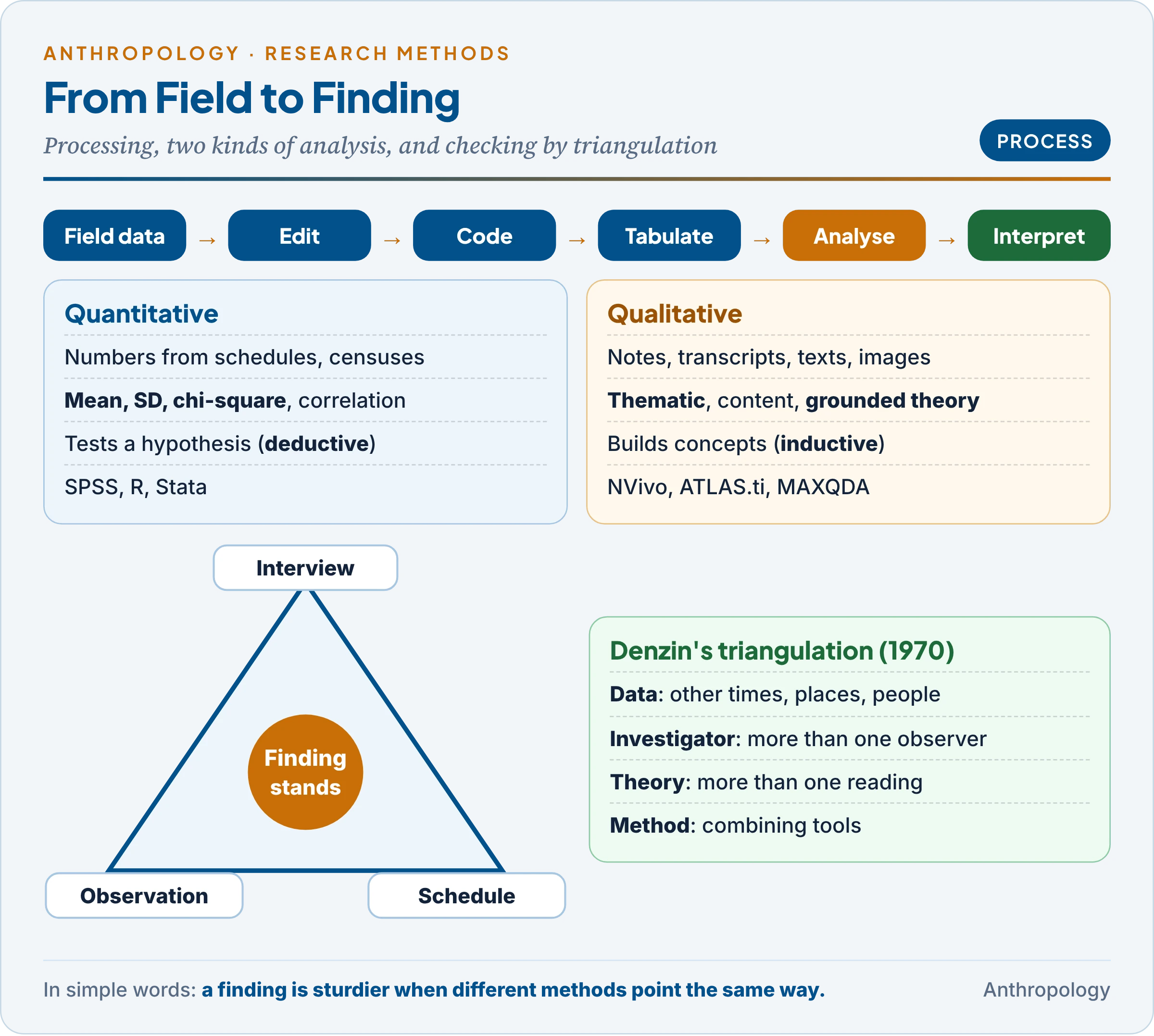
- Editing (checking completeness), coding (labelling each answer or passage with a category), and classification and tabulation (grouping coded data into simple and cross-tables).
9.2 Two kinds of analysis
| Quantitative analysis | Qualitative analysis | |
|---|---|---|
| Data | Numbers from schedules, measurements, censuses | Field notes, transcripts, texts, images |
| Main procedures | Frequencies, mean, median, mode, standard deviation; cross-tabulation; chi-square test (whether two variables are associated); correlation and regression | Coding and thematic analysis; content analysis; grounded theory; domain, taxonomic and componential analysis; narrative and discourse analysis |
| Logic | Mostly deductive: test a hypothesis | Mostly inductive: build concepts from data |
| Software | SPSS, R, Stata, spreadsheets | NVivo, ATLAS.ti, MAXQDA (earlier The Ethnograph) |
| Quality test | Reliability and statistical significance | Credibility, depth, fit with the people’s view |
The point of the comparison is that both are systematic. Qualitative analysis is not “impressions”: it has explicit steps, and the software only organises the coding that the researcher must still do and justify.
- Grounded theory (the American sociologists Barney Glaser and Anselm Strauss, The Discovery of Grounded Theory, 1967): concepts are built from the data upward. Codes are compared constantly; in Strauss’s later scheme, open coding labels the data, axial coding links categories, and selective coding integrates them around a core idea.
- Thematic analysis finds recurring themes (“debt”, “shame”, “migration”) across interviews; content analysis counts words or images in texts; domain and componential analysis, from cognitive anthropology (Unit 6j), sorts native categories (kinds of rice, kinds of kin) and the features that distinguish them.
- The life table, a demographic tool, summarises for each age how many of an initial cohort survive (lx), die (dx), the probability of dying (qx) and the expectation of life (ex). Anthropologists build it from genealogical censuses and skeletal series (Unit 11).
9.3 Triangulation
Triangulation means checking a finding through more than one angle, as a surveyor fixes a point from two known positions. The American sociologist Norman Denzin (The Research Act, 1970) distinguished four kinds:
- Data triangulation: different times, places and persons.
- Investigator triangulation: more than one observer.
- Theory triangulation: reading the same data through more than one theory.
- Methodological triangulation: combining tools, such as observation, interview and a household schedule.
How it works: if villagers say bride-price is falling (interview), the household schedule shows lower recorded payments, and the fieldworker observes smaller transfers at weddings, the finding stands on three legs. If they disagree, the disagreement is itself a clue (perhaps the ideal norm differs from practice).
10. Interpretation and Presentation: From Field Notes to Ethnography
In simple words
Interpretation asks what the findings mean and how they connect to other studies and theory. Presentation is how the findings reach readers: through tables, charts, maps, kinship diagrams, photographs, film and, above all, the written ethnography. The way anthropologists write has itself changed a great deal.
10.1 Interpretation
Interpretation is drawing inferences from analysed data: searching for the broader meaning of findings. It links results to other studies (continuity in research) and to explanatory concepts (theory).
- Functions: reveals the principle beneath the findings; explains why results are what they are; turns exploratory findings into new hypotheses.
- Precautions: data must be adequate and trustworthy; do not confuse correlation with causation; do not over-generalise beyond the time and place studied; a supported hypothesis is “in accord with” the data, not proven.
- Analysis vs interpretation: analysis finds patterns within the data (“women in landless households migrate more”); interpretation explains what they mean and links them to theory (“a household strategy of spreading risk”).
- The American methodologist Pauline Young (Scientific Social Surveys and Research, 1939) located originality in the interaction of hypothesis, observation and theory: interpretation is where the three meet.
10.2 Presentation
- Forms: tables, graphs and population pyramids; kinship diagrams, settlement maps, photographs and ethnographic film (from Robert Flaherty’s Nanook of the North, 1922, to Jean Rouch’s participatory cinema); today GIS maps and digital archives.
- The research report: outline → rough draft → rewriting → bibliography → final draft. A technical report stresses methods, data and limitations; a popular report stresses findings, implications and visuals. Either should be long enough to cover the subject, short enough to hold interest, and state its limitations.
10.3 Ethnographic writing: classical to contemporary
The written ethnography is anthropology’s main product, and its conventions have shifted with the discipline’s theory.
| Classical (realist) | Contemporary | |
|---|---|---|
| Voice | Impersonal, all-knowing narrator; the author hidden | Reflexive: the author’s position and encounters shown |
| Time | “Ethnographic present“: the culture described as timeless | Historical: change, colonialism and the global context included |
| Subject | A bounded tribe or village “as a whole” | Networks, flows, multi-sited fields (Unit 6k) |
| Other voices | Informants quoted as data | Dialogic and polyphonic texts: several voices, sometimes co-authored |
| Authority | “I was there”, so the account is true | Authority questioned; texts seen as partial truths |
| Media | Monograph with tables and diagrams | Monograph plus film, photography, digital and sensory forms |
Classical monographs (Malinowski’s Argonauts, 1922; Evans-Pritchard’s The Nuer, 1940) wrote in the ethnographic present, which the German-born anthropologist Johannes Fabian (Time and the Other, 1983) criticised for denying coevalness: placing the studied people outside the writer’s own time. Clifford Geertz‘s thick description (1973) moved writing toward meaning; Paul Rabinow‘s Reflections on Fieldwork in Morocco (1977) put the fieldworker into the text; and Writing Culture (1986, edited by James Clifford and George Marcus) opened the debate on the “crisis of representation” (Unit 6k). The Dutch-American ethnographer John Van Maanen (Tales of the Field, 1988) classified ethnographic writing as realist, confessional (the fieldworker’s own story) and impressionist (vivid scenes that recreate the experience).
- Indian example: M.N. Srinivas lost his Rampura field notes in a fire at Stanford in 1970 and rebuilt the village from memory in The Remembered Village (1976): a classic that is openly personal, written in the first person, and a bridge between the realist and reflexive styles.
Key Terms
| Term | Meaning in simple words |
|---|---|
| Research design | The plan linking a research question to the data and tools needed |
| Sample / sampling frame | The part studied / the list from which it is drawn |
| Stratified sampling | Dividing a population into groups and sampling within each |
| Snowball sampling | Each informant leads the researcher to the next |
| Mixed methods | Combining numbers and in-depth qualitative study in one design |
| Phenomenology | Studying experience as people live and feel it |
| Hawthorne effect | People change their behaviour because they know they are watched |
| Key informant | A knowledgeable person interviewed repeatedly as a guide |
| Focus group | A guided group discussion on one topic |
| Schedule | A question form filled in by the researcher face to face |
| Questionnaire | A question form filled in by the respondent alone |
| Pre-test (pilot) | Trying a form on a few people before the main study |
| Case study | Intensive study of one person, group or event |
| Extended case method | Following one dispute or event over time |
| Life history | One person’s life told in its social setting |
| Oral history | The remembered past recorded from speakers |
| Genealogical method | Recording family trees to study kinship and population |
| PRA / PLA | Methods by which local people map, rank and plan for themselves |
| Grounded theory | Building concepts step by step from the data |
| Triangulation | Checking a finding through several sources, observers or methods |
Contemporary Developments
- Census 2027, India’s first digital census: houselisting (33 questions) ran from April to September 2026 with an optional self-enumeration portal in 16 languages before each enumerator’s visit; population enumeration (40 questions, including caste recorded as declared) is due in February 2027, with a reference date of 1 March 2027 (Ministry of Home Affairs; Registrar General of India).
- NFHS-6 (2023–24): fact sheets released on 29 May 2026; four schedules canvassed by CAPI in local languages in about 6.79 lakh households, with new items on digital literacy and self-help groups (International Institute for Population Sciences).
- GenomeIndia biobank (2025): alongside 10,000 genomes, the project stores anthropological and socio-economic data for its participants, but codes the 83 populations numerically rather than by caste or tribe name, a live example of research ethics shaping how data are kept and shared (Department of Biotechnology).
- AI-assisted qualitative analysis: the major qualitative packages (NVivo, ATLAS.ti, MAXQDA) now offer automatic coding suggestions and summaries, reopening old questions about who interprets the data and how confidential transcripts are protected.
Diagrams to Master
- Topic map: design and sampling → tools (observation, interview, schedule, questionnaire, case, life and oral history, genealogy, secondary sources, PRA) → analysis → interpretation → presentation.
- Schedule vs questionnaire: label who fills, literacy, clarification, response rate, cost, anonymity; Census 2027 example.
- Genealogy chart: Ego, △ ○ = and descent lines, Rivers’ five terms, a chain such as FZS built from them.
- RRA vs PRA: extract vs empower, “hand over the stick“, six PRA tools.
- Analysis and triangulation: edit → code → tabulate; quantitative vs qualitative; Denzin’s four triangulations.
Revision Grid
| Scholar | Work (year) | Key idea |
|---|---|---|
| L.H. Morgan | Systems of Consanguinity and Affinity (1871) | Kin-term schedule circulated from 1859 |
| W.H.R. Rivers | “A Genealogical Method…” (1900); The Todas (1906) | Genealogical method; five basic terms |
| Thomas and Znaniecki | The Polish Peasant (1918–20) | Personal documents as data |
| Paul Radin | Crashing Thunder (1926) | Life history |
| John Dollard | Criteria for the Life History (1935) | Six criteria |
| Max Gluckman; van Velsen | Zululand bridge (1940); 1967 | Extended case method |
| Robert Merton | The Focused Interview (1956) | Origin of focus groups |
| F.G. Bailey | Caste and the Economic Frontier (1957) | Village case study (Bisipara) |
| Glaser and Strauss | The Discovery of Grounded Theory (1967) | Theory built from data |
| Norman Denzin | The Research Act (1970) | Four kinds of triangulation |
| M.N. Srinivas | The Remembered Village (1976) | Ethnography from memory, first person |
| Robert Chambers | Rural Development: Putting the Last First (1983) | RRA and PRA; development tourism biases |
| K.S. Singh | People of India (from 1985) | 4,635 communities surveyed |
| John Van Maanen | Tales of the Field (1988) | Realist, confessional, impressionist tales |
| David Mosse | 1994 | Critique of PRA as public performance |
Previous Year Questions
Tools of data collection
- 2026Discuss the mixed method approach in anthropological research.
- 2025Differentiate between pedigree and genealogical analyses. Discuss the history and application of these methods in anthropological studies.
- 2024Discuss the applicability of various sampling techniques in selecting the study group.
- 2022Write notes on: Participatory Rural Appraisal (PRA) and Participatory Learning and Action (PLA).
- 2021Discuss various tools of data collection in conducting anthropological research.
- 2019Evaluate participant observation in producing anthropological knowledge.
- 2019Discuss phenomenology as a research method in anthropological studies.
- 2018How is case study method helpful in understanding a social phenomena? Explain with suitable example.
- 2017Write a note in 150 words on Questionnaire.
- 2014Write a note in 150 words on Genealogical Method.
- 2013Discuss the relevance of Case Study method of data collection. (250 words).
- 2012What are the tools of data collection? Discuss the advantages and limitations of participants-observations as a technique of data collection.
- 2009Write a note on ‘Schedule’ and Questionnaire’ in research methodology.
- 2007Critically examine the contribution of Positivistic and Non-Positivistic approaches in Social Science Research.
- 2006Critically examine the role of subjectivity in Anthropological Research.
- 2005Write a note on Schedule and Questionnaire.
- 2004Write a note on Participatory Rapid Assessment (PRA).
- 1995What are questionnaire and schedule techniques of field study? Assess their relative usefulness in anthropological studies.
- 1994Write a note on Genealogical method of field investigation.
- 1989Write a note on Participant Observation in Anthropological Field Work.
Analysis, interpretation and presentation of data
- 2023Describe various methods of qualitative data analysis. Highlight some popular computer softwares used in qualitative analysis.
- 2020How have interpretation and presentation of data changed from classical to contemporary writings in anthropological texts?
- 2010What do you understand by the following terms? a. Systemic sampling b. Stratified sampling c. Multistage sampling
- 2006Write a note on Life-Table.
Related questions from other units
- 2025Unit 8: Write notes on: Multispecies, Multi-sited and Critical Ethnography.
- 2020Unit 8: Write notes on the Experiential Ethnography in about 150 words.
- 2008Unit 8: Discuss the importance of field work in anthropology and describe various tools of data collection.
- 2002Unit 12: What are the statistical methods used in Physical Anthropology.
- 2001Unit 12: Write a note on Sampling Methods.
- 2000Unit 12: Write a note on Chi-square Test.
- 2000Unit 8: Write a note on Etic and Emic approach.
- 1996Unit 8: Examine the importance of observation as a fieldwork technique in Anthropology. Differentiate between participant and non-participant observation and analyze the problem of objectivity in participant observation.
- 1986Unit 8: Explain the significant role of an informant in anthropological fieldwork.