

Political Ideologies: Anarchism; Marxism and Socialism
Official Syllabus: Paper II, Section A, Unit 5
Socialism is the political and economic ideology which holds that the major means of production should be owned, controlled or regulated by the community as a whole, so that wealth serves social needs rather than private profit, and political rights are matched by social and economic rights. Its core values are equality, community (fraternity), cooperation and the satisfaction of need. But the word has been claimed by so many movements that C. E. M. Joad famously said socialism is “like a hat that has lost its shape because everybody wears it”. This article sorts out the shape of the hat: how socialism should be defined (by its values or by its institutions), its core features, and its main kinds: utopian, scientific, revolutionary and evolutionary, Fabian, revisionist, syndicalist, guild, state, market and ethical socialism, ending with the old UPSC question: which is superior, utopian or democratic socialism?
In simple words
Think of a joint family kitchen. Everyone contributes what they can; food is shared by need, so the grandmother, the child and the working son all eat; and big decisions are taken together. No one charges the others for a meal. Socialism wants society’s big “kitchens” (land, factories, banks, hospitals, schools) to work somewhat like this: owned or controlled in common, run for everyone’s needs, not for one owner’s profit.
Context & Problem
- Origins of the word: from the Latin socius, companion or partner. “Socialist” came into use in the 1820s–30s among the followers of Robert Owen in Britain and Saint-Simon in France.
- The problem it answered: the Industrial Revolution produced wealth alongside child labour, slums, long hours, unemployment and crises. Liberal laissez-faire said these were natural results of free contracts. Socialists replied that a society of competing private owners cannot be free or just for the majority.
- Many answers: some socialists built model communities; some appealed to reason and conscience; Marx called for revolution; others worked through trade unions and parliaments. Hence the many kinds of socialism.
Core Doctrine
Defining Socialism: Values or Institutions?
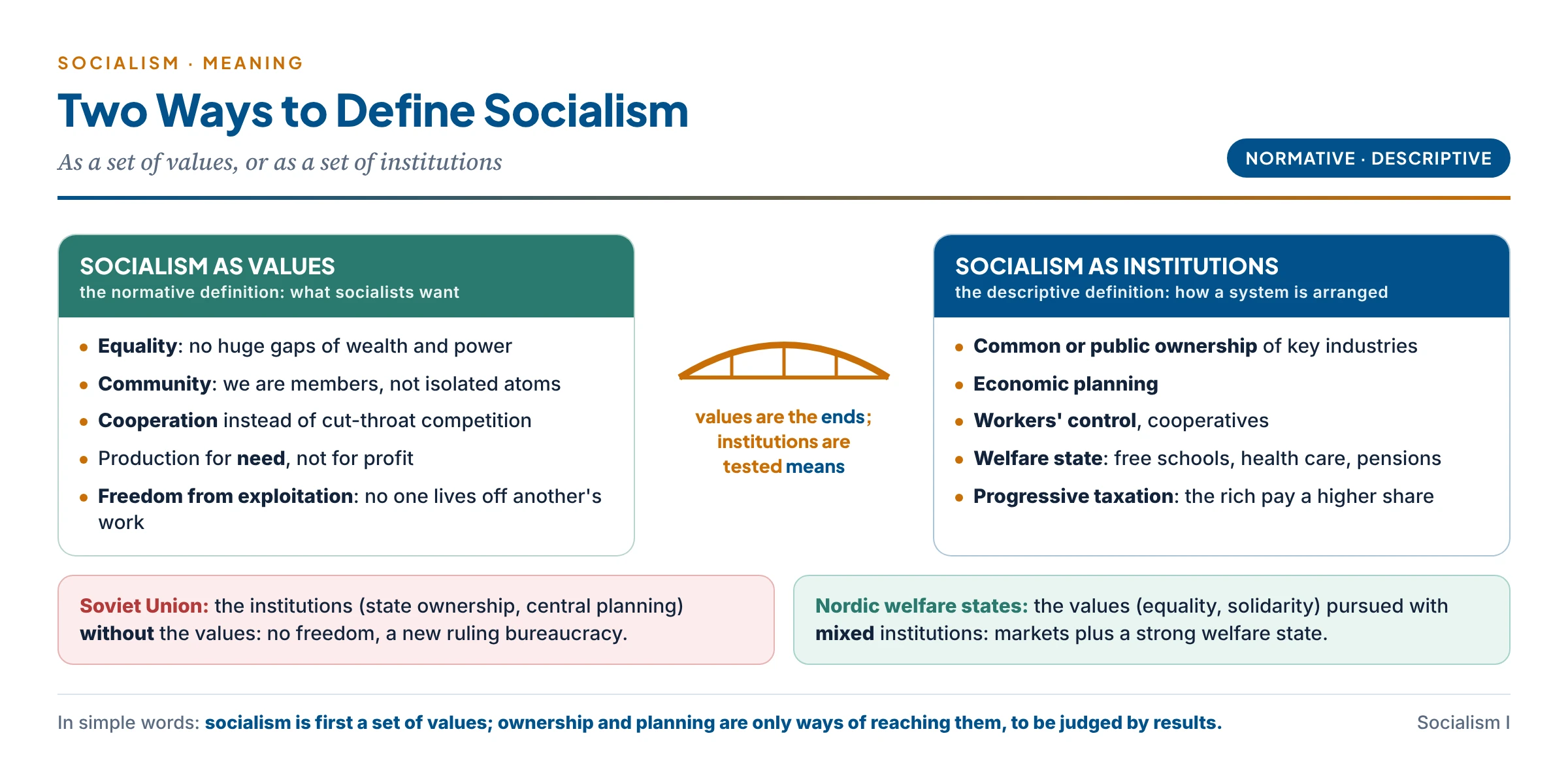
UPSC asked (twice, as a 60-mark question) whether socialism should be defined normatively, by the values and ideals socialists seek to realise, or descriptively, by the economic and political institutions of a socialist society, and whether the tension between the two can be resolved.
1. The normative definition (socialism as values):
- Equality, especially equality of condition or outcome, not just of opportunity.
- Community and fraternity: people are social beings bound by mutual obligation.
- Cooperation instead of competition.
- Need: distribution should reflect what people need, not only what they can pay.
- Freedom from exploitation and domination, and real (positive) freedom to develop one’s capacities.
- Social justice: a fair share in the social product.
- On this view, socialism is an ethical vision, closer to a moral ideal than a blueprint.
2. The descriptive definition (socialism as institutions):
- Public or common ownership of the major means of production (nationalisation, cooperatives, municipal ownership).
- Economic planning in place of, or alongside, the market.
- Workers’ control or participation in management.
- The welfare state: universal health, education, social security.
- Redistributive taxation, regulation of capital, strong trade unions.
- On this view, socialism is an economic and political system that can be identified and measured.
3. The tension between them:
- Institutions without values: the Soviet Union nationalised almost everything and planned the whole economy, yet produced new privileges, bureaucratic domination and lack of freedom. By the descriptive test it was socialist; by the normative test it failed.
- Values without classical institutions: the Nordic countries achieved high equality, universal welfare and strong labour rights while keeping private ownership of most industry. By the normative test they come close; by the strict descriptive test they are capitalist.
- The British Labour Party shows the debate in practice: its 1918 constitution (Clause IV, drafted by Sidney Webb) committed it to the “common ownership of the means of production, distribution, and exchange”; in 1995 it replaced this with a statement of values (a “dynamic economy”, “power, wealth and opportunity in the hands of the many, not the few”).
- Anthony Crosland (The Future of Socialism, 1956) argued that socialism is about equality and welfare; public ownership is only one possible means, to be used where it serves those ends.
4. Can the tension be resolved?
- Yes, partly, by treating values as ends and institutions as means:
- Values define socialism; institutions are revisable tools to be judged by how well they realise those values.
- But values need institutions: equality without public services, progressive tax or labour rights remains a wish. So socialism cannot be purely normative either.
- The test is experimental and democratic: institutions (nationalisation, cooperatives, welfare, planning, markets) should be tried, tested and revised in democratic debate according to their results for equality, community and freedom.
- Remaining tension: Marxists reply that private ownership itself creates class power, so without changing ownership the values will always be undermined by capital. Revisionists reply that democracy and regulation can tame capital. The debate between these two answers is the history of socialism.
Core Features of Socialism
- A critique of capitalism: capitalism produces inequality, exploitation, insecurity, alienation and waste.
- A social view of human nature: people are social and cooperative, shaped by their environment; selfishness is a product of competitive society.
- Common or public ownership of key resources, or at least strong social control over them.
- Equality: reducing differences of wealth, income and power; Tawney: equality is not identical rewards but a society that values common humanity above differences.
- Class politics: socialism usually speaks for workers and the poor.
- Political rights accompanied by socio-economic rights: the vote plus the right to work, health, education and a living wage.
- Planning and purpose: production for social need, not only for the market.
Socialism and Capitalism: The Basic Clash
- All real economies are mixed. Even its strongest defenders admit that a pure, unregulated laissez-faire capitalism has never existed; every economy combines markets with public provision and regulation. A democracy, which rests on compromise, naturally produces a mixed economy.
- Capitalism is not the same as freedom. The free-market argument that capitalism guarantees freedom defines coercion as physical force only. But economic coercion is real: a worker who must accept a low wage or starve, or a town whose only water supply is bought by one owner, is not free in any meaningful sense.
- Markets tend to concentrate power: capital accumulates, firms merge, monopolies form, and big business lobbies the state for privileges.
- Markets swing between boom and slump: high profits attract competitors, production outruns demand, prices and profits fall, firms fail and workers lose jobs. Without overall coordination, recessions recur.
- Planning has dangers and advantages: a central board may err or become corrupt and bureaucratic; but it can gather information once instead of many times, conserve resources, protect the weak and replace outdated industries. A combination of public and private, plan and market, may serve people best.
- Property is social: no individual creates wealth alone; every invention stands, in Newton’s words, “on the shoulders of giants”, on language, education, roads and the work of others. So society has a legitimate claim on part of what individuals earn.
Utopian Socialism
Marx gave the name “utopian” to the socialists before him. They drew an attractive picture of an ideal society far removed from the harsh realities of life, believed people of all classes could voluntarily adopt their plan if it were presented convincingly, and some relied on the benevolence of enlightened capitalists. They wanted to free the working class from capitalist oppression but, in Marx’s view, had no clear understanding of the remedy.
Henri de Saint-Simon (1760–1825):
- Industrial society should be run by industrialists, scientists and engineers, the productive classes, not by idle nobles and priests.
- The state’s task would change from governing people to “administering things” and organising production.
- His followers coined the formula: “to each according to his capacity, to each capacity according to its works”.
Charles Fourier (1772–1837):
- Attacked the waste, fraud and boredom of commercial civilisation.
- Proposed self-sufficient cooperative communities, “phalansteries” of about 1,600 people, where work would be “attractive”: varied, chosen by inclination and rotated through the day.
- A pioneer of women’s emancipation: the degree of women’s freedom is the natural measure of a society’s general freedom.
- Early socialist humanism: he sought to improve social conditions by appealing to the humanist conscience and persuading capitalists to fund his communities.
Robert Owen (1771–1858):
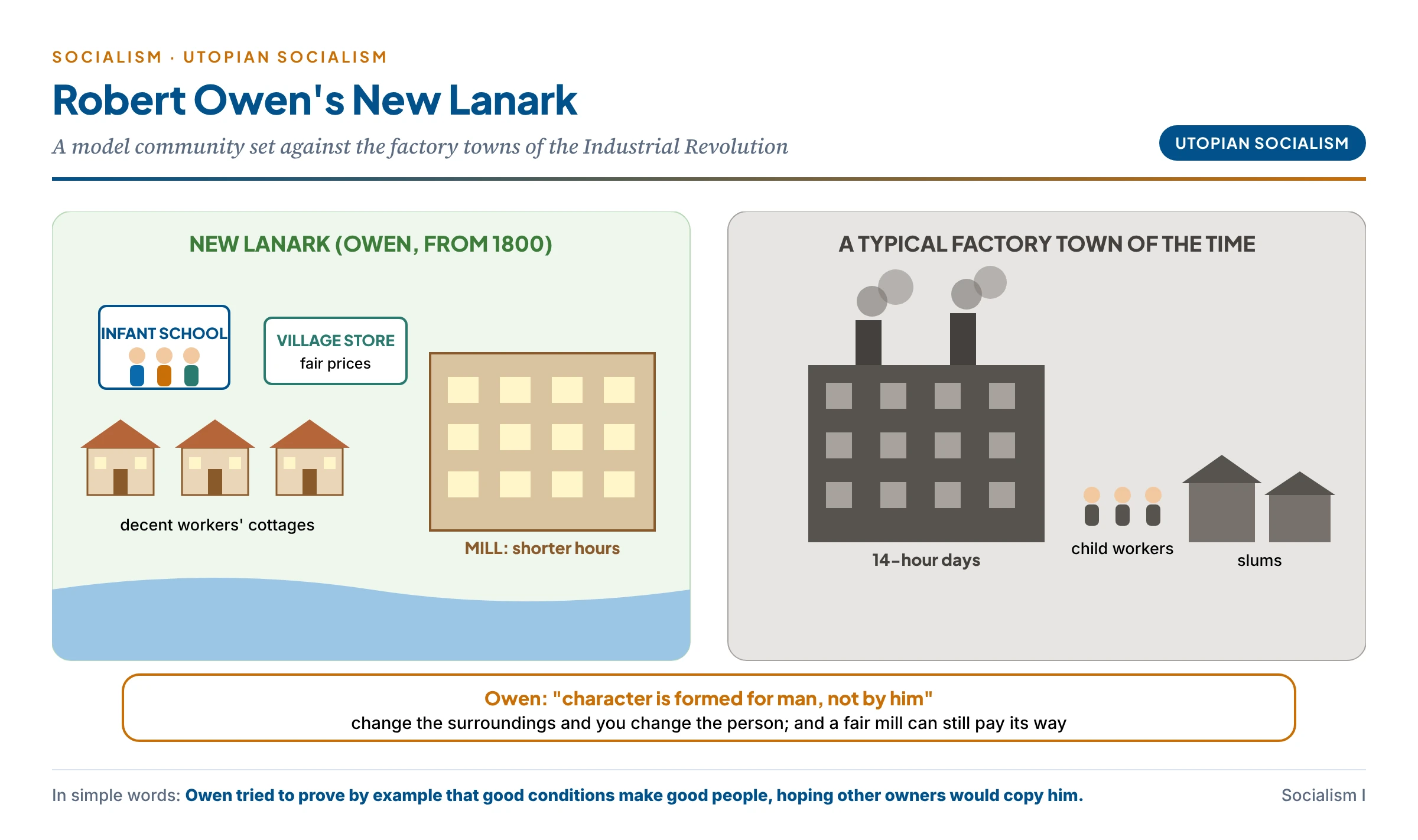
- A successful Welsh mill owner who turned his New Lanark mills in Scotland into a model community: shorter working hours, no employment of young children, decent housing, the first infant school in Britain, and shops selling goods at fair prices.
- “Character is formed for, not by, the individual”: a good environment makes good people.
- Founded a cooperative community at New Harmony, Indiana (1825), which collapsed within a few years.
- Inspired the cooperative movement (the Rochdale Pioneers, 1844) and early trade unions.
- Similar communities in America in the nineteenth century, such as Brook Farm and the Fourierist settlements, tried to blend common ownership with personal freedom.
Strengths and weaknesses of utopian socialism:
- Strengths: a powerful moral critique of capitalism; practical experiments (cooperatives, model villages, schools); early ideas on women’s equality, education and the environment’s role in shaping character.
- Weaknesses: reliance on the goodwill of the rich; small, isolated communities that rarely lasted; no theory of how society as a whole would change; neglect of class conflict and political power.
Utopian versus Scientific Socialism
| Criterion | Utopian socialism (Saint-Simon, Fourier, Owen) | Scientific socialism (Marx and Engels) |
|---|---|---|
| Philosophical root | Moral idealism, humanitarian philanthropy, Enlightenment reason | Historical materialism, dialectics, economic analysis |
| View of the bourgeoisie | Can be persuaded by conscience and model communities (New Lanark) | Class interests are irreconcilable; the bourgeoisie will not give up property voluntarily; force is the midwife of history |
| Method | Model communities, education, philanthropy | Class consciousness, workers’ organisation, revolutionary seizure of power |
| Agent of change | Enlightened individuals of all classes | The proletariat as a class |
| Marx’s verdict | Romantic daydreams without understanding of class struggle and economic laws | Discovered the objective laws of capitalism (surplus value, crises, falling rate of profit) |
- Why “scientific”: Marx and Engels claimed their socialism rested on a scientific understanding of history and of the injustice built into capitalist society. (Engels, Socialism: Utopian and Scientific, 1880.)
Revolutionary versus Evolutionary Socialism
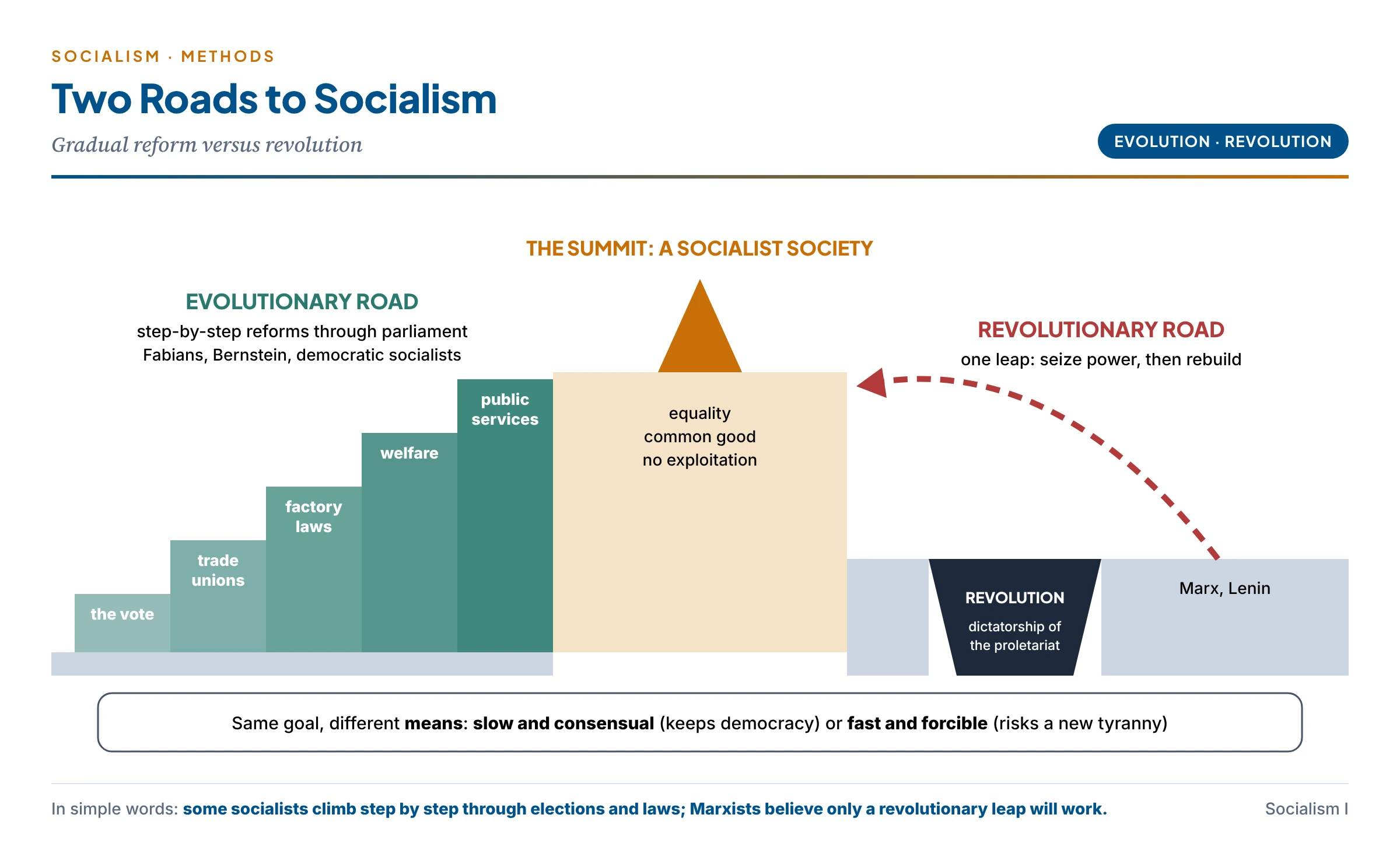
| Point | Evolutionary socialism | Revolutionary socialism |
|---|---|---|
| Pace | Achieved by degrees, step by step | Achieved by wholesale transformation in a single stroke |
| Attitude | Compromise | Direct attack on prevailing contradictions |
| Method | Democratic methods, parliamentary reform, economic planning for the underprivileged | Organising the working class to overthrow the capitalist order and fully socialise the instruments of production |
| Label | Liberal (democratic) socialism | Marxian socialism |
| Social relations | Harmony as the governing principle | Antagonistic class interests |
| Aim | Secure workers’ rights as part of the common interest of the community | Reverse the position of dominant and dependent classes, then a classless society |
| Examples | Fabian socialism, revisionism, guild socialism; syndicalism is evolutionary in rejecting state seizure but revolutionary in method | Scientific socialism (Marx, Lenin) |
Fabian Socialism
- The Fabian Society was founded in London in 1884; its leading members included Sidney and Beatrice Webb, George Bernard Shaw, Graham Wallas, Annie Besant and H. G. Wells. Fabian Essays in Socialism appeared in 1889.
- The name comes from the Roman general Quintus Fabius Maximus “Cunctator” (the Delayer), who defeated Hannibal through patient delay rather than direct battle.
- The first systematic doctrine of evolutionary socialism.
- Method: the gradual democratisation of society in the political, economic and intellectual fields, through parliamentary legislation, universal suffrage, municipal ownership of public utilities (“gas and water socialism”) and progressive taxation.
- Permeation: rather than forming a revolutionary party, Fabians sought to permeate existing parties, government departments and opinion with socialist ideas, through research, pamphlets and expert advice.
- The middle class: they sought to make use of the services of the middle class, especially intellectuals and administrators, in building the new order, and to arouse the social conscience of the community.
- Main objectives:
- Base the case for socialism on the Ricardian law of rent (the “unearned increment” that landowners and capitalists receive from social progress), rather than on Marx’s labour theory of value.
- Use land and industrial capital for the general benefit.
- Equality of opportunity.
- Spread socialist ideas through education and research.
- Universal education, which would also free children from labour.
- Achievements: the Webbs founded the London School of Economics (1895) and the New Statesman; Fabians helped found the Labour Party (1900), and Sidney Webb drafted its Clause IV (1918). Many ideas behind the post-1945 welfare state came from Fabian research.
- Influence in India: Nehru and many Indian administrators and economists were deeply influenced by Fabian ideas of planning and gradual reform.
In simple words
The Fabians worked like water on a stone: no single drop breaks it, but steady dripping wears it away. One law limits child labour, another makes the water supply public, another taxes large incomes, another opens free schools. None of them is a revolution, but together, over decades, they change the shape of society.
Common confusion
Was the Fabian slogan the “inevitability of gradualism”, and was the society named after “Quintus Fabian”? The phrase is “the inevitability of gradualness”, from Sidney Webb’s presidential address to the Labour Party conference in 1923. And the society took its name from Quintus Fabius Maximus, nicknamed Cunctator (the Delayer), not “Quintus Fabian”.
Critical appraisal of Fabian and evolutionary socialism:
- Uneven impact: it brought widespread prosperity to the Scandinavian nations, but only a marginal improvement in living standards in countries like India.
- No coherent doctrine: many varieties, with no single theory.
- Rejected many tenets of Marxian socialism without evolving suitable alternatives.
- Not working-class based: Fabians depended on the middle class and on experts.
- Legitimises the bourgeois state: it tries to fit socialist goals inside a capitalist framework, and so may end by managing capitalism rather than replacing it.
Significance:
- Despite its shortcomings, it has been an effective instrument for softening the harshness of capitalism.
- If democracy is real enough, it will be reflected in the fulfilment of the aspirations of the common man, and this is best reflected in evolutionary socialism.
- Even revolutionary socialist states like China have adopted market socialism, departing from the basic tenets of revolutionary socialism.
Revisionism: Eduard Bernstein
- Eduard Bernstein (1850–1932), a leading German Social Democrat and friend of Engels, published The Preconditions of Socialism (1899), translated as Evolutionary Socialism.
- His empirical critique of orthodox Marxism:
- Capitalism was not collapsing: crises were becoming milder, and capitalism was adapting through credit and cartels.
- The middle class was expanding, not disappearing; ownership was spreading through shares.
- Small and medium firms survived alongside big ones.
- Workers were winning political rights, higher wages and legal protection through trade unions and parliaments.
- Conclusion: socialism should come through gradual democratic reform, not revolution. Bernstein still accepted class conflict and exploitation but rejected the idea of inevitable collapse and the need for violent revolution.
- Famous dictum: “The final goal of socialism, whatever it may be, is nothing to me; the movement is everything.”
- Ethical socialism: he argued that socialism rests on moral ideals (he invoked Kant) rather than on historical necessity.
- Opponents: Karl Kautsky defended orthodoxy; Rosa Luxemburg (Reform or Revolution, 1900) argued that reforms cannot change the capitalist nature of the state; Lenin denounced revisionism as betrayal.
- Legacy: revisionism became the theory behind twentieth-century social democracy.
Syndicalism
- From the French syndicat, trade union; strongest in France, Spain, Italy and the United States (the Industrial Workers of the World) before 1914.
- Trade unions, not parties or the state, are the instruments of change and the units of the future society.
- Direct action: strikes, boycotts, sabotage, culminating in a general strike that would paralyse capitalism.
- The Charter of Amiens (1906) of the French union federation declared the union independent of all political parties.
- Georges Sorel gave it a philosophy: the general strike as a mobilising myth (see Article 2).
- Criticism: neglects the state and consumers; may replace one oppressor with powerful unions.
Guild Socialism
- A British movement (about 1906–1925): A. J. Penty, S. G. Hobson, A. R. Orage and above all G. D. H. Cole.
- Inspired by medieval craft guilds, self-governing associations of producers.
- A middle path between syndicalism and state socialism: it rejected both bureaucratic state socialism (which would make the state a giant employer) and capitalism.
- Industrial democracy: each industry should be run by a national guild of all its workers, managing production democratically.
- Producers and consumers: guilds represent people as producers; the state (or a commune) represents them as consumers and handles general interests; the two would balance each other (functional democracy: people are represented in each function of their lives).
- Criticisms: unclear how guilds and state would settle conflicts; risk of guild selfishness; little practical success, though it influenced ideas of workers’ participation.
State Socialism and Collectivism
- Socialism achieved by the state taking over industries (nationalisation) and running them for the public: railways, mines, banks, steel.
- Ferdinand Lassalle in Germany urged workers to win universal suffrage and use the state to fund producer cooperatives.
- Criticisms: concentrates economic and political power in the state; bureaucracy; the worker exchanges a private boss for a state boss. (This was the anarchist and guild socialist objection.)
Market Socialism
- A mixture of market principles with socialism.
- Oskar Lange (1930s): a central planning board could set prices by trial and error, like a market, while keeping public ownership, answering the claim that socialism cannot calculate.
- Yugoslav self-management: worker-run enterprises competing in a market (1950s–80s).
- China: the “socialist market economy” since the 1990s: markets, private firms and foreign capital under state guidance and one-party rule.
Ethical and Christian Socialism
- R. H. Tawney (The Acquisitive Society, 1921; Equality, 1931): capitalism worships acquisition; a good society organises work around function and service, and treats all as equals in dignity.
- Christian socialists (F. D. Maurice, Charles Kingsley in nineteenth-century England) drew socialism from the Gospel’s teaching on brotherhood and care for the poor.
- Eco-socialism today joins socialist values with ecological limits.
In simple words
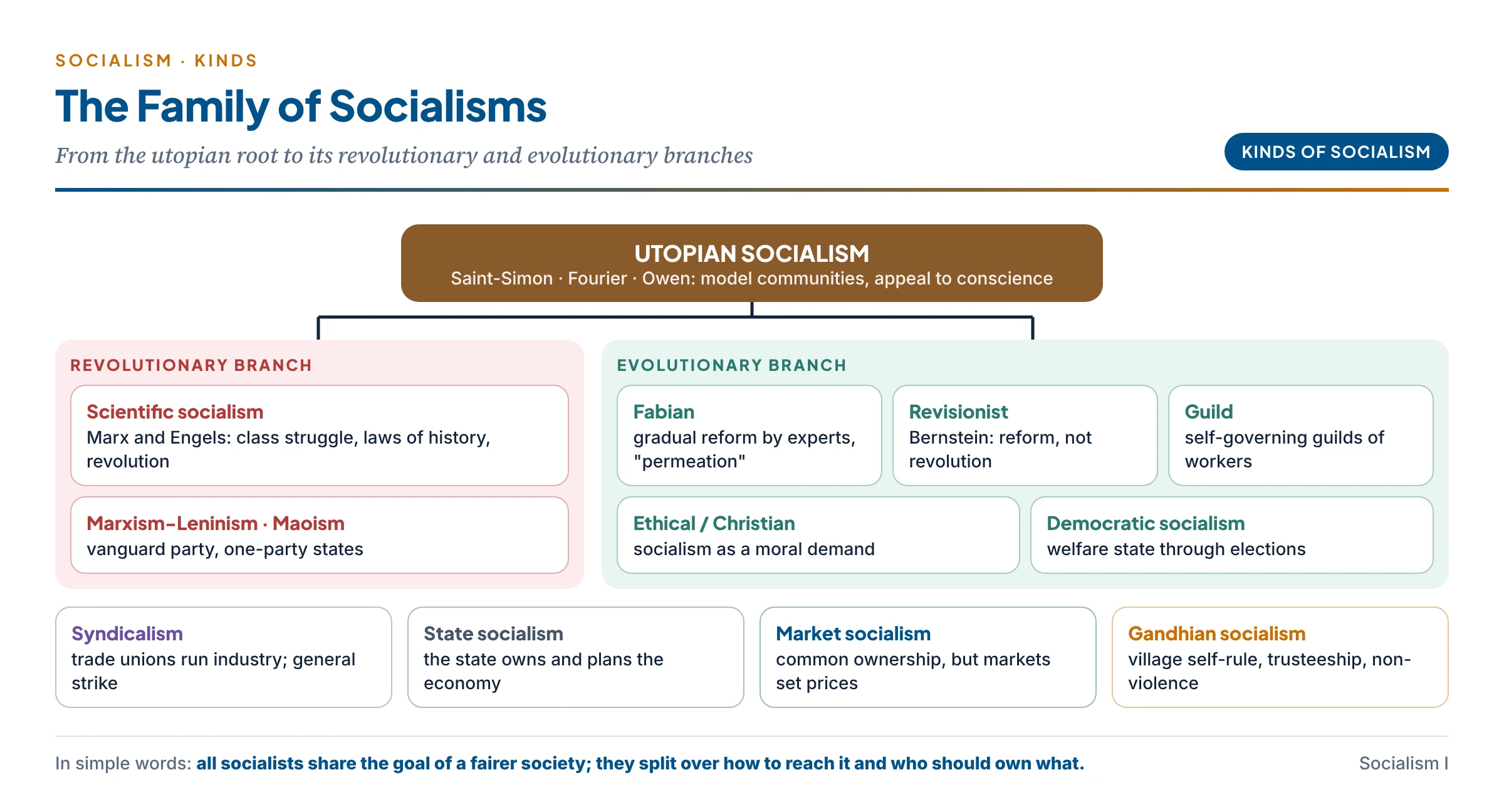
Different kinds of socialism are like different ways of getting a village to share a well. The utopian builds one model well and hopes others copy it. The Marxist says the landlord owns the well, so the villagers must take it. The Fabian petitions the council, step by step, to make wells public. The syndicalist says the well-diggers’ union should run all wells. The guild socialist lets the diggers run the work while the village council speaks for those who drink. Gandhi asks the landlord to hold the well in trust for everyone.
Which Is Superior — Utopian or Democratic Socialism?
The case for utopian socialism:
- It supplies the moral imagination without which socialism would be mere economic management.
- Its experiments (cooperatives, model villages, schools) proved that alternatives are possible and survive today in the cooperative movement.
- It relied on persuasion and example, not force.
The case for democratic socialism:
- It works within society as it is, through votes, laws and unions, and so can change whole nations, not just villages.
- It has real achievements: universal suffrage, the welfare state, public health and education, labour rights, the Nordic model.
- It rests on consent and keeps civil liberties, avoiding the dictatorship of revolutionary socialism.
- It is flexible: it can learn from experience and correct mistakes.
The case against both:
- Utopian socialism ignored power and class; its communities collapsed.
- Democratic socialism risks compromise and dilution: it may end up managing capitalism and accepting inequality, and it depends on economic growth to fund welfare.
Conclusion: democratic socialism is superior as a method, because it combines socialist goals with consent, freedom and the capacity to reform whole societies. But it needs the utopian spirit to keep its goals alive: without a vision of a better society, reform becomes routine administration. The best socialism is a “realistic utopia”: democratic in method, utopian in aspiration.
Critical Evaluation
Criticisms of Socialism
- Hayek: planning destroys freedom (“the road to serfdom”); markets coordinate knowledge better than planners.
- Mises: without market prices, rational economic calculation is impossible.
- Incentives: equalising rewards weakens effort and innovation.
- Bureaucracy: public ownership creates a powerful, unaccountable officialdom.
- Friedman: economic freedom is a precondition of political freedom.
- Marxists against evolutionary socialism: reform legitimises capitalism and never reaches socialism.
Defences
- Real freedom needs resources: health, education and security make liberty meaningful.
- Mixed economies combine markets and public provision successfully.
- The welfare state is socialism’s practical achievement.
- Inequality and crises keep showing the limits of unregulated markets.
Critics and Defenders
Criticism — Critics
- Hayek and Mises: planning cannot calculate and leads to serfdom.
- Friedman: only capitalism protects freedom.
- Marx against the utopians: moral appeals without class power are daydreams.
- Luxemburg against revisionism: reform cannot change the class character of the state.
- Joad: the word has lost all definite meaning.
Defence — Defenders and strengths
- Owen and Fourier: environment and cooperation shape good character.
- Fabians and Bernstein: socialism can be won by consent, step by step.
- Tawney and Crosland: socialism is about equality and fellowship; institutions are means.
- Lange: a socialist economy can use market signals.
- Practice: cooperatives, the welfare state and the Nordic model.
Cross-Tradition Comparison
| Point | Western socialism | Indian parallels |
|---|---|---|
| Ideal | Equality, community, need | Loka-saṅgraha (welfare and holding together of the world, Gītā); sarvodaya (welfare of all) |
| Model communities | Owen’s New Lanark, Fourier’s phalansteries | Gandhi’s Phoenix Settlement and Tolstoy Farm in South Africa; Sabarmati and Sevagram ashrams |
| Property | Common or public ownership | Trusteeship (Gandhi); the Buddhist saṅgha’s common property; dāna (giving) |
| Uplift of workers | Proletarian emancipation | Vivekananda’s prophecy of a coming “Śūdra rājya”, rule by the labouring masses, and his call to serve daridra-nārāyaṇa (God in the poor) |
| Cooperation | Rochdale cooperatives | Amul dairy cooperatives (Anand, 1946); India’s cooperative movement |
Indian Connect — Indian takeaways
- Gandhi’s ashrams were Indian “utopian communities”: shared labour, simple living and common property, but grounded in ahiṁsā and religion rather than secular reason.
- Vivekananda described a cycle in which power passes from priests to warriors to merchants, and predicted that the labouring Śūdras would rule next, a spiritual version of the socialist hope (sometimes called Vedantic socialism).
- Nehru combined Fabian gradualism with planning (Article 10), and Amul shows how cooperative ownership can transform a sector without nationalisation.
Synthesis (Siddhānta)
- Socialism is best defined as a set of values (equality, community, cooperation, need, freedom from exploitation) pursued through institutions that must be tested by results. Defined only by values it is a wish; defined only by institutions it can become a bureaucratic shell, as in the Soviet case.
- Its kinds differ mainly on method (persuasion, revolution, legislation, union action) and ownership (state, cooperative, guild, mixed).
- Utopian socialism gave the vision; scientific socialism gave the analysis of power; evolutionary socialism gave the practical achievements of the welfare state.
- Democratic socialism has proved the most durable form, provided it keeps the utopian aspiration alive. Article 9 examines it in detail, together with the great comparisons with Marxism, communism, liberalism and anarchism.
Previous Year Questions
- 2010Which type of socialism, according to you, is superior – utopian or democratic? Why?
- 2007Describe your understanding of socialism. Must it be defined in normative terms of a set of values and ideals which socialists seek to realize, or in descriptive terms of the specific economic and political institutions of socialist society? Can the tension between the two be adequately resolved? Discuss.
- 2006Describe your understanding of socialism. Must it be defined in normative terms of a set of values and ideals which socialists seek to realize, or in descriptive terms of the specific economic and political institutions of socialist society? Can the tension between the two be adequately resolved? Discuss.