

Anthropology Optional › Paper II › Unit 05: Indian Village and Social Change
5.3 Indigenous and exogenous processes of socio-cultural change in Indian society: Sanskritization, Westernization, Modernization; Inter-play of little and great traditions; Panchayati raj and social change; Media and social change.
Official Syllabus: Paper II, Unit 5.3
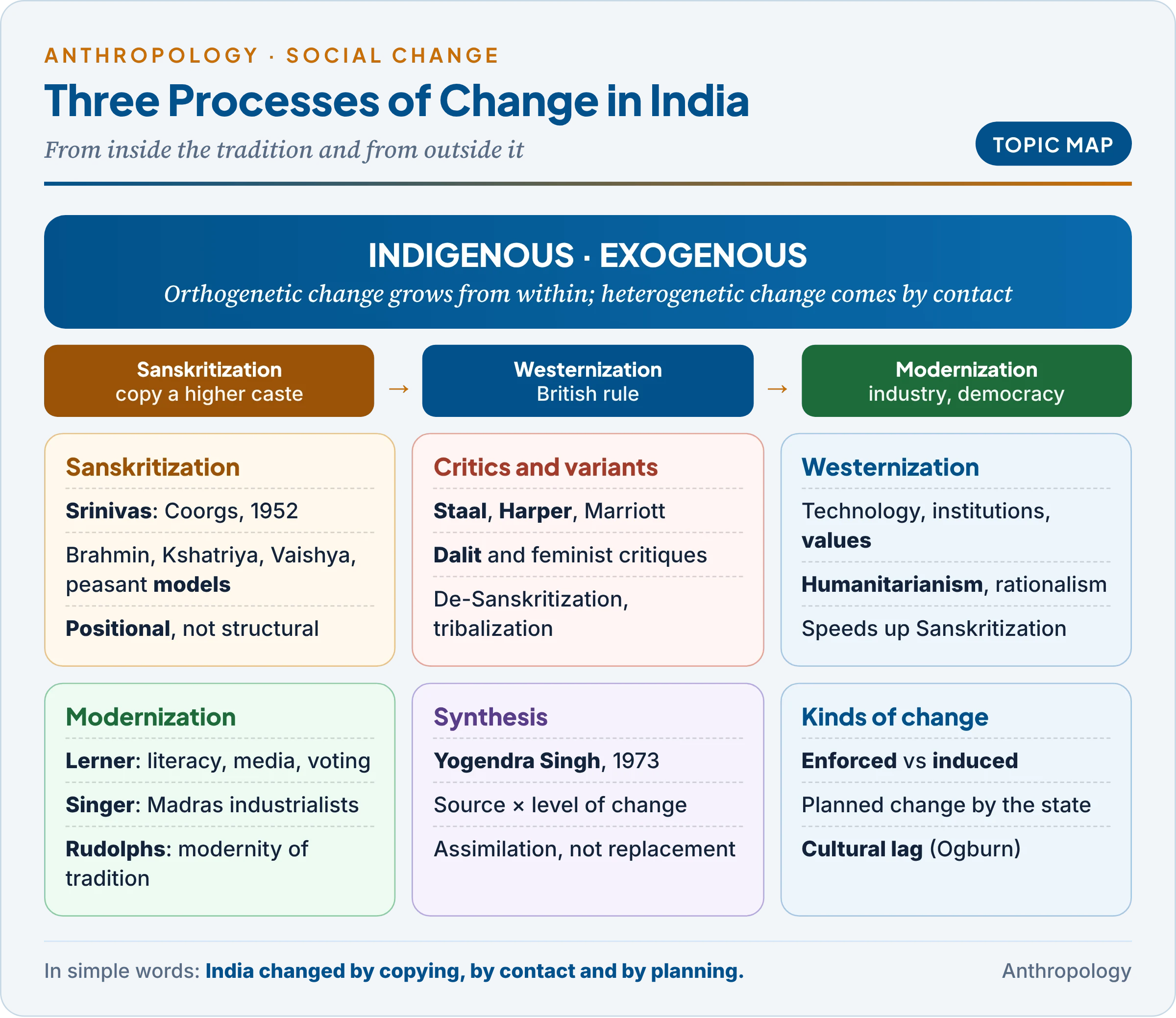
This article covers the first part of the syllabus line: indigenous and exogenous sources of change and the three processes, Sanskritization, Westernization and modernization. Sanskritization appears in 3.2b as one route of caste mobility (Bisipara distillers, Nadars, types of mobility); here it gets its full treatment as a process of cultural change. Little and great traditions, Panchayati Raj and media are in 5.3b.
1. Social Change in India: Indigenous and Exogenous Processes
In simple words
Every society changes, but change can start from inside or arrive from outside. In India some changes grew out of its own traditions, such as low castes copying the customs of higher castes, while others came through contact with Islam, the British and the modern world. Most real change mixes the two.
1.1 Social change, cultural change and technological change
- Social change means a change in the structure of social relations: who works for whom, who marries whom, who holds power. The abolition of untouchability in law and the rise of Dalit panchayat heads are social changes.
- Cultural change means a change in values, beliefs, symbols and ways of life: diet, dress, ritual, language, taste. A caste giving up meat and adopting the sacred thread is a cultural change.
- The two overlap, but they need not move together. A caste can change its customs without changing its place in the hierarchy, which is exactly the limit critics found in Sanskritization (§2.8).
- Technological change is change in tools and techniques. William Ogburn, an American sociologist (Social Change, 1922), argued that material culture (technology) changes faster than non-material culture (values, laws, family norms), producing a cultural lag. In India the tractor, the mobile phone and the hospital arrived faster than the norms that govern land, gender and caste, which is why new technology often produces tension before it produces adjustment.
1.2 Indigenous and exogenous sources
Robert Redfield and Milton Singer, American anthropologists at the University of Chicago (“The Cultural Role of Cities”, 1954), distinguished orthogenetic change, which grows out of a civilization’s own older culture, from heterogenetic change, which comes through contact with other civilizations. The Indian sociologist Yogendra Singh (Modernization of Indian Tradition, 1973) built this into his account of Indian change (§4.4). The table sorts the main processes; notice that a process can begin as exogenous and become indigenous once Indians take it over.
| Source | Process | Example |
|---|---|---|
| Indigenous (orthogenetic) | Sanskritization | Coorgs adopt Brahmin diet and rites |
| Bhakti and sect movements | Lingayats, Kabirpanthis: devotion against hierarchy | |
| Universalization, parochialization | Village goddesses linked to all-India deities (5.3b) | |
| Exogenous (heterogenetic) | Islamization | Sufi orders, Indo-Islamic culture (3.4) |
| Westernization | English schools, courts, railways under British rule | |
| Modernization, globalization | Planning, industry, democracy, markets, media |
The distinction matters for resistance: change in the tradition’s own idiom (a caste claiming Kshatriya descent) is accepted more easily than change from outside (a law against untouchability), though the second reaches the structure more deeply.
1.3 Enforced, induced and planned change
- Enforced change is imposed by authority with penalties: the ban on sati (Bengal Regulation XVII of 1829), the abolition of untouchability (Article 17), the forced relocation of villages for dams. It works fast on the surface but can provoke resistance.
- Induced (directed) change works through persuasion, incentives and example: schooling, health campaigns, the Community Development Programme (1952). It is slower but lasts because people adopt it as their own.
- Planned change is the state’s deliberate pursuit of set goals (the Five-Year Plans from 1951); it succeeds when planners understand local culture (9.2).
1.4 Socio-cultural factors and “underdevelopment”
Older development writing blamed culture for poverty: fatalism drawn from karma, ritual spending, caste restrictions on occupation and seclusion of women. Gunnar Myrdal, a Swedish economist (Asian Drama, 1968), called India a “soft state”. Anthropologists qualify this: people are rational within their constraints (a farmer avoids a risky new seed because one bad harvest means ruin), and structural factors such as land concentration and debt explain more than values do. Culture shapes how change is received, not whether a people can change.
2. Sanskritization
In simple words
In a caste society a low caste cannot simply announce that it is high. Instead it slowly copies the food, rituals and customs of a respected higher caste, and after a generation or two claims a higher rank. Sanskritization is the name for this process. It can lift a caste up the ladder, but it leaves the ladder itself in place.
2.1 The Coorgs: the example
The Coorgs (Kodavas) of Coorg (now Kodagu district, Karnataka) are a landowning, martial community who ate pork, drank liquor and worshipped ancestors and local deities. M.N. Srinivas, the Indian social anthropologist trained at Oxford under Radcliffe-Brown, studied them in the early 1940s and published Religion and Society among the Coorgs of South India (1952). He found that the caste order was not rigid: “A low caste was able, in a generation or two, to rise to a higher position in the hierarchy by adopting vegetarianism and teetotalism, and by Sanskritizing its ritual and pantheon.“
- A section of the Coorgs, the Amma Coorgs, came under strong Brahmin influence in the first half of the nineteenth century, became vegetarian and teetotal, wore the sacred thread and became a separate endogamous group (only 666 people at the 1941 census).
- The Coorgs as a whole claimed to be Kshatriyas, while neighbouring Lingayats still called them “jungle people” (kadu jana): a claim to rank must be accepted by others to count.
The case shows three steps: adopt higher-caste customs, claim a higher rank, wait for acceptance.
2.2 From “Brahminization” to Sanskritization
- Srinivas first spoke of Brahminization, but chose Sanskritization in the Coorg book because certain Vedic rites are shared by all three twice-born (dvija) varnas, not only by Brahmins, and because the model copied was often not Brahmin at all.
- In “A Note on Sanskritization and Westernization” (Far Eastern Quarterly, 1956) and Social Change in Modern India (1966), he widened the definition: Sanskritization is “the process by which a ‘low’ Hindu caste, or tribal or other group, changes its customs, ritual, ideology and way of life in the direction of a high, and frequently, ‘twice-born’ caste.” Generally such changes are followed by a claim to a higher position in the caste hierarchy than the one the local community had conceded.
- Srinivas kept the local term because Sanskritization is the particular form that acculturation (culture change through contact) takes in Hindu society.
- It is an instance of reference group behaviour (Robert Merton): people copy a group they admire. Yogendra Singh called it a culture-specific case of anticipatory socialization (learning the ways of a group one hopes to join).
2.3 What changes: the contents of Sanskritization
The table lists what a Sanskritizing group typically adopts and gives up. Read it as a menu, not a fixed package: each group borrows what is visible and prestigious locally.
| Domain | Given up | Adopted |
|---|---|---|
| Diet and drink | Beef, pork, fowl, liquor | Vegetarianism, teetotalism (or at least “cleaner” meats) |
| Ritual and worship | Animal sacrifice, spirit cults, own caste priests | Brahmin priests, Sanskrit mantras, pilgrimage, Vaishnava or Shaiva sects |
| Deities | Local, blood-taking godlings | All-India gods (Rama, Krishna, Shiva) or local gods renamed after them |
| Symbols | Marks of low status | Sacred thread, caste names ending in Sharma, Singh, Varma; new origin myths |
| Marriage and women | Bride-price, widow and divorcee remarriage, adult marriage | Dowry, ban on widow remarriage, early marriage, seclusion of women |
| Occupation | “Polluting” work (carrion, toddy, scavenging) | Cultivation, trade, service |
Giving up polluting work is an economic sacrifice only a group with other income can afford, and the marriage changes show Sanskritization tightening control over women (§2.7).
2.4 Models of Sanskritization and the dominant caste
In 1966 Srinivas admitted: “I emphasized unduly the Brahminical model of Sanskritization and ignored the other models—Kshatriya, Vaishya, and Shudra.” The British anthropologist David Pocock had shown a Kshatriya or kingly model in Gujarat, and Milton Singer spoke of “three if not four” models.
- Brahmin model: vegetarianism, teetotalism, ritual purity, scholarship. Srinivas noted that this puritanical model enjoyed overall dominance: even meat-eating groups conceded it the highest prestige.
- Kshatriya model: meat and liquor allowed, but martial pride, Rajput titles, genealogies, the sword and the red turban. In Gujarat’s Kaira district the Barias copied the turban and sword of the Patidars of thirty years earlier.
- Vaishya model: thrift, vegetarianism, trade and sect membership. The Patidars, who long sought Kshatriya status, later preferred Vaishya status as business success raised its prestige.
- Shudra or peasant model: where a peasant caste is dominant, lower castes copy its way of life.
The models are mediated by the local dominant caste, which Srinivas defined as numerically strong, landed and politically powerful (3.2b). If the dominant caste is Brahmin or Lingayat it transmits a Brahmin model; if it is Rajput or Bania, a Kshatriya or Vaishya model. Pocock’s point sharpens this: a low caste does not imitate an abstract idea of Brahmanism but the caste just above it in its own locality.
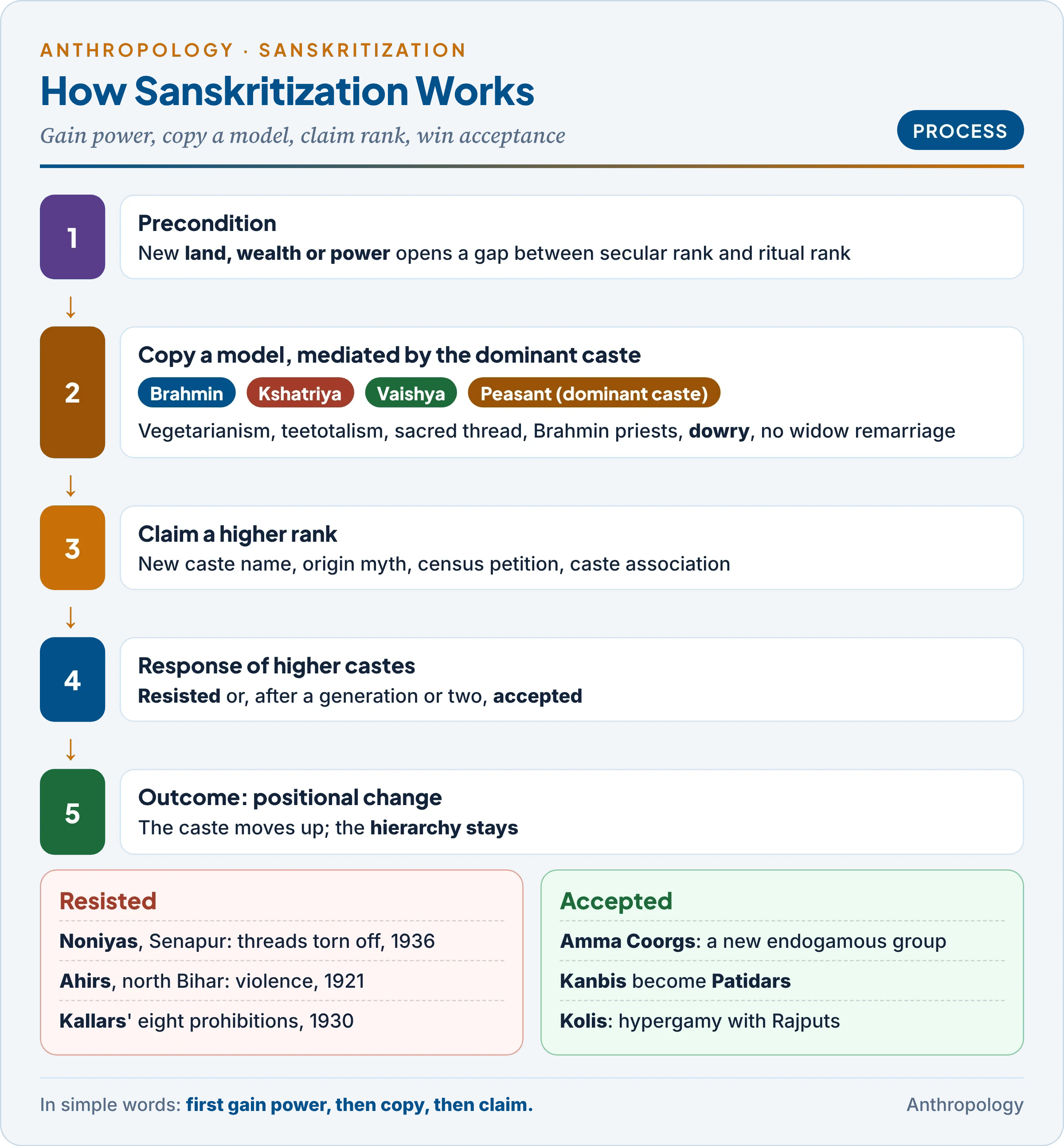
2.5 How it works: preconditions, resistance and success
Preconditions. Sanskritization usually follows a gain in wealth or political power. A caste with land, trade profits or a share in rule felt the gap between its secular rank (wealth, power) and its ritual rank (purity) and closed it by Sanskritizing. Srinivas also noted the reverse: mobility can occur without Sanskritization, and Sanskritization without mobility.
Resistance. Dominant castes guarded the symbols of rank:
- Noniyas of Senapur (eastern Uttar Pradesh): the American anthropologist William Rowe recorded that when this caste of salt-makers put on the sacred thread en masse in 1936, the Kshatriya landlords beat them, tore off the threads and fined the caste. Years later they wore the thread again, quietly and individually, and were unopposed.
- Ahirs (cowherds) who wore the thread in north Bihar met violence and court cases from Rajputs and Bhumihar Brahmins (Census report, 1921).
- Kallars of Ramnad (Tamil Nadu) in December 1930 laid down eight prohibitions on Adi-Dravidas (no gold ornaments, no blouses for women, no umbrellas or sandals) and burnt huts when defied.
Success. Change succeeds when the claimant has resources and the rank gap is moderate:
- Kanbis to Patidars (Gujarat): a peasant caste took the honorific name Patidar, prospered from cash crops and became one of the most Sanskritized castes of the region (Pocock).
- Kolis: tribal Koli chiefs married daughters into Rajput lineages (hypergamy, marrying a daughter upward), and bardic genealogists (Vahivanca Barots, studied by A.M. Shah and R.G. Shroff, 1958) wrote Koli genealogies that supported their rise.
- Lingayats (Karnataka) spread a Sanskritized way of life through Kannada, not Sanskrit, and a network of wealthy monasteries.
Tribes. Srinivas reported Sanskritization among the Bhils of western India, the Gonds and Oraons of central India and the Pahadis of the Himalaya. The usual result is that the tribe claims to be a caste, and therefore Hindu. The Bhumij became Rajput-claiming Hindus (Surajit Sinha, 3.2b), and Oraon reformers such as the Tana Bhagats (1914) gave up meat, liquor and spirit worship. The process shades into the tribe-caste continuum (3.2b).
Regional limits. Sanskritization was weak where Brahmin influence was weak. D.R. Chanana showed that in pre-Partition Punjab, where Muslims and Sikhs were dominant, Hindus were influenced more by Islam and Sufism; Sanskritization grew there only under British rule through the Arya Samaj.
2.6 Why British rule speeded up Sanskritization
- Census: from 1901 castes petitioned for higher varna names.
- Courts: British courts would not enforce an upper caste’s monopoly over symbols such as the sacred thread.
- Caste associations pressed claims and reformed members’ customs (3.2b).
- New wealth from trade, army service and urban jobs gave lower castes the economic base Sanskritization needs.
The paradox is that Westernization accelerated Sanskritization: the instruments of a modern state were used to pursue a traditional kind of rank (§3.5).
2.7 Positional change, not structural change
Srinivas stated the limit himself: “the mobility associated with Sanskritization results only in positional changes in the system and does not lead to any structural change. That is, a caste moves up, above its neighbors, and another comes down, but all this takes place in an essentially stable hierarchical order.”
- Positional change: a caste changes its place on the ladder.
- Structural change: the ladder itself changes, for example when untouchability is abolished, when votes count equally, or when jobs are allocated by merit and reservation rather than birth.
- The unit of mobility in Sanskritization is the group, not the individual: a whole caste or a local section of it moves together.
In his later lecture “The Changing Position of Indian Women” (Man, 1977), Srinivas showed a hidden cost: castes that Sanskritized often replaced bride-price with dowry, banned widow remarriage and restricted women’s work and movement. Feminist scholars such as the historian Uma Chakravarti (“Conceptualising Brahmanical Patriarchy”, 1993) argue that control over women’s sexuality is central to maintaining caste purity, so a caste rising by Sanskritization imports Brahmanical patriarchy.
Common confusion
Does Sanskritization mean that a caste becomes Brahmin? No. The caste copies some customs of a higher caste (not always Brahmin) and claims a higher rank, often Kshatriya or Vaishya. Its success depends on whether neighbouring castes accept the claim, and even when they do, only its position changes. The hierarchy, purity rules and endogamy remain.
2.8 Critiques of the concept
Is Sanskritization a culture-bound concept, useful only for Hindu India? The critics fall into four groups, and the concept’s strengths follow.
Conceptual critiques
- J.F. (Frits) Staal, a Dutch Indologist (“Sanskrit and Sanskritization“, Journal of Asian Studies, 1963), argued that the term is misleading: its link with the Sanskrit language is “extremely complicated”, and it lumps together a class of concepts (language, ritual, diet, myth) under the name of one of them.
- Edward Harper, an American anthropologist who studied the Havik Brahmins of Karnataka (“A Hindu Village Pantheon”, 1959), treated the distinction between Sanskritic and non-Sanskritic deities as functional rather than historical: villagers rank gods by what they do, not by where they came from, so “Sanskritic” is an interpretive label, not a historical fact.
- McKim Marriott, an American anthropologist (Kishan Garhi, 1955; 5.3b), found no replacement of local rites: Sanskritic rites are added on to non-Sanskritic ones by accretion. Sanskritization exaggerates how much the little tradition is displaced.
Critiques of scope
- Yogendra Singh argued that it neglects non-Sanskritic traditions (Islamic, tribal, folk), is cultural rather than structural, and is culture-specific, so it cannot serve for comparison across societies the way great and little traditions can.
The Dalit critique
- B.R. Ambedkar had already described caste as spread by imitation of the Brahmin’s closed group (3.2a): Sanskritization is the same mechanism and therefore reproduces caste.
- Dalit and Bahujan writers such as Kancha Ilaiah (Why I Am Not a Hindu, 1996) and Gail Omvedt (Dalit Visions, 1995) argue that the concept takes the Brahmanical value scale for granted: it treats meat-eating, labour and women’s freedom as “low” and calls their abandonment “upward”. It ignores counter-cultures of labour and equality.
- Untouchables gained little: Sanskritization rarely worked for Dalits, whose claims met violence (the Kallar prohibitions). The American anthropologist Owen Lynch (The Politics of Untouchability, 1969) showed the Jatavs of Agra moving from Kshatriya claims to Ambedkarite politics and Buddhism.
Strengths that survive the critique
- It showed that caste was never static and gave a name to group mobility that the textual view of caste denied.
- It linked village ethnography to the all-India tradition, and connected ritual rank with economic and political power through the dominant caste.
- It remains a useful middle-range concept: limited to Hindu India, but precise there, and it inspired parallel concepts (Islamization, tribalization, Kshatriyaization).
2.9 Related processes
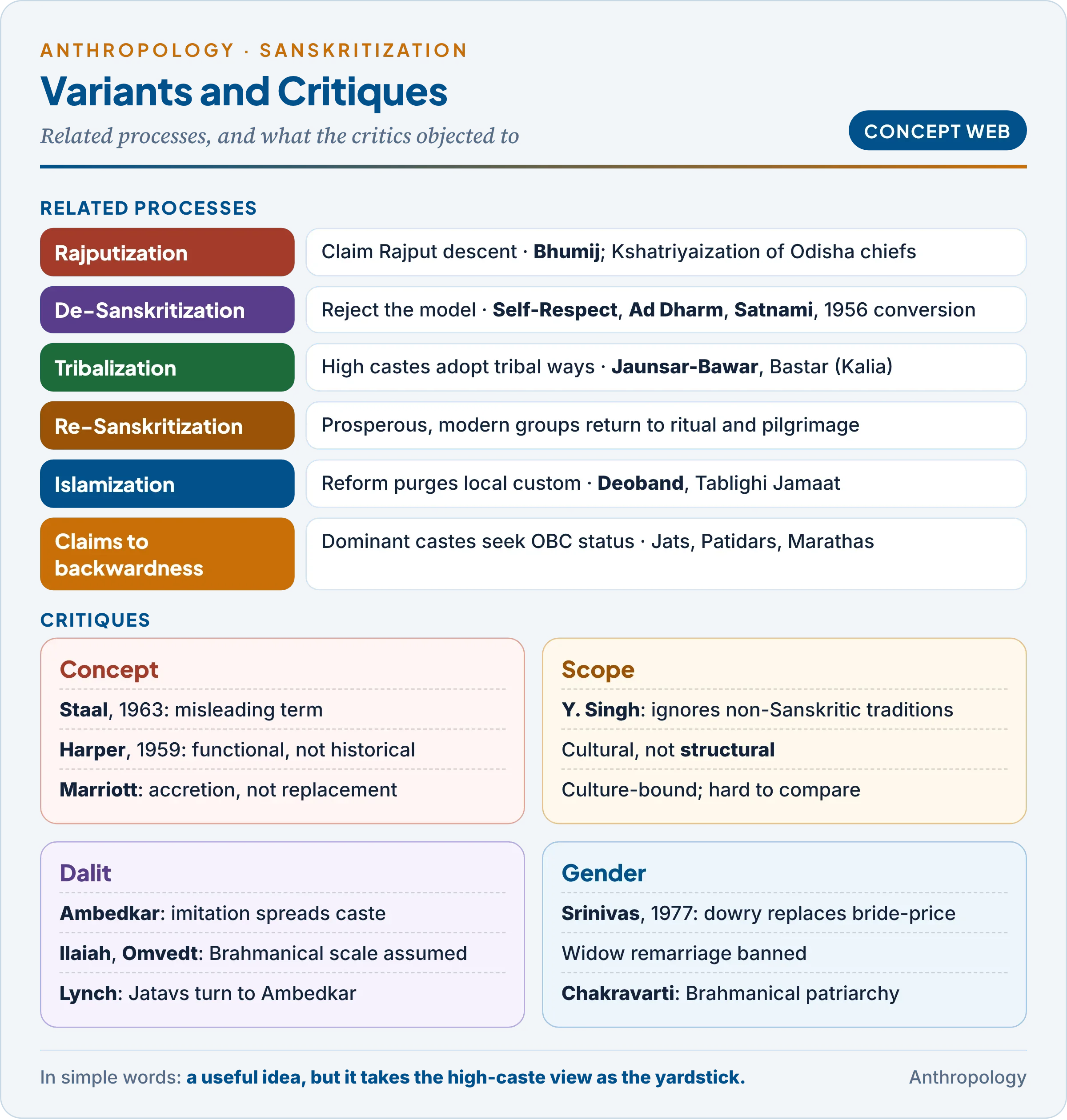
- Rajputization or Kshatriyization: chiefs and peasant groups claim Rajput descent through genealogies, temples and Brahmin priests. The German historian Hermann Kulke used Kshatriyaization for the way tribal chiefs of Odisha became Hindu kings; Surajit Sinha described the Bhumij (3.2b).
- De-Sanskritization: a deliberate rejection of the Sanskritic model. The Self-Respect Movement of E.V. Ramasamy (Periyar) in Tamil Nadu (from 1925) promoted marriages without Brahmin priests; the Ad Dharm movement of Mangu Ram in Punjab (1925–26) declared Dalits the original inhabitants with a religion of their own; the Satnami movement of Guru Ghasidas in Chhattisgarh (early nineteenth century) rejected idols and caste; the Mahar conversion to Buddhism at Nagpur in 1956 rejected Hinduism itself.
- Tribalization: the reverse borrowing. Srinivas cites S.L. Kalia, who found high-caste Hindus posted in Jaunsar-Bawar (Uttarakhand) and Bastar taking over tribal food, drink and customs, promising to “purify ourselves the day we cross the Jumna”. The word is also used for tribes reasserting their own religion and identity, as in the Sarna movement of Jharkhand (3.3).
- Re-Sanskritization: prosperous, Westernized groups returning to Sanskritic ritual and pilgrimage: modernization and Sanskritization can rise together.
- Islamization: the Muslim parallel, in which reform movements (Deoband, Tablighi Jamaat) purge local customs for textual Islam (Imtiaz Ahmad; 3.4).
- Claims to backwardness: dominant castes seeking OBC status through the state’s categories rather than ritual rank (3.2b).
3. Westernization
In simple words
When the British ruled India they brought English schools, courts, railways, newspapers and new ideas such as equality before the law. Indians who took up these new things changed their dress, diet, jobs and outlook. Westernization is the name for this change, which began with the upper castes and slowly reached everyone.
3.1 The example: eating at a table
Srinivas described how, among upper castes and especially Brahmins, eating was a religious act: food cooked by women in a state of ritual purity, offered first to the deities, eaten on leaves while men sat in silk dhotis, the floor purified with cowdung afterwards. In the towns, educated families began to eat at tables, at hours set by school and office, with spoons and stainless-steel plates. The table is not purified with cowdung, so the ritual acts before and after meals drop away, and food begins to be judged by health rather than by purity. A change in technology (the table) produced a change in values (secularization), and the new values then spread the new technology.
3.2 Definition and value core
- Srinivas defined Westernization as “the changes brought about in Indian society and culture as a result of over 150 years of British rule, the term subsuming changes occurring at different levels: technology, institutions, ideology, values.“
- It brought new institutions (newspapers, elections, Christian missions) and changed old ones: Indian schools existed before the British, but they had been restricted to upper-caste children and taught traditional knowledge.
- Its central value is humanitarianism: “an active concern for the welfare of all human beings irrespective of caste, economic position, religion, age, and sex“, which includes equalitarianism and secularization. Its other mark is rationalism: a scientific, critical attitude to custom.
- British law ended certain legal inequalities: in pre-British Hindu law punishment varied with the caste of offender and victim.
3.3 Primary, secondary and tertiary Westernization
Srinivas proposed qualifying Westernization as primary, secondary or tertiary according to how direct the link is between the Western stimulus and the Indian response.
- Primary: the link is simple and direct, as when printing and towns raise literacy.
- Secondary and tertiary: the link is indirect and passes through other changes, as with the Backward Classes Movement, the Arya Samaj or twentieth-century linguistic consciousness, each a reaction to conditions that Western rule created.
The distinction shows that Westernization produced not only liberal reform but also revivalism, communalism, “casteism”, linguistic consciousness and regionalism, often spread through Western-style schools and pamphlets.
3.4 Agencies and impact
- Print, English education and the professions created a new middle class, first in Calcutta, Bombay and Madras; by 1877 over 3,000 titles had appeared in the vernaculars alone.
- Army: the Indian army grew from about 175,000 men in 1939 to about two million in the Second World War, uprooting villagers and teaching new skills.
- Social reform by the Westernized elite: Raja Ram Mohan Roy and the Brahmo Samaj (1828), campaigns against sati, child marriage and the ban on widow remarriage, and later the national movement.
- Unequal spread: the castes that had traditional literacy (Brahmins, Kayasthas, Prabhus) took to English education first, so traditional elites extended their dominance into new jobs. This overlap provoked the Backward Classes and non-Brahmin movements (the Non-Brahmin Manifesto of Madras, December 1916), which demanded a share of the new opportunities.
3.5 Sanskritization and Westernization together
The two processes are not opposites. Srinivas showed that they run together and often reinforce each other.
- Railways, post and newspapers ease pilgrimages, caste conferences and religious publishing, so Westernization speeds up Sanskritization.
- Different groups, different directions: Brahmins in towns Westernized and dropped some ritual, while lower castes in villages Sanskritized by adopting the very rituals Brahmins were relaxing.
- Same group, both processes: Patidars or Lingayats Sanskritized their rites while Westernizing their education and business.
- Discrete change: Westernization in one area need not spread to another. In Rampura in 1952 Srinivas met a government bulldozer driver who gave demonstrations of black magic in his spare time and saw no inconsistency.
The table compares the two processes.
| Feature | Sanskritization | Westernization |
|---|---|---|
| Source | Indigenous, historical | British rule, continuing after 1947 |
| Reference model | Higher, often twice-born caste | British and Western ways |
| Outlook promoted | Sacred, purity-centred | Secular, rational, humanitarian |
| Mobility | Within the caste framework | Largely outside caste (education, jobs) |
| Diet | Vegetarianism, teetotalism | Meat, eggs and alcohol became acceptable among some upper castes |
| First adopters | Middle and low castes | Upper castes, urban middle class |
| Change | Positional | Positional, with some structural pressure |
3.6 Critiques of Westernization
- Too local a label: the American sociologist Daniel Lerner (The Passing of Traditional Society, 1958) preferred “modernization” because the model a country copies may be Russia, Turkey or Japan, not the West, and because educated people in new nations want “the modern package” without the label “made in U.S.A.”. Srinivas agreed that each Western country offers a different model (British, American, Soviet).
- Is it ethically neutral? Srinivas claimed that “Westernization”, unlike “modernization”, carries no judgment of good or bad. Critics reply that the West he describes was also the West of racism, colonial exploitation and economic drain, so calling its values “humanitarian” is selective.
- Cultural, not structural: like Sanskritization, it describes changes in style of life more than changes in power and property.
- Indians as passive receivers? Srinivas himself rejected a “blotting-paper role”: Indians selected, reinterpreted and resisted. Ashis Nandy (The Intimate Enemy, 1983) showed colonialism shaping the minds of colonizer and colonized alike.
- Imprecise: it lumps technology, institutions and values together without saying which change causes which (Yogendra Singh).
4. Modernization
In simple words
Modernization means a society becoming industrial, urban, literate, scientific and democratic, with people choosing jobs and partners rather than inheriting them. In India this did not wipe out tradition. People kept caste, family and ritual, but used them in new ways inside modern offices, factories and elections.
4.1 The example: Madras industrialists
Milton Singer studied industrial leaders in Madras (Chennai) in the 1960s (When a Great Tradition Modernizes, 1972). These men ran modern factories, travelled abroad and wore suits at work, yet kept joint-family ties, consulted astrologers and performed domestic rituals. They managed the two worlds through three adaptive strategies:
- Compartmentalization: keeping traditional and modern spheres apart in space and time: rules of purity at home, rules of the factory at work.
- Ritual neutralization: treating a modern act that breaks a traditional rule (eating with other castes at the office) as ritually neutral, so that it does not count as pollution.
- Vicarious ritualization: having others perform rituals on one’s behalf: the wife or a hired priest keeps the household rites the busy industrialist cannot.
Tradition adapts to modernity rather than collapsing.
4.2 Meaning and indicators of modernization
- Daniel Lerner described modernization as a linked sequence: urbanization raises literacy, literacy raises media exposure, and media exposure goes with wider economic and political participation (voting). Its psychological core is empathy, a “mobile personality” able to imagine itself in new roles.
- Neil Smelser, an American sociologist, stressed structural differentiation: the family that was once farm, school and welfare office gives way to specialised institutions.
- Alex Inkeles and David Smith (Becoming Modern, 1974), surveying men in six developing countries including India, found the modern man to be an informed participant citizen with a sense of personal efficacy, independent of traditional authority and open to new experience; factory work and schooling produced these traits.
- Indicators: industrial employment, urbanization, literacy, life expectancy, secularization, achieved status and mass political participation.
- Instruments: essays edited by Myron Weiner (Modernization: The Dynamics of Growth, 1966) named education, mass communication, nationalism, charismatic leadership and coercive authority.
4.3 Modernization theory and its critics
The modernization school of the 1950s–60s assumed that tradition and modernity are opposites and that all societies would follow the Western path.
| Critic | Work (year) | Objection |
|---|---|---|
| Joseph Gusfield | “Tradition and Modernity: Misplaced Polarities” (1967) | Tradition is not static or uniform; the two coexist and mix |
| Lloyd and Susanne Rudolph | The Modernity of Tradition (1967) | Traditional institutions carry modern functions |
| Andre Gunder Frank | “The Development of Underdevelopment” (1966) | Poverty results from dependency on the West, not from tradition |
| M.N. Srinivas | Social Change in Modern India (1966) | “Modernization” assumes the rationality of ends, which is a value preference |
| S.C. Dube | Modernization and Development (1988) | Western growth model brings inequality and ecological damage; seek alternative paradigms |
| S.N. Eisenstadt | “Multiple Modernities” (2000) | There are many modernities, each shaped by its civilization |
The critiques changed the question from “will India become modern?” to “how does India make its own modernity?”.
4.4 Yogendra Singh’s paradigm
Yogendra Singh, an Indian sociologist at Jawaharlal Nehru University, offered the most systematic synthesis in Modernization of Indian Tradition (1973). He described Indian tradition by four values: hierarchy (in caste and status), holism (the individual subordinate to the group), continuity (karma and rebirth across lives) and transcendence (legitimation by sacred values beyond reason). Modernity, by contrast, values universalism, achievement and rationality.
He then cross-classified change by its source (orthogenetic or heterogenetic) and its level (cultural structure: little and great traditions; social structure: micro and macro).
| Source | Little tradition | Great tradition | Micro-structure | Macro-structure |
|---|---|---|---|---|
| Orthogenetic | Sanskritization | Reform and protest within the tradition: Buddhism, Jainism, Bhakti | Cyclical change in family and caste (joint to nuclear and back) | Circulation of elites, succession of kings, rise and fall of cities |
| Heterogenetic | Islamization, Westernization of folk life | Islamic and Western great traditions in contact with the Hindu | New roles and legitimations in caste, family and village | New institutions: bureaucracy, industry, democracy, new elites |
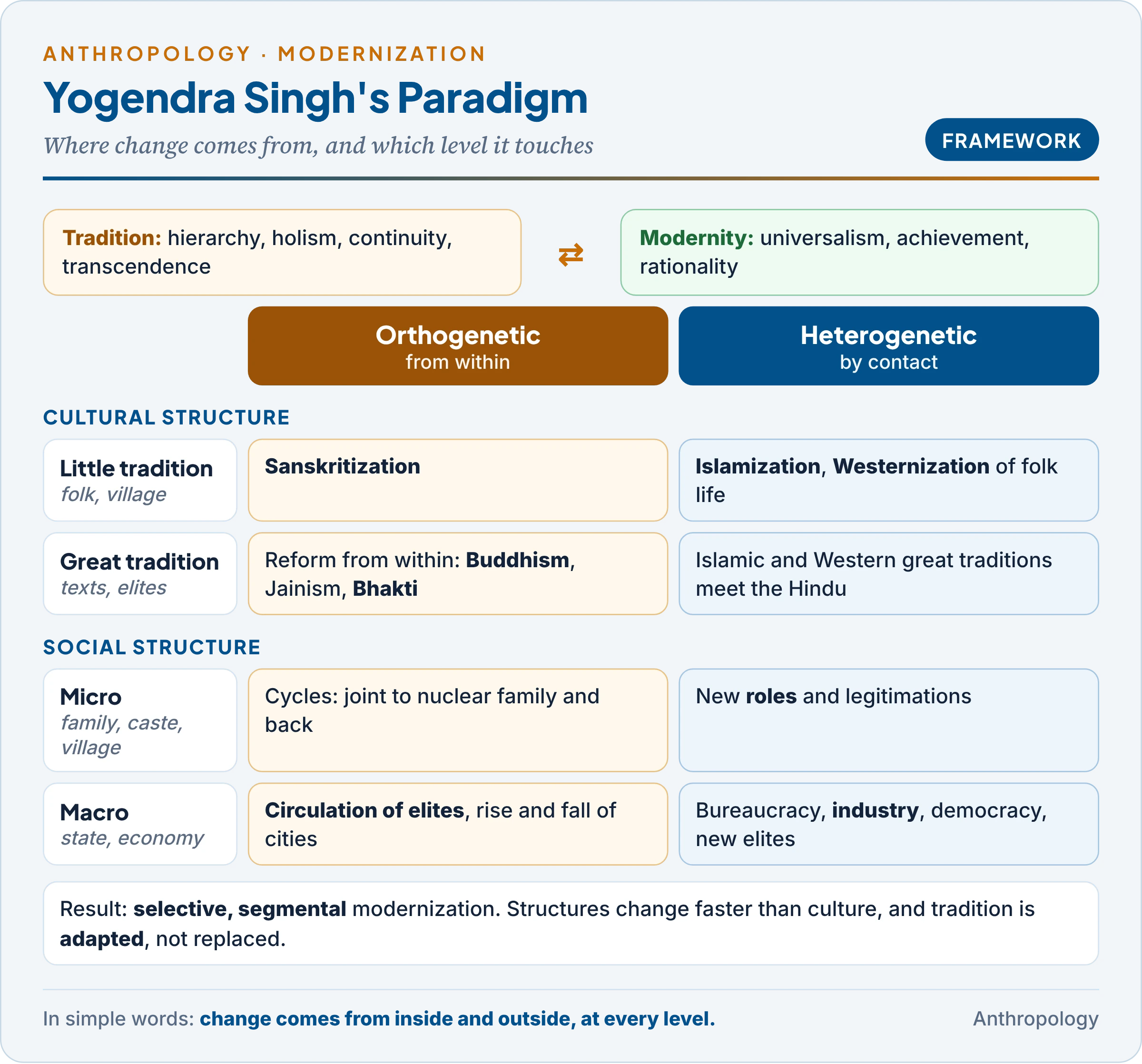
Singh’s conclusion was that modernization in India has been selective and segmental: structures such as bureaucracy and industry modernized faster than culture, producing structural inconsistencies, and many traditions were adapted rather than discarded. His framework places Sanskritization and Westernization inside a larger scheme rather than rejecting them.
4.5 The Rudolphs: the modernity of tradition
Lloyd and Susanne Rudolph, American political scientists (The Modernity of Tradition: Political Development in India, 1967), argued that tradition and modernity are dialectically related, each containing elements of the other.
- Caste associations (the Nadars, the Vanniyars) turned castes into voluntary, interest-group organisations that run schools, lobby and contest elections: a traditional unit doing modern work.
- Gandhi used a traditional idiom (fasting, renunciation, Ram Rajya) to build a modern mass movement.
Their argument shows modernity entering India through assimilation, not replacement.
4.6 Modernization in India: institutions and outcomes
Constitutional and legal modernization
- The Constitution (1950) promises justice, liberty, equality and fraternity: Article 15 forbids discrimination on grounds of religion, race, caste, sex or place of birth, Article 16 gives equality in public employment, Article 17 abolishes untouchability, and the Supreme Court has read Article 21 as a right to live with dignity.
- Laws: the Protection of Civil Rights Act (1955, renamed 1976), the Special Marriage Act 1954, the Hindu Marriage and Succession Acts (1955–56) and the SC and ST (Prevention of Atrocities) Act 1989; planning from 1951 made the state the main agent of directed change.
Agricultural modernization
- The Green Revolution (high-yielding seeds, fertiliser, irrigation, from the mid-1960s) transformed Punjab, Haryana and western Uttar Pradesh. India’s foodgrain output reached a record 357.73 million tonnes in 2024–25 (final estimates, November 2025).
- Its gains were uneven: they went to irrigated regions and larger farmers, while common lands shrank and groundwater was depleted.
Artisans and the jajmani economy
- Colonial imports ruined many village crafts; later, markets weakened jajmani ties (3.2b) and artisans moved into wage labour and the rural non-farm sector, so occupation and caste came apart.
Tribal and rural people
- Roads, schools, health centres and markets brought literacy, mobility and new aspirations; but modernization also brought land alienation, displacement by dams and mines, indebtedness and loss of control over forests (6.2, 6.3a). For tribes modernization often arrived as enforced rather than induced change, which explains their movements of protest (7.4).
4.7 Problems and contradictions of Indian modernization
- Modern roles, traditional values: factories are opened at an auspicious hour (muhurat), and engineers consult astrologers; the role is modern, the value system traditional.
- Uneven change: industry and administration modernize while family, religion and caste change slowly; education expands faster than jobs, producing educated unemployment and frustration.
- Caste in politics: democracy did not dissolve caste but politicised it. Rajni Kothari, an Indian political scientist (Caste in Indian Politics, 1970), showed caste turning into a vote bank and an interest group.
- Communalism, regionalism and the ecological costs of growth (S.C. Dube) grew alongside modernization.
Common confusion
Is Westernization the same as modernization? No. Westernization (Srinivas) refers to the specific changes caused by contact with the West, above all British rule, and covers behaviour (dress, diet), knowledge and values; Srinivas called it ethically neutral. Modernization is a broader, universal process of industrialisation, urbanisation, literacy, secularisation and democracy that can happen without copying the West (Japan) and is usually treated as desirable. India’s modernization after 1947 was driven by its own Constitution and planning, not by imitation of Britain.
The table sets out the differences point by point.
| Point | Westernization | Modernization |
|---|---|---|
| Scope | Changes from contact with a particular culture | A universal process open to any society |
| Value loading | Claimed to be neutral | Usually implies “good”, progress |
| Content | Dress, diet, manners, knowledge, values | Industry, cities, literacy, science, democracy |
| Agents in India | British rule; upper-caste urban elite first | The Indian state, markets, media; a mass process |
| Period | Mainly colonial, continuing after 1947 | Mainly post-1947 planned change |
| Possible without the West? | No, by definition | Yes (Japan, and India’s own path) |
5. Comparing the Three Processes
In simple words
The three processes are three lenses on the same moving society. Sanskritization explains change inside the caste order, Westernization explains change brought by British rule, and modernization explains the larger shift to an industrial, democratic society. Today all three work at once, often in the same family.
- Overlap: Sanskritization is the oldest and continues; Westernization began with British rule; modernization became a national project after 1947. None replaced the others.
- Level and unit: Sanskritization is positional and cultural and moves groups; Westernization adds structural pressure (education, law); modernization aims at structural change and increasingly moves individuals.
- Evaluation: Srinivas’s concepts were descriptive tools from fieldwork; Singh and the Rudolphs turned them into a theory of Indian change in which tradition is a resource, not only an obstacle. Globalization (5.1) and media (5.3b) are the newest layers.
Key Terms
| Term | Meaning in simple words |
|---|---|
| Sanskritization | A lower caste or tribe adopting the customs of a higher caste to claim higher rank |
| Twice-born (dvija) | The three upper varnas entitled to the sacred thread and Vedic rites |
| Reference group | A group people admire and copy when judging themselves |
| Positional change | A caste changes its place in the hierarchy; the hierarchy stays |
| Structural change | The hierarchy or system itself changes |
| Dominant caste | The locally powerful caste that sets the model others copy (3.2b) |
| De-Sanskritization | Rejecting the Sanskritic model in favour of one’s own or an egalitarian culture |
| Tribalization | Caste Hindus adopting tribal ways, or tribes reasserting their own identity |
| Westernization | Changes in India caused by British rule: technology, institutions, ideology, values |
| Humanitarianism | Concern for the welfare of all people regardless of caste, religion, age or sex |
| Modernization | Becoming industrial, urban, literate, secular and democratic |
| Orthogenetic change | Change growing out of a civilization’s own tradition |
| Heterogenetic change | Change brought by contact with another civilization |
| Cultural lag | Values and laws changing more slowly than technology |
| Compartmentalization | Keeping traditional and modern life in separate spheres |
Contemporary Developments
- Priests of all castes (Tamil Nadu): on 14 August 2021 the state appointed 24 trained archakas of various castes, including five from Scheduled Castes, to temples run by its Hindu Religious and Charitable Endowments Department, under a 2006 order that the Supreme Court had upheld in 2015. A ritual role once guarded against Sanskritizing castes was opened by law, a structural rather than positional change.
- Caste in the census: Census 2027 (notified June 2025) will count caste, the first full caste count since 1931; the census, once an arena of Sanskritizing claims, now records caste for policy.
- Prison manuals: in Sukanya Shantha v. Union of India (3 October 2024) the Supreme Court struck down jail rules that assigned work such as cooking or cleaning by caste, applying Articles 15, 17 and 21 to a colonial-era practice.
- Agricultural modernization: record foodgrain output of 357.73 million tonnes in 2024–25 sits beside groundwater depletion and agrarian distress, the uneven pattern that critics of the Green Revolution described.
Diagrams to Master
- Topic map: three processes on an indigenous/exogenous axis; label Coorgs, Srinivas 1952 and 1966, Singh 1973.
- How Sanskritization works: preconditions, adoption, claim, response, positional outcome, with the four models entering through the dominant caste; label Noniyas (1936) and Kanbi to Patidar.
- Related processes and critiques: Sanskritization at the centre with its variants around it; critics in a side panel.
- Yogendra Singh’s paradigm: a 2 × 4 grid with one example per cell.
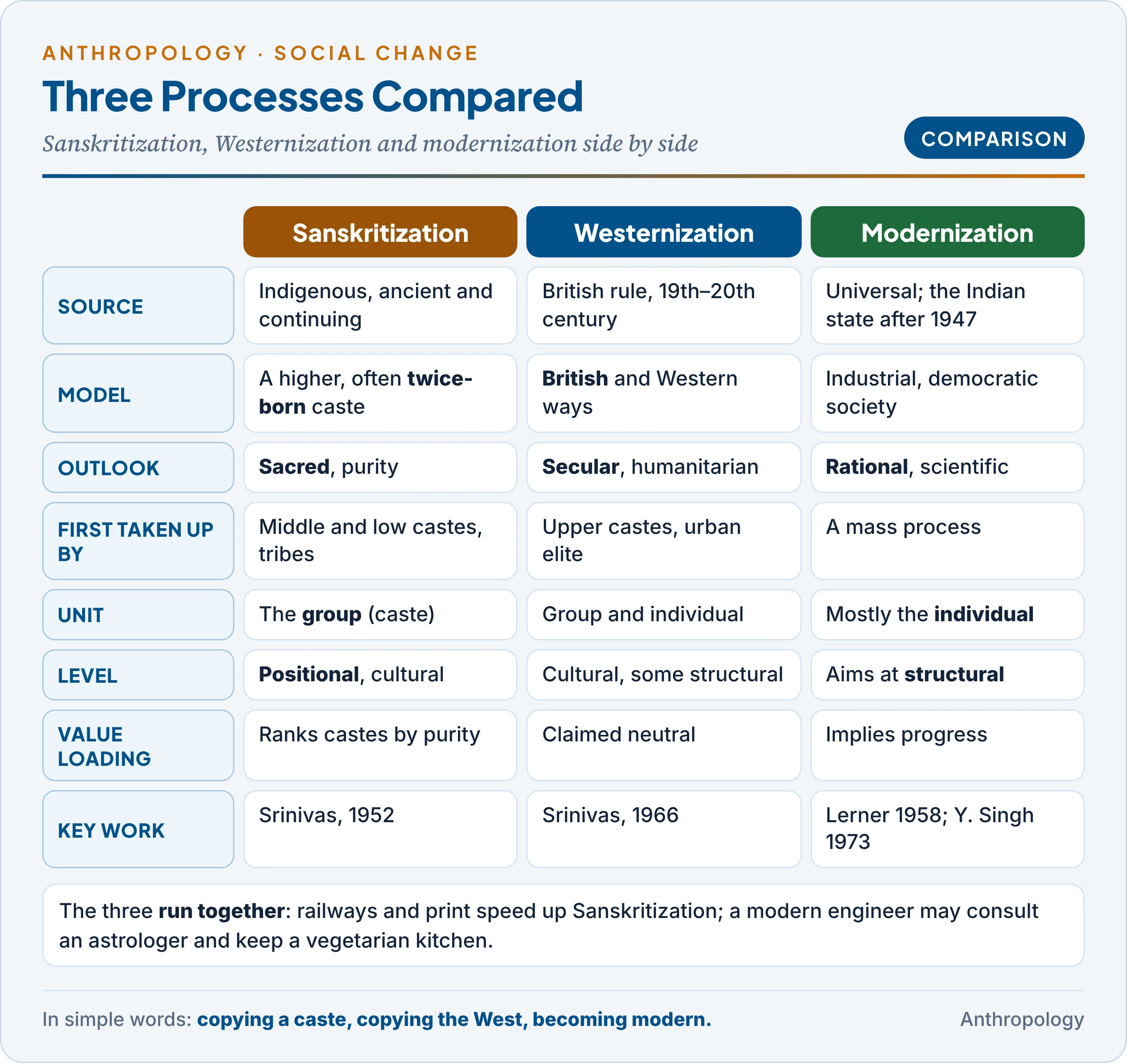
- Three processes compared: source, model, outlook, agents, level of change.
Revision Grid
| Scholar | Work (year) | Key idea |
|---|---|---|
| M.N. Srinivas | Religion and Society among the Coorgs of South India (1952) | Sanskritization; low castes rise in a generation or two |
| M.N. Srinivas | “A Note on Sanskritization and Westernization” (1956) | Both concepts set side by side |
| M.N. Srinivas | Social Change in Modern India (1966) | Models of Sanskritization; Westernization defined; positional change |
| M.N. Srinivas | “The Changing Position of Indian Women” (1977) | Sanskritization tightened control over women |
| David Pocock | Kaira, Gujarat studies | Kshatriya (kingly) model; Kanbi to Patidar |
| William Rowe | Senapur studies | Noniyas and the sacred thread (1936) |
| J.F. Staal | “Sanskrit and Sanskritization” (1963) | The term is misleading; a class of concepts |
| Edward Harper | “A Hindu Village Pantheon” (1959) | Sanskritic vs non-Sanskritic is functional, not historical |
| Owen Lynch | The Politics of Untouchability (1969) | Jatavs move from Sanskritization to Ambedkarite politics |
| Daniel Lerner | The Passing of Traditional Society (1958) | Modernization: urbanization, literacy, media, participation, empathy |
| Lloyd and Susanne Rudolph | The Modernity of Tradition (1967) | Tradition and modernity dialectically related; caste associations |
| Joseph Gusfield | “Tradition and Modernity: Misplaced Polarities” (1967) | Tradition and modernity are not opposites |
| Milton Singer | When a Great Tradition Modernizes (1972) | Compartmentalization, ritual neutralization, vicarious ritualization |
| Yogendra Singh | Modernization of Indian Tradition (1973) | Orthogenetic/heterogenetic × cultural/structural paradigm |
| S.C. Dube | Modernization and Development (1988) | Critique of Western growth model |
| S.N. Eisenstadt | “Multiple Modernities” (2000) | Many civilizational paths to modernity |
Previous Year Questions
Sanskritization, Westernization, Modernization; indigenous and exogenous processes of change
- 2023“Sanskritization is a culture-bound concept.” Critically comment to assess the strength and limitation of this concept in developing a theoretical framework to study social change.
- 2022Write notes on: Westernisation and Modernisation.
- 2020Write short note on Concept of Sanskritisation.
- 2018Write a note in 150 words on Modernization.
- 2011“Modernity has entered Indian character and society, but it has done so through assimilation not replacement.” Discuss.
- 2009Write a note on Sanskritization.
- 2009What are the various exogenous processes of socio-cultural changes in Indian Society ?
- 2002Write a note on Sanskritisation and Westernisation.
- 1999Distinguish between sanskritization and desanskritization. Critically examine impact of sanskritization on social mobility in India.
- 1998Discuss the impact of modernization of the tribal and rural people in India.
- 1994Write a note on Cultural change-enforced and induced.
- 1994Do you think that the process of Sanskritization leads to any structural changes in the society ? Discuss with reference to the modern Indian society.
- 1992Write a note on Sanskritization as a mode of social change.
- 1991Write a note on Relationship between Sanskritization and Westernization as processes of sociocultural change.
- 1990Write a note on Sanskritization as a factor of social change among the scheduled castes in India.
- 1989Write a note on : Are the socio cultural factors which justify calling an area underdeveloped? Elaborate.
- 1989Make a distinction between sociocultural change and technological change. Indicate how technological development bring about changes in other aspects of culture.
- 1986Discuss how the concepts of Sanskritization and Westernization. Explain the processes of change in Indian society and culture.
- 1983Write a note in 200 words : Sanskritization as a mode of social change.
- 1983Assess the nature of social change in India since Independence, specially pertaining to the main institutions of the society.
- 1981Describe the different forms and proces of sanskritization and assess the overal impact of this phenomenon on caste structure in India.
Related questions from other units
- 2024Unit 5.1: Compare and contrast the approaches of M. N. Srinivas and L. P. Vidyarthi to social change in village India.
- 2016Unit 3.2: How is process of tribe-caste continuum different from Sanskritization? Comment.
- 2015Unit 3.2: What do you understand by dynamics of caste mobility ? How did the concept of Sanskritization contribute to its functionality ?
- 2015Unit 4: Discuss the contribution of M.N. Srinivas to the study of Indian society. Examine the influence of British social anthropologists on his ideas.
- 2010Unit 4: Assess the contributions of M.N. Srinivas towards Indian Anthropology in general. Add a note on his understanding in the context of studying social mobility in India.
- 2006Unit 7.2: Critically review the processes of social changes the contemporary Indian society is undergoing.
- 1997Unit 2.1: Elucidate the various concepts of social and cultural changes indicating the specific problems involved in the change process.
- 1995Unit 2.5: What is kinship system? Describe the changing roles of the system in the context of westernization in India.
More from Indian Village and Social Change: all notes of this unit · every PYQ of this unit · Anthropology Optional hub