

Anthropology Optional › Paper II › Unit 03: Indian Social System and Caste
3.3 Sacred Complex and Nature- Man-Spirit Complex.
Official Syllabus: Paper II, Unit 3.3
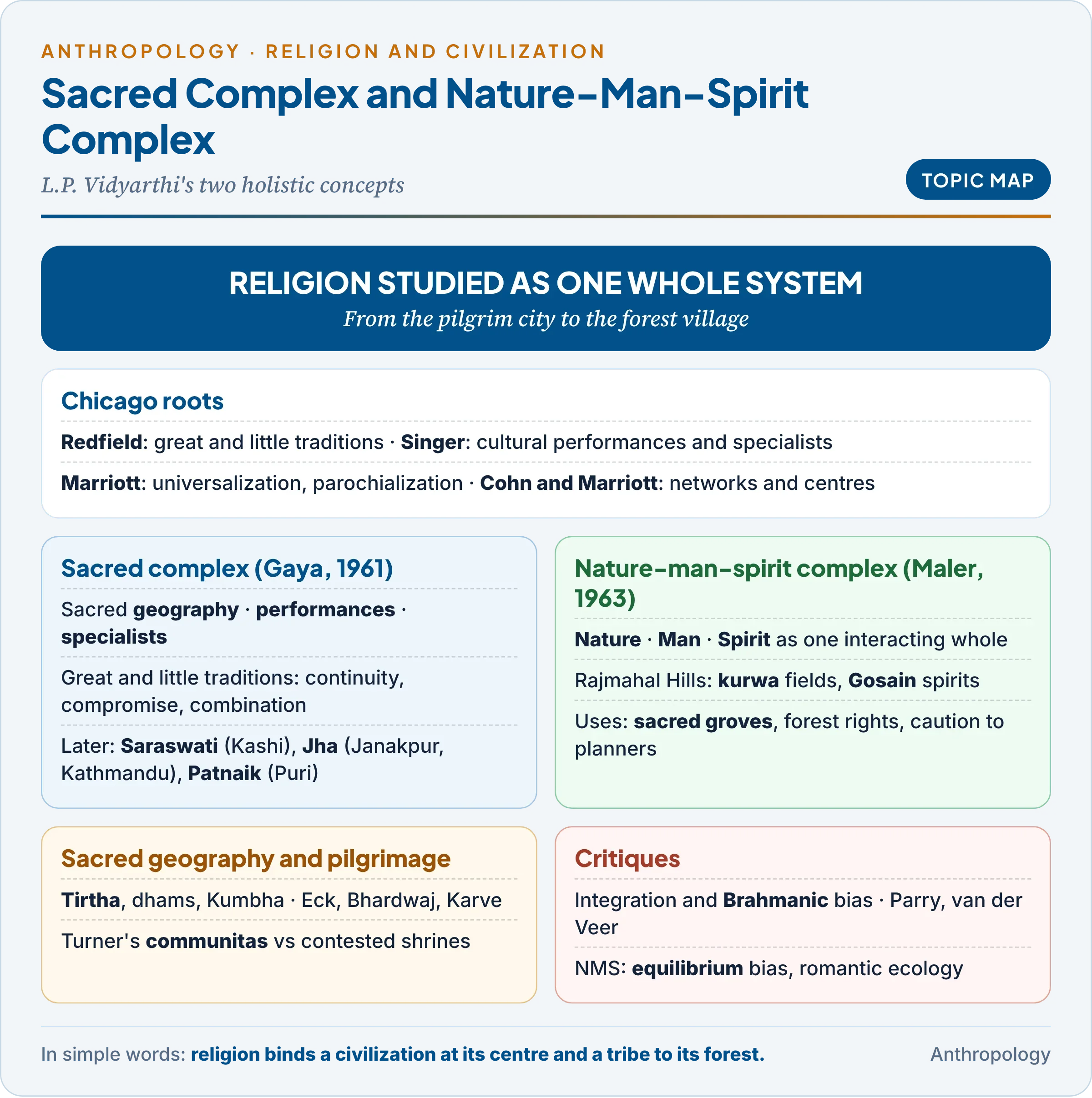
This article covers two concepts of the Indian anthropologist L.P. Vidyarthi: the sacred complex, for studying Hindu pilgrim centres as parts of Indian civilization, and the nature-man-spirit complex, for studying tribal life as one ecological, social and religious whole. The textual Hindu model (varna, ashrama, karma) is in 3.1; the interplay of little and great traditions as a process of change is in 5.3b; the impact of Hinduism, Christianity and other religions on tribes is in 8.1; Vidyarthi’s wider career is in 4b.
1. The Civilizational Approach: Where Both Concepts Come From
In simple words
Early anthropologists studied small tribes and villages as if each were a closed world. A group of scholars in the 1950s asked a bigger question: how does a huge civilization like India hold together across thousands of villages, castes and languages? Vidyarthi’s two concepts grew out of that question, one for pilgrimage towns and one for forest tribes.
1.1 The Chicago framework
- Robert Redfield, an American anthropologist at the University of Chicago, argued in Peasant Society and Culture (1956) that a civilization has two interacting levels: the great tradition (the reflective, written culture of texts, temples and learned specialists) and the little tradition (the oral culture of villagers and tribes: local goddesses, spirit cults, folk songs).
- Redfield and Milton Singer (“The Cultural Role of Cities”, 1954) called India an orthogenetic civilization (one whose great tradition grew out of its own older folk cultures), unlike a heterogenetic one built by contact with foreign cultures. If the great tradition grew from local roots, the two levels should still be connected, and the connection can be studied in the field.
- Milton Singer, Redfield’s colleague, studied Madras city through cultural performances (festivals, recitations, rituals), cultural media and cultural specialists (priests, reciters, musicians): a civilization can be observed in the concrete events where people enact it, not only read from texts.
- McKim Marriott, an American anthropologist who studied Kishan Garhi (Uttar Pradesh), described two flows in “Little Communities in an Indigenous Civilization” (1955): universalization (a local deity or rite is lifted up and identified with an all-India form) and parochialization (a great-tradition element is reshaped into a local form).
- Bernard Cohn and McKim Marriott (“Networks and Centres in the Integration of Indian Civilization”, 1958, in the Ranchi Journal of Social Research) argued that India is held together by networks (marriage, trade, pilgrimage, patronage) running through centres (pilgrim towns, courts, markets).
1.2 Vidyarthi and the Ranchi school
- Lalita Prasad Vidyarthi (1931–1985) took his MA at Lucknow under D.N. Majumdar (1953) and his PhD at Chicago (1958) with Redfield and Marriott. He built the anthropology department of Ranchi University (the Ranchi school) and led the organisation of the International Congress of Anthropological and Ethnological Sciences in India in 1978.
- He turned the Chicago ideas into two field concepts:
- The Sacred Complex in Hindu Gaya (1961), built from his Chicago doctoral research on the pilgrim city of Gaya in Bihar;
- The Maler: A Study in Nature-Man-Spirit Complex of a Hill Tribe in Bihar (1963), on a shifting-cultivating tribe of the Rajmahal Hills.
- Why two concepts? The first studies civilization at its centre, the second a tribal society at its margin. Both apply the same holistic logic: no part of life can be understood alone.
The table shows how Vidyarthi re-labelled the Chicago concepts for a Hindu pilgrim centre.
| Chicago concept (Redfield, Singer) | Vidyarthi’s adaptation | What it captures at Gaya |
|---|---|---|
| Cultural stage, place where culture is enacted | Sacred geography | Temples, river, hills, trees and altars of the Gaya kshetra |
| Cultural performance | Sacred performances | Shraddha and pinda-dana, worship, recitation |
| Cultural specialist | Sacred specialists | The Gayawal priests and their assistants |
| Great and little traditions | Continuity, compromise and combination of the two | Vedic mantras beside folk offerings at the same sites |
Changing one word, “cultural” to “sacred”, fixed the study on religion as the main integrating force of Indian civilization, a country whose most widely shared institutions were pilgrimage, ritual and priesthood rather than a common state or language.
2. The Sacred Complex: Concept and Components
In simple words
A sacred complex is the whole religious world of a holy town studied as one system: the holy places, the rituals done there and the priests who run them. Studying all three together shows how a single town connects millions of people from different regions, castes and levels of learning into one civilization.
2.1 Example first: Gaya
- Gaya (Bihar; renamed Gaya Ji by the state cabinet in May 2025) is the pre-eminent Hindu centre for pinda-dana, the offering of rice or flour balls to the dead so that ancestors (pitri) reach peace. The centrepiece is the Vishnupad temple, built over a footprint of Vishnu carved in rock; the myth of the demon Gayasura, pinned down by Vishnu’s foot, explains why the ground itself is holy.
- The rites move along the Phalgu river, the immortal banyan Akshayavat, the hills of Pretshila (offerings for those who died unnatural deaths) and Ramshila, and a circuit of altar-sites called vedis (lists give between about 45 and 55).
- The peak season is Pitripaksha, the fortnight for ancestors. In 2025 (6–21 September) the district administration counted more than 30 lakh pilgrims.
- The rites are led by the Gayawal (also Gayapal) Brahmins, popularly called pandas, a hereditary priestly caste whose families hold pilgrim families from distant regions as their clients (jajmans) across generations.
2.2 Definition and hypotheses
- Vidyarthi defined a sacred complex as an “intricate and interdependent grouping of sacred centres, sacred performances and sacred specialists“, standing “in cultural-structural relationship with the whole Hindu civilization” (1961). The phrase “cultural-structural” means the complex is tied to the civilization both by shared meanings (myths, texts, values) and by social relations (priest–client ties, patronage, caste).
- His main hypotheses:
- The sacred complex of a Hindu pilgrim centre shows continuity, compromise and combination between the great and little traditions.
- The sacred specialists keep a distinct style of life and transmit the great tradition to the rural population by popularising texts, organising pilgrimage and officiating as ritual and temple priests.
- The specialists themselves are modified and transformed by general changes in the wider Hindu civilization.
- The classification into sacred geography, performances and specialists applies not only to Gaya but to all Hindu places of pilgrimage.
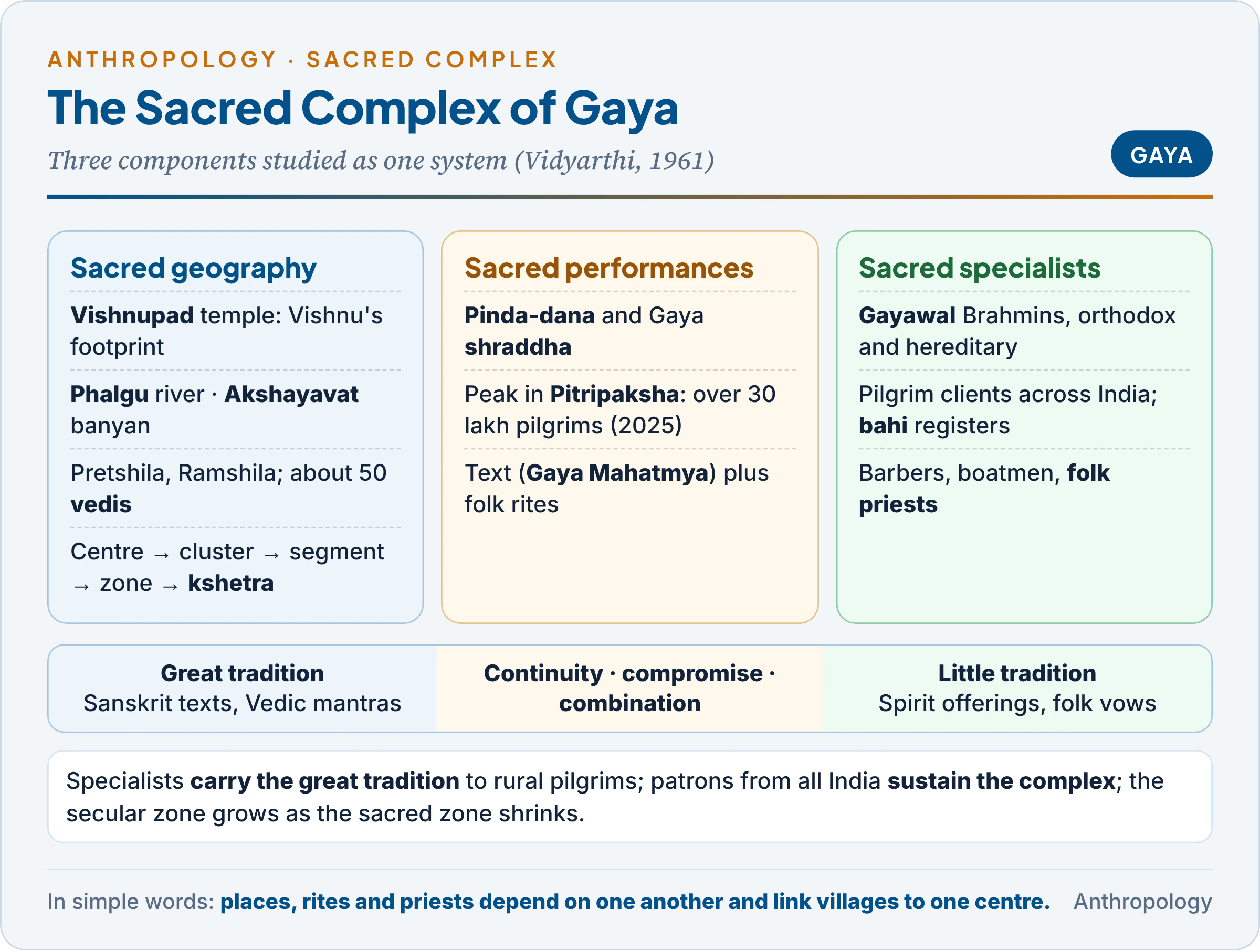
2.3 Sacred geography
- Meaning: the arrangement of holy places in space, in a spatial hierarchy:
- Sacred centre: “the smallest unit of worship, represented by an image, river, tank or tree” (1961), the spot where one rite is done;
- Sacred cluster: several centres close together;
- Sacred segment: a group of clusters forming a distinct sector of the town;
- Sacred zone: a large area made of segments;
- the whole kshetra: the sacred territory of Gaya, bounded by mythical limits and revered by all Hindus.
- What the hierarchy reveals:
- Continuity in space: Sanskritic temples stand beside tree, snake and spirit shrines, and pilgrims worship at both.
- Hindu–Buddhist combination: Vidyarthi gave a chapter to Buddhist and Hindu centres side by side; Bodh Gaya lies in the same region.
- Change: the secular zone (markets, rest houses, restaurants) grows at the expense of a shrinking sacred zone; some old sacred spots are abandoned.
2.4 Sacred performances
- Meaning: all the rites done at the centres: bathing, shraddha, pinda-dana, tarpan (water offerings), arti, recitation, vows, songs and fairs.
- At Gaya the defining performance is the Gaya shraddha, done in set order at set vedis. Its textual charter is the Gaya Mahatmya (part of the Vayu Purana), but the rites mix text with folk practice, such as offerings to restless spirits at Pretshila.
- Graded by class of pilgrim: a wealthy patron may sponsor a long ritual with many priests; a poor villager completes a single offering in a day. The range of performances mirrors the social structure of the pilgrims.
2.5 Sacred specialists
- The Gayawals are the core: a small, orthodox priestly caste with a highly ceremonial, Sanskritic way of life. Each family has hereditary rights over pilgrims from particular regions and keeps registers (bahi) of past rites, so a pilgrim is matched to the priest who served his forefathers.
- A pan-Indian jajmani: patrons give gifts, land and money; priests give ritual service. Rich patrons also financed temples and rest houses, so the complex lives on sustenance from outside: the relation is two-way.
- Below the Gayawals work ancillary specialists (barbers, boatmen, flower sellers, guides) and folk practitioners who serve the poorest pilgrims: a ranked hierarchy, each level linked to a different section of the pilgrim stream.
- Why they matter for civilization: the priest is the channel through which texts, myths and values reach rural pilgrims who cannot read Sanskrit; in Redfield’s terms he is the cultural specialist who links great and little traditions.
Common confusion
Is a “sacred complex” simply a big temple or a pilgrimage? No. A temple is one sacred centre; a pilgrimage is one kind of sacred performance. The sacred complex is the whole interacting system of a holy place: its centres in space, its rites, its specialists, and the network of patrons and pilgrims linking it to the civilization. Studying only the main temple, or only pilgrims’ journeys, misses how these parts depend on each other.
3. Sacred Geography and Pilgrimage in Indian Civilization
In simple words
Indians have long treated their land itself as holy: rivers, mountains and cities are linked by stories and visited in long journeys. Studying this “sacred geography” shows how pilgrimage creates a shared sense of one land among people who speak different languages and live far apart, though it does not make all pilgrims equal.
3.1 Tirtha and the sacred land
- A tirtha literally means a crossing place, a ford where the human world meets the divine, often on a river bank. Pilgrimage (tirtha-yatra) is a journey to such crossings.
- Networks of tirthas cover the subcontinent: the four dhams (Badrinath, Dwarka, Puri, Rameshwaram), the twelve jyotirlingas, the Shakti pithas and the Kumbha melas at Prayagraj, Haridwar, Ujjain and Nashik.
- Diana Eck, an American historian of religion, argued in India: A Sacred Geography (2012) that these linked places created an imagined landscape of India long before the modern nation-state: the land was known by walking it.
- Surinder Bhardwaj, a geographer, in Hindu Places of Pilgrimage in India (1973), showed that pilgrimage centres form a hierarchy: a few pan-Indian centres draw pilgrims from everywhere, while regional and local centres draw a narrower following, often seeking practical boons (cures, vows) rather than merit or liberation.
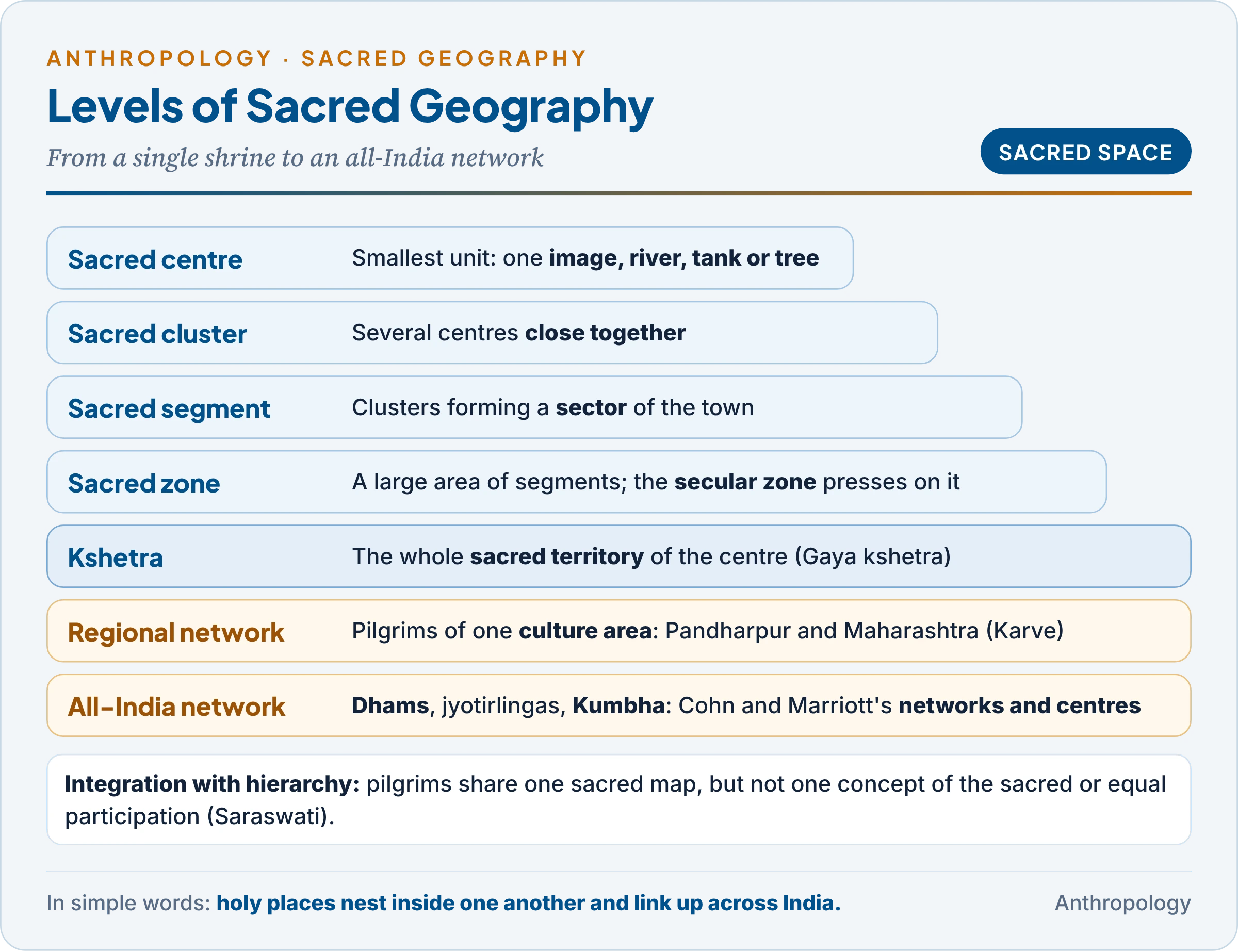
3.2 Pilgrimage as integration
- Cohn and Marriott and Vidyarthi treated pilgrim centres and networks as functionally important for integration: regions meet, priests carry texts to villages, local cults are drawn into all-India forms.
- Irawati Karve, the Indian anthropologist, walked with the palkhi procession to Pandharpur and described it in “On the Road: A Maharashtrian Pilgrimage” (1962). The walk made a region visible (Maharashtra as the land whose people go to Pandharpur), yet castes still camped and ate separately: unity and hierarchy coexisted.
- Levels at one centre: a local level (deities residents visit), a regional level and a civilizational level (pilgrims from all India who often visit only the main deity). One centre also holds orthodox, semi-orthodox and modern phases of Hinduism at once.
3.3 Two theories of pilgrimage
The table sets the main anthropological theories of pilgrimage side by side, since the Indian evidence speaks to both.
| Communitas view | Contest view | |
|---|---|---|
| Scholar | Victor Turner, British anthropologist (“The Center Out There”, 1973; with Edith Turner, Image and Pilgrimage in Christian Culture, 1978) | John Eade and Michael Sallnow (eds.), Contesting the Sacred (1991) |
| Claim | Pilgrimage is a liminal journey that suspends social rank and creates communitas, a feeling of equal, direct fellowship | A shrine is an empty stage on which different groups bring different meanings and compete for control |
| Indian evidence for | Pilgrims of many regions and castes bathe in the same river and sing the same songs at Pandharpur or the Kumbha | Priests compete for clients; castes eat apart; temple entry was long refused to Dalits; groups dispute the meaning of sites |
The Indian material supports a middle position. Pilgrimage does integrate, but it integrates a hierarchy: people share a sacred map while keeping caste, sect and class distinctions.
3.4 The sacred complex as a dimension of Indian civilization
- Why sacred centres matter for studying civilization:
- They are where the great tradition is most concentrated (texts, learned priests, temple ritual) and where the little traditions of every region arrive with pilgrims.
- They make the continuity of the civilization visible across centuries.
- They show how diversity is managed: different castes, sects and even religions (Hindu and Buddhist at Gaya; Hindu, Buddhist and animist at Kathmandu) share one complex.
- A contrast with the Semitic religions: at Mecca or Jerusalem, pilgrims hold a common concept of the sacred and take part equally. At Hindu centres, Saraswati noted, they do not, yet the centres still bind diverse traditions into one civilizational bond.
4. Later Sacred-Complex Studies: Saraswati, Jha and Others
In simple words
After Gaya, Vidyarthi’s students and colleagues studied many other holy towns, in India and Nepal, using the same three-part model. Two of them, B.N. Saraswati and Makhan Jha, extended it most: Saraswati by asking what “sacred” means to different pilgrims, Jha by testing the model across borders and religions.
4.1 The Kashi project
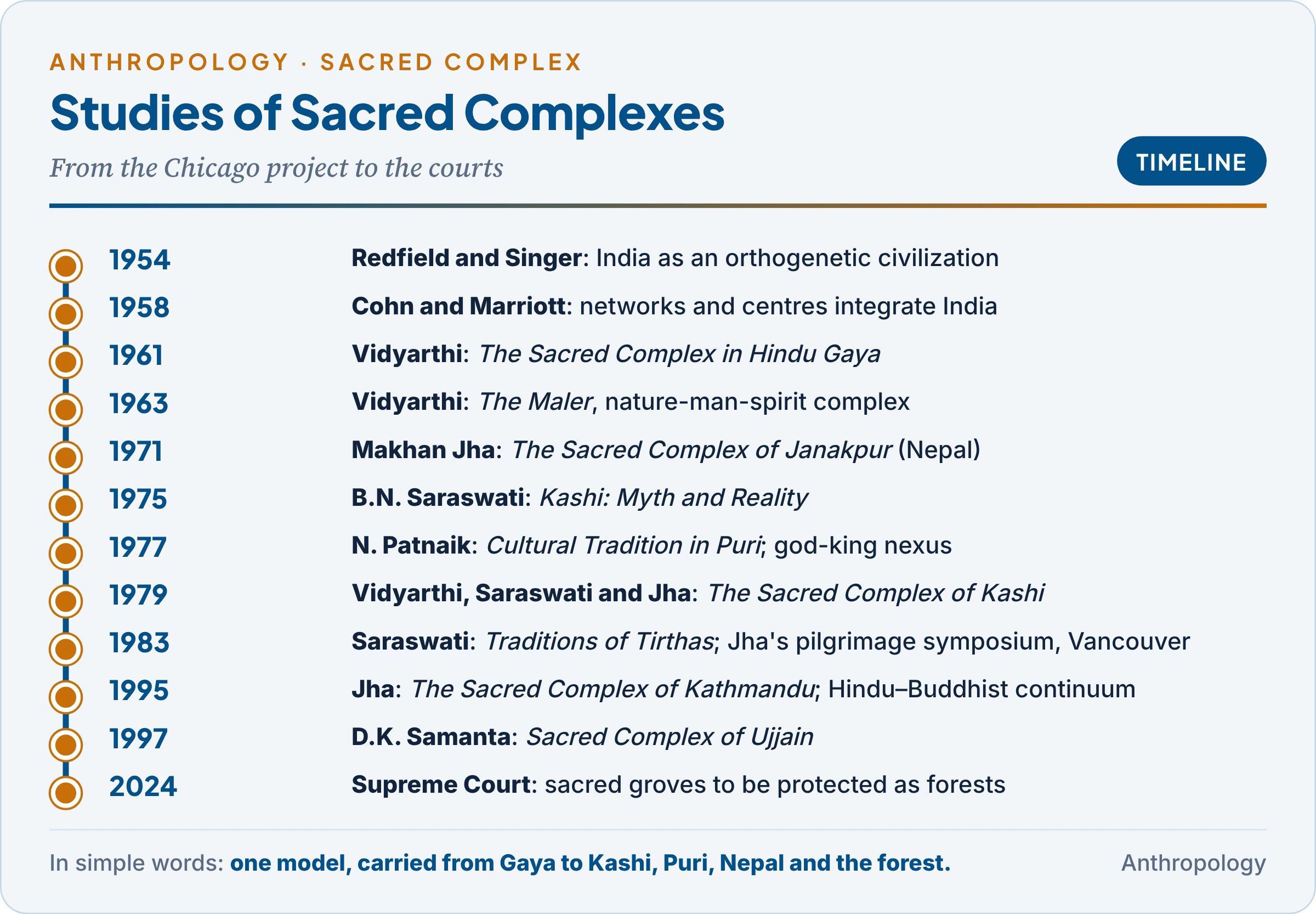
- From 1972 to 1976 Vidyarthi directed a large research project on Kashi (Varanasi), with Makhan Jha as deputy director and Baidyanath Saraswati as a principal researcher. Its outcome was The Sacred Complex of Kashi: A Microcosm of Indian Civilization (Vidyarthi, Saraswati and Jha, 1979).
- Why Kashi: the city of death and liberation (dying there is believed to bring moksha), with the Vishwanath temple, burning ghats, monasteries of every sect and Sanskrit pandits. A microcosm means the whole civilization, from Vedic ritual to folk cults, is found in one city.
4.2 B.N. Saraswati
- Baidyanath Saraswati (1932–2013), an Indian anthropologist close to N.K. Bose and Surajit Sinha, wrote Kashi: Myth and Reality of a Classical Cultural Tradition (1975), Brahmanic Ritual Traditions in the Crucible of Time (1977), Ascetics of Kashi (with Surajit Sinha, 1978), Traditions of Tirthas in India: The Anthropology of Hindu Pilgrimage (1983) and The Spectrum of the Sacred (1984).
- His key arguments:
- The sacred rests on man’s desire to communicate with the spiritual world, ultimately to attain moksha. The sacred complex is thus a means of communication, not just a set of buildings.
- Kashi is more than a Brahmin complex. It may look predominantly Brahmanic, but it is really a part of the wider organisation of Indian civilization, which lets the Brahmanic temple of Vishweshwara and the non-Brahmanic shrine of Agiyabir coexist, and the learned ritual priest (karmakandi) and the Dom, the untouchable keeper of the cremation fire, take part in the same rites of death. The message to pilgrims is that no tradition should claim to be the only true one.
- Unity through absorption: he used the image of Nilakantha, Shiva’s blue throat (Shiva held the poison of the churned ocean in his throat), for the way Kashi’s tradition absorbs challenges, including modernisation, without breaking.
- Do all pilgrims share the same sacred? He asked whether heterogeneous pilgrims share the Brahmanic concept of the sacred and interact fully and equally with it. His answer was no: integration works without uniformity.
- Contribution: he moved the model from structural description to the meaning of the sacred.
4.3 Makhan Jha
- Makhan Jha (born 1941), an anthropologist at Ranchi University, wrote The Sacred Complex of Janakpur (1971), on the Nepal town revered as the birthplace of Sita in the Mithila region shared by Nepal and Bihar; Aspects of a Great Traditional City in Nepal (1978); and The Sacred Complex of Kathmandu, Nepal (1995). He edited Dimensions of Pilgrimage (1985), from the World Symposium on Pilgrimage he organised at the anthropological congress in Vancouver (1983), and Social Anthropology of Pilgrimage (1991).
- His key arguments:
- At Janakpur he applied the Gaya model and tested the hypotheses of Redfield, Singer and Vidyarthi, finding the same continuity and combination of great and little traditions.
- At Kathmandu he described a Hindu–Buddhist–animist continuum that strengthens the civilizational solidarity of the Himalayan kingdom: a sacred complex need not belong to one religion.
- Pilgrimage studies as a field: his volumes (on Tirupati, Puri, Ujjain, Kashi, Garhwal) treated pilgrim centres as civilizational centres providing a moral order to the masses.
- Contribution: the model travels across borders and religions, and the anthropology of pilgrimage became an organised, international field.
4.4 Other centres
The table lists the main sacred-complex studies after Gaya and what each added.
| Centre | Scholar | Work (year) | What it added |
|---|---|---|---|
| Janakpur (Nepal) | Makhan Jha | The Sacred Complex of Janakpur (1971) | Test of the Chicago and Gaya hypotheses |
| Dwarka | V.S. Upadhyaya | “The Sacred Geography of Dwarka” (1974) | Sacred geography of a dham |
| Kashi | Saraswati; Vidyarthi, Saraswati and Jha | Kashi: Myth and Reality (1975); The Sacred Complex of Kashi (1979) | City as microcosm; meaning of the sacred |
| Puri | Nityananda Patnaik | Cultural Tradition in Puri (1977); Sacred Complex in Orissa (2000) | God-king nexus; secularisation |
| Kathmandu | Makhan Jha | The Sacred Complex of Kathmandu (1995) | Hindu–Buddhist–animist continuum |
| Ujjain | D.K. Samanta | Sacred Complex of Ujjain (1997) | Centre–region link in Malwa; Mahakal and Kumbha |
- Puri in more detail: Patnaik’s work began in 1958 at the Lingaraj temple, Bhubaneswar, under N.K. Bose’s guidance and moved to Puri. His complex links sacred geography, the Gajapati kings (revered as chalanti Vishnu, “moving Vishnu”), the temple servants (sevakas), monasteries, Brahmin sasan villages, feudatory chiefs, and pilgrims and government. It is equally a study of secularisation: monetisation of ritual services, land reforms that cut temple income and state control weakened the complex.
4.5 Assessing Jha and Saraswati
| Makhan Jha | B.N. Saraswati | |
|---|---|---|
| Main centres | Janakpur, Kathmandu, pilgrimage in general | Kashi, tirthas in general |
| Method | Comparative, hypothesis-testing, organisational | Interpretive, textual and philosophical |
| Strength | Model extended across borders and religions; built an international field | Asked what the sacred means to different actors; brought ascetics and Doms in |
| Limits | Largely descriptive and integration-centred; little on conflict, gender or economy | Leaned towards Indological idealism and spiritual interpretation; sometimes defended tradition more than analysing power |
Both broadened Vidyarthi’s model without changing its assumption that the sacred complex integrates a diverse civilization; Saraswati’s question about unequal participation opened the way to the critiques below.
5. Critique of the Sacred Complex Approach
In simple words
The sacred-complex model is good at showing how holy towns bring people together. Its critics say it says too little about who is kept out, who gets rich, who controls the temples and how holy places change when the state, tourism and politics move in.
- Integration bias: rooted in structural-functionalism (how parts keep a whole in balance), the model highlights harmony and plays down conflict: priests’ quarrels over clients, sectarian disputes, and the long exclusion of Dalits from temple entry.
- Brahmanic centre: the model is built around Sanskritic priests and textual rites; folk practitioners, women’s rites and non-Brahmin cults appear as the “little” end of a scale whose standard is Brahmanic. Saraswati himself showed that pilgrims do not share one concept of the sacred.
- Political economy: later ethnographies looked at money and power:
- Jonathan Parry, a British anthropologist, in Death in Banaras (1994), showed that the funeral priests of Kashi live by gifts (dana) that are believed to carry the sins of the donor, so the priests are both indispensable and despised: the sacred economy is full of tension.
- Peter van der Veer, a Dutch anthropologist, in Gods on Earth (1988), studied Ayodhya as a centre where priests and monastic orders manage pilgrims and compete for patronage and identity.
- Gender: rules on women’s entry and ritual roles are rarely analysed in the classical studies; the Sabarimala litigation (2018 onward) showed how central they are.
- The state and the market: temple corridors, government temple boards, online rituals and religious tourism now reshape sacred complexes; describing this as “secularisation” needs political and economic analysis to explain it.
Criticism — Limits of the model
- Functionalist harmony hides caste exclusion and conflict
- Brahmanic standard for what counts as “great”
- Little on money, power, gender, the state
- Mostly a snapshot; change seen as decline
Defence — Why it still holds
- First field method for studying a civilization, not just a village
- Three-part model works at any centre, even across religions
- Saraswati and Patnaik already built in inequality and secularisation
- Still explains how pilgrimage links a diverse population
The model survives as a descriptive framework; later work added the questions it left out: who controls, who profits and who is excluded.
6. The Nature-Man-Spirit Complex: Vidyarthi’s Maler Study
In simple words
In many tribal societies, the forest, the community and the spirits are not three separate things. The forest feeds people, people live by rules and rituals, and the spirits who live in the hills and trees decide whether crops grow or sickness comes. Vidyarthi called this tight bond the “nature-man-spirit complex” and showed it through one hill tribe.
6.1 Example first: the Maler
- Who: the Maler or Sauria Paharia of the Rajmahal Hills, Santal Parganas (now Jharkhand), a Particularly Vulnerable Tribal Group (PVTG). They speak Malto, a North Dravidian language close to Kurukh (Oraon); Maler means “men of the hills”.
- Economy: shifting cultivation on steep, stony slopes (kurwa; some studies record khallu), with hunting and gathering of fruits, roots, fuel and herbal medicines; the forest also supplies timber and craft materials.
- Religion: spirits called Gosain, benevolent (health, wealth, crops, children) or malevolent (sickness, miscarriage, death, calamity); ancestral spirits that must be fed; a village priest (demano) who speaks with the ancestors; and a presiding Gosain who is the bridge to the other spirits.
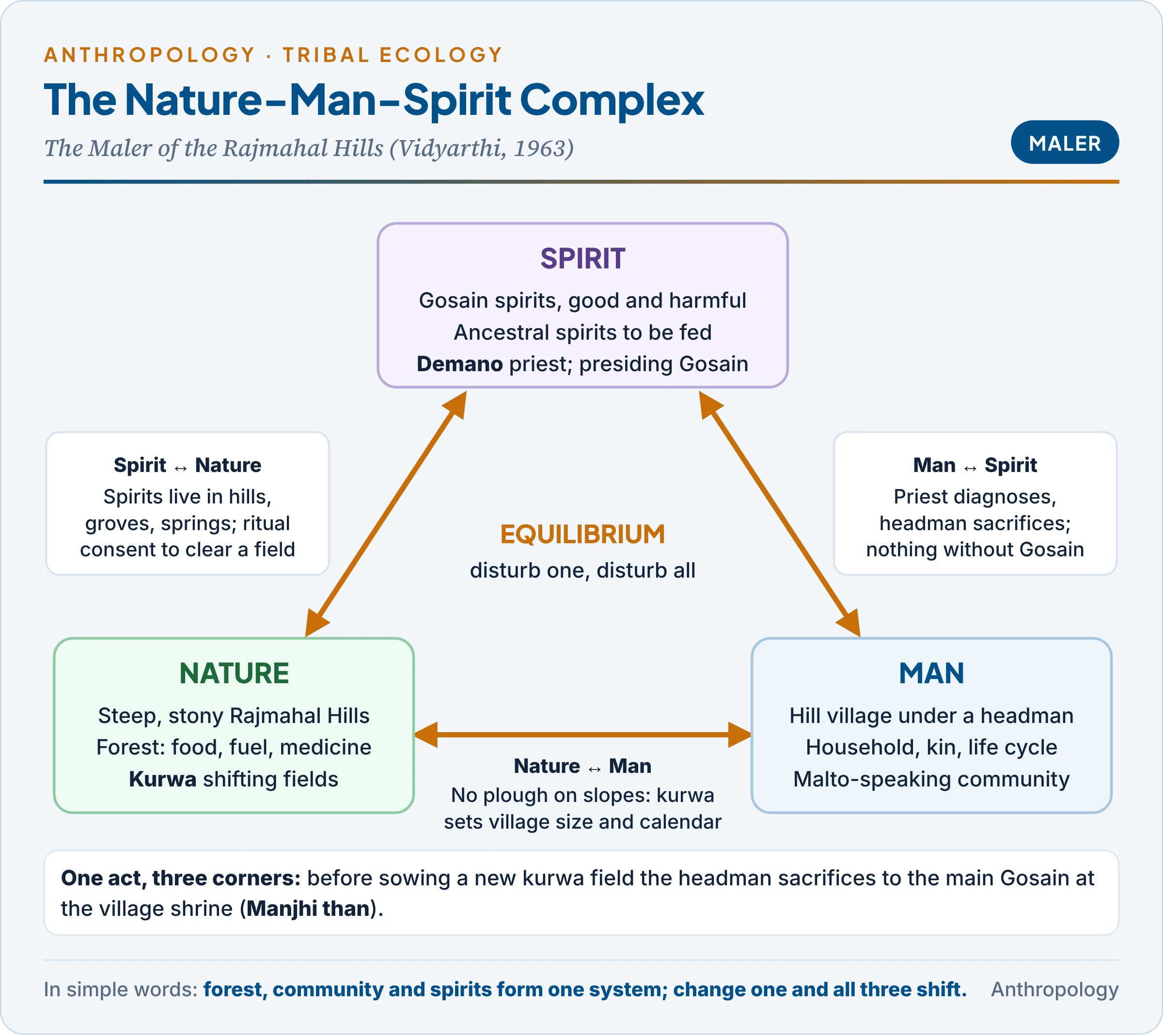
- Concrete link of all three: before sowing a new kurwa field, the village headman (manjhi) offers a sacrifice to the main Gosain at the village shrine (Manjhi than, marked by stones under a small tree); when calamity strikes, sacrifices are made on the nearest hilltop. The farming cycle (nature), the village organisation (man) and the spirit world (spirit) meet in one act.
6.2 The concept
- Vidyarthi published The Maler: A Study in Nature-Man-Spirit Complex of a Hill Tribe in Bihar (Calcutta, 1963).
- Definition (in substance): the NMS complex is the close interdependence of a tribe’s natural environment (nature), its social organisation (man) and its supernatural world (spirit), so intertwined that each shapes the others and they are sometimes fused.
- A method of presentation: to show the “soul” of a tribal culture rather than its “skeleton”, he arranged his data under Nature, Man and Spirit, not in the usual separate chapters, and traced the links between them.
- An ecological idea: like other cultural ecologists, he saw culture as a human adaptation to a particular environment; his addition was that the spirit world is part of that adaptation, not a separate “superstructure”.
The table shows what each part of the complex covers in the Maler study.
| Component | What it covers | Maler example |
|---|---|---|
| Nature | Habitat, forest, hills, water, seasons | Steep hills; kurwa fields; forest foods, fuel, medicine, timber |
| Man | Family, marriage, kinship, village, life cycle, personality | Small hill villages under a headman; social life fitted to the hill economy |
| Spirit | Gods, spirits, ancestors, priests, ritual | Gosain spirits; ancestral spirits; the demano priest; sacrifices |
6.3 How the three interact
- Nature ↔ Man: the hills limit technology (no plough on stony slopes), so shifting cultivation and gathering set settlement size, work groups and the seasonal calendar.
- Man ↔ Spirit: health, fertility and crop success are read as signs of the spirits’ favour, so social life is organised around ritual: the priest diagnoses, the headman sacrifices, the household feeds its ancestors. Nothing important is done without the approval of the Gosain.
- Spirit ↔ Nature: the spirits live in hills, groves, springs and trees. Clearing a field, felling a tree or using a spring requires permission through ritual; misuse brings punishment (sickness, crop failure, calamity).
- Result: the three parts maintain an equilibrium. Any disturbance in one (losing forest, moving to the plains, banning shifting cultivation) is felt as a disturbance in all, including the spirit world, and causes hardship and anxiety.
6.4 The complex as a research tool
- The frame became a paradigm for holistic tribal studies in the Ranchi school and for forest ethnographies in the same vein, such as S.G. Morab‘s The Soliga of Biligiri Rangana Hills (1977) and A.N. Sandhwar‘s The Korwa of Palamau (1978).
- It joins the two halves of this unit: Vidyarthi also described the Maler’s sacred geography (a sacred area around the village, sacred centres for rites) and sacred performances. At Gaya the sacred links a village to a civilization; among the Maler it links a village to its forest.
Common confusion
Is the nature-man-spirit complex just another name for animism or nature worship? No. Animism (E.B. Tylor’s term) is a belief: that souls or spirits inhabit beings and objects. The NMS complex is an analytical framework about relations: it asks how environment, social organisation and belief shape one another as one system. The frame can, for example, analyse how a change in forest law alters ritual and social life.
7. NMS as an Ecological Concept and Its Applied Uses
In simple words
The idea that spirits guard the forest is not only a belief; it also works as a rule that limits how much people take. Sacred groves, taboos and seasonal rituals have helped many communities use resources without exhausting them. The same idea warns planners that moving people or changing their economy also breaks their moral and spiritual world.
7.1 NMS among the ecological approaches
The table places Vidyarthi’s frame beside the ecological theories of Paper I.
| Approach | Scholar (year) | Core idea | Place of religion |
|---|---|---|---|
| Cultural ecology | Julian Steward, Theory of Culture Change (1955) | A culture core of subsistence and technology adapts to the environment | Secondary; shaped by the core |
| Ecological functionalism | Roy Rappaport, Pigs for the Ancestors (1968) | Among the Tsembaga Maring of New Guinea, a ritual cycle of pig feasts regulates pig numbers, land use and warfare | Regulator of the ecosystem |
| Cultural materialism | Marvin Harris, “The Cultural Ecology of India’s Sacred Cattle” (1966) | The sacred cow taboo is ecologically useful (traction, dung, milk) | A materially explained rule |
| Nature-man-spirit complex | L.P. Vidyarthi, The Maler (1963) | Environment, society and the spirit world form one interacting whole | An equal, active partner |
Steward put religion at the edge of the explanation; Rappaport and Harris explained it by its material effects. Vidyarthi keeps the spirit world as the people understand it: for the Maler the Gosain are real actors whose anger is the reason for restraint. The frame is both emic (the insider’s view) and ecological, an early statement of traditional ecological knowledge.
7.2 NMS and the sustainable use of natural resources
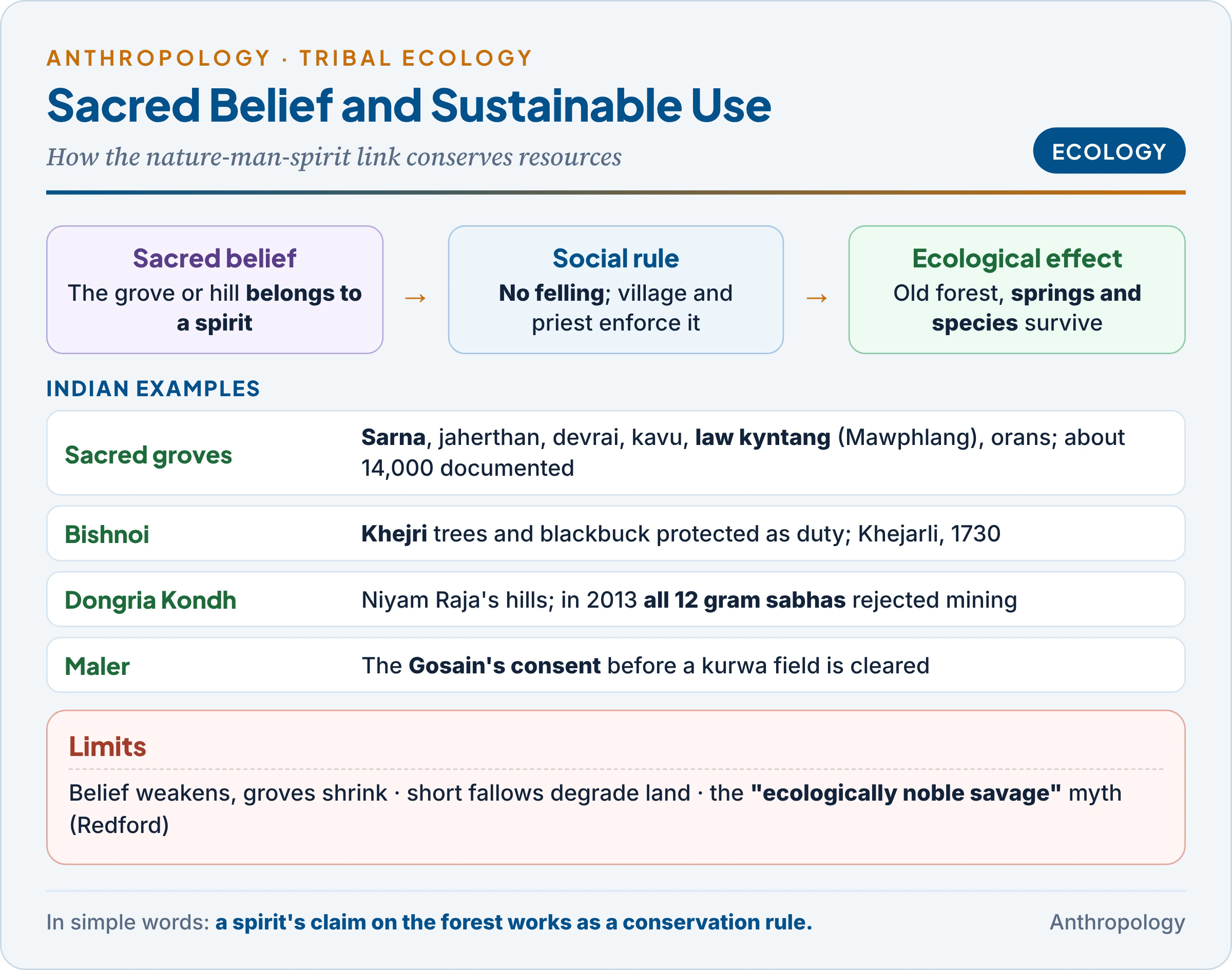
- How belief becomes conservation: a sacred rule (a grove belongs to the spirit, so no tree may be cut) becomes a social rule (the village enforces it, the priest punishes breach) and produces an ecological effect (a patch of old forest, springs and species survive). The sanction is supernatural, but the enforcement is social and the result is material.
- Sacred groves: the Indian ecologists Madhav Gadgil and V.D. Vartak drew attention to them in “Sacred Groves of India: A Plea for Continued Conservation” (1975). About 14,000 groves have been documented, and estimates of the total run to about one lakh. Regional names include the Sarna of the Munda and Oraon and the jaherthan of the Santal (Jharkhand), devrai (Maharashtra), kavu (Kerala), law kyntang (Khasi, Meghalaya; Mawphlang is the best known) and orans (Rajasthan).
- The Bishnoi of Rajasthan protect khejri trees and blackbuck as religious duty; Khejarli (1730) commemorates Amrita Devi and others who died resisting the felling of khejri trees.
- The Dongria Kondh of Odisha revere Niyam Raja, deity of the Niyamgiri hills. In Orissa Mining Corporation v. Ministry of Environment and Forest (18 April 2013) the Supreme Court left bauxite mining to the gram sabhas, which were to weigh religious and cultural rights; all twelve rejected it. A spirit-centred landscape became a legal argument.
7.3 Applied anthropology: a caution to planners
- Why schemes fail: tribal groups often resist programmes that move them or change their life suddenly. Under the NMS frame this is not obstinacy: a move to the plains means leaving the spirits and ancestors of the hills, a loss of the whole world.
- The “empty vessel” error: the American anthropologist Steven Polgar (1963) named the fallacy of the empty vessels: the assumption that people have no existing system and can simply be filled with a new one. The NMS frame shows the vessel is full; little traditions can reject an imposed great tradition.
- What it asks of planners: study the whole complex first; change gradually and with consent; protect sacred sites and forest access. It does not mean freezing tribes in the past, but development without breaking the community’s equilibrium.
- In law and policy: the Forest Rights Act, 2006 recognises community rights over community forest resources, and in December 2024 the Supreme Court asked the Centre for a national policy on sacred groves (see Contemporary Developments): culture and ecology managed together. Religion’s wider impact on tribes is in 8.1.
7.4 Critique of the NMS complex
- Equilibrium bias: it assumes a balanced whole, yet the Rajmahal Hills were long shaped by state and market, including colonial settlement of Santal cultivators in the Damin-i-koh (from the 1830s).
- Romantic ecology: assuming forest peoples always conserve risks what the American conservationist Kent Redford called the “ecologically noble savage” (1991); shifting cultivation degrades land when fallows shorten, and groves shrink when belief weakens.
- A method more than a theory, built from one tribe; and the “spirit” corner is not fixed: conversion, Hinduisation and the Sarna movement have changed tribal religion (8.1).
- Defence: its holism and use of the people’s own categories anticipated work on traditional ecological knowledge, community commons and cultural rights in forest law; failed resettlements keep bearing out its caution.
8. The Two Concepts Compared
In simple words
Both of Vidyarthi’s concepts treat religion as tied up with space, society and livelihood. The sacred complex looks at how a holy town connects a whole civilization; the nature-man-spirit complex looks at how a tribe’s spirits connect it to its forest.
The table sets the two concepts side by side.
| Sacred complex | Nature-man-spirit complex | |
|---|---|---|
| Work | The Sacred Complex in Hindu Gaya (1961) | The Maler (1963) |
| Setting | Hindu pilgrim city | Tribal hill villages |
| Components | Sacred geography, performances, specialists | Nature, man, spirit |
| Key relation | Great ↔ little traditions | Environment ↔ society ↔ supernatural |
| Level | Civilization | Local ecosystem |
| Roots | Redfield, Singer, Marriott | Cultural ecology, holism |
| Main critique | Integration and Brahmanic bias | Equilibrium and romantic ecology |
Together they form one programme: India studied from both ends, the sacred centre where the great tradition is densest and the forest margin where little traditions are rooted in nature, joined by the continuum also described as the tribe-caste continuum (3.2b).
Key Terms
| Term | Meaning in simple words |
|---|---|
| Sacred complex | The holy places, rituals and priests of a pilgrim centre studied as one linked system |
| Sacred geography | How holy places are arranged in space, from a single shrine to a whole region |
| Sacred centre | The smallest unit of worship: one image, river, tank or tree |
| Kshetra | The whole sacred territory of a pilgrim centre |
| Sacred specialists | Priests and ritual workers who run the rites and link pilgrims to the tradition |
| Gayawal | The hereditary Brahmin priests of Gaya who serve pilgrim families across generations |
| Pinda-dana | Offering balls of rice or flour to the dead for the peace of ancestors |
| Tirtha | A “crossing place” between the human and divine worlds; a pilgrimage site |
| Great tradition | The written, learned culture of texts, temples and specialists |
| Little tradition | The oral, local culture of villagers and tribes |
| Communitas | Turner’s term for the equal fellowship felt during a pilgrimage or ritual |
| Nature-man-spirit complex | The interdependence of environment, society and the spirit world in tribal life |
| Gosain | The spirits of the Maler, both helpful and harmful |
| Sacred grove | A patch of forest protected because it belongs to a deity or spirit |
| Fallacy of the empty vessels | The planner’s mistaken belief that people have no existing system of their own |
Contemporary Developments
- Gaya Ji: Bihar renamed Gaya as Gaya Ji on 16 May 2025; the 2025 Pitripaksha drew over 30 lakh pilgrims by official count; the state tourism corporation sells an e-pinddaan package (rites performed by a priest at Vishnupad, Akshayavat and the Phalgu, sent as video), reshaping the sacred specialist’s role.
- Temple corridors: the Kashi Vishwanath Dham (13 December 2021) enlarged the temple area to about 5 lakh sq ft, and Puri’s Shree Mandir Parikrama (17 January 2024) cleared a corridor around the Jagannath temple: state-led remaking of sacred geography for crowds and tourism, raising Patnaik’s questions of state control.
- Sacred groves judgment: in In Re: T.N. Godavarman Thirumulpad v. Union of India (18 December 2024) the Supreme Court directed Rajasthan to map and notify orans and other sacred groves as forests, recommended their protection as community reserves (Wildlife Protection Act, s.36-C) and asked the MoEFCC to frame a national policy and survey of sacred groves: the NMS logic in law.
- Sarna identity: the Jharkhand Assembly unanimously passed a resolution on 11 November 2020 seeking a separate Sarna Adivasi Dharma Code in the Census, for tribal nature-worshippers who do not identify as Hindus; the demand continues ahead of the next Census (8.1).
Diagrams to Master
- Topic map: Chicago background → Vidyarthi → the two complexes → later studies, uses, critiques.
- Sacred complex of Gaya: three linked boxes with Gaya examples; a great ↔ little tradition bar beneath.
- Levels of sacred geography: centre → cluster → segment → zone → kshetra → regional and all-India networks.
- Studies timeline: Gaya 1961, Maler 1963, Janakpur 1971, Kashi 1975/1979, Puri 1977, Tirthas 1983, Kathmandu 1995, Ujjain 1997.
- NMS triangle (Maler): three corners with two-way arrows and one example per link.
- Belief → rule → ecological effect: sacred groves, Bishnoi, Niyamgiri; one line of limits.
Revision Grid
| Scholar | Work (year) | Key idea |
|---|---|---|
| Robert Redfield | Peasant Society and Culture (1956) | Great and little traditions |
| McKim Marriott | “Little Communities in an Indigenous Civilization” (1955) | Universalization and parochialization |
| Cohn and Marriott | “Networks and Centres in the Integration of Indian Civilization” (1958) | Pilgrim centres and networks integrate India |
| L.P. Vidyarthi | The Sacred Complex in Hindu Gaya (1961) | Sacred geography, performances, specialists |
| L.P. Vidyarthi | The Maler (1963) | Nature-man-spirit complex |
| Makhan Jha | The Sacred Complex of Janakpur (1971); Kathmandu (1995) | Model tested across borders and religions |
| Surinder Bhardwaj | Hindu Places of Pilgrimage in India (1973) | Hierarchy of pilgrimage centres |
| Victor Turner | “The Center Out There” (1973) | Pilgrimage as communitas |
| B.N. Saraswati | Kashi (1975); Traditions of Tirthas (1983) | Meaning of the sacred; unequal participation |
| N. Patnaik | Cultural Tradition in Puri (1977) | God-king nexus; secularisation |
| Vidyarthi, Saraswati and Jha | The Sacred Complex of Kashi (1979) | City as microcosm of civilization |
| Gadgil and Vartak | “Sacred Groves of India” (1975) | Sacred groves as conservation |
| Jonathan Parry | Death in Banaras (1994) | Ambivalent gift economy of priests |
Previous Year Questions
3.3 Sacred Complex and Nature- Man-Spirit Complex.
- 2026Write notes on: Nature-Man-Spirit-Complex.
- 2021Explain the impact of the concept of nature-man-spirit complex on sustainable use of natural resources with suitable examples.
- 2018Critically examine the contributions of Makhan Jha and B.N. Saraswati to the study of sacred complexes in India.
- 2017Write a note in 150 words on Nature-man-spirit complex.
- 2015Write a note in 150 words on Sacred complex as a dimension of Indian civilization.
- 2014Describe the concept of ‘Sacred Complex’ with an ethnographic example.
- 2013Examine Nature – man – spirit complex as an ecological concept. (250 words).
- 2012Write a note in 150 words on Sacred Geography.
- 2009Write a note on Nature-Man-Spirit complex.
- 2005Write a note on Sacred complex.
- 2001Write a note on Nature-Man-Spirit complex.
- 1999Write a note on Sacred Complex.
- 1993Write a note on Basic principles concerned with nature-man-spirit complex.
- 1990Write a note on Concept of sacred complex in the Indian Society.
- 1983Write a note in 200 words: Nature- man Spirit Complex.
Related questions from other units
- 2026Unit 5: How do religious beliefs help people to devise cultural mechanisms to adapt to their environment? Discuss in detail with appropriate examples.
- 2024Unit 5.1: Compare and contrast the approaches of M. N. Srinivas and L. P. Vidyarthi to social change in village India.
- 2016Unit 4: Compare the contribution of L.P. Vidyarthi and D.N. Majumdar to the study of Indian tribes.
- 2015Unit 5: How do you relate the concepts of ‘Sacred’ and ‘Profane’ in Durkheim’s theory of religion with a focus on the role of totem ?
- 2013Unit 5.2: Discuss the significance of study of religious centers to the understanding of Indian civilization. (250 words).
- 2013Unit 4: Examine anthropological contributions dealing with tribes and Indian civilization. (375 words).
- 2010Unit 5.3: Write a note in 150 words on Universalization and Parochialization.
- 2009Unit 4: Write a brief note on the contributions of Prof. L. P. Vidyarthi in the field of anthropology.
- 2002Unit 8.1: Write a note on Bases of tribal religion.
- 1984Unit 5.3: Discuss in what way the study of Great tradition and Little tradition is essential for understanding the cultural processes of Indian civilization.
More from Indian Social System and Caste: all notes of this unit · every PYQ of this unit · Anthropology Optional hub