

Religious Experience: Nature and Object (Indian and Western).
Official Syllabus: Paper II, Section B, Unit 6
A religious experience is an experience in which a person feels that he or she has come into direct contact with the sacred — God, the Divine, Brahman, nirvāṇa or some ultimate reality. Unlike the proofs for God, which argue towards God from the world, religious experience claims to meet the divine directly. Countless people in every age and culture report such experiences. For some they are first-hand evidence that their faith is true; for others they are illusions produced by the mind, the brain or society. Philosophy of religion therefore asks three questions: what is a religious experience, what kinds of it are there, and what is its object — and only then, can it be trusted?
In simple words
You can read about the sea, see photographs of it and hear people describe it — or you can stand in the waves. Reading gives you information; standing in the sea gives you an experience. Religion, too, has both sides: doctrines and arguments about God, and the believer’s claim to have felt God’s presence, seen a vision, or been changed by an encounter. Religious experience is the “standing in the waves” side of religion.
Context & Problem
Why Religious Experience Became a Central Topic
- The crisis of the proofs. After Hume and Kant criticised the classical proofs (ontological, cosmological, design), many thinkers felt that religion cannot rest on argument alone. If God cannot be proved, perhaps God can be experienced.
- The Romantic answer — Schleiermacher. Friedrich Schleiermacher (On Religion: Speeches to Its Cultured Despisers, 1799) told the educated critics of religion that religion is neither a set of doctrines (that is metaphysics) nor a set of rules (that is morality). Religion is “a sense and taste for the Infinite” — an immediate feeling. In The Christian Faith he called its core the feeling of absolute dependence (schlechthinniges Abhängigkeitsgefühl): the awareness that we, and everything finite, depend wholly on something beyond us.
- A defence against rationalism. The very idea of “religious experience” arose in the 19th century as a defence of religion against the growing rationalism and scientific spirit of the West. William James made the term popular with The Varieties of Religious Experience (1902), treating personal religion as more basic than theology or church.
- Two opposite readings. Religious and mystical traditions see such experiences — and the knowledge they bring — as revelations caused by divine agency, real contact with a higher reality of which we are normally unaware. Sceptics see them as an evolved feature of the human brain, open to ordinary scientific study like any other mental state.
In simple words
Schleiermacher’s “feeling of absolute dependence” is like the feeling a small child has on a crowded railway platform while holding a parent’s hand. The child does not reason that it depends on the parent; it simply feels that without that hand it would be lost. Schleiermacher said the religious person feels this about the whole of existence: everything, including oneself, rests on a power one did not make and cannot control.
Three General Features
- Universality. Religious experience has been reported across space and time — in ancient and modern societies, among tribal peoples and in highly secularised societies. One study suggests that at least thirty per cent of the world’s population report having had some religious experience.
- Diversity. There is a wide variety of religious experiences, and each is in some sense unique to the person who has it. Experiences in different religions are similar in some ways and different in others — and this adds to the richness of the phenomenon.
- Importance. Religious experience matters in momentous ways. It often transforms or reorients a life, leads a person to rethink how he thinks and lives, or even changes his whole world-view.
Core Doctrine
1. What Is a Religious Experience?
- Broad meaning. Any experience of the sacred within a religious context — religious feelings, visions, voices, conversions, and mystical and numinous experiences. It is intensely personal and often occurs during prayer, meditation, worship, chanting or ritual, frequently in a church, synagogue, mosque, temple, monastery or other holy place — though it has also been reported in ordinary places and situations.
- A wide spectrum of meanings. The term can cover anything from saying a prayer or attending a service to “hearing the voice of God“. Philosophers therefore fix its meaning before they examine it.
- A working definition. A religious experience is a non-empirical occurrence — it is not simply a sense perception of a physical object — which may be perceived as supernatural.
- It is a mental event that a person undergoes and is aware of.
- It may be spontaneous (it simply happens) or the fruit of intensive training and self-discipline (prayer, fasting, yoga, meditation).
- Those who have it usually say it has drawn them into a deeper knowledge or awareness of God or the ultimate.
- The experience is not a substitute for the Divine; it is a vehicle that brings a person closer to the Divine.
- Each experience is unique and in its fullness cannot be shared with anyone else.
- Genuine religious experiences tend to be encouraging: they do not condemn the person but help him to live a better life and to help others.
- Swinburne’s definition. Richard Swinburne (The Existence of God, 1979) defines a religious experience as “an experience of God or of some other supernatural thing“. This matters, because some critics reject reports in which the person met an angel, a saint or the Virgin Mary rather than God. On Swinburne’s definition these also count as religious experiences — of “some other supernatural thing”.
- Subjective but interpreted. A religious experience is a subjective experience that is interpreted within a religious framework. The same thunderstorm may be, for one person, just weather; for another, the voice of God. The religious meaning lies partly in the experience and partly in the framework through which it is understood.
2. What Makes It an Experience — and How It Differs from Ordinary Feelings
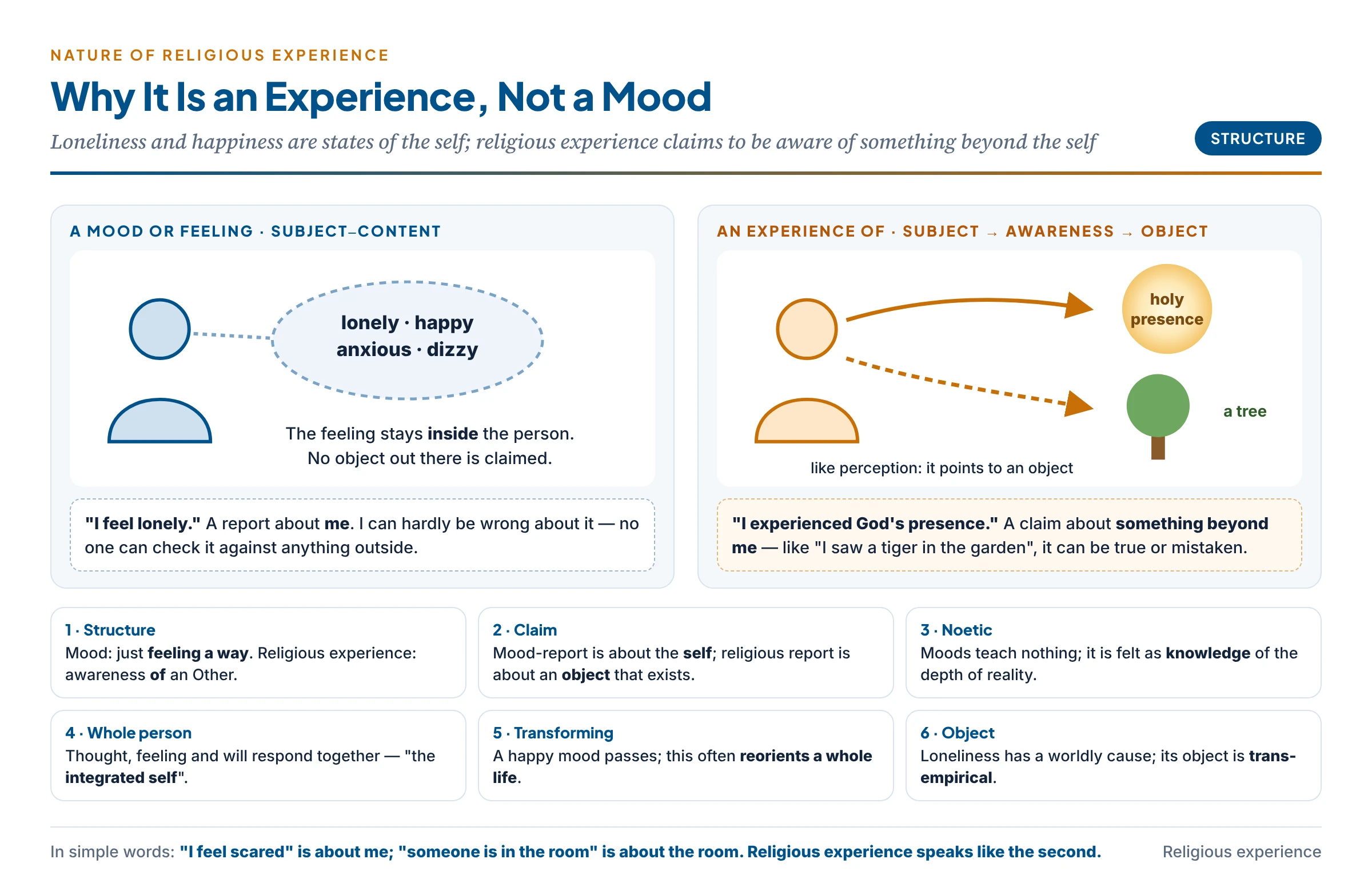
Religious experience is said to be unique (unlike anything else). Then why call it an experience at all, and how does it differ from loneliness, happiness or anxiety, which are also private and inner?
- It has the form of perception. In ordinary feelings like generalised loneliness, euphoria, dizziness or a headache, the person simply feels a certain way; there is no object “out there” that the feeling claims to reveal. Keith Yandell calls this a subject–content structure. Seeing a tree or hearing a bell has a different structure: subject → awareness → object. A typical religious experience — Moses before the burning bush, Isaiah’s vision of the Lord, Arjuna’s vision of Kṛṣṇa — has the second structure: it presents itself as an awareness of something other than oneself.
- It makes a claim beyond the self. “I feel lonely” reports only my own state; I can hardly be mistaken about it. “I experienced God’s presence” claims that something exists outside me and was present to me — and that claim can be mistaken, just as “I saw a tiger in the garden” can be mistaken. This is the decisive logical difference: a feeling-report is about the self; a religious-experience report is about an object.
- It has a noetic quality. Loneliness and happiness are moods; they do not teach anything. Religious experiences are felt as knowledge — insight into the depth of reality (James calls this the noetic quality).
- It is a response of the whole person. Ordinary emotions engage one side of us. A religious experience, as Radhakrishnan puts it, is “the response of the whole personality, the integrated self to the central reality” — thought, feeling and will together.
- It transforms. A happy mood passes and leaves life as it was; a religious experience often leaves a lasting reorientation of life (conversion, saintliness, service).
- Its object is not empirical. Loneliness is caused by an empirical situation (no friends nearby); happiness by events in the world. The object of religious experience is claimed to be trans-empirical — beyond the senses and beyond the world.
- Why “experience” is still the right word. Like all experience, it is immediate (not reached by inference), given (the person does not invent it at will) and lived through by a subject. It is unique in its object, not in its being an experience.
In simple words
Compare two sentences. “I am scared” — no one can tell you that you are not scared; it is a report about you. “There is a snake under the bed” — your sister can look under the bed and say “No, there isn’t.” A report of religious experience is like the second sentence, not the first: it says that someone is there. That is why it is an “experience of” something — and also why people can argue about whether it is true.
3. Swinburne’s Five Types
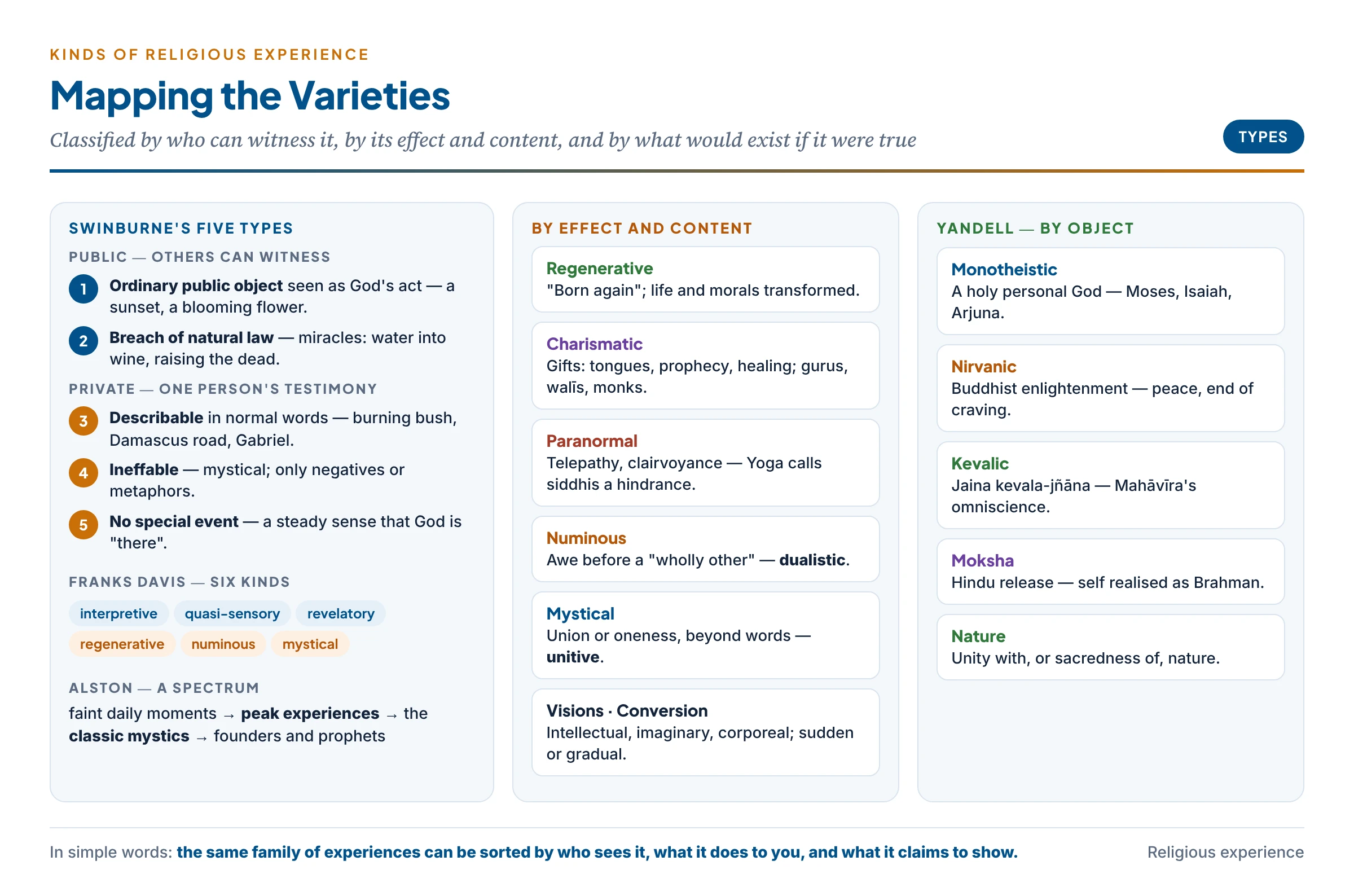
Richard Swinburne divides religious experiences into five types — two public and three private:
| Type | What happens | Example |
|---|---|---|
| 1. Public — ordinary object | A person sees God’s action in an ordinary public object or scene | Seeing the sunset as the “hand of God”, the blooming of a flower as a “miracle of God” |
| 2. Public — unusual event | A breach of natural law that others can also see; miracles | Water turned into wine; Jesus raising the dead |
| 3. Private — describable | A personal experience that can mostly be described in normal language | Moses and the burning bush; Saul on the road to Damascus; visions of the Virgin Mary; Muhammad‘s vision of the angel Gabriel |
| 4. Private — indescribable | A personal experience that cannot be described in normal language — ineffable | Mystical experiences, described only by negatives (what it is not) or by metaphor |
| 5. Private — no special experience | A constant, regular sense that God is simply “there“; his presence is felt | The believer who lives with a steady awareness of God in daily life |
- The common thread. In all five there is, the subject claims, an experience of God or of some Absolute force or being.
- Why the public–private divide matters. Public experiences can in principle be witnessed by others (a crowd at a miracle); private ones rest on one person’s testimony. This becomes central in the debate about verification (Article 8).
4. Visions
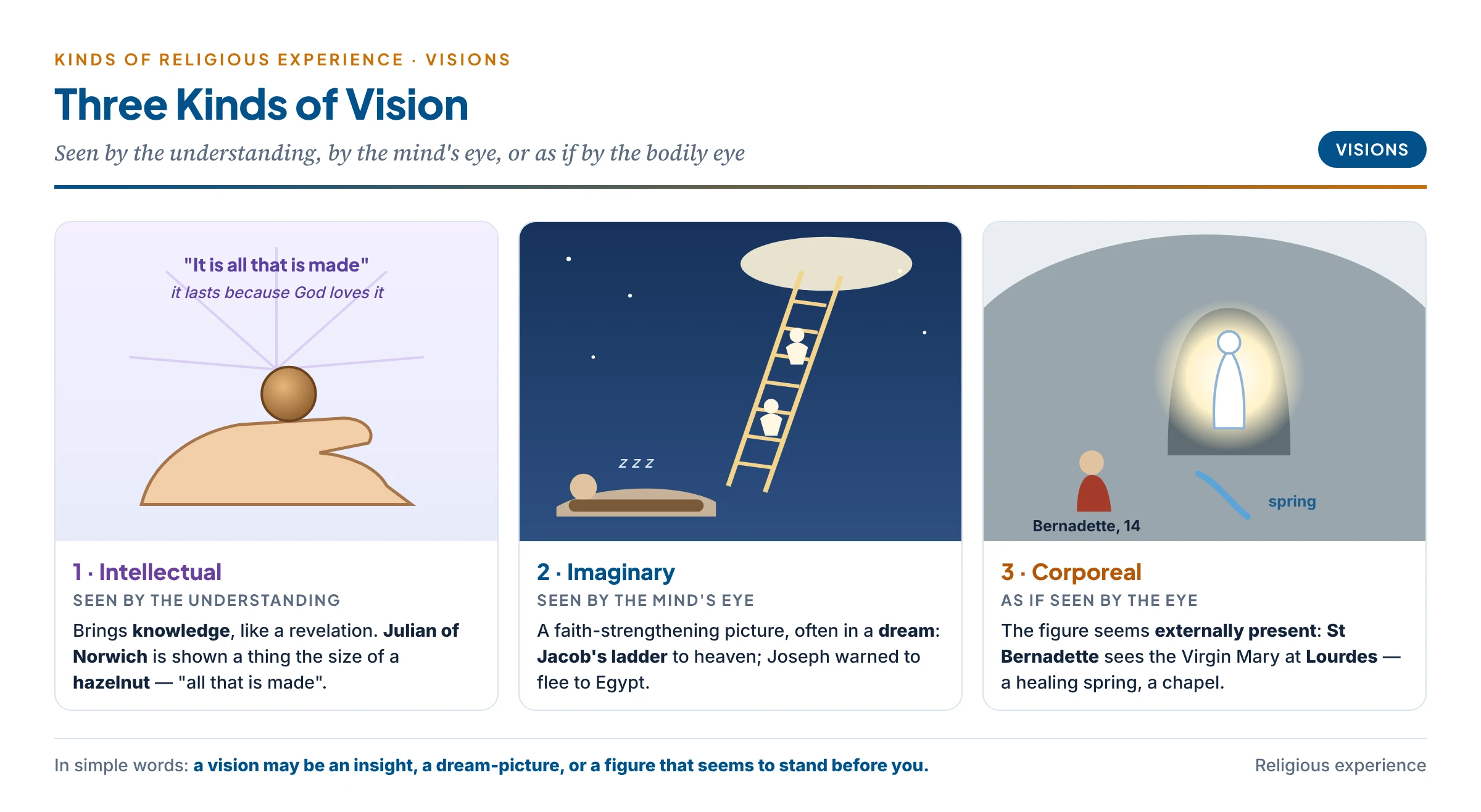
A religious vision occurs when a person believes he has seen or heard something supernatural, or a supernatural being. There are three kinds:
- Intellectual vision — brings knowledge and understanding, like a revelation from God; nothing need be “seen” with the eyes. Julian of Norwich (14th–15th century English mystic), in Revelations of Divine Love, was shown “a little thing, the size of a hazelnut, on the palm of my hand, round like a ball”. She asked, “What is this?” and the answer came: “It is all that is made.” It continues to exist “because God loves it“. The vision taught her that everything owes its existence to the love of God.
- Imaginary vision — something that strengthens faith is seen with the mind’s eye, often in a dream. Jacob dreams of a ladder reaching to heaven with angels going up and down. In Matthew’s Gospel Joseph is warned in a dream to take Mary and Jesus to Egypt to escape Herod.
- Corporeal vision — the figure seems to be externally present, as if seen with bodily eyes. St Bernadette, aged 14, saw the Virgin Mary at Lourdes over several months. At first the figure did not speak; later “The Immaculate Conception” told her that the spring water had healing powers and that a chapel should be built there.
Common confusion
Is a “vision” always something seen with the eyes? No. Only the corporeal vision seems to be seen with the eyes. The imaginary vision is seen inwardly (often in a dream), and the intellectual vision may contain no picture at all — it is a sudden understanding. Julian of Norwich’s hazelnut was a picture, but what made it a vision was the insight it carried: “all that is made” exists because God loves it.
5. The Numinous
- Meaning. The numinous is the feeling of being in the presence of something greater — an awesome, overpowering power from which one feels distinctly separate. Many testimonies speak of this sense of awe.
- Feature or type? Many regard numinosity as a feature found in many religious experiences; others treat it as a type of its own and contrast it with mystical experience (Article 3).
- Otto. The German theologian Rudolf Otto (The Idea of the Holy, 1917) gave the word its meaning. He held that religion derives from a being totally separate from this world, in whose presence numinosity is felt; many biblical visions, such as Moses’ burning bush, are numinous experiences.
6. Conversion
- Meaning. Conversion is the adoption of a new religious belief different from the one held before — the case in which the effects of a religious experience are life-changing. More broadly, “religious conversion” is the process that leads to the adoption of a religious attitude or way of life. Its effects may be permanent or temporary; on the personal level it usually brings a deeper understanding of faith.
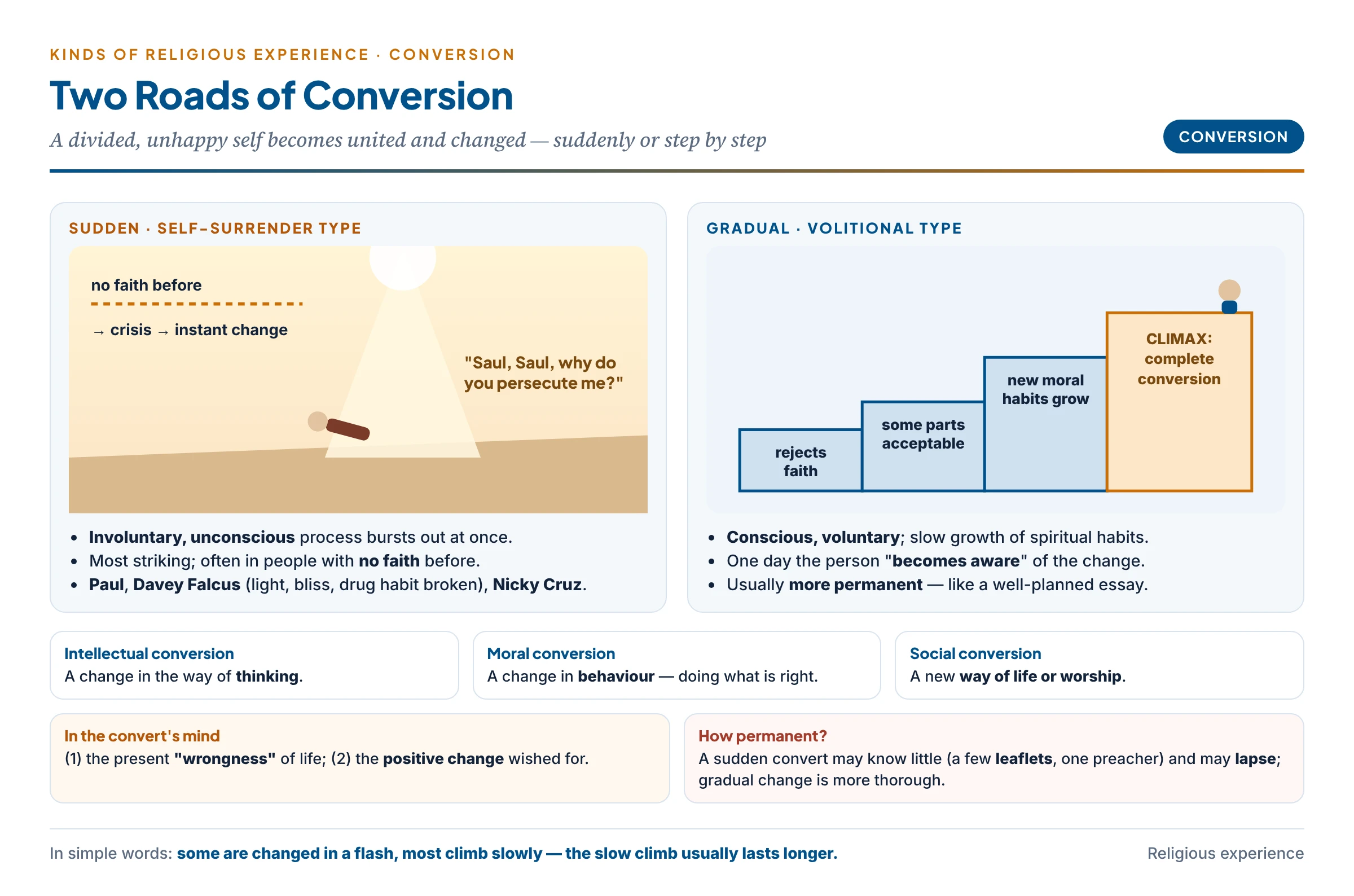
- Two kinds of conversion (by the kind of mental process):
- Volitional (gradual) — a conscious and voluntary process: the slow building of new moral and spiritual habits. The person may suddenly “become aware” of the change one day, though it has been growing for long.
- Self-surrender (sudden) — an involuntary and unconscious process that bursts into consciousness all at once.
- What is in the convert’s mind. As a rule, two things: (i) the present “wrongness” of his life — sins, failures — that he wants to change; (ii) the positive changes he wishes to make.
- Sudden vs gradual.
- Most conversions are gradual, but the sudden experience seems the most profound and striking. It often happens to people with no religious faith at all beforehand.
- In gradual conversion the process is what matters: at first the person rejects religious faith; then some elements begin to seem acceptable; this continues until a climax, when complete conversion occurs.
- Kinds of change. Conversion includes a change in belief, which changes the motivation of behaviour in society. So one may speak of:
- Intellectual conversion — a change in the way of thinking about something.
- Moral conversion — a change in behaviour, so that the person does what he thinks is right.
- Social conversion — acceptance of a different way of life or worship.
- Examples.
- St Paul. Saul, a persecutor of Christians, hears on the road to Damascus the voice: “Saul, Saul, why do you persecute me?” — and the speaker declares himself the risen Christ. Saul becomes Paul, spends his life spreading the Christian message and, by tradition, dies a martyr in Rome. The change of name marks the change of life.
- Davey Falcus. A violent criminal from Newcastle upon Tyne, a drug addict and alcoholic at 29. In 1995 he picked up a Bible; a light brighter than the sun filled the room, “wave after wave of pure bliss” rolled over him, and he saw Jesus, who said, “Son, your sins are forgiven, go now and sin no more.” A fifteen-year drug habit broke at once, his craving for alcohol left, and the voices in his head fell silent.
- Nicky Cruz. Leader of a New York street gang, the Mau Maus. When the preacher David Wilkerson told him that Jesus loved him, Cruz slapped him and threatened to kill him. Wilkerson replied that Cruz could cut him into a thousand pieces, and every piece would still say Jesus loves him. Two weeks later, at Wilkerson’s meeting, Cruz was overwhelmed by guilt, asked for God’s forgiveness, studied the Bible and became a preacher himself.
- How permanent is conversion?
- A sudden convert may know very little about what he now believes — perhaps only what he read in a few leaflets or heard from a local preacher. He is more likely to discover problems later and drift away.
- Gradual conversion is more likely to be permanent, because a slower process is more thorough — as a well-planned essay is more thorough than one scribbled in a hurry.
Indian Connect — Conversion and transformation in India
- Vālmīki, the highway robber Ratnākara who became the poet of the Rāmāyaṇa, and Aṅgulimāla, the murderer who became a monk on meeting the Buddha, are classic Indian stories of sudden regenerative change.
- Emperor Aśoka, after the bloodshed of Kaliṅga, turned to the Buddha’s dhamma — a “moral conversion” in which a change of belief remade public policy.
- In modern times Ramana Maharshi‘s sudden death-experience at sixteen and Ramakrishna‘s visions transformed their lives permanently — the “born again” pattern in Indian dress.
7. Regenerative, Charismatic, Paranormal and Mystical Experience
Another common classification sorts experiences by their effect and content into four kinds:
- Regenerative experience — the person undergoes a life transformation: a conversion, a change of the whole world-view.
- In Evangelical Christianity this is “being born again” or “born from above” — from Jesus’ words in John’s Gospel: “no one can see the kingdom of God without being born from above“. Elsewhere it is called “experiencing religion”, “experiencing salvation” or being “delivered from evil“.
- Such persons find life changed, filled with meaning, love, joy and hope, with remarkable and permanent changes of attitude.
- A further side is moral transformation: before the experience the person feels sin, guilt or helplessness to do what is right; afterwards he senses that sin and guilt have been removed, sees a new vision of goodness, and takes up his moral duties with new energy.
- Such experiences are found in all the major traditions.
- Charismatic experience — special abilities, gifts or blessings are manifested.
- In the Judeo-Christian tradition: speaking in tongues, prophecy, healing, revelatory dreams; they are often reported at Christian retreats.
- In Buddhism the monk is often seen as a charismatic, holy figure — not as one who received a gift from God but as one who has experienced the blessings of the Dharma.
- Hinduism has its gurus and sādhus, Islam its sheikhs and walīs — spiritual leaders believed to have charismatic qualities, gifts and powers.
- Paranormal experience — less intense than mystical experience: telepathy, clairvoyance, apparitions. Yoga treats such powers (siddhis) as a hindrance on the path to liberation, not as its goal.
- Mystical experience — the believer feels that he is not distinct from the cosmos, the deity or ultimate reality, but one with it. James lists its four marks — ineffability, noetic quality, transiency, passivity (Articles 2 and 4).
Common confusion
Are “regenerative” and “mystical” experiences the same thing? No. A mystical experience is defined by its content — a sense of union or oneness, beyond words. A regenerative experience is defined by its effect — a changed life. They can coincide (a mystic’s life is usually transformed), but a regenerative conversion like Nicky Cruz’s involved guilt and forgiveness, not a sense of oneness with God; and a brief nature-mystical moment may change nothing in one’s conduct.
8. Other Classifications
- Yandell’s five kinds (by content). Keith Yandell sorts experiences by what would exist if they were true:
- Monotheistic — awareness of a holy, personal God (Moses, Isaiah, Arjuna).
- Nirvanic — the Buddhist experience of enlightenment: peace, freedom from craving, the sense of having reached one’s last birth.
- Kevalic — the Jaina experience of kevala-jñāna, in which Mahāvīra is said to have known “all conditions of the world” — omniscience.
- Moksha — the Hindu experience of release, in which the self realises its identity with Brahman (“That art thou”).
- Nature experiences — a sense of unity with or sacredness of nature.
- Franks Davis’s six kinds. Caroline Franks Davis distinguishes interpretive (an ordinary event seen as God’s act), quasi-sensory (visions, voices), revelatory (sudden insight or conviction), regenerative, numinous and mystical experiences.
- Alston’s “M-beliefs”. William Alston calls the beliefs formed in religious experience M-beliefs (M for manifestation): “God is speaking to me, comforting me, strengthening me, enlightening me, giving me courage, guiding me, pouring out His love or joy into me, sustaining me in being”.
- A continuous spectrum. These experiences form a spectrum:
- the faint and occasional moments of religious awareness in an ordinary believer’s life — God’s presence felt in moments of joy, challenge or tragedy, through worship and fellowship, or through the beauty and grandeur of nature;
- the occasional “peak experiences” that come to many people;
- the outstanding experiences of the classic mystics;
- the paradigmatic experiences of founders — the prophets hearing the word of the Lord, the apostles experiencing Jesus as the Christ.
- Streams of experience. This spectrum flows through historic streams (traditions) in which believers participate, by which they are formed and confirmed, and to which they contribute.
9. Hick: All Experience Is “Experiencing-As”
- Seeing-as. Wittgenstein drew attention to puzzle pictures: the famous drawing that can be seen as a duck or as a rabbit; a page of random dots that suddenly becomes a picture of people standing among trees. Nothing on the paper changes; what changes is how we see it.
- Experiencing-as. John Hick extends this: in every experience we grasp a situation as having a certain meaning, and our readiness to act depends on it. Driving on a highway, a person is aware that certain reactions are appropriate and others not; we react differently in the midst of a battle and on a quiet Sunday afternoon stroll. Being an act of interpretation, experiencing-as can be mistaken — as when a mentally ill person experiences everyone as a threat.
- Religious experience as a second level of meaning. The religious person experiences the same events that others experience — but also as the presence and activity of God. A religious significance is superimposed on the natural significance.
- The Hebrew prophets saw the history of their time both as dealings between Israel and the nations and as God’s dealings with Israel — leading, disciplining and punishing. Jeremiah, watching the Chaldean army attack Jerusalem, saw behind its ranks God fighting against his own people.
- The life of Jesus can be seen as that of a self-appointed prophet who clashed with the priests and was eliminated — or, with the New Testament writers, as the Messiah of God.
- The whole of life. For Hick religious experience is not only rare ecstasy; it is “the whole experience of the religious person“: he feels the pressure of divine command in conscience, sees God’s grace in the beauty of nature, and finds God in and through ordinary life rather than apart from it. Its truth is reflected in the life of the believer.
- Cognitive freedom. God, being infinite, does not overwhelm us; he leaves us free to recognise or not recognise his presence. Faith is the uncompelled response — “faith is related to cognition as free will to conation”. Hick concedes that such experience does not demonstrate God; the matter will be settled only in the end (eschatological verification — Article 8).
In simple words
Two people stand by the same river in flood. One sees water level, rainfall and a weak embankment. The other sees all that too — and also feels that God is calling the village to repent and help one another. Hick says neither is “seeing more water”; they are experiencing the same event as different things. Religious experience is often this second way of seeing, laid over ordinary life.
Critical Evaluation
Is It Necessary to Have a Religious Experience to Understand What It Is?
- Yes — only the experiencer fully understands.
- James and Swinburne say such experiences, especially mystical ones, are ineffable: they go beyond explanation, so the experiencer cannot convey them fully.
- Religious experience is subjective, like an emotion. Otto says the numinous leaves a person scared, anxious and in awe — feelings almost impossible to describe precisely.
- St Teresa of Avila: “I wish I could give a description of at least the smallest part of what I have learned, but, when I try to discover a way of doing so, I find it impossible.”
- Learning by doing. We understand many things fully only when we apply them; since each religious experience is unique, perhaps only the recipient can understand it.
- Experiences happen to individuals, not groups. At Lourdes, Bernadette saw Mary while those around her saw nothing — the experience is personal.
- No — others can understand it to a large degree.
- Conversion can be assessed objectively: people see its results. Davey Falcus’s change from crime to serving others is visible to all.
- Swinburne’s public experiences — a statue said to weep, Hindu idols said to drink milk (the 1995 “milk miracle”), the visions of Knock in Ireland — are shared by many.
- Many experiences contain natural features that can be described: one who experiences God in nature or in a vision can say what he felt and saw. Bernadette described Mary and repeated her words.
- On the word “fully”. To understand a religious experience fully — from inside — may require having it, just as only one who has been in love understands love fully. But to understand it sufficiently for philosophical discussion — its structure, its effects, its claims — does not.
Problems with the Very Concept
- Too wide or too narrow. If every prayer and every sense of wonder counts, the concept becomes too wide to be useful; if only rare mystical states count, it becomes too narrow and ignores the everyday faith of millions (Alston’s spectrum answers this).
- Experience or interpretation? Is the religious element in the experience or only in the framework through which it is read (Hick’s experiencing-as)? If the latter, the same experience may be religious for one and secular for another.
- The dependence feeling questioned. Against Schleiermacher it is objected that a conviction that everything depends on God does not show that it does: “being sure” is not “being right”. Dependence is a relation, not a property one can directly perceive — passengers depend on an aeroplane for their lives, but lose no inner property when they step off it.
- Can the finite meet the infinite? God is said to be infinite, eternal, omnipotent, omniscient and the Creator. How could anyone, just by encountering something, recognise it as omniscient? “It takes one to know one.” (Detailed in Article 8.)
- Hick’s experiencing-as cuts both ways. It shows that religious perception is no worse off than ordinary perception, which also interprets. But it does not show that the religious interpretation is correct rather than the naturalistic one; it only shows that it is possible.
Critics and Defenders
Criticism — Critics
- Hume and the empiricists: what is not given in sense experience gives no knowledge of a reality beyond it.
- Sceptics: the “experience” is an interpretation imposed on an ordinary feeling; the brain and society can explain it.
- Against Schleiermacher: a feeling of dependence proves nothing about what we actually depend on — being sure is not being right.
- Against conversion as evidence: sudden converts often lapse; dramatic changes also follow political or therapeutic “conversions”.
- The concept itself: so wide (from a prayer to a vision) that it explains nothing.
Defence — Defenders and strengths
- Schleiermacher: religion is its own province — not a weaker form of science or ethics but an immediate sense of the Infinite.
- James: personal experience is the root of religion; theology and churches grow out of it.
- Hick: all experience is experiencing-as; the religious reading of life is as rational as the naturalistic one.
- Alston: religious experience forms a continuous spectrum, from daily awareness to the great mystics — it is not a rare oddity.
- Transformed lives: Paul, Aṅgulimāla, Falcus — the fruits of such experiences are publicly visible.
Cross-Tradition Comparison
Indian and Western Approaches to Religious Experience
| Point | Western (mainly theistic) | Indian |
|---|---|---|
| Typical name | Religious experience, vision, conversion, mystical union | Anubhava (direct experience), darśana (vision/insight), sākṣātkāra (realisation), samādhi |
| Usual object | A personal God, angels, saints | Brahman/Ātman, Īśvara, nirvāṇa, kaivalya |
| Typical structure | Dualistic — the self meets a holy Other | Often non-dual — the self realises its identity with the real, or the end of the self |
| How it comes | Often as grace, unbidden (Moses, Paul) | Usually through sādhanā — yoga, meditation, devotion, study under a guru |
| Role in religion | Supports faith; scripture remains the norm | Scripture (śruti) itself is the record of the seers’ experiences; experience is the goal |
| Classic thinkers | Schleiermacher, James, Otto, Swinburne, Hick | Upaniṣadic seers, Śaṅkara, Rāmānuja, Ramakrishna, Vivekananda, Radhakrishnan |
Indian Connect — Takeaways
- Indian traditions treat religious experience less as evidence for a doctrine and more as the goal of the religious life: “religion is realisation” (Vivekananda).
- Radhakrishnan: Hinduism subordinates “intellect to intuition, dogma to experience, outer expression to inward realisation”; religion is darśana and anubhava.
- Indian schools also classify experiences — savikalpa (with distinctions) and nirvikalpa (without distinctions) samādhi, saguṇa and nirguṇa realisation — much as Western writers distinguish theistic and monistic mysticism (Articles 4–6).
Synthesis (Siddhānta)
- A genuine and distinct kind of experience. Religious experience is not a mood like loneliness or happiness. It has the form of an awareness of something beyond the self, a noetic claim and a transforming effect; this is what makes it an experience and what makes it philosophically interesting.
- Many kinds, one family. Visions, conversions, regenerative, charismatic, paranormal, numinous and mystical experiences — and Swinburne’s five types — share a family resemblance: each claims contact with the sacred and each tends to reshape life.
- Experience and interpretation are intertwined. Following Hick, every experience is “experiencing-as”; religious experience lays a second level of meaning over ordinary events. This explains both its diversity across traditions and the dispute over whether it is true.
- Contemporary relevance. Surveys in many countries continue to find large numbers reporting experiences of a presence or power beyond themselves; psychology, neuroscience and comparative religion now study them seriously. The philosophical task remains the one set out here: to describe them accurately before judging their validity (Article 8).
Previous Year Questions
- 2010If religious experience is unique, what makes it an experience? How is this experience logically different from the experience of loneliness, happiness, etc.?
- 2009Explain the nature of religious experience. Can this experience be validated?