

Schools of Vedānta: Brahman; Īśvara; Ātman; Jīva; Jagat; Māyā; Avidyā; Adhyāsa; Mokṣa; Apṛthaksiddhi; Pañcavidhabheda.
Official Syllabus: Paper I, Section B, Unit 19
Rāmānuja built Viśiṣṭādvaita by arguing against Śaṅkara. His central target is māyā–avidyā — the cosmic ignorance that, for Advaita, makes the one Brahman appear as the many. In the Śrībhāṣya he raises seven objections (saptavidha-anupapatti) against it: it has no locus, cannot conceal Brahman, has no coherent nature, cannot be indescribable, has no proof, has no remover, and cannot be removed. He also rejects Śaṅkara’s quality-less Brahman and the “lower” status of Īśvara, and replaces knowledge-only liberation with devotion (bhakti), surrender (prapatti) and grace. This article sets out the seven objections with the Advaita replies, the critique of Brahman and Īśvara, the two views of the world, why both thinkers still need māyā, Rāmānuja’s theory of bondage and liberation, and the old verdict that each is “right in what he affirms, wrong in what he denies“.
In simple words
Imagine a teacher who says: “This classroom is not really here — it is a dream.” A student asks: “Whose dream? Where is the dreamer? How do you know? And who will wake us?” If the teacher cannot answer, the dream theory collapses. Rāmānuja asks exactly such questions about māyā: Whose ignorance? Where is it? What is it? How do we know it? What removes it?
Context & Problem
Why Rāmānuja Attacks Māyā
- Māyā is Advaita’s linchpin. Without it, Śaṅkara cannot explain how the one, changeless Brahman appears as a changing world of many souls and things.
- If māyā fails, Advaita fails. The world would then be real, souls real, and Brahman the real God who creates and saves — Rāmānuja’s own position.
- His positive alternative. The world is God’s real body; “māyā” in scripture means God’s real wonderful power of creation; ignorance is the soul’s real forgetfulness of its dependence on God, caused by karma.
Core Doctrine
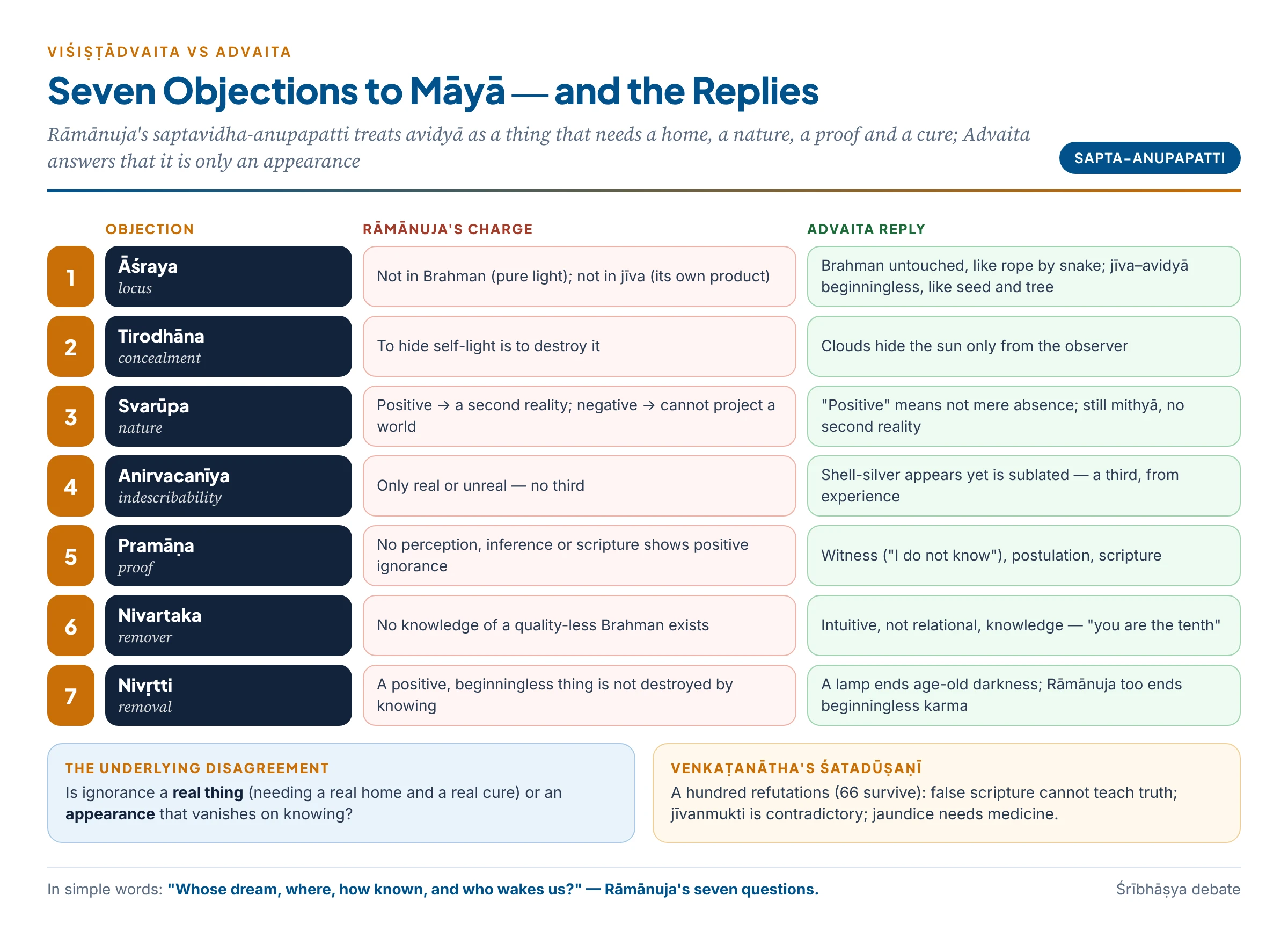
The Seven Objections (Saptavidha-anupapatti) and the Advaita Replies
1. Āśraya-anupapatti — no locus for avidyā.
- Objection. Ignorance must belong to someone. It cannot reside in Brahman, which is pure knowledge — light cannot house darkness. It cannot reside in the jīva, because the jīva is itself a product of avidyā — the effect cannot be the ground of its cause. So avidyā has no home.
- Advaita reply.
- Vivaraṇa view: avidyā rests in Brahman without touching it, as the rope is the ground of the snake but is never bitten by it; ignorance contradicts only knowledge as a mental state, not Brahman’s witnessing light, which in fact reveals ignorance (“I do not know”).
- Bhāmatī view: avidyā rests in the jīva; the circle (jīva from avidyā, avidyā in jīva) is beginningless, like seed and tree, so it is not a vicious circle.
- From the highest standpoint there is no avidyā to locate; the question itself is asked from within ignorance.
2. Tirodhāna-anupapatti — avidyā cannot conceal Brahman.
- Objection. Brahman is self-luminous consciousness. To conceal self-luminosity is to destroy it, for its very nature is to shine. If avidyā concealed Brahman, Brahman would be destroyed.
- Advaita reply. Concealment is from the jīva’s point of view, not in Brahman itself — as clouds hide the sun from the observer without touching the sun. Brahman’s light is not destroyed; the jīva fails to recognise it.
3. Svarūpa-anupapatti — the nature of avidyā is incoherent.
- Objection. Is avidyā positive (bhāva-rūpa) or negative? If positive and real, it is a second reality beside Brahman — dualism. If negative (mere absence of knowledge), how can an absence project a whole world?
- Advaita reply. “Positive” only means not a mere absence — it covers and projects. It is not a second reality, because it is mithyā: neither real nor unreal. A dream is “positive” in appearing, yet is no second reality beside the dreamer.
4. Anirvacanīya-anupapatti — “indescribable” is impossible.
- Objection. Every cognition is of the real or the unreal; there is no third. To call avidyā “neither real nor unreal” violates the law of excluded middle; and to call it “indescribable” is already to describe it.
- Advaita reply. “Real” means never contradicted, “unreal” means never appears (like a barren woman’s son). The shell-silver both appears and is contradicted — so it fits neither; the third category is drawn from experience, not invented. “Indescribable” means “not describable as real or as unreal“, not “not describable at all”.
5. Pramāṇa-anupapatti — no means of knowledge proves avidyā.
- Objection. Perception, inference and scripture reveal no positive ignorance. “I am ignorant” only means that a particular knowledge is absent. Scripture’s “māyā” means God’s wonderful power, not illusion.
- Advaita reply.
- The witness (sākṣī) directly reveals ignorance (“I do not know myself”, “I knew nothing in deep sleep”).
- Postulation (arthāpatti): the appearance of the many in the one is otherwise inexplicable.
- Scripture: “they are covered by untruth“; “know prakṛti to be māyā”.
- Ignorance cannot be “proved” like a real object precisely because it is not real.
6. Nivartaka-anupapatti — nothing can remove avidyā.
- Objection. Advaita says the knowledge of quality-less Brahman removes avidyā. But all knowledge is of qualified objects; there is no knowledge of a quality-less Brahman. And scripture teaches a qualified Brahman. So the remover does not exist.
- Advaita reply. The liberating knowledge is not verbal or relational but intuitive realisation produced by the great saying — like “you are the tenth“, which gives immediate knowledge of what was overlooked.
7. Nivṛtti-anupapatti — avidyā cannot be removed.
- Objection. A beginningless, positive entity cannot be destroyed by mere knowledge. Bondage is real karma, removable only by God’s grace, won through devotion.
- Advaita reply. A false appearance, however old, vanishes the moment it is known — darkness of ages goes when a lamp is lit; the rope-snake goes when the rope is seen. Moreover, Rāmānuja too admits beginningless karma that is ended — by grace; his own system faces the same question.
| Objection | Rāmānuja’s charge | Advaita reply in one line |
|---|---|---|
| Āśraya (locus) | Neither Brahman nor jīva can house avidyā | Brahman untouched (rope and snake); jīva–avidyā beginningless like seed and tree |
| Tirodhāna (concealment) | Concealing self-light destroys it | Clouds hide the sun only from the observer |
| Svarūpa (nature) | Positive → dualism; negative → cannot project | Positive-like, but mithyā — no second reality |
| Anirvacanīya (indescribability) | No third besides real and unreal | Shell-silver appears and is sublated — a third, from experience |
| Pramāṇa (proof) | No pramāṇa proves avidyā | Witness, postulation, scripture |
| Nivartaka (remover) | No knowledge of quality-less Brahman | Intuitive, non-relational knowledge — “you are the tenth” |
| Nivṛtti (removal) | Positive beginningless thing not removed by knowledge | Lamp removes age-old darkness; Rāmānuja too ends beginningless karma |
In simple words
A cinema screen is never wet when the film shows a flood. Rāmānuja asks: “How can the pure screen hold the flood?” Advaita answers: “It doesn’t — the flood only appears on it, for the viewers.” Most of the seven debates come down to this: is an appearance a real thing that needs a real home, or only an appearance that disappears on knowing?
Venkaṭanātha’s Hundred Refutations (Śatadūṣaṇī)
Vedānta Deśika (Venkaṭanātha), the great successor of Rāmānuja, wrote the Śatadūṣaṇī — “a hundred refutations” of Advaita, of which sixty-six survive. Some typical charges:
- If all difference is false, the difference between teacher and pupil, bondage and liberation, scripture and its meaning is also false — Advaita undermines its own teaching.
- If scripture is mithyā, it cannot reveal the real Brahman — a false means cannot give true knowledge.
- Jīvanmukti is contradictory — a liberated person still having a body and experiences is not liberated.
- Illusions do not vanish by mere knowledge — the jaundiced person’s yellow vision goes only with medicine; so bondage needs more than knowledge.
- If knowledge liberated, Śaṅkara would have merged in Brahman and would not have taught.
- Advaita replies: a false means can lead to truth (a dream-tiger can wake one up; a reflection shows the real face); jīvanmukti is freedom from identification, not from the body; the knower of the illusion is no longer deceived, though his body may still need medicine; and the enlightened teach out of compassion at the empirical level.
Rāmānuja’s Critique of Śaṅkara’s Brahman and Īśvara
- No quality-less Brahman. No pramāṇa reveals it; perception, inference and language all deal with qualified objects; scripture everywhere describes Brahman with qualities.
- The negative texts are misread. “Neti neti” and “nirguṇa” deny limitations and bad qualities, not all qualities; “one without a second” denies any equal reality, not internal difference.
- The higher/lower split is unwarranted. Scripture never speaks of two Brahmans; the saguṇa texts are as authoritative as the nirguṇa ones.
- Īśvara is not a lower appearance. If God is Brahman reflected in māyā, then God is a product of ignorance — and devotion, prayer and grace become worship of an illusion.
- Who is ignorant in Īśvara? Brahman cannot be ignorant; the jīva did not create the world; so whose ignorance projects Īśvara and the world?
- A quality-less Brahman cannot be known — and an unknowable reality cannot be the goal of liberation.
- Knowledge requires distinction. Pure, objectless, subjectless consciousness is a contradiction; consciousness is always someone’s and of something.
- The unity texts deny the independence of the world, not its reality. “All this is Brahman” means the world has no being apart from Brahman, as a body has none apart from its soul.
- Advaita replies.
- The nirguṇa texts are primary, as they alone teach something not known otherwise; saguṇa texts serve worship.
- Īśvara is real at the empirical level — fully real for every worshipper; Śaṅkara himself was a devotee and hymn-writer.
- Brahman is not known as an object but as one’s own Self — self-evident, beyond the knower–known split.
- Rāmānuja’s own apṛthaksiddhi keeps unity only in name; true non-duality needs the qualities to be appearances.
The Status of the World: Śaṅkara and Rāmānuja’s Response
| Point | Śaṅkara | Rāmānuja’s response |
|---|---|---|
| Status | Mithyā — empirically real, absolutely unreal | Real — God’s body |
| Causation | Vivarta — Brahman only appears as the world | Pariṇāma — God’s body really transforms |
| Māyā | Indescribable power of appearance | God’s real creative power |
| Analogy | Rope–snake, dream, magic | Milk–curd, spider and web, body and soul |
| Error | Anirvacanīya-khyāti — the illusory object is indescribable | Sat-khyāti — every cognition is true, error partial |
| Sublation | The world is sublated by Brahman-knowledge | Nothing real is ever sublated; the world continues in liberation |
| Argument | Only the unchanging is real; the world changes | Change is real; “if the world is mithyā, the Vedas too are mithyā” |
- Rāmānuja’s key responses.
- Perception shows a real world; no later experience contradicts it.
- Scripture speaks of real creation (“He desired, may I become many”).
- If the world is unreal, ethics, ritual and scripture — which are part of the world — become unreal too.
- The dream analogy fails: dreams are contradicted by waking, but waking is contradicted by nothing.
- Śaṅkara’s defence. The world is not called unreal; it is fully real for practice. Its unreality is seen only from the standpoint of Brahman-realisation, as the dream’s unreality is seen only on waking.
Why Do Both Śaṅkara and Rāmānuja Need Māyā?
- The common problem. Both accept the Upaniṣadic teaching that Brahman is one, perfect and changeless; both must explain how this one is related to the many and the changing without losing its perfection. Māyā is each one’s answer.
- Śaṅkara’s need. Māyā is the inexplicable power by which Brahman appears as the world without changing — preserving Brahman’s changelessness (vivarta).
- Rāmānuja’s need. Māyā is God’s real, wonderful creative power (sometimes prakṛti itself) by which God really creates a varied world through His body, while His soul remains untouched — preserving God’s perfection.
- The shared structure.
- Both need a principle of multiplicity that does not compromise Brahman’s perfection.
- Both hold that ignorance (avidyā) causes bondage — for Śaṅkara, ignorance of identity; for Rāmānuja, ignorance of dependence on God.
- Both hold that knowledge/intuition of the truth is the means of release (for Rāmānuja, knowledge that has become loving devotion).
- The difference. For Śaṅkara, māyā makes the world appearance; for Rāmānuja, māyā makes it real — the same word with opposite consequences.
Bondage in Rāmānuja
- Bondage is real. The soul is really bound by karma, accumulated over beginningless time.
- Its root is ignorance (avidyā) — but not cosmic illusion; it is the soul’s ignorance of its true nature as a dependent mode of God. The soul thinks itself independent and identifies with the body.
- Egoity, not individuality, binds. The sense of being an independent agent (ahaṃkāra as self-will) causes bondage; the soul’s individuality itself is good and remains in liberation.
- Attachment to the world (prapañca) as if it existed for one’s own enjoyment, rather than as God’s body, deepens bondage.
- Bondage is curable — not by mere knowledge, but by devotion and God’s grace.
Liberation (Mokṣa) in Rāmānuja
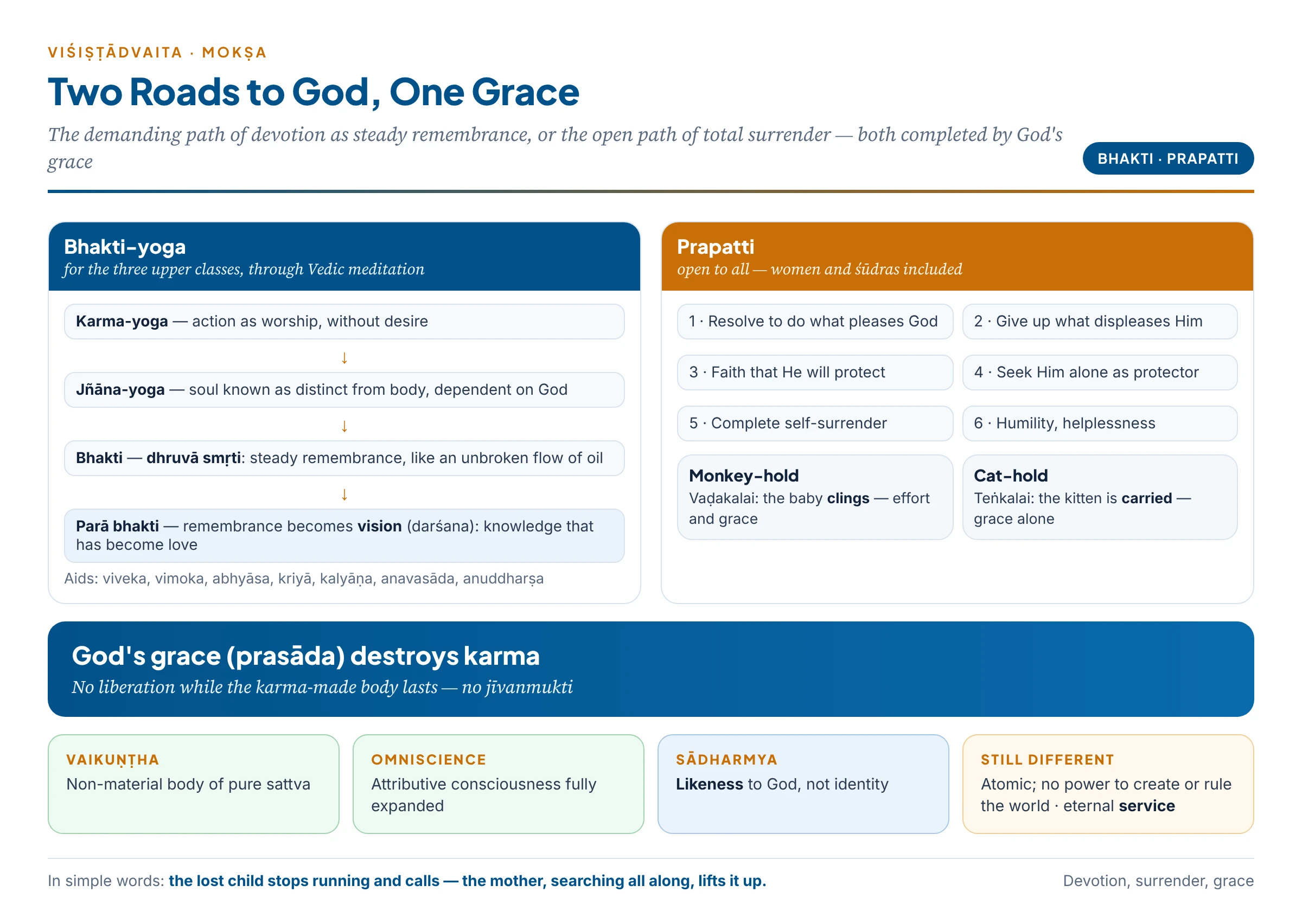
- What liberation is. The removal of karma and the soul’s realisation of its true nature as a mode of God, followed by eternal communion with God in Vaikuṇṭha. It is not merging or identity.
- The means — a graded path.
- Karma-yoga — disinterested action, done as worship of God, purifies the mind.
- Jñāna-yoga — knowledge of the soul as distinct from the body and dependent on God.
- Bhakti-yoga — the culmination: knowledge and action combined (jñāna-karma-samuccaya) lead to devotion.
- What bhakti is. Dhruvā smṛti — “steady, constant remembrance” of God, like an unbroken flow of oil. It is the same as the Upaniṣadic meditation (upāsanā, dhyāna, nididhyāsana). When perfected, it becomes direct vision (darśana) of God — highest devotion (parā bhakti). Rāmānuja identifies the highest knowledge with the highest devotion: “knowledge that has become love“.
- Seven aids (sādhana-saptaka) to bhakti:
- Viveka — purity of body through pure food.
- Vimoka — freedom from desire.
- Abhyāsa — constant practice.
- Kriyā — doing good to others (the five daily duties).
- Kalyāṇa — virtues: truthfulness, compassion, non-violence, charity.
- Anavasāda — freedom from dejection, cheerfulness.
- Anuddharṣa — freedom from excessive elation.
- Ordinary versus highest bhakti. Ordinary devotion is emotional worship, prayer and ritual; highest devotion is continuous loving contemplation that has become vision of God.
- Prapatti — total self-surrender. For those unable to follow the demanding path of bhakti-yoga, surrender to God is a direct way. It has six parts:
- Ānukūlyasya saṅkalpaḥ — resolve to do what pleases God.
- Prātikūlyasya varjanam — giving up what displeases Him.
- Rakṣiṣyatīti viśvāsaḥ — firm faith that He will protect.
- Goptṛtva-varaṇam — seeking Him alone as protector.
- Ātma-nikṣepa — complete surrender of oneself.
- Kārpaṇya — humility, sense of utter helplessness.
In simple words
A small child lost in a crowded fair runs here and there, crying and searching, and only gets more lost. The moment the child stops, stands still and simply calls out “Mother!”, the mother — who was searching all along — finds and lifts it. Prapatti is that stopping and calling; grace is the mother’s arms.
- Open to all. Bhakti-yoga through Vedic meditation was restricted to the three upper classes, but prapatti is open to everyone — women and śūdras included. The Ālvārs taught that prapatti itself is bhakti.
- Grace (prasāda, kṛpā). Pleased by devotion and surrender, God destroys the soul’s karma and grants liberation. Human effort prepares; grace completes.
- Vaḍakalai (northern school) — the “monkey-hold” (markaṭa-nyāya): the baby monkey must cling to its mother — effort plus grace.
- Teṅkalai (southern school) — the “cat-hold” (mārjāra-nyāya): the kitten is carried by its mother — grace alone.
- No jīvanmukti. As long as the body — itself a product of karma — lasts, the soul is not fully free; liberation comes after death.
- The state of liberation.
- The soul goes to Vaikuṇṭha by the path of light and receives a non-material body of pure sattva.
- Its attributive consciousness expands fully — it becomes omniscient.
- It attains similarity of nature with God (sādharmya), not identity (tādātmya).
- It still differs from God in two ways: it is atomic, not all-pervading; and it has no power to create, sustain or dissolve the world.
- It enjoys eternal service (kaiṅkarya) and the bliss of God’s presence, and never returns.
Common confusion
Does Rāmānuja reject knowledge (jñāna)? No. He rejects Śaṅkara’s view that verbal knowledge of identity liberates. For Rāmānuja the Upaniṣadic words “know” (vid) and “meditate” (upās) mean the same thing: loving, continuous meditation on God. Highest knowledge is highest devotion. Knowledge and action are combined and both culminate in bhakti.
Why Grace Is Needed
- Finite effort, infinite karma. The soul’s limited effort cannot cancel beginningless karma; only an infinite, loving God can.
- Liberation is communion, a relationship — and a relationship cannot be forced from one side; it is a gift.
- Pride is the obstacle. Self-reliant striving can feed egoity, the very root of bondage; surrender to grace dissolves it.
- Example. In the story of Gajendra, the elephant-king seized by a crocodile struggles for years in vain; when he gives up and calls on Viṣṇu with a lotus in his trunk, Viṣṇu comes and frees him at once. Effort reaches its limit; surrender invites grace.
- Beyond human effort. In Christianity, too, salvation is “by grace through faith“, not by works alone.
Evaluating Bhakti as a Pathway to Liberation
- Strengths.
- Accessible to all — regardless of caste, gender, learning.
- Engages the whole person — emotion, will and intellect — not intellect alone.
- Cultivates humility and love, dissolving egoity.
- Has deep experiential support in the lives of saints (Ālvārs, Mīrā, Tulsīdās).
- Criticisms.
- Advaita: devotion presupposes duality and so cannot give final freedom; it is preparatory.
- Blind faith and emotionalism may replace inquiry.
- Sectarianism — devotion to one form of God can divide.
- Grace may seem arbitrary — why does God save some and not others?
- Balanced view. The Gītā presents knowledge, action and devotion as complementary; Rāmānuja shows how devotion can include knowledge; Śaṅkara shows how devotion can lead to knowledge.
Liberation in Advaita and Viśiṣṭādvaita Compared
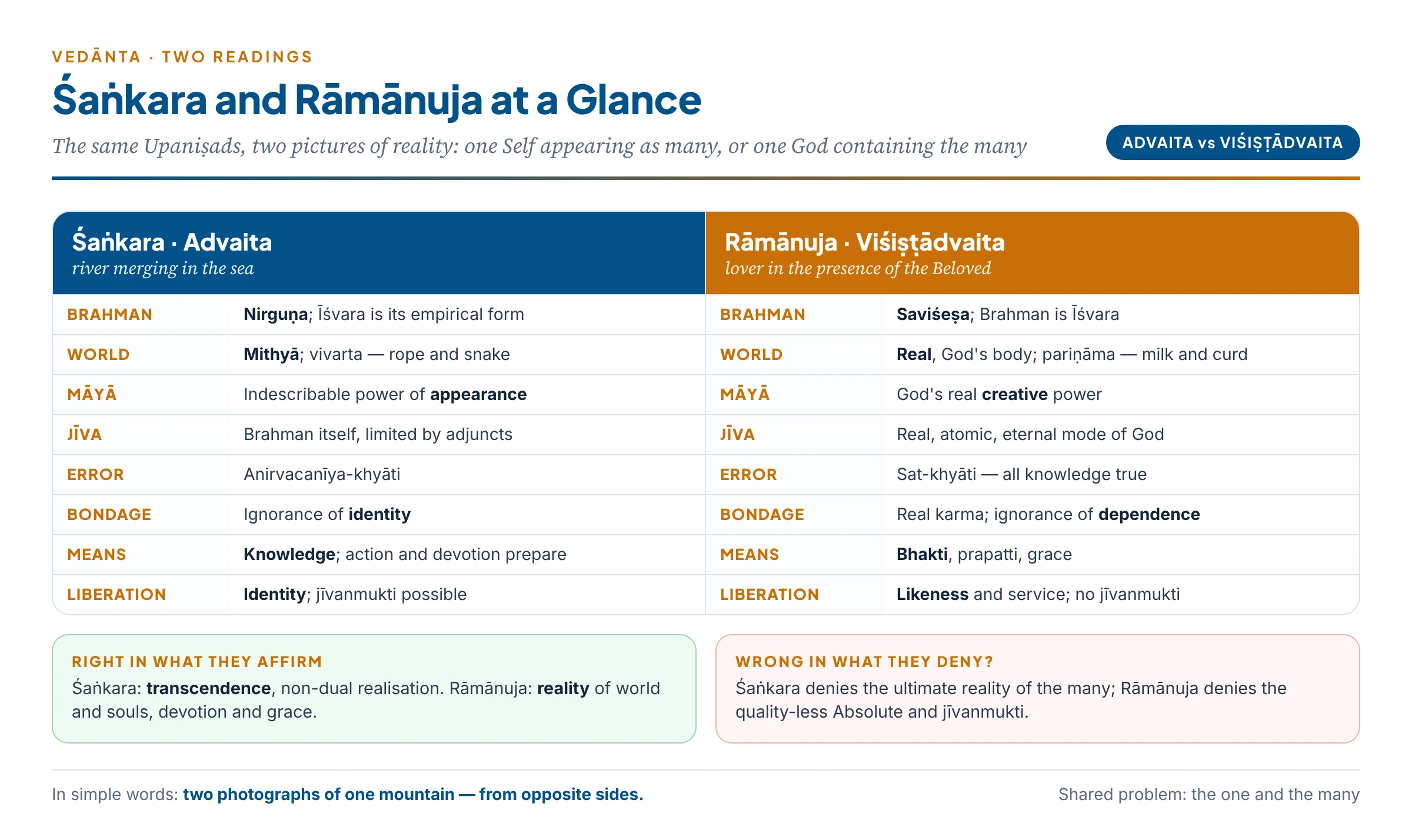
| Point | Advaita (Śaṅkara) | Viśiṣṭādvaita (Rāmānuja) |
|---|---|---|
| Bondage | Ignorance of identity — mithyā | Real karma; ignorance of dependence |
| Liberation | Realising identity with Brahman | Eternal communion with God |
| Means | Knowledge alone; action and devotion prepare | Bhakti (knowledge become love), prapatti |
| Grace | Little role | Essential |
| Agent | No real agent ultimately; liberation from agency | Real agent who is liberated and enjoys |
| Individuality | Dissolves | Retained (egoity goes) |
| Jīvanmukti | Accepted | Rejected |
| State | Sat–cit–ānanda, non-dual | Sādharmya, omniscience, service in Vaikuṇṭha |
| Image | River merging in the sea | Lover in the presence of the Beloved |
“Both Are Right in What They Affirm, Wrong in What They Deny”
- The maxim. An old saying (found in Leibniz) holds that thinkers are usually right in what they affirm and wrong in what they deny. Applied to Śaṅkara and Rāmānuja, the verdict runs as follows.
- Śaṅkara is right in affirming:
- The unity and transcendence of Brahman beyond all categories.
- Intuitive realisation beyond subject–object duality.
- That the ego is the root of bondage.
- Śaṅkara is wrong (says the critic) in denying:
- The reality of the world and of individual selves.
- The ultimate status of a personal God and devotion.
- Rāmānuja is right in affirming:
- The reality of the world, souls and God’s qualities.
- Devotion, grace and ethics as essential to the spiritual life.
- Rāmānuja is wrong (says the critic) in denying:
- The transcendent, quality-less aspect of the Absolute.
- Jīvanmukti and the possibility of non-dual experience.
- Synthesis. The two can be seen as complementary emphases — transcendence and immanence, knowledge and love, the One and the many. Radhakrishnan saw them as two sides of one truth; Sri Aurobindo’s integral non-dualism tries to affirm both — a real world and a real Absolute — without the denials.
In simple words
Two photographers shoot the same mountain — one from the north at dawn, one from the south at dusk. Each photo is true; each is wrong only if it claims “this is the only view of the mountain”. The maxim says Śaṅkara and Rāmānuja are like them: each sees the Absolute truly from one side.
- Counter-view. Each denial follows from each affirmation: if Brahman is strictly one and changeless, the world must be appearance; if the world is real, Brahman must be internally differentiated. A simple combination may hide a real contradiction.
Critical Evaluation
Strength and Weakness of Rāmānuja’s Critique
- Strengths.
- It exposes genuine difficulties in the concept of avidyā — locus, nature, proof — which later Advaitins took very seriously.
- It defends common sense, scripture as a whole, and religious life.
- It anticipates modern criticism that “indescribable” may be an evasion.
- Weaknesses.
- It treats avidyā as if it were a real thing needing a real locus and real removal — which Advaita denies.
- Its own concepts — apṛthaksiddhi, God’s body unaffected by change — face parallel difficulties.
- Its rejection of non-relational intuition assumes that all knowledge is relational, which Advaita disputes.
Critics and Defenders
Criticism — Critics
- Rāmānuja: avidyā has no locus, cannot conceal, has no coherent nature, cannot be indescribable, has no proof, no remover, and cannot be removed.
- Venkaṭanātha: a hundred refutations — false scripture cannot teach truth; jīvanmukti is contradictory.
- Theists: Īśvara as reflection in māyā makes devotion worship of an illusion.
- Realists: perception shows a real world, contradicted by nothing.
Defence — Defenders and strengths
- Advaitins: avidyā is an appearance, not a thing; questions about it are asked from within it.
- Vivaraṇa and Bhāmatī: two consistent answers to the locus question.
- Madhusūdana and later Advaitins: detailed replies to every objection, including the Śatadūṣaṇī.
- Śaṅkara: Īśvara is fully real for practice; the world is not denied but placed.
- Synthesis: both thinkers need māyā; they differ on what it does.
Cross-Tradition Comparison
Grace and Devotion East and West
| Point | Rāmānuja | Western parallel | Similarity | Difference |
|---|---|---|---|---|
| Grace | God’s grace destroys karma; prapatti | Augustine, Luther — salvation by grace through faith | Human effort insufficient; God’s initiative | No karma or rebirth in Christian scheme |
| Monkey vs cat | Vaḍakalai (co-operation) vs Teṅkalai (grace alone) | Catholic (grace with works) vs Lutheran (grace alone) debate | Same question: effort or grace? | — |
| Liberation | Likeness to God, eternal service, individuality kept | Beatific vision, communion of saints | Personal communion with God | — |
| Critique of illusion | World real; māyā God’s power | Common-sense realism (Moore) | Experience not overturned | Rāmānuja’s realism is theistic |
Indian Connect — Key takeaways
- Rāmānuja and Madhva both attack māyā; Madhva goes further to absolute difference.
- Rāmānuja and the Bhakti movement: prapatti open to all influenced Rāmānanda, Kabīr and the north Indian saints.
- Śaṅkara and Rāmānuja share the problem (one and many) and even the word māyā; they differ in what it explains.
Synthesis (Siddhānta)
- The seven objections — locus, concealment, nature, indescribability, proof, remover, removal — are Rāmānuja’s systematic case against māyā; Advaita replies by treating avidyā as appearance, not a real thing.
- Venkaṭanātha’s Śatadūṣaṇī extends the attack; Advaita answers each charge from the two standpoints.
- Brahman and Īśvara: Rāmānuja denies a quality-less Brahman and a lower Īśvara; Advaita keeps Īśvara real at the empirical level.
- The world: mithyā (vivarta) for Śaṅkara, real body of God (pariṇāma) for Rāmānuja.
- Both need māyā to explain the one and the many — as power of appearance or as power of real creation.
- Bondage is real karma rooted in ignorance of dependence; liberation is eternal communion attained by bhakti (steady remembrance), prapatti (six-fold surrender) and grace; no jīvanmukti; likeness, not identity.
- “Right in affirmation, wrong in denial”: Śaṅkara secures transcendence and non-dual realisation, Rāmānuja the reality of world, souls and devotion.
- Contemporary relevance.
- Inclusive spirituality. Prapatti open to all classes and genders was a social revolution; Rāmānuja’s legacy fed the Bhakti movement’s critique of caste.
- Philosophy of religion. The debate between knowledge and love, effort and grace, remains central in comparative theology.
- Critical thinking. The seven objections are a model of rigorous, internal criticism of a rival system.
“Meditation is steady remembrance — an unbroken stream of remembrance, like the flow of oil.” — Rāmānuja, Śrībhāṣya
Previous Year Questions
- 2025Examine Rāmānuja’s seven objections against Māyāvāda of Advaita.
- 2023Discuss Rāmānuja’s criticism of Śaṅkara’s conception of Brahman and Īśvara (God).
- 2022Is it possible to have an idea of Liberation without the conception of a real agent? In this context, discuss the difference between Advaita and Viśiṣṭādvaita systems of thought.
- 2021Compare and contrast the views of Śaṅkara and Rāmānuja regarding the status of the world.
- 2018How does Rāmānuja refute the doctrine of Māyā as propounded by Śaṅkara? Why is Māyā needed by both Rāmānuja and Śaṅkara to establish their doctrines? Discuss.
- 2018Evaluate the concept of Bhakti (Devotion) as a pathway to attain liberation.
- 2017Distinguish between vivartavāda and pariṇāmavāda with reference to causation and explain how in the light of these theories Śaṅkara and Rāmānuja differ on the status of the world.
- 2015Compare and contrast the notion of Brahman in Śaṅkara and Rāmānuja.
- 2014Compare and contrast the concept of liberation according to ‘Advaita’ and ‘Viśiṣṭādvaita’.
- 2013Evaluate Rāmānuja’s critique of Śaṅkara’s theory of māyā.
- 2013Is there anything else other than human efforts which may be conducive to attainment of liberation?
- 2010“Both Śaṅkara and Rāmānuja are right in their affirmation, but wrong in their denial.” Critically evaluate.
- 2010Why is grace of God needed for liberation? Discuss with an example.
- 2008Explain Śaṅkara’s view on the status of Jagat and Rāmānuja’s response to it.
- 2003Rāmānuja’s criticism of Advaita concept of māyā (short note).
- 2002Rāmānuja’s refutation of Māyāvāda (short note).
- 2001Evaluate Śaṅkara’s analysis of mokṣa in the light of Rāmānuja’s arguments.