

Differences between Normal cycle and Arid cycle of Davis. (2013)
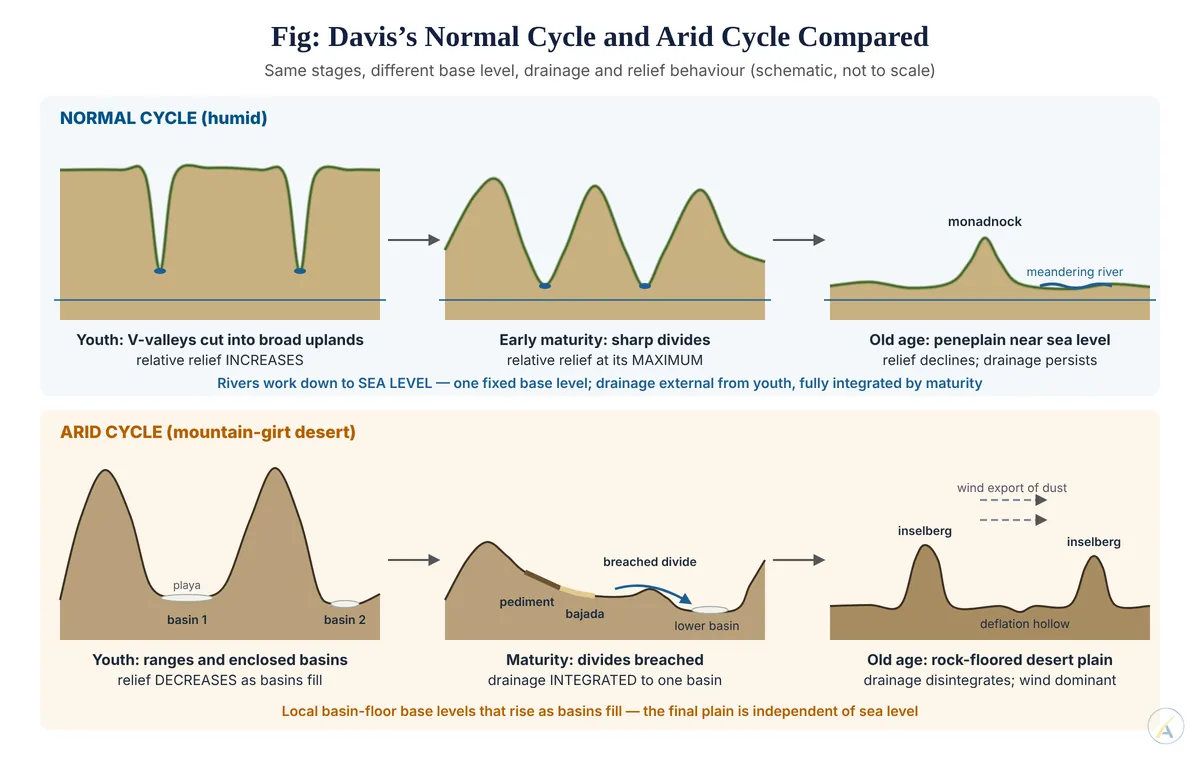
- William Morris Davis set out the normal cycle in 1899 for humid-temperate lands, where running water carves an uplifted mass down to a peneplain near sea level.
- In 1905 he adapted it to mountain-girt deserts — ranges separated by enclosed basins (bolsons) — as the arid cycle, where scarce water, interior drainage and wind change almost every stage.
- Both keep the same uplift–youth–maturity–old age sequence; the differences lie in agents, base level, drainage, relief behaviour and end-form.
Differences in Agents and Base Level
- Agent: in the normal cycle perennial rivers do nearly all the work under a vegetation cover. In the arid cycle, intermittent streams and sheetfloods dominate early, while wind gains relative importance in maturity and becomes decisive in old age.
- Climate assumed: the normal cycle needs enough rain for perennial, sea-reaching rivers; the arid cycle assumes very low rainfall (roughly under 250 mm a year) and high evaporation, so most streams die out before leaving their basin.
- Weathering: humid lands have a chemically weathered, plant-bound soil; deserts have mechanically broken, bare waste that wind can sort and lift.
- Base level: the normal cycle grades every river to sea level, a fixed and single base level. In the arid cycle each basin has its own local base level, which rises as the basin fills with waste.
- Final level: the arid desert plain stands at a height independent of sea level. Because wind exports dust out of the region, William Morris Davis held that it could be lowered below the deepest initial basin, and even below sea level if the sea is kept out.
Differences in Drainage Evolution
- Starting point: the normal cycle begins with an uplifted surface sloping to the sea; the arid cycle begins with tectonic basins formed by folding or faulting, each a closed hollow.
- Normal cycle: drainage is external from youth, widely spaced consequent rivers flowing to the sea and lengthening headward; it becomes fully integrated and adjusted to structure in maturity and persists into old age.
- Arid cycle: drainage passes through three phases.
- Youth — disintegrated and centripetal, with many short streams ending in separate basins and playas.
- Maturity — integration: divides are worn back and breached, so higher basins drain into lower ones until the whole region drains to one aggraded basin.
- Old age — disintegration again, as wind-blown hollows break the integrated slopes into many small, shifting systems.
- William Morris Davis himself stressed that this return to disintegrated drainage has no close analogy in the normal cycle.
Differences in Relief Behaviour
- Normal cycle: relative relief increases through youth as rivers incise, peaks in early maturity, and then declines as divides are lowered.
- Arid cycle: relief decreases from the very start, because the ranges are worn down while the basins between them are filled — degradation and aggradation work together.
- A feedback unique to deserts: the initial highlands act as rain-provokers; as they are worn down, rainfall falls further and the winds gain the upper hand in transport.
- Desert erosion is slow early, but William Morris Davis argued that wind export in the later stages may partly make up the lost time.
Differences in Landforms and End-Form
| Basis | Normal cycle | Arid cycle |
|---|---|---|
| Typical landforms | V-valleys, floodplains, meanders, oxbow lakes | Alluvial fans, bajadas, playas and salinas, rock-cut pediments, deflation hollows |
| Residual hills | Monadnocks | Inselbergs (the Inselberge of Wilhelm Bornhardt and Siegfried Passarge) |
| End-form | Soil-covered peneplain graded to sea level | Rock-floored desert plain, thinly veneered with waste, unrelated to sea level |
| Typical setting | Appalachians, humid Europe | Basin and Range of the western USA |
- Pediments: the arid cycle’s rock floors at the foot of retreating mountain fronts have no true equivalent in the normal cycle; the later pediplain of Lester Charles King (1953) grew out of this arid model rather than out of William Morris Davis’s peneplain.
Significance and Critique
- The arid cycle showed that sea level is not the only base level and that wind can erode a landscape independently of rivers — a credit William Morris Davis gave to Siegfried Passarge.
- Limitations: it suits only basin-and-range deserts, not open low-level deserts or sand seas, and it inherits the normal cycle’s assumption of one rapid uplift followed by long stability.
- Indian case: the Thar is largely an open sand desert that the bolson model fits poorly, though rock pediments and inselbergs flank the hills of western Rajasthan, as the arid cycle predicts.
- Climatic geomorphology later built on the contrast: Louis C. Peltier (1950) and Julius Büdel treated process suites as climatically zoned, while Lester Charles King went further and made the semi-arid cycle, not the humid one, the norm.
- Present-day relevance (2018): Jida Wang, Chunqiao Song, John T. Reager and colleagues showed from satellite gravimetry that endorheic basins, which coincide with arid and semi-arid climates, lost about 106 gigatonnes of water a year in 2002–2016 — interior drainage, the arid cycle’s defining trait, remains a distinct and sensitive hydrological system.
- Judgement: the two cycles differ not in their stages but in their controlling base level and agents — a single sea-level base and running water in the normal cycle, versus shifting local base levels, integrating-then-disintegrating drainage and wind in the arid cycle. That contrast was William Morris Davis’s own first admission that climate changes the rules of landscape evolution.