

Write an essay on the evolution of continents and oceans using various theories and models. (2020)
- How continents and oceans acquired their present shape and position has been answered by a succession of models, each built on the observations of the last and correcting its mechanism.
- The sequence runs from a fixed Earth (permanence, contraction, geosynclines) through mobile continents (continental drift, convection) to mobile oceans (sea floor spreading, plate tectonics), and now to the cyclic view of the Wilson and supercontinent cycles.
- The essay’s argument: the decisive shift was from treating ocean basins as permanent hollows to seeing them as temporary, recycled features — once oceans could open and close, the history of the continents followed.
The Fixed-Earth Models
Permanence of continents and oceans
- James Dwight Dana (mid-nineteenth century) held that continents and ocean basins had kept their places since the Earth’s crust first formed; similar fossils on distant continents were explained by land bridges that later sank.
- Isostasy later undermined this: light continental crust cannot simply founder into the denser ocean floor.
Contraction theories
- Eduard Suess, Leopold Kober (1921) and Harold Jeffreys (1924) explained relief by a cooling, shrinking Earth.
- Leopold Kober: rigid forelands (kratogens) moved towards each other and squeezed the intervening geosyncline (orogen) into mountains, leaving an undisturbed median mass between the two ranges — the Tibetan plateau between the Kunlun and the Himalaya.
- “Kober is definitely a contractionist, contraction providing the motive force for the compressive stress.” — James Alfred Steers
- Harold Jeffreys: the outer shells, already cooled, became too large for the still-cooling layers beneath; above a level of no strain they buckled under compression into fold mountains, while below it the layers were stretched and fractured.
- Why they failed: the calculated shrinkage was far too small to fold ranges like the Alps or Himalaya, as Arthur Holmes pointed out; radioactive heat meant the Earth was not simply cooling; and each model explained only one trend — Leopold Kober’s the west–east Alpine–Himalayan belt, Harold Jeffreys’s the north–south Rockies and Andes.
Geosynclines: Oceans Become Mountains
- James Hall (1859) showed that the Appalachians were built from very thick shallow-water sediments; James Dwight Dana (1873) named the subsiding trough a geosyncline.
- Émile Haug (1900) mapped five Mesozoic landmasses separated by four great geosynclines — the Rocky, Ural, Tethys and Circum-Pacific.
- Hans Stille separated stable cratons from mobile belts and divided geosynclines into volcanic eugeosynclines and quieter miogeosynclines.
- Lasting value: the Tethys became the Alpine–Himalayan system — an ocean turned into mountains; plate tectonics later reinterpreted miogeosynclines as passive continental margins and eugeosynclines as island-arc and ocean-floor sequences.
Mobile Continents: Drift
- Frank Bursley Taylor (1910) and Alfred Wegener (1912) proposed that continents move; Alfred Wegener’s Pangaea, ringed by Panthalassa, split into Laurasia and Gondwanaland across the Tethys.
- Alfred Wegener’s account of the oceans: the Atlantic is a widening rift between separating continents; the Pacific is the shrinking remnant of Panthalassa; the Rockies and Andes are folds raised at the leading edges of westward-drifting continents; the Himalaya rose as India moved north.
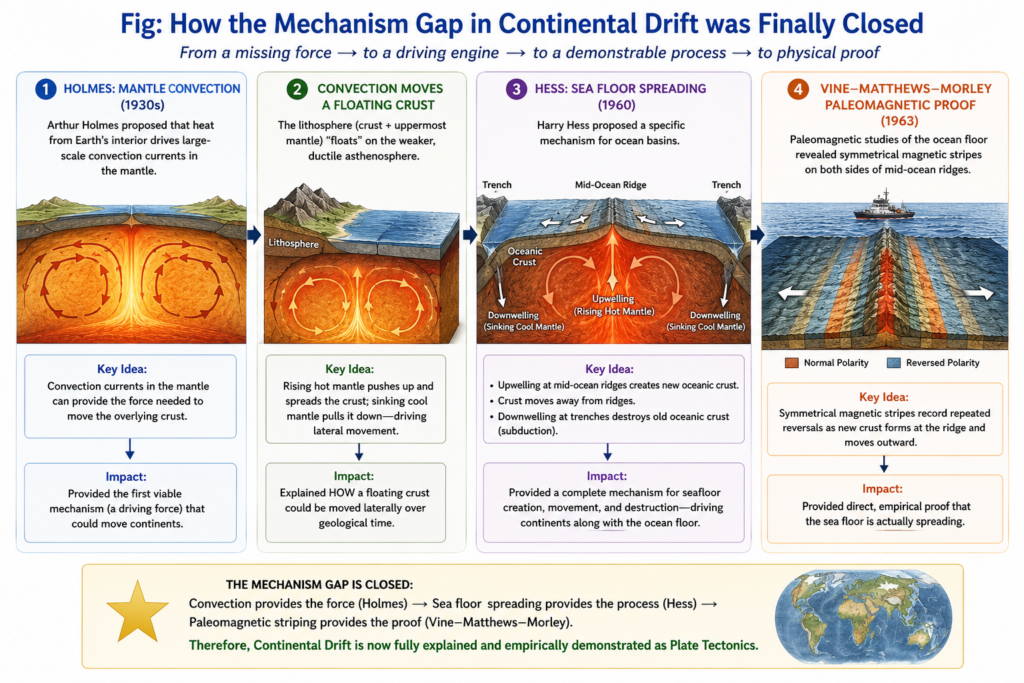
- Alexander du Toit (1937) strengthened the Gondwana case with South African and South American geology, and Arthur Holmes (1928–31) offered mantle convection as the motor — but the ocean floor was unexplored, and drift remained unproven.
Mobile Oceans: Sea Floor Spreading and Plate Tectonics
- Harry Hess (1960–62): ocean floor forms at mid-ocean ridges and sinks back at trenches; Fred Vine, Drummond Matthews and Lawrence Morley (1963) found the proof in symmetrical magnetic stripes.
- Consequence for oceans: no ocean floor older than about 200 million years survives in place — the ocean floor of Pangaea’s time has largely been consumed.
- Plate tectonics (1965–68: J. Tuzo Wilson, W. Jason Morgan, Dan McKenzie, Xavier Le Pichon) combined these: continents ride passively on plates, and oceans open at divergent margins and close at convergent ones.
- Consequence for continents: they grow at their margins as island arcs and ocean-floor slivers are welded on, and they are too buoyant to subduct — hence continental rocks up to about 4 billion years old survive.
Cycles: Wilson Cycle and Supercontinents
- J. Tuzo Wilson (1966) asked whether the Atlantic had closed and reopened — its predecessor, the Iapetus Ocean, closed to form the Caledonian–Appalachian mountains before the present Atlantic opened.
- Wilson cycle stages with present examples:
- Embryonic rift — East African Rift
- Young ocean — Red Sea
- Mature ocean — Atlantic
- Declining ocean ringed by trenches — Pacific
- Terminal ocean — Mediterranean
- Suture after collision — Indus–Tsangpo suture of the Himalaya
- Repeated cycles assemble supercontinents roughly every 500–700 million years — Columbia (Nuna) about 1.8 billion years ago, Rodinia about 1 billion, Pangaea about 300 million.
- Mantle plumes (W. Jason Morgan, 1971) can trigger break-up: the Deccan Traps erupted over the Réunion plume about 66 million years ago as the Seychelles block separated from India.
Where the Theory Still Disagrees
- Chuan Huang, Zheng-Xiang Li and Nan Zhang (2022) modelled that, because oceanic lithosphere has weakened as the Earth cooled, the next supercontinent, Amasia, will form by closing the Pacific in roughly 200–300 million years.
- Bernhard Steinberger (2022) disputed the model’s assumptions, and rival reconstructions close the Atlantic instead (Pangaea Proxima of Christopher Scotese) — the future geography of oceans is a live debate.
Evaluation
- Each model left a durable idea: permanence — continental buoyancy; contraction — compression builds fold mountains; geosynclines — oceans can become mountains; drift — continents move; spreading — oceans are young.
- Judgement: continents and oceans evolve as one coupled system — ocean basins are the short-lived, recycled component and continents the long-lived, accumulating one; plate tectonics with the Wilson cycle explains both, though the future arrangement of oceans remains genuinely unsettled.