

With the help of suitable sketches describe the mountain genesis and mountain types. Give suitable examples from various mountain systems of the world. (2022)
- A mountain rises steeply and prominently above its surroundings with a small summit area. Scale terms matter: a ridge; a range (linear set of ridges); a chain (parallel ranges); a system (ranges of common origin and age, e.g. the Alpine–Himalayan system); a group (an unordered cluster).
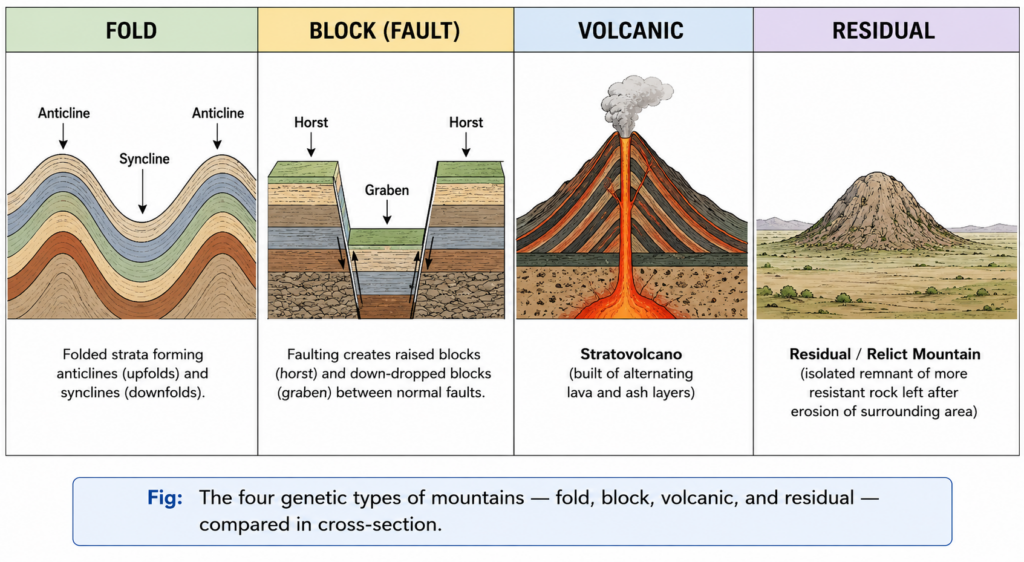
- Genesis depends on which process dominates: compression (folding), tension or vertical movement (faulting), magma (volcanic construction) or denudation (residual relief). This gives the classical four genetic types.
- Young mountains cluster in two great systems along active plate margins — the Alpine–Himalayan belt (Atlas and Pyrenees to the Himalaya and Indonesia) and the Circum-Pacific belt (Andes, Rockies, Japan, New Zealand); old, worn ranges lie deep inside the continents.
1. Fold mountains — compression of thick sediment piles
- Genesis: thick marine sediments collect on continental margins and in subsiding basins (the classical geosyncline); when an ocean closes by subduction, the converging plates squeeze them into anticlines, synclines, overturned and recumbent folds, thrusts and nappes, and the thickened crust rises isostatically.
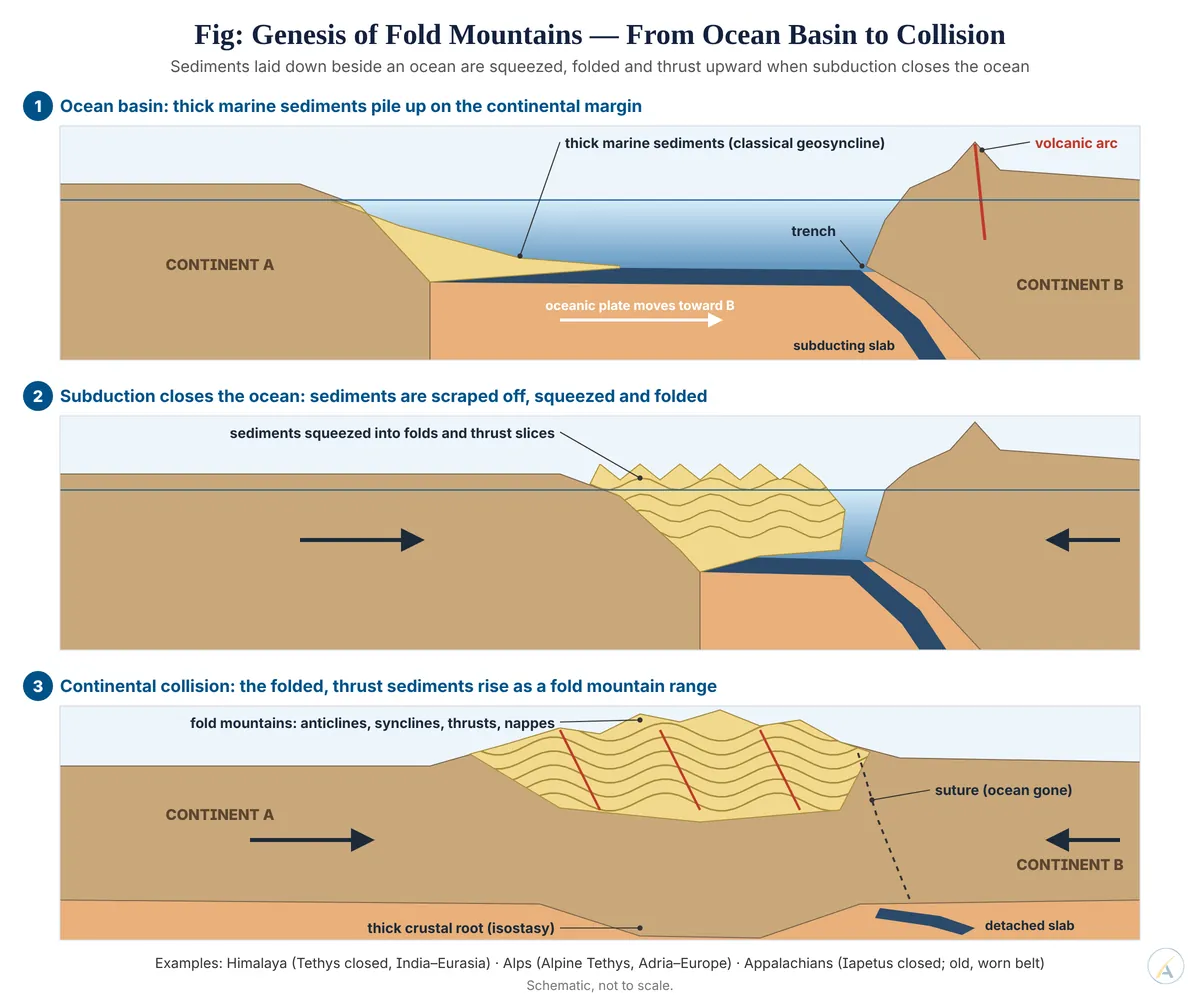
- Young (Tertiary–Alpine) fold mountains — high, sharp-crested, seismically active:
- Himalaya (India–Eurasia collision), Alps (Africa/Adria–Europe), Atlas, Zagros;
- Andes and Rockies (ocean–continent convergence around the Pacific).
- Old fold mountains — Caledonian and Hercynian (Variscan), long denuded:
- Appalachians (closure of the Iapetus Ocean and assembly of Pangaea), Urals (Europe–Siberia collision), Caledonides of Scotland and Norway;
- Aravalli in India, Precambrian, among the oldest fold belts on Earth.
- Folding is not uniform: moderate compression gives open folds, intense compression overturned folds, recumbent folds and far-travelled nappes, as in the Alps and the Greater Himalaya.
- Indian example of folding in progress: the Siwaliks, folded and lifted along the Himalayan Frontal Thrust in the last few million years.
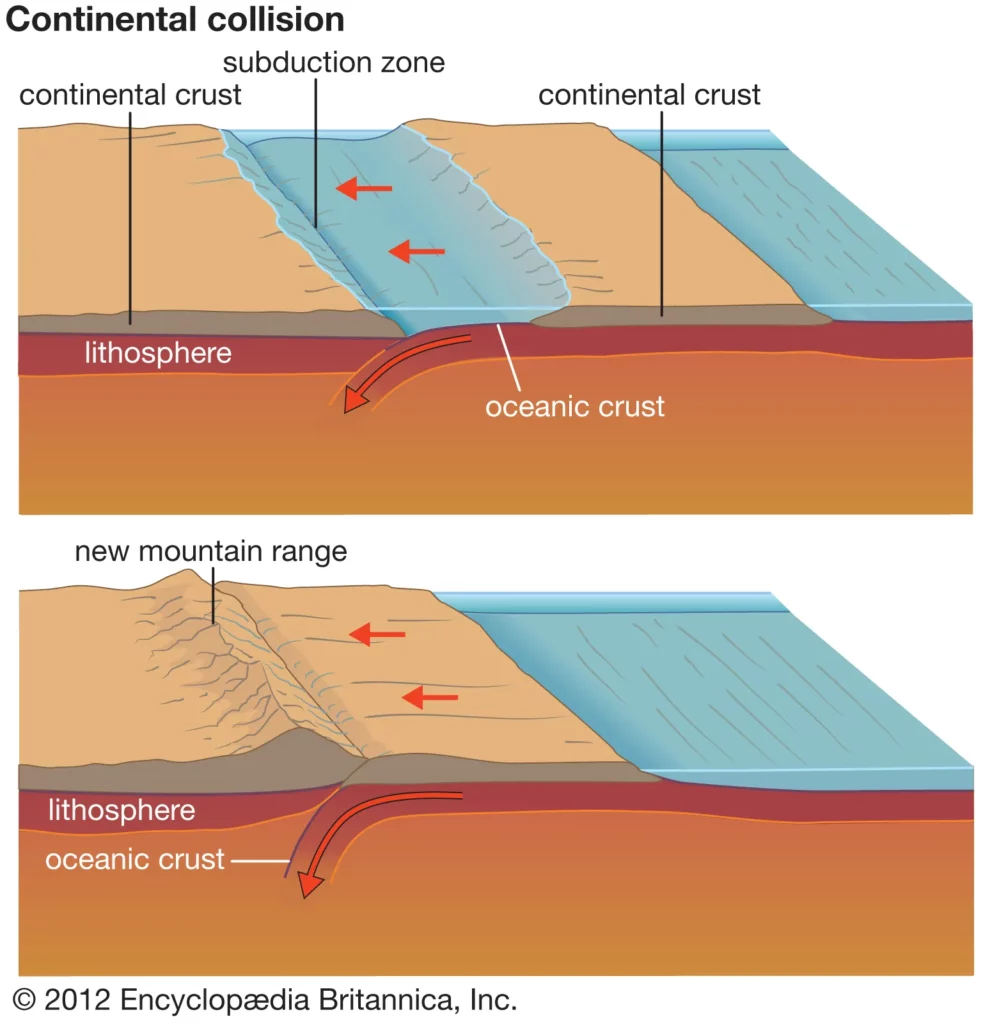
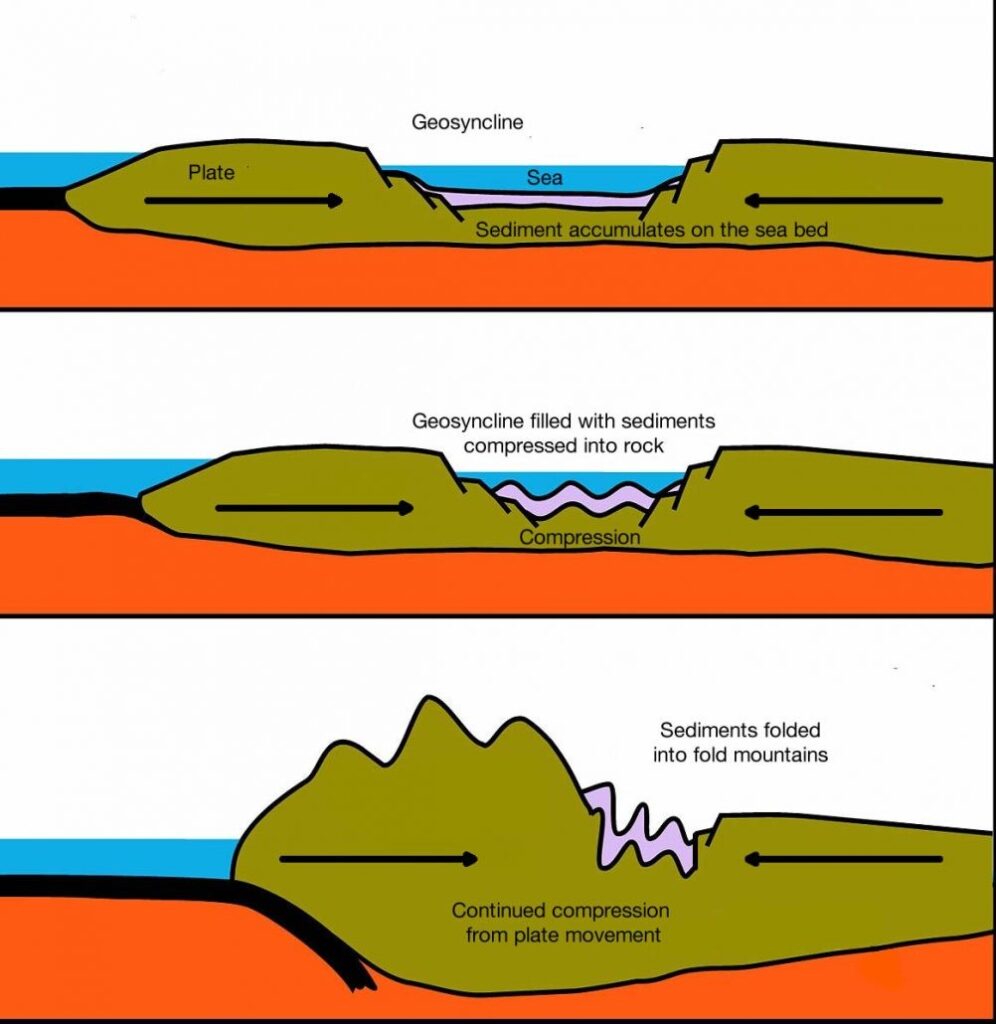
2. Block (fault) mountains — vertical movement on faults
- Genesis: tension (or uplift from below) breaks the crust into blocks along normal faults; a block left standing between down-faulted blocks is a horst, the sunken strip a graben (rift valley). Strata inside the block stay nearly horizontal, and the edges are steep, straight fault scarps.
- Tilted blocks rise on one side only, with a steep scarp face and a gentle back slope.
- Examples:
- Vosges (France) and Black Forest (Germany) — horsts on either side of the Rhine Graben;
- Sierra Nevada (USA) — a block tilted westward, with its steep scarp facing east over the Basin and Range;
- Ruwenzori — a horst within the western branch of the East African Rift;
- Satpura (India) — block relief between the Narmada and Tapi troughs.
3. Volcanic mountains — construction, not deformation
- Genesis: lava and pyroclasts pile up around a vent; the only mountain type built by addition of material.
- Form follows magma:
- fluid basalt builds broad shield volcanoes — Mauna Loa, Earth’s largest active volcano, and Mauna Kea, about 10 km tall from the sea floor;
- viscous, gas-rich andesite builds steep stratovolcanoes — Fuji, Vesuvius, Cotopaxi.
- Settings: subduction arcs (Pacific “Ring of Fire”, Andes, Indonesia’s Merapi), continental rifts (Kilimanjaro, Africa’s highest peak at 5,895 m, near the East African Rift) and hotspots (the Hawaiian chain, ageing away from the active plume). India’s Barren Island in the Andaman Sea is an active arc volcano.
4. Residual (relict) mountains — what denudation leaves behind
- Genesis: prolonged weathering and erosion strip weaker rock from an old upland, leaving resistant cores standing. The idea matches William Morris Davis’s monadnock and the inselberg of Lester Charles King’s pediplain, scaled up to whole ranges.
- Examples: Aravalli and the dissected Eastern Ghats in India; the Scottish Highlands; much of the low, rounded Appalachian relief.
- Low, subdued form is itself evidence of great age.
Mountains in deep time
- Mountain types are stages, not fixed boxes: fold and volcanic ranges degrade towards residual ones, and one tectonic episode can make several types at once — collision folds the core, faults the margins and opens paths for magma.
- Ziyi Zhu, Ian H. Campbell and Charlotte M. Allen and colleagues (2022) traced two “supermountain” belts, up to ~8,000 km long — the Nuna (2,000–1,800 million years ago) and Transgondwanan (650–500 million years ago) — and linked their erosion to nutrient supply, oxygen rise and leaps in early life.
- Judgement: the four-fold genetic scheme remains the clearest way to describe mountains, provided it is read through plate tectonics — fold and most volcanic ranges belong to plate margins, block mountains to extension, and residual mountains to time and denudation acting on all of them.