

What is ‘Helical’ flow ? How Helical flow accounts for meander modifications ? (2026)
What Helical Flow Is
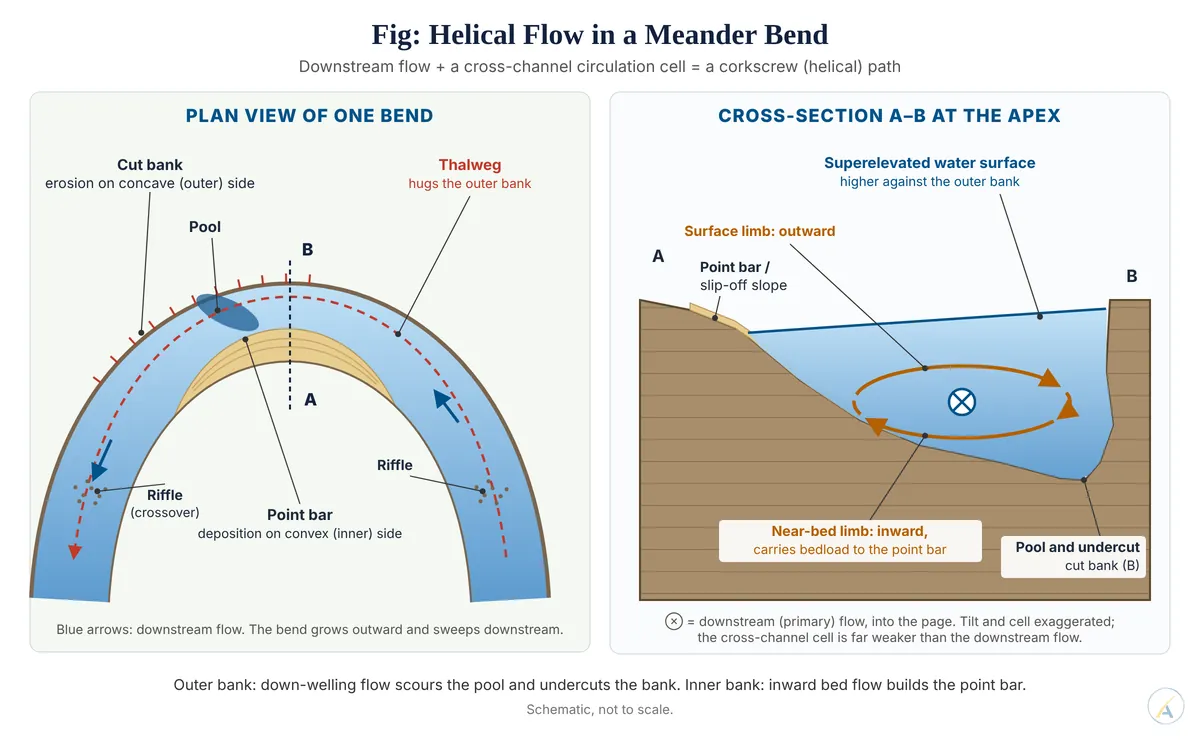
- Helical (helicoidal) flow is the corkscrew path water follows through a channel bend: the downstream primary flow carries a transverse secondary circulation cell, so each water particle spirals forward.
- The force imbalance: inertia carries bend flow outward and superelevates the water surface against the concave bank. The resulting cross-stream pressure gradient pushes inward, almost equally at all depths, but the outward centrifugal effect scales with u²/r — strong in the fast surface layer, weak in the friction-slowed layer near the bed.
- The closed cell: surface water therefore moves outward, near-bed water inward towards the convex bank, closing a rotating cell that is much weaker than the downstream flow but works continuously on the bed and banks.
- James Thomson explained this bend circulation in 1876. In 1926 Albert Einstein used the same mechanism — illustrated by the tea-leaf paradox, where the inward near-bed flow sweeps leaves to the centre of a stirred cup — to explain meander growth, and showed that Earth’s rotation acting through such circulation could account for Baer’s law of preferential right-bank erosion in the northern hemisphere.
How It Accounts for Meander Modification
- Outer-bank attack: the helix drives the thalweg and the fastest flow against the concave bank, causing undercutting, block collapse, a steep cut bank and a pool scoured near the bend apex.
- Inner-bank construction: the inward near-bed limb rolls bedload up the convex bank, building a point bar and slip-off slope; between bends, where the cell reverses, flow spreads across shallow riffles, typically five to seven channel widths apart.
- Growth, sweep and skew: circulation and bank shear peak just downstream of the bend apex, so bends both grow in amplitude and migrate downvalley, becoming skewed rather than simply wider. Successive point-bar ridges (scroll bars) record each step.
- A bounded shape: Ralph Alger Bagnold (1960) showed flow resistance in a bend is least at a radius-to-width ratio of about 2 to 3, and Luna Bergere Leopold and Markley Gordon Wolman found meander wavelength near 10 to 14 channel widths — so helical flow modifies bends within a recurring geometry.
- Cutoff and reset: migration narrows the neck until a flood cuts across it (neck cutoff) or across the point bar (chute cutoff), leaving an oxbow lake. The southward-shifting Ganga in Uttar Pradesh has left trails of palaeochannels and oxbow lakes north of its present course, as in Pratapgarh district.
Where Recent Work Refines the Picture
- Migration rate: Edward J. Hickin and Gerald C. Nanson (1975) found bends migrate fastest at a radius-to-width ratio near 2–3, implying tighter bends slow down. Zoltán Sylvester, Paul R. Durkin and Jacob A. Covault (2019), tracking more than 1,600 bends on seven Amazon rivers by satellite, found instead that migration rate follows curvature with a downstream lag — the sharpest bends move fastest unless their outer banks resist erosion.
- Sharp bends: Koen Blanckaert (2011) showed that sharp bends develop a small counter-rotating outer-bank cell that partly shields the bank, and that secondary flow stops strengthening beyond a certain curvature.
- Supply and banks: José Antonio Constantine, Thomas Dunne and co-workers (2014) linked faster migration and more frequent cutoffs on Amazon rivers to higher sediment supply; Alessandro Ielpi and Mathieu G. A. Lapôtre (2020) found rivers with unvegetated banks migrate about ten times faster.
- Judgement: helical flow explains the form meander modification takes — outer-bank erosion, inner-bank point bars, downstream sweep and cutoff. Bank strength, vegetation and sediment supply decide how fast it happens.