

What geological and tectonic processes lead to the formation of nappes in orogenic belts? (2025)
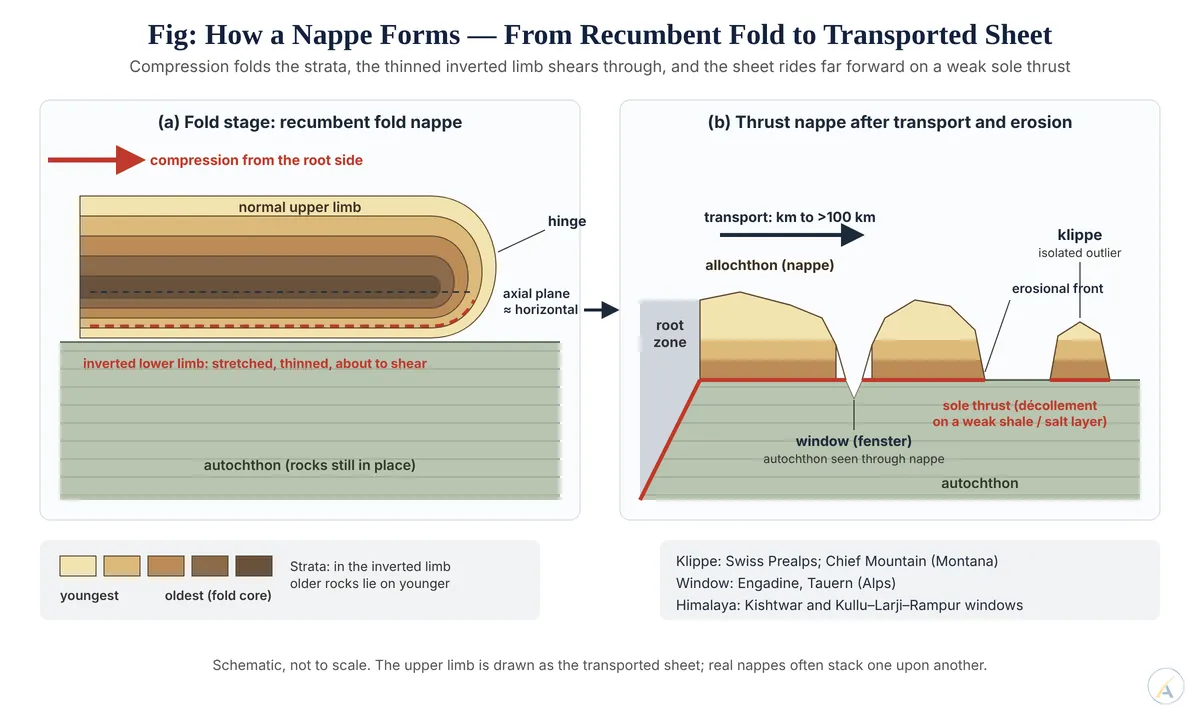
- A nappe (French, “tablecloth”) is a large sheet of rock carried kilometres to over 100 km from its root zone over a low-angle fault, so that it rests on rocks it did not form on.
- The transported sheet is the allochthon; the rocks beneath that stayed in place are the autochthon.
- Fold nappes are giant recumbent folds with an inverted, sheared lower limb; thrust nappes are slabs cut loose along a thrust.
- Marcel Bertrand (1884) reinterpreted the “double fold” of the Glarus Alps as one great overthrust; Hans Schardt showed the Swiss Prealps to be exotic, far-travelled masses; Maurice Lugeon extended the nappe idea across the Alps.
1. Plate convergence and crustal shortening — the driver
- Nappes form where convergence demands more shortening than folding alone can absorb: continental collision belts (the Alps, from the closure of the Alpine Tethys between Europe and Adria; the Himalaya, from India–Eurasia collision) and the overriding plate at subduction zones.
- The Glarus thrust in the Swiss Alps carries old Permian (Verrucano) rocks of the Helvetic nappes over much younger Jurassic–Palaeogene strata — the textbook proof of far-travelled sheets, now a UNESCO World Heritage Site (Tectonic Arena Sardona, 2008).
2. Progressive folding to the recumbent stage
- Rising compression tightens open folds into overturned, then recumbent folds whose axial planes lie almost flat.
- The middle (inverted) limb is stretched and thinned until it ruptures; the upper limb is then pushed forward over the lower one as an overthrust fold, and finally detached as a nappe.
3. Detachment on a weak layer
- Transport needs a décollement — a mechanically weak horizon such as shale, gypsum or salt, or a ductile shear zone in hot crust.
- The Jura fold belt slid on Triassic evaporites; the Himalayan wedge moves on the Main Himalayan Thrust.
- High pore-fluid pressure reduces effective friction on the fault, explaining how enormous sheets can move without shattering (M. King Hubbert and William W. Rubey, 1959).
4. Tectonic inheritance
- Thermomechanical models by Dániel Kiss, Thibault Duretz and Stefan M. Schmalholz (2020) show that the half-grabens and horsts of the old rifted margin decide where nappes form:
- thrust sheets shear off where stress concentrates at the sediment–basement contact and ride on thin, weak sediments;
- fold nappes form when a sediment-filled half-graben is squeezed shut and its fill extruded — the Wildhorn thrust nappe stacked on the Morcles fold nappe of the Helvetic Alps.
- Nappes thus record the pre-collision architecture of the margin, not only the collision itself.
5. Gravity and ductile extrusion
- Once relief is high, sheets can glide or spread under their own weight — gravity tectonics, championed by Reinout Willem van Bemmelen.
- In hot, thick crust the nappe can flow: the Greater Himalayan crystallines were extruded southward between the Main Central Thrust below and the South Tibetan Detachment (a normal fault) above, as a low-viscosity crustal channel focused by monsoon erosion at the front (Christopher Beaumont, Rebecca A. Jamieson and colleagues, 2001).
- Channel flow remains contested by critical-taper and thrust-duplex models — the Himalaya shows that compression below and extension above can work at once.
6. Erosion — how nappes are recognised
- Erosion isolates klippen (outliers of the nappe on autochthon, e.g. the Prealps, Chief Mountain in Montana) and cuts windows (fensters) through it (Engadine and Tauern windows in the Eastern Alps).
- In India, nappes were mapped by Darashaw Nosherwan Wadia in Kashmir, John Bicknell Auden in Garhwal and Arnold Heim and Augusto Gansser in Kumaon; the Chail and Jutogh nappes of Shimla, the Almora and Kathmandu crystalline sheets, and the Kishtwar and Kullu–Larji–Rampur windows are standard examples.
- Judgement: nappes are not the product of one force — plate convergence supplies the push, weak layers and fluid pressure allow transport, inherited rift structure decides where sheets detach, and gravity and ductile flow carry them further; the current view treats nappe formation as this coupled sequence, still being tested by numerical models.