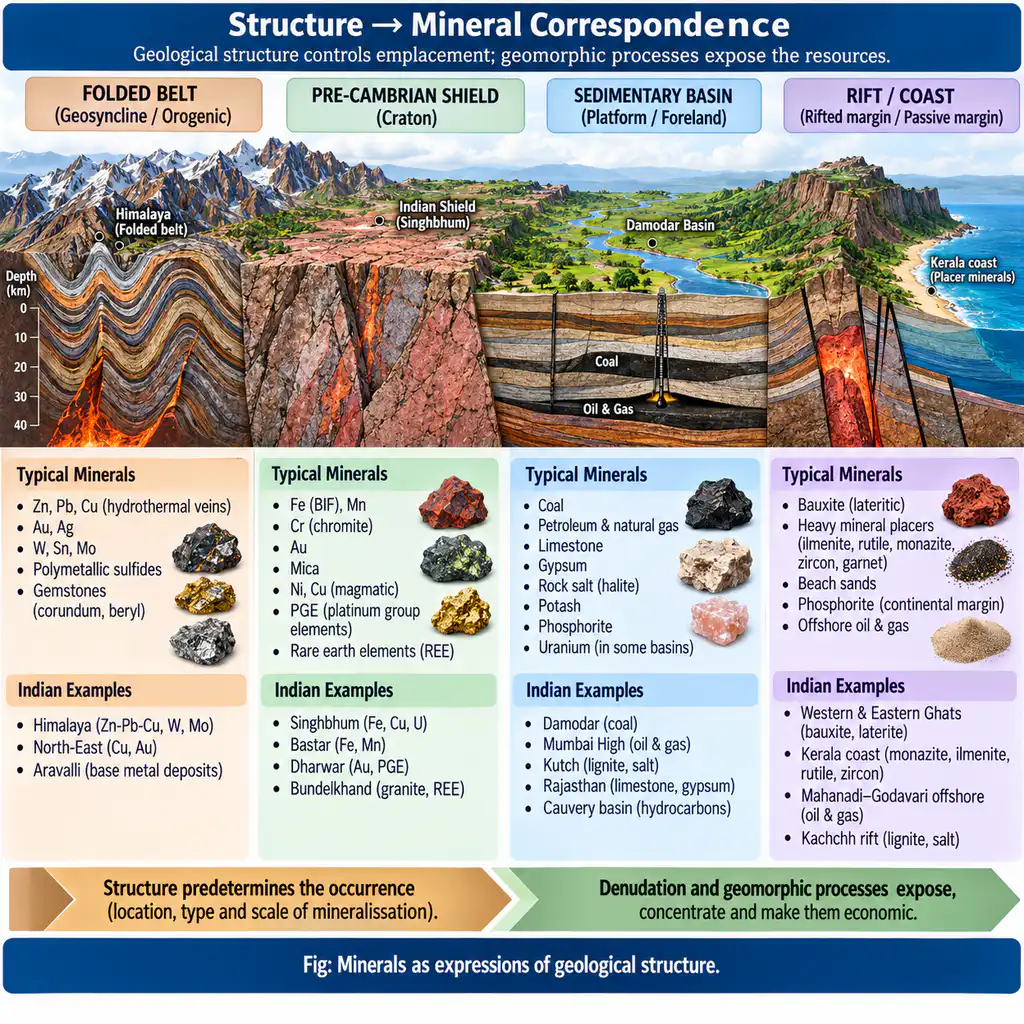
Question: “There is intimate relationship between the distribution of minerals and geological structure.” Discuss.
Introduction: Geology Governs Mineral Geography
The distribution of minerals is not accidental — it is a systematic expression of geological structure: the age, composition, and tectonic architecture of rocks (shield vs platform vs folded belt vs rift vs volcanic province) determine which minerals exist, their nature (metallic/non-metallic/energy), and their regional geography. The association runs at every structural scale: from continental units (Precambrian shields bearing metallic ores; sedimentary basins carrying coal, oil and gas) to regional provinces (folded mountains with hydrothermal veins) and local structural traps (anticlines for oil, faults for veins, unconformities for bauxite/laterite). The statement is fundamentally correct — it is the classic dictum of applied/economic geology — and it carries immediate implications for India’s mineral map, exploration strategy, and self-sufficiency ambitions.
1. The Structure–Mineral Correspondence (The Causal Matrix)
| Geological structure | Associated mineral provinces | Example minerals |
|---|---|---|
| Precambrian shields/cratons (ancient crystalline basement) | Metallic ores from magmatic–metamorphic concentration | Iron, gold, chromite, manganese, uranium, mica, REE, PGEs |
| Sedimentary basins / platforms (stable shallow seas & troughs) | Fossil fuels and evaporites | Coal, petroleum, gas, limestone, salt, potash, phosphorite |
| Folded mountain belts (geosynclines) | Orogenic vein, replacement and stratiform deposits | Zinc, lead, copper, tin, tungsten; petroleum in foredeep basins |
| Rift zones / fault systems | Hydrothermal vein, shear-zone and lode deposits | Gold, silver, copper, rare metals, groundwater aquifers |
| Volcanic provinces & plateaus | Extrusive and gas-driven deposits | Bauxite (weathering caps), building stone, sulphur, geothermal, kimberlite diamonds |
| Coastal/placer belts (gravel–sand–heavy-mineral) | Detrital concentration landforms | Monazite, ilmenite, rutile, zircon, garnet, rare-earth beach sands |
2. How Structure Controls Occurrence (Mechanisms)
- Orogenesis (folding) concentrates minerals: the world’s great zinc–lead–copper belts (e.g., European Variscan–Alpine, Himalayan Tethyan) lie along former geosynclines; petroleum accumulates in anticlinal traps and fault-bounded reservoirs of fold-and-thrust margins (Gulf, Zagros, Assam foredeep).
- Igneous–metamorphic differentiation in shields: magmatic segregation (chromium, PGEs — Sukinda, Odisha; Nuggihalli), and metamorphic remobilisation (banded iron formations → the Haematite ores of the Archaean Iron Ore Group between Noamundi-Gua-Kiriburu). Kimberlite pipes (diamonds) and granitic intrusions (tin, tungsten) are structurally emplaced.
- Faulting and shearing provide conduits for mineralising hydrothermal fluids (gold-silver lodes of Kolar/Hutti are shear-zone hosted); rifts host evaporites and geothermal systems.
- Sedimentary structures control stratiform deposits — coal seams (Lower/East Gondwana basins of Damodar, Son, Mahanadi), limestone (Cuddapah–Vindhyan), and the petroleum reservoir–trap architecture (Mumbai High anticline; Assam–Arakan fold belt).
- Unconformities and relict surfaces matter geomorphologically: laterite/bauxite caps (Chotanagpur plateau; Netarhat ~1,065 m; East coast bauxite) form by weathering of structurally elevated planation surfaces — a direct link of structure + surface to ore.
3. India’s Mineral Map Read Structurally
- Peninsular shield (Archaean–Proterozoic): the mineral wealth of India — Chotanagpur–Singhbhum belt (iron, manganese, mica, copper, chromite, uranium), Karnataka–Andhra greenstone belts (gold — Kolar, Hutti), Odisha (chromite at Sukinda, PGEs), Kerala–Tamil Nadu-Karnataka coastal placer deposits of monazite and ilmenite (~30% of world’s beach sand heavy minerals). This is shield-hosted metallogeny — the direct expression of Precambrian crust.
- Gondwana basins (Permo-Triassic, trough-fault controlled): coal — Damodar (Jharia, Raniganj), Mahanadi–Godavari valley, Son Valley; structure = fault-bounded down-warps. India’s coal output hit a record ~1 billion tonnes in FY 2024–25, overwhelmingly from these structural basins.
- Fold belts and foredeeps: Himalayan foothills — petroleum in Assam Arakan fold belt, coal in Eocene lignites; Western Ghats; Alpine-type lead-zinc in lesser Himalayan zones (Rampura-Agucha is a major zinc-lead in a metallogenic belt).
- Rift/Deccan province: Mumbai High (basin-and-ridge structure) offshore petroleum; Deccan basalts (only minor lateritic bauxite).
- Evaporites and minor minerals: Rajasthan’s Precambrian–Phanerozoic basins (salt — Sambhar; phosphorite; now first potash block auction in Rajasthan tranche V, 2025).
4. Structure + Strategy: The Critical Minerals Push (2023–2025)
- Critical minerals (Li, REE, graphite, nickel, cobalt, vanadium, potash, PGE) are being sought through structural targeting: the Chhattisgarh Katghora lithium + REE block (first lithium awarded, June 2024, premium 76.05%) is in a felsic-granite/replacement terrain; the Reasi (J&K) lithium occurrence lies in the Himalaya’s leucogranitic belt with pegmatitic structure; REE beach-sand and carbonatite associations in the shield.
- Policy architecture built on the same structure-based logic:
- MMDR (Amendment) Act, 2023 — empowered Central government to auction critical minerals; allowed private commercial mining of six critical minerals (lithium, beryllium, niobium, tantalum, titanium, zirconium) and deep-seated minerals (gold, silver, copper).
- Five tranches of critical mineral block auctions (from Nov 2023): 34 blocks successfully auctioned out of 55 offered by mid-2025 — including first-ever potash auction (Tranche V, Rajasthan), first REE auction in UP, and offshore block auctions (Tranche VI, 2025–26).
- National Critical Mineral Mission — end-to-end mineral development; royalty rates fixed for lithium, niobium, REEs (2023) and 12 critical minerals (Feb 2024).
- Significance: structural mapping is the exploration lens — because distribution follows structure, India’s critical-mineral push is, at bedrock, a structural geology enterprise (shear zones, granite-pegmatites, beach placers, sedimentary brines).
5. Testing the Intimacy (Limiting Factors)
- Not every structure holds ore — only where concentration processes (magmatic, hydrothermal, sedimentary, placer, weathering) have operated; structure is necessary, rarely sufficient.
- Environic/uniformitarian caution: mineral deposits are fossils of ancient processes — an Archaean iron resource may bear no relation to present-day structure; “intimate” applies to the genetic/emplacement structure, not always present form.
- Geomorphic control matters in exploitation: ore is accessible where denudation has exposed it (exposed Archaean shields) and hidden under cover (Gondwana coal under Peninsular alluvium; offshore hydrocarbons) — relief, denudation and burial determine discoverability, complementing structure.
- Plate-tectonics adds the why: the structure-mineral mapping is ultimately explained by plate-tectonic histories (rifted shields, convergent arcs, passive margins) — a modern resolution of the “intimate relationship”.
6. Conclusion
The statement expresses a first-order law of economic geology: the global and Indian distribution of minerals maps onto geological structure — shields*host metallic ores, sedimentary basins host coal and petroleum, folded belts and rifts host vein and hydrothermal deposits, volcanic/surficial settings host bauxite, and coastal structure bombs placer sands. India is a live demonstration — Chotanagpur iron, Damodar-Godavari coal, Mumbai High petroleum, Himalayan gas — each structurally predetermined. The “intimate relationship” is also the operating principle of exploration: the 2023–26 critical-minerals auction programme targets precisely the structures (katghora-type granites, pegmatitic Himalaya, coastal placers, brine basins) where structure predicts new minerals for Atmanirbhar Bharat. The relationship is not deterministic — structure is the necessary geological precondition, concentration processes the sufficient one — but in framing, mapping and prospecting, mineral geography remains a mirror of geological structure.