

Question: “The same physical processes and laws that operate today operated throughout geologic time, although not necessarily always with the same intensity as now.”
Introduction: A Statement of Refined Uniformitarianism
The statement is a precise, modern formulation of the principle of uniformitarianism — the methodological foundation of geology and geomorphology. It deliberately couples two claims: (i) uniformity of natural law and process — the physics, chemistry and mechanics operating today (erosion, weathering, plate motion, isostasy) are the same set of causes that operated through deep time; and (ii) non-uniformity of intensity — those processes have not always acted at today’s rates, so gradual dominance is not assumed. This is the crucial refinement. Hutton’s original 1785 doctrine, Playfair’s popularisation, Lyell’s fourfold systemisation, and the twentieth-century critique that exposed its gradualism as an over-reach — all converge on this mature reading. The question rewards an examined account: the principle’s core survives, its rate-uniformity claim does not.
1. The Classical Doctrine and Its Four Components
- Origin: James Hutton (1785, “Theory of the Earth”) — “the present is the key to the past”; his epigram “No vestige of a beginning, no prospect of an end” asserted an endlessly self-repairing Earth. John Playfair (1802, Illustrations of the Huttonian Theory) rendered it palatable; Charles Lyell (Principles of Geology, 1830–33) made it the law of geological reasoning against the prevailing catastrophism of Cuvier and Buckland (violent, supernatural, short-lived events).
- Lyell’s fourfold scheme (core of any exam answer):
| Aspect | Claim | Example |
|---|---|---|
| Uniformity of law | Natural laws are constant across time and space | Abrasion, corrosion, attrition in rivers operate identically today as in the Archaean |
| Uniformity of process | Present processes explain past events; no unknown causes needed | Ocean basins and mountains explained by plate tectonics, not unproven catastrophes |
| Uniformity of rate | Change is slow and steady — gradualism | Denudation, sedimentation proceed imperceptibly |
| Uniformity of state | Earth’s surface is in a steady, non-directional, cyclic state | Peneplain → uplift → re-denudation → peneplain (Davis) |
- The strategic function of the doctrine was methodological: it moved Earth science from teleology and theology to actualism — the disciplined inference of past causes from presently observable ones.
2. The Response to the Statement: “Intensity” as the Decisive Qualification
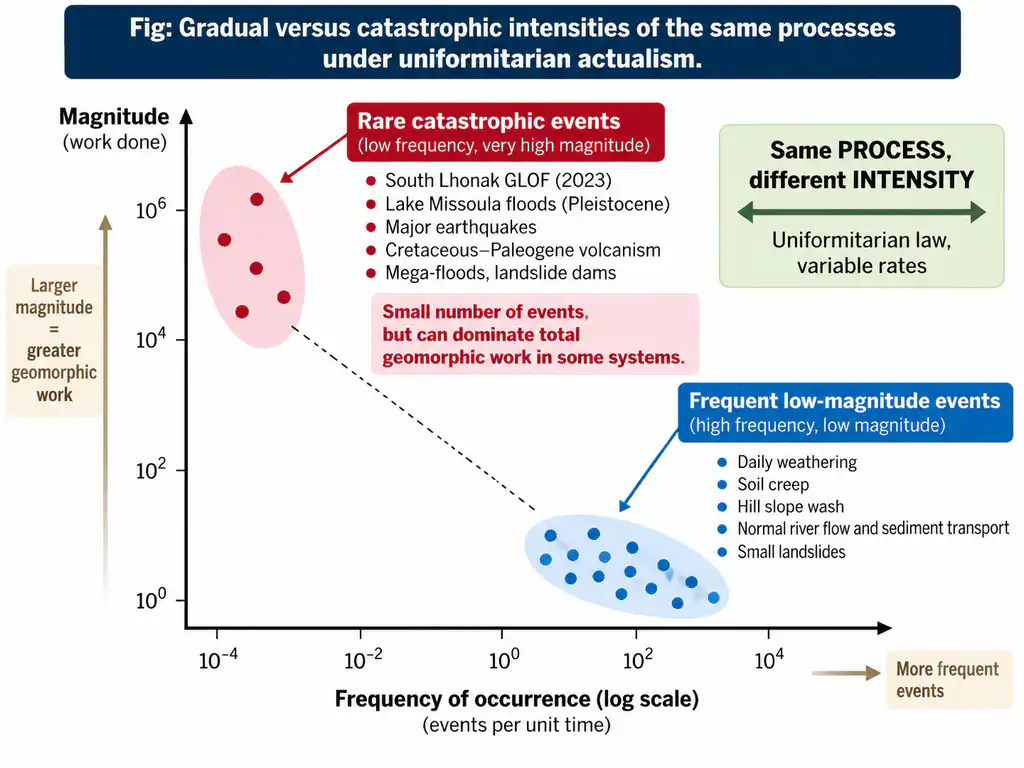
The second clause — “not necessarily always with the same intensity as now” — exactly anticipates the twentieth-century correction:
- Over-generalisation of rate: Hutton and Lyell assumed intensity constancy; modern geomorphology accepts both gradualism and transient high-intensity events as structurally significant.
- Documented intensity variation through time:
| Period/Event | Intensity Contrast |
|---|---|
| Pleistocene glaciation | Ice-sheet erosion and isostatic loading many times more vigorous than today’s alpine glaciers |
| Cretaceous volcanism (Deccan, Ontong-Java) | Flood-basalt outpourings vastly exceeding historic rates |
| Late-Glacial mega-floods (Missoula, Channeled Scablands; Altai) | Peak discharges of ~17 million m³/sec (Lake Missoula) vs modern river floods — a process (flooding) constant, an intensity radically higher |
| Carboniferous coal forests / Permian aridity | Different global climate states producing non-uniform process activity |
- Neo-catastrophism and actualism reconciled: The intense events are not violations of law — they are extreme magnitudes of ordinary processes (Derek Ager’s “episodic uniformitarianism”; Gould’s “time’s arrow, time’s cycle”). The 2023 South Lhonak GLOF (Sikkim) — a permafrost landslide displacing 14.7 million m³ of moraine, generating an impulse wave, draining ~50 million m³ of water at a peak discharge near 48,500 m³/s — is a modern, monitored analogue: an “ordinary” process (moraine collapse, flood) at an extraordinary, catastrophic intensity. It illustrates that the kind of mechanism is uniform; the magnitude is not.
3. Validation: Where Uniformitarian Reasoning Is Indispensable
- Process geomorphology: gauging, sediment-load and weathering measurements on contemporary rivers anchor the reconstruction of ancestral landforms — e.g., Kosi’s ~100 million tonnes annual sediment and 133 km westward avulsion over 250 years are used to read its own Holocene megafan evolution.
- Denudation chronology and dating: cosmogenic ¹⁰Be exposure dating assumes constant production laws (uniformity of law) while calibrating rates — e.g., Kosi-catchment denudation rising from 0.12 mm/yr (4.4 Ma) to 4.4 mm/yr (Holocene) is itself an intensity change measured within a uniformitarian frame.
- Extrapolation to unobserved deep time: uniformitarian logic lets us model Archaean processes (uniformitarianism of law) while acknowledging they operated in a hotter, more vigorous planetary regime (non-uniformity of intensity).
4. Limits and the Modern Critique
- Uniformity of law vs uniformity of rate must be separated: The core (law/process) is ontology — nearly absolute; the rate claim is empirical — demonstrably false.
- Non-uniform planetary states: early Earth’s higher heat flow, lack of an oxygen-rich atmosphere, and different continental distribution mean some processes (e.g., komatiite volcanism, banded-iron deposition) have no present analogue — pure uniformitarianism of process fails there.
- Climatic uniqueness: glacial-interglacial oscillation had no exact modern equivalent; cryospheric, eolian and fluvial intensity varied with climate state, hence geomorphologists must read landscapes as palimpsests of variable-intensity episodes (verify with Q28, Q30).
- Protracted genetic changes: vegetation, soils and slope processes co-evolved — present rates cannot be blindly deflated/inflated to the past.
5. The Balanced Verdict
The statement is substantially correct, with precision in its phrasing. Uniformitarianism is best kept as uniformity of law and process (its indispensable core — the licence and discipline for all historical inference in geomorphology), while its uniformity of rate is properly rejected in favour of episodic, intensity-variable operation of the same processes. Modern geomorphology therefore stands on a refined uniformitarianism: the past is read through present processes and present measurement of past rates — “the present is the key to the past” balanced by “the past constrains the present.” This is precisely the marriage of process geomorphology and historical geomorphology the statement endorses: same laws, same processes — different intensities, episodic through time.