

“Present-day landforms bear more complexity than simplicity.” Elucidate. (2015)
- The statement restates William D. Thornbury’s sixth fundamental concept — complexity of geomorphic evolution is more common than simplicity.
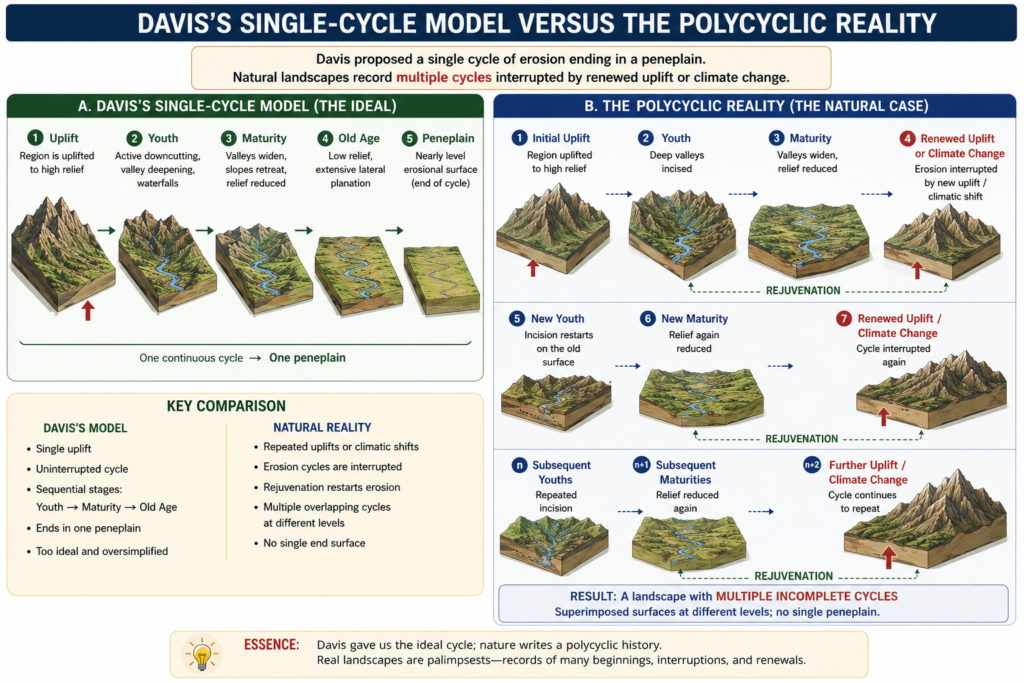
- William Morris Davis’s geographical cycle (1899) pictured a deliberately simple history: one uplift, one climate, one dominant process, one uninterrupted run from youth to a peneplain.
- Real landscapes are instead palimpsests — a surface written on many times, each earlier inscription only partly erased — carrying the marks of several cycles, processes, climates and ages at once.
Simple and Complex Landscapes Defined
- Leland Horberg (1952) grouped landscapes into five types:
- simple — one dominant process;
- compound — two or more processes;
- monocyclic — one cycle of erosion;
- multicyclic (polycyclic) — several interrupted cycles;
- exhumed (resurrected) — an old surface buried and later re-exposed.
- Simple and monocyclic landscapes are confined to young surfaces — fresh volcanic cones and lava plains, newly emerged coastal plains; almost everything else is compound, multicyclic or both.
Sources of Complexity
Interrupted Cycles: Polycyclic Relief
- Uplift or a fall of sea level rejuvenates rivers before a cycle is complete, so a new cycle is cut into the old one.
- Its signatures are valley-in-valley forms, paired terraces, incised meanders, knickpoints and uplifted, dissected peneplains.
- Chotanagpur is the Indian type example: the Pat surface stands above the Ranchi surface, which stands above a lower peripheral surface; knickpoint falls such as Hundru (Subarnarekha), Dassam (Kanchi) and Jonha mark heads of rejuvenation; the Damodar at Rajrappa and the Narmada at Bheraghat flow in terraced, rejuvenated valleys.
- More broadly, much of Peninsular India carries planation surfaces at several elevations, each the remnant of an earlier, interrupted cycle.
- The Appalachians were classically read as three successive erosion surfaces — Schooley, Harrisburg and Somerville.
Several Processes Together: Compound Landforms
- Deserts are shaped by wind and by rare flash floods — dunes and yardangs beside pediments, bajadas and playas.
- Glaciated regions combine glacial forms with fluvio-glacial kames, eskers and outwash plains.
- A single Himalayan valley can pass from glacial troughs and moraines near its head, through frost-shattered periglacial slopes, into a river gorge flanked by landslide scars — three process suites in one landscape.
- A composite fault-line scarp has a tectonic upper face and an erosional lower face.
Climatic Change: Inherited Forms
- Quaternary glacial–interglacial swings mean many forms were made under climates no longer present: periglacial block fields and solifluction terraces in temperate uplands, fossil dunes on desert margins, and drowned river valleys (rias) from post-glacial sea-level rise.
- In the Thar, stabilised older dunes and the buried palaeochannels of the Ghaggar–Hakra record alternating wetter and drier phases beneath today’s active sand.
- William D. Thornbury himself stressed that little topography is older than the Tertiary and most is Pleistocene or younger — so most landscapes span more than one climatic regime.
Burial and Exhumation
- Old surfaces can be buried under younger cover and later stripped bare — the sub-Cambrian peneplain of southern Sweden is a classic exhumed surface standing in a modern landscape.
Complexity in Time
- Stanley A. Schumm and Richard W. Lichty (1965) showed the same landform may be evolving over cyclic time (millions of years) yet in equilibrium over graded time (hundreds of years).
- Stanley A. Schumm’s complex response (1973) showed that a single fall in base level can trigger several episodes of incision and aggradation and multiple terraces — one cause, many forms.
A New Layer: Human Agency
- Dams, mining, urbanisation and farming now add an anthropogenic inscription to the palimpsest; Jaia Syvitski and colleagues (2022) concluded that between 1950 and 2010 human action came to dominate global sediment fluxes.
- In India, sediment trapped behind dams on rivers such as the Krishna and Godavari starves their deltas, adding an artificial erosional episode to natural deltaic history.
Why Simplicity Persists in Theory
- Simple models remain useful teaching and analytical devices: isolating one dominant process — fluvial, glacial, aeolian — makes a landscape intelligible before its complications are added.
- Equifinality cuts both ways: a simple-looking form can hide a complex history, which is why landscapes are read through dated deposits and surfaces, not form alone.
- Judgement: the statement holds — repeated tectonic interruption, Quaternary climatic change, multiple processes, exhumation and now human action make polycyclic, polygenetic landscapes the norm and simple, monocyclic ones the exception, found mainly on very young surfaces; simplicity survives as a method of analysis, not as a description of the land.