337,362+ aspirants visit every month


Unlock Elite Access: Level Up Your Preparation with Exclusive Content
PSIR Optional PYQ Solutions · Model answer
NonAlignment 2.0 underscores India’s unique aspiration to emerge as a site for an alternative universality. Comment.
- UPSC 2025
- 15 marks
- India and the Non-Aligned Movement
Unlock the full answer · ₹1,770 ↓
NonAlignment 2.0 (29 February 2012) was a report by eight analysts and former officials, among them Sunil Khilnani, Pratap Bhanu Mehta, Srinath Raghavan and Shyam Saran, issued by the Centre for Policy Research with the National Defence College. It opens by calling strategic autonomy the "defining value and continuous goal" of India's international policy since…
You are reading the opening of the model answer. The full answer is part of the PSIR Optional PYQ Solutions.
What the full answer covers
- What the claim means
- The case for it
- The critiques
- Conclusion
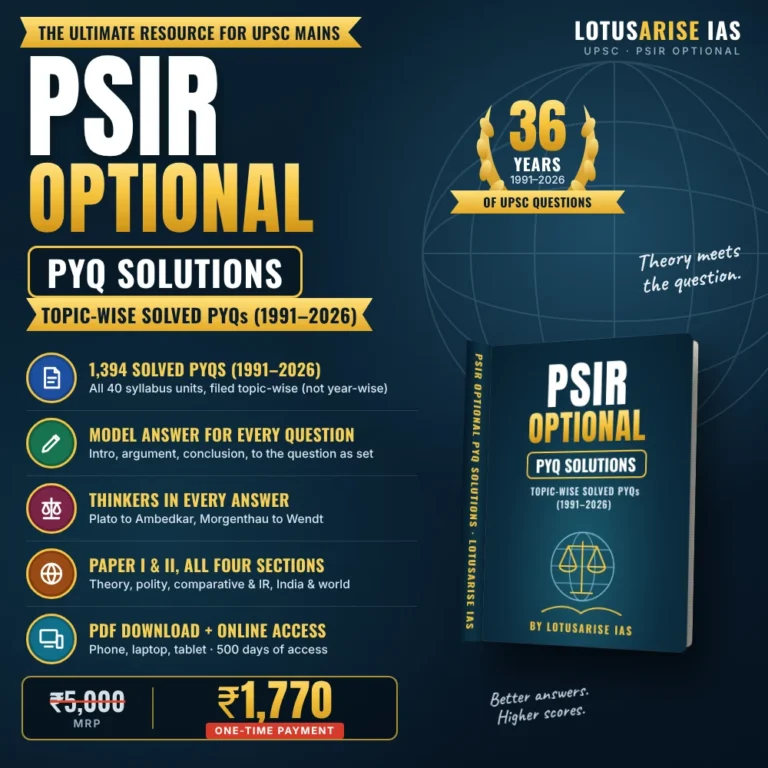
PSIR Optional PYQ Solutions
Unlock this answer and 1,393 more
- 1,394 solved UPSC PSIR PYQs from 1991 to 2026, Paper-1 and Paper-2
- Topic-wise across all 40 syllabus units
- A full model answer for every question
- Read online on lotusarise.com, plus PDF download
- 500 days of access from the day you enrol
₹1,770₹5,00064% off
One-time payment · No subscription · Instant access · UPI, cards, RuPay
See every India and the Non-Aligned Movement question (23 solved) →Already enrolled? Log in
PSIR Optional · Kits & packs
Score more in PSIR Optional.
PSIR PYQ Solutions give you a full model answer to all 1,394 PSIR PYQs, topic by topic. The Mains Master Kit gives you the complete self-study system for Paper 1 and Paper 2.
- 1,394 solved PYQs from 1991 to 2026, across all 40 units
- Notes for all four sections, updated with current developments
- One-time payment · instant access · no subscription
Trusted by 3,00,000+ aspirants every month · Secure checkout · UPI, cards, RuPay
Most enrolled in PSIR Optional