337,362+ aspirants visit every month


Unlock Elite Access: Level Up Your Preparation with Exclusive Content
PSIR Optional PYQ Solutions · Model answer
Discuss the strategic implications of India’s ‘Look East Policy’ transforming into ‘Act East Policy’. (150 words)
- UPSC 2021
- 10 marks
- India and South Asia
Unlock the full answer · ₹1,770 ↓
The Look East Policy of P. V. Narasimha Rao's government (1991–92) was chiefly economic: Southeast Asian markets and capital after the 1991 crisis. When Narendra Modi told the East Asia Summit at Nay Pyi Taw in November 2014 that it had become Act East, the change was one of register more than of verbs: the…
You are reading the opening of the model answer. The full answer is part of the PSIR Optional PYQ Solutions.
What the full answer covers
- What the transformation changed
- Strategic implications
- Limits
- Conclusion
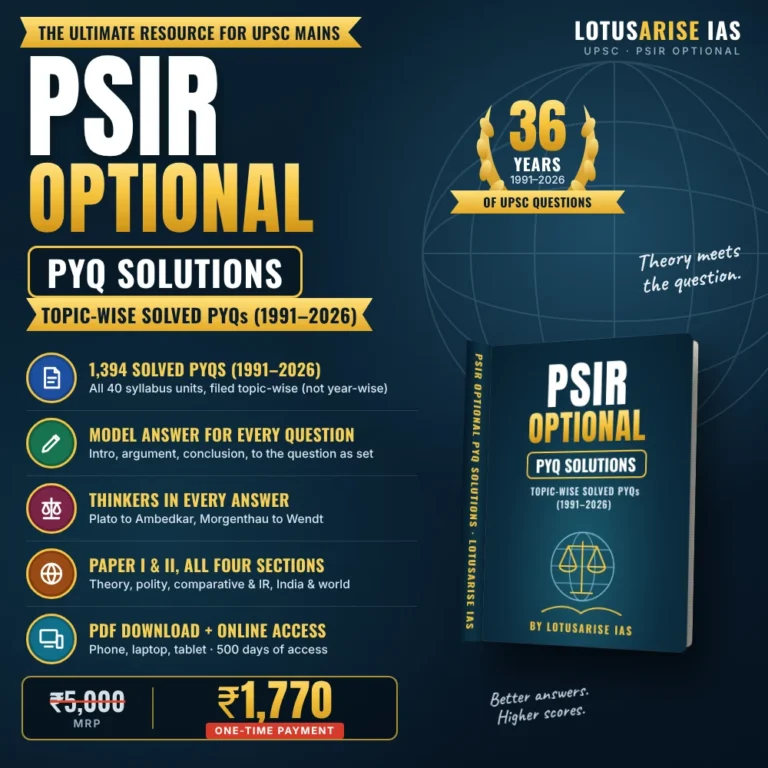
PSIR Optional PYQ Solutions
Unlock this answer and 1,393 more
- 1,394 solved UPSC PSIR PYQs from 1991 to 2026, Paper-1 and Paper-2
- Topic-wise across all 40 syllabus units
- A full model answer for every question
- Read online on lotusarise.com, plus PDF download
- 500 days of access from the day you enrol
₹1,770₹5,00064% off
One-time payment · No subscription · Instant access · UPI, cards, RuPay
See every India and South Asia question (84 solved) →Already enrolled? Log in
PSIR Optional · Kits & packs
Score more in PSIR Optional.
PSIR PYQ Solutions give you a full model answer to all 1,394 PSIR PYQs, topic by topic. The Mains Master Kit gives you the complete self-study system for Paper 1 and Paper 2.
- 1,394 solved PYQs from 1991 to 2026, across all 40 units
- Notes for all four sections, updated with current developments
- One-time payment · instant access · no subscription
Trusted by 3,00,000+ aspirants every month · Secure checkout · UPI, cards, RuPay
Most enrolled in PSIR Optional