

Question: “Little of the earth’s topography is older than Tertiary and most of it no older than Pleistocene.” Elaborate.
Introduction: The Fundamental Recency of Relief
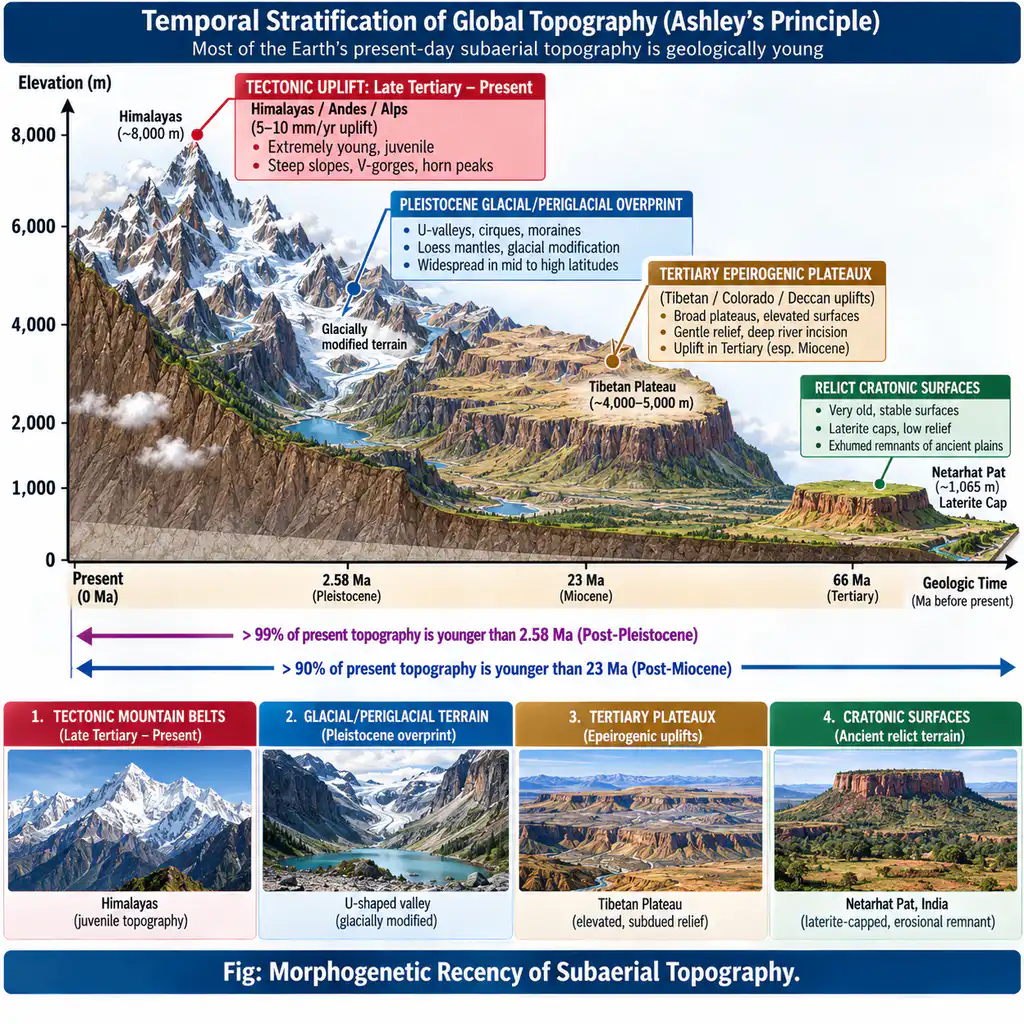
The statement, originally formulated by George H. Ashley (1931) and reinforced by W.D. Thornbury, articulates one of the foundational tenets of modern geomorphology: the profound recency of the Earth’s subaerial topography. While the rocks constituting the Earth’s crust span billions of years (e.g., Archaean cratons > 3.5 Ga), the topographic landforms carved upon them are ephemeral, dynamic boundary features. Ashley estimated that over 90% of present-day topography was shaped post-Miocene (late Tertiary), and over 99% acquired its definitive geometry during or post-Pleistocene (Quaternary).
1. The Two Decisive Morphogenetic Pulses
A. The Late Tertiary Orogeny (Cenozoic Orogenic Climax)
- Global Tectonic Reshaping: The collision of tectonic plates during the Alpine-Himalayan, Andean, and Circum-Pacific orogenies created the primary relief of the contemporary globe.
- Active Neotectonic Uplift: The Himalayas are actively rising at ~5–10 mm/year (GPS convergence across the Main Frontal Thrust ~13.6–18 mm/yr). This rapid tectonic advection drives antecedent rivers (Indus, Brahmaputra, Kali Gandaki) to incise the world’s deepest gorges, constantly renewing juvenile landforms and obliterating pre-Tertiary topographies.
- Continental Broad Upwarps: Epeirogenic crustal warping uplifted high-standing plateau surfaces (Tibetan Plateau ~4,500 m, Colorado Plateau, East African Rift shoulders) exclusively during the late Cenozoic.
B. Pleistocene Glaciation and Eustatic Turmoil (Quaternary Pulse)
- Glacial-Periglacial Resculpting: Repeated glacial-interglacial cycles (4–5 classical glaciations: Günz, Mindel, Riss, Würm / Nebraskan to Wisconsinan, alongside >50 Marine Isotope Stages) radically re-engineered high and mid-latitude landforms.
- Glacio-Eustasy: Sea levels dropped by ~120–130 m during the Last Glacial Maximum (LGM ~21 ka), causing global base-level drops that forced worldwide river rejuvenation, deep coastal valley incision, and subsequent Holocene ria/estuary/delta formation.
- Superficial Mantles: Aeolian loess (Loess Plateau of China, European brick-earth) and thick glacio-fluvial tills blanket millions of square kilometres, sealing pre-Pleistocene surfaces.
2. High Denudation Rates vs. Geologic Deep Time
- The Denudation Paradox: Global continental denudation averages ~0.05–0.1 mm/year (50–100 m per million years). In high-energy orogenic belts like the Eastern Himalayan Syntaxis (Namche Barwa), cosmogenic in-situ ¹⁰Be and thermochronology reveal denudation rates exceeding 3–5 mm/year.
- Theoretical Eradication: At a modest erosion rate of 0.1 mm/yr, a mountain belt of 2,000 m relief is planed down to sea level in just 20 million years (less than the duration of the Miocene). Consequently, ancient Mesozoic or Palaeozoic topographies cannot survive subaerial exposure without burial.
3. The Rare Exceptions: Relict, Exhumed, and Palimpsest Relief
Only specific morphotectonic environments preserve pre-Tertiary topographic remnants:
- Cratonic Lateritic Duricrusts: Resistant ferricrete/bauxite-capped plateaux on stable Gondwana fragments—e.g., the Netarhat Pat (~1,065 m) and Ranchi plateau erosion surfaces in Chotanagpur, preserving late Cretaceous–early Paleogene paleosurfaces.
- Exhumed Landscapes: Ancient topographies buried under thick sedimentary blankets or volcanic lava flows and subsequently re-exposed by stripping of the overburden (e.g., Sub-Cambrian peneplain of the Canadian Shield; pre-Deccan Traps topography in Peninsular India).
Conclusion
Ashley’s principle underpins the paradigm shift from historical Davisian cycles toward dynamic equilibrium (Hack) and process geomorphology (Strahler, Schumm). Topography is not a passive antiquity, but a rapidly renewed, dynamic interface continuously adjusted to Cenozoic tectonics and Quaternary climate oscillations.