

“Landscape is a function of structure, process and stage.” Critique the statement. (2018)
- The statement is the “trio” of William Morris Davis, the organising principle of his geographical cycle (1899): every landform is explained by structure (rock type, hardness, folds, faults), process (the agents of weathering and erosion) and stage (how far the cycle has advanced from youth through maturity to old age and a peneplain).
- A critique must test each term: structure has survived largely intact, process survives only once freed from William Morris Davis’s single “normal” climate, and stage — the term that made the model cyclic — has been the most contested.
What the Formula Got Right
- It gave geomorphology its first genetic and explanatory framework, replacing description with a cause-and-sequence logic that could be taught and applied anywhere.
- William Morris Davis treated stage as relative, not absolute time: a landscape on weak rock reaches maturity sooner than one on resistant rock, so stage measures progress of denudation against structure, not years.
- Its vocabulary — youthful gorges, mature dissection, old-age floodplains — remains in everyday use even among those who reject the cycle.
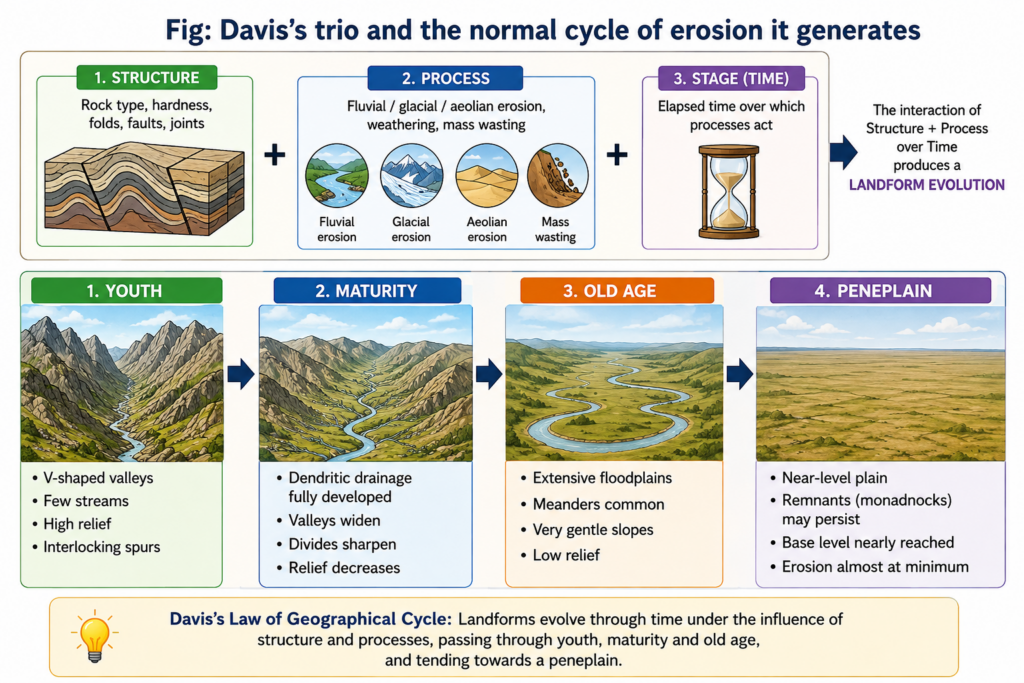
Critique of Each Element
Structure — Accepted, but Not Static
- No later school denies that lithology and tectonic architecture set the template on which processes work.
- But William Morris Davis treated structure as a passive input after a brief, rapid uplift followed by long stillstand; plate tectonics shows crust in continuing motion, so structure is itself an active, changing variable.
Process — Not One “Normal” Process
- William Morris Davis took humid-temperate running water as normal and treated arid and glacial landscapes as “climatic accidents”.
- Lester Charles King (1953) argued that parallel scarp retreat producing a pediplain is the more widespread mode, which makes slope behaviour a matter of process, not stage.
- Julius Büdel (1948) and Louis C. Peltier (1950) built climatic geomorphology on the premise that each climatic regime has its own process suite — in effect adding climate as a fourth control.
Stage — The Weakest Link
- Walther Penck (1924) held that landforms express the ratio of the rate of uplift to the rate of denudation, operating together, not a time sequence after uplift stops; slope form records the uplift rate, not elapsed time.
- Arthur Newell Strahler (1950) and John Tilton Hack (1960) proposed dynamic equilibrium: slopes and channels adjust to present process and rock resistance and may keep a time-independent form, so stage becomes irrelevant.
- Richard J. Chorley (1962) recast landscapes as open systems — undermining the idea of a directional march to one end-form.
A Reconciliation and the Current Debate
- Stanley A. Schumm and Richard W. Lichty (1965) showed the dispute is partly one of scale: over cyclic time (millions of years) time and initial relief do control form, as William Morris Davis claimed; over graded time (hundreds of years) forms are in equilibrium and time drops out.
- Stage now survives as landscape inheritance and transience. Rong Yang, Sean D. Willett and Liran Goren (2015) argued that elevated low-relief surfaces can form in place through drainage reorganisation; Kelin X. Whipple and colleagues (2017) answered that the south-eastern Tibetan surfaces are relict landscapes uplifted and then incised — history still shows in the land.
- Judgement: the statement holds as a framework but not as a law. Structure stands, process must be read as climate- and tectonics-dependent, and stage is valid only at long timescales as inherited history, not as a fixed youth–maturity–old age sequence; a defensible form is landscape = f(structure, process, time, climate, rate of uplift).