337,362+ aspirants visit every month


Unlock Elite Access: Level Up Your Preparation with Exclusive Content
PSIR Optional PYQ Solutions · Model answer
Discuss India’s contribution to the growth and development of the Non-Aligned Movement.
- UPSC 2002
- India and the Non-Aligned Movement
Unlock the full answer · ₹1,770 ↓
The Non-Aligned Movement (NAM) grew from 25 states at Belgrade in 1961 to about a hundred by the New Delhi summit of 1983, and its agenda shifted from Cold War neutrality to decolonisation, development and disarmament. India shaped each stage, though unevenly: decisive in ideas and diplomacy, reluctant in institution-building, and outmatched in material resources.
You are reading the opening of the model answer. The full answer is part of the PSIR Optional PYQ Solutions.
What the full answer covers
- Genesis: preparing the ground (1946–61)
- Expansion of the agenda (1961–89)
- Adaptation after the Cold War
- Other perspectives
- Conclusion
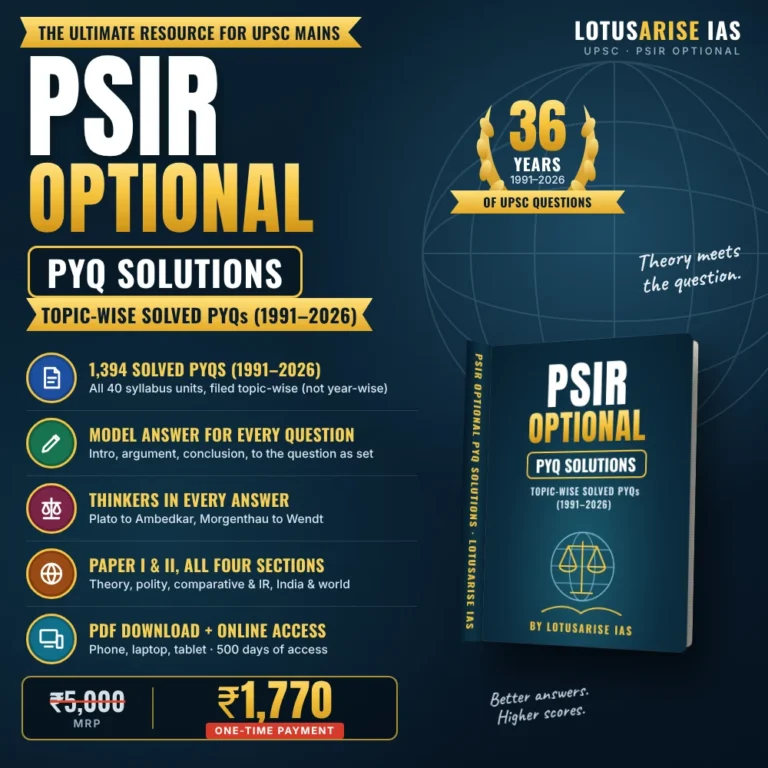
PSIR Optional PYQ Solutions
Unlock this answer and 1,393 more
- 1,394 solved UPSC PSIR PYQs from 1991 to 2026, Paper-1 and Paper-2
- Topic-wise across all 40 syllabus units
- A full model answer for every question
- Read online on lotusarise.com, plus PDF download
- 500 days of access from the day you enrol
₹1,770₹5,00064% off
One-time payment · No subscription · Instant access · UPI, cards, RuPay
See every India and the Non-Aligned Movement question (23 solved) →Already enrolled? Log in
PSIR Optional · Kits & packs
Score more in PSIR Optional.
PSIR PYQ Solutions give you a full model answer to all 1,394 PSIR PYQs, topic by topic. The Mains Master Kit gives you the complete self-study system for Paper 1 and Paper 2.
- 1,394 solved PYQs from 1991 to 2026, across all 40 units
- Notes for all four sections, updated with current developments
- One-time payment · instant access · no subscription
Trusted by 3,00,000+ aspirants every month · Secure checkout · UPI, cards, RuPay
Most enrolled in PSIR Optional