

“Geological structure has a dominant control on landforms and is reflected on them.” Discuss. (2016)
- The statement is the second of William D. Thornbury’s fundamental concepts of geomorphology, and it echoes structure, the first term of William Morris Davis’s trio of structure, process and stage.
- Structure is used in its wide sense: lithology (rock type and hardness), arrangement of beds (dip, folds, faults, domes) and rock characteristics (joints, fracture density, permeability, solubility).
- Structure acts as the template that processes exploit through differential erosion — so the same climate on different structures yields recognisably different landforms. The discussion below tests how far that control is dominant, and where it is not.
Lithological Control
- Resistant rocks stand up as ridges, scarps and residual hills; weak rocks are worn into vales and lowlands.
- Jointing decides the form of crystalline terrain: widely jointed granite and gneiss survive as tors, domes and inselbergs — the bornhardts of the Bundelkhand and Karnataka granites; closely jointed rock is reduced to low ground.
- Horizontal basalt flows of the Deccan Traps weather into stepped, flat-topped mesas and buttes — “trap” derives from the Scandinavian word for stairs.
- Soluble limestone yields karst wherever water is available — dolines, caves and dry valleys, as in the caves of the Meghalaya plateau and the Borra Caves of the Eastern Ghats.
- A recent field test sharpens the point: Roman A. DiBiase, Matthew W. Rossi and Alexander B. Neely (2018) showed in the mountains of southern California that bedrock fracture density, through the grain size of sediment it supplies to rivers, strongly controls relief between two sites of similar rock type and climate.
Arrangement of Strata: Dip and Folds
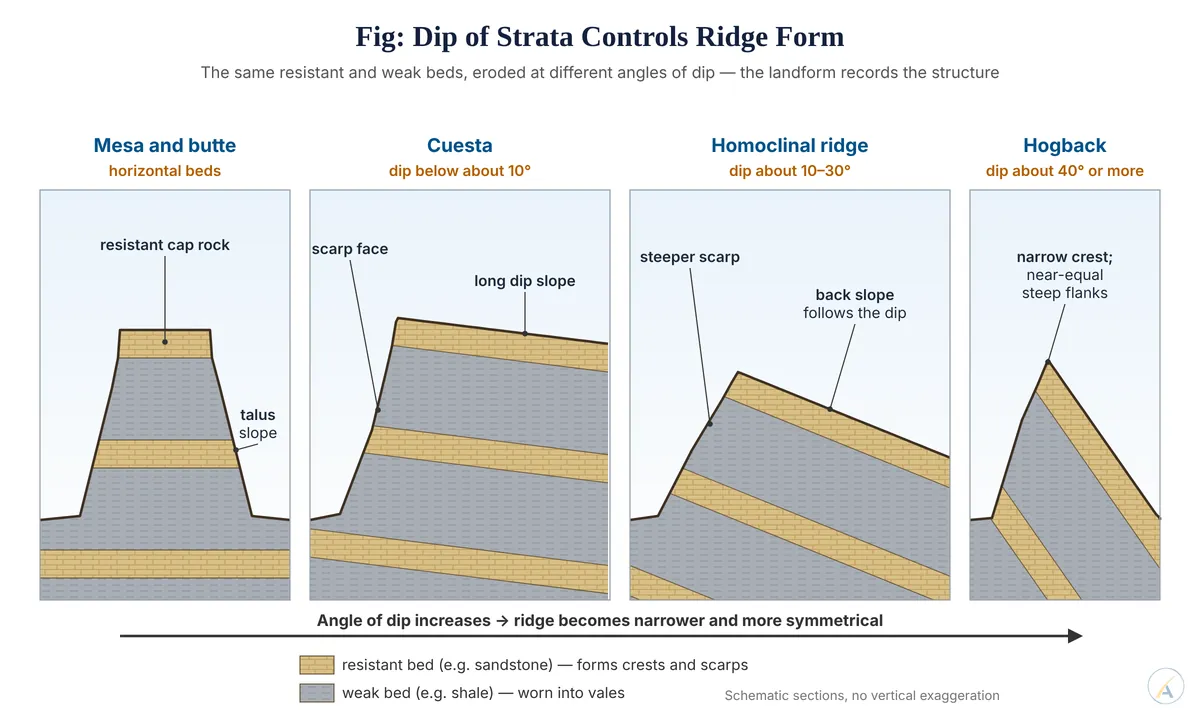
- The angle of dip is read straight off the ridge form, a graded series:
- horizontal beds → mesas and buttes;
- gentle dip (below about 10°) → cuesta, with a long dip slope and a steep scarp face facing up-dip — the côtes of the Paris Basin;
- moderate dip (about 10–30°) → homoclinal ridge;
- steep dip (about 40° or more) → hogback, a narrow ridge with near-equal flanks.
- The Vindhyan scarplands — the Kaimur and Bhander ranges — are stepped escarpments of resistant sandstone over weaker shale; the basin’s north-western margin is the Great Boundary Fault of Rajasthan, marked by a line of scarps.
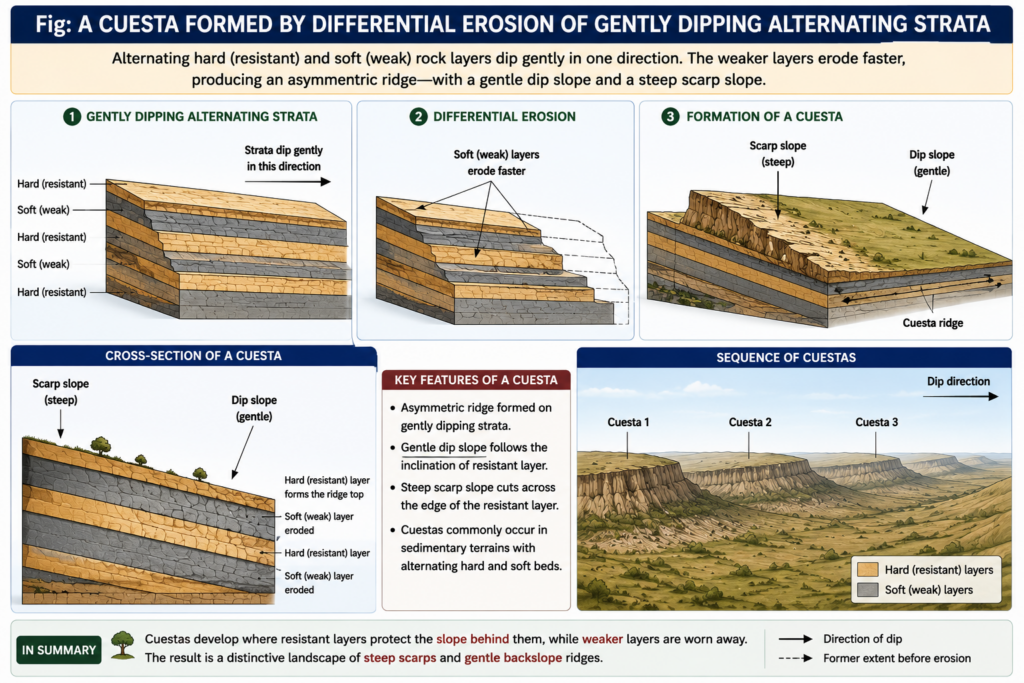
- In folded strata, anticlines first form ridges and synclines valleys; streams adjust to weak bands to give trellis drainage, classically in the Ridge-and-Valley Appalachians.
- Prolonged erosion can produce inversion of relief — anticlinal valleys and synclinal ridges — yet the landform still mirrors the structure, only in reverse.
- In the Himalaya, the duns such as Dehradun are longitudinal structural valleys between the Siwalik and Lesser Himalayan ranges.
Faults, Domes and Drainage
- Fault scarps mark displacement directly; erosion along an old fault produces a fault-line scarp.
- Parallel normal faults produce horsts and grabens: the East African Rift, and in India the Narmada and Tapi valleys flowing west through rift troughs, with the Satpura often described as a block mountain.
- The Damodar valley is a down-faulted trough that preserved the Gondwana coal measures — structure controlling landform and resource together.
- Drainage patterns encode structure: radial on domes and volcanic cones (around Amarkantak), rectangular along joints and faults, trellis on folds.
Where Structure Is Not Dominant
- Planation surfaces bevel across rocks of different hardness and dip — William Morris Davis’s peneplain and Lester Charles King’s pediplain truncate structure rather than reflect it.
- Antecedent rivers cut across rising structures: the Indus, Sutlej and Brahmaputra gorges through the Himalaya; superimposed drainage, let down from a cover, ignores the buried structure.
- Climate can override lithology: deep tropical weathering produces etchplains on varied rocks; glaciers carve U-shaped troughs across mixed lithologies; the same granite forms tors in one climate and buried saprolite in another.
- Equifinality — similar forms from different structures — warns against reading structure from form alone; geomorphologists such as Eric H. Brown cautioned that structure is not always the principal control and never the only one.
- Judgement: structure is the most enduring control and is genuinely “reflected” in dip-controlled ridges, fault scarps and drainage patterns; but its dominance is greatest in young, tectonically or lithologically varied terrain and weakest on ancient planation surfaces and where climate or antecedence intervene — a first-order control, not a sole one.