

Explain with examples as to how channel dynamics has been responsible for the development of alluvial fans and cones. (2015)
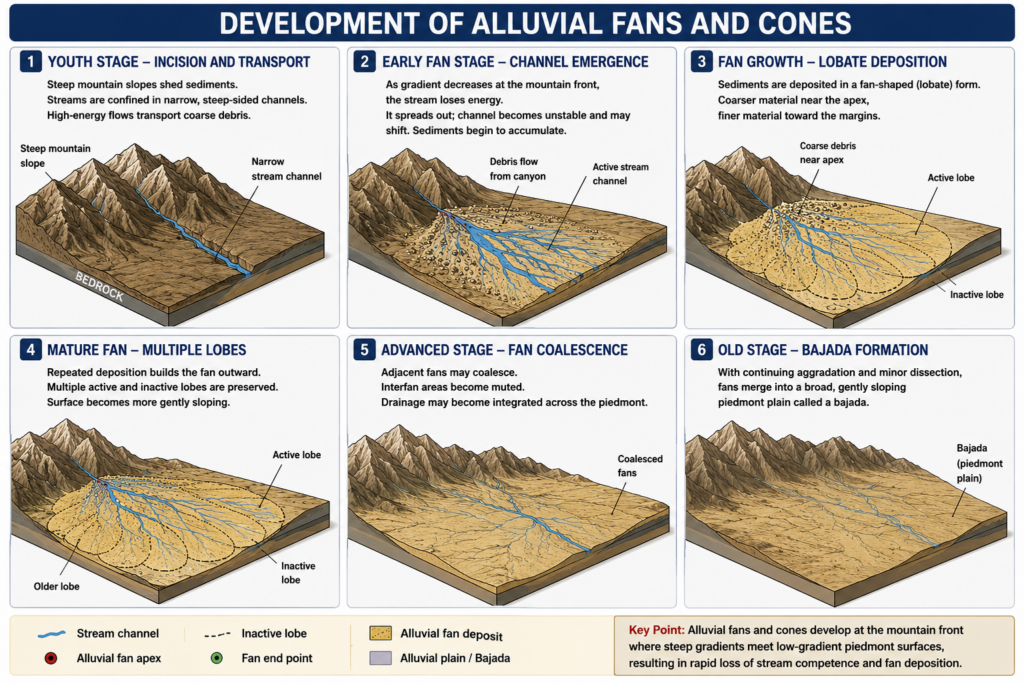
- An alluvial fan is a fan-shaped body of stream-laid debris spread where a confined mountain stream emerges onto a plain at a break of slope: a sector of a circle in plan, part of a cone in three dimensions, with a concave long profile and a convex cross-profile.
- An alluvial cone is its steeper, smaller, coarser relative: average slopes of about 15° against under 1° on large fans and about 5° on small ones. Cones form where debris is plentiful and water scarce; fans where water exceeds debris and spreads it into an arc.
- Neither is the product of one depositional event. Each is the cumulative record of a channel that loses confinement, aggrades, braids, switches course and incises — that is, of channel dynamics.
1. The Trigger: Loss of Confinement at the Mountain Front
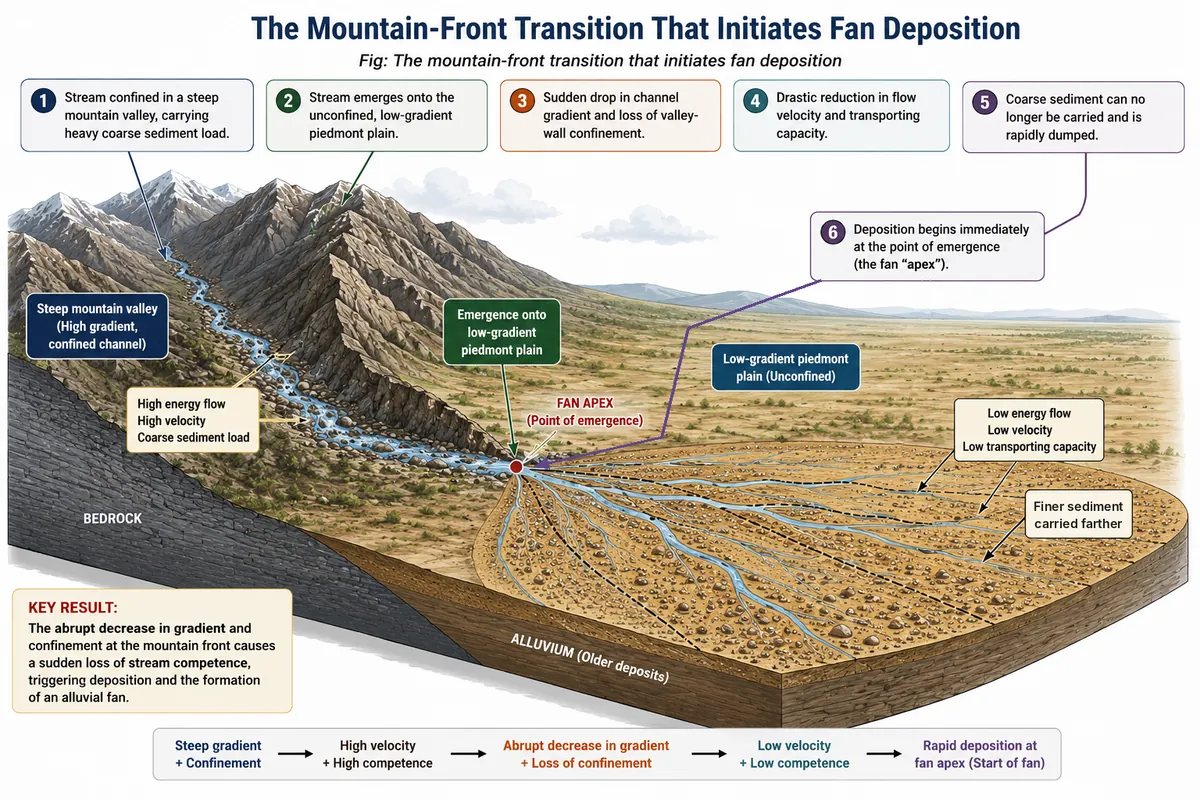
- Inside the valley, walls hold flow deep and fast. At the mountain front the flow spreads: width rises, depth and velocity fall, and on permeable fan gravels water sinks into the bed, so discharge itself shrinks downfan.
- Because competence rises steeply with velocity — the weight of the largest movable particle varies roughly with the sixth power of velocity — a modest fall in velocity strands the largest boulders at once. Deposition therefore starts at the apex, and grain size falls from boulders near the apex to sand and silt at the toe.
- Terence C. Blair and John G. McPherson (1994) argued that this sudden unconfinement, with debris flows and sheetfloods, is what separates fans from rivers: no floodplain, a plano-convex cross-profile and short radii.
2. How the Channel Builds the Fan
Aggradation and braiding
- Overloaded below the apex, the stream splits into shallow braided threads around bars. Each flood backfills the active channel and raises its bed, so the channel stands progressively higher than the fan surface beside it.
Avulsion: the source of the radial form
- Once the active channel has aggraded, the next flood takes the lowest neighbouring sector. Repeated avulsions pivoting on the apex spread lobes across the whole arc — each new lobe filling the low left by the last — which is why fans are symmetrical in plan.
- In the Death Valley region Charles Storrow Denny (1965) found that modern washes, floored with fresh gravel, occupy only parts of each fan; most of the surface is abandoned washes coated with desert varnish. At any moment a fan grows sector by sector.
Fan-head trenching and the intersection point
- When sediment supply falls or discharge rises, the channel incises its apex (a fan-head trench); deposition moves to the intersection point where the trench meets the fan surface, building a new lobe farther out — the intersection-point concept comes from Roger LeB. Hooke‘s work on Californian desert fans. Repeated, it yields segmented or telescopic fans.
Debris flows versus stream flows: cone versus fan
- Cones are built by debris flows — sediment-rich slurries that stop on steep slopes, leaving lobes and levees — so they stay short and steep; the steep boulder cones where short Siwalik gullies reach the Bhabar belt are examples.
- Fans are built by sheetfloods and braided channels, which carry finer material farther and spread it more evenly, so they grow long and gentle.
3. Examples
- Death Valley, California: on the west, streams from the Panamint Range build large fans that merge into a continuous bajada; on the east, the valley floor tilts down fastest against the rising Black Mountains front, so older fans are buried under playa sediments and stay small and steep. The same channel processes give different fans under different tectonic rates.
- Kosi megafan, Bihar–Nepal: about 15,000 km², extending some 180 km from the Himalayan foothills to the Ganga, crossed by more than 12 abandoned courses. In August 2008 a breach at Kusaha sent the river back into old channels near the fan’s centre — avulsion building a fan within living memory. Andrew L. Leier, Peter G. DeCelles and Jon D. Pelletier (2005) linked such megafans to rivers with strongly seasonal, monsoon discharge, whose flashy floods keep channels unstable.
- Bhabar belt, Himalayan foothills: coalescing fans and cones of boulders, gravel and coarse sand, where small streams sink into the porous debris and re-emerge in the Terai. Fans studied in the Chandigarh Dun at the Siwalik foot cover about 20–27 km² each.
4. A Current Debate
- Gary S. Weissmann, Adrian J. Hartley and Gary J. Nichols (2010) argued that distributive fluvial systems — fan-shaped river systems from small fans to megafans — dominate modern continental basins. The definition of Terence C. Blair and John G. McPherson would instead exclude river-built megafans such as the Kosi from the alluvial-fan family altogether. A 2018 review by Dario Ventra and Lucy Clarke notes that the importance of fluvial fans has been fully recognised only in the last decade.
- Judgement: both camps agree on the mechanism. Whatever the size, it is channel dynamics — loss of confinement, aggradation, avulsion around a fixed apex and periodic incision — that turns a sediment load into a fan. The water-to-debris ratio decides whether the result is a steep cone or a broad fan.